The Money of The Upstarts

The BRICS countries want to create their own currency to end the hegemony of the U.S. dollar. China holds a dominant position in the alliance.

Tomasz Konicz

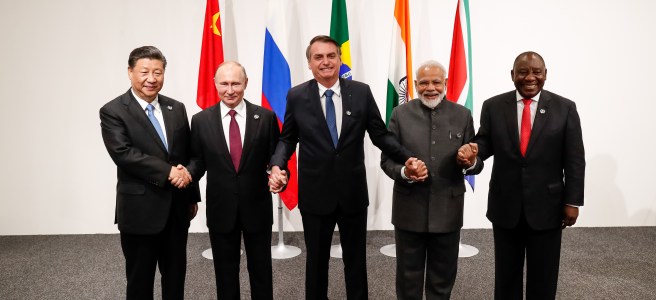
In August, after several more or less concrete announcements since 2012, the time has finally come: At its upcoming summit in South Africa, the expanding group of BRICS countries wants to concretize plans to create its own currency in order to openly challenge the global hegemony of the U.S. dollar.

Founded in 2009, the alliance of the (then) emerging economies Brazil, Russia, India, China and South Africa, which takes its name from their initials, also plans to discuss admitting more countries to the loose alliance. There are now 19 applications for membership, including from regional powers such as Egypt, Saudi Arabia, Indonesia, Iran, Argentina, Thailand and Venezuela.

It seems within reach that this alliance will achieve its strategic goal of breaking the hegemony of the West and the U.S. and establishing a so-called multipolar world order. A first step in the direction of de-dollarization is to be taken by the agreements of individual BRICS countries to use their domestic currencies in trade with each other.

At first glance, a replacement of the U.S. dollar as the world’s reserve currency seems quite realistic, given that the over-indebted U.S. has been in geopolitical and economic decline for years, while the BRICS alliance is on the rise. On the surface, the numbers speak for themselves: The share of the G7 countries (the U.S., Germany, Japan, France, Great Britain, Italy and Canada) in global gross national product has fallen from 50 percent in the early 1980s to 30 percent today, while the BRICS countries have increased their economic output from around 10 percent to 31.5 percent of global economic output over the same period. Thus, even before the upcoming enlargement, the ambitious alliance already has a larger production base than the Western states.

However, this rise is largely due to China; thus, the disparities and imbalances in the potential new currency bloc would be enormous. Between 2008 and 2021, China’s per capita gross domestic product increased by 138 percent. In India, the figure was 85 percent, while Russia saw only a modest increase of 14 percent. Brazil effectively stagnated with a meager increase of four percent, and in South Africa, GDP fell by five percent.

China now accounts for 70 percent of the gross national income of the BRICS countries, while Russia’s per capita income is five times that of India. These huge disparities make even the notorious imbalances in the eurozone, as exposed during the euro crisis, pale in comparison. Moreover, the BRICS grouping has so far had a very loose structure, hardly comparable to the results of the long process of institution-building and standardization that preceded the introduction of the euro in the EU. The alliance has no executive or legislative branch; it has not even established a central secretariat.

The alliance is also marked by a strong ambivalence. It was founded with the intention of ending the hegemony of the West and the imperial practices of the hegemonic power, the U.S. Attacking the U.S. dollar as the world’s reserve currency is a central project within this strategy. But at the same time, the BRICS countries are not striving for a fundamental change in world trade, they are ultimately only seeking to inherit the West and the U.S. within the framework of the world capitalist system – and to fall into the same imperialist practices that the U.S. is accused of. This is evident not only in Russia’s imperialist war in Ukraine, but also in the conflicts within the alliance: China and India, for example, are often on the brink of war in the Himalayas over border disputes.

But the common economic interests are at least as strong as the centrifugal forces outlined above. It is not just a matter of intensifying trade relations and geopolitical cooperation in order to reduce dependence on the Western centers. The BRICS states are not only striving to create their own currency, but also their own development bank based in China. This is because the semi-peripheral states have to operate in a late capitalist world system whose structures and institutions are Western-dominated, from the leading role of the dollar to Western supremacy in the World Bank and International Monetary Fund.

What this Western supremacy leads to is illustrated by the central banks’ fight against inflation in the centers, which is leading to outright economic collapses in many poorer countries. As a result of the U.S. Federal Reserve’s interest rate hikes, a quarter of all emerging and developing countries “have effectively lost access to international bond markets,” the Financial Times warned in mid-June. The World Bank’s growth forecast for this group of countries with particularly poor access to credit was cut from 3.2 to 0.9 percent.

This credit crunch, triggered by the fight against inflation in Western countries, is an important factor in the huge rush to join the BRICS group. Many crisis-ridden countries, such as Argentina and Venezuela, which are currently seeking membership, are simply hoping to tap alternative sources of financing – especially from China. In the future, not only will trade between these countries be conducted in the future BRICS currency, but it will also become the foundation of a new financial system geared to the interests of the semi-periphery.

This all sounds great in theory. But in practice, the emerging economies will find themselves similarly financially dependent on China, which, by creating a BRICS currency and an alternative financial system, will also seek to create alternative investment opportunities to reduce its vulnerability to U.S. sanctions. The potential BRICS currency would thus only be conceivable as a monetary vehicle for a hypothetical national hegemony, like the U.S. dollar.

Still, 60 percent of the world’s foreign exchange reserves are in dollars, down only slightly from an all-time high of 70 percent at the beginning of the 21st century. Some 74 percent of international trade, 90 percent of currency transactions, and nearly 100 percent of oil trade is conducted in U.S. dollars. To take the lead, China would ultimately have to bear the hegemonic costs inevitably incurred in a crisis-ridden late capitalism choking on its productivity: Chinese trade surpluses would have to be reduced and turned into deficits, while the Chinese financial market would have to be opened up.

Since the 1980s, the dollar’s hegemony has been based in economic terms precisely on global deficit cycles, in which enormous U.S. trade deficits generate credit-financed demand, while the U.S. financial market absorbs the resulting profits in the form of securities. China still holds huge amounts of U.S. securities and was for a time the United States’ largest creditor.

China would have to become a “black hole” of the world economy, like the U.S., whose gravitational pull sucks up, by means of trade imbalance and budget deficits, the surplus production of a late capitalist world economy choking on its hyperproductivity – at the cost of deindustrialization and destabilizing speculative bubbles. And this is hardly conceivable, given that the Chinese financial sector has already been and is being shattered by severe financial and debt crises. A new world reserve currency does nothing to change the causes of the economic and ecological crisis process, in which capital is coming up against its internal and external limits.

This is also illustrated by the current trade relations between Russia and India, where the U.S. dollar has been eliminated as a payment currency. After the outbreak of the war in Ukraine, Russia became by far the largest supplier of oil to India, which is running a large trade deficit. In the first eleven months after the outbreak of the war, Russian exports to India amounted to $41.5 billion, while Indian exports to Russia reached only $2.8 billion.

In fact, this is a classic beggar thy neighbor policy, as practiced by the long-time “world export champion” Germany: By running a trade surplus, they also export debt, deindustrialization and unemployment. The difference is that Russian banks and oil companies currently have to park their trillions of rupees in Indian bank accounts because there is no way to transfer or reinvest the money.

Originally posted in jungle world on 06/22/2023

Economic Deceptive Packaging

Robert Kurz

The healthy positivist scientific mind prefers to rely on facts, facts, facts – and nothing else. But pure bean-counting is questionable because, especially in economics, it is not certain that the beans being counted even exist. The most primitive form is, of course, the direct falsification of balance sheets, which neither corporations and banks nor governments shy away from, especially in times of crisis, as we have seen again recently. And as far as official statistics are concerned, Churchill famously said that he did not trust any that he himself had not falsified. But the distortion of empirical truth usually goes on quite legally. All that is needed is to change the criteria for collecting the figures.

It was not only in the U.S. that the accounting rules during the financial crisis were designed in such a way that banks could conveniently outsource their toxic paper to so-called special purpose vehicles. What the U.S. economist Roubini called the “shadow banking system” and blamed in part for the crisis was not dismantled, but actually expanded. The same goes for public finances. A considerable mass of debt is hidden in “shadow budgets” that are not accounted for. A similar trick has long been used in unemployment statistics. Every year the methods of recording are reformulated. For example, part of the labor market miracle in the FRG can be attributed to the fact that, as of recently, the unemployed served by private placement agencies are simply no longer counted.

But even if the numbers are correct, they can be colored nicely by interpretation. When it comes to gross domestic product, neither absolute figures nor relative percentages of growth tell us anything if the reference variables are ignored. What matters about growth is the starting point. In Eastern Europe, high growth rates of 7 percent and more have been celebrated. This was accomplished after the collapse of the Eastern Bloc had led to devastating deindustrialization. Moreover, post-crash growth was largely fueled by debt in foreign currencies (euros, dollars, Swiss francs) and is now proving extremely fragile.

The notion of China as a new economic world power is also based on distorted interpretations. The impressive growth rates are not only due to deficit structures (export one-way streets, now credit-financed government programs), but also to a low starting level. Experience shows that growth declines sharply during the transition from extensive to intensive industrialization. Despite the increase, China’s GDP of $4.6 trillion is still far below that of the U.S. and the EU of $14 trillion each, with a much larger share of the world’s population. It is doubtful that China can serve as a global growth engine for the FRG, for example. Here, too, the 1.4 percent growth forecast for this year must be seen in the context of the lower starting level after last year’s 5 percent slump. Everywhere and in every respect, the lazy magic of numbers stands on feet of clay. The apparent facts should be taken with a grain of salt, because ultimately the objective logic of capital valorization cannot be fooled. This was already true of the financial crash of 2008, which was not apparent from the official facts.

Originally published in Neues Deutschland on 07/23/2010

The Multipolar Debt Crisis

More and more countries in Latin America, Africa and Asia are over-indebted or even facing bankruptcy. As a lender, China is also affected by this crisis and has had to grant emergency loans to protect its own banks from payment defaults.

Tomasz Konicz

The interest rate hikes by Western central banks to combat stubborn inflation – the key rate is now 5 to 5.25 percent in the U.S., and 3.75 percent in the euro zone – have already led to the collapse of three regional banks in the U.S. and are dampening economic growth on both sides of the Atlantic. But this turbulence is nothing compared to the shocks facing many economically weaker countries. As it becomes more and more expensive to take out new loans, they are finding it increasingly difficult to service their foreign debts, most of which are denominated in U.S. dollars.

Particularly in Africa, Asia, Latin America and the Middle East, more and more countries are finding themselves in a classic debt trap, in which economic stagnation, recession and rising borrowing costs fatally interact. The situation has already been compared to the “Volcker shock” of 1979, when the then chairman of the U.S. Federal Reserve, Paul Volcker, raised key interest rates in the U.S. to over 20 percent at times to combat many years of stagflation, triggering a debt crisis particularly in countries in South America and Africa.

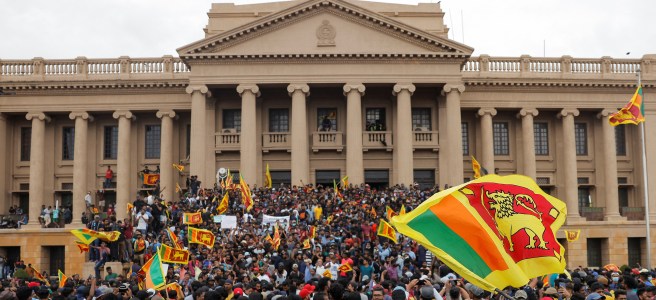
In mid-April, the Financial Times, citing a study by the NGO Debt Justice, reported that the foreign debt service of a group of 91 of the world’s poorest countries would consume an average of 16 percent of their government revenues this year, with that figure expected to rise to 17 percent next year. The last time a similar figure was reached was in 1998. The hardest hit, according to the report, is Sri Lanka, whose debt service this year is equivalent to about 75 percent of projected revenues, leading the Financial Times to expect the island nation to “default on payments” this year.

Zambia, which, like Sri Lanka, went through a sovereign default last year, is also in acute danger. The situation is similarly dire in Pakistan, where 47 percent of government revenues will have to be used to service foreign loans this year. The consequences for the people of these and many other countries are already dramatic: Governments are no longer able to pay salaries, for example, or finance imports of energy or food, and the fall in the value of their currencies is exacerbating inflation, poverty and hunger.

But it is not just the poorest countries that are threatened. In Argentina, for example, where the central bank is printing money to finance the budget deficit, inflation has reached 109 percent and threatens to turn into devastating hyperinflation. Like many other states in crisis, Argentina has signed an emergency program with the International Monetary Fund (IMF) that includes $44 billion in loans in exchange for austerity measures. In mid-May, Argentine President Alberto Fernández called for renegotiations with the IMF in light of a drought-induced crop failure for wheat, Argentina’s most important export. Vice President Cristina Fernández de Kirchner called the agreement “scandalous” and a “fraud.”

China, which has become one of the world’s largest lenders in recent years, plays a special role in the current debt crisis. Under the global development program of the Belt and Road Initiative alone, also known as the “New Silk Road,” at least $838 billion in loans and transactions had been made by the end of 2021, mostly to finance infrastructure and other major projects in Africa, Asia and Latin America. Most of the loans were made by Chinese banks. China wanted to lay the foundation for future economic hegemony.

But since then – after the Covid 19 pandemic and the Russian invasion of Ukraine, the global surge in inflation and a slowdown of growth in China itself – Chinese banks have become more reluctant to lend to poorer countries. According to a study by the Rhodium Group, as early as 2021, about 16 percent of loans made abroad from China, worth about $118 billion, were at risk of default and would have had to be renegotiated.

Just one year later, the Chinese foreign debt crisis had already expanded considerably, according to a study by the Kiel Institute for the World Economy (IfW). According to the study, 60 percent of loans were already at risk of default in 2022, prompting Beijing to grant 128 emergency loans totaling $240 billion to 22 debtor countries. In most cases, the debtor countries are only granted a deferral by issuing new loans to repay due payments, which allows for an “extension of maturities or payment terms”; a cancellation of debts occurs “only extremely rarely,” according to the IfW.

Most of these refinancing loans were granted by the Chinese central bank, which effectively rescues the Chinese banks that originally granted the loans. The authors of the IfW study therefore compared China’s current actions to the granting of so-called rescue loans to Greece and other southern European countries during the euro crisis, which also involved rescuing banks that were threatened with default.

Crisis and bridging loans flow mainly to “middle-income countries” because they account for 80 percent of China’s foreign credit volume and thus represent “major balance sheet risks for Chinese banks,” according to the IfW. Low-income countries, on the other hand, have received very little in the way of crisis loans, as their sovereign bankruptcies would be unlikely to jeopardize the Chinese banking sector. Moreover, the average interest rate on Chinese crisis loans is said to be five percent; the IMF standard is two percent. Debtor countries that have received crisis loans include countries such as Sri Lanka, Pakistan, Argentina, Egypt, Turkey and Venezuela.

The IfW also noted that for a large part of the rescue loans, the modalities and scope of the loan programs are not publicly available. As a result, “the international financial architecture is becoming more multipolar, less institutionalized and less transparent.” This lack of transparency also affects loans previously made by Chinese banks, they said. In a recent in-depth report on the debt crisis, the Associated Press (AP) news agency cited findings from a study by the research group Aid Data that found at least $385 billion in Chinese loans in 88 countries through 2021 alone that were “hidden or inadequately documented.”

Many of the poorest countries in Africa or Asia readily accessed Chinese money at the height of the global liquidity bubble between 2010 and 2020, using it to finance infrastructure and prestige projects that are increasingly turning into investment ruins during the current crisis surge. For these countries, secrecy is now a serious problem because, in the event of default, the affected country’s international creditors will have to agree on who will defer loans or waive repayments, and to what extent. However, Western lenders and institutions such as the IMF or the World Bank are currently refusing emergency programs in many cases because the modalities of China’s loan programs are unclear and they cannot reach an agreement with China. Some poor countries are therefore in a “state of limbo,” writes AP, because China is unwilling to accept losses, while the IMF refuses to grant low-interest loans if they are only used to pay off Chinese debts.

The lenders’ negotiations are further complicated by the intensifying global political competition between Western countries and China. The increasing fragmentation of the global economy makes it “more difficult to resolve sovereign debt crises, especially when there are geopolitical divisions among major sovereign lenders,” IMF Managing Director Kristalina Georgieva warned in January.

Western countries, meanwhile, are hoping to use China’s foreign debt crisis to roll back the influence China has built up through its lending in many regions of the world. EU Commission President Ursula von der Leyen said in May that there was now an “opportune moment” for the G7 countries and their partners after “many countries in the Global South have had bad experiences with China” and found themselves in “debt crises,” while Russia had only “mercenaries and weapons” to offer. If the West acted quickly, she said, it could form mutually beneficial partnerships with these countries. Companies and banks could be involved in developing “comprehensive packages” that would also shift parts of production chains to developing countries. She said the EU wants to promote “not only the extraction of raw materials, but also their local processing and refinement.” Von der Leyen is thus speculating with a bad memory of her potential “partners” in the Global South, who have already had painful experiences with Western credit programs since the 1970s.

Originally published in jungle world on 06/01/2023

The End of The World Power Economy

Robert Kurz

In Germany, the “summer fairy tale” of strong quarterly growth is being celebrated, driven primarily by export successes in the automotive industry (domestic sales have slumped by 30 percent at the same time) and mechanical engineering. The crisis is considered to have been overcome, although GDP has by no means returned to its previous level and a sustained boom in the global economy is unlikely. The current uncertainty factor is the world’s largest economy, the United States. The mood there is deteriorating. This is mainly due to a phase shift in the economy, as the government programs in the U.S. started first and therefore expire earlier. Now it is becoming clear that this supposed “stimulus” is in danger of coming to nothing. Leading economists are talking about an imminent double dip, possibly an even deeper relapse into recession.

The main problem, apart from government debt, is the massive over-indebtedness of U.S. households, whose consumption accounts for 70% of GDP. At the height of the deficit stimulus in 2007, average real incomes were below those of 1970, with spending power coming solely from credit cards and leveraged mortgages, most of which are now worth nothing. Official unemployment has doubled to 10 percent; real unemployment is estimated at 17 percent. Annual growth of 3 percent is needed just to maintain this precarious status quo; a permanent reduction in the unemployment rate would require growth of 6 to 9 percent growth. This is out of the question in the long term, as the middle class in particular is eroding at a breathtaking pace. To regain purchasing power, U.S. households would have to pay down more than $6 trillion in debt or massively reduce their spending for 10 years. That would drag the economy down even further. But further government subsidization calls into question the creditworthiness of the U.S., not to mention its global military power. The cost of operations in Afghanistan, Iraq and elsewhere has risen by several hundred percent since 2002 and can no longer be paid out of petty cash after the financial bubbles burst.

The rampant anti-American gloating in the face of this development ignores the role of the world power economy for global capitalism. A longer-term decoupling of the world economy from the U.S. is illusory. This structure, built up over decades and based on deficit-financed consumption of the world power, cannot be reversed within months. Neither China nor the EU nor Japan is in a position to take over the role of the U.S. This also applies to the function of world money. After the end of the “gold dollar,” the “arms dollar” is now up for grabs. The Chinese yuan is not even a convertible currency, and the euro is itself in deep crisis. The loss of a recognized world trade and reserve currency would hit the global economy even harder. As soon as the cyclical phase shift evens out and the government programs in China and in the EU (exacerbated here by the imposed austerity programs) also reach their limits, a similar situation will arise for these centers as is now the case for the U.S. The actual end of the world power economy, which is only hanging on by a thread, could then trigger a second wave of the world economic crisis in the next few years at the latest.

Originally published in Neues Deutschland on 08/20/2010

The SPD, The Rich, and Morality

Robert Kurz

Perhaps German social democracy is only on the rise in the polls because the black-yellow coalition government is looking more miserable from week to week. In opposition, the former party of the imaginary “new center” is even rediscovering its social soul. At least, it pretends to. A key motion of the SPD presidium for the upcoming party congress calls for an increase in the top tax rate from the current 42 percent to 49 percent, but only for incomes above 100,000 euros. In addition, private assets are to be taxed at a higher rate. But there is a small credibility problem: the SPD is heroically taking a stand against a tax cut for the rich that it had itself introduced under Chancellor Schröder.

It is doubtful, however, that this regression is the result of any deeper insight. In the meantime, the rich themselves have overtaken the SPD on the left. There is no talk show in which a top earner does not explain how much he resents being taxed so leniently. Even before the SPD, well-known big owners were demanding higher taxes for themselves so that the state could fulfill its duties. In the U.S., billionaires want to give away half or more of their fortunes.

When the rich and super-rich go into sackcloth and ashes like this, even the FDP’s usual rhetoric about the sheer “envy” of those who are less fortunate through their own fault gets in the way. If social cynicism was considered chic at the height of the financial bubble and deficit boom, the insatiable gluttons were denounced in the global crash and now turn out to be role models of altruistic philanthropy. The SPD has gone through all the socio-economic zeitgeist cycles of the past decade. First it gave without restraint to those who already had it; then it was the turn of the locusts to be scolded; now it is allowed to participate in the moral catcalls as soon as the top-earning clientele indulges in them. The contemplative rethinking, however, is probably due to the fear that the global economic crisis will not be over as quickly as hoped and that its still unresolved consequences could plunge society in chaos.

But the moralization of the economy always comes too late. As long as they can afford it, because the economic horn of plenty is overflowing anyway, the elites don’t want to know anything about it – and the political class warns not the rich, but the poor against an excessive sense of entitlement. If, on the other hand, the valorization machine has seized up and, despite all the all-clear signals, is making eerie noises, then it is no longer much use to want to finally become decent. Capitalism is not a matter of good will. The mode of production of wealth itself proves to be a problem that cannot be solved with mere distributive justice. Even if the U.S. billionaires were to give away all their wealth down to the last cent, subjective generosity alone could hardly prevent the impending second crash of the economy. Unfortunately, the system of abstract surplus creation cannot be donated as such to a good cause, so that social peace would finally prevail.

Originally published in the print edition of the weekly newspaper Freitag on 09/02/2010.

Climate Catastrophe and “Consumer Freedom”

On the Misery of the (Late) Bourgeois Discourse on “Freedom”

Thomas Meyer

1.

It is not five to twelve, but five past twelve, to quote the philosopher Slavoj Žižek (Žižek 2021, 219). The fact that climate change is indisputable (even if its nuances continue to be debated) and represents a serious threat to the future of humanity should be clear even to the last fool by now.[1] What is more, it is now obvious that emissions of CO2 and other greenhouse gases will need to be radically and rapidly reduced if the climate catastrophe is not to assume an even more catastrophic proportion. This means not only a complete transformation of our infrastructure, but also a complete change and upheaval in the way that we produce and live. It is thus a program of abolitions and shutdowns that we must demand. The “locomotive” of the development of productive forces burns everything in its path. Pulling the “emergency brake,” as Walter Benjamin put it, is inevitable, unless one wants to risk or accept the death of the “passengers” (see Böttcher 2023).

Apart from the questions of how the capitalist mode of production could be abolished, how a corresponding “transformative movement” could be set up, or what kind of “transitional society” (?) would have to be dealt with (since “the train” would only be stopped), there is also the problem of the affective rejection of these facts by many people. What they should already know and that which should lead to a rethinking and a “re-action” is affectively pushed back. The (decades-long) downplaying or denial of climate change and the dissemination of propaganda and disinformation by think tanks, corporations and the media fall on fertile psychic ground (see Quent, Richter, Salheiser 2022).

Criticizing one’s own identity (and therefore work, consumption, home ownership, etc.), which is necessary to rethink and change one’s actions, is avoided by invoking a vulgar bourgeois concept of freedom. Freedom is reduced to the freedom of the consumer, which, like the freedom to produce what is to be consumed, must not be restricted under any circumstances. (Bourgeois) freedom, on the other hand (see Lepenies 2022), originally had to do with “responsibility”; it was about limiting and modernizing domination (checks and balances, protection against arbitrary state or judicial power, freedom of religion and publication, enforcement of private property, production of security, etc.), it was about shaping and disciplining people to become “useful” parts of a community or society.[2] The freedom of one citizen ended where the freedom of another citizen was violated. It was not about unlimited consumption, but about renunciation of consumption, inner-worldly asceticism, affect control. This was interpreted by some as a process of civilization.[3] Many philosophers believed that man could not be free if he indulged his passions without restraint. He who is at the mercy of his passions, who follows them directly, is not free but a slave. However, passions were not only judged negatively, they could also prove to be “useful” for the state and the economy, if they were guided by “reason.”

Now, “developed capitalism” (since about the Fordist boom) no longer depends on ascetic subjects who (have to) try to limit their consumption, but on consuming subjects who want to buy all the bullshit that is produced[4] (and even sensible things turn out to be bullshit in capitalism: planned obsolescence and the like – so that money is fed into the valorization process M-C-M” as soon as possible). The spectacle of advertising, with which whole world is littered (today mostly “individualized” in the form of “apps” etc.), serves as a propagandistic “means of motivation” (so that the now mass-produced goods can also realize themselves as value) for this. Work, performance and “well-earned” consumption became the central identity of modern capitalist societies (especially of the “middle class”; the car as a famous “status symbol” see Kurz 2020 & Koch 2021). Self-denial and discipline in working life were rewarded or “compensated” by the fact that one could privately carve out a “successful life” for oneself through one’s own performance, which found its confirmation in being able to afford or buy this and that (a vacation, car, house and the “cricket on the hearth”). The ecological costs of Fordist mass consumption were usually of no interest (or were dismissed as left-wing propaganda, as in the case of Ayn Rand: Rand 1971).

This consumerist self-centeredness has been intensified by neoliberalism, under which people have been thrown back on themselves and urged to constantly optimize themselves in order to “freely” and “self-determinedly” submit to the imperatives of the (labor) market as “responsible citizens” who do not allow themselves to be “patronized.” The “responsible citizen” finds his freedom in submitting to the dictates of the capitalist crisis in a fully enlightened and self-determined way, and still interprets this as self-realization and self-optimization. The freedom to consume is supported by the freedom to realize oneself in submission and to shit on all those who can’t keep up (anymore); those who are considered “underachievers” or even “work-shy” and fail in the competition are just “unlucky.” The society of total competition (i.e. competition on all levels), i.e. of “individual self-responsibility,” of the “entrepreneurial self” is a breeding ground for antisocial affects of all kinds. The narcissistic social character proves here to be the precondition and result of unrestrained consumer capitalism (see Wissen 2017 & Jappe 2022).

In developed capitalism, consumption is no longer primarily aimed atsatisfying needs shaped by the commodity-form, but above all at creating identity. Philipp Lepenies writes (citing to Zygmunt Bauman): “The individual no longer pursues his own needs, but satisfies desires that have been awakened in him by the producers and that, in extreme cases, obey only the pleasure principle. As soon as the longings for certain products can be constantly renewed and adapted, consumption becomes an endless vicious circle. Individuals succumb to the illusion that they can define their personality and identity, even their social status, through consumption. Consumption becomes an island of stability, one’s own identity a function of consumption. If a certain desire is denied, people perceive this as an attack on the person they want to be” (Lepenies 2022, 234, emphasis T.M.). Therefore, nothing enrages the bourgeois reactionary more than the fact that some “Left-Green” people question his unrestricted freedom of consumption or want to prohibit or even “take away” something from him (whereby one must also be able to afford freedom of consumption, which poor people cannot, see Mayr 2020). It is seen as an attack on one’s own identity (what a joke, when these people rail against the “identity politics” of the left or left-liberals at the same time). The bourgeois reactionary has earned all this himself, has worked hard for it, and therefore it is his “natural human right” to buy and consume what he likes. It is therefore unacceptable, in this view, for the “achiever” to be “patronized” by the state or by some alleged communists or eco-socialists (and yet at the same time he claims for himself the freedom to patronize the freedom of others, such as Hartz IV recipients, or to harass them).

2.

It is undoubtedly correct and necessary to criticize the bourgeois freedom of “earlier times” in the sense that it was effectively the freedom of the white and male propertied bourgeoisie and its realization had to take place within the framework of the capitalist “cage of bondage” (Max Weber). This will not be elaborated in detail here (see for example: Losurdo 2010, Hentges 1999, Kurz 2004 & Landa 2021). What is crucial here is that the appeal to one’s own so-called freedom has the effect of making one unwilling or unable to deal seriously with problems. The perspective of the individual’s freedom as a monad of consumption and work, of an immediate self-centeredness, prevents from the outset the ability to deal with problems that require a social perspective, i.e. one in which the “individual” would have to transcend his or her narrow-minded self-centeredness. Contradictions and dissonances are thus avoided and covered up with verbiage and affective indignation. Finally, the aggressive self-centeredness of “consumer freedom” and often accompanying defense of fossil capitalism – which, not coincidentally, is often part of androcentric identity, leading Cara Dagget (2018) to coin the apt term petro-masculinity – points to an inherent “possibility” of bourgeois freedom itself, that is, to the possibility of freedom turning into unfreedom. As Andrea Maihofer writes, “The common neoliberal rhetoric of the individual self-responsibility of each person now means that freedom is understood by many only as individual freedom. This can be seen in the current protests against the Corona measures, when people claim the right to the individual freedom not to wear a mask […] or to evade the requirements in general – regardless of the consequences for themselves or others – with the slogan: “My health! My choice!” […] In this way, freedom is not only understood exclusively as individual freedom, but also explicitly rejects any responsibility for the social consequences of one’s own actions. In other words, the concept of freedom is increasingly used in an explicitly anti-emancipatory sense. But this is not a new phenomenon. Not only has an authoritarian understanding of freedom always been present in (right-wing) conservative to right-wing extremist discourses, but this danger of turning into unfreedom has been inherent in the bourgeois understanding of freedom from the very beginning” (emphasis in the original). It is therefore not surprising that “in the name of freedom, right-wing conservative to right-wing extremist social actors not only legitimize growing social inequalities, social exclusions and divisions, but also claim the right to exclude and discriminate against others in the name of freedom” (Maihofer 2022, 327).

Freedom is thus understood not as something social, as a historical social relation, something that could potentially be realized by hitherto oppressed and discriminated minorities or classes, but as something that an individual subject possesses and is willing to assert against others, regardless of the possible consequences (thus this “freedom” has a “business-like” character – consequences are “externalized” or ignored, see also: Amlinger & Nachtwey 2022). It is precisely the freedom to be autonomous, i.e. to make use of one’s freedom to submit to systemic constraints without the guidance of another. A fundamentally socially- and ecologically-ignorant “view of life” is almost a necessary consequence and prerequisite for successful “adaptive performance.” This freedom, as it has been propagated especially in neoliberalism as a “guiding culture” [Leitkultur], is thus nothing other than the ability to autonomously adapt to heteronomous conditions. The “autonomy” consists in flexibly taking into account the overwhelming dynamics of the valorizing movement of capital and the increasing existential insecurity, in order to always remain profitable and exploitable, so that one can count oneself among the “high achievers” and naturally derive certain claims for oneself from this. These claims can consist of “well-deserved” unlimited consumption (certainly limited only by the amount of money or credit available), or of feeling empowered to always see oneself as the actual victim. This is probably the origin of the blatant affectation (“prohibition politics,” “eco-dictatorship,” etc.) that we see when people talk about introducing a vegetarian day in the cafeteria, limiting speed on the highways, or abolishing domestic flights. Under no circumstances should one reflect on one’s own habits in any way, certainly not in connection with a particular mode of production that is destroying the planet. Philipp Lepenies comments again: “However, the planned measures that the irritating words “ban” and “renunciation” evoke today are – and this must be clearly emphasized – reactions to the decisive fundamental crisis of our time and to an increasingly urgent need for action. It is not a question of a complete change of behavior according to a certain ideology, nor of the homogenization and suppression of other ways of life. Behind the ban and renounce proposals is an attempt to mitigate or reverse the negative effects of our consumption patterns that have led to and continue to exacerbate the climate catastrophe. The idea that we should ban and renounce certain things does not stem from a perverse and sadistic desire to ban and call for renunciation for no reason. They are concrete proposals for saving our climate” (Lepenies 2022, 263f.).

Bans and restrictions can point out how certain types of production and consumption are environmentally problematic and should be abolished. In this way, they are similar to environmental protection measures: They are immanent stopgap measures that are (or must be) enforced by the state, but they do not point to a radical critique of the commodity form or the self-purpose of capital accumulation. It makes perfect sense to insist on the political enforcement of bans and restrictions if we want to prevent the ecological crisis from becoming even more catastrophic. It is important to make the immanent limits and contradictions recognizable in the process. Of course, such bans and restrictions can aim to merely “paint capitalism green” and place the responsibility on the individual, the supposedly autonomous individual (see Hartmann 2020). Also, debates about “healthy and sustainable nutrition” or the like can contain a paternalistic and puritanical moment (here, some liberal critics of nudging, etc. are partly right).[5] However, consumption cannot really be separated from production, both of which have a specifically capitalist character. Here, Lepenies could be criticized for writing about (and dwelling on) “consumer behavior” and its critical questioning. With regard to the “disintegration of production and consumption already inherent in the simple commodity form,” the consequence of which is the degradation of the “consumer competence of people,” Robert Kurz writes in his book critical of postmodern lifestyle leftists (some of whom were so narrow-minded in the 90s that they celebrated consumption as an allegedly subversive act – “the consumer as dissident,” they said in all seriousness): “Capitalist consumers are de-skilled precisely in this capacity because they have already been de-skilled as producers. As illiterates of social reproduction and/or specialized idiots, they consume in a de-aestheticized, functionally oriented social space. From the grotesque incomprehensibility of the often real-satirical instructions for use to the perpetual “uncomfortableness” of public spaces, this de-skilling expropriation of consumer competence is evident at all levels. The professional idiots are always also consumer idiots and vice versa. The universalism of commodities cannot therefore correspond to a universality of individuals […]” (Kurz 1999, 155ff.).

What is to be consumed is present in a reified form, it is the materialization of the value abstraction; the “addressee” is the incapacitated, isolated and alienated subject. “Use-value,” often asserted only as a promise of use-value, is shaped and realized by managerial rationality. The goal is not the common production of use-values that can be collectively consumed. On the contrary, the objective is that on the managerial level a single capital asserts itself in competition via the successful sale of commodities and thus registers “profit” for itself, in order to then be able to continue with the production and realization of (surplus) value forever (M-C-M’-C’-M’’…). The goal of production is mediated on the level of society as a whole with the irrational and abstract goal of the overall capitalist process, to increase capital/money for its own sake. What happens to the goods after the sale, whether the promise of use value is really redeemed – if this was not only clumsy propaganda anyway – where the individual parts for the production of this commodity came from and in turn how they were produced, etc., is of no interest to the individual capital, nor is their disposal and all of the corresponding ecological consequences (these appear to the individual capital only afterwards in the form of state interventions and regulations – if at all!)

The consumer has the freedom to insert himself into this process and to buy what is for sale. What can be chosen for consumption has long since been “decided” by the valorization process of capital. In the words of Robert Kurz: “On the other hand, however, the general capitalist commodity form expropriates not only the competence to consume, that is, the ability to use things universally in their social context and their sensuous qualities, but also the determination of the content of what individuals have to consume. Since they produce what they do not consume, and consume what they have not produced (even if only in the sense of an institutional communal determination of the content of production) even in consumption they become objects of managerial rationality, from which nothing is further removed than human self-determination” (ibid.).

There is no social understanding about the content of production and consumption. The freedom of the consumer is therefore a chimera. It is a mirage that one must be able to afford. It is the reverse of the “freedom of the assembly line worker.” The “responsible consumer” can only choose what has already been put in front of him anyway: “Demand never determines supply, it is always the other way around. If it were otherwise, then the members of society would have to agree in advance how to satisfy their needs and then organize production accordingly; in other words, in the social-institutional sense (not directly from the activity of the individuals), there would have to be an identity of producers and consumers. Then, of course, demand would no longer be demand for commodities, but rather the direct social discussion, negotiation and realization of the structures of need” (ibid.). This is where a critique of consumer behavior would have to start, however, if it does not want to advocate for bans and renunciations alone and appeal to an abstract common responsibility or to a kind of socio-ecological common sense.

When we talk about needs and their realization, we must do so in the context of the form determination of needs by capital. For certain needs, the compensatory character of consumption is obvious. However, necessary social and material needs and their realization are also determined by capital. Out of necessity, the realization of necessary needs must still be demanded and fought for in the capitalist form (affordable housing, for example), but it is by no means necessary to perceive them in this form or to naturalize their capitalist form. The question here is what “necessity” actually stands for. Adorno notes in this regard in his Theses on Need (2017): “The notion, for example, that cinema is as necessary as housing and food for the reproduction of labor power is “true” only in a world where people are organized by the reproduction of labor power, a world that also forces their needs into harmony with the profit and domination interests of employers [or, at the level of the overall social context, with the imperatives of capital accumulation, T.M.].” Necessity is thus relative, since it implies a necessity for the bourgeois subject.

On the one hand, needs are compensatory, since their realization through freedom of consumption promises identity and self-realization – and are thus necessary for the conditioning and reproduction of people as variable capital; on the other hand, the form determination of capital thwarts the realization of actually necessary social and material needs. Their realization, to the extent that they are at all sufficiently “materially” available or affordable for those in need, is capitalistically adjusted, as can be seen, for example, in the capitalist housing system. On the one hand, for the better-off, a fenced-in bourgeois home of one’s own (i.e., the idiocy of the socially isolated bourgeois nuclear family), the construction of which is defended by some as an elementary human right; on the other hand, concrete boxes constructed in such a way that the individual “housing units” can have nothing to do with each other socially. Both are depositories for containers of labor power – housing goods.

Housing and food are necessary, in contrast to, say, air travel and individual transportation, because they relate to the generic traits of human beings. But “generic traits” here are not to be understood in a naturalizing way. In the words of Agnes Heller, ““natural needs” […] refer to the simple maintenance of human life (self-preservation) and are “naturally necessary” simply because, without satisfying them, man is not able to preserve himself as a mere natural being. These needs are not identical with those of animals, because for his own self-preservation man must also have certain conditions (warmth, clothing) for which the animal has no “need”. The necessary needs for sustaining man as a natural being are therefore also social […]: the mode of satisfaction makes the need itself social” (Heller 1976, 31).

Although nature and thus “natural needs” cannot be dissolved into “discourse” or understood only as something “socially constructed,” both are always already mediated by society and history. In Adorno’s words: “Each drive is so socially mediated that its natural side never appears immediately, but always only as socially produced. The appeal to nature in relation to this or that need is always merely the mask of denial and domination.” (2017). Naturalizations usually had to do with the legitimation of domination. While in the Middle Ages, for example, domination and hierarchy were justified with “God,” in “enlightened” bourgeois society this was done with “nature” (or with what one thought one understood about it). In this way, racism, sexism, eugenics and other things were “scientifically” justified (see for example Reimann 2017, Gould 1996, Weingart et al. 1992, Honegger 1991).

It is precisely the specifically capitalist socialization of needs and their realization that must be the focus of critique if certain forms of production and consumption are to be restricted or banned. These bans and restrictions on their own may be as ineffective as state environmental protection laws, but that would not change the fact that the corresponding discourses as to why we need such abolitions and shutdowns are linked to the climate catastrophe and the urgent need for action and it is precisely this insight that is affectively repelled from the outset. But an abolition of the capitalist mode of production, of the self-purpose of capital accumulation (and thus also of all senseless or insane consumption), cannot be envisaged or even made conceivable if people cannot detach themselves from their “consumer identity” (and from their identity as “achievers”), do not reconsider their affects and also justify their bigotry with a completely stupid concept of “freedom”; a concept of freedom that always means their freedom and is meant to maintain and enforce their status quo (if need be, with exclusion and violence, see Koester 2019).

3.

The realization of needs that are not offered by the market and/or are not profitable, and the planning and discussion of what to produce when this “what” is not determined by the valorizing movement of capital, are not part of bourgeois freedom. As Kurz writes: “the aspiration to deliberate, conscious cooperative sociality is represented as a sin against the Holy Spirit of an anti-social and blind social machine which has again and again been proclaimed as the law of nature” (Kurz 1999a, 645). Any attempt, even any claim or thought, to want to plan production and not leave it to the so-called spontaneity of the market (which implies nothing other than fundamentally short-term thinking) was always suspected of totalitarianism. A concept of freedom that included freedom from social need was considered by bourgeois ideologues like F. A. Hayek as a path to servitude (ibid., 644ff.). Instead, Hayek sees submission to the imperatives of the market as the epitome of freedom. Anything else, he argues, leads to the gulag (so simply can Hayek’s redundant works be summarized). The framework in which bourgeois freedoms are realized is the valorizing movement of capital: “Nothing may be thought, written, done, or made that would go beyond this society […]” (Adorno 2017). One receives recognition (and even this has to be fought for and is by no means a matter of course – even worse than having to be a subject is not being allowed to be a subject, although so far there is no alternative to having to be a subject), provided that one successfully proves oneself as an agent of abstract labor. Civil liberties and human rights are thus valid only with reservations (if they are valid at all – as is well known, capitalism also runs without them). Their validity and enforcement depend on a successful accumulation of capital, during which people are incorporated as variable capital, and on a financing state, by which they are administered as subjects of the state. These reservations become particularly evident in the crisis, when people”s existence should be profitable. Bourgeois recognition thus presupposes a fundamental non-recognition of people as corporeal beings. This can be seen very clearly in the debates on euthanasia (in addition to the situation of refugees and the “punishment of the poor,” see Böttcher 2016 & Wacquant 2009). For example, active euthanasia has been legal in Canada since 2016. Initially, this was intended for people who are terminally ill and whose imminent death is foreseeable. However, the choice of assisted suicide is by no means “only” for the terminally ill, but has long since been extended to people who are lonely or poor, who do not want to be a burden on their family, or who simply see no point in living.[6] Economists rejoice that this reduces the costs of the health care system![7] Euthanasia, which is anything but “self-determined”, does not even stop at Long Covid patients (!): “The Canadian Tracey Thompsen (50) suffers from Long Covid and is unable to work. For two years, the former cook has had to struggle with chronic fatigue and other severe symptoms. She can hardly cope with her everyday life. As a result, she has now applied for active euthanasia. The reason she gives is that her savings would only last for five months. She doesn’t really want to die, but the hopelessness of her situation and the lack of financial support have made her do it.”[8] Patients who cost a lot are persuaded or pressured to opt for the less expensive (!) euthanasia: “In fact, in Canada, people with severe disabilities can choose to be killed even if there is no other medical problem. Human rights groups complain that the country offers no safeguards. Families are not allowed to be informed. Instead, healthcare workers are urged to suggest euthanasia even to those who have not considered the procedure on their own. Unsurprisingly, this targets people who need expensive treatment but don’t receive adequate government support.”[9] So-called bioethicists and pediatricians (!) are still calling for an expansion of euthanasia: “Some Canadian pediatricians and bioethicists, for example, argue in an essay published in the Journal of Medical Ethics (!) that killing on demand should be classified as palliative end-of-life treatment and thus be part of health care. This would mean that the “treatment” would not have to be preceded by any special information or forceful determination of the ability to form a will. If euthanasia is now considered part of health care, the question arises as to why it should not be offered to everyone, including minors, according to the authors of the essay. Physicians should be encouraged to make patients aware of all the options available to them as part of health care – including active euthanasia. The authors further argue that minors who are capable of giving consent should be allowed to make decisions without parental consent, if necessary.” [10][11] The “self-determined” liquidation of people as “part of health care”! Orwellian newspeak really cannot get any more perfidious than this!!!

The euthanasia discourse in Canada thus followed a similar trajectory to that in the Netherlands (van Loenen 2009). However, it was “pursued more ruthlessly and rapidly” in Canada (Yuill 2022) than elsewhere. In the Netherlands, the legalization of so-called euthanasia did not lead to an end of the debate; rather, the debate then really took off: if euthanasia is granted to the terminally ill, why not to the disabled or mentally ill? If it is granted to the elderly, why not to the young? If it is granted to the terminally ill, why not to the depressed or simply to people who no longer see any meaning in their lives because they are lonely? Or because they are poor. Or at risk of homelessness (!!)![12] It is not chronic pain, disability or illness that drives some people to “euthanasia,” but poverty and lack of perspective. It is not that they want to die, but that they see no way out.[13]

Those who are superfluous for capitalism and those whose labor cannot be exploited in the valorization process are denied any right to exist; a denial that is above all – and this is especially disgusting – legitimized by bioethics and the like. How repulsive that euthanasia henchmen even dare to publish a propaganda brochure for children![14] So that children learn that it is “normal” for grandpa or their disabled brother to be murdered because of cost concerns? In the end, the “superfluous” and “human cost factors” are to be “disposed of” just like unsold tomatoes. Freedom under capitalism is in the last instance nothing more than the freedom to die!

So one still dares to speak of freedom and self-determination without recognizing and radically criticizing the logic of the capitalist social system at all, which always objectively questions both and makes the submission to and internalization of the valorization imperatives of capital the precondition of all freedom and self-determination! This applies all the more if by freedom and self-determination people really mean consumer freedom. No thought is wasted on how the capitalist mode of production (and thus the mode of consumption) prepares and destroys man and nature for the “monstrous end in itself” (Kurz 1999a, 648) of capital accumulation. For the bourgeois philistine, everything should remain as it is (although it is becoming increasingly obvious that nothing will remain as it is). Under no circumstances should one’s own freedom of consumption, freedom of vacation or the like be questioned. In order to stop or at least (!) slow down the climate collapse, however, all kinds of things have to be questioned…

If, on the other hand, we are to speak of freedom, then it should be in a completely different sense than it is at present. In the words of Robert Kurz: “Freedom would consist solely in circumstances in which the people who come together for the purpose of the reproduction of their lives not only do so voluntarily, but also discuss and decide both what they will do and how they will do it together. […] A freedom of this kind, which would be the exact opposite of the liberal universal serfdom under the diktat of the labor markets, is in principle possible, in practical terms, on all levels of social reproduction—from the household to transcontinental networked production.” (ibid.). There would have to be a social agreement on what, how and for what purpose production should take place without ruining the planet – and not in order to accumulate capital, even if it is “green” capital. Climate protection and economic growth are not compatible, as even some Greens have come to realize (e.g. the Taz editorUlrike Herrmann, who in her new book advocates a war economy, similar to that of Great Britain during World War II, as an alleged means to overcome capitalism and its destructive valorization dynamics; for a critique see Konicz 2022). The fact that people would no longer have to sacrifice themselves and nature for the monstrous end in itself of capital would be, so to speak, the basis for real freedom and self-determination, which, however, would have nothing to do with bourgeois freedom and self-determination (a fortiori not with the so-called freedom of consumption), since the latter are nothing other than the freedom to servitude and self-valorization, to self-stupefaction and finally – as the euthanasia debates show clearly – the freedom to die.

To evade the radical critique of the existing, and the crises and catastrophes that go along with it, by means of affectation and freedom mumbo-jumbo, in order to cling to a historical model that is on its way out, has indeed something suicidal about it in the medium to long term; “freedom to die” can thus hardly be an exaggeration. To conclude in Tomasz Konicz’s words, “The adherence of late capitalist ideology to the existing, which is obviously in the process of decay, thus comes close to a suicide, a suicide out of fear of the death of capital. In the end, death is unconsciously sought as a way out of the growing social contradictions that permeate every individual. The nothingness of death thus becomes the last resting place in the face of the escalating contradictions of the late capitalist permanent crisis and the accompanying abyss between the increasing renunciation of drives and social requirements that can hardly be fulfilled anymore. […] The death drive latently inherent in capital, manifest in its deadly crisis, wants to transfer the world into nothingness, into the yawning void that forms the concrete substance of the real abstraction value. It is a subjectless nihilism that unfolds due to the crisis: The world is to be made identical to the black hole of the value-form, which is at the center of the whirlwind of rampant accumulation of dead wage labor that has been devastating the world for some 300 years. Consequently, everything that cannot be pressed into commodity form and valorized by sale on the market is consigned to destruction in times of crisis rather than the grip of the world’s valorization machine on man and nature being loosened because of its decline. The destruction of unsaleable goods in times of crisis, which in the meantime are increasingly withdrawn from the access of impoverished people by corresponding legal regulations (e.g. by laws against “containerization”), is only the obvious outflow of this urge for self-destruction” (Konicz 2022a, 79f.).

Literature

Adorno, Theodor W. 2017. “Theses on Need.” Translated by Martin Shuster and Iain Macdonald. https://www.academia.edu/.

Amlinger, Carolin and Oliver Nachtwey. 2022. Gekränkte Freiheit: Aspekte des libertären Autoritarismus. Berlin: Suhrkamp.

Böttcher, Herbert. 2016. “‘Wir schaffen das!’ – Mit Ausgrenzungsimperialismus und Ausnahmezustand gegen Flüchtlinge.” exit-online.org.

Böttcher, Herbert. 2023. “Weltvernichtung als Selbstvernichtung: Was im Anschluss an Walter Benjamin ‘zu denken’ gibt.” Exit! Krise und Kritik der Warengesellschaft 20: 159-207.

Daggett, Cara. 2018. “Petro-Masculinity: Fossil Fuels and Authoritarian Desire.” Millennium: Journal of International Studies 47 (1): 25–44. https://doi.org/10.1177/0305829818775817.

Dreßen, Wolfgang. 1982. Die pädagogische Maschine: Zur Geschichte des industrialisierten Bewußtseins in Preußen/Deutschland. Frankfurt: Ullstein.

Gould, Steven Jay. 1996. The Mismeasure of Man. New York: W.W. Norton & Company.

Hartmann, Kathrin. 2020. Grüner wird’s nicht: Warum wir mit der ökologischen Krise völlig falsch umgehen. Munich: Karl Blessing.

Heller, Agnes. 1976. The Theory of Need in Marx. London: Allison & Busby.

Hentges, Gudrun. 1999. Schattenseite der Aufklärung: Die Darstellung von Juden und “Wilden” in philosophischen Schriften des 18. und 19. Jahrhunderts. Frankfurt: Wochenschau.

Honegger, Claudia. 1991. Die Ordnung der Geschlechter: Die Wissenschaft von Menschen und das Weib, Frankfurt: Campus.

Jappe, Anselm. 2022. “Narcissus or Orpheus? Remarks on Freud, Fromm, Marcuse and Lasch.” Exit! Krise und Kritik der Warengesellschaft 19: 112-146.

Koch, Thomas. 2021 “Zur Aktualität von Robert Kurz’ ‘Freie Fahrt ins Krisenchaos.’” Exit! Krise und Kritik der Warengesellschaft 18, 190-219.

Koester, Elsa. 2019. “Die Allzuvielen: Ökofaschismus – Rechte Ideologen entdecken den Klimaschutz für sich. Das ist keine gute Nachricht.” Freitag 34. https://www.freitag.de/autoren/elsa-koester/die-allzuvielen.

Konicz, Tomasz. 2022. “Rebranding Capitalism.” https://exitinenglish.com/2023/04/02/rebranding-capitalism/.

Konicz, Tomasz. 2022a. “Von Crashpropheten, Preppern und Krisenprofiteuren: Rechte Ideologie in der Krise.” Exit! Krise und Kritik der Warengesellschaft 19: 67-81.

Kurz, Robert. 2004. Blutige Vernunft – Essays zur emanzipatorischen Kritik der kapitalistischen Moderne und ihrer westlichen Werte. Bad Honnef: Horlemann.

Kurz, Robert. 1999. Die Welt als Wille und Design: Postmoderne, Lifestyle-Linke und die Ästhetisierung der Krise. Berlin: Edition TIAMAT.

Kurz, Robert. 2020. “Freie Fahrt ins Krisenchaos – Aufstieg und Grenzen des automobilen Kapitalismus,” Exit! Krise und Kritik der Warengesellschaft 17: 23-44.

Kurz, Robert. 1999a. Schwarzbuch Kapitalismus. Frankfurt: Eichborn.

Reimann, Sarah. 2017. Die Entstehung des wissenschaftlichen Rassismus im 18. Jahrhundert. Stuttgart: Franz Steiner.

Landa, Ishay. 2021. Der Lehrling und sein Meister: Liberale Tradition und Faschismus. Berlin: Dietz Berlin.

Lepenies, Philipp. 2022. Verbot und Verzicht: Politik aus dem Geiste des Unterlassens. Berlin: Suhrkamp.

Losurdo, Domenico. 2010. Freiheit als Privileg: Eine Gegengeschichte des Liberalismus. Cologne. PapyRossa.

Maihofer, Andrea. 2022. “Zur Aktualität des Verständnisses von Freiheit bei Engels.” In Naturphilosophie, Gesellschaftstheorie, Sozialismus: Zur Aktualität von Friedrich Engels, edited by Smail Rapic. Frankfurt: Suhrkamp.

Mayr, Anna. 2020. Die Elenden: Warum unsere Gesellschaft Arbeitslose verachtet und sie dennoch braucht. Berlin: Hanser Berlin.

Pfeisinger, Gerhard. 2006. Arbeitsdisziplinierung und frühe Industrialisierung 1750-1820. Vienna: Böhlau.

Quent, Matthias, Christoph Richter and Axel Salheiser. 2022. Klimarassismus: Der Kampf der Rechten gegen die ökologische Wende. Munich: Piper Paperback.

Rand, Ayn. 1971. The Return of the Primitive: The Anti-Industrial Revolution. New York: Meridian.

Richter, Susan, Angela Siebold, and Urte Weeber. 2016. Was ist Freiheit?: Eine historische Perspektive. Frankfurt: Campus.

Rutschky, Katharina. 1997. Schwarze Pädagogik: Quellen zur Naturgeschichte der bürgerlichen Erziehung. Berlin: Ullstein.

van Loenen, Gerbert. 2014. Das ist doch kein Leben mehr!: Warum aktive Sterbehilfe zu Fremdbestimmung führt, Frankfurt: Mabuse-Verlag.

van Ussel, Jos. 1970. Sexualdrückung: Geschichte der Sexualfeindschaft, Reinbek bei Hamburg.

Wacquant, Loïc. 2009. Punishing the Poor. Durham: Duke University Press.

Weingart, Peter, Jürgen Kroll and Kurt Bayertz. 1992. Geschichte der Eugenik und Rassenhygiene in Deutschland. Frankfurt: Suhrkamp.

Wissen, Leni. 2017. “The Socio-Psychological Matrix of the Bourgeois Subject in Crisis.” https://exitinenglish.com/2022/02/07/the-socio-psychological-matrix-of-the-bourgeois-subject-in-crisis/.

Yuill, Kevin. 2022. “Kanadas Euthanasiegesetze sind ein moralischer Skandal.” https://www.novo-argumente.com/.

Žižek, Slavoj. 2021. Heaven in Disorder. New York: OR Books.


[1] https://www.deutsches-klima-konsortium.de/fileadmin/user_upload/pdfs/Publikationen_DKK/basisfakten-klimawandel.pdf

[2] For a historical overview (with a focus on Germany), see Richter, Siebold, Weeber 2016.

[3] On the other hand, on the disciplinary history of modernity, see e.g.: Dreßen 1982, Pfeisinger 2006, van Ussel 1970 & Rutschky 1997.

[4] See, for example, the Chinese fast fashion group Shein: https://en.wikipedia.org/wiki/Shein.

[5] See Consumer Issues in Focus – A Special Issue of Novo Arguments for Progress, 2016, https://www.novo-argumente.com/images/uploads/pdf/novo_plus_1_inhaltsverzeichnis.pdf

[6] https://www.imabe.org/bioethikaktuell/einzelansicht/kanada-sinnloses-leben-und-einsamkeit-sind-gruende-fuer-aktive-sterbehilfe

[7] https://www.imabe.org/bioethikaktuell/einzelansicht/sterbehilfe-spart-kosten-kanadas-oekonomen-favorisieren-sterbehilfe-ausweitung

[8] https://www.imabe.org/bioethikaktuell/einzelansicht/kanada-euthanasie-auch-fuer-long-covid-patienten

[9] https://www.stern.de/gesundheit/-haben-sie-schon-mal-ueber-sterbehilfe-nachgedacht–teure-patienten-offenbar-zum-assistierten-suizid-ueberredet-32628792.html

[10] https://jme.bmj.com/content/45/1/60?papetoc

[11] https://www.ief.at/kanada-ueberlegt-sterbehilfe-fuer-minderjaehrige/

[12] https://ottawa.citynews.ca/local-news/ontario-man-applying-for-medically-assisted-death-as-alternative-to-being-homeless-5953116

[13] How poverty, not pain, is driving some disabled Canadians toward medically assisted death: https://www.youtube.com/watch?v=ZD0O_w3HzJg see also Yuill 2022.

[14] https://www.virtualhospice.ca/maid/media/3bdlkrve/maid-activity-book.pdf

Originally published on the exit! homepage on 05/24/2023.

Between Austerity and Megalomania

Robert Kurz

The more capitalism invokes its rationality, the more irrational it seems to become. Thus, the competition for survival on the markets has led to policy of cutting costs no matter what. Fewer and fewer employees are expected to handle more and more tasks. Wages are to be reduced, and breaks should ideally no longer occur at all. When it comes to working conditions, stinginess is cool. During the crisis, this cost-cutting mania was accelerated, even to the detriment of quality control. Recalls, breakdowns, defects and scandals are on the rise. The radicalization of business management is backfiring on business management itself. This is simply because the capitalist concept of “efficiency” is completely empty. It does not refer to the concrete content of production, but only to the abstract maximization of profit, which has apparently finally entered the stage of its historical incompetence.

This is precisely why the business mania has spread to everyday life. Not only schools, scientific institutes, theaters or children’s shops are to be run like businesses and oriented towards cost-cutting, but also personal relationships. Even the individual person is regarded as a two-legged business, and is subjected to tests (e.g. by the labor administration) to determine the “rationalization potential” of his or her lifestyle. The satirical slogan “sleep faster, comrade” appears as the animalistic seriousness of crisis capitalism; the general pressure for a meaningless “increase in efficiency” has taken on the dimension of a social obsessive-compulsive disorder.

But the imperialism of the economy has two faces. While, on the one hand, a penny-pinching miserliness of the abstract time regime prevails and even going to the toilet is monitored by companies, on the other hand, an almost feudal culture of extravagance prevails. The mania for cost-cutting in business management is matched by a mania for economic grandeur, which blossoms in a relationship with politics. A prime example of this is Deutsche Bahn’s absurd prestige project Stuttgart 21, the estimated cost of which has risen from 4 to 7 billion euros to 12 billion euros, according to independent experts. There is no money for the tracks for local and freight traffic, but for the ICE metropolitan traffic, which is supposed to compete with the airplane, they are allowed to splurge. This pyramid scheme is also likely to backfire on its creators, because the result is likely to be ruined investments.

Ruinous economic prestige thinking has spread to all areas of society, as has a miserly obsession with saving money. They are two sides of the same coin. Municipalities that are thinning out their administrative and transportation personnel are greedy for large-scale events (see Duisburg and the Love Parade disaster); others want to build stadiums for international matches from scratch, while at the same time almost rationing toilet paper. And the same “entrepreneurs of their labor” who allow themselves to be made fools of the performance hustle, omnipresent surveillance and senseless rationalization programs of their lifetimes, plunge into debt for the sake of neurotic prestige consumption, the servicing of which they then save from their mouths. It is not a sign of stability when a society vacillates between extremely contradictory behaviors. Those who rationalize themselves to death must in turn puff themselves up to survival size. Alienated total expenditure is both; but the world is perishing in a noble way.

Originally published in Neues Deutschland on 09/17/2010

Nobel Prize for Hartz IV

Robert Kurz

This year, ex-Chancellor Helmut Kohl narrowly missed out on the Nobel Peace Prize, which, according to the prevailing do-gooder doctrine, he undoubtedly deserved for his role in the annexation of the former GDR to the FRG. Not even Iranian President Mahmoud Ahmadinejad was shortlisted for his efforts to bring stability to the Middle East. For political reasons, a Chinese dissident had to serve this time. The furor over this has somewhat eclipsed another delicacy of the Nobel Committee, namely the award in the field of economics. This most political of all Nobel Prizes is usually awarded to those who have achieved an intellectual feat for the noble purpose of putting humanity even more under the thumb of capitalism. In 2010, the two Americans Peter Diamond and Dale Mortensen, and a Briton, Christopher Pissarides, were awarded in this spirit.

At first glance, the research of this year’s award winners seems to be in a fairly neutral field. Their topic is so-called search costs. This is a rather banal everyday phenomenon: buyers and sellers often need a lot of time to find the right goods or the right buyer; and time, as is well known, is money in this best of all worlds. However, these search costs are ignored in economic models. The economists now being honored conclude that the automatism of supply and demand does not always work, and that government assistance could potentially reduce search costs. Dandy Keynesianism, then, as the statist left loves it. The Oslo Committee also seems to have given neoliberalism the boot.

Things become a bit clearer when you learn that the fabulous problem of search costs is supposedly most important in labor markets. Scientists have shown, they claim, that unemployment is not only (!) caused by wages that are too high, but also by the unemployed taking too long to look for a job or having expectations that are “too high.” In plain language: Wage reductions through the free play of supply and demand on the markets for the commodity labor power are not enough; additional state coercive measures are needed to prevent the unemployed from causing high search costs with their “demanding attitude.” And since they can only be happy if they can finally call a lousy cheap job their own, this is of course in the very best interest of those concerned. And all of this is apparently “scientifically” proven.

No wonder the Handelsblatt blurts out that the work of this year’s Nobel laureates laid “the intellectual foundation” for the “strategy of incentives and demands,” i.e. also for Hartz IV. Unfortunately, the practitioner and namesake of the application of these findings, Peter Hartz, was not among the honorees. But he may yet become the “laureate of the hearts” as soon as it is recognized that he actually gave neoliberalism the boot with his reform. The “invisible hand” of the market is not enough to discipline wage earners; the “visible hand” of the labor administration must also strike. The well-known U.S. Keynesian Paul Krugman has described his prize-winning colleagues as “incredibly deep thinkers,” which makes clear once and for all what we can expect from crisis Keynesianism.

Originally published in Neues Deutschland on 10/15/2010

New Old World Order?

Can state-capitalist China inherit the United States’ position as global hegemon?

Tomasz Konicz

If the Russian-Chinese summit declarations and Western assessments are to be believed, the 21st century will be defined as an era of Chinese hegemony. At their Moscow war summit in mid-March, Putin and Xi advocated a “just multipolar world order” that would put an end to the era of U.S. hegemony.[1] A British government report, on the other hand, warned of a world of “danger, disorder and division” that Beijing was creating in an open, “epoch-shaping challenge” to the liberal, “rules-based world order.”[2] Even British analysts should find it difficult to see the crisis-ridden late capitalist world as anything other than “danger, disorder and division.” Such assessments are obviously simple projections. But that does not necessarily mean that they are completely wrong – as a cursory glance at the carnage in Ukraine and the saber-rattling over Taiwan shows.

Talk of a multipolar world order is thus, on the one hand, the ideology of all those authoritarian states of the semi-periphery which, by means of imperialist power and war policies, are striving to take over from the eroding U.S. in order to achieve a similar supremacy or dominance at the regional or global level as Washington achieved in the second half of the 20th century. The rise of regional interstate conflicts is precisely an expression of this very real multipolar world disorder in a period of global crisis in which there is effectively no longer a world hegemon. Whether we’re talking about Russian imperialists, Iranian mullahs, Turkish neo-Ottomaniacs, or German out-and-out Nazis and Querfrontler, envy of Washington’s disintegrating means of power is what is motivating this new era of anti-Americanism. And this is especially true of the U.S. dollar. The greenback, as the world’s reserve currency based primarily on the oil trade, has given Washington the ability to borrow in the value of all commodities to finance, for example, its military machine. If, on the other hand, Erdogan turns on the printing press, inflation will simply rise.

This is why recent currency deals between China, Russia and a number of semi-peripheral states are raising eyebrows. In mid-March, during a state visit to Riyadh, President Xi proposed switching oil trade with Saudi Arabia to the Chinese yuan to counter the “increasing weaponization of the dollar.”[3] Riyadh is said to be seriously considering the symbolic move to unwind some of its oil trade with Beijing. In warring Russia, the yuan has risen to become the most traded currency in the face of Western sanctions.[4] Beijing has struck similar bilateral currency deals with Brazil,[5] Pakistan[6] and Venezuela.[7] At the last BRICS meeting in February, the creation of an alternative currency system for “emerging markets” was even discussed.[8] The Financial Times warned back in March that Western functional elites should prepare for a “multipolar currency world order” – which would mean the loss of Washington’s “extraordinary privilege” of borrowing in the world’s reserve currency.

On the one hand, these increased movements away from the dollar can be traced back to the U.S. sanctions against Russia at the beginning of the war of aggression against Ukraine, since this was the first time that Russian foreign assets were frozen (Lavrov spoke of “theft”), a fact that was carefully registered by all regimes that have to reckon with the prospect of coming into conflict with Washington. But this tendency towards de-dollarization and de-globalization can only be fully understood against the background of the imperial decline of the United States and the historical crisis process. Only when this is taken into account does it become clear why China will not be able to take over the United States’ role as hegemon.

Giovanni Arrighi, in his fascinating work Adam Smith in Beijing, has described the history of the capitalist world system as a succession of hegemonic cycles. A rising power achieves a dominant position within the system in a phase of ascendancy characterized by commodity-producing industry; after a signal crisis, this hegemonic power enters imperial decline, in which the financial industry gains importance, to be finally replaced by a new hegemon with greater means of power.

And this sequence can be empirically traced in the case of both Great Britain and the USA. The British Empire, which became the ‘workshop of the world’ in the context of industrialization in the 18th century, transformed itself into the world’s financial center in the second half of the 19th century, before being replaced in the first half of the 20th century by the economically ascendant U.S., which in turn experienced its ‘signal crisis’ during the crisis phase of stagflation in the 1970s. This was followed by the deindustrialization and financialization of the U.S., leading to the economic dominance of the U.S. financial sector. The indebtedness of the declining hegemon to the imperial ascender, which Arrighi also addressed, can be seen both in the case of Great Britain vis-à-vis the United States and through the deficit cycle of the United States vis-à-vis China.

The dollar thus achieved its world position in the context of the postwar Fordist boom, when the Marshall Plan also cemented U.S. hegemony in devastated Europe. And it was precisely this long period of Fordist expansion that formed the economic basis of U.S. hegemony. With the end of the postwar boom in the stagflationary phase, financialization and the implementation of neoliberalism, the economic basis of the Western hegemonic system changed: in the systemic crisis of valorization, the increasingly indebted United States became the “black hole” of the world system, absorbing the surplus production of export-oriented states such as China and the FRG through its trade deficits – at the price of increasing deindustrialization. Beijing and Berlin thus had every reason to tolerate U.S. hegemony and the dollar as the world’s reserve currency, for without the American market China’s rise to become the new “workshop of the world” would not have been possible.

Late capitalism, choking on its own productivity and increasingly running on credit, chained the “production sites” and deficit states together within the framework of this globalization of deficit cycles and the corresponding bubble economy, while at the same time increasing the potential for conflict due to processes of socio-economic disintegration. This crisis tendency was personified very concretely by Donald Trump, who was elected by an eroding white middle class and who wanted to reindustrialize the U.S. by means of protectionism – and thus unintentionally accelerated the decline of the dollar, which was accepted precisely because of the deficits of the dollar area. In fact, since Trump’s presidency, we can hardly speak of U.S. “hegemony” in the traditional sense of the word. The United States now holds its position only by means of naked dominance, mainly because of its military-industrial sector, which is the real backbone of the dollar – and this is what makes a military confrontation between China and the United States likely. The U.S. has its back against the wall globally, just as Russian imperialism did in the post-Soviet space on the eve of the Ukraine war. This was also evident in the current banking quake, which was triggered by U.S. government bonds, of all things.[9]

The crisis-induced rise in protectionism thus seems to be giving the world’s reserve currency, the dollar, a break. And yet, because of the unfolding global socio-ecological crisis of capital, the 21st century will not usher in an epoch of Chinese hegemony. The yuan is not going to inherit the dollar. The hegemonic rise of the People’s Republic, marked by the dominance of commodity production, took place within the framework of the aforementioned global deficit cycles, in which the debt dynamics in the West generated demand for Chinese exports – and it ended with the crisis surge of 2008. With the bursting of the real estate bubbles in the U.S. and Europe, the extreme Chinese export surpluses declined (with the exception of the U.S.), while the gigantic stimulus packages launched by Beijing to support the economy led to a transformation of China’s economic dynamics: Exports became less important, and the credit-financed construction industry and the real estate sector became the main drivers of economic growth.

Thus, China already passed its ‘signal crisis,’ which marks the transition to a financial market-driven growth model, in 2008. China’s growth is thus also based on credit; the People’s Republic is highly indebted, just like the declining Western centers of the world system.[10] The Chinese deficit economy generates even greater speculative excesses than in the U.S. or Western Europe, as the distortions in the absurdly inflated Chinese real estate market in 2021 made clear.[11] Economically, the hegemonic decline of the People’s Republic has already begun due to the global systemic crisis, even though it has not yet been able to gain its hegemonic position geopolitically.

The lack of a new leading sector, of an accumulation regime that mobilizes wage labor on a mass scale in commodity production, which is a manifestation of the internal barrier of capital, constitutes the major difference between contemporary China and the U.S. at the end of World War II. This is particularly evident in Beijing’s foreign policy ambitions, where the “New Silk Road” initiated an ambitious global development project modeled on the Marshall Plan – and brought the People’s Republic its first international debt crisis.[12] Of the approximately $838 billion that Beijing has invested in building a China-centered economic and alliance system in developing and emerging countries by 2021, about $118 billion is said to be at risk of default after the outbreak of the current wave of crisis (the pandemic and the war in Ukraine).[13]

There is no global economic springtime in sight, only over-indebtedness[14] and inflation.[15] Because of its collapsing debt towers at home and abroad, China appears to be in decline even before it has achieved hegemony. In addition, there is the external, ecological barrier of capital, since the People’s Republic, in the course of its state-capitalist modernization, has become the largest emitter of greenhouse gases, which, given the threat of climate catastrophe, makes a similar development path for other countries of the global South pure ecological insanity (but at the same time, it would be simply perverse for the centers to preach renunciation to the global South). The historical hegemonic cycle of the capitalist world system is thus superimposed on the socio-ecological crisis process of capital, interacting with it and allowing the hegemonic rise and fall of China to merge.

A hegemonic system, in which the position of the hegemon would be tolerated, is no longer feasible due to the increasingly manifest internal and external barriers of capital, due to the economic and ecological double crisis. Imperialism in the current phase of crisis, in which the historical expansionist movement of capital has turned into a contraction leaving behind Failed States, amounts to isolation and pure resource extractivism. The isolation of the areas of socio-economic collapse, which no longer play a role as markets, goes hand in hand with the brutal struggle of various countries for the dwindling raw materials and energy sources needed to feed the sputtering valorization machine.[16]

There is a clear historical trend here. The quest for direct control of colonies and protectorates in the 19th century, the era of British hegemony, gave way in the 20th century to informal imperialism, as practiced by Washington through coups and the installation of dependent regimes. In the final phase of the capitalist world system, imperialist rule seems to amount to the mere maintenance of infrastructural extraction routes through which resources and energy carriers are to be transported from the areas of economic and ecological collapse to the remaining centers.

Thus, what is unfolding in the current crisis imperialism is a logic of last man standing, in which the consequences of the crisis are passed on to the competition.[17] These power struggles between state subjects, which have now reached the point of open war, are carrying out the objectively advancing crisis process. It is a geopolitical power struggle on the sinking late capitalist Titanic, in which there are in fact no winners. That is why all the apparent alliances are so fragile, as was seen most recently in the EU’s moves to distance itself from the United States on the Taiwan issue.[18]

And yet, against the backdrop of the socio-ecological crisis, the struggle between Russo-Chinese Eurasia and the United States’ Oceania, in which Ukraine and Taiwan form an acute and a potential flashpoint, can certainly also be understood as a struggle between the future and the past. It is a struggle between the declining era of neoliberal governance and the emerging era of openly authoritarian rule,[19] in which authoritarian structures and social disintegration interact, as can be seen almost paradigmatically in the Russian state oligarchy and mafia rule.[20] The crisis is literally driving the eroding late capitalist state behemoths into confrontation, so that the unleashing of capital’s growing auto-destructive tendencies in a large-scale war is quite possible.


[1] https://www.n-tv.de/politik/Xi-und-Putin-wollen-gerechtere-Weltordnung-article23996962.html

[2] https://www.aljazeera.com/news/2023/3/14/russia-china-creating-world-of-danger-disorder-division-uk

[3] https://www.globaltimes.cn/page/202212/1281416.shtml

[4] https://www.bloomberg.com/news/articles/2023-04-03/china-s-yuan-replaces-dollar-as-most-traded-currency-in-russia#xj4y7vzkg

[5] https://www.globaltimes.cn/page/202303/1288326.shtml

[6] https://www.aa.com.tr/en/energy/invesments/pakistan-china-agree-to-trade-in-yuan/22190

[7] https://www.aa.com.tr/en/energyterminal/finance/venezuela-opts-to-use-chinese-yuan-for-oil-trade/763

[8] https://www.ft.com/content/02d6ab99-ea36-41c4-9ad3-9658bb1894a7

[9] https://exitinenglish.com/2023/06/09/silicon-valley-bank-the-weakest-link/

[10] http://fingfx.thomsonreuters.com/gfx/rngs/CHINA-DEBT-HOUSEHOLD/010030H712Q/index.html

[11] https://www.konicz.info/2021/11/27/einstuerzende-neubauten/

[12] https://www.ft.com/content/ccbe2b80-0c3e-4d58-a182-8728b443df9a

[13] https://exitinenglish.com/2023/03/05/china-multiple-crises-instead-of-hegemony/

[14] https://www.theguardian.com/world/2023/mar/28/china-spent-240bn-belt-and-road-debts-between-2008-and-2021

[15] https://www.ft.com/content/049aef43-4f03-45a1-bf65-749cd44921cc?emailId=af7e811c-648b-4ffa-b140-d7980fc81974&segmentId=22011ee7-896a-8c4c-22a0-7603348b7f22

[16] https://www.konicz.info/2021/10/14/ddr-minus-sozialismus/

[17] https://www.konicz.info/2022/06/23/was-ist-krisenimperialismus/

[18] https://www.nbcnews.com/news/world/macron-europe-china-taiwan-usa-outrage-rcna79090

[19] https://exitinenglish.com/2022/08/12/a-new-quality-of-crisis/

[20] https://www.konicz.info/2022/05/25/rackets-und-rockets/

Originally published on the EXIT homepage on 05/10/2023

Creative Accounting

Robert Kurz

In the fall of 2010, obsessive expectations of economic salvation are booming, especially in Germany. Although not a single one of the global causes of the crisis has been overcome, the media are already painting the prosperous landscapes of a new economic miracle. The belief in faith as the self-sustaining force of the upswing sets the standards for dealing with reality. Whoever falls behind in the race for optimism has already lost. That’s why exaggerated reports of success are always necessary. The worldwide state-financed growth, which is still below the pre-crisis level, is not sufficient for the flights of fancy of the current monetary hope-mongering. But if the state administration allows itself to falsify the unemployment figures with ever new tricks, and the banks are allowed to outsource their bad loans to special-purpose vehicles – why should the industrial groups take a back seat in “creative accounting”? A whitewashing “accounting policy” has always been commonplace. But what the corporations have allowed themselves to do in this respect since the supposed end of the crisis is record-breaking.

This is made possible by the International Financial Reporting Standards (IFRS), which have now been adopted by all major public companies. There is not a trace of increased control in it, on the contrary. The new accounting guidelines give the CFOs a free hand for almost adventurous accounting acrobatics. This applies to both the past and the future. The basis for this is the lax definition of depreciation and so-called special expenses. This means that charges can be removed from the balance sheet almost at will. Siemens, for example, make the liabilities of its finance division disappear; airlines conjure away their leasing costs. And despite high future valuation risks, the overpriced costs of company acquisitions are not written off to a realistic extent. The result is what U.S. financier Warren Buffett derisively calls “bullshit-earnings,” because a growing proportion of up-front or follow-on costs no longer appear on the official balance sheet. In reality, profits are nowhere near as abundant as quarterly reports might suggest.

The lively balance sheet policy only makes sense in relation to the financial markets. The Fed’s desperate dollar glut drives neither consumption nor investment, but only global stock market prices. The stock markets are now less a barometer of real economic development than of profit expectations based on legalized lazy balance sheet tricks. Behind closed doors, there is already talk of a “valuation bubble” among large international corporations. When they buy back their own shares, they reap differential profits quite independently of the real business, for which they themselves have created the wrong conditions in purely mathematical terms. This does not change anything about the dependence of the economy on public finances, because the new valuation bubble can no longer feed a “consumption miracle” as the real estate bubble did recently. It is merely the economic downside of an equally adventurous monetary policy that threatens to lead to a trade and currency war. Then, however, the air will very quickly escape from the valuation bubbles in corporate balance sheets.

Originally published in Neues Deutschland on 11/15/2010