Nobel Prize for Hartz IV

Robert Kurz

This year, ex-Chancellor Helmut Kohl narrowly missed out on the Nobel Peace Prize, which, according to the prevailing do-gooder doctrine, he undoubtedly deserved for his role in the annexation of the former GDR to the FRG. Not even Iranian President Mahmoud Ahmadinejad was shortlisted for his efforts to bring stability to the Middle East. For political reasons, a Chinese dissident had to serve this time. The furor over this has somewhat eclipsed another delicacy of the Nobel Committee, namely the award in the field of economics. This most political of all Nobel Prizes is usually awarded to those who have achieved an intellectual feat for the noble purpose of putting humanity even more under the thumb of capitalism. In 2010, the two Americans Peter Diamond and Dale Mortensen, and a Briton, Christopher Pissarides, were awarded in this spirit.

At first glance, the research of this year’s award winners seems to be in a fairly neutral field. Their topic is so-called search costs. This is a rather banal everyday phenomenon: buyers and sellers often need a lot of time to find the right goods or the right buyer; and time, as is well known, is money in this best of all worlds. However, these search costs are ignored in economic models. The economists now being honored conclude that the automatism of supply and demand does not always work, and that government assistance could potentially reduce search costs. Dandy Keynesianism, then, as the statist left loves it. The Oslo Committee also seems to have given neoliberalism the boot.

Things become a bit clearer when you learn that the fabulous problem of search costs is supposedly most important in labor markets. Scientists have shown, they claim, that unemployment is not only (!) caused by wages that are too high, but also by the unemployed taking too long to look for a job or having expectations that are “too high.” In plain language: Wage reductions through the free play of supply and demand on the markets for the commodity labor power are not enough; additional state coercive measures are needed to prevent the unemployed from causing high search costs with their “demanding attitude.” And since they can only be happy if they can finally call a lousy cheap job their own, this is of course in the very best interest of those concerned. And all of this is apparently “scientifically” proven.

No wonder the Handelsblatt blurts out that the work of this year’s Nobel laureates laid “the intellectual foundation” for the “strategy of incentives and demands,” i.e. also for Hartz IV. Unfortunately, the practitioner and namesake of the application of these findings, Peter Hartz, was not among the honorees. But he may yet become the “laureate of the hearts” as soon as it is recognized that he actually gave neoliberalism the boot with his reform. The “invisible hand” of the market is not enough to discipline wage earners; the “visible hand” of the labor administration must also strike. The well-known U.S. Keynesian Paul Krugman has described his prize-winning colleagues as “incredibly deep thinkers,” which makes clear once and for all what we can expect from crisis Keynesianism.

Originally published in Neues Deutschland on 10/15/2010

New Old World Order?

Can state-capitalist China inherit the United States’ position as global hegemon?

Tomasz Konicz

If the Russian-Chinese summit declarations and Western assessments are to be believed, the 21st century will be defined as an era of Chinese hegemony. At their Moscow war summit in mid-March, Putin and Xi advocated a “just multipolar world order” that would put an end to the era of U.S. hegemony.[1] A British government report, on the other hand, warned of a world of “danger, disorder and division” that Beijing was creating in an open, “epoch-shaping challenge” to the liberal, “rules-based world order.”[2] Even British analysts should find it difficult to see the crisis-ridden late capitalist world as anything other than “danger, disorder and division.” Such assessments are obviously simple projections. But that does not necessarily mean that they are completely wrong – as a cursory glance at the carnage in Ukraine and the saber-rattling over Taiwan shows.

Talk of a multipolar world order is thus, on the one hand, the ideology of all those authoritarian states of the semi-periphery which, by means of imperialist power and war policies, are striving to take over from the eroding U.S. in order to achieve a similar supremacy or dominance at the regional or global level as Washington achieved in the second half of the 20th century. The rise of regional interstate conflicts is precisely an expression of this very real multipolar world disorder in a period of global crisis in which there is effectively no longer a world hegemon. Whether we’re talking about Russian imperialists, Iranian mullahs, Turkish neo-Ottomaniacs, or German out-and-out Nazis and Querfrontler, envy of Washington’s disintegrating means of power is what is motivating this new era of anti-Americanism. And this is especially true of the U.S. dollar. The greenback, as the world’s reserve currency based primarily on the oil trade, has given Washington the ability to borrow in the value of all commodities to finance, for example, its military machine. If, on the other hand, Erdogan turns on the printing press, inflation will simply rise.

This is why recent currency deals between China, Russia and a number of semi-peripheral states are raising eyebrows. In mid-March, during a state visit to Riyadh, President Xi proposed switching oil trade with Saudi Arabia to the Chinese yuan to counter the “increasing weaponization of the dollar.”[3] Riyadh is said to be seriously considering the symbolic move to unwind some of its oil trade with Beijing. In warring Russia, the yuan has risen to become the most traded currency in the face of Western sanctions.[4] Beijing has struck similar bilateral currency deals with Brazil,[5] Pakistan[6] and Venezuela.[7] At the last BRICS meeting in February, the creation of an alternative currency system for “emerging markets” was even discussed.[8] The Financial Times warned back in March that Western functional elites should prepare for a “multipolar currency world order” – which would mean the loss of Washington’s “extraordinary privilege” of borrowing in the world’s reserve currency.

On the one hand, these increased movements away from the dollar can be traced back to the U.S. sanctions against Russia at the beginning of the war of aggression against Ukraine, since this was the first time that Russian foreign assets were frozen (Lavrov spoke of “theft”), a fact that was carefully registered by all regimes that have to reckon with the prospect of coming into conflict with Washington. But this tendency towards de-dollarization and de-globalization can only be fully understood against the background of the imperial decline of the United States and the historical crisis process. Only when this is taken into account does it become clear why China will not be able to take over the United States’ role as hegemon.

Giovanni Arrighi, in his fascinating work Adam Smith in Beijing, has described the history of the capitalist world system as a succession of hegemonic cycles. A rising power achieves a dominant position within the system in a phase of ascendancy characterized by commodity-producing industry; after a signal crisis, this hegemonic power enters imperial decline, in which the financial industry gains importance, to be finally replaced by a new hegemon with greater means of power.

And this sequence can be empirically traced in the case of both Great Britain and the USA. The British Empire, which became the ‘workshop of the world’ in the context of industrialization in the 18th century, transformed itself into the world’s financial center in the second half of the 19th century, before being replaced in the first half of the 20th century by the economically ascendant U.S., which in turn experienced its ‘signal crisis’ during the crisis phase of stagflation in the 1970s. This was followed by the deindustrialization and financialization of the U.S., leading to the economic dominance of the U.S. financial sector. The indebtedness of the declining hegemon to the imperial ascender, which Arrighi also addressed, can be seen both in the case of Great Britain vis-à-vis the United States and through the deficit cycle of the United States vis-à-vis China.

The dollar thus achieved its world position in the context of the postwar Fordist boom, when the Marshall Plan also cemented U.S. hegemony in devastated Europe. And it was precisely this long period of Fordist expansion that formed the economic basis of U.S. hegemony. With the end of the postwar boom in the stagflationary phase, financialization and the implementation of neoliberalism, the economic basis of the Western hegemonic system changed: in the systemic crisis of valorization, the increasingly indebted United States became the “black hole” of the world system, absorbing the surplus production of export-oriented states such as China and the FRG through its trade deficits – at the price of increasing deindustrialization. Beijing and Berlin thus had every reason to tolerate U.S. hegemony and the dollar as the world’s reserve currency, for without the American market China’s rise to become the new “workshop of the world” would not have been possible.

Late capitalism, choking on its own productivity and increasingly running on credit, chained the “production sites” and deficit states together within the framework of this globalization of deficit cycles and the corresponding bubble economy, while at the same time increasing the potential for conflict due to processes of socio-economic disintegration. This crisis tendency was personified very concretely by Donald Trump, who was elected by an eroding white middle class and who wanted to reindustrialize the U.S. by means of protectionism – and thus unintentionally accelerated the decline of the dollar, which was accepted precisely because of the deficits of the dollar area. In fact, since Trump’s presidency, we can hardly speak of U.S. “hegemony” in the traditional sense of the word. The United States now holds its position only by means of naked dominance, mainly because of its military-industrial sector, which is the real backbone of the dollar – and this is what makes a military confrontation between China and the United States likely. The U.S. has its back against the wall globally, just as Russian imperialism did in the post-Soviet space on the eve of the Ukraine war. This was also evident in the current banking quake, which was triggered by U.S. government bonds, of all things.[9]

The crisis-induced rise in protectionism thus seems to be giving the world’s reserve currency, the dollar, a break. And yet, because of the unfolding global socio-ecological crisis of capital, the 21st century will not usher in an epoch of Chinese hegemony. The yuan is not going to inherit the dollar. The hegemonic rise of the People’s Republic, marked by the dominance of commodity production, took place within the framework of the aforementioned global deficit cycles, in which the debt dynamics in the West generated demand for Chinese exports – and it ended with the crisis surge of 2008. With the bursting of the real estate bubbles in the U.S. and Europe, the extreme Chinese export surpluses declined (with the exception of the U.S.), while the gigantic stimulus packages launched by Beijing to support the economy led to a transformation of China’s economic dynamics: Exports became less important, and the credit-financed construction industry and the real estate sector became the main drivers of economic growth.

Thus, China already passed its ‘signal crisis,’ which marks the transition to a financial market-driven growth model, in 2008. China’s growth is thus also based on credit; the People’s Republic is highly indebted, just like the declining Western centers of the world system.[10] The Chinese deficit economy generates even greater speculative excesses than in the U.S. or Western Europe, as the distortions in the absurdly inflated Chinese real estate market in 2021 made clear.[11] Economically, the hegemonic decline of the People’s Republic has already begun due to the global systemic crisis, even though it has not yet been able to gain its hegemonic position geopolitically.

The lack of a new leading sector, of an accumulation regime that mobilizes wage labor on a mass scale in commodity production, which is a manifestation of the internal barrier of capital, constitutes the major difference between contemporary China and the U.S. at the end of World War II. This is particularly evident in Beijing’s foreign policy ambitions, where the “New Silk Road” initiated an ambitious global development project modeled on the Marshall Plan – and brought the People’s Republic its first international debt crisis.[12] Of the approximately $838 billion that Beijing has invested in building a China-centered economic and alliance system in developing and emerging countries by 2021, about $118 billion is said to be at risk of default after the outbreak of the current wave of crisis (the pandemic and the war in Ukraine).[13]

There is no global economic springtime in sight, only over-indebtedness[14] and inflation.[15] Because of its collapsing debt towers at home and abroad, China appears to be in decline even before it has achieved hegemony. In addition, there is the external, ecological barrier of capital, since the People’s Republic, in the course of its state-capitalist modernization, has become the largest emitter of greenhouse gases, which, given the threat of climate catastrophe, makes a similar development path for other countries of the global South pure ecological insanity (but at the same time, it would be simply perverse for the centers to preach renunciation to the global South). The historical hegemonic cycle of the capitalist world system is thus superimposed on the socio-ecological crisis process of capital, interacting with it and allowing the hegemonic rise and fall of China to merge.

A hegemonic system, in which the position of the hegemon would be tolerated, is no longer feasible due to the increasingly manifest internal and external barriers of capital, due to the economic and ecological double crisis. Imperialism in the current phase of crisis, in which the historical expansionist movement of capital has turned into a contraction leaving behind Failed States, amounts to isolation and pure resource extractivism. The isolation of the areas of socio-economic collapse, which no longer play a role as markets, goes hand in hand with the brutal struggle of various countries for the dwindling raw materials and energy sources needed to feed the sputtering valorization machine.[16]

There is a clear historical trend here. The quest for direct control of colonies and protectorates in the 19th century, the era of British hegemony, gave way in the 20th century to informal imperialism, as practiced by Washington through coups and the installation of dependent regimes. In the final phase of the capitalist world system, imperialist rule seems to amount to the mere maintenance of infrastructural extraction routes through which resources and energy carriers are to be transported from the areas of economic and ecological collapse to the remaining centers.

Thus, what is unfolding in the current crisis imperialism is a logic of last man standing, in which the consequences of the crisis are passed on to the competition.[17] These power struggles between state subjects, which have now reached the point of open war, are carrying out the objectively advancing crisis process. It is a geopolitical power struggle on the sinking late capitalist Titanic, in which there are in fact no winners. That is why all the apparent alliances are so fragile, as was seen most recently in the EU’s moves to distance itself from the United States on the Taiwan issue.[18]

And yet, against the backdrop of the socio-ecological crisis, the struggle between Russo-Chinese Eurasia and the United States’ Oceania, in which Ukraine and Taiwan form an acute and a potential flashpoint, can certainly also be understood as a struggle between the future and the past. It is a struggle between the declining era of neoliberal governance and the emerging era of openly authoritarian rule,[19] in which authoritarian structures and social disintegration interact, as can be seen almost paradigmatically in the Russian state oligarchy and mafia rule.[20] The crisis is literally driving the eroding late capitalist state behemoths into confrontation, so that the unleashing of capital’s growing auto-destructive tendencies in a large-scale war is quite possible.


[1] https://www.n-tv.de/politik/Xi-und-Putin-wollen-gerechtere-Weltordnung-article23996962.html

[2] https://www.aljazeera.com/news/2023/3/14/russia-china-creating-world-of-danger-disorder-division-uk

[3] https://www.globaltimes.cn/page/202212/1281416.shtml

[4] https://www.bloomberg.com/news/articles/2023-04-03/china-s-yuan-replaces-dollar-as-most-traded-currency-in-russia#xj4y7vzkg

[5] https://www.globaltimes.cn/page/202303/1288326.shtml

[6] https://www.aa.com.tr/en/energy/invesments/pakistan-china-agree-to-trade-in-yuan/22190

[7] https://www.aa.com.tr/en/energyterminal/finance/venezuela-opts-to-use-chinese-yuan-for-oil-trade/763

[8] https://www.ft.com/content/02d6ab99-ea36-41c4-9ad3-9658bb1894a7

[9] https://exitinenglish.com/2023/06/09/silicon-valley-bank-the-weakest-link/

[10] http://fingfx.thomsonreuters.com/gfx/rngs/CHINA-DEBT-HOUSEHOLD/010030H712Q/index.html

[11] https://www.konicz.info/2021/11/27/einstuerzende-neubauten/

[12] https://www.ft.com/content/ccbe2b80-0c3e-4d58-a182-8728b443df9a

[13] https://exitinenglish.com/2023/03/05/china-multiple-crises-instead-of-hegemony/

[14] https://www.theguardian.com/world/2023/mar/28/china-spent-240bn-belt-and-road-debts-between-2008-and-2021

[15] https://www.ft.com/content/049aef43-4f03-45a1-bf65-749cd44921cc?emailId=af7e811c-648b-4ffa-b140-d7980fc81974&segmentId=22011ee7-896a-8c4c-22a0-7603348b7f22

[16] https://www.konicz.info/2021/10/14/ddr-minus-sozialismus/

[17] https://www.konicz.info/2022/06/23/was-ist-krisenimperialismus/

[18] https://www.nbcnews.com/news/world/macron-europe-china-taiwan-usa-outrage-rcna79090

[19] https://exitinenglish.com/2022/08/12/a-new-quality-of-crisis/

[20] https://www.konicz.info/2022/05/25/rackets-und-rockets/

Originally published on the EXIT homepage on 05/10/2023

Creative Accounting

Robert Kurz

In the fall of 2010, obsessive expectations of economic salvation are booming, especially in Germany. Although not a single one of the global causes of the crisis has been overcome, the media are already painting the prosperous landscapes of a new economic miracle. The belief in faith as the self-sustaining force of the upswing sets the standards for dealing with reality. Whoever falls behind in the race for optimism has already lost. That’s why exaggerated reports of success are always necessary. The worldwide state-financed growth, which is still below the pre-crisis level, is not sufficient for the flights of fancy of the current monetary hope-mongering. But if the state administration allows itself to falsify the unemployment figures with ever new tricks, and the banks are allowed to outsource their bad loans to special-purpose vehicles – why should the industrial groups take a back seat in “creative accounting”? A whitewashing “accounting policy” has always been commonplace. But what the corporations have allowed themselves to do in this respect since the supposed end of the crisis is record-breaking.

This is made possible by the International Financial Reporting Standards (IFRS), which have now been adopted by all major public companies. There is not a trace of increased control in it, on the contrary. The new accounting guidelines give the CFOs a free hand for almost adventurous accounting acrobatics. This applies to both the past and the future. The basis for this is the lax definition of depreciation and so-called special expenses. This means that charges can be removed from the balance sheet almost at will. Siemens, for example, make the liabilities of its finance division disappear; airlines conjure away their leasing costs. And despite high future valuation risks, the overpriced costs of company acquisitions are not written off to a realistic extent. The result is what U.S. financier Warren Buffett derisively calls “bullshit-earnings,” because a growing proportion of up-front or follow-on costs no longer appear on the official balance sheet. In reality, profits are nowhere near as abundant as quarterly reports might suggest.

The lively balance sheet policy only makes sense in relation to the financial markets. The Fed’s desperate dollar glut drives neither consumption nor investment, but only global stock market prices. The stock markets are now less a barometer of real economic development than of profit expectations based on legalized lazy balance sheet tricks. Behind closed doors, there is already talk of a “valuation bubble” among large international corporations. When they buy back their own shares, they reap differential profits quite independently of the real business, for which they themselves have created the wrong conditions in purely mathematical terms. This does not change anything about the dependence of the economy on public finances, because the new valuation bubble can no longer feed a “consumption miracle” as the real estate bubble did recently. It is merely the economic downside of an equally adventurous monetary policy that threatens to lead to a trade and currency war. Then, however, the air will very quickly escape from the valuation bubbles in corporate balance sheets.

Originally published in Neues Deutschland on 11/15/2010

The Bankruptcy of Micro-Capitalism

Robert Kurz

At present, the crisis of the international financial system and the slump in the global economy are considered to have been overcome, although the problem has only shifted to public finances. In recent weeks, however, a supposedly successful model of deficit capitalism has once again come under fire.

The flagship project of microcredit in the impoverished regions of the world and in many so-called emerging countries was not only considered crisis-resistant, but also proof of the elemental power of free-market thinking. Under the sign of neoliberal “self-responsibility,” poor women in particular were to be mutated into small entrepreneurs in the service sector with the help of tiny loans of the equivalent of 100 to 500 euros, enabling them to take their capitalist destiny into their own hands.

Significantly, Muhammad Yunus from Bangladesh, the inventor of the model, was awarded the Nobel Peace Prize in 2006, not the Economics Prize. The enthusiasm of the elites was great, because the idea seemed to kill several birds with one stone and to combine a strictly market-based fight against poverty with an equally strictly market-based emancipation of women, i.e. to initiate a social pacification that was entirely in line with the system. Donations from philanthropic capitalists, such as Bill Gates’ foundation, poured in.

Starting in Bangladesh and India, a new financial market for predominantly “female” microcredit in Asia, Africa and Latin America, worth billions, was created within a short period of time. Major Asian banks, as well as financial institutions such as Deutsche Bank, created relevant investment companies. In the course of this expansion, the first microbanks have already gone public. What started out as ethical image cultivation has turned into a hard-hitting business. Every little bit helps. Officially, most microloans go to women’s self-help groups and their business projects. But the same applies to microloans as to large loans: they are an anticipation of future real income and must be “serviced,” i.e., repaid in full with interest.

However, the women’s small businesses financed with these loans hang on by a thread and can quickly fail due to external circumstances. Even the illness of a family member or one of the increasingly frequent floods in the wake of capitalist-induced climate change can cause the microcredit to disappear into “unproductive” (in market terms) costs. As microcredit markets exploded, the microenterprises they supported became increasingly illusory. It became a matter of being in on the growth at all costs. In India, self-help groups increasingly became mere formal shells, while the money was simply used to buy food.

After the crisis of the big financial markets, the crisis of microcredit is now due. However, the situation is much more brutal than in the halls of high finance. Debt rescheduling at the microbanks increases the weekly interest burden. Many women are forced into prostitution in order to stay solvent. In India, suicides are on the rise among debtors who can no longer afford the 5 or 6 euro installments. So much for free-market philanthropy and women’s liberation. The bursting of this particular financial bubble, which is no longer so small, will not only have repercussions on the economies of many emerging countries, but is also a warning sign for the credit crisis as a whole, which has by no means been overcome.

Originally published in Neues Deutschland on 12/13/2010

Future Consumption

Robert Kurz

The crisis, whether it is now contained for the time being or will soon return in an aggravated form, is at its core a so-called debt crisis. But what does that mean? Production capital borrows money through the banking system. Therefore, it then has to share its profit with finance capital, which receives  interest from it as the price for the borrowed money. However, if the production capital cannot make a sufficient amount of profit, there is a crisis for both the debtor and the creditor. The “popular prejudice” (Marx) likes to blame the “greedy” finance capital, which wants to enrich itself unproductively. But the question is why production capital needs to borrow money at all in order to be able to pay for the means of production. That is the crux of the matter, not “evil” finance capital.

Competition forces a constant increase in productivity, and this is only possible through the use of an ever larger scientific-technical aggregate. Marx showed that in this process the share of dead material capital, which does not create new value, increases more and more in relation to the share of labor power, which alone creates additional value. Bourgeois statistics say the same thing when they state that the cost of a job is constantly rising along with capital intensity. In other words, the dead upfront costs of production capital can no longer be financed from current profits. Hence the resort to credit to pay for the growing physical capital. In the 20th century, the debt problem has spread from production capital to government and households. Even government spending on infrastructure and private consumption can no longer be financed out of current real income, but only by credit.

But mega-debt at all levels is nothing more than the anticipation of future profits, wages and taxes from real production processes. This “future consumption” becomes a general crisis when it has been advanced too far and the credit chains break. This applies to all actors, including the state. There is now talk of “deficit sinners” and dubious financial behavior. We must not live at the expense of future generations, they say. What is needed is a new “domestic paternalism” with an iron will to save. In reality, however, it is not future food, clothing, housing and equipment that are being consumed, but only increasingly illusory future monetary income, in order to be able to use currently abundant material resources at all.

This absurdity points to the fact that capitalism is an end in itself of abstract money multiplication and has nothing to do with the efficient satisfaction of needs, as its apologists claim. Money is not a real resource, but the fetishistic form of real resources. And the global debt crisis is the result of the desperate attempt, through inflated “future consumption” of money revenues that will never come again, to forcibly keep the vast productive forces within the limits of capitalist self-purpose, even though they have long since grown beyond it. Because capitalism has already consumed its own future, we are now supposed to live worse and to downgrade intact resources, up to and including medical care. It is not only in Greece that the pain threshold has already been reached. But the social consciousness has not yet learned to use the “devalued” resources according to a different logic.

Originally published in Neues Deutschland on 01/10/2011

Silicon Valley Bank: The Weakest Link

The current turmoil in the financial sphere is only the latest chapter in the late capitalist systemic crisis.

Tomasz Konicz

Here’s to a new one? The collapse of the IT industry’s house bank, California’s Silicon Valley Bank (SVB),[1] seems at first glance to herald a new financial crisis, bringing back memories of the collapse of the transatlantic housing bubble in 2007-09.[2] With Silvergate Capital, a financial institution specializing in cryptocurrencies, having recently gone into liquidation, and Signature Bank also stumbling, the entire financial system is threatened with a conflagration that can only be averted by a massive intervention by U.S. policymakers – who have had plenty of experience in crisis management over the past few decades.[3]

This banking crisis initially seemed to affect mainly financial institutions with ties to the IT industry. SVB specialized in financing startups in the Californian tech industry. The bank ran into trouble after accumulating $1.8 billion in losses on the sale of securities.[4] After an emergency round of capital raising failed and the bank became effectively insolvent, the Department of Financial Protection and Innovation (DFPI) took control of the financial institution. The crypto bank Silvergate Capital, which also financed new tech companies, is also in liquidation.

In their initial public reactions, U.S. President Joe Biden and Treasury Secretary Janet Yellen went to great lengths to clearly distinguish the current crisis measures from Washington’s approach after the housing bubble burst in 2008.[5] In a television interview, Yellen categorically ruled out a government bailout of troubled banks similar to the infamous bailouts during the 2008 financial crisis. The banking system is truly safe and resilient, the Treasury secretary said, citing the financial market reforms and additional regulations put in place in response to the 2008 financial crisis – even though the Trump administration had rolled back some of them.[6]

President Biden gave a speech assuring U.S. citizens that they could rely on their financial system because all bank customers would have access to their savings. In the United States, the FDIC protects deposits of up to $250,000, but Biden announced that he would protect all bank deposits in unlimited amounts and guarantee their payment. In this way, Washington apparently wants to prevent a banking storm. The U.S. president promised that taxpayers would not incur any costs as a result of these crisis measures, since the Deposit Insurance Fund, into which the financial institutions pay, would be responsible for this. On the other hand, investors who had invested capital in the affected financial institutions had taken a risk and would now have to bear their losses. The U.S. president also said the management of the banks that went into liquidation should be fired.

However, Washington’s concrete crisis measures are nowhere near as populist as the U.S. president promised in his speech. Washington needs to throw some kind of lifeline to the faltering banking sector in order to avoid an uncontrollable escalation like the one that followed  the bankruptcy of Lehman Brothers in 2008, which resulted in a “freeze” of the financial sphere (interbank lending came to a virtual standstill because financial market players no longer trusted each other).[7]

The lifeline that crisis policy is throwing to the shattered late-capitalist financial sector this time bears the sonorous name Bank Term Funding Program (BTFP).[8] In essence, it is a lending program of the U.S. Federal Reserve, which, even in the face of manifest market turbulence, will quickly provide banks with emergency loans against collateral in order to prevent defaults and liquidity shortages in the financial sector. Banks will be able to pledge government bonds in particular, but also mortgage-backed securities, as collateral. The trick to the whole thing is that the securities are to serve as collateral at their face value, not at their current market value.[9] Normally, banks have to put up their securities as collateral at market value if they want to get additional liquidity from the central bank. The central bank is thus effectively overriding the typical market mechanism in order to stabilize the shattered financial sector. In addition, banks can take advantage of the central bank’s crisis program known as the discount window, where bonds can be deposited as collateral for loans without the usual haircuts.

Like stocks, government bonds trade at a market value that may differ from their face value at issuance. Changes in interest rates and the market value of government bonds are inversely proportional. When interest rates fall, bond prices rise. The reverse is true when interest rates rise, causing bond prices to fall. And this is logical: Bonds issued in a low interest rate period lose market value because of their lower interest rate in a high interest rate period. And it is precisely this period of high interest rates, initiated by central banks to fight inflation, that has led to a massive decline in the value of government bonds.

Deviations between the face value and market value of government bonds are not a problem as long as they do not have to be sold prematurely. After all, government bonds are usually used as a safe haven for low-interest, long-term investments. It only becomes a problem if banks have to sell these securities prematurely during a period of high interest rates due to a lack of liquidity. This was precisely the case for SVB, which operates in Silicon Valley, where many companies in particular are suffering from the Fed’s high interest rate policy and have to draw on their deposits more often than average. It was thus emergency sales of U.S. government bonds that led to SVB’s bankruptcy.[10] Rumors of liquidity problems at the IT bank then triggered a run on the bank, with customers withdrawing $42 billion in a single day.[11]

The Californian IT bank was just the weakest link in an unstable financial sector, as many financial institutions are in a similar predicament. They hold huge amounts of government bonds on their balance sheets, which are rapidly losing value as central banks fight inflation. How big is the problem? According to the Financial Times, the potential losses on bonds that could result from the growing discrepancy between face value and market value are currently around $600 billion in the U.S. alone.[12]

Meanwhile, other crisis candidates are emerging, such as the U.S. bank First Republic, which had to be stabilized by several major banks with a $30 billion liquidity injection.[13] At the same time, U.S. banks made massive use of the Federal Reserve’s emergency lending programs. The Fed pumped $152 billion into the financial sector through its discount window in one week, far surpassing the previous weekly record of $111 billion, set shortly after the collapse of investment bank Lehman Brothers in 2008.[14] By comparison, in the week before the Silicon Valley bank failure, U.S. financial firms borrowed only $4.58 billion through the Fed’s discount window.

The massive losses in the value of bank shares in recent days are thus merely an expression of accumulated crisis potential, which is leading to a corresponding flight of capital. Moreover, the imminent bankruptcy of Credit Suisse shows that this latent crisis potential is not limited to the U.S. The ailing Swiss bank’s shares have plummeted and it is suffering from a massive outflow of capital,[15] forcing it to ask the Swiss central bank for a “sign of support.”[16] Switzerland’s currency guardians did not let themselves be left out: 50 billion francs are being pumped into the ailing financial institution to stabilize it for the time being. In a sense, the noble Swiss bank was also an ailing financial institution that had already run into rough waters some time ago in the wake of a series of scandals and dealings that were nothing short of criminal.

Thus, there seems to be an important difference between the current turmoil and the crisis surge of 2007-09. The great wave of transatlantic real estate speculation was accompanied by the mass issuance of dubious subprime mortgage securitizations, which proved toxic after the bubble burst in 2007 and endangered the global financial system. This time, it is bland, supposedly risk-free government bonds that are threatening to be the downfall of the banks involved. These securities are not being bought for speculative purposes, as was the case with the mortgages bundled into “securities” during the housing bubble, but as collateral – especially in uncertain times.

And yet: This most recent “financial quake” is actually just the latest chapter in a long-running, systemic crisis process,[17] in which latent and manifest stages alternate.[18] The sharp decline in the value of government bonds is simply due to the fact that many of these securities were issued during a prolonged period of very low interest rates. With brief interruptions, the global financial system has been in a historically unique period of zero interest rates since the bursting of the real estate bubbles in the U.S. and the EU in 2008. With this “cheap money” policy and the extensive purchasing of junk securities, the aforementioned “toxic” mortgage securitizations, the central banks have stabilized the financial sphere.

Central banks have thus become the toxic waste dumps of the global financial system, as evidenced by their bloated balance sheets. In recent years, the ECB and the Fed have bought trillions of dollars worth of securities, effectively printing money.[19]  This “liquidity” of the central banks led to the formation of a corresponding liquidity bubble,[20] which stabilized the global economy and fueled the boom in the financial sphere, which in its overheated final phase led to absurdities like the swarm speculation in meme stocks like Gamestop.[21] The crisis policy used to combat the consequences of the real estate bubble thus laid the foundation for the speculative dynamics to come.

In addition, central banks have increasingly bought up government bonds simply to finance the deficits of the states – especially in the U.S. and the eurozone. Government bonds form the backbone of the financial sphere, and the “market” for them is gigantic, as the states have had to take on more and more debt in the past bouts of crisis in order to keep the late capitalist world system from collapsing through economic stimulus programs and other crisis measures. The U.S Treasury market alone, which has been in crisis for months,[22] and which, according to the Financial Times, is suffering from a latent lack of liquidity (in other words: nobody wants to buy them), includes securities with a nominal value of about $23.5 trillion (that’s 23,500 billion!). The currently looming crisis surge is thus much more dangerous than it appears, because the foundation of the world financial system, the markets for sovereign debt of the core states, has become brittle. (For more details, see: “Mountains of Debt on the Move”).[23]

And that’s really the point: There is no fundamental difference in terms of economic impact between the dubious mortgage securitizations from the era of great transatlantic real estate speculation and the stodgy government securities that are now causing problems for the financial sector. Whether the private sector borrows subprime mortgages to stimulate the construction industry and fuel the economy, or whether governments borrow to keep the great “economy” alive through their stimulus programs and investments, it is all the same in this respect. In both cases, demand is created in the here and now, with the loan representing an anticipation of future capital valorization. The mortgagee has to pay off his mortgage, including interest, just as the government has to service its bonds through tax revenues. When this no longer seems realistic, speculative bubbles burst, the corresponding mountains of debt threaten to collapse – and financial crises ensue.

The recurring financial crises are thus an expression of a crisis-ridden late capitalist world system that is increasingly running on credit. Since the implementation of neoliberalism in the 1980s, which was only possible in response to the stagflation crisis of the 1970s,[24] global debt has been rising much faster than world economic output.[25] In a sense, capitalism, which is based on the valorization of labor power in commodity production, has become too productive for itself; the system is choking on its productivity, lacking a new accumulation regime in which wage labor could be profitably valorized since the emergence of the IT industry in the 80s. To paraphrase Marx, the productive forces are, as it were, breaking the bonds of the relations of production.

The emergence of a globalized, neoliberal financial market capitalism with a veritable financial bubble economy is thus a systemic reaction to this inner barrier of capital (Robert Kurz), which, through ever increasing competition and rationalization, gets rid of its own substance, value-creating labor in commodity production. The missing demand is to a certain extent generated by credit, which brings with it ever greater instabilities and crises of increasing intensity. In this historical process of indebtedness and crisis, states play an increasingly important role as crisis managers. On the one hand, through the many economic stimulus programs, and on the other hand, through the central banks’ purchases of government bonds and other securities, which stabilized the financial sphere and effectively printed money. The expansionary monetary policy of the central banks allowed the corresponding liquidity bubble to form, in which the liquidity pumped into the markets led to an inflation of securities prices, until finally the inflation bled into the real economy.[26]

The pandemic and the war in Ukraine ultimately acted as external triggers, bursting the liquidity bubble that had been inflated by central banks’ loose monetary policies. The current inflation is thus fed by several sources: in addition to the explosion in energy prices in the wake of the war in Ukraine, the inflationary consequences of the full-blown climate crisis (especially for food), and the supply shortages during the pandemic, the rise in prices is also attributable to the money printing of recent years, which is now manifesting itself in the form of real inflation following the bursting of the Everything Bubble in the financial sphere.[27]

Monetary policy was therefore forced to change course in order to be able to combat inflation. Interest rates were successively raised and, at least in the U.S., bond purchases by the central bank were scaled back. The fact that this policy of tight money, viewed in isolation, has been somewhat successful is evidenced by the latest inflation figures from the U.S., where inflation has now been reduced to six percent – just a few months ago, the United States was still threatened with double-digit inflation. The slightly lower core inflation rate of 5.5 percent, which excludes energy and food prices, also shows that price increases are not only being driven by shocks from the war in Ukraine and the pandemic.[28]

At the same time, however, the fight against inflation has starved the financial sphere of liquidity and made it more difficult to run the deficits that are systemically necessary in late capitalism. To put it bluntly, the system can now no longer simply run on credit (last year, global debt levels actually fell significantly, as reported by the IMF).[29] Thus, a few months after the great monetary policy turnaround to a restrictive monetary policy, the financial sphere is thus again on the verge of a full-blown banking crisis, which only points to the systemically necessary debt compulsion of the hyper-productive late capitalist world system outlined above.

This debt compulsion of crisis-ridden late capitalism can be traced very concretely in the balance sheets of the central banks, which, as explained above, have had to buy up more and more securities and government bonds in order to stabilize the world financial system through this indirect money printing. This was supposed to end with the advent of inflation and the shift in monetary policy to a policy of high interest rates. Indeed, the Fed’s balance sheet has been shrinking rapidly over the past few months as it has stopped buying new bonds and securities. The Fed’s total assets have fallen from a peak of nearly $9 trillion in mid-2022 to $8.3 trillion. But after the banking panic of the past few days, massive amounts of liquidity had to be pumped into the markets again as part of the crisis programs described above, so that the Fed’s balance sheet swelled to more than $8.6 trillion. A few days of crisis were thus enough to revise months of gradual reduction of slowly maturing securities on the central bank balance sheet. The central banks simply cannot escape their function as toxic waste dumps of the late capitalist financial system.[30]

The long-term hopelessness of capitalist crisis management is manifested in this increasingly obvious monetary impasse. It is a veritable crisis trap in which monetary policy finds itself,[31] which in fact can only determine the further path into the inevitable unfolding of the crisis: deflation or inflation? Either inflation is given free rein to stabilize the economy and the financial markets, or the path of deflation is chosen, which would be triggered by a financial market quake – as the Wall Street Journal recently warned.[32]

This aporia of capitalist crisis policy,[33] which only refers to the inner barrier of the capital relation choking on its own productivity, could so far be bridged by the continued construction of global debt towers, which the current inflationary surges now threaten to put an end to. Thus, in the end, politics can only determine the form of the inevitable impending devaluation of value: either via the path of inflation, which would devalue money as a general equivalent of value, or via the path of deflation, in which capital would be devalued in its constant (factories, machines, production sites) and variable aggregate states (wage labor).

I finance my journalistic work mostly through donations. If you like my texts, then you are welcome to contribute – either via Patreon or via Substack.


[1] https://www.ft.com/content/b556badb-8e98-42fa-b88e-6e7e0ca758b8

[2] https://www.konicz.info/2007/03/05/vor-dem-tsunami/

[3] https://www.zeit.de/wirtschaft/2023-03/usa-silicon-valley-bank-janet-yellen-signature-bank-notenbank?utm_referrer=https%3A%2F%2Fnews.google.com%2F

[4] https://www.tagesschau.de/wirtschaft/finanzen/kursrutsch-cryptobanken-101.html

[5] https://www.dw.com/de/us-regierung-sichert-einlagen-bei-pleite-banken/a-64964942

[6] https://edition.cnn.com/2023/03/14/politics/facts-on-trump-2018-banking-deregulation/index.html

[7] https://www.konicz.info/2009/09/11/produkt-der-krise/

[8] https://www.ft.com/content/72c25414-aabe-432a-a785-a8b2bd6887f9

[9] https://www.finanzen.net/nachricht/zinsen/mitteilung-us-notenbank-fed-wirft-rettungsleine-aus-kreditlinie-soll-banksystem-stabil-halten-yellen-optimistisch-biden-verspricht-einlagensicherheit-12249312

[10] https://www.zeit.de/wirtschaft/2023-03/usa-silicon-valley-bank-janet-yellen-signature-bank-notenbank/seite-2

[11] https://edition.cnn.com/2023/03/14/tech/viral-bank-run/index.html

[12] https://www.ft.com/content/5e444ba2-0afc-49e8-bfec-5fc17ef7ee39

[13] https://www.faz.net/aktuell/finanzen/us-banken-stuetzen-first-republic-bank-mit-30-milliarden-dollar-18754703.html

[14] https://www.manager-magazin.de/unternehmen/banken/bankenkrise-fed-gibt-ueber-notfallprogramme-derzeit-mehr-geld-aus-als-nach-lehman-pleite-a-ef292d06-47de-40eb-b8ee-e5ebb999d2db

[15] https://www.ft.com/content/85f6768d-0a01-41a3-8925-1c636d3f7dbc

[16] https://www.ft.com/content/0324c5a6-cecd-4fb3-85b3-7cdc99a33e4e

[17] https://www.konicz.info/2021/11/16/zurueck-zur-stagflation/

[18] https://www.konicz.info/2019/01/28/die-urspruenge-der-krise/

[19] https://www.konicz.info/2022/12/09/geldpolitik-vor-dem-bankrott/

[20] https://www.konicz.info/2015/08/26/die-grosse-liquiditaetsblase/

[21] https://www.konicz.info/2021/01/30/hedge-fonds-gamestop-und-reddit-kleinanleger-die-grosse-blackrock-bonanza/

[22] https://www.ft.com/content/bc7271f9-a0aa-4643-bed3-40d2d5ec80d1

[23] https://exitinenglish.com/2022/08/12/mountains-of-debt-on-the-move/

[24] https://www.konicz.info/2021/11/16/zurueck-zur-stagflation/

[25] https://www.imf.org/en/Blogs/Articles/2022/12/12/riding-the-global-debt-rollercoaster

[26] https://www.konicz.info/2021/08/08/dreierlei-inflation/

[27] https://www.konicz.info/2022/09/03/the-walking-debt/

[28] https://edition.cnn.com/2023/03/14/economy/cpi-inflation-february/index.html

[29] https://www.imf.org/en/Blogs/Articles/2022/12/12/riding-the-global-debt-rollercoaster

[30] https://www.federalreserve.gov/monetarypolicy/bst_recenttrends.htm

[31] https://www.konicz.info/2022/12/09/geldpolitik-vor-dem-bankrott/

[32] https://www.wsj.com/articles/bank-failures-like-earlier-shocks-raise-odds-of-recession-beb1e376

[33] https://www.konicz.info/2011/08/15/politik-in-der-krisenfalle/

Originally published on konicz.info on 03/20/2023

Keynesianism in Crisis

While many elements of Keynesian economic policy are used in the day-to-day crisis, post-Keynesianism is running wild as an ideology on the German left.

Tomasz Konicz

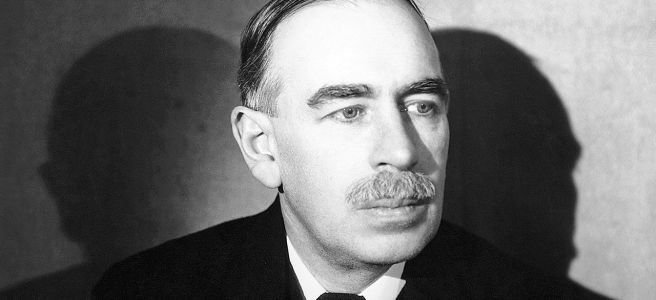
Whether they are stock-conservative market disciples[1] or staid social-democratic trade unionists,[2] in times of crisis, they are all Keynesians. In every crisis episode of recent years, when it was once again necessary to save the fading late capitalism from collapse by means of billion-dollar economic stimulus programs and massive money printing, the British economist, whose demand-oriented economic policy was dominant until it was replaced by neoliberalism in the 1980s, experienced a fleeting public boom. After the bursting of the transatlantic housing bubble in 2008 or the pandemic-induced slump in 2020, everyone was suddenly talking about John Maynard Keynes, who, as the court economist of the old statist social democracy, had advocated an active role for the state in investment programs and monetary policy. Until, after the usual wear and tear in the media circus, nobody talked about him anymore and capitalism seemed to return to “business as usual” after the “Keynesian” stabilization phase.

All that was left were the Keynesians, who had been pushed out of the political and academic mainstream in the neoliberal age and were constantly whining, and with whom the left beyond social democracy now had to contend. But the constant lament from the spectrum of neo-Keynesians and Modern Monetary “Theory” (MMT) that more Keynesianism is needed to make everything better again and for late capitalism to return to the era of the economic miracle is, to put it mildly, misplaced in the face of political realities. Many of the tools of Keynesianism continue to be used in crisis management, but they are not discussed or perceived as such. Keynes has long been a pragmatic part of everyday crisis management, and many of the crisis measures and programs that have stabilized the system since 2008 bear his signature.

And this is only logical against the background of the historical genesis of this school of economics: Keynesianism found its way into the capitalist mainstream after the end of the Second World War precisely as the great “lesson” from the crisis phase that began in 1929 – and in times of crisis the capitalist functional elites almost reflexively resort to its instruments. Consistent regulation of the currency and financial markets, the state as an economic regulatory and steering agent pursuing an active investment policy, a demand-oriented wage and social policy, in which the wage earners of the economic miracle were also understood as consumers, and a counter-cyclical economic policy – these were the now idealized features of the Keynesian economic order until the rise of neoliberalism under Thatcher and Reagan, to which the neo-Keynesians want to return.

It Doesn’t Get Cheaper Than This

The pragmatic recourse to the instruments of Keynesianism finds its clearest expression in all the economic stimulus programs that were launched in the wake of the intensifying episodes of crisis. As a result of this increasing intensity, these government subsidy and investment packages have grown in size with each new wave of crisis,[3] as the notorious management consultancy McKinsey demonstrated with reference to the global financial crisis of 2008/09 and the pandemic of 2020.[4] By mid-2020, global government spending to mitigate the effects of the pandemic-generated crisis surge had already reached around $10 trillion – three times the amount of the 2008/09 crisis programs.

And it was precisely the German government, which was cautious in its economic policy in 2008 and only made negative headlines at the time with the infamous (and disastrous in terms of climate policy) car scrappage program, that launched particularly far-reaching crisis programs in 2020. In relation to Germany’s GDP, Berlin even launched the largest economic stimulus package of all Western industrialized countries: it amounted to 33 percent of GDP. In addition, the Merkel government also initiated a gradual shift away from the pernicious austerity regime in the “German” eurozone by agreeing to a European economic stimulus program in mid-2020 as part of the European budget, which, with a volume of 750 billion, nevertheless includes 380 billion euros of aid payments to the periphery.[5]

And in terms of monetary policy, both the European Central Bank (ECB) and the Federal Reserve (Fed) have, until recently, followed the “it doesn’t get cheaper than this” approach. Key interest rates in all Western currency areas have tended to fall further and further in the 21st century. Between 2009 and 2021, a zero interest rate policy prevailed – with brief interruptions – to support the economy and the financial sector. In addition, after the bursting of the transatlantic real estate bubble, the central banks resorted to pure money printing, first by buying mortgage securities and later increasingly by buying government bonds– injecting additional liquidity into the financial sphere and leading to securities price inflation in the context of the great liquidity bubble that burst in 2020. Over the course of the 21st century, the Fed and the ECB have increased their balance sheets almost tenfold, becoming the dumping grounds of the late-capitalist financial system, doomed to perpetual boom, and the largest holders of their sovereigns’ debt instruments.

Hyperactive Central Bank Capitalism

The central banks have thus become key economic actors in the course of the crisis process, since without their intervention both the financial sphere and government financing would have collapsed. One could speak of central bank capitalism, as the political economist Joscha Wullweber does in a book of the same title, which highlights the dependence of one part of the financial sphere, the largely unregulated market for repurchase agreements (repos), on central banks’ money printing.[6] The current attempt by the ECB and the Fed, in the face of double-digit inflation rates (only the Bank of Japan is desperately bucking the trend),[7] to curb inflation, which has multiple causes (the pandemic, war, the bursting of the liquidity bubble, the climate crisis), by resorting to restrictive monetary policy is not working,[8] but does not necessarily go hand in hand with an end to government bond purchases.

In the eurozone, the PEPP (Pandemic Emergency Purchase Program), a 1.85 trillion euro program that buys government bonds while raising interest rates (net purchases are to be suspended next March),[9] has been created specifically to stabilize the eurozone, effectively undermining the fight against inflation – and in turn strengthening the economic role of the state, which can continue to finance its budget deficit under the PEPP. In addition, there have been steps toward an active economic policy by the state, especially with regard to the Green New Deal. Neoliberal hardliners[10] are now complaining loudly in the Handelsblatt about the state’s efforts to “steer credit” towards the environment, which would be expressed above all in the introduction of the EU taxonomy regulation defining sustainable investments (ironically, investments in natural gas and nuclear power are also considered “sustainable” in this context). Moreover, German Vice-Chancellor Robert Habeck’s State Secretary Sven Giegold – an Attac activist from the very beginning – already spoke out a year ago in the Financial Times (FT) in favor of an “active industrial policy” by Berlin, which should “support innovations” in order to transform the FRG into an “ecological and social market economy.”[11]

However, this structure of crisis capitalism, characterized by increasing state activity, is not the result of a coherent strategy, but an expression of the respective efforts to prevent a collapse of the world economy during the acute episodes of crisis. It is a Keynesianism of blind action, in which functional elites acted quasi-reflexively. The emergency programs and policy changes, often introduced as temporary measures, then become permanent in the course of the crisis; they coagulate into new structures and dynamics in latent crisis phases. In the words of then Finance Minister Schäuble, the German government’s actions during the global financial crisis in 2009 were “driving on sight.”[12][13] The packages of measures simply build on each other. Habeck’s active industrial policy, for example, for which Giegold drummed up support in the FT, has its precursor in the state promotion of “national champions” under his predecessor Peter Altmaier, who also wanted to specifically promote Germany’s export industry in the face of increasing crisis competition and informal state subsidies in China and the United States.[14]

This “driving on sight” of the functional elites in manifest times of crisis, in which ever new elements of state-capitalist crisis management are applied in response to waves of crisis, gives this formation all the characteristics of a transitional stage within the late-capitalist unfolding of crisis. The economic and ecological crises that force politicians to adopt crisis Keynesianism are not the expression of a “wrong” economic policy, but of the escalating internal and external contradictions of the capital relation, which manifest themselves quite concretely in constantly rising debts (faster than world economic output) and an incessantly rising CO2 concentration.

Due to the ever increasing global level of productivity, the world system is, in fact, increasingly running on credit, unable to develop a new leading industrial sector, a new regime of accumulation in which masses of wage labor would be valorized. Through money printing and deficit spending, the state is increasingly acting as a last resort to postpone the crisis, now that deficit accumulation in the context of the neoliberal financial bubble economy (dot-com bubble, real estate bubble, liquidity bubble) has largely exhausted itself in the hot financial markets. For example, the broad-based U.S. stock index S&P 500 has now fallen about a thousand points after reaching its historic high of more than 4700 points at the end of 2021.

Modern Monetary Ideology

The late phase of globalized financial bubble capitalism, in which central banks’ expansionary monetary policies contributed to the inflation of securities prices in the financial sphere – to the point of swarm investing and the fleeting booms of meme stocks like GameStop[15] – also gave rise to an extreme form of late- and post-Keynesian economic ideology, which, ignoring any systemic crisis analysis, especially the connection between bubble formation and central banks’ monetary open floodgates, could claim that all of the economic and social problems of late capitalism could be solved by printing money. After all, interest rates and inflation remained low between 2008 and 2020.

Modern Monetary Theory (MMT) seemed to have succeeded in squaring the capitalist circle. Full employment, the welfare state, economic growth and ecological turnaround are only a matter of expansionary monetary policy, according to the central thesis of MMT. According to this neo-Keynesian monetary theory, which is very popular on the socialist left in the United States, governments that control their currency can freely increase government spending without worrying about deficits. This is because they can always print enough money to pay off their national debt in their currency. According to this theory, inflation is not a problem as long as the economy does not reach its natural growth limits or there is unused economic capacity, such as unemployment.

Printing money until full employment – that is the goal of this late Keynesian demand-driven economic ideology, born in the wake of the financialization of capitalism that it failed to understand. Most proponents of MMT point to the expansionary monetary policy of the U.S. Federal Reserve, which pumped trillions of dollars into the faltering financial markets from 2007 to 2009 and from 2020 onward. Since the money printing known as “quantitative easing” apparently did not result in any surge in inflation, MMT wants to elevate these crisis measures to the guiding principle of neo-social democratic economic policy. An expansive monetary policy is supposed to increase the supply of money as a commodity until demand is satisfied, unemployment has disappeared and the economy is humming along. The historically unprecedented purchasing programs of the central banks, with which a late capitalism running on credit is painstakingly stabilized, are ultimately to be declared the new normality by MMT – and thus become an ideology, a justification of the existing.

It is also no coincidence that MMT has its political home in the U.S., which controls the world’s reserve currency, the U.S. dollar. This allows Washington to borrow in the global value measure of all commodities. What it looks like when peripheral countries, which find their global measure of value in the U.S. dollar, start printing their own currencies at will can currently be studied, for example, in the Turkey of the “interest rate critic” Erdogen, where the inflation rate threatens to accelerate into triple digits.[16] MMT is thus not only a very exclusive ideology that may still find supporters in the eurozone, but it is simply disgraced by the experiences in the periphery and semi-periphery.

Thus, neo-Keynesianism sees the cause of the current capitalist malaise primarily in a lack of money supply. The real cause of the crisis, however, is the lack of a leading economic sector, the lack of a new regime of accumulation that would valorize wage labor on a massive scale. Of course, such a regime will never be re-established due to the high level of global productivity. The irrational end in itself of capital is, after all, its highest possible valorization through the exploitation of wage labor – the only commodity that can produce surplus value as the substance of capital – in commodity production. Keynesian demand policy, on the other hand, pretends that capitalism has already been overcome, as if the satisfaction of needs – and not the unlimited valorization of capital – were the purpose of the capitalist economy. It is the usual Keynesian sleight of hand that simply hides the irrationality of capitalist socialization.

We can clearly observe that since the 1980s, as a rule, when capital accumulation in the real economy sputters, speculative growth in the financial sphere sets in. What MMT ignores here is the connection between quantitative easing and the growth of the bloated late capitalist financial sector. The Fed’s money printing (like that of the European Central Bank) did indeed lead to inflation – to the inflation of securities prices in the financial markets. Thus, the inflated financial sector so frequently demonized by the Keynesians – the basis of the global debt dynamics that act as an economic engine – was the decisive factor in preventing a period of stagflation, such as the one that broke the back of Keynesianism in the 1970s and opened the way for neoliberalism. Neoliberalism unleashed the financial sphere precisely in response to the crisis phase of stagflation, which, as a form of crisis postponement, led to the formation of a zombie capitalism that ran on credit and lurched from bubble to bubble.[17]

The Return of the Deflationary Past

Capital thus loses its own substance, value-creating labor, in commodity production, which drives policymakers, confronted with ever greater mountains of debt, into a dead end: Inflation or deflation? In concrete terms, the aporia of capitalist crisis policy resulting from the inner barrier of capital is illustrated by the dreary dispute between supply-oriented neoliberals and demand-oriented Keynesians over the priorities of economic policy, which has been going on for years.[18] Twitter Keynesian Maurice Höfgen likes to practice this mindless shadowboxing.[19] It’s always the same refrain, reeled off in a thousand variations: The neoliberal warning of over-indebtedness and inflation in the case of economic stimulus programs is countered by the Keynesians with the warning of the deflationary downward spiral triggered by austerity programs. Both sides are correct in their diagnoses, which were only obscured by the financial bubble economics of the neoliberal era. Now, in the era of stagflation, it is becoming clear that it is precisely the monetary policy of central banks that is in a crisis trap.[20] Central banks would have to raise interest rates for the sake of inflation, and at the same time lower interest rates to prevent a recession.

Incidentally, the historical period of stagflation in the 1970s outlined above – to which the late capitalist world system is currently returning at a much higher level of crisis– was the point at which Keynesianism actually failed brilliantly.[21] After the end of the great post-war boom, which was fueled by the Fordist accumulation regime, all Keynesian policy prescriptions failed. Thus, neoliberalism was able to prevail in the 1980s only because Keynesianism failed spectacularly –with double-digit inflation rates, frequent recessions, and mass unemployment. When a has-been Keynesian like Heiner Flassbeck claims – true to style in the Querfront magazine Telepolis[22] – that it was only the energy and oil price crisis that triggered the rise in inflation then as now, he is lying to himself. Despite all the economic stimulus programs, Keynesianism was not able to create a new regime of accumulation – and it will not be able to conjure up new markets that could valorize masses of wage labor at the current global level of productivity.

Neoliberalism “solved” the problem through the speculative expansion of the financial sphere, the financialization of capitalism, i.e. through the postponement of crisis within the framework of a veritable financial bubble economy, which allowed capital to live a kind of zombie life on credit for three decades. This is also the fundamental difference between the stagflation of the 1970s and the current phase of stagflation. The level of crisis is much higher – and this can easily be seen from the ratio of total debt to economic output, which has risen from around 110 percent at the beginning of the neoliberal era in 1980 to 256 percent today (excluding the financial sector).[23]

And a sustainable reduction of this mountain of debt is possible only at the price of a recession – in other words, not at all in the long run. Quite apart from the fact that responding to recessions with Keynesian stimulus programs is ecological madness. The recessions of 2009 and 2020, which erupted in the wake of the crisis surges of the time, resulted in the only years in the 21st century in which CO2 emissions declined. But the stimulus packages described above led to the highest emissions increases of the century in the years that followed. In 2009, greenhouse gas emissions fell by 1.4 percent,[24] only to rise by 5.9 percent in 2010 thanks to Keynesian stimulus programs![25]In 2020, emissions fell again by 4.4 percent due to the pandemic, while in 2021 they increased by 5.3 percent due to multiple stimulus packages.[26] Destitution in recession or climate death? This is the expression of the ecological aporia of capitalist crisis policy.

Ideological Material for Leftist Crisis Opportunism

Obdurate old Keynesians like Flassbeck, as well as the completely crazy new generation around MMT, stubbornly ignore these simple connections, which point quite clearly to the necessity of system transformation. They still promote the fairy tale that the wrong policies led to financialization, to the expansion of the financial markets in the neoliberal era – and that the only thing to do is to “contain” them. And, of course, they routinely repeat their tired routine of warning against restrictive monetary policy despite double-digit inflation. But the acrobatics with which the evidence of the crisis trap of bourgeois policies is denied in order to repeatedly dismiss inflation as an “anomaly” to be fought with “real” Keynesian policies are becoming downright embarrassing. In Keynesianism, which is rapidly turning into regression, there is simply no sense of shame, even when one’s own predictions are so clearly embarrassed by the reality of the crisis, as in the current phase of stagflation.

In Flassbeck, the notorious Höfgen, and in many other Keyensians who are absolutely blind to the world crisis of capital, there is a reflex to deny all evidence of the ideological impasse in which they find themselves. Just as inflation is not “real” inflation, they call for the “real” Keynes in crisis policy, since everything that has been used so far in terms of methods does not correspond to the ideal. In all depressing frankness, this is evident in the author of the above-mentioned book on central bank capitalism, who describes at length how central banks have to prop up the bloated financial system, only to claim that this is not Keynesianism because financial markets are not restrained:[27] “So the current heavy intervention by central banks in the financial system and even the support measures taken by governments during the Covid pandemic are not a return to the strong state or a new Keynesianism. Despite the severity of the crises, there have been no far-reaching changes in the course of economic and fiscal policy. It is a way of governing that takes place within the market-liberal economic order that continues to prevail. Neither the functioning of the financial system in general nor that of the shadow banking system in particular is being questioned. But that is exactly what would have to happen to overcome the system’s inherent tendencies toward crisis.”

In fact, today’s crisis Keynesianism cannot live up to the old ideal because, as a form of precarious crisis management, it is confronted with the consequences of the decade-long financialization of capitalism. It is depressing: Joscha Wullweber describes the consequences of this financialization on the basis of what he calls the “shadow banking system” of repo transactions[28] and laments the consequences of the rapid expansion of the financial sphere, only to remain in the capitalist thought-prison and declare the structural dynamics a mere question of a wrong policy. And it is precisely this way of thinking that makes Keynesianism an easy ideological vehicle for left opportunism.[29]The Keynesians are courted by the “Left Party” because they reduce the systemic crisis to a mere question of policy, which legitimizes the deliberate complicity in crisis management of entire Left Party rackets, from left-liberal to right-nationalist. The Keynesian critique of capitalism has long since coagulated into an ideology.

Post Keynesian War Economy

Keynesianism, with its drab deficit spending and its love for the state, cannot, of course, solve the deepening internal and external crisis of capital, but it can function as a transition to a new quality of crisis. Keynes can provide a useful bootloader, a transitional vehicle, to a qualitatively new form of authoritarian crisis management, especially for functional elites who often act “on sight.” Ideologically advanced post-Keynesians, such as the Taz editor Ulrike Herrmann, have long understood this:[30] In her recent book on the “end of capitalism,” she combines an account of the external limit of capital largely cribbed from the critique of value with a commitment to the war economy – including ukase (decree, Russian) and rationing. The Taz editor wants to endow the German state, which is blind in its right eye and riddled with right-wing cronies, with immense power and make it the central agent of social reproduction in the crisis. Here too, of course, Ms. Herrmann is building on a Keynesian critique of capitalism in which the state appears as the great antagonist of capital – and not as part of the capitalist system that is going down with it, as is already the case in a number of “failed states” on the periphery.

This, authoritarian, post-democratic crisis management, carried out by eroding, sometimes openly savage state apparatuses, is what the course of the crisis boils down to. The Keynesians play only the – stupid or perfidious – cheerleaders of this objective crisis tendency towards anomic authoritarianism. Keynesianism, which is only considered to be to the left of social democracy because of the absurd rightward shift of the entire political spectrum, thus degenerates here, too, into ideology in the purest sense: to justify the threatening authoritarian state-capitalist crisis administration, which would be the exact opposite of the emancipation from the collapsing late-capitalist objective coercion regime, an emancipation that is necessary for the survival of humanity. Consequently, the left should finally come to see the Keynesians for what they objectively are: ideologues.

I finance my journalistic work mostly through donations. If you like my texts, then you are welcome to contribute – either via Patreon or via Substack.


[1] https://www.faz.net/aktuell/wirtschaft/der-volks-und-betriebswirt/volkswirtschaftslehre-sind-wir-jetzt-alle-keynesianer-1775435.html

[2] https://www.freitag.de/autoren/der-freitag/in-der-krise-sind-alle-keynesianer

[3] https://www.konicz.info/2020/10/27/vergleich-der-krisen-2020-vs-2008/

[4] https://www.mckinsey.com/featured-insights/coronavirus-leading-through-the-crisis/charting-the-path-to-the-next-normal/total-stimulus-for-the-covid-19-crisis-already-triple-that-for-the-entire-2008-09-recession

[5] https://www.sueddeutsche.de/politik/eu-sondergipfel-haushalt-1.4973847

[6] https://www.bpb.de/shop/zeitschriften/apuz/geldpolitik-2022/507732/zentralbankkapitalismus/

[7] https://www.konicz.info/2022/12/30/japan-in-der-krise-mehr-alkoholismus-wagen/

[8] https://www.konicz.info/2021/08/08/dreierlei-inflation/

[9] https://www.ecb.europa.eu/mopo/implement/pepp/html/index.en.html

[10] https://www.handelsblatt.com/meinung/homo-oeconomicus/gastkommentar-homo-oeconomicus-kreditlenkung-ist-kein-gutes-rezept-fuer-klimaschutz/27974940.html

[11] https://www.ft.com/content/fa740376-da98-4067-92b4-85d315bbb6e2

[12] https://wolfgang-schaeuble.de/wir-fahren-auf-sicht-dazu-muss-man-sich-offen-bekennen/

[13] TN: The phrase “driving on sight” [Fahren auf Sicht] refers to driving a car with the headlights off, in essence only being able to see and react to what is right in front of you, without much ability to anticipate or plan for the future.

[14] https://www.ifo.de/publikationen/2005/aufsatz-zeitschrift/nationale-industriepolitik-brauchen-wir-nationale-champions

[15] https://www.konicz.info/2021/01/30/hedge-fonds-gamestop-und-reddit-kleinanleger-die-grosse-blackrock-bonanza/

[16] https://www.konicz.info/2022/01/31/werteverfall/

[17] https://www.streifzuege.org/2017/wir-sind-zombie/

[18] https://www.konicz.info/2011/08/15/politik-in-der-krisenfalle/

[19] https://twitter.com/MauriceHoefgen/status/1610588756754534400

[20] https://www.konicz.info/2011/08/15/politik-in-der-krisenfalle/

[21] https://www.xn--untergrund-blttle-2qb.ch/wirtschaft/theorie/stagflation-inflationsrate-6794.html

[22] https://www.telepolis.de/features/Die-Welt-vor-der-Rezession-Diese-alten-Fehler-werden-die-Lage-verschaerfen-7286773.html?seite=all

[23] https://www.imf.org/en/Blogs/Articles/2021/12/15/blog-global-debt-reaches-a-record-226-trillion

[24] https://www.reuters.com/article/us-climate-emissions-idUSTRE6AK1OU20101121

[25] https://www.reuters.com/article/us-iea-co2-idUSTRE74T4K220110530

[26] https://joint-research-centre.ec.europa.eu/jrc-news/global-co2-emissions-rebound-2021-after-temporary-reduction-during-covid19-lockdown-2022-10-14_en#:~:text=In%202021%2C%20global%20anthropogenic%20fossil,the%20world’s%20largest%20CO2%20emitters.

[27] https://www.bpb.de/shop/zeitschriften/apuz/geldpolitik-2022/507732/zentralbankkapitalismus/

[28] Wullweber (source in footnote no. 26) summarizes repurchase agreements (repos) as follows: “Repos are contracts under which securities are sold at a certain price in order to repurchase them after a defined period of time at a predetermined price plus interest. […] In principle, a repo is nothing more than a pawnshop: One side needs money and deposits a pledge in the form of a security as collateral. The other side has money and lends it against this collateral. […] Generally speaking, in the shadow banking system there are, on the one hand, financial players such as hedge funds and commercial banks that need funds to make a short-term profit through transactions with different risk profiles or to make up for a shortfall in capital reserves. […] On the other hand, you find money market funds, asset managers, pension funds and other institutional investors or even companies that want to invest their excess capital with relatively low risks and comparatively high returns.”

[29] https://exitinenglish.com/2023/01/23/opportunism-in-the-crisis/

[30] https://exitinenglish.com/2023/04/02/rebranding-capitalism/

Originally published on oekumenisches-netz.de in 02/2023

Value-Dissociation, Gender and the Crisis of Capitalism

Interview by Clara Navarro Ruiz with Roswitha Scholz

First of all, we would like to share some moments of your career with the Ibero-American readers. What were your defining experiences as a student? How did your politicization take place? In what social context? Which theoretical references or concepts were important in this process? Were there any breaks? How did you come to join the Krisis Group, or how were you involved in its founding? What significance did the split of this group and the founding of EXIT! have for you, where you further developed your theoretical approach of the value-dissociation critique?

As a young person, I read a lot. In the 1970s, the zeitgeist was left-wing, and I was infected by it. In my youth I read a lot of existentialist texts. Especially novels and plays by Sartre, but also Camus. I also read The Second Sex by de Beauvoir. Other authors included Erich Fromm, Bertrand Russell, and psychoanalytic literature by Freud, Adler, Jung, and Wilhelm Reich. Whether I understood all this at the time is debatable. I also read feminist literature by Alice Schwarzer, Carla Lonzi, Shulamith Firestone, Klaus Theweleit and others, as well as anti-psychiatry texts by Basaglia, Szasz, Laing and many others. I read an introduction to Marxism by a Polish Jesuit priest whose name escapes me. Basically, though, I identified Marx primarily with Eastern Bloc Marxism and the K-groups, all of which were deeply suspect to me. In any case, my attitudes placed me on the anti-authoritarian left.

I was already in a women’s center when I was 17, but I was an absolute outsider and didn’t dare to say much. Then I went to a second-chance school and concentrated on that for a couple of years. Before that, I had trained as a pharmacy assistant and worked for a pharmaceutical wholesaler for a few years. I come from a lower class background. When I was studying social pedagogy at the University of Applied Sciences, I attended seminars on the Frankfurt School. That was something quite different from the Marxism of “really existing socialism” and the K-groups! I soon realized that I needed to know more about Marx in order to understand these texts and so I joined the “Initiative Marxistische Kritik,” which offered a Marx course, and Robert Kurz was a central figure there. In the meantime, I had also become suspicious of the “sponti” left, which couldn’t live up to its own claims, e.g. everything was supposed to be anti-hierarchical and pro-social, but de facto there were many authoritarian informal structures; free love and sex were advocated, while in reality others were treated as commodities on the love market, so to speak. The promise of emancipation in the here and now was a lie. Anyone who didn’t habitually fit into this scene (language, clothing, etc.) was effectively excluded. There was a double standard. But it was not only these experiences that led me to distance myself from a “false immediacy.” It was also leftist teachers at school in the course of my secondary education who taught me that leftist theory is necessary and not just useless chatter that is of no use in practice.

Incidentally, the study of Marx and critical theory made me realize how questionable existentialism is, e.g. the talk of the “abstract individual” in the “German Ideology” – and how it comes about at all – was very enlightening for me. This individual is presupposed in existentialism without justification. Later, when I went to university (I studied mainly sociology, education and philosophy, but also attended seminars in other subjects), I looked for interesting non-Marxist theories that could be made fruitful for feminism. Feminism was a topic that had been on my mind since puberty. The value critics of the time were not exactly open-minded about feminism, to say the least. At university I also attended several seminars on symbolic interactionism and phenomenology. In the end, however, I came to the conclusion that the “Dialectic of Enlightenment” with its inclusion of psychoanalysis is a key work to which feminist theory must critically connect.

I was involved in the founding of the Krisis group as an outsider, so to speak, because of the conflicts around feminism, but also because of questions of the subject and ideology. I did go to the bar with them, but unlike in previous years, I was no longer involved in a working context within the Krisis group. Together with others, I had formed an outsider group, which, however, did not go as far as the critique of value-dissociation, but moved in the dualistic cosmos: patriarchy-capitalism critique. In this group we dealt with the history of the women’s movement and feminist theory.

In the first years of our being together, there were always fierce clashes with Robert Kurz about feminism. To my amazement, it then made perfect sense to him when I presented him with the thesis that “value is the man.” From then on, he tried to introduce this thesis into the Krisis group, which consisted of men, as its mastermind, but to his surprise he succeeded only with difficulty, in contrast to other innovations. There were fierce arguments and resistance. Some thought that critique of value-dissociation was only an aspect of the critique of value, not a dialectically conceived basic context, whereby neither value nor dissociation were to be deduced separately as origins, i.e. dissociation was to be categorically subordinate to value. This remained the case until the Krisis split.

Then, in the mid-1990s, I started working more intensively on the value-dissociation theory. I was pretty much alone in this. On the one hand, there were the androcentric Marxists and value critics (Robert Kurz was busy at the time with a large number of his own publications; moreover, he had little idea of theoretical approaches that were relevant to the development of value-dissociation critique from a feminist perspective). On the other hand, however, there were hardly any Marxist approaches left at that time, feminist theory was mainly oriented towards the deconstructivism of a Judith Butler; objective structures were hardly an issue in this discussion. In our working group on surplus value theory, I was under massive pressure to consider queer theoretical approaches. And so, I was relegated to working in silence. Especially as a woman, you do need a certain amount of steadfastness to “do your thing” when there is a lot of resistance from the outside. I think I also internalized a little bit of an attitude that came from my time with existentialism.

As far as the split in the Krisis group is concerned, I have already said that there was a tension here between the critique of value-dissociation and the critique of value in the Krisis group. However, the differences were not only based on theoretical content. Sexist behavior also characterized the general atmosphere in the Krisis group – as in many left-wing groups. This went so far that one Krisis man slapped me in the face after a disagreement. I was completely taken aback; I would not have thought that such a thing was possible. Nevertheless, I dismissed this as a slip. The reason I didn’t fight back harder at the time was because I was afraid the whole group would break up, and then where would I have published? At the beginning of the 2000s, a woman was to be expelled from the editorial board (she was the only other member of the inner core of the Krisis group besides me, not so much as a purveyor of theory as I was, but as a member of the editorial board) because she rejected a Krisis man who tried to get involved with her. After she had turned him down, he could no longer stand her in the group because he felt unappreciated. This was the immediate cause for the split of the group. Parts of the group went along with it, others did not. In addition, Robert Kurz had written a large number of books and texts since the early 1990s. If he had been the driving force of the Krisis group until then, and if he had been expected to be the “Supreme Leader,” so to speak, he was now reproached for exactly that. In short, it was, as the cliché would have it, about patricide in the male alliance. In the process, I was accused, also stereotypically, of having broken the Krisis group. And in fact, I had rebelled in many ways, thus disturbing the peace of the Brotherhood.

Since the founding of EXIT!, the critique of value-dissociation has been taken more seriously and has become part of our self-representation, but there is a tendency, especially when new people join – and these are mostly men – to treat the critique of dissociation as a subordinate contradiction. Over time, however, we have become picky about this. For example, if someone doesn’t acknowledge value-dissociation as a basic structuring social context from the outset, he/she won’t be included in the editorial board. But we nevertheless accept articles for publication in EXIT! even if their content does not strictly conform to the criteria of the “value-dissociation” critique, but contain topics and ideas that are interesting, whatever their shortcomings. On the whole, however, we regard the critique of value-dissociation as an absolute framework. It has also long since been clarified how it is to be taught in the so-called theory-practice context. This was also an important point in the Krisis split: they thought that value critique should become more practical and meet people where they are in their everyday lives. At EXIT! it is clear: we are a theory group and we see theory as an independent field of social practice, and theory cannot be directly and platitudinously broken down to the political level. We are by no means against a practical socio-critical engagement – on the contrary – for example against neo-fascist tendencies, but such an engagement cannot be played off against a necessary theory formation on another level.

Theoretically strong groups like EXIT! are hard to find in the Spanish context outside of the academic framework. How would you define the social-theoretical context of the EXIT! group, which has no firm ties to so-called social movements, party-political foundations or the university? This has to do not only with the social location of the theory, but also with the ability to influence and change the existing.

It is indeed the case that there are few theory groups that do not have some sort of institutional background – especially nowadays. When I was a student in the 1980s, it wasn’t quite like that. There was still a lot of the spirit of ‘68. Marxist theory, even in the universities, began to establish itself in the 1970s and for a long time still had an APO[1] smell to it. In the first half of the 1980s, being established was still rather frowned upon– unlike today. Critical social theory cannot simply be reserved for a reified university business and its associated constraints in terms of content and methodology, which, when combined with careerist intentions under precarious living conditions, allow a conformist attitude to flourish.

It is not easy to maintain oneself as a separate project for the development of leftist theory. This is not only because of financial problems (we are financed by private donations). In addition, there is always the insistence on the practical relevance of the critique of value-dissociation. This is a structural problem for a theory group that is not associated with a university, which would automatically legitimize theoretical endeavors, so to speak. Most people interested in theory on the left have some kind of connection to the university or want to get into the university. Today we are confronted with this is on the one hand, and on the other hand with the demand to become practical. Once again, one needs strong nerves and a certain steadfastness to resist the demands  made of non-university theory. It has always been the position of the old critical theory that, if necessary, one must have the courage to go outside the city walls if there is no other way. In this sense, I think that extra-institutional theory formation is very important. Precisely because it seems all too obvious today that alternatives to capitalism must be sought, a theoretical distance and a categorical classification of one’s own position and situation are essential in order not to fall for pseudo-concepts that do not really advance the process of social transformation, but rather inhibit it.

Especially after the collapse of the Eastern Bloc, Marxist and feminist theorizing has become hand-wringing. I very much hope that in the future there will also be movements of intellectuals on the left who resist the university or otherwise institutional Procrustean bed into which they are supposed to fit if they want to get a job, and who dare to swim against the tide. Usually you don’t have any real chance to influence or change things at the university, you are rather made to fit in and mutate into a “lurch” (Horkheimer/Adorno) for the sake of self-preservation. This doesn’t mean that you can’t accept outside money or participate in left-wing establishment events, just that there would be a cost. There may be niches in academia where other things are possible, but that is not the rule. From these niches, it would then be necessary to carry the corresponding ideas into the university and to create unrest.

Can you tell us something about your collaboration with Robert Kurz? How did you influence and enrich each other’s work? Were there any differences? Were they mediated?

As far as the collaboration with Robert Kurz is concerned, it’s quite simple. We never sat down together according to a schedule and had structured, disciplined discussions; we just did it. We weren’t divided into two parts: life here, and our theory projects and the associated collaboration there. Correcting each other’s texts was sometimes quite conflictual, but we dealt with it humorously, calling it “bickering on the computer.” What is not true, however, is that Robert Kurz and I wrote several books together, as the Wikipedia entry about me says. We wrote our texts separately and then it was time for the “computer bickering.” In the evenings, in a relaxed atmosphere, over a glass of wine, we discussed all sorts of things, and in this way – even in controversy – we influenced each other. We had different focuses. Roughly speaking, Robert Kurz’s main topics were economics and politics, and mine were feminism, “race,” class, gender and the “subject.” Atmospherically, our cats were important – but I won’t go into that here. Our lives were often scrutinized – even in the context of Krisis. We didn’t have any children, which was somehow unnatural. Poor Robert Kurz had to talk to his wife all the time, he wasn’t even allowed to relax in a separate private sphere! Some people simply cannot understand that the formation of theory is not simply toil and trouble, but can be a passion, as it was with Marx, despite having many children, especially when women have this attitude.

There were, of course, substantive differences between Robert Kurz and myself. At the beginning of our relationship, these mainly concerned feminism, the subject and ideology (see above). A controversial issue in the early 1990s was the assessment of racism and anti-Semitism, which were making waves at that time. There were tendencies in Robert Kurz to say that these were to be understood as a symptom of the process of the decay of capitalism; for me, on the other hand, it was equally important to see such tendencies in a country-specific context, i.e. as far as Germany was concerned: the Nazi rule and the Holocaust had to be taken into account. I then wrote an article about this in Krisis: “The Metamorphoses of the Teutonic Yuppie,” in which I also criticized the positions of Krisis. While Kurz accepted and appreciated this article and later, for example in the “Black Book,” classified Germany’s specificity in the process of modernization with regard to the Holocaust, there were fierce defensive reactions against this text in the rest of Krisis. Today, after the split, the Krisis homepage is full of texts that target precisely the kind of structural anti-Semitism that had been fiercely contested in the discussion of the text at the time. Of course, there is no written evidence of this dispute. But the discussion with me at that time is not mentioned at all, and it seems as if people had always held this view.

In this context, one area of conflict in the relationship between Kurz and myself was the confrontation with the so-called anti-Germans in the first half of the 2000s. Kurz was very angry about their bellicose attitude and then broke with all sorts of journals in which he had been publishing regularly. He then wrote a whole book about the anti-Germans; in my opinion, that would not have been necessary – two or three basic articles on the subject would have sufficed. Today I understand his agitation at that time a little better; after all, the Iraq war accomplished nothing. Many people died in the process, and it was based on lies about the weapons arsenals, as even Colin Powell admitted afterwards. Moreover, such interventions only prepared the ground for the Islamic State, as was widely reported in the press. Nevertheless, I don’t think that such an intense engagement of Robert Kurz with the “anti-Germans” would have been necessary. In order not to be confused with them – they, too, have a value-critical foundation, albeit a different one than the critique of value-dissociation (which cannot be pursued here) – a few texts would have sufficed.

Another difference between me and Kurz concerned the question of whether pre-modern societies are also fetish societies or whether fetishism refers to modern societies. Kurz took the former position, I the latter. I am also not sure that firearms play the central role in the constitutional process of capitalist patriarchy that Robert Kurz ascribes to them. There were other differences as well, not all of which I can go into here. They were just there in our life together. That’s just the way it was. We were able to deal with them, they were not so dramatic that they would have developed a centrifugal force. Once Robert Kurz said to me that he couldn’t be with a Bavarian monarchist; admittedly we both laughed heartily.

On the whole, however, we pulled together. Besides Adorno’s critical theory, Kurz was the second main pillar of the critique of value-dissociation. The critique of value-dissociation would not have existed if Kurz, as the leader of the Krisis gang, had not massively supported it – against all the resistance from within the group. Thus, in addition to the immediate practice of the value-critical men’s alliance, which was opposed to its content, this was ultimately another major cause of the Krisis split. Moreover, one must see that Kurz correctly predicted the desolate crisis situation in the world today. Today there is a lot of talk about the end of capitalism, but not so long ago Kurz was often declared crazy and not to be taken seriously.

The approach of the critique of value-dissociation is based on the incompleteness of the critique of value. To put it simply (and without taking into account individual critical statements of the EXIT! group), it places at the center of its critique only the category of labor as a social relation and a central concept of the commodity-producing society. Capitalism is to be understood as a total civilizational whole and at the same time as a particular and historical entity. This in itself represents a decisive correction to traditional Marxism, which is centered on surplus value and its distribution/appropriation. For your part, you have developed the thesis that the assertion of the value dynamic is necessarily accompanied by a “dissociation” of reproductive labor and of the “femininity” traditionally associated with this labor. Could you explain the central elements of this thesis and its unfolding?

In doing so, I assume that it is not only value as an automatic subject that constitutes the totality, but that equal account must be taken of the “fact” that in capitalism there are also reproductive activities that are primarily carried out by women. In this context, “value-dissociation” essentially means that female-determined reproductive activities, as well as the feelings, characteristics and attitudes associated with them (sensuality, emotionality, caring, etc.) are dissociated from value/surplus value. Female reproductive activities in capitalism thus have a different character than abstract labor, which is why they cannot be easily subsumed under this concept; it is a side of capitalist society that cannot be grasped by the Marxian conceptual system. This side relates to value/surplus value, necessarily belongs to it, but on the other hand it is outside of it and is therefore its precondition. (Surplus) value and dissociation are thus in a dialectical relationship. The one cannot be derived from the other, but both emerge from each other. In this sense, value-dissociation can also be understood as a metalogy that transcends the internal economic categories.

The categories of political economy, however, are not sufficient in another respect; the dissociation of value must also be understood as a specific socio-psychological relationship. Certain inferior qualities (sensuality, emotionality, weakness of character, and the like) are dissociated from the male subject and projected onto the woman. Such gender-specific attributions essentially characterize the symbolic order of capitalist patriarchy. Thus, beyond the moment of material reproduction, both the socio-psychological and the cultural-symbolic dimensions of capitalist gender relations must be taken into account. It is precisely on these levels that capitalist patriarchy reveals itself as a social totality. However, in the case of value-dissociation, understood as a basic social context, it is crucial that it is not a matter of a rigid structure, as in some sociological structural models, but of a process.

It can be assumed that a contradiction of substance (products) and form (value) is, in a sense, the law of crisis theory, which ultimately leads to crises of reproduction and the disintegration/collapse of capitalism. Schematically speaking, the mass of value per individual product becomes smaller and smaller. The result is an abundance of products while the total mass of value decreases. The decisive factor here is the development of productive power, which in turn is related to the formation and application of (natural) science. With the microelectronic revolution (culminating today in “Industry 4.0”), in contrast to the Fordist era, in which the production of relative surplus-value was compensated by the additional need for labor to generate surplus value, abstract labor is now becoming obsolete. The result is a devaluation of value and a collapse of the (surplus) value relation. Robert Kurz wrote as early as 1986 that this collapse should not be thought of as a single event, even though sudden collapses, e.g. bank failures, mass bankruptcies, will certainly be part of it, but rather as a historical process, a whole epoch, perhaps lasting several decades, in which the capitalist world economy will no longer be able to escape from the maelstrom of crisis and devaluation processes, swelling mass unemployment, and so on. Today, it has long since become clear that the very impossibility of making profits through the extraction of surplus value, mediated by this process, has led not only to a shift to the speculative level, but also the decline of capitalism.

This structure and dynamic, however, must now be modified according to the critique of value-dissociation. Dissociation is not a static moment in contrast to the dynamic moment of the logic of value, but is itself at the same time dialectically upstream of it and makes the moving contradiction possible in the first place, which is why a moving logic of value-dissociation must also be assumed. Dissociation is thus deeply involved in the elimination of living labor. In the process, it has also changed itself.

Especially in the natural sciences, whose application to the production process constitutes the development of productive power in capitalism in the first place, but also in the development of labor science, which is concerned with the optimal increase in efficiency and rational organization of the production process (keyword Taylorism), a dissociation of the feminine and corresponding images of women were almost the silent socio-psychological prerequisite of their existence, which also finds its expression on the symbolic-cultural level (women are less rational, worse at mathematics and the natural sciences than men, etc.). But it is not only in scientific, philosophical, theological, etc. discourses since modernity that a dissociation of the feminine can be observed. Rather, this classification was realized and materialized in the Fordist phase itself, which was conditioned by the dissociation of the feminine, in that the man now became the breadwinner of the family and the woman the housewife in the enforced nuclear family, at least according to the ideal. The more social relations became objectified, the more a hierarchical gender dichotomy took hold. This dissociation of the feminine is a precondition for the development of the productive forces, which first establishes capitalist patriarchy with its “moving contradiction” and as such first brings about its development as a decisive condition for the production of relative surplus value, and that the gap between material wealth and the form of value finally widens more and more. From the point of view of historical processes, objectification and the formation of hierarchical gender relations are mutually dependent and not contradictory. Such a dissociation of the feminine as a prerequisite for the development of productive power ultimately led to the microelectronic revolution, which made not only abstract labor, but also classical-modern gender norms and the housewife obsolete.

From an economic point of view, the expansion of reproductive, caring and nurturing activities, which used to be carried out privately, and which have now been transferred to the professional sphere, is a component of the crisis, since the mass of surplus value has to be redistributed in order to finance them; however, in the context of moving contradiction and a capitalism that has reached its limits, these redistributive possibilities no longer exist. Thus, there is also a reproductive deficit when women can no longer carry out such activities because they are doubly burdened, i.e. they are equally responsible for family and work. Professionally performed care and welfare activities also reach qualitative limits, since they are largely contrary to considerations of efficiency, even though they often end up professionally in the care sector or similar services. In principle, women today are expected to take on all kinds of work, including work that has traditionally had a masculine connotation, even though they are still responsible for care work, including in the private sphere.

Dissociation has thus by no means disappeared, which is also reflected, for example, in women’s lower earning potentials and opportunities for advancement. It should be emphasized that value-dissociation is not located in the split spheres of private and public, with women assigned to the private sphere and men to the public sphere (politics, economy, science, etc.). Rather, value-dissociation runs through all levels and spheres, including those of the public sphere; it forms the basic structuring context of society as a whole. This is shown, among other things, by the fact that women often earn less than men, even though they do the same work and are on average better educated than men today.

On the other hand, when abstract labor becomes obsolete, there are also tendencies toward the “housewifification” of men. The patriarchy becomes feral when the institutions of family and gainful employment erode in the face of increasing tendencies towards crisis and impoverishment, without patriarchal structures and hierarchies having fundamentally disappeared. Today, women are forced to work just to survive. In the slums of the so-called Third World, it is women who initiate self-help groups and become crisis managers. At the same time, however, they are expected to take over the functions of “rubble women” [Trümmerfrauen] in the commanding heights of the economy and politics in this country [Germany], when the cart is stuck in the mud in the fundamental crisis.

The dissociation of value as a historical-dynamic basic structuring context combined with the development of productive forces based on it thus undermines its own foundation, the caring activities performed in the private sphere. The central point here is that the changes – not only in gender relations, but in social relations as a whole – must be understood in terms of the mechanisms and structures of value-dissociation in their own historical dynamics and not, as has already been said, in terms of “value” alone.

Theoretically, then, the hierarchical gender relationship is thus limited to modernity and postmodernity. This does not mean that this relationship does not have a pre-modern history, but under capitalism it took on a completely new quality. Women were now supposed to be primarily responsible for the less valued private sphere, while men were supposed to be responsible for the capitalist sphere of production and the public sphere. This contradicts views that see capitalist-patriarchal gender relations as a pre-capitalist vestige. For example, the nuclear family as we know it did not emerge until the eighteenth century, and public and private spheres as we know them did not develop until the modern era.

The critique of value-dissociation does not simply assume that a critique of value is inadequate; rather, it raises this critique to an entirely new level of quality.

In addition, your theory of value-dissociation has engaged with the discourses of difference that were widespread in the 1980’s and 90’s, coming from feminist critique. This engagement had important implications for the qualitative determination of your own theory, which then defines itself as a “realist dialectic” and configures a “broken totality.” How does the critique of value-dissociation assess these discourses of difference? How does it critique these discourses and how does it enrich itself through this critique?

In order to do that, I have to say something about the history of feminism/feminist theory in Germany since 1968. First of all, the 1970s were about the connection between Marxism and feminism. How can the oppression of women be theoretically integrated into a workers’ movement Marxism? Then, in the early 1980s, it was mostly about making the connection between capitalism, women’s oppression, the destruction of nature, and colonization/the Third World. Then in the second half of the 1980s, the discourse on women’s differences began. The white women’s movement was accused by black women, Latinas, lesbians, etc. of stereotyping them and making the white woman’s position as housewife the standard for theorizing. This discourse overlapped with one that assumed a multiplicity of life trajectories, individualization tendencies, etc. in the Western industrialized countries against the background of welfare state security. It was now assumed that “the woman” (but also the man) did not exist, but that there were “many” different shades of these two genders. After the collapse of the Eastern Bloc, Marx became passé in feminism. Now a culturalist deconstructivism in the sense of Judith Butler reared its head and became the feminist master theory. Materialist theory was mega-out, culturalist, poststructuralist theory mega-in. It was no longer about the gender division of labor, for example, but about how gender is discursively produced. Gender now no longer seemed to be something real, fixed, but discursively negotiable and, in a vulgar constructivist understanding of the left milieu, freely selectable. Cultural relativist theories moved in. Gender relations were supposed to differ fundamentally from culture to culture, and a universal view of them was taboo. Language, discourse, and culture were, so to speak, substitutes for an old materialist understanding of totality.

Instead, the critique of value attempted to explain the collapse of the Eastern bloc itself in Marxist terms, beyond an old workers’ movement Marxism, by making the category of value the center of its essays and interpreting Marx from there. By that time, I had long since landed as a feminist in the critique of value – with all the dissatisfactions I have already explained – when, in the late 1980s/early 1990s, in my preoccupation with feminist theory, not least the persecution of witches, the thought came to me: “value is the man,” and in this context I also realized that a reference to the dialectic of the Enlightenment on the part of feminist theory was unavoidable. And so it came about organically, as it were, that the previously posed questions about the connection between the domination of nature, the oppression of women, anti-Semitism and racism could be dealt with through a critique of value-dissociation. As far as differences, not only between men and women, are concerned, Adorno’s critique of the logic of identity was very illuminating for me. In contrast to the postmodernists and poststructuralists, he was not concerned with hypostatizing difference, but with respecting and looking at the individual, particular object. This was what the theory of value-dissociation was supposed to convey. By the way, it was by no means the case that the women’s movement of the 1970s and 1980s was simply blind to other dimensions of inequality, such as “race”/ethnicity, and certainly not to class, and was only concerned with women’s emancipation, as was often claimed in the 1990s. It was just that at that time it did not hypostatize difference against the background of culturalist and poststructuralist views. A primarily cultural relavatist view has the consequence that existing commonalities in the oppression of women can no longer come into focus. In this respect, I did not first adopt a way of thinking about differences from a post-structuralist oriented women’s movement, because this was already there before. Nevertheless, I think that for a long time, even in Marxist theory as a whole, the importance of culture and the symbolic order has not been given enough attention. It is therefore important not to negate this level in the abstract, but to include it in the sense of a certain negation in the critique of value-dissociation, as something separate and at the same time belonging to it, similar to the psychoanalytical level.

Of the various authors in the EXIT! group, you are undoubtedly the one who has most strongly emphasized the connections between the critique of value-dissociation and the Critical Theory of the so-called first generation of the Frankfurt School. Theodor W. Adorno seems to be very important for your thinking, as some texts (The Significance of Adorno for Feminism Today, The Theory of the Sexual Dissociation and Adorno’s Critical Theory, Social Form and Concrete Totality) show. You claim his importance for feminism in general and for the critique of value-dissociation in particular. Could you tell us in what sense one can speak of the topicality of Adorno’s thought?

Adorno was not on the workers’ movement Marxist steamship, nor was he an Eastern Bloc socialist. The struggle for money was not his central point of reference; rather, he was concerned with alienation, reification and fetishism at the heart of society. The economy played only a marginal role for him. His critique of fetishism should be taken up again today in economic terms, but without adopting his primitive recourse to “exchange” as the basic form of capitalism. Instead, the moving contradiction and the abstract labor/care activity in the sense of the (surplus) value-dissociation theory are to be taken as the core of capitalist-patriarchal socialization. Adorno, in a reversal of Hegel, had already seen that the whole is the untrue and thus argued for a broken totality in order to explode the hermetic. A broken totality is indeed what we have today. At the exit of postmodernism, however, it becomes clear that this does not necessarily lead to emancipation, but to (civil) war. If differences are allowed to float freely, as poststructuralism had theoretically anticipated, this, in conjunction with processes of material impoverishment in the “collapse of modernization” (Robert Kurz), leads to barbarism. As already mentioned, however, Adorno was never abstractly concerned with differences per se; in his case, non-identity was always claimed against the background of total capitalism and its reifying thinking. The positivist thinking of difference in postmodernism, however, corresponds only laterally to a classical modernist thinking of identification and classification. In this respect, one should continue to insist on the recognition of the non-identical as a prerequisite for a different society, without, however, leaving it in abstraction, and this also means not recognizing every barbaric difference, but also not making the identical the standard. In this respect, a further developed Adorno is highly topical today. A new recourse to Lenin and a workers’ movement Marxism, as can be observed again today, is of course far removed from this and desperately tries to activate old ideas that have long since lain in their graves.

On the other hand, you have had to distance yourself from Adorno’s thinking, especially from the confusion between Adorno’s non-identical and your own concept of the “dissociated.” Could you explain this difference?

Adorno derived a critique of the logic of identity from exchange. What is decisive, however, is not simply that the common third – disregarding qualities – is the socially necessary labor time, the abstract labor, which stands, as it were, behind the equivalence form of money, but that this in turn makes it necessary to exclude what is connoted as feminine, namely “domestic work,” the sensual, emotional, non-identical, not clearly ascertainable by scientific means, and to regard it as inferior. In this way, however, the dissociation of the feminine is by no means congruent with Adorno’s non-identical. For it is precisely the “special” object of the gender relation, which is at the same time a fundamental social relation, that would itself require a “concept” on a very fundamental theoretical level; for it is significant that it is precisely this relation and “the feminine” that was regarded as a dark realm that existed precisely as a dualistic opposition to the conceptual. It would be somewhat absurd to declare half of humanity to be non-identical; nevertheless, and precisely because of this, the thought-form of the non-identical emerges from this basic structure. The thought-form of the logic of identity is thus established with value-dissociation as the socially-constituting basic structuring context, and not first with exchange or value. Dissociation is therefore not the non-identical. It is, however, the precondition for a formal and positivist way of thinking that abstracts from the particular quality of the concrete thing and any corresponding differences, contradictions, breaks, etc. becoming dominant in science and politics. However, it is crucial to start from a modified conception of the moving contradiction according to the theory of value-dissociation (see above), which ultimately leads to the obsolescence of abstract labor, but also of household activities in the modern sense. We can only speak of abstract labor when capital has begun to move on its own foundations and has taken a course within itself against the background of the logic of value-dissociation. Non-identity is that which is not absorbed in the concept, the structure. At the same time, the non-identical cannot be concretely defined from the outset, since it is itself always bound to the concrete content and to the thing in itself.

For the critique of the logic of identity from the perspective of the critique of value-dissociation, this means that the various levels and areas and the “thing” itself must not only be irreducibly related to one another, but must also be equally considered in their “inner” connection on the level of  value-dissociation as a negatively dialectical basic context of the in-itself broken social totality. In this respect, however, the critique of value-dissociation goes much further than the traditional critique of value. Since the critique of value-dissociation has always been aware of its limitations, it does not make itself absolute as an overarching meta-level, but knows exactly how to acknowledge the “truth” of other, particular levels and areas as well. For example, it must acknowledge the socio-psychological and psychoanalytical dimension, which it cannot theoretically grasp because of its necessarily high level of abstraction. In Adorno’s case, “woman” is not the non-identical, but this is only established through exchange; the dissociation of the feminine merely ekes out a descriptive existence, it has neither a categorical status nor is it the non-identical.

Incidentally, in accordance with such a certain critique of the logic of identity, one must not take a linear view when analyzing the capitalist-patriarchal development in the different regions of the world. This development has not taken place in the same way in all societies, up to and including (formerly) gender-symmetrical societies that have not yet completely adopted modern gender relations; however, it must also take into account differently knitted patriarchal relations that have been superimposed by modern Western, objectified patriarchy in the course of the development of the world market, without having completely lost their distinctiveness.

Another reference figure in your thinking is undoubtedly Karl Marx. I would like to ask a few questions about this figure: What are the main theoretical challenges for Marx-inspired thought? This question does not refer to an academic Marxism, but a Marxism that understands itself as a contemporary radical critique of capitalism.

Marx is, of course, the classic of the radical critique of capitalism, who showed that capitalism must collapse not for moral reasons but because of its objective dynamics, without, however, denying the subjective level. Individuals repeatedly generate the fetishistic dynamic, which becomes independent of them and thus ultimately dominates them. It is, of course, the fundamental dimension of value-dissociation in its contradictory complexity that poses the greatest challenge, since, as I have said, it cannot be grasped in simple economistic terms. Marx was a child of his time. One cannot simply say that we need to work out this and that about Marx and then his theory will be perfect and we will have worked him out correctly – in the sense of what he lacked. The dynamics of the moving contradiction has led to the fact that in its historical realization, at the latest in the 4th Industrial Revolution, dimensions of capitalism become visible that Marx himself did not yet have systematically on his radar: specifically racism, anti-Semitism, anti-Gypsyism, and the destruction of nature. A merely androcentric theory of the moving contradiction, a dynamic that has long concealed these repressions that are becoming visible today, must deal with this.

There are many things in Marx’s work that still need to be worked out: for example, the problem of the relationship between productive and unproductive labor, the rate of profit, the problem of price transformation, etc., which would need to be examined even more closely than in Robert Kurz’s Geld ohne Wert. And all this has to be thought about. However, I do not believe that a solution to the problem of a value-dissociation society as a fragmented totality can be found by focusing only on such problems. It’s necessary to work on both, although I don’t think it’s worthwhile to cram Marx indefinitely and still aspire to reconstruct him into old age when you have snow-white hair. It cannot just be a Marx-philological approach. Today, we have long been aware of its limitations, which is why one cannot promise oneself access to the ultimate truth from a meticulous reading of Marx. The crucial and difficult point here is that, in terms of the critique of value-dissociation, the critique of (surplus) value and the critique of dissociation can neither be lumped together nor treated separately from each other. They are thus to be regarded as both separate and negatively-dialectically intertwined, but this also means that they cannot exist as a logically coercive unit.

In some of your recent texts (After Postone, Fetish Alaaf) and in reference to Geld ohne Wert by R. Kurz, you have begun to speak, in contrast to commodity fetishism, of a “fetishism of capital” as a central critical point for cogent critique of capitalism. Could you briefly explain the difference between commodity fetishism and capital fetishism?

This is, of course, a difference that is still entirely within the realm of an androcentric reading of Marx’s “Capital.” But I will first explain the difference against the background of this contrast. The chapter on the commodity fetish in Capital follows methodological individualism for didactic-methodological reasons. Abstract labor is mentioned here, but it is not systematically considered. The first 150 pages are an introduction to the understanding of capital, which is what Marx is actually concerned with. Capitalism in the narrower sense does not exist until capital has begun to stand on its own feet, that is, since the second half of the 18th century. Many interpretations of Marx assume a simple commodity form as the cell form of today’s capitalism, even though this simple commodity form never existed as a principle of socialization, not even in niche form. This is not to say that the commodity fetish chapter should simply be neglected. But Marx wants to point to the capital fetish, which only comes into effect from a higher density of socialization. Only then does the moving contradiction begin to “work” and society become truly independent vis-à-vis the individuals. This would not even be possible in a fictitious situation of simple commodity production, because here there would still be personal, not objectified domination. Within this reading – and only within this reading – the analysis of the commodity form then also has its place. In this context, Kurz criticizes not only a “methodological individualism” with regard to the commodity form (“cell form”), but also with regard to the concept of capital, the capital fetish, and a Marxian understanding that takes individual capital as the starting point. “What transcends the acting subjects and constitutes the real movement of valorization, however, is the whole of the ‘automatic subject,’ the constitutive and transcendental a priori, which only appears in individual capital, but is not categorical. Total capital alone is the self-movement of value, so to speak, a ‘breathing monster’ that confronts the actors, even though they themselves produce […] in Marx’s words, ‘self-valorizing value, a breathing monster that begins to ‘work’ as if it had ‘love’ in its body’” (GoW, p. 178). One of the central moments is the competition between the individual capitals as a necessity of mediation to the capitalist whole which is mediated in-itself. It is not possible to start from individual capital and then aggregate this level upwards.

Within the theory of value, there seems to be a certain proximity between your thinking and that of Moishe Postone, who is better known in the Ibero-American academic space. He too speaks of labor as a specifically capitalist “social relation.” What connects and what distinguishes your approach from that of the North American author?

Postone’s thinking overlaps in many respects with the old critique of value; my criticism of it, as of the old critique of value, is that he does not assume value-dissociation as a basic structuring context, but argues reductively in terms of value theory. But even within the framework of value theory, Postone knows no crisis theory. For him, it’s not a matter of abstract labor becoming obsolete, but rather he assumes a treadmill effect; when jobs are eliminated, new ones are created. This is actually illogical if one thinks the “moving contradiction” through to its logical conclusion. Moreover, labor in capitalism is not simply a “social relation” but an “abstract-material substance,” as Robert Kurz calls it. And in this respect, abstract labor is the inner bond of capitalist socialization.

In principle, the capital form is the actual starting point of an analysis of capitalism and not the commodity form, as in Postone (see above). Robert Kurz formulates this as follows: “Under the condition of this a priori whole, production is already the unity of ‘concrete’ and ‘abstract’ labor, in the result the unity of material product and the object of value. In social terms, only the aspect of ‘abstract’ labor, as the expenditure of human labor or life energy (nerve, muscle, brain), is ‘valid’ in ‘concrete’ labor. Thus, ‘concrete’ and ‘abstract’ labor do not fall apart into two separate spheres, but are aspects of the same logic, which overlaps all spheres, but allows the concrete side to be valid only as a manifestation of the (real)abstract. The product, for its part, is therefore only socially ‘valid’ as an object of representation of this real-abstract substance, as the object of value” (GoW, p. 204). Against this background, “labor” only emerged in capitalism and can and must be abolished. For Postone, on the other hand, the concept of labor is ambiguous. There are certainly passages in which he ontologizes labor. But as little as (concrete) labor can be ontologized, one must insist on an abstract-material substance of social labor, which Postone – and here he is contradictory – sees as the “creator of value,” but then determines this value as a social relation and only insofar assumes a dialectic of “concrete” and “abstract” labor.

In Postone, surplus value is primarily an emanation of value (as it is also in part in an old critique of value); in a new critique of value (of dissociation), on the other hand, it is an indispensable dynamic moment in the self-realization of value, without which abstract labor as a tautological end in itself would have no meaning and a “moving contradiction” would be impossible. It exists in Postone, but it is a secondary moment. And, of course, care activities, which are predominantly carried out by women, are not systematically considered in Postone. A care crisis in the context of a general fundamental crisis of the capitalist-patriarchal system as a whole cannot be grasped by Postone, whereby, to repeat, gender relations and the dissociation of value as a basic capitalist-patriarchal social context are not included in the care dimension.

Given theMarxist and critical-theoretical roots of your thinking, does the theory of value-dissociation have, in your opinion, the possibility of being a critical theory of the present? How do you evaluate this possibility? How do you see the relationship between theory and politics?

For a long time, the critique of value (and dissociation) with its thesis of the end of capitalism, of capitalist patriarchy, was presented by the ruling left establishment as crazy; today, the mainstream left assumes the end of capitalism, even if it is then often supposed to be saved from itself (for example, by Varoufakis). Politics is seen as the salvation, instead of seeing without blindness that it has come to its end with capitalism itself. It is merely itself the fetish administration in the form of a general will. Politically-practically, it is a matter of turning against the new fascism, but not of renouncing its androcentric-democratic roots for that reason.

In the spirit of the last question and considering your work on postmodern individualization and its theoretical reverberations, do you think that both have lost their relevance and impact due to the current deep crisis? What role have theories of individualization (difference vs. inequality) played in recent decades? What other forms and theories of subjectivation can replace them?

I think that in recent years, even in the so-called developed countries, the individualization of prosperity supported by the welfare state has turned into a self-responsible individualization of misery without a safety net or a double bottom. For a long time, the perspective of (accepted) difference corresponded to this individualization of prosperity– after all, it also corresponded to a lifestyle orientation of its own for many years. However, when the middle class threatens to fall, the inequality dimension is quickly activated and an obsolete working class and proletariat are conjured up, especially when it comes to the falling, poor, pitiful Western man. The real underclasses/“proletariats” today are formed via “race” and gender, with the “Jew” as the alleged string-puller in conspiracy theories bringing the world to the brink, and with the “Gypsy” as the alien-racial anti-social person occupying the lowest rank. To this I can only respond with my critique of value-dissociation, which has always been paradoxical in itself. I, as a theoretical individual, cannot concoct new forms of subjectivation; these must already emerge from the dynamics of value-dissociation, which, since they are fetishistic, have always known the dialectic of the logic of structure and action, with the former having the upper hand. The dynamics of the Third World and the fear of antisociality now strike back at members of the First World and the middle classes. Social AND economic inequalities must now be put on the agenda beyond a traditional class struggle thinking. “Class” in the Marxian sense is not a category that has any essential meaning in today’s decaying patriarchy. It is history. Today’s talk of workers and a proletariat that would have helped Trump and the right to power is at best a political fighting term, but in times of Industry 4.0 and a globalized world society it is not even suitable for a sociological determination of the social fabric. Social and economic inequalities can no longer be dealt with in such terms.

I would now like to come back to feminism. How do you assess the current situation within academic feminism? Even if critical economic texts are regaining space, they are sharing it with a revival of sociological discourses, which is opening up a so-called “fourth wave of feminism.” Gender studies is also still receiving a lot of attention. What do you think about this situation?

The crux of the matter is that the critique of value-dissociation is not taken seriously as a basic logic. Academic feminism does not assume a fragmented totality in a negative dialectical way, but is based on a sociological understanding of society. In Germany, an attempt has already been made at the university level to make my theory of value-dissociation explicitly sociological and political. On the other hand, there have also been efforts, especially outside the university, to incorporate central moments of the critique of value dissociation into non-university feminist theory groups. I can only mention this here without going into further detail. On the whole, the critique of value dissociation, as well as the simple critique of value, is being cut off at the university level in Germany. I hope, of course, that the critique of value-dissociation will spread beyond the long-established university and scene establishment, and that within leftist universities and leftist milieus there will be protests against entrenched organizational structures, methods, and content that move in well-trodden paths and do not want to allow anything else.

As the crisis increases the number of subjects who are monetized but do not have access to money, forms of feminism that focus on care work are also spreading: the valorization of motherhood, the rediscovery of the feminine as “the other” of capitalism, the return to communal bonds, to a certain immediacy, and so on. How are we to understand these approaches in the context of the social decomposition in which we currently find ourselves? (see above).

I have already said that value and dissociation are dialectically mediated with each other, that one emerges from the other. It also follows that the dissociated can thus be conceived as an Other, as something abstractly different from value, not as something better, as it is also conceived in some leftist and feminist approaches. In times of social decomposition, this also awakens a need for an imagined ideal world of the past. In a highly complex globalized and technologically sophisticated world, people want manageable structures, especially when living conditions become precarious and even the middle class is threatened with collapse. Then the call for women as mothers, as gentle crisis managers, becomes louder (“Mary spread out her mantle, make it a screen and protection for us,” as it says in an old Catholic hymn). As I said, women in the slums of the Third World are often crisis managers in their immediate lives, having to secure money and survival. It is completely wrong for this to be seen as emancipation in left-wing and feminist groups; rather, such crisis management tendencies can be exploited to maintain the status quo on the basis of a supposed maintenance of order. False immediacy can be costly for feminist and leftist intentions that settle into a comfort zone built on fantasies. What is ignored is the need for a planning perspective that does not simply dictate from above, as in the socialism of the Eastern bloc, but rather, formulated in terms of systems theory, places the overall system and the subsystems in an appropriate relationship to one another. Moreover, the recourse to old gender roles and the left’s turn to the communitarian correspond to new needs for normality and conformity, which in their Biedermeier-like character appear oppositional and thus provide a breeding ground for Querfront politics.

What can we learn from the women in the peripheral countries of capitalism if we want to counteract the processes of social decomposition that are coming upon us with the collapse of modernization? What do the possible differences show about the inequalities of  value-dissociation and how it develops?

It would be a complete fallacy to believe, after what has been said so far, that women in the Third World, when they are responsible for money and survival in the slums, are brave and tough and should be held up as role models. The fact that women in patriarchal capitalism have to be egg-laying mealy-mouths has nothing, absolutely nothing to do with emancipation. It is not the case that the housewife and mother in Western countries is the model of progress for the Third World as well, as was long thought; rather, in the course of the decomposition tendencies of capitalist patriarchy, the crisis existence of women in developing countries is the harbinger of things to come for women in the so-called highly developed countries as well. To be a woman in such a situation is a misfortune, not a fortune. It is true that in Germany, for example, the welfare state coffers are still somewhat larger than in the so-called Third World; however, the crisis is eating its way further and further into the European centers via Southern Europe (Greece, Spain, Italy, etc.). The further decline of the middle class will mean that women will no longer be able to afford domestic and nursing help, e.g. from Eastern Europe, as they have been able to do in the past, but will have to do these jobs themselves, taking on many additional jobs at the same time. At the same time, men no longer have the role of breadwinner and therefore do not feel responsible for their families and offspring. The institutions of family and gainful employment have long been eroding in this country too, and this will become even more pronounced in the course of Industry 4.0 and increasing robotization and abstraction.

Women are supposed to do the social work as crisis managers, so to speak, while men are supposed to be authoritarian and, in the Carl Schmittian sense, the keepers of order, one might say. The fact that there are also a few female leaders on the right is irrelevant here; it only shows that value-dissociation is a basic structuring social context in which individuals are not absorbed into the cultural patterns and women can also be or are (co-)perpetrators.

You have also made important contributions to the theory of anti-Semitism and racism as false solutions to capitalist crises. These phenomena are undoubtedly gaining new relevance in the face of the xenophobic, nationalist resurgence in Europe (AfD, Front National, Donald Trump’s election victory in the US, etc.). How can the intensification of xenophobia and racism be countered from the perspective of value-dissociation theory?

A broad anti-fascist movement is necessary in any case. But it would be completely wrong to fall into a hurrah-democratism. Because democracy itself is the womb from which anti-Semitism, antiziganism, racism and also sexism and homophobia crawl. The famous people, the demos, voted for Trump by a majority, for example. That’s why you can’t just appeal to an idealized democracy, which is itself essentially exclusion. Postcolonialist works and historical studies, for example, bear eloquent witness to this. I don’t want to deny that Obama wanted overcome these mechanisms of exclusion. But he deported more migrants than any US president before him. But he did it with a humane and democratic discourse. Trump presents himself as the wolf who cannot hold back, as the one who dares to proclaim reality in all its harshness. The state and democracy are institutions for moderating the fetishistic relations that are now going off the rails; that is why, in their impotence, they are increasingly resorting to relations of domination based on “strongmen.” Certain developments in law should not be understood as civilizational ruptures beyond democracy, but are a structural part of this process, part of the “civilizational process” itself.

This process of civilization now also brings with it corresponding forms of consciousness; a positivist view, also in science, a view that hypostatizes alleged data, facts and supposed everyday certainties. The critical accusation of “post-facticity” against Trump etc. merely refers to this basic fact. Superficially, then, it is the others who are responsible for one’s own misfortune in this “pathic projection.”

This (everyday) positivist view is by no means limited to the dominant culture. From a particular point of view, equality feminists and multicultural feminists, gays and Islamists, right-wing gays and conservative feminists, etc. are fighting each other today. The problem between Turks and Kurds has been existed for a long time, different strands of Islamism are also fighting each other, and so on. This shows today the omnipresence of a general competition resulting from the moving logic of value-dissociation. There are tendencies of a “multicultural barbarism” today, as Robert Kurz once said. Group-specific and individual identities are to be fettered in various ways, instead of seeing that they, and also the struggles for them, are the result of the capitalist-patriarchal form.

It is therefore crucial to make it clear that a view outside of this overarching level leads to barbarism. This does not mean disregarding particularities, peculiarities, or individuality, including hybrid identities, as long as one always thinks of such dimensions as liquefied at the same time.

However, all this has to be related to the value-dissociation-form as the dominant social relation, even if they do not merge into it and represent something else. In THIS sense, it would also be a matter of achieving a new universalism, beyond the universalism of the Enlightenment, which already has exclusion inherent in itself.

Even in broad “anti-fascist” movements, massive imbalances can arise that reproduce what they seek to thwart. In this respect, from the perspective of the critique of value-dissociation, it is necessary to consider with whom one can ally oneself, and with whom not. There is no patent remedy for this. However, it is crucial to always maintain a reflexive distance that does not join cheap antifa impulses that are barbarically divided within themselves. In Germany, for example, since the fall of the Berlin Wall, this has been the case for anti-imperialists/anti-nationals on the one side and anti-Germans on the other, although even here the fronts no longer seem so clear-cut and bizarre ideological distortions sometimes occur. But I cannot go into this here. It is necessary to assert a broad vision within an antifascist movement that is bitterly necessary. But this cannot be posed from the point of view of the critique of value-dissociation, but must be set in motion by itself; an external and voluntarist invective along the lines of value-dissociation would make no sense. A rule of thumb here is never to make oneself compatible with Querfront movements or to give them even the smallest concession. Syriza, Podemos, or even “Die Linke” in Germany, for example, which in any case only pursue system-imminent reformist goals, are by no means immune to this, as is well known. An emancipatory, value-critical perspective goes beyond this from the outset. No false compromises, even if one is then thrown back on oneself. I find particularly dangerous a perspective close to the critique of value that defends small networks, solidarity economy and decentralization, sometimes with open source and new technologies tendencies, and that has gained strength since the split of the Krisis group; this includes the return of old-new tendencies that rely on technology from an apology of progress that expects – in the line of traditional Marxism – that all problems will be solved in the future, as happens in accelerationism and speculative realism, which puts its hopes in an extraterrestrial mission to conquer other planets.

Note: “GoW” is “Geld ohne Wert” [Money without Value], Horleman-Verlag Berlin, 2012.


[1] TN: APO, short for Außerparlamentarische Opposition, or extra-parliamentary opposition, was a political protest movement in West Germany during the late 60’s and early 70’s, and formed a central part of the German student movement.

Originally published in Spanish in Constelaciones. Revista de Teoría Crítica, no. 8-9 (2017)

Liberation Theology – Called Upon to Serve the Querfront!

Herbert Böttcher

Now liberation theology has also been hit. Roland Rottenfußer, who worked as a journalist for the spiritual magazine connection from 2001 to 2005 and is currently editor-in-chief of Rubikon, has called upon it to serve the Querfront. In his article “Der Schrel der Armen [The Cry of the Poor]”[1] he draws on approaches to the critique of capitalism associated with liberation theology. This serves the purpose of giving a theological impetus to the resistance against Covid policyand the subsequently staged crises around war, inflation and gas shortages, and charging them with a blessed aura.

His points of contact with liberation theology include taking the side of the poor, the exploited and the oppressed, and the associated opposition to the rich and powerful. For him, the biblical basis for this is the Gospel of Luke, which contains a striking number of passages that address the social differences between the rich and the poor. Even before the birth of Jesus, Mary had proclaimed something socially revolutionary: the reversal of the relationship between the poor and the rich, the humble and the powerful (cf. Lk 1:51-53). In this context, the rich are exhorted to see their attachment to material gain as an obstacle to salvation. They should cancel debts, return unjustly appropriated property and, in general, donate a large part of their possessions to the poor. Although this is primarily a spiritual theology, it also contains the fundamental outlines of a social order that, in contrast to the modern economic order, is capable of closing the gap between rich and poor.

The content taken up is certainly covered in the biblical texts. But their immediate appropriation and instrumentalization is problematic. The differences between ancient and modern power relations are consistently ignored. The personalizing biblical talk of the rich and powerful reflects personalized and religiously legitimized power relations. Capitalist domination, as subjugation and the irrational end in itself of the multiplication of money/capital and as the dissociation of the reproductive spheres, represents an abstract domination that cannot be directly represented in the roles of the poor and the powerful or the exploited and the capitalists, the ruling political class and the powerless masses. Moreover, the biblical traditions fail to show that their talk of rich and poor, powerful and powerless, is bound up with the distinction between God and idols (fetishes). On the cultural-symbolic level, idols legitimize a structuring social context of domination, manifested, for example, in the rule of kingdoms and their ties back to the world of the gods. Biblical texts not only criticize the actions of individuals, but also delegitimize the structuring context of domination in which the actions of individuals are situated. Not only the direct criticism of the rich and powerful should be taken up, but also the biblical distinction between God and idols, i.e. the biblical criticism of domination. And here, too, a distinction must be made again between the ancient personalized domination, which was limited in its reach, and the modern abstract domination, which reaches out to the social totality and thus penetrates into the body and psyche of human beings. The latter is the submission to the objective constraints connected with the law of value. It constitutes the form of capitalist society and reaches out to the whole of this society. It cannot be used to immediately ignite anger and indignation and mobilize the masses to vent their frustrations. Before such immediate and confused outbursts, critical, i.e. theoretical, reflection, which seeks to gain knowledge of social conditions, is necessary. Only on this basis can there be a purposeful overcoming of the constitution of capitalist socialization.

Crisscross, But Always Direct: On Positioning in The Present

Those statements of liberation theologians that seem to be compatible with the understanding of social processes and events as the expression of the will of social elites and their targeted control are used for positioning in the present. The elites suppress the will of the people through manipulation of the media and authoritarian measures up to the state of emergency of a Covid dictatorship. A cosmopolitan program of the ruling elites, which is supposed to corrode the sovereignty of the peoples and national identities, is hallucinated. Against this, elements of liberation theology are now being positioned. All this happens in a crisscross manner, but the domination is always direct. Part of this immediacy is the appeal to the movement of the poor, through which liberation theology was set in motion. They interpreted the biblical stories as something that had immediate (sic!) consequences for their daily lives. Without questioning any forms of mediation, the poor are ascribed a higher quality of knowledge, seemingly independent of social fetish relations. Those who speak of the poor with a false immediacy will speak of their counterpart, the rich, in such a way as to make their wealth directly responsible for the poverty of the poor.

The reflection on the capitalist social context of domination developed within the framework of liberation theology, a social context criticized as fetishistic on the basis of the biblical tradition of the distinction between God and idols, is largely ignored. Taking it up, however, would sharpen the view on structuring contexts of social mediation. In this respect, such a critique represents an immanent corrective to a way of thinking that, probably inspired by categories of the class struggle, associates the poor in their struggle against the rich with the revolutionary subjects of the class struggle without reflecting on social contexts. Rottenfußer does not really know what to do with reflections critical of fetishism that aim at the structural social context of domination. He takes up Boff’s critique of neoliberalism, a critique that understands social exclusion as a consequence of the new modes of production, the world market and neoliberalism. But he immediately lands on the financial economy driven by greed for wealth and the rich who profit from interest and financial investments. In addition to Heiner Geißler, with his equally agile and confused tirades against capital interests measured in stock market value and share price, he identifies the theologian Ulrich Duchrow and Pope Francis as benchmarks for his position.

Rottenfußer refers to Duchrow’s speech on poverty-creating wealth and to Pope Francis’ statement that “this economy kills.” With regard to poverty-creating wealth, Duchrow is quoted with reference to mechanisms of enrichment, which are declared as natural necessities and are thus idolized. The mechanisms of enrichment are located on the legal level with the reference to private property. The right to property is thus the reason that one can pursue wealth enrichment according to the laws of the market. Thus, according to Duchrow, the following is made possible: if the interest rate is higher than the growth rate, the owner of monetary assets robs the others involved in the economic process, i.e. mainly the working people, of their fair share of what they have jointly earned. The Pope’s criticism of capitalism is similar. His criticism of the dogma of the neoliberal credo, according to which the market solves all problems, is quoted, as well as his demand to renounce the absolute autonomy of the markets and to address the structural causes of the unequal distribution of income. Last but not least, the pope’s criticism of the tendency toward uniformity in world culture fits into the worldview of the opponents of erased ethnic, national, and/or regional identities. Accordingly, Francis is quoted as saying: “Local conflicts and disinterest in the common good are exploited by the global economy to impose a single cultural model. Such a culture unites the world but divides people and nations.”

Duty to Resist

At the end of the text it finally becomes clear what the discussion about liberation theology is aiming at: the resistance against the Covid narrative, before which the churches had folded in their conformism, even though Jesus had embraced lepers. Their failure in the face of the cultural rupture sparked by Covid forbids them from muddling along any further. The issue of Covid does not exist independently of the discourse on capitalism. After all, the Pope and others, with their insistence on a moral obligation to vaccinate, have helped to swell the coffers of a few pharmaceutical giants. Above all, growing poverty will be the big issue of the next few years. The culprits for worsening poverty are easily identified: de facto occupational bans in the lockdowns, investments in armaments, and inflation wantonly caused by politicians through disastrous energy policies. Against this, a sentence from the Acts of the Apostles is invoked: “We must obey God rather than men.”

A Twisted Way of Thinking

A common thread running through the text is the attempt to identify victims and pinpoint perpetrators. This is also reflected where structural factors linked to capitalism come into play. They are not understood as structures that have become independent as abstract domination, but rather are traced back to the immediate actions of the actors: to those of the rich, who enrich themselves within the framework of these structures and make the poor their victims. Of course, this critique does not imply a simple determinism. Rather, the point is that the form of abstract domination cannot be deliberately bypassed, and the conditions that drive people into poverty cannot be overcome by a change of direction on the part of the elites.

Such a critique of capitalism also remains truncated in that it is limited to the level of circulation, and there again to the circulation of finance capital. There, the greedy actions of the profiteers can be scandalized particularly drastically. The proximity to (structural) anti-Semitism, with its distinction between rapacious and creative capital, is no problem for lateral thinkers anyway. The fact that Jesus was not the founder of a religion, but a Jew, and that Christianity is rooted in the Jewish tradition, and is therefore not simply a new religion, is consistently overlooked by Rottenfußer.[2] After all, the rootedness in the Jewish tradition is inherent to Christianity: Christians refer to no other God than the God of the Jews.

In the fixation of the critique on (Jewish) rapacious finance capital, the critique of commodity production remains hidden, i.e. the law of value (M-C-M’) and thus the production of capital itself, together with its irrational goal of increasing capital for its own sake and subjugating the globe to this madness. Thus, the crisis of this madness must also remain unrecognized: the logical and historical barrier to the multiplication of capital, which was reached with the replacement of labor by technology and, since the microelectronic revolution, can no longer be compensated for, despite the expansion of commodity production and markets. For a while, the inflow of money from the money multiplication simulated on the financial markets, i.e. money without value (R. Kurz), could serve as compensation. The bursting of the resulting bubbles and, above all, the coincidence of inflation and economic crises signal that the end of this possibility of compensation is rapidly approaching.

This cannot be grasped directly, but only through theoretical reflection that shows how social phenomena are mediated by the social whole. But such insight does not provide an immediate target for the expression of anger and indignation, accompanied by illusions of agency and fantasies of power in the midst of real powerlessness. Lateral thinkers prefer to cling to the cult of immediacy (Günter Frankenberg).[3] It promises to be concrete instead of abstract, practice-oriented instead of concerned with theoretical explanations far removed from practice. This addiction to immediacy is also connected with the recourse to elements of liberation theology and its connections to biblical traditions. Reflection on different historical social contexts, which should be critically related, is ignored. Instead, elements such as the question of the poor are taken up and placed in direct relation to lateral-thinking world views.

Questions for Liberation Theology

It is also not enough to indignantly reject the instrumentalization of elements of liberation theology by lateral thinkers and Querfrontler. Rather, it would be important to reflect critically on where and why such points of contact are offered and how liberation theology needs to be corrected and further developed. This is all the more true since it emerged in social contexts in which it seemed possible to achieve alternatives, up to and including socialist options, through political changes and thus through the state. Liberation seemed conceivable within the horizon of the liberation of labor from capital. In addition, the various variants of liberation theology, which also existed in Africa and Asia, were concerned with liberation from colonial dependence. But this, too, remained largely stuck in the transfer of political power to indigenous elites.

Against this, it would be necessary to recognize that labor, as well as the levels of state and politics, are elementary components of the formal structuring context of capitalist socialization, and that the more the crisis of commodity production progresses, the more the possibilities of regulation collapse. Furthermore, the possibilities of crisis management reach their limits, and state structures collapse and go wild in the interplay and struggles of remnants of the state and gangs.

The tradition of fetish critique in liberation theology could be critically continued. But here, too, it would have to be taken into account that the critique of the market as a fetish remains limited to the level of circulation, that it is not enough to single out individual fetishes such as the market, money and power from the fetishistic social structure of the whole. Rather, it would be important to reflect on the social whole as an in-itself broken totality and to recognize it on the most abstract level in its constitution through commodity production and the dissociation of the femininely connoted and subordinated areas of reproduction, which unfolds in the structuring forms of labor, state, subject, etc. It would be crucial here to recognize this fetishistic social structure as crisis-ridden in its potential for destruction, not discounting the possibility of a destruction of the world. In this framework there can be no emancipatory developments, but only an emancipatory break. Only a consequent negation can open up horizons for emancipatory action.

What this means for theological reflection should also be considered:[4] For the theologically central option for the poor, for speaking of God in the face of suffering and the ever-advancing catastrophe, for connecting with biblical traditions, the Samaritan action and a practice that aims at overcoming the capitalist constitution through negation. Indispensable is the demarcation from identitarian thinking and all temptations to immediacy, and in this sense from all Querfront-like lateral thinking.

Ulrich Duchrow and Pope Francis, who are mentioned in Rottenfußer’s text, must also allow themselves to be questioned. When Ulrich Duchrow speaks of greedy money he does not mean direct personal greed, but a structural social context that is greedy for money, i.e. for the multiplication of capital.[5] Nevertheless, his analysis also focuses more on finance capital than on that of production and circulation and its related crisis. Accordingly, the alternative approaches listed in the book are not adequate attempts to break with capitalism.[6] The same applies to Pope Francis. His critique is courageous because it takes on conservative-reactionary forces, and helpful because it opens doors within the Church for a more radical critique of capitalism. Nevertheless, it is far from the indispensable critique of fetishism.[7] It clings to the ethical regulation of the market, to the illusion that money can serve instead of rule.[8] Furthermore, positions and strategies in the ecclesial sphere that do not or insufficiently include the fetishistic social context of capitalist commodity production and its crisis are worthy of criticism. In this context, the positioning of the Institute for Theology and Politics with regard to Covid policies must be criticized,[9] as well as the insufficient reflections and practical orientations in the environment of Kairos Europa.[10]

In view of the necessity of a consistent demarcation from all lateral thinking, the acceptance and consistent continuation of the critique of fetishism, which can be connected theologically to the biblically central distinction between God and idols, is of decisive importance. It is within this framework that the crisis that is destroying the foundations of life is to be located. The destructive irrationalism of capitalist self-purpose seems to determine more and more the thoughts and actions of people in the struggles for self-assertion in the crisis. Combined with the structural impossibility of rigorous action, this can also explain the confusion in the actions of political-economic actors and the lateral thinking resistance against them. Critical reflection is all the more important if there are to be paths to liberation.


[1] Cf. https://www.rubikon.news/artikel/der-schrei-der-armen

[2] The impression that Christianity is a new religion is suggested by the history of Christianity, insofar as Christianity separated itself from Judaism in anti-Judaic tirades. This is expressed, among other things, in the (anti-Jewish and anti-Semitic) view that the Church has taken the place of Judaism, which became obsolete with the advent of Christianity. To speak of Christianity as a new religion would confirm this, but it is not immune to the danger of Christian appropriation of Jewish tradition. It is crucial to understand Judaism and Christianity as two variants of the search for liberation, connected in their (fetish-critical) reference to the one God of Israel.

[3] Günter Frankenberg talks about this in his book Autoritarianism, Berlin 2020.

[4] Cf. Herbert Böttcher, “Kapitalismuskritik und Theologie. Versuch eines Gesprächs zwischen wert-abspaltungskritischem und theologischem Denken,” in: Ökumenisches Netz Rhein-Mosel-Saar (ed.). Nein zum Kapitalismus, aber wie? Unterschiedliche Ansätze der Kapitalismuskritik, Koblenz 2013/2015, 117 163, online: https://www.oekumenisches-netz.de/wp-content/uploads/2016/10/Festschrift_Kapitalismus_web.pdf; cf. ders, Der Krisenkapitalismus und seine Katstrophen. Challenge for Theological Reflection, in: Netztelegramm. Information of the Ecumenical Network Rhine-Moselle-Saar, Koblenz 2016, online: https://www.oekumenisches-netz.de/wp-content/uploads/2016/10/NT16-02.pdf.

[5] Ulrich Duchrow, Gieriges Geld. Auswege aus der Kapitalismusfalle. Befreiungstheologische Perspektiven, Munich 2012.

[6] Cf. Dominic Kloos, “Alternativen zum Kapitalismus. Im Check: Gemeinwohlökonomie,” in: Ökumenisches Netz Rhein-Mosel-Saar (ed.): Die Frage nach dem Ganzen, Koblenz 2018, 299-356, online: https://www.oekumenisches-netz.de/wp-content/uploads/2020/01/festschrift-final-Druck-innen.pdf; cf. also Thomas Meyer, “Alternativen zum Kapitalismus. In Check: Buen Vivir und das Ende der nachholenden Entwicklung,” in: Ökumenisches Netz Rhein-Mosel-Saar (ed.): Bruch mit der Form, Koblenz 2020, 465-479, online: https://www.oekumenisches-netz.de/wp-content/uploads/2021/02/08263_%C3%96kuNetz_Festschrift_Bruch_Monitor.pdf.

[7] Cf. Herbert Böttcher, “In der Freude des Evangeliums. Aufstehen gegen Repression und Depression. Der Papst wechselt die Perspektiven, in: Perspektivenwechsel!? Eine Herausforderung für die Kirche angesichts sich verschärfender gesellschaftlicher Krisen. Eine Intervention zur Synode und daruber hinaus,” 14-32, online: https://www.oekumenisches-netz.de/wp-content/uploads/2016/10/Synodenbroschuere.pdf.

[8] Cf. Evangelii gaudium, 57f. For a critique of the Vatican positions on financial markets, see Dominic Kloos, “Die Himmelfahrt des Geldes in den Prinzipienhimmel Zur Finanzialisierung des Kapitalismus und den Grenzen christlicher Sozialethik,” Bielefeld 2022.

[9] Cf. AK Theologische Orientierung, “An Corona und am Kapitalismus vorbei Anmerkungen zu Corona und die Kirchen. Eine Kritik,” Koblenz 2021, online: https://www.oekumenisches-netz.de/2021/03/an-corona-und-am-kapitalismus-vorbei-anmerkungen-zu-corona-und-die-kirchen-eine-kritik/.

[10] Cf. the Zacchaeus Tax Campaign https://zachaeus-kampagne.de/ (cf. critically Kloos, note 8) and the call of casa comun on the occasion of the 11th Assembly of the World Council of Churches in Karlsruhe in September 2022: https://casa-comun-2022.de/wp-content/uploads/2021/03/Aufruf-Casa-Comun-Deutsch-final.pdf.

Originally published in Net Telegram in October 2022

Free Debate for Free Citizens?

Some remarks on cancel culture and its critique

Thomas Meyer

“Cancel culture […] is a political buzzword that describes systematic efforts for the partial social exclusion of individuals or organizations that are accused of offensive, discriminatory, racist, anti-Semitic, conspiratorial, bellicose, misogynistic, chauvinistic, or homophobic statements or actions” (Wikipedia). Today, many see the freedom and diversity of opinion as threatened by cancel culture. Liberal classics such as Voltaire or John Stuart Mill are often quoted. The critics of cancel culture point out the importance of being able to hear and take note of dissenting voices (because of course, without a plurality of opinions there would be no progress in knowledge), as well as to the danger of censorship and exclusion from civil society (boycott, deplatforming).

As the anthology Cancel Culture und Meinungsfreiheit – Über Zensur und Selbstzensur [Cancel Culture and Freedom of Expression – On Censorship and Self-Censorship] points out, critics also complain that Cancel Culture prevents free scientific discourse.[1] Cancel culture acts emotionally. It operates in the mode of argumentum ad hominem. It opposes the “misconduct” of individuals. The aim is not the truth, but the moral or professional destruction of public figures who have expressed a “wrong opinion.” The opponent is not refuted, but cancelled, i.e. the person is dismissed, he is forced to resign, becomes a non-person. The discourse is broken off. Or so these critics claim.

A fundamental problem of cancel culture, we are told, is its tendency to “equate verbal expression with physical violence” (p. 64). This encourages “censorious thinking” (ibid.) and leads to a “cult of vulnerability” (p. 24). Comparatively harmless statements are scandalized (e.g., so-called microaggressions). On the basis of individual statements, conclusions are drawn about the defendant’s “attitude,” and they are accordingly judged as guilty. It is the fact of being affected and of belonging to a certain group that is decisive for this assessment, not an unbiased argumentation. There is an aggressive protest culture whose central argument is being offended. If certain people or groups felt offended, they feel as if they are on the right side as victims. Being offended is used as justification and reason (especially on “social media”) for militant agitation. This ranges from preventing events (i.e. restricting freedom of speech and teaching) to death threats (e.g. against J.K. Rowling, because she believes that trans women are not “real” women). So far, no representative of “TERF” (Trans-Exclusionary Radical Feminism) has been beheaded for insult, transphobia, or the like (unlike people who would have “insulted” Islam, such as French teacher Samuel Paty in 2021). Rowling’s books, however, have been burned[2] (by Christian fundamentalists as well, by the way).[3] Such events are used to argue that “cancel culture” (or what is considered as such) poses a threat to democracy. The consequences are (self-)censorship and a narrowing of the space of discourse. A “climate of fear” (p. 57) emerges. The purge of the classical educational canon in schools, in art, in museums, etc. is also criticized. One can summarize this criticism of Cancel Culture by saying that the agitators of Cancel Culture appear thoroughly authoritarian and self-righteous, but adorn themselves with the halo of being progressive and forward thinking.

According to Stefan Laurin, cancel culture has its origins in postmodernism, “which in turn has its roots both in linguistics and in the rejection of democracy, the Enlightenment, and the market economy” (p. 175).[4] In the United States in particular, Helen Pluckrose & James Lindsay[5] point out that identity politics agitators, unlike classical postmodern theorists (such as Michel Foucault), espouse an absolute truth claim (queer theory, “critical race theory”, disability studies, fat studies, and others).[6] According to Pluckrose and Lindsay, it is hardly possible to disagree with these people without this disagreement being quickly identified as part of a pernicious normality.[7]

It is indeed a problem when substantive differences are not resolved through “sober discourse” but when everyone starts a shitstorm from within their own filter bubble (if they are capable of receiving or understanding content outside their own bubble at all). The inability to deal with content or other positions outside of one’s peer group or filter bubble is characteristic of authoritarian and narcissistic subjects.[8] Disagreeing with one or another premise of certain identity politics practices or theories does not necessarily indicate a reactionary point of view (one is not, for instance, immediately a Western imperialist or a racist with a “colonialist view” if one rejects certain aspects of non-Western cultures as authoritarian or reactionary, or if one criticizes Islamist anti-Semitism).[9] Although postmodernism spoke out against essentialist and binary thinking, it falls into these very waters when it acts in an identitarian way. Terry Eagleton therefore accused postmodernism of not applying its methods to itself.

The critiques of cancel culture and of the claims to the absoluteness of postmodern “cynical theories”[10] and their agitators described here certainly have their true and justified moments. However, against the background of emerging right-wing or fascist movements and agitations, a critique of postmodern thought and its identitarian derivatives remains highly inadequate if this critique remains based on the idea of a liberalism of “free” discourse and the progress of knowledge through sober argumentation. This critique of cancel culture is therefore problematic in several respects: the first concerns the “idealism of domination-free scientific discourse.” Free discourse at universities is often not possible, even without cancel culture. After all, there is the standard academic pecking order. Then there is the academic filter-bubble thinking itself, which emerges out of hyper-specialization and precarious employment. The latter encourages conformist behavior. If you do not conform, your contract will not be renewed (or your grant application will not be approved). Instead of open and non-hierarchical discourse, ass-kissing is the order of the day. Professional bans are not even necessary in the entrepreneurial university.[11]

It is not that every idea is freely discussed and disproven theories disappear. On the contrary. One example is Peter Singer, the philosopher and animal rights activist. While he wants to grant personhood to certain animals, he simultaneously denies personhood to certain humans. What he proposes is a concept of “life unworthy of life” – as one would have formulated it in earlier times. Today, the right to life is denied to those who only cost money and, according to Singer, would be better off if they had never been born. Misanthropic positions do not disappear just because they have been refuted in a free scientific discourse. Capitalist conditions themselves reproduce Social Darwinist ideologies that deny the right to exist to those who are not exploitable (any longer). Finally, such positions do not remain only “gray theory,” but become a program.[12] And is it really an expression of an authoritarian character and of a ‘hostility to democracy’ to try to prevent events with Peter Singer, who has not revised his position since the 1980s until today, by demonstrations and agitation?

Secondly, we have seen quite a few people (Thilo Sarrazin comes to mind) that have received a career boost and a growing degree of recognition as a result of shitstorms and cancellations (or attempted cancellations), i.e. people who have not disappeared from the public eye or lost their jobs. But to then stand up and claim that the corridor of opinion is being narrowed or something like that shows nothing other than that those who criticize racist or anti-Semitic etc. positions are being excluded from the supposedly free discourse. Cancel culture can thus also be classified as a right-wing rallying cry that isinstrumentalized to deny legitimacy to the political movements of those who are marginalized and discriminated against. This rallying cry is meant to immunize against criticism. Of course, no one is racist, anti-Semitic or sexist anyway.[13] Nor is the lumpen intelligentsia. From this point of view, any accusation is pure denunciation: Criticism of racist positions is not criticism, but a shitstorm and a suppression of freedom of speech (which is ironic, given the fact that these opinions are pushed by the mainstream media and the “victims of leftist do-goodism” are invited to a thousand talk shows). Criticism of discriminatory language is not criticism of the linguistic devaluation of certain people or groups of people (think of the endless denigration and harassment of the unemployed!),[14] but nothing other than the unacceptable paternalism of “free citizens.” Privileged people[15] feel that they are being “trampled on” when the official channels of criticism are not followed, or when they encounter any opposition at all (what were the times when sexist and homophobic hostility could be expressed without those affected having the opportunity to complain!).[16] Criticism thus becomes “censorship.” If Friedrich Merz regards cancel culture as the “greatest threat to freedom of speech,” it is not exactly difficult to guess what he will probably invoke in the next election campaign in order to avoid criticism of himself and his reactionary positions. Merz thus instrumentalizes “cancel culture” in order to be able to delegitimize and denounce his political opponent from the outset.[17]

We can see that the public discourse has shifted more and more to the right in recent years. So-called “taboo breakers” have played an active role in this.[18] The aim of the right-wingers was to push back the “limits of what can be said.” This was apparently successful. Fighting the extremism of the center is entirely justified and necessary (those who see it differently may be part of the problem). The repeated demand to “talk to the right” because freedom of speech requires it can be interpreted as an unconscious desire to let the right say what one has secretly been afraid to say.[19] The liberal critique of cancel culture thus suffers from the fact that freedom of expression – freedom of opinion – is formally conceived and usually depoliticized. There is a reluctance to admit that there are social struggles and antagonisms that cannot be erased by arguing with each other in the lecture hall. The connection of certain positions with a social (crisis) dynamic that promotes anti-human viewpoints is ignored. Instead, all opinions (except, of course, those that violate the law, i.e., Holocaust denial) are made equal. A supposedly free and neutral scientific and democratic discourse, i.e. a free exchange of arguments, is supposed to pave the way to truth. Of course, this presupposes a positivist understanding of science, which makes no distinction between a natural order, which would be what it is even without human intervention (e.g. the movement of the planets), and an objectified social order, which is, however, historically contingent, i.e. has only come into being through human action itself. Positivist thought can only trace reality, but cannot criticize it as a false or alienated reality. It makes “the existing reality appear as the only possible and historically necessary one.”[20]

The prevailing conditions are not soberly “analyzed” by the critics of cancel culture at all. Rather, they blindly assume them, and their catastrophic consequences for man and nature are trivialized, distorted, naturalized, or denied altogether. That the critique of cancel culture remains only a bourgeois critique, i.e. one that is unable to establish a connection to the capitalist enclosure of bondage, is shown, for instance, by the publicist (and Novo editor) Kolja Zydattis when he documents the following example of cancel culture from 2017: “A planned lecture by the federal chairman of the German police union Rainer Wendt at Goethe University in Frankfurt am Main on the subject of ‘Everyday police work in an immigration society’ was cancelled. Left-wing groups had previously mobilized against the event. An open letter from 60 academics at Goethe University and other German universities also demanded that Wendt not be allowed to speak. The head of the police union reinforces ‘racist thought structures’ and positions himself ‘far away from an enlightened discourse.’ Wendt had spoken of Germany ‘not being a constitutional state’ in reference to Merkel’s opening of the border to refugees in 2015 and claimed that police officers in Germany do not engage in so-called racial profiling.”[21]

Positions that promote isolationism, view refugees as disruptive factors and security risks, and trivialize racist police violence should apparently still be discussed “with an open mind.” The demand to open discussion ignores the fact that there are already “results.”[22] You don’t have to discuss all the shit people say, especially when it is clear that what’s being discussed is meant to shift the discourse and public opinion further to the right,[23] and criticism is dismissed as unfounded leftist intolerance anyway. A leftist critique would certainly say that such agitation is insufficient and that the reference to “enlightened discourses” initially sounds somewhat naive. But a more far-reaching critique that goes beyond this, one that addresses the causes of migration[24] and places them in the context of the crisis of capitalism, would not even occur to the liberal critics of cancel culture in their wildest dreams. No critic of cancel culture would ever think of calling the closure of hospitals, libraries, and swimming pools for “economic reasons” cancel culture (or all kinds of IMF austerity policies and structural adjustment reforms, etc.). If people cannot successfully sell their labor power in order to participate in the valorization process of capital, if they are thus only “social waste” and a “security risk” for the allegedly “open society,” their existence is cancelled in real terms, they can freely and openly discuss different opinions as much as they want… But at the same time, on the contrary, the space of the free opinion and discussion may not be so wide after all, if in it people dare to question the sanctified capitalism. To take the liberty ofcriticizing and pointing out the limits and restrictions of bourgeois freedom[25] would certainly be considered by some an “abuse of freedom” by the “enemies of freedom,” especially if this criticism were not limited to language and argumentum ad hominem, but went as far as the realization of this freedom. The mendacity of the bourgeois critics of the cancel culture lies precisely in the fact that the bourgeois public itself is unable or unwilling to argue neutrally, soberly and openly when, for example, there is talk of expropriation (to the detriment and not the advantage of capital)[26] or if the “C-word” is even mentioned, i.e. when capitalism is considered as a fundamental problem! There is no mention of Voltaire here, but right away comes an aggressive shitstorm from the liberal Twitter mob (again, just a coincidence that they are mostly men).[27] The bourgeois ideal of an open-ended debate is disgraced by the reality of its bourgeois bigotry!

The emptiness and meaninglessness of the monstrous capitalist self-purpose (M-C-M’) finds its expression in the emptiness and groundlessness of positions charged in an indentitary manner (“free ride for free citizens” or the like). Just when identities fall into crisis because their social foundations are breaking down, they are defended all the more fiercely. Their disintegration or obsolescence is blamed on an “external threat” (leftists, politicians, migrants, feminists, the “gay agenda,” etc.). The insistence on the formal correctness of a “dominance-free” discussion ultimately leads to what is called “dominance-free” and “democratic” – what is considered “normal” – shifting further to the right. This does not make all bourgeois criticism of cancel culture wrong (it is right to criticize senseless purges of historical artifacts and affective shitstorms instead of discussions), but it would have to grow out of its bourgeois bigotry if it wanted to contribute to the critique of ideology against widespread brutalization. However, the bourgeois critique of cancel culture, with its idealized liberalism and its adherence to capitalist real-metaphysics (sometimes summarized as “common sense”), makes it more compatible with right-wing positions or, as it is called in popular jargon, connectable [anschlussfähig]tothem. It is therefore no coincidence that some Novo authorsalso write for magazines such as Achse des Guten or Eigentümlich frei. In fact, the focus of the bourgeois critique of cancel culture is not the critique of right-wing cancel-culture: think here of “political masculinity,”[28] which aggressively mobilizes for patriarchy, and the agitation against Fridays for Future.[29] The ban on gender studies in Hungary apparently did not count as cancel culture to liberal/conservative and right-wing critics.[30] On the contrary, gender studies is considered by many to be a pseudo-science that should be abolished!

The decisive factor in criticism is the question of content and not the formality of a so-called domination-free discourse. If one follows the liberal critics of cancel culture, and only focuses on the freedom or openness of discussion, the question of the historical and social context of “controversial” positions remains unanswered. Likewise, the constraints and structures of domination that prevent (or at least make very difficult) an open discussion – for example, about the possibility of a non-capitalist mode of production – remain unthematized. But that is exactly what ison the agenda![31]


[1] See for the following remarks: Sabine Beppler-Spahl (ed.): Cancel Culture und Meinungsfreiheit – Über Zensur und Selbstzensur, Frankfurt 2022.

[2] Cf: https://www.fr.de/panorama/jk-rowling-neues-buch-boeses-blut-vorwurf-transphobie-harry-potter-autorin-90045507.html.

[3] For example, in Poland: https://www.spiegel.de/kultur/gesellschaft/harry-potter-polnische-priester-verbrennen-buecher-von-j-k-rowling-a-1260746.html.

[4] Stefan Laurin: Ein Angriff auf die Aufklärung, in: Sabine Beppler-Spahl (ed.): Cancel Culture und Meinungsfreiheit – Über Zensur und Selbstzensur, Frankfurt 2022, 175-190.

[5] Helen Pluckrose, James Lindsay: Cynical Theories: How Activist Scholarship Made Everything about Race, Gender, and Identity – and Why This Harms Everybody, Durham 2020.

[6] Authoritarian tendencies have also been noted in the German queer scene, as is well known: Patsy L’Amour Lalove (ed.): Beißreflexe – Kritik an queerem Aktivismus, autoritären Sehnsüchten, Sprechverboten, Berlin 2017. The situation is no better in the anti-racist scene: Vojin Sasa Vukadinovic (ed.): Freiheit ist keine Metapher – Antisemitismus, Migration, Rassismus, Religionskritik, Berlin 2018.

[7] On the critique of postmodernism, see: Terry Eagleton: Die Illusionen der Postmoderne, Stuttgart/Weimar 1997, first, Oxford 1996, as well as Robert Kurz: Die Welt als Wille und Design: Postmoderne, Lifestyle-Linke und die Ästhetisierung der Krise, Berlin 1999, and ders: Der Kampf um die Wahrheit – Anmerkungen zum postmodernen Relativismusgebot in der gesellschaftskritischen Theorie, in: exit! – Krise und Kritik der Warengesellschaft No. 12, Angermünde 2014, 53-76.

[8] Cf. Leni Wissen: The Socio-Psychological Matrix of the Bourgeois Subject in Crisis – A Reading of Freudian Psychoanalysis from a Value-Dissociation-Critical Perspective, https://exitinenglish.com/2022/02/07/the-socio-psychological-matrix-of-the-bourgeois-subject-in-crisis/.

[9] Cf. Sama Maani: Respektverweigerung – Warum wir fremde Kulturen nicht respektieren sollen. And neither should we respect our own, Klagenfurt/Cleovec 2015.

[10] Pluckrose & Lindsay cannot be discussed further in the following.

[11] Cf: Gerhard Stapelfeldt: Der Aufbruch des konformistischen Geistes – Thesen zur Kritik der neoliberalen Universität, Hamburg 2011.

[12] Cf: Peter Bierl: Unmenschlichkeit als Programm, Berlin 2022, and Gerbert van Loenen: Das ist doch kein Leben mehr! – Warum aktive Sterbehilfe zu Fremdbestimmung führt, Frankfurt, 2nd ed. 2015, first Amsterdam 2009.

[13] The satirical magazine Titanic put this denial and downplaying of anti-Semitism in a nutshell a few years ago https://shop.titanic-magazin.de/war-hitler-antisemit.html.

[14] Cf: Anna Mayr: Die Elenden – Warum unsere Gesellschaft Arbeitslose verachtet und sie dennoch braucht, Berlin, 3rd ed. 2021. As if it were the most normal thing in the world, the culture industry is also busy generalizing and hounding, see Britta Steinwachs: Zwischen Pommesbude und Muskelbank – Die mediale Inszenierung der “Unterschicht,” Münster 2015.

[15] As, for example, Herfried Münkler: Cf. Peter Nowak: Münkler-Watch – Neue Form studentischen Protestes?, Telepolis, 11.5.2015, https://www.heise.de/tp/news/Muenkler-Watch-Neue-Form-studentischen-Protestes-2639903.html. Cf. also https://www.wsws.org/de/articles/2015/06/20/medi-j20.html.

[16] No kidding: Jasper von Altenbockum (of the FAZ) writes in all seriousness, in the Novo anthologyI listed here, about the Adenauer era: “The question is, however, whether political mores were not much more open, tolerant, interested, and argumentative back then than they are today. Debates about Thilo Sarrazin, Boris Palmer, Sahra Wagenknecht and Hans-Georg Maaßen show a degree of political prudishness in the respective parties and beyond that even the Adenauer era, which was truly uptight and taboo-laden in other respects, seems like a haven of freedom” (p. 73f.). What a mockery of the victims of the Adenauer regime! (Communists, opponents of rearmament, homosexuals, etc.).

[17] Cf. The Dark Parabolic Knight: Fritz Meinecke and the Cancel Culture Danger: https://www.youtube.com/watch?v=-Uzu9Whzd9g.

[18] Cf: Annett Schulze, Thorsten Schäfer (eds.): Zur Re-Biologisierung der Gesellschaft – Menschenfeindliche Konstruktionen im Ökologischen und im Sozialen, Aschaffenburg 2012.

[19] Cf. Christine Kirchhoff: Gefühlsbefreiung by proxy – Zur Aktualität des autoritären Charakters, in: Katrin Henkelmann, et al. (eds.): Konformistische Rebellen – Zur Aktualität des autoritären Charakters, Berlin 2020, 213-230.

[20] Miladin Zivotic: Proletarischer Humanismus – Studien über Mensch, Wert und Freiheit, Munich 1972, first Beograd 1969, p. 39.

[21] Kolja Zydatiss: Cancel Culture – Eine Begriffsbestimmung, in: Sabine Beppler-Spahl (ed.): Cancel Culture und Meinungsfreiheit – Über Zensur und Selbstzensur, Frankfurt 2022, 50-65, pp. 53f.

[22] Cf: Herbert Böttcher, “Wir schaffen das!” – Mit Ausgrenzungsimperialismus und Ausnahmezustand gegen Flüchtlinge, 2016, https://exit-online.org/textanz1.php?tabelle=autoren&index=20&posnr=554&backtext1=text1.php.

[23] On Rainer Wendt, see https://amnesty-polizei.de/das-prinzip-rainer-wendt-ein-kommentar/.

[24] Cf: Georg Auernheimer: Wie Flüchtlinge gemacht werden – Über Fluchtursachen und Fluchtverursacher, Cologne 2018.

[25] Cf. e.g.: Leo Kofler: Zur Kritik bürgerlicher Freiheit – Ausgewählte politisch-philosophische Texte eines marxistischen Einzelgängers, Hamburg 2000 and especially: Robert Kurz: Blutige Vernunft – Essays zur emanzipatorischen Kritik der kapitalistischen Moderne und ihrer westlichen Werte, Bad Honnef 2004.

[26] Tomasz Konicz: “Comrade Kühnert,” Telepolis, 12.9.2020, https://www.heise.de/tp/features/Genosse-Kuehnert-4892403.html.

[27] Cf. Der Fall Elisa Avesa – Das Gespenst des Kommunismus, Neues Deutschland, June 9, 2022, https://www.nd-aktuell.de/artikel/1164402.der-fall-elissa-asesva-das-gespenst-des-kommunismus.html.

[28] Cf.: Susanne Kaiser: Politische Männlichkeit – Wie Incels, Fundamentalisten und Autoritäre für das Patriarchat mobilmachen, Frankfurt 2020.

[29] Cf: Enno Hinz, Lukas Paul Meya: Headwinds for the climate movement, akweb.de of 12.11.2019 or Analyse & Kritik No. 654.

[30] Cf. https://www.tagesspiegel.de/wissen/zwei-jahre-nach-dem-verbot-wie-geht-es-den-gender-studies-in-ungarn/26978612.html.

[31] Cf. Tomasz Konicz: Emancipation in Crisis, https://exitinenglish.com/2023/02/22/emancipation-in-crisis/.

Originally published in Grassroots Revolution No. 475 (January 2023)