Savings Terror and Revolt

Robert Kurz

German export chauvinism believes itself to be on the island of the blessed, where no crisis exists anymore. It is true that mass poverty and slum conditions have continued to rise in this country as well. But that is not an issue when the economy is booming all the same. China and the USA are not the only ones buying big in Germany thanks to government aid. Together with cars and machine tools, the crisis was mainly exported to the less blessed parts of the EU for the time being. The euro makes it possible because it favors the high-tech export roller. And that’s why it has to be saved. The regulars get artificially excited about alleged gifts of billions for the “lazy Greeks.” But the gifts are not gifts at all, but additional loans that are to be serviced by hook or by crook. This is only possible if Greece saves itself to death and literally cuts the costs of the euro bailout out of its citizens, including the middle class. It is no longer just militant young people who are taking to the streets against this, but also conservative housewives, doctors and teachers, grandpas and grannies.

As is well known, the social pain threshold is not only being exceeded in Greece. For similar reasons, the austerity terror is also raging in Spain, Portugal, Ireland and elsewhere; even in Great Britain, which, although not part of the euro zone, had to save its own banks and is now making its own population pay for it. Everywhere, a revolt is brewing against the selling off of the last public resources, which, although so far aimless in sociopolitical terms, will soon be containable only by force. Suddenly, “Arab conditions” are looming in the middle of the EU. Whereas the uprisings there have so far been perceived by the media as crucifixive “democratization movements,” the social misery is now emerging as the true motivation on the ground of the European democracies themselves. At the center, here as well as there, is the dramatic mass unemployment of the academic youth, which, by the way, has long been noticeable in China and the other Asian boom countries.

It was the central banks’ flood of money and the global government bailout programs that led to new financial bubbles, rampant inflation or, as in the euro zone, to the brink of currency collapse. The extremist austerity policy is the about-face to escape these consequences. However, this is the only way to manifest the crisis in its full extent. Greece, currently the weakest link in the chain, shows after Arabia the future of the capitalist economy and its world of states. If, after the young, the older generation also suffers the consequences of the crisis as a result of state intervention, the legitimacy of the political system will collapse. This is not only a social and political problem, but also affects capital itself. After all, the mania for austerity against the consequences of the bailout mania is also stifling the global economy again in the end. It is absurd to imagine that the FRG can bask in the glow of its successful crisis exports while the world around it is on fire. It will be interesting to see how the supposed winners of the crisis react socially and politically when the misery finally reaches them.

Originally published in Freitag on 07/07/2011

Toxic Waste Dumps of Credit

Robert Kurz

Anyone who still has a vestige of memory might wonder what happened to the huge masses of bad loans for which the search was on after the financial crash of 2008 to find as inconspicuous a resting place as possible. Nothing has been paid off; on the contrary, the imaginary liabilities have continued to swell. The game of apparently servicing old loans with new ones, and servicing them again with new ones, has long been exhausted in the private sector. On the other hand, the notorious “toxic papers” were not allowed to be written off in full because of their sheer mass, apart from a few cosmetic operations by the banks. According to the financial gurus themselves, this would have meant the famous “meltdown” of the global financial system. In balance sheet terms, the banks were allowed to offload their toxic waste. But even the “bad banks,” which were supposed to temporarily cushion the collapse of the shadow banking system after the bursting of the real estate bubble with the help of government guarantees, have gone quiet.

Officially, hopes and expectations were raised that the government guarantees could soon create enough new “confidence” to bring the long worthless securities back to a halfway decent price. The prerequisite for this would have been that the U.S. real estate sector, from which the shock wave had emanated, recovered strongly. There is no evidence of such a recovery. But the government guarantees did not come due either. This was simply not allowed to happen, because otherwise the “meltdown” would have taken place via the detour of the state budgets. So where has the highly toxic waste of the financial system gone? A final repository has indeed been found, namely the central banks. As is well known, they are currently flooding the world with dollars, euros, etc., in order to breathe life into what is actually a clinically dead global economy. Officially, they are not yet dropping the money from the helicopter, but are giving it to the commercial banks as a loan; albeit at low or even zero interest rates. As with any loan, the banks have to deposit “collateral” for it. And what does this collateral consist of? In the masses of toxic waste paper that the central banks take in their stride as if they were the crown jewels.

Less than three years have passed since the crash of the financial markets, and already the public finances of more and more countries are running out of steam because they were overstretched in the course of the anti-crisis policy. Basically, the same development is repeating itself with government securities as with private financial securities. A growing part of the barely serviceable debt has been transferred to shadow budgets. More and more government bonds are turning into toxic waste like real estate mortgages before them. And central banks are also becoming grateful customers for this. The Asians are buying less and less U.S. bonds? No problem, the U.S. Federal Reserve itself is asking for them like grain during a famine. The European sovereign debt crisis would also have worsened, despite all the rescue packages, if the European Central Bank had not long since started buying up worthless bonds of the crisis states en masse. Of all things, the central banks, the supposed guardians of the Grail of financial stability, have become toxic waste dumps of the global financial system. This is the final disposal site because there is no longer any authority behind it that could, in turn, relieve the central banks of their burden. The façade of normality that has been put up since 2008 consists of the adventurous policy of money creation based on the “safety net” of bad loans.

Originally published in Neuen Deutschland in 07/25/2011

Attack on Ukraine: Struggle for World Order

The Rupture in German-Russian Relations and The Return of War as A Continuation of Imperialist Geopolitics in Europe

Tomasz Konicz

Shock and awe – that’s the denominator of the massive Russian attack on Ukraine, in which dozens of targets have been shelled in a very short time to paralyze Ukrainian forces and prevent coordinated resistance to the Russian army’s advance in the east of the country (so far, Russian ground forces have been active only east of the Dnieper River). The large-scale nationwide attack, which targeted and partially destroyed Ukraine’s command structures, depots, and air force, is similar to the U.S. approach in the last Iraq war, when the U.S. Air Force also relied on an overwhelming assault against the ailing Iraqi regime’s military infrastructure.

The start of the war over Ukraine should teach the U.S. and the EU a lesson. By emulating the American attack on Iraq, the Kremlin wants to prove that Russia is militarily on the same imperialist level as the West, a fact that Washington, Berlin, and Brussels want to deny Moscow geopolitically. The imperial Russian sphere of influence in the post-Soviet space, which the economically declining Moscow was no longer willing to concede – is now literally being bombed back into existence by the nuclear power Russia, while the West has to watch impotently if it does not want to risk a nuclear doomsday. The Kremlin thus makes it clear that it will defend to the utmost its imperial position as a great power that wants to dispose of its “spheres of influence” just like the USA and Germany.

Germany and Russia: Close Economic Relations

The political and economic fallout from the war will be massive, especially for Berlin, as the Federal Republic continues to maintain close economic ties with Russia – even though these peaked after the pro-Western overthrow in Kiev in 2014 and the subsequent Ukrainian civil war. The German-Russian trade balance peaked at a volume of 80 billion euros in 2012, only to fall to 48 billion euros in 2016 in the wake of the sanctions. Last year saw a slight recovery to just under 60 billion. Germany mainly exports high-tech products such as machinery and cars, while Russia exports raw materials and in particular fossil fuels with a slight trade surplus. Around 55 percent of the natural gas imported into Germany comes from Russian deposits. Germany is still Russia’s most important European trading partner – globally, the FRG was overtaken by China as a trading partner only a few years ago.

A major setback for Berlin’s energy policy ambitions is the cancellation of the controversial Nord Stream 2 pipeline, the commissioning of which would have made Germany a central European energy hub. Instead, Germany’s consumers and industry must prepare for rapidly rising energy prices. According to former Russian President Dmitry Medvedev, they are likely to reach $2,000 per 1,000 cubic meters of gas soon. This economic fallout, which is now imminent, may have been the most important reason for Berlin’s hesitant attitude toward Moscow. In Washington, in the U.S. press, Berlin’s refusal to supply weapons to Ukraine or to abandon the pipeline project in the North Sea was sharply criticized for weeks.

Now that even the Tagesschau considers the course of German Russia policy, characterized by “dialogue,” to have “failed,” a fundamental reorientation of Berlin is likely to take place. Thus, for the time being, Berlin’s strategy of a mainly economic penetration of the post-Soviet space has failed because of the Russian invasion of Ukraine, ultimately because of Moscow’s military means. German think tanks like to substantiate this German path to geopolitical power development with the term geoeconomics as a complex strategy in which “trade, technology, finance or energy policy are instrumentalized as means to achieve strategic goals.” Greece had to experience how such a geoeconomic conflict is played out in the course of the debt crisis in the summer of 2015, when the country, mistreated by the then German Finance Minister Wolfgang Schäuble, was driven to the brink of economic collapse.

German Geopolitics and Inner-Western Differences

But in reality there is no uniform German policy toward Russia; it has always been an expression of the shifting power constellation between Western-oriented forces within the German functional elites (often derided as Atlanticists) and the forces teased as “Putin whisperers,” who advocated a Eurasian orientation toward Russia, China, and so on.

There is no complete overlap between the political spectrum and the respective geopolitical preference, as Eurasians and Atlantists are found in varying proportions in almost all Bundestag parties – even if the SPD, Die Linke and, above all, the AfD have a particularly high proportion of “Putin whisperers.” Atlantists, on the other hand, are mainly to be found among the Greens. It is simply a question of the geopolitical orientation of the FRG as the dominant European superpower, within the framework of which its own global ambitions are to be realized: for example, the expansion of the German sphere of influence in eastern and southeastern Europe, which in the course of EU enlargement has long since been transformed into the extended workbench of the German export industry.

Against the background of this loose and changing faction formation within German functional elites, a double strategy emerged vis-à-vis Russia, which the German geostrategist Wolfgang Ischinger described as “congagement,” a portmanteau created from the words containment and engagement. Economic cooperation, in which Russia in fact assumes the peripheral position of a supplier of energy and raw materials, was accompanied, with varying emphases, by German efforts to minimize Russia’s geopolitical influence in Eastern Europe and the post-Soviet space. The phase of tumultuous economic and political expansion in the 1990s – when Berlin supported the breakup of Czechoslovakia, the breakup of Yugoslavia, and the eastward expansion of the EU and NATO – was followed by the phase of cooperation with Putin’s rise to power, which ended only in 2014 with the crisis in Ukraine.

In the wake of the pro-Western upheaval in Kiev, however, it also became clear that Berlin operates as an independent geopolitical actor and does not allow Washington to dictate its policy. In 2013, there was still agreement on the effort to remove Ukraine from the planned Russian economic union. At the time, Germany, through the Konrad Adenauer Foundation, built up the Klitschko party UDAR, which was aiming for a change of power through new elections and quickly came into conflict with more radical, U.S.-sponsored forces during the fighting around the Maidan. U.S. diplomat Victoria Nuland’s famous “Fuck the EU,” published as a recording of a telephone conversation at the height of the crisis, reflects precisely these intra-Western differences, which also explain Germany’s current reticence.

Oceania vs. Eurasia

Washington has since sought to drive a wedge between Berlin and Moscow through additional escalation in order to prevent the formation of a grand Eurasian alliance, while Berlin has rather wanted to embrace Moscow to death and turn it into a periphery as part of a strategy of change through economic rapprochement. The declining empire in Washington sees China, together with a Eurasian alliance (keyword: New Silk Road), as the central threat to its eroding hegemony. The U.S. intervention in Kiev is therefore aimed at consolidating its own “oceanic” alliance, which extends as far as possible across the Atlantic and the Pacific and is ultimately directed against China.

Oceania vs. Eurasia – this is the denominator of the current global hegemonic struggle, with the imperialist camps striving to expand the boundaries of their spheres of influence. The U.S., for example, is trying to re-establish the German-dominated EU, which since the Trump era has increasingly wanted to act as an independent actor, firmly in its sphere of influence.

The increasing autonomy of action of the late capitalist states also comes to bear in the Eastern European countries, which, although economically dependent on the Federal Republic, at the same time tended to pact with the USA (above all Poland and the Baltic countries) when it came to torpedoing further rapprochement between Berlin and Moscow. The old Central Eastern European fear of a renewed division of the region between Berlin and Moscow, revived by the Nord Stream pipeline, provided the U.S. with a good lever of power in the economic “backyard” of the FRG to push this agenda.

Ultimately, the increasing military conflicts in the semi-periphery of the world system, including Turkey’s imperial ambitions, are due precisely to the imperial decline of the USA. Washington can no longer maintain the claim it made in the 1990s to be the “world’s policeman,” largely monopolizing the use of military means globally in bloody world-order wars. Regional powers are pushing into the emerging power vacuum to enforce their imperialist ambitions by military means if necessary.

Shaky World Order and The Crisis of Capital

This is, in a nutshell, the much-invoked “multipolar world order” in the socio-ecological crisis of capital. The decline of the USA has in fact resulted in the emergence of a number of small “baby USAs” that want to project the increasing social (and, in the long term, ecological) distortions caused by the crisis outward by military means: from the Turkish war adventures in Syria, the South Caucasus and Libya, to Russia’s invasion of Ukraine, to the possible showdown between Beijing and Washington over Taiwan.

Similar to the 1930s, the economic crisis is breathing down the necks of the shattered state apparatuses. The need to pass on the consequences of the crisis to others is growing steadily. In the course of its economic expansion, the Federal Republic literally managed to export the consequences of the crisis, such as debt or unemployment, by means of high trade surpluses – at the expense of the deficits of the importing countries of the German export offensives. The eurozone sovereign debt crisis of the last decade is a case in point.

In this context, it is not least the mercilessly over-indebted United States that is de facto forced to fight for the hegemonic position, since it must hold the dollar as the world currency. Without the greenback as the measure of value of all commodity things, which Washington until recently could print at will to finance the extreme U.S. budget deficit, the U.S. would degenerate into a gigantic, nuclear-armed debt state. Because of the social disruption at home, the U.S. elites have therefore long since developed a paranoia of Russian influence, similar to that which prevails in the Kremlin with regard to Western-financed “color revolutions.”

But in the end it is precisely the socio-ecological world crisis of capital, concretely in the form of increasing inflation, which prevents Washington itself from using “deficit spending” to whitewash the internal contradictions.

Danger of a Major War

War as a means of politics will thus gain in attractiveness for the late capitalist functional elites. It forms a catalyst of the economic and, in perspective, ecological crisis process: The resulting social distortions find in it a violent medium of external discharge, which ultimately executes the self-destructive tendency of capital – up to the threat of large-scale nuclear war. In the case of Ukraine, one can still hope that the nuclear power plants in the country constitute the only nuclear danger: NATO intervention seems unlikely so far, after U.S. President Biden ruled out direct military intervention even in the run-up to the war.

Nevertheless, a further escalation of the war cannot be ruled out. The powerless left currently has only the option of peace struggle and educational work: the emphasis on the survival necessity of a post-capitalist system transformation in order to prevent the barbaric collapse by means of a repeated large-scale war.

Originally published in analyse & kritik on 02/24/2022

End of The Automotive Fairy Tale

Robert Kurz

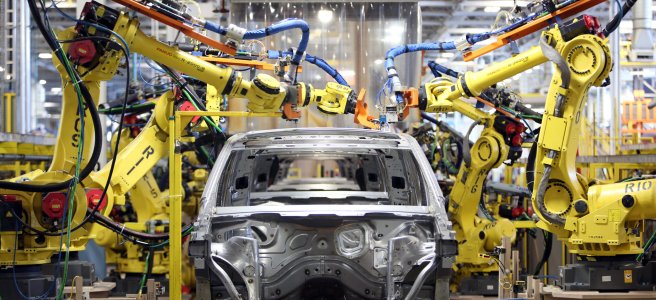
Despite all the talk of a service society, industrial production is still the basis of real capitalist value creation. And the auto industry still forms the core sector. A wide range of suppliers and services depend on it. That is why the auto companies were the preferred recipients of state aid alongside the banking system during the major crisis slump in 2009. They were given a helping hand in the form of direct state investments (General Motors), rescue measures and guarantees, as well as subsidies for car sales worldwide. In this country, there was the infamous scrappage premium. This was sorely needed, because it was precisely in the auto industry that the largest global overcapacities had built up, which threatened to melt away like snow on the sun after the collapse of the fictitious purchasing power fed by the financial bubbles.

Within a very short time, car companies everywhere were miraculously deemed to have been saved. The central banks’ flood of money did the rest to cushion the crashing economy. And car sales also benefited from this to a considerable extent, because the rolling tin can is now the preferred object of desire in this world. The next dream of anyone who has just escaped starvation is a car. China in particular experienced a car boom with almost fantastic growth rates. A few months were enough to make the country shine as the most important new export market for German carmakers. A warning sign could have been that it was not small and medium-sized cars that made up the bulk of the export miracle, but the extremely expensive premium class. It was not solid mass consumption that matured here, but rather the need for ostentation on the part of crisis profiteers – not least on the airy basis of the Chinese real estate bubble, which (along with government programs) had replaced the U.S. one as the driving force of the economy.

As is well known, public finances around the world are now running out of steam. The debt crises in the USA and the EU are already having an impact on the economy. In China, galloping inflation and the central bank’s so far inadequate dampening measures indicate a slowdown. Just as the auto industry was one of the first beneficiaries of the rescue packages, it is now likely to be the first to be hit by the increasingly likely return of the global recession. The recovery was too fast and too lush to be true. As early as the second quarter of 2011, the global passenger car market entered a period of stagnation. Forecasts are being revised downward, from 65 to 60 million cars for 2012. The end of the automotive fairy tale will also soon put the substantially unsolved problem of global overcapacity back on the agenda. The old bankruptcy candidates are also the new ones, with General Motors at the forefront. If the robust business feigned with the help of government injections dissolves into the old misery, the fate of GM’s German subsidiary Opel will also once again be on the line. The rumors about a possible sale of Opel a few months ago already spoke a clearer language than any success stories. The only thing is that no one will want the company in the event of a new economic slump. The tame eagle of the subsidized upswing could soon mutate again into the bankrupt vulture of the crisis. In any case, the development of the auto industry is an example of the development of the global economy.

Originally published in Neuen Deutschland on 08/22/2011

Economic Doping

Robert Kurz

Crises come and go, but capitalism remains. Liberal and left-wing theorists alike are convinced of this. How is a major economic crisis overcome? By devaluing surplus capital in all its forms (means of production, labor power, commodities, money capital). After that, it can supposedly go on and on. The economics professors call this “adjustment,” the academic leftists “cleanup.” Since the fall of 2009, it has generally been said that the new global economic crisis is already over. But the great devaluation or shakeout has not taken place at all. Instead, there has been “rescue” by hook or by crook. According to the official economists’ own views as well as those of their leftist colleagues, this would prove that the real devaluation shock has yet to come.

Perhaps the pragmatists were wiser than the theorists because they sensed that only economically scorched earth would remain after the global shakeout. Admittedly, their rescue measures only push the elementary problem in front of them and let it grow into ever greater dimensions. For more than 20 years, the global economy has lived mainly on financial doping. For a long time, it was the financial bubbles that created purchasing power without a real basis, then, since the turn of the century, the central banks and state budgets. The mobilization of labor in China, India and Europe was based solely on one-sided deficit cycles. Ultimately, the production processes stimulated in this way are “invalid.” They must end with the devaluation of all their components. Thus, while the theorists will be proved right, no new prospects for global capital valorization will follow from this.

One can speak of a paralysis of economic theory and economic or monetary policy. This is also evidenced by the fierce controversies in the economic guild and in governments. The neoliberal hardliners, such as the ECB chief economist Jürgen Stark, who has just resigned, want to accept an end of the horror because they believe their ideology more than reality. The pragmatists, on the other hand, want to extend fiscal policy doping excessively, even though in doing so they are always piling up new fuel for the inevitable devaluation shock. At present, government stimulus programs are coming to an end everywhere, and immediately growth rates are falling at a remarkable pace – just like a doped-up runner runs out of air when he runs out of dope. The next global recession is just around the corner. In the USA, President Obama already wants to put together a new mega stimulus package without knowing where he is going to get the money for it.

The unsolvable capitalist dilemma can also be formulated differently. As long as only the thoroughly ailing financial system is propped up with ever new measures, the crisis will remain in abeyance, so to speak. But as soon as insubstantial money creation turns into real demand, demonetization, which was still limited as long as only the economic slump of 2009 was bridged, will march on. Nevertheless, inflation, which can hardly be curbed in the emerging markets, is also on the doorstep in the EU; in the UK, it has already reached the 4.5 percent mark. Like the British administration, the ECB, the Sarkozy and the Merkel governments have apparently opted for inflation as the supposed lesser evil. This is leading to political and economic turmoil. In reality, it is a systemic issue, but no one wants to admit that.

Originally published in Neuen Deutschland on 09/19/2011

The End of The Raw Materials Boom

Robert Kurz

There are increasing signs that the economic downturn is turning into a new global recession. After the crash of the financial markets, the extremely indebted world economy is reaching its second barrier, that of public finances. As in the first half of 2009, a renewed slump would hit the export-heavy countries hardest, and all the harder the smaller the share of the domestic market in their national product. This does not bode well for Germany, whose elites are currently patting themselves on the back in view of their world market leadership in key sectors. But it would also hit the much-vaunted emerging countries hard, all of which have bought their recent rise with a one-sided export orientation.

However, there are different forms of dependence on the world market. While China acts as the world’s industrial workbench with still relatively little vertical integration of its own, most emerging countries are mainly dependent on the export of raw materials. They have thus not been able to improve their traditional weakness vis-à-vis the industrialized countries. Their position has even deteriorated structurally because industrialization processes have failed or at least declined. This has only been masked by the commodity boom of the global deficit economy, especially the commodity hunger of rapid Chinese growth. A new world recession, which can no longer be absorbed by public finances, would mercilessly bring to light the particular plight of the raw material countries.

Thus, the Brazilian upswing of the last few years has feet of clay. The export success is based primarily on industrial and agricultural raw materials such as iron ore, sugar, ethanol (biofuel from sugar cane), coffee and meat. Their upward price jumps spurred growth and foreign exchange reserves. In a global recession, this process can reverse within a very short time. Behind this is a dramatic shift in the structure of exports. While the share of manufactured goods has fallen by 16 percent over the last five years, the share of raw materials has also risen by 16 percent. Accordingly, the contribution of industry to the national product fell by almost half. An important factor in deindustrialization is foreign trade with China, which floods the Brazilian market with cheap industrial goods as a countertrade for raw materials. This only works well as long as raw material prices are high.

The situation is even worse with countries like Russia and Venezuela, which are extremely dependent on oil and gas exports. It is true that the depletion of natural reserves promises a demand surplus in the long term. But in the short and medium term, these countries would hardly survive a cyclical drop in the price of their “liquid gold.” The designation of Russia as an “emerging market” is sheer mockery and only an expression of the widespread deindustrialization after the collapse of state socialism. The consequences were concealed by the raw materials boom, but must appear all the more violently when it ends. The highly indebted economies of the Emirates and Saudi Arabia, with their bizarre construction activity, are also threatened with collapse if the oil price crashes. Such a development would not only cut off the air to the autocratic regimes of the oil-exporting states, but would also intensify the chain reaction of a global recession and financial crisis.

Originally published in Neuen Deutschland on 10/17/2011

Devaluation Race

Robert Kurz

A hard currency with a high external value is generally regarded as a sign of economic superiority. So-called soft currencies, on the other hand, belong to losing states and candidates for relegation on the world market. However, this rule seems to have lost its credibility. Everywhere, people are afraid that their own currency could become too strong. In Switzerland, the central bank is intervening to push down the rising franc against the ailing euro. Central banks in Japan and other countries are pursuing the same policy against the dollar. Emerging economies such as Brazil are also desperately fighting the appreciation of their money. Conversely, people in the U.S. and the EU are anything but sad about the downward trend of their own currency, no longer so proud. Since the supposed end of the crisis, one can practically speak of a devaluation race.

This can be explained by the changed economic structure of crisis capitalism. The world economy now runs only on surreally inflated credit and the associated external economic relations. Surplus countries like Japan, China or the FRG are dependent on one-sided exports, deficit countries on the equally one-sided inflow of transnational money capital. Both have reached their limits. Now they are all trying to rehabilitate themselves at the expense of the others. Some want to save their export surpluses by hook or by crook; others, conversely, want to gain a larger export share themselves. However, the weaker a country’s currency, the cheaper and more competitive its exports become, while imports become more expensive. The devaluation race shows that the domestic economy is being written off everywhere and that the focus is now only on increasing exports.

In the euro zone, we have the particularly paradoxical situation that the deficit countries cannot devalue against the surplus country FRG, because both sides have a common currency. Moreover, the relatively weaker euro, precisely because of the southern European debt crisis, is additionally boosting German exports to the rest of the world. But this success story is short-lived because it is destroying its own preconditions. It is the German export roller that is flattening the euro. Even every textbook of economics knows that such a thing cannot work. A dissolution into the old national currencies would, of course, increase the external debts of the deficit countries immeasurably and at the same time cause the returned deutschmark to appreciate so drastically that the export machine would grind to a halt. The construction of the euro was obviously a suicide mission.

For countries with large export surpluses, revaluation is unproblematic for some time only if they also have a strong domestic market and/or an industrial monopoly. This was the case for Great Britain in the 19th century and the USA in the mid-20th century. Therefore, the currencies of these world powers were able to take over the function of world money. After the descent of the heavily indebted USA, there is no successor candidate anywhere in sight, least of all China. The overdue drastic revaluation of the Chinese currency would ruin large parts of the export industries there, too, and at the same time devalue its huge dollar foreign exchange reserves. No one can get down from their position anymore, but objectively, permanently unilateral exports to indebted countries are impossible. The devaluation race leads beyond the euro crisis into a world currency crisis.

Originally published in Neuen Deutschland on 11/14/2011

Capitalism Does Not Repeat Itself

Robert Kurz

In terms of lifestyle, it’s called nostalgia: namely, the memory of supposedly better times, for example, of the economic miracle. In pop culture, it’s called “retro”: When producers can’t think of anything else, they rehash old stuff in a slightly different form. And when you watch “Tatort” on TV, you have to make sure you haven’t already seen it a few years ago. Nothing new under the sun, that seems to be the motto. Somehow, the belief has spread that if you want to find a recipe for the present, all you have to do is look to the past. Why else are politicians, the media and economists constantly looking for historical parallels in the crisis developments of recent years? Anyone who opens the newspaper often believes they have been transported to a history lesson.

Breakneck financial speculation, minor and major crises, a host of state bankruptcies, even the odd failed monetary union – the economic historians of modern times have just about everything on offer. And the moral of the story? It’s all been there before, which also means that everything is not so bad, everything can be overcome on the basis of the prevailing facts. Not only is wishful thinking the father of thought here, but also a certain image of capitalism as the eternal return of the same. Sometimes the economy is humming, sometimes it is crashing; there are up-and-comers and down-and-comers of the year or the century. But in principle, so the belief goes, it will always go on like this.

However, this is a mistake. We are not dealing with a static system, but with a dynamic one. Capitalism does not repeat itself, nor does it go round in circles, because it is itself an irreversible historical process. Capital valorization does not always start from scratch, but on a social scale it must exceed its last level if it is to continue. The degree of global economic integration cannot be turned back, and neither can the development of the productive forces. Universal competition ensures that this is the case.

But if globalization and productivity are developing ever higher, why should the character, depth and scope of crises always remain the same? The fondly told story of the tulip bulb speculation on the Amsterdam stock exchange in the 17th century teaches us nothing about the real estate bubble of 2008 and the bankruptcy of Lehman Brothers. To understand that a sovereign bankruptcy in the early 19th century was something quite different from what it would be today, just look at the government’s share of the national product. The current history lesson of the experts and media tea-leaves readers is a witching hour.

Again and again, one hears the claim that politics and management have learned so much from the crises of the past that today there are sufficient instruments and tools available for coping with them. At most, the diagnosticians argue about whether the crisis is now one like 1872 or possibly one like 1929 or merely one like 1973. The learning success seems to be a minor one when governments and central banks prove to us every day that their economic and monetary policy concepts are about as helpful and competent as the toolbox of a steam locomotive for the emergency repair of an high-speed train. Anyone who talks as much about the future as the elites of the present should not rely too much on the system rescues of the past. In the memory of mankind, the old rescue packages and their consequences tend to go down as disasters anyway.

Originally published in Neuen Deutschland on 12/12/2011

The Climax of Capitalism

Brief Outline of The Historical Dynamics of Crisis

Robert Kurz

In the crisis is almost after the crisis. That has been the message of positive thinking since the Lehman bankruptcy. Why should the biggest financial crash since the 1930s provoke any crisis-theory thinking? Sometimes things just go up and sometimes they go down. Anyway, everything changes all the time; but just to keep things the way they are. The crises come and go, but capitalism remains eternal. Therefore, it is not the crisis as such that is of interest, but what comes next, when it is over again like all the boring crises before. Who are the up-and-comers and who are the down-and-comers of the new era? Is the economic miracle finally upon us in Africa, is the Pacific century coming with China as the new world power, or rather the rebirth of the United States from the spirit of dishwashing? Will we perhaps even see the rise of the reborn lira as the reserve currency? Anything goes. One is allowed to do a bit of courageous trend research when the financial markets, which have become overconfident for their part, emit ash clouds like Mount Etna in its best days.

Who cares about the inner historical context of capitalist development: Happy is he who forgets. The fact that in 1982, with Mexico’s first insolvency, a crisis cycle of a new quality could have begun that continues to this day, eating its way from the periphery into the centers, must not even be thought of. The postmodern structure of perception excludes any insight that would go beyond the horizon of a seasonal trend. What Marx described in the preface to the first volume of “Capital” as a prerequisite of social-theoretical insight, namely the “power of abstraction,” has long been regarded as disreputable essentialism. Like Margret Thatcher, discourse-dominant microeconomics no longer knows society, but only individuals. Where everything is business management, even the relationship to one’s own self, space and time shrink to the horizon of mouse clicks and shopping experiences. The negative whole is not to be spoken of, so that it remains in merciful invisibility. Many a hoodie wearer might ask: What Lehman bankruptcy? Was it before or after the First World War? If one only moves between incoherent event points in the media space without any awareness of the past or the future, one can think the crisis away as long as money is still coming out of the vending machine.

But gradually it smells so dicey that even the entertainment value of trend scouts as soothsayers has diminished. The crisis seems to want to grow old in the new century. One recession and one false all-clear follows the next, while the guardians of the global banking system count their skeletons in the closet and would prefer to throw away the key. Not even German export chauvinism is quite sure whether the FRG is really in a different league from the rest of the euro zone with itself alone. No one knows where the fire will flare up under the roof tomorrow or the day after. But everyone knows that the trouble spots lurk everywhere and seem to be mysteriously connected. The postmodern primordial confidence in capitalism is crumbling, even if its disgrace has not yet become the leading theme.

Even the Foucault left is beginning to realize that it knows about as much about the critique of political economy as Karl Marx knew about riding a motorcycle. That is why the crisis has at least been allowed to steer the discourse onto terrain that was previously condemned as “economistic” and avoided on principle. So what’s wrong with capitalism? Unfortunately, Marx did not leave behind a handy crisis theory in Merve volume format. Because the urge is strong to unite deconstructive loss of reality with the cheapest possible rediscovery of disdainful economics, it is best to look up the somewhat shallower versions of Marxist lore.

According to these, capital from time to time enters a phase of so-called over-accumulation. Too much capital has been accumulated which cannot be sufficiently further valorized because the surplus value produced can no longer be transformed or “realized” into its money form for lack of social purchasing power. The investments in machines and labor were too large for the capacity of the market, overcapacities of production have arisen, unsaleable goods lie around everywhere, money capital flees into the financial markets and drives bubbles there. The surplus capital in all its components (physical capital, labor, commodity capital, money capital) must now be devalued in a crisis. After that, everything can start all over again.

This version is the most palatable for the postmodern un-spirit. For the crisis appears here as an ahistorical event in the eternal return of the same. Such a purge now and then does capitalism good like a sweating cure. The crisis is part of its miraculous functioning, as the detached left has long known. Expansion and contraction alternate in endless succession, without any recognizable coherent and progressive process.

But Marx also has quite different considerations. According to him, the problem in the long run is not the periodically lacking realization of surplus value on the market, but much more fundamentally its lacking production itself. Capital is self-contradictory in that, on the one hand, it has as its sole purpose the incessant accumulation of value or “abstract wealth” (Marx), but on the other hand, competition forces it to make human labor power, as the exclusive source of this value, increasingly superfluous through the development of productive power and to replace it with a scientific-technical apparatus.

The development of productive power, however, is not an eternal return of the same, but an irreversible historical process. As Marx shows in the “Grundrisse”, this process drives towards a situation in which the products are commodities, but as commodities they cannot represent a sufficient amount of past human labor power. They become unsaleable because they no longer represent any abstract value. This is not an adjustment, but an “inner barrier” (Marx) of capital. This aspect of Marx’s theory was already unacceptable to traditional Marxism, which was concerned with the “planning of value” rather than its abolition. For a consciousness that neither knows history nor can formulate a concept of value, but that rushes from event to event and wants to persuade itself of the compulsion to self-valorization as boundless freedom, an objective barrier of this form of existence is all the less conceivable.

What matters to capital is not value per se, but the surplus value that labor power produces above its own cost. The same development of productive power, which makes labor power progressively superfluous, cheapens the costs of the labor power still in use. Thus the relative share of surplus value in the total labor time spent increases. But for the social mass of surplus value it is not only the relative share per labor power that matters, but also the number of applicable labor forces at a given standard of productivity.

Marx formulated this problem in the third volume of Capital as the theory of the tendency of the rate of profit to fall. For each unit of money capital invested, the share of physical capital grows steadily, while the number of workers who can be mobilized with it declines just as steadily. Indirectly, this can be seen in the bourgeois statistics by the fact that the advance costs of a job historically rise inexorably, because an ever larger aggregate of machinery, infrastructure, etc. must be employed in order to be able to apply a labor force. Since only labor power produces new value, the average profit on a social scale per money capital advanced must decrease, even though the relative share of surplus value in the value production of a labor power increases.

In the social result, what matters is the magnitude ratio of the two opposing tendencies. Read together with the theory of a fundamental historical devaluation of value in the “Grundrisse,” however, the argumentation outlined is so inconvenient to the ahistorical understanding of eternally alternately expanding and contracting capital that the latest new Marx reading has taken the precaution of declaring the tendency of the rate of profit to fall to be a mere figment of Marx’s imagination.

In fact, the falling rate of profit can be compensated to some extent by a rising mass of profit, if the capitalist mode of production as such expands and thus additional money capital is productively employed. Externally, this expansion is exhausted by the “valorization” of the entire earthly space. However, there are various concepts of a qualitative internal expansion, all of which go back to the bourgeois economist Joseph A. Schumpeter. The latter described capitalist development as a periodic creation of new products and branches of production. According to this description, expansion is sustained by certain product cycles until they turn into stagnation and innovative entrepreneurs put an end to them with new products for new needs. In the “creative destruction” phase, contraction occurs. Only gradually does the new product cycle become sustainable and renewed expansion on the changed basis can begin.

Schumpeter’s theory has the small flaw that it is in no way related to the connection between the development of productive forces and substantial surplus value production. As in all of economics, the market surface is regarded as the sole object of economic science. Thus, the creation of new branches of production and needs automatically appears as the basis of a capitalist upswing, without the question of the concrete conditions of valorization of labor-substance under a changed standard of productivity being raised at all. This is precisely why the postmodernized left so readily seizes on Schumpeter’s idea and related theorems to add a bit of anti-substantialism to Marx. New branches of production, new opportunities for valorization, because the mass of expended labor energy could not possibly play such an important role, if soon money can be downloaded like everything else. One could then choose whether the central field for the coming boom is created by genetic monster production, friendship networks on the Internet, biofuel instead of bread for the world or saving the polar bears.

In the blanked-out strand of Marxian argumentation, the calculation looks different. No matter what content of production is concocted: For capital, the only thing that matters is the applicable quantity of value-creating labor power. This must increase absolutely if the presupposed end in itself of accumulation is to succeed. The creation of additional branches of production or the incorporation of former luxury products into mass production can, however, compensate for the scientific-technological rationalization of labor power only for a historically limited period of time. Capitalism reaches its climax when the internal expansion is caught up and overtaken by the development of productive power. Then the relative fall of the rate of profit turns into an absolute fall of the social mass of surplus value and thus of profit, and thus the supposedly eternal valorization of value turns into its historical devaluation.

There are some indications that capitalist development has entered this state with the third industrial revolution since the 1980s. The culmination of the internal contradiction is modified and filtered by the historical expansion of the credit system, which is a mirror image of the stagnation and decline of the value-productive labor mass. The permanent relative increase of physical capital drove up the dead up-front costs of production gradually to such an extent that they could be financed to an ever smaller extent from current profits. Credit transformed itself from an auxiliary driving force of surplus-value production into its substitute. Since then, accumulation has been fed less by past real labor substance and more and more by the anticipation of imaginary labor substance of the future. By means of an unprecedented global indebtedness and the financial bubbles that have arisen from it, investments and employment are financed without real foundations. This was also the social condition of possibility for the triumph of virtualist and deconstructionist ideologies. Despite temporary appearances, however, capital is not accumulated in the process, as was shown by the construction industry of many countries after the bursting of the real estate bubbles.

On the surface of the world market, the constantly advanced consumption of future profits and wages took the correspondingly absurd course of a functional division of surplus and deficit countries. The former buy goods with money from future revenues, the production of which was pre-financed by the latter by accessing future revenues. There is an expanding black hole between past real and fictitiously anticipated future value creation. This construct of a global deficit cycle has two focal points: a larger Pacific deficit cycle between China/East Asia and the U.S. and a smaller European deficit cycle between the FRG and the rest of the EU or the euro area. The employment mobilized for this, for example in China, is as unsustainable as the construction activity for the real estate hype. In the one case, Asia has accumulated dollar foreign exchange reserves on an astronomical scale; in the other, the international banking system has financed similarly high deficits within a common currency area. These notorious “imbalances” even make a mockery of the textbooks of economics, which nobody takes seriously anymore anyway.

After a dense chain of financial crises that had shaken individual countries and economic sectors and accompanied deficit booms over the past 30 years, the 2008 financial crash took on global proportions for the first time. The rupture of credit chains put the big devaluation push on the agenda. It was the already highly indebted countries that stopped the avalanche from going down with massive additional loans and the printing presses. They at least suspected that it was not a mere cleansing storm on the way, but that the lights of world capital were threatening to go out. So the bad loans were stashed away like nuclear waste with the help of state guarantees, the industrial overcapacities were maintained by horrendous subsidies, and the economy was artificially fed by state programs. Chinese state capitalism, in particular, forced its banking system, supported by the hoard of foreign currency, to finance investment ruins in the form of ghost cities, ghost airports, ghost factories, etc., pumping up the mother of all real estate bubbles.

All these adventurous measures did not solve anything, but only postponed the devaluation process and shifted the problem from the financial markets to the state. It was foreseeable that the government programs would quickly run out of steam. The euro zone started out as the weakest link, but all other government finances are also teetering and threaten to set off chain reactions. The Chinese dollar mountain, for example, will go up in smoke when the USA has to admit that it is broke. The unserviceable national debts add up to the bad loans of the financial markets; the meltdown of the credit system is approaching. The already spent capitalist future has become the present. Greece exemplifies that people will have to stop living for years to come in order to continue to meet capitalist criteria.

As soon as the central bank no longer merely delays the devaluation of debt securities but directly feeds the economy with insubstantial money, bypassing credit simulation, the money medium will devalue itself. Inflation also has a historical precedent. While it was almost unknown from industrialization until World War I, the war economies could only be financed with the printing press. After the world war epoch, however, the specter of inflation became a constant companion of capitalism, because the expanding credit system also became constitutive for ordinary commodity production. Today, the bailouts have already exceeded the dimensions of the war economy, and the direct money glut of central banks is proving to be the last resort. Even a radical monetary reform, dissolving all assets and credit balances, would not lead to a zero point and a new start. This is because the standard of productivity incorporated in the knowledge aggregate of society, which no longer permits sufficient surplus-value production, is inescapable. The devaluation would only repeat itself in ever shorter intervals.

May there come what will. Despite all this, the media consciousness of experience does not want to be bothered with uncool realities. The end of the world to be expected in 2012 according to the Mayan calendar promises more fun. The main thing is not to have one’s credit card confiscated. In the meantime, even the re-social-democratized postmodern left can imagine a capitalism without a world more easily than a world without capitalism. The ultimate self-deconstruction will certainly be a tingling affair. After all, one doesn’t treat oneself to anything else.

Originally published in Konkret 02/2012

Emergency Terror

How an Example Should Be Made in Greece

Robert Kurz

In the 21st century, as has become known, the powers of capital are no longer looking for territorial conquests. What should they do with zones of economically scorched earth and superfluous populations? This does not mean that imperialism has died out. But it is no longer about national empires and zones of influence, but about the controllability of globalization as a crisis. The limits of capital valorization are to be redefined into limits of viability for the losing masses, the collapse of national economies into a controlled coexistence of credit-financed boom towns and abandoned slum regions.

The production of security for the residual businesses under these conditions requires ideological legitimation. It is a good thing that the dismissed and disinherited children of capital are not better people, but rather like to attack their fellow citizens instead of their impossible conditions of existence. Not the external but the internal war along ethnic and religious divisions became the conflict paradigm of a disintegrating world of states. The world police operations on the part of the powers of order of the capitalist center against the barbarians of the periphery could be justified with democratic idealism.

This picture was, of course, only a snapshot in the process of the gradual dissolution of the global order. At the latest, the global economic crisis since 2008 has once again fundamentally changed the situation. Now the limits of creditworthiness are being reached even in the Western centers themselves. Everywhere, debt crises are emerging there of a kind that had previously only flared up in the peripheral zones of the global market. Thus, a qualitatively different crisis management is on the agenda for the metropolises, shifting the emphasis from external to internal distress. In addition to unaccountable populations in the squalid backyards of world capital, their own middle classes must increasingly be targeted. The content-empty democratic formalism, which the God-fascists of various stripes have long since recognized as the shaping principle of their madness, asserts the valorization compulsion of capital as its “natural basis” (Marx) all the more when its inner barriers are erected. The capitalist lifeblood of money must no longer be turned off step by step to solely a marginalized new poor, but to also the majority of the metropolitan “people’s sovereign.”

This, of course, also points to a state of legitimacy emergency. While NATO bombed the Sharia in Libya with reference to democratic values, for the Western core zones of globalization only the practical constraint of the teetering financial system can take over the role of the combat bombers for the time being. The execution of this economic imperative in the name of democracy against the elementary vital interests of a majority of the formal “sovereign” seems to take place first in the EU, because here the monetary construct of the euro has already taken the contradiction to extremes and there is a supranational instance of intervention.

Greece has become a precedent under global crisis conditions qua de facto state bankruptcy. An uncontrolled execution would blow up not only the European financial system and exceed the consequences of the Lehman bankruptcy. Controlled execution, however, would only be possible if almost the entire Greek population were pushed below the subsistence level. Mass unemployment in new dimensions, impoverishment deep into the middle classes, collapse of medical care and public infrastructures will become reality. The Greek elites can no longer justify such a collection of capital logic on their own account. What is needed is crisis-imperialist intervention from the outside, claimed by a troika of the EU Commission, the ECB and the IMF; now no longer against a poorhouse of the former Third World, but for the first time against a Western country.

The Merkel government has become a hardliner, speaking from the heart of the management, political and media class as well as the lowly master race in this country. With the assistance of the deputy sheriff Sarkozy, the systemic crisis is denied in order to appear as the self-appointed bailiff of the “automatic subject” (Marx). The Greeks, who have been dismissed as capitalistically untrustworthy, are not to be hooked up to Berlin Disneyland, but they are to be taken by the purse strings until they spit blood. There was even talk of a German savings commissioner for Greece, even though the EU majority spoke out against this with a residual sense of shame. The false gesture of superiority feeds on the FRG’s provisional position as a crisis winner, because German exports have profited from the expiring global government programs, from the devaluation of the euro precisely because of the debt crisis, and from the implementation of the homegrown low wage since Hartz IV. Suppressed is the fact that the Teutonic economic fairy tale has as its prerequisite not only its own debts but also those of others and must end with the evaporation of purchasing power in the European and global recession. Nevertheless, at least enough is known to make an example of Greece, which, if necessary, must also apply to Germany, in the hope of the historic social masochism of the German “sovereign,” which has always been unable to walk with civic goodness.

Greece also lends itself as an experimental field for the new democratic crisis management, because an isolated youth revolt with no prospects can serve as a sparring partner. It fits in well with the picture that the Greek state budget is being driven to zero socially, while the military budget almost doubled in 2012 compared to the previous year. The associated debts are also perceived favorably by the savings commissioners-to-be, because orders from Athens account for 15 percent of the sales of German arms manufacturers. Besides, in any case, the apparatus of the democratic state of emergency is also flexing its muscles militarily, which is only allowed to be as pseudo-self-reliant in this respect in Greece as it is to become in Afghanistan. If things really heat up, the state of emergency terror under German leadership could already show what it is capable of. The Assad regime may appear to be a wimp as soon as more than a slim Arab social product is at stake.

For the time being, the Greek political class will have to haggle a bit over its surrender terms and feign resistance in order to save its barely recognizable face. The electorate no longer knows what it should want anyway, and the entire party system is also wrapping itself up in exemplary fashion. The post-national crisis administrators approve of the nationalist upsurge, which can serve as an outlet all the more because it only processes the bankruptcy in a manner appropriate to the species, so to speak. The merely anti-German rage of the Greeks does not concern the German export chauvinists, because the pogrom that is due is really directed against Albanian and African refugees or other migrants, as has long been practically demonstrated, and not just in Greece. In this point, too, Germany, with its neo-Nazi serial killers spoiled by the democratic Stasi, certainly has pan-European leadership qualities to offer.

Originally published in Konkret 03/2012