Covid In The Void Of Capitalism
Herbert Böttcher/Leni Wissen
1. Monitor – A Spotlight In Covid Times
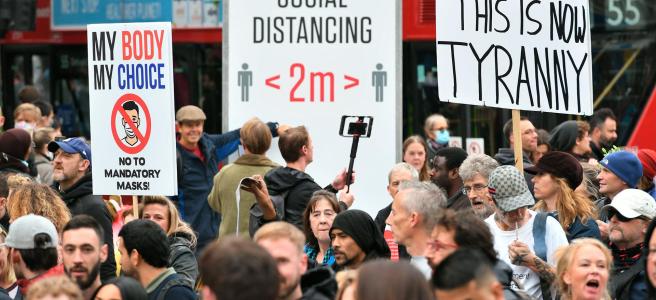
At the beginning of December 2020, on the WDR television program ‘Monitor,’ two phenomena were linked that can be understood as a spotlight on the social situation during the Covid-19 pandemic: the insistence on freedom and democracy in right-wing movements and the intensified repression of refugees. The example of Bautzen was used to show how the right-wing, in its association with conspiracy fantasists and Covid deniers, had found a ‘new self-confidence’ and has firmly established itself in urban society. Into the picture comes a children’s toy store in the city center, where a superhero on a poster on the door indicates that people without masks are also welcome here. Right-wing reading material is displayed in the shop window. Even the entrance scene is threatening: the viewer’s gaze falls on a 50km-long stretch of road, where people equipped with Reich flags and German flags express their displeasure against the ‘Covid dictatorship’; and this despite massively increasing case numbers in their own region.
The following segment was about the EU’s new asylum and migration pact: After the closure of the Mediterranean route, people are taking the riskier route across the Atlantic. The places of arrival are the Canary Islands. The fear is that people will be put in camps with conditions similar to Moria. The problem of the lamented excessively long stays in detention centers could be ‘solved’ by facilitating deportations. Perhaps – according to the commentary in the segment – Spain is already executing what the EU is planning on a grand scale: a new asylum and migration pact. At its heart – as it says – is ‘robust management’ at the EU’s external borders, as well as ‘fair’ and ‘efficient’ procedures. It is primarily about accommodating refugees near the borders. They may also be detained ‘if necessary.’ Determining ‘need’ is at the discretion of member states. ‘Robust management’ is already being practiced in the fight against rescue ships, which aid organizations use to save refugees from distress at sea. They are detained for the most absurd reasons, e.g. on the grounds that a ship has too many life jackets on board.
The two spotlights make clear opposites that collide and at the same time get confused in the disputes about Covid: Freedom and state of emergency, self-reference and solidarity, social Darwinism and humanity. ‘Angry citizens’ who rehearse the democratic uprising against the state of emergency of a so-called ‘Covid dictatorship’ have no objection to the democratically executed state of emergency against refugees, or have even insisted on it and demonstrated their political will to do so by setting fire to refugee shelters – in times when the focus was not yet on Covid, but on the supposed threat posed by refugees. The protests of the ‘decent,’ who defend freedom and democracy, are different from and yet close to the protests of the ‘angry citizens.’ The ‘angry citizens’ and the ‘decent’ are similar in that they both chase ‘illusions’ and avoid confronting them with reality. Closely connected to this is the common tendency to ‘self-reference’ in the sense of an inability to perceive the world outside one’s own universe. Ultimately, for both, ‘solidarity’ ends where limits to one’s freedom – whether real or imagined – are feared. It is about one’s own freedom as self-assertion. The ‘decent’ differ from the ‘angry citizens’ in that they maintain democratic decency and abide by the rules of the game. But the state of emergency is an integral part of these rules. It is imposed to protect democratic freedoms against those who flee from conditions in which the freedom to live and the freedom from repression are deprived of their basis – not least by the freedom of the ‘decent’ who insist on the right to ‘free travel for free citizens,’ not only with regard to car traffic, but above all to the forms of traffic of capitalist normality, which cannot be separated from the destruction of the basis of life.
That leaves the ‘humane’ and the ‘in solidarity.’ The FDP, of all people, which is anything but averse to social Darwinist selection, discovered in its pleas for relaxation the social disadvantage of poorer children in the closing of schools and the social inhumanity of contact restrictions. Alongside them in the confused and errant mix are those who want to remain ‘good people’ or feel the need to ‘wash their hands of the matter.’ Humanity and solidarity already blossomed in the welcome culture of 2015 and the willingness to hospitably take in refugees. But it quickly evaporated when it became clear that such reception was not so easy to ‘manage’ in the face of worsening crisis conditions. The Chancellor’s slogan “We can do it” then quickly turned into an intensification of repression against refugees (cf. Böttcher 2016). Against this, only a few protests arose. Just as quickly, the humanity and solidarity initially shared in the Covid crisis disappeared from large parts of the population when it became clear that the restrictions would drag on for a longer period of time. These concepts were now being claimed primarily by politicians who had sung the high song of ‘personal responsibility’ for decades when it came to dismantling the welfare state and programming individuals to be ego-agents. Now there is great lamentation when it is discovered that the lever cannot simply be turned from ‘homo economicus’ to solidarity, and the pressure demanding a return to capitalist normality and its ‘natural’ selection mechanisms as quickly as possible is growing stronger. “One could not, after all, paralyze the whole economy and stop public life just because the elderly did not want to die” reported the Kölner Stadt Anzeiger on November 21/22, 2020, about statements made in hate mail sent to the SPD health expert Karl Lauterbach. Those superfluous for the valorization of capital should die. Some can drown in the Mediterranean, the others – depending on their social situation – can perish in intensive care units or on the street. This is just as ‘natural’ as it is cost-efficient.
2. The Conditions, They Are Not So…
Appeals to values and morals remain helpless. Solidarity comes up against objective limits. But even the recourse to individual rights of freedom accompanied by a habitus of self-reference or the open approval of social Darwinist selection offers no way out. The Covid crisis acts as a fire accelerant and makes clear what is inherent in capitalism and its crisis. To be sure, the economic crisis still remains in the background of consciousness, given the apparent inexhaustibility of state bailout activities. The simulated multiplication of capital via debt mechanisms and money transactions seems inexhaustible again – unclouded by the logical and historical barrier to the production of value and surplus value associated with the superfluousness of labor. Around the world, central banks prop up financial systems. Governments are borrowing exorbitantly to prop up the economy. Accordingly, financial markets and stock exchanges boom on the basis of simulated money multiplication, of “money without value” (Kurz 2012).
It doesn’t take much imagination to envision what is likely to happen in the longer term – whether still ‘with’ or ‘after Covid’: The bill for anticipating future production will be presented – in the form of collapses and/or measures that, climate or no climate, will focus on growth and will be associated with intensified social cuts. Then the loud liberal complaints about the inhumanity of social divisions and the social deprivation of children will fall silent. Social cruelty will set the agenda and be repressively enforced. The state of emergency rehearsed under Covid can be brought to bear democratically against the superfluous as well as against possible protests, without the liberal conscience taking a significant stand against it.
If the intensifying economic dimension of the crisis is currently still lurking in the background, the crisis of capitalism shows itself decidedly drastically in the crisis of its subjects. With the logical and historical barrier of capital valorization and the form of reproduction that goes with it, the subjects lose their basis. Their freedom and autonomy – philosophically speaking, the self-execution of their freedom – is tied to the basis of the valorization of labor as human capital. With dwindling labor substance, not only capital but also the subject gets into a valorization crisis of its human capital. The competition for the valorization of one’s own labor power becomes fiercer and produces losers who are passed down the elevator. Social security is being dismantled as no longer affordable or as counterproductive for the valorization of capital. Once again, subjects are to become ego-agents and learn to assert themselves as ‘entrepreneurial selves’ to the point of exhaustion (cf. Bröckling 2007, especially 46ff; cf. also Ehrenberg 2004). This is all the more hopeless the more the foundations for it collapse. Nevertheless, the strategies of self-optimization are unfinishable. They do not come to an end because they can no longer be connected to a realizable goal as an object for which the efforts would be ‘worthwhile’ and with which they would be ‘rewarded.’ The efforts reach nowhere. Even still the failure falls back on those who have exerted themselves beyond the limits of their burdens. It is their own fault. The fact that they fail because of the circumstances must not be discussed and remains invisible. The reason for failure can only be their own inability or insufficient effort. And so the cycle must begin anew – unless it is interrupted by exhaustion.
Comfort and relief are offered in the markets of event and experience, therapy and esotericism. Events offer entertaining relief from the dull monotony of everyday repetition of the same. Seemingly immediate experiences imagine authenticity. A self that has become socially groundless and unsustainable is to be strengthened therapeutically. With the illusions of esoteric spirituality, a self is built up that experiences the emptiness of its circumstances as its own emptiness. In the imperative ‘Become yourself!’ therapeutic and spiritual offers converge. They double and exaggerate the self-reference that intensifies with the crisis and at the same time fails because of the insubstantial emptiness of the conditions as well as of one’s own self. These ‘services’ are also not independent of the process of valorization; they, too, have to be financed by the state, health insurance companies or out of one’s own pocket. If financing collapses here due to empty public and private coffers, it is no longer possible to buy on this market either. What remains here is wildness in ‘private spirituality,’ which costs nothing and nevertheless – like conspiracy theories- offer an illusory support to individuals.
3. Between Self-Reference And Solidarity
With the Covid measures, people are once again thrown back onto themselves. Some people were still able to see positive aspects of the first lockdown in the spring of 2020. The more privileged saw it as a chance to slow down and spend time at leisure, while others had to suffer from impending or worsening poverty and were forced to live in cramped and thus infectious spaces. The longer the lockdown dragged on, however, the more voices calling for a relaxation were heard, i.e., calling for a gradual return to capitalist normality. In this phase, a sense of unity initially still existed, which was nourished by what the chancellor had propagated in the so-called refugee crisis: “We can do it!” However, the clearer it became that the Covid crisis could not be overcome with a one-time and temporary lockdown, the “we-feeling” was increasingly counteracted by the fact that people in Covid times are thrown back onto themselves and – as they have learned in neo-liberal capitalism – must look out for themselves first. The background for this is not insignificantly the experience that hitherto familiar places where togetherness could be experienced are collapsing (Grünewald 2021). The family has become fragile, as can be seen in children’s fears of its disintegration. Such fragility becomes more and more difficult to endure with the Covid-conditioned confinement. Thus, there are already many indications that violence in families has once again increased as a result of the Covid-19 pandemic. In any case, women once again have to bear the greatest burdens. They are responsible for home office and children, and have to work in permanent on-call duty. In the world of work, the experience of working with colleagues is increasingly being replaced by the experience of being outsourced or dismissed as an employee. The imperative, ‘save yourself if you can,’ is practiced. The experience of being thrown back onto oneself and being so alone could be compensated and repressed ‘before Covid,’ not least through illusions of being digitally networked with everyone, or of being able to make extended use of the freedoms offered in capitalist normality (which appear as one’s very own freedom) through access to experience, event, entertainment and – for more sophisticated demands – spirituality services. With the long-lasting Covid crisis, communinitarian reliefs are now as limited as the reliefs offered by the entertainment and culture industry. At the same time, excessive demands are growing due to the lack of childcare as the workload continues and social isolation intensifies.
Whereas during the initial lockdown, under the pressure of the devastating images of the sick and dying in Italy, the restrictions were still accepted and perceived in relation to the catastrophes associated with the spread of the virus, this relation recedes into the background as the pandemic progresses. The thousands of deaths that caused horror at the beginning of the pandemic disappear in the statistics. Their stories of suffering are hardly told anymore. It no longer seems bearable to deal with them in view of the intolerability of one’s own emptiness and that of the circumstances, and the longing for “normality” is correspondingly intense, as is the rage due to the personal deprivations that have to be endured. Of course, this must not be openly expressed to the outside world; one does not want to be accused of not showing “solidarity.” The concern for the children and the youth is just the right thing, so that one can be distracted from one’s own ‘sensitivities’ and still make one’s own interest in easing the situation known.
Now there is no denying that Covid situations exacerbate not only social but also psychological stresses – not least in hospitals and nursing homes. It is striking, however, that demands that come to the fore are oriented to one’s own situation and are not related to what is happening in the intensive care units of hospitals. There seems to be a silent agreement that an indefinite number of sick and dead should be accepted in order to return to capitalist normality. “The ease with which the life expectancy of the elderly has sometimes been demanded in exchange for the right to go on vacation bodes well for the future” (Liessmann 2020). That life is not the most important consideration was, after all, also known to Bundestag President Schäuble – with the support of theologians and ‘ethics councils’ – quite early on in contributions to the discussion about ‘relaxations’ that would pave the way for a return to capitalist normality.
The ‘self-referentiality’ to which individuals are increasingly urged, or rather which is virtually required in order to be able to assert oneself in this world as a Me Inc. [Ich-AG], corresponds to the actions of corporations. Under the pressure of competition, they too must assert themselves. In times of crisis, their room for maneuver also becomes narrower and the fear of being thrown out of the race greater. So it is not surprising that in the crisis, which has been exacerbated by Covid, they defend the freedom to produce – of course without reference to the situation of those who are endangered.
Retail chains and shops are insisting on the right to ensure that the shopping experience, including its meaningful power, remains possible – all the more so before Christmas. Although chains of infection can no longer be traced, soccer officials know that Bundesliga operations are so hygiene-secured that they could continue to run even with spectators. And fireworks on New Year’s Eve are probably also a right of freedom, if not a human right. And what will become of the fireworks industry if there is no fireworks? It would be as miserable as the armaments industry if weapons were no longer sold and wars no longer fought. In the event and culture industry, which is trimmed to experience and entertainment, it is discovered that culture is ‘more’ and ‘higher’ than entertainment, that it has, so to speak, a meaningful added value to offer…
Now it would be far from the mark to brand such self-references as egoism from a high moralizing horse and to preach conversion to solidarity. This would be as illusionary and obfuscating as Kant’s purely formal morality and its contentless categorical imperative – illusionary because it is about social problems that cannot be solved with individual morality, obfuscating because moral ‘solutions’ shift the problem from the social to the individual level and withdraw its social character from reflection.
4. Government Policy As An Expression Of Solidarity?
It would be far from the mark to misinterpret the observation of self-reference as a simple apology of government policy or to label it as solidarity. There is plenty of reason to criticize, for example, the lack of protective equipment in hospitals and nursing homes, in daycare centers and schools, the lack of plans for homeschooling and, last but not least, for the protection and care of homeless people. Like people who have to live in cramped housing conditions or solo self-employed people such as artists, they suffer particularly from the state’s restrictions and are hardly reached by state cushioning measures.
Despite all the contradictions, however, the contact restrictions contribute significantly to interrupting the spread of the virus and protecting the old and sick as well as other risk groups, i.e. the ‘superfluous’ in capitalist normality. This is an effect that should not be underestimated. Government officials repeatedly use solidarity as a legitimization and appeal to citizens to show ‘self-responsible’ solidarity – in contrast to the previously valid neo-liberal ‘credo’ that the perception of one’s own interest is the best social measure. However, this has nothing to do with solidarity in the sense of thinking and acting in the context of all people with a special consideration of the weak. The state Covid measures aim at what the capitalist state is there for: to secure the functioning of capitalist relations. The functioning of the health care system and the majority of the economy is to be maintained so that people can continue to work and consume, while the restrictions in private areas as well as in the gastronomy, event and cultural sectors are to slow down the virus and protect the health care system from overload. In the case of the lockdown imposed at the turn of the year 2020/21, it is striking that the contact restrictions relate primarily to the private sector and the corresponding service industries. The world of manufacturing, on the other hand, was largely left out. Only in the first weeks of 2021 did the world of work come into play with demands for an obligation to work from home. Despite all the talk about education, the opening or reopening of daycare centers and schools as quickly as possible is also less about education or ‘the children’ and more about keeping them safe so that their parents can go back to work.
Thus, it is neither a matter of attacking the governmental measures with the demands for individual liberties, nor of misunderstanding them as ‘solidarity’ measures. Fundamentally, they aim at maintaining at least some semblance of a functioning capitalism. Statists and libertarians argue about how this should be done (Hauer, Hamann 2021). “Common good or egoism, freedom or paternalism, generality or individuality” (ibid.) are put into position as good or evil, while the role of the state within the framework of ‘societal totality’ is ignored in a deliberate and illusionary way. The fact that in the Covid crisis the state is increasingly faced with the dilemma of having to simultaneously protect citizens and maintain as much capitalist normality as possible can then also no longer come into view. In the context of the Covid crisis, political actors are also resorting to a means that seemed to have already proven its worth in the management of the normal capitalist crisis: the opinion of experts. These opinions seems to stand above the parties and to offer an ideology-free, objective and alternative-free, ‘post-political’ way out. The fact that there are different opinions in science now comes as a great surprise to politicians and citizens alike. The consequence is legitimization by ‘the’ science and its delegitimization at the same time. In the case of the latter, the formal reference that there are different opinions seems to suffice. The way is paved for moralization, articulation of the political will as ‘angry citizens’ – all this in a false immediacy, whose ‘self-reference’ can no longer develop any understanding of the fact that a hard ‘lockdown’ could be more sensible in the interest of the capitalist general public and its free normal operation than the insistence on the right to freedom accompanied by the compulsion to downplay and/or deny the health risks.
To attack the measures to contain the virus with false immediacy, or to speak of the Covid regime or Covid dictatorship, fails to recognize the dangerous nature of the virus as well as the role of freedom, democracy and human rights in capitalism. Even before Covid, measures in Western centers became more repressive and controls more comprehensive as the crisis has progressed. In this country [Germany], the Hartz legislation in particular aimed at disciplining and controlling the ‘superfluous’ and making work even more precarious (cf. Rentschler 2004). The catalog of measures here was so ‘harsh’ that even the Federal Constitutional Court in 2019 declared the sanctions partially unconstitutional. Overall, the legislation aimed at forcing people to work, which no one is allowed to evade. All are urged to keep themselves in constant readiness for work and to optimize themselves as ‘entrepreneurial selves’ for this purpose. The more capitalist normality collapses, the more states at all levels will try, as long as they can, to stop the disintegration with authoritarian and repressive measures.
In this perspective, it would be naïve to believe that the measures practiced under Covid would not also be used beyond Covid in the further course of the crisis. Wilhelm Heitmeyer, among others, points this out: the state as the “great power winner … could be tempted to perpetuate the control measures introduced after the pandemic has (temporarily) subsided,” especially since “political and controlling institutions … are designed to maintain competencies once they have been acquired” (Heitmeyer 2020, 296). However, it is problematic to reject the current measures outright for this reason, since, in addition to the goal of keeping the entire shop somewhat operational, they are also (this time) protecting people’s lives in real terms. Of course, this does not mean that there is no reason for criticism (see above).
5. ‘Self-Reference’ And ‘Solidarity’ At The Same Time?
In the Covid crisis, ‘solidarity’ is not only a slogan of government policy, but also finds resonance in parts of the population. It is important in social movements as advocacy for the victims: for the opera of the pandemic as well as for the victims of capitalist crisis normality, from refugees to victims of sexist, racist, antiziganist and anti-Semitic violence. But again, the limits set by capitalist normality are not questioned. Justice is to be done to the victims within the framework of the system. Those excluded by it as superfluous should find recognition and be able to participate within the framework of the conditions. Ultimately, it is a solidarity of the ‘decent.’ They want to remain decent within the framework of a deadly system, to belong to it and yet to act in solidarity. ‘Self-reference’ and ‘solidarity’ are by no means mutually exclusive here. The recognition as system-conforming decent people remains and is even rewarded by a good feeling. In this way, individuals can supposedly relieve themselves of their own ‘guilt’ through small acts of solidarity, making themselves believe that they belong to the ‘good guys.’ However, it is simply impossible for individuals to ‘get out of debt’ in view of the overall context. Everyone is under the compulsion to carry out and reproduce the abstract categories of the value-dissociation society in their actions and thoughts on a daily basis, if they do not want to catapult themselves ‘out,’ i.e. into poverty and nothingness. No individual living under capitalism gets through this ‘guilt-free.’ Nevertheless, individuals are always expected to act morally and ethically in accordance with ‘higher’ moral values, especially those of democracy and human rights. Robert Kurz has described these contradictory demands on the subject thus: The “people (are) supposed to be at the same time self-interested and altruistic, at the same time assertive and helpful; competitive and solidary … at the same time (they are) supposed to be … poor and rich, … thrifty and wasteful, … fat and thin, ascetic and hedonistic” (Kurz 1993; quoted in: Scholz 2019, 50).
This insanity imposed on the subjects becomes analytically understandable if it is seen in connection with the self-referentiality of capital. The self-referentiality of capital cannot place itself in any other relation than to itself. The commodities it produces count not in their material content, but as the quantitative objectification of value and surplus value. Capital serves no other purpose than the irrational end in itself of the multiplication of itself. This could be obfuscated in the ascendant and high phase of capitalism by social prosperity, by partial ‘prosperity’ and the mythologies of a steady progress “in knowledge and in the consciousness of freedom” (Hegel). In crisis, the deadly irrationality of capitalist self-reference, of capitalist normality, becomes ‘apparent’: capital “must empty itself into all the things of this world in order to be able to present itself as real: from the toothbrush to the subtlest mental stirring, from the simplest object of use to philosophical reflection or the transformation of entire landscapes and continents…” (Kurz 2008, 69f)… It must thus divest itself in order to return to itself and its irrational self-purpose of multiplication for its own sake and to be able to begin anew with it.
6. Form And Subject
The connection between the irrational self-valorization of capital, which becomes insubstantial and thus empty as the crisis progresses, and the subject has been described by Robert Kurz as the “self-referentiality of the empty metaphysical form ‘value’ and ‘subject’” (ibid., 69): “The form ‘value’ and thus the form ‘subject’ (money and state) are self-sufficient according to their metaphysical essence and yet must ‘divest’ themselves into the real world; but only in order to always return to themselves. This metaphysical expression of the seemingly banal (and in sensual-social terms actually horribly banal) movement of valorization forms the actual theme of the entirety of Enlightenment philosophy […]. In this self-sufficient, nevertheless necessary divestment movement and ultimate self-reference of the empty metaphysical form ‘value’ and ‘subject’ is founded a potential for world annihilation, because only in nothingness and thus in annihilation can the contradiction between metaphysical emptiness and the ‘compulsion towards representation’ of value in the sensuous world be solved. The lack of content of value, money, and the state must divest itself into all things of this world without exception in order to be able to represent itself as real” (ibid., 69f).
The collapse of the real-categorical supports of capitalist socialization can be compensated less and less by the fact that once the market was made strong against the state, as at the beginning of the neo-liberal phase of capitalism, the state was made strong again, as after the financial crisis of 2008/09, or in repressive measures against refugees and the ‘superfluous’ in the societies of the centers, in military interventions, etc. The change between the polarities of politics and economy, market and state, planning and competition, subject and object occurs ever faster and across a variety of measures. The same is true with regard to the questions of freedom and repression, of self-assertion and solidarity, of ego and we-feeling. The contradictions are confusing and cross-cutting into groups and subjects and can hardly be sorted out any more. People are supposed to be everything at the same time.
In this way, however, subjects become untenable, threaten to fall into emptiness, and find no support in themselves either, because the social emptiness reproduces itself in them as well and can only be appeased or anesthetized in the form of illusionary buildups and exaggerations of the self. After all, the intolerability of the emptiness of content “calls for an identity that is substantially meaningful, that makes sense” (Kurz 2018, 161). Despite their emptiness, people cannot simply leave behind the subject form bound to the emptiness of money in which they are banished and act “as if” the subject form “did not” exist-analogous to the acting “as if not” that philosopher Giorgio Agamben recommends, following his interpretation of Paul, as a messianic way of life: buying as if one did not own, making use of the world as if one did not use it (cf. 1 Cor 7:29ff) (cf. Böttcher 2019, 143ff). “Since one’s own zero identity as a money subject may not be questioned, it can … only ever be a matter of synthetic pseudo identities, untrue in themselves and a priori, laboriously padded up and then evaporated again by the restless nirvana of money, by the actual zero identity” (Kurz 2018, 161). Neither with pseudo-Messianism nor with pseudoidentities is it possible to escape the collapse of the forms of value-dissociation socialization. On the contrary, the crisis and the experiences associated with them must be processed in and with the subject form associated with this socialization. This suggests the search for identitary forms of processing, which can find expression in racism and sexism, in anti-Semitism and anti-gypsyism, as well as in authoritarian self-establishment or in cross-fronts, which in their confused constellations can also still go through one’s own thinking and feeling, up to the back and forth between changing identities, if they only promise support and secure ground under one’s feet for the moment.
7. The Socio-Pyschological Matrix of The Bourgeois Subject
The dynamic of the disposal of all ‘content’ in favor of a ‘metaphysical emptiness’ mediated by the form of the value-dissociation must also show up in the subjects themselves. Even if the socio-psychological modes of processing are not simply derivable from the form of value-dissociation, they are also not simply ‘freely’ selectable. The “(bourgeois) subject and its socio-psychological matrix are thereby centrally based on the dissociation of the feminine, the phantasm of the mastery of nature and the imagination of self-establishment. They are also essentially linked to the internalization of the work ethic. Corresponding to this is a drive dynamic in which, when drives surge, the libido skyrockets in joyful anticipation of the ‘reward for this failure.’ This ‘trick’ of the libido to deal with drive refusals also lays the track for drive sublimation processes.” (Wissen 2017, 39). Freud assumes that the bourgeois subject is driven by two kinds of drives: eros and thanatos. In their mediation, they significantly shape psychological temporality and processuality. The life instincts show themselves mainly in the form of narcissism and object libido and aim at the production of larger entities (reproduction),[1] while the death instincts aim at the “repetition of a primary experience of satisfaction” (Freud CW XVIII, 3760):[2] something that, however, cannot be achieved in real terms, since it would mean one’s own death. Freud writes: “one group of drives rushes forward in order to reach the final goal of life as soon as possible, the other rushes back at a certain point on this path in order to make it again from a certain point and thus to prolong the duration of the path” (ibid., 3759). In this respect, the death drive must not be equated too directly with death wishes. It first aims at restoring a lost state of ‘oceanic oneness with the world.’ This state, however, is not to be had in reality and therefore lies ‘beyond the pleasure principle.’
In addition to the constitution of the subject, the real courses of the crisis must be taken into account and from here it must be asked how the disappearing possibilities of a ‘successful sublimation,’ in the sense of a successful constitution of the subject as a usable subject, who also feels ‘recognized’ and ‘important’ (narcissism) in what he does, are processed. In the course of the capitalist crisis processes, with the disappearance of work as a substantial basis for the production of value and surplus value, the subjects continue to lose their hold, because the forms of social production and reproduction (work, family, state) collapse as supports. The crisis phenomena are accompanied by processes of individualization and flexibilization, which brand failure in reality as individual failure. This is reflected not least in depressions, in which people are primarily occupied with permanently accusing and judging themselves. Thrown back on themselves, they become their own accuser and judge at the same time.
The proximity of narcissism and depression should not be overlooked; both find it difficult to relate to the world of objects, they revolve around themselves, and cannot find the way to the objects. Making oneself big when ‘one’ actually feels small is, besides depression, the other variant of dealing with the unbearable (narcissistic) permanent threat of not ‘getting it.’ Here, one’s own experiences of powerlessness, dependency and mortification are denied, repressed and one’s own genius is imagined in narcissistic delusions of grandeur. Analogous to the quoted analyses of Robert Kurz, it can be said with regard to the socio-psychological level: the last anchor of the bourgeois subject is its ‘narcissism,’ here the subject withdraws to itself. But: “After the bourgeois, enlightened subject has stripped off all its covers, it becomes clear that NOTHING is hidden under these covers: that the core of this subject is a vacuum; that it is a form which ‘in itself’ has no content” (Kurz 2003, 68). And there we are again with the phenomenon of depression, in which not the world but the ego has become empty (cf. Freud CW XIV, 3041)….
In relation to the question of death and life drives, it can be concluded that life drives are made more and more difficult, and that it must be assumed that the forces that can be opposed to the death drives are weakening. Here the amok seems to have become a ‘good solution’: in the extended suicide, in which the annihilation of the world is imagined, the act of male self-establishment is carried out at the same time. Here life and death drives find a precarious ‘compromise.’ The shells which Robert Kurz speaks of could also be read as the ‘civilized coating’ of the bourgeois subject.
Against the background of the First World War, Freud dealt with the question of how ‘civilized’ modern man is. In the text ‘Thoughts for the Times on War and Death’ he describes that the disillusionment which the “low morality of the states” and the great “brutality” (Freud CW XIV, 3072) in the face of the First World War had caused in people was itself based on an illusion. Thus, “within the nations of the cultural community … high moral norms had been established for the individual, according to which he had to orient his conduct of life if he wanted to participate in the cultural community. These often over-strict regulations demanded much of him, an extensive self-restraint, a far-reaching renunciation of drive gratification” (ibid., 3068). This renunciation, however, was also connected with a certain ‘enjoyment’ insofar as the world cultural citizen, if the “circumstances of life” did not prevent him from doing so, could “assemble a new great fatherland out of all the advantages and charms of the cultural countries” (ibid., 3069). Then, however, came the ‘disillusionment’: “The war in which we had refused to believe broke out and it brought – disillusionment. Not only is it bloodier and more costly than any of the wars before, … it is at least as cruel, bitter, unsparing as any previous one… It tramples in blind fury all that stands in its way, as if there should be no future and no peace among men after it is over” (ibid., 3070f).
According to Freud, the fact that the disillusionment in the face of the First World War is based on an illusion has to do with the fact that it is often assumed that the “evil inclinations” can be eradicated through education and cultural environment. But this is not so: drives are elementary in nature and cannot be divided into good and evil anyway; rather, we classify them “according to their relation to the needs and requirements of the human community” (ibid., 3072). According to Freud, all of the instincts frowned upon as ‘evil’ are ‘primitive’ instincts that travel a developmental path: “They are inhibited, directed toward other goals and areas, become comingled, alter their objects, and are in some part turned back against their own possessor” (ibid., 3073). All in all, the “selfish drives” are transformed by the “admixture of the erotic components … into social ones” (ibid., 3074), whereby for this process the external factor of education, into which, of course, again social norms flow, is decisive. Through them, external coercion is constantly transformed into internal coercion, whereby Freud emphasizes that the individual is also subject to the influence of the cultural history of his ancestors. In the end, the cultural community, “which demands good conduct and does not trouble itself with the drive basis of this conduct(,) has thus won over to obedience a large number of people who do not follow their nature in doing so” (ibid., 3076). The “continued suppression of drives” expresses itself “in the most peculiar phenomena of reaction and compensation” (ibid.). Freud writes: “Whoever is thus compelled to react constantly in the sense of prescriptions which are not the expression of his drive inclinations, lives, psychologically speaking, beyond his means and may objectively be called a hypocrite, whether or not he has become clearly aware of this difference. It is undeniable that our present culture favors the formation of this kind of hypocrisy to an extraordinary extent” (ibid.).
Freud’s interpretations throw an illuminating light on the problems connected with ‘metaphysical emptiness,’ self-establishment and narcissism. He made these observations during a time when immanent development, and thus a halfway ‘successful subject development’ was conceivable. This is different today. The situation is becoming precarious: while the ‘rewards’ for the renunciation of drives have an ever higher price and are no longer noticeable for many, the demands on the individual are constantly growing. Now the male subject definitely cannot admit one thing: his own dependence and powerlessness, because this would mean his own end. This is where narcissism comes into play. It is used as a defense, so to speak, in order not to have to look one’s own nakedness, emptiness and insignificance in the face.
This applies, albeit in different ways, to both the uprising of the ‘decent’ and the uprising of the ‘angry citizens.’ While some try to wash their hands of the matter and to get out of debt (also as an anti-depressive measure), the others try to demonstrate their power and want to ‘establish themselves’ once again – no matter what the cost. The ones set on solidarity, strive primarily for human rights and don’t want to/can’t see that the value-dissociation society is also the basis of human rights. The more this basis falters, the more human rights erode or turn out to be a farce. The others seek salvation in ‘freedom’ and ‘autonomy’ and defend democracy as their political and normative basis. Because with the limits of the valorization of capital the basis for this is also dwindling, the struggle for ‘freedom’ and ‘autonomy’ threatens to become a social Darwinist struggle of all against all. The self-horrid bourgeois subject feels free and self-empowered, omnipotent. In its megalomania it cannot – as noted – admit one thing: its own powerlessness and dependence, and realize that within the framework of capitalist socialization not ‘everything is possible’ and also no ‘alternatives are possible.’ In these forms, there is simply nothing more to be done (Böttcher 2018). The apostles of illusionary possibilities, who are often invoked as emergency helpers in leftist circles, are of no help: neither Žižek’s “act” in his Lacanian Marxism nor Soiland’s feminist Marxism (Scholz 2020, 51), nor Badiou’s “event” nor Agamben’s “time that remains” with its advice to act “as if not,” that is, as if capitalism or even Covid did not exist (cf. Böttcher 2019).
8. Little Man – Big Despite Everything?
The erosion in the world of gainful employment and the accompanying disorientations generate fears of falling. They are connected with (male) fears of no longer being able to fill the ‘male’ role, of failing and of being ‘emasculated.’ The mortifying and unbearable weakness of not being master of oneself and one’s world, the experience of confusion provokes the need for unambiguity, in the experience of insecurity the need to regain a firm footing, to be master of oneself and master of how to proceed. “Crises are times of confusion and loss of control” (Heitmeyer 2020, 299). The ‘knowledge’ of who is behind the problems seems to provide clarity. Sickening powerlessness and loss of control seem to be compensated in powerful resistance. The delusion of conspiracies, or even the need to identify actors, is accompanied by a false immediacy that dispenses with reflection on social mediations. In this way, the world becomes clear and manageable. The man made small can once again exist in his greatness and power before himself and the world.
And then there are ‘the migrants,’ who show the ‘little man’ where to go if you don’t make it in reality (see also Scholz 2007, 215ff). There are threats from ‘above’ as well as from ‘below’: there is Bill Gates and the ‘Jewish conspiracy’ and there are the ‘superfluous’ who are best simply drowned in the sea – according to the will of a democratic head of public order in Essen, who in 2000 had already declared his political will to deport refugees no matter what – “even if we drop them from the airplane” (Ökumenisches Netz Rhein-Mosel-Saar 2000, 5). In view of the constriction by comprehensive threats, Covid restrictions are unacceptable: just there, where the ‘(masculine) autonomy’ has been eroded long ago and freedom means, first of all, a compulsion to valorization, the crisis subject inflates itself once more, wants to show politics, the media… and the world its potential, which can no longer exist or shows itself as the potential of further destruction.
Even if there has long been a crisis in the AfD, the ‘right’ seems to be well positioned overall in terms of ‘picking up’ the ‘little man’ and meeting his needs. It is precisely the ‘community,’ the ‘neighborhood,’ that the right-wing scenes ‘offer’ that make it so dangerous: because where more and more people are at risk of isolation and loneliness, such ‘projects’ are very attractive. It can be assumed that the Covid denier scene and its resistance is not least driven by a kind of ‘social need’ for togetherness and community, which is staged as a powerful demonstration of solidarity of the knowledgeable against the ignorant, of the little ones ‘below’ against the elites ‘above,’ of the ‘real’ democrats against the interests of the powerful – admittedly without ‘one’ admitting the real powerlessness and dependence. After all, ‘one’ wants to prove to oneself how ‘independent’ and ‘capable of action’ one is. These stubborn illusions are what make the desperate attempts of the male subject to assert himself so dangerous.
9. Return To Capitalist Normality?
During the first lockdown, there were voices pointing out that it was an opportune time to fundamentally reflect on undesirable societal developments, and even on what the outbreak of the virus had to do with societal relations – the domination of nature as well as capitalist forms of production and transport. The hope, however, quickly evaporated. Soon the need to return to capitalist normality broke out and demanded relaxations in the name of freedom and democracy. The virus lost its immediacy in everyday experience. So it was gone or on its way towards disappearing. When it returned with not the same, but rather – as would have been predictable with critical thought – even more intensity, the pendulum of the majority swung back to acceptance of the restrictions.
However, this has less to do with critical insight than with the hope of finally being able to return to capitalist normality in the foreseeable future by means of vaccinations. However, this normality was already a crisis normality before the outbreak of the virus, and it was this crisis normality that made the outbreak of the virus possible, paving the way for it. Biologist Rob Wallace (2021) sees the outbreak of the virus in the context of dwindling biodiversity, land overuse, and factory farming, or in other words, the conditions under which food is produced. They enable and encourage zoonosis, the spread of diseases transmitted from animals to humans. At the same time, these are phenomena that are an expression of the capitalist relationship to nature and its forms of production and transport, which have been deregulated, liberalized and globalized in order to compensate for the accumulation crisis of capital, so that they can produce more cheaply and open up new sales markets. In this respect, the ‘outbreak’ of the virus is related to crisis capitalism.
If a return to normality is currently being called for, in plain language this simply means: carry on as if the aporias of capitalist crisis normality did not exist. Even if the problems intensify with and after Covid, one may fear that they will not be seen in the context of the crisis. It is likely to continue to be denied and accompanied by the attempt to fight problems and supposed ‘perpetrators’ directly and with a focus on action. In this context, Freud’s reference to the ‘cultural hypocrite’ becomes interesting once again. The normality of the crisis drives the conflicts between adaptation and self-assertion psychologically upwards and forces people once again to live psychologically beyond their means. This is impossible without deceptions and illusions, which promise support where the circumstances have become untenable. For some, it is illusionary invocations of freedom and democracy that conceal the fact that the so-called liberal order and its normative values and human rights are bound to the framework of the capitalist mode of production and collapse with it. For the others, it is the values of solidarity. The fact that the struggle for survival in the emptiness of the capitalist valorization process comes to a social Darwinist head will not be stopped by any solidarity. The solidarity of the conspiracy maniacs is even a part of this struggle for the survival of the fittest. But even the solidarity of the decent comes up against the limits of the circumstances. It is not even possible to have enough solidarity to keep pace with the victims of crisis normality. Solidarity as a structure of social coexistence fails because the means required for it would have to be provided by the valorization process of capital. The illusions and deceptions associated with the insistence on freedom and democracy as well as with the demands for a world of solidarity certainly have the character of cultural hypocrisy. They live beyond the means of what the conditions make possible. With capitalism, the ‘civilization’ and ‘civilized’ man associated with it are collapsing. To want to counter the ‘savagery’ of the conditions and a barbaric social Darwinist struggle for survival with the claim of freedom and democracy is just as illusionary as are the demands for solidarity, which move within the framework of the unconsciously presupposed capitalist normality and are thus part of cultural hypocrisy.
When democracy and solidarity become recognizable as part of capitalist normality, Freud’s remark about the cultural hypocrites hits home: “In reality, they have not sunk as low as we fear, because they had not risen as high as we thought they had” (Freud CW XIV, 3077). This is meant by Freud as a certain consolation in view of the disappointment associated with disillusionment. Disillusionment in the sense of a correction of delusions seems indispensable if there is to be a way out of the crisis. Nothing less than a break with the relations that require illusions and the form of value-dissociation that characterizes them is needed. This will not be possible without conceptual analysis and critical reflection, which, however, must be able to take into account the different levels of the ‘reproduction’ of the relations and therefore knows that thinking alone cannot accomplish a break; because the abstract categories are reproduced in the thinking, acting and feeling of people and a break is also needed on these levels. This will not be available overnight, but one thing is already clear: without disenchantment with the masculine delusion of domineering self-establishment and the admission of the grievances that arise where self-establishment meets its limits, there can be no necessary break with the conditions.
10. Learning To Live With The Virus Or Bringing The Case Count To Zero?
The current discussion is centered around those who propose learning to live with the virus and those whose goal is to bring the virus to zero. In a sense, they are represented by the Expert Council of the state government of North Rhine-Westphalia on the one hand and an interdisciplinary group of scientists (cf. https://www.zeit.de/wissen/gesundheit/2021-01/Covidvirus-strat.; https://www.zeit.de/wissen/gesundheit/2021-01/no-covid-strategie) and the ZeroCovid campaign (https://zero-covid.org/) on the other. One group wants to integrate the virus as well as targeted protective measures into capitalist normality “in order to be able to live with this virus publicly and privately” – according to the NRW Expert Council. The others rely on a longer-term European strategy of a hard lockdown to stop the spread of the virus in order to then return to a state of capitalist normality.
It is striking that the demand for a longer-term hard lockdown as formulated by the campaign is met with criticism from a left spectrum around the Committee for Fundamental Rights and Democracy (http://www.grundrechtekomitee.de/details/einige-gedanken-des-grundrechtekomitees-zur-kampagne-zerocovid) as well as from Alex Demirović (social scientist and member of the scientific advisory board of Attac and Fellow of the Rosa Luxemburg Foundation) (https://www.akweb.de/bewegung/zerocovid-warum-die-forderung-nach-einem-harten-shutdown-falsch-ist/). Against this, the demands for democracy, human rights and freedoms are once again brought directly into view. Any reflection on the mediation of democracy, freedom and human rights with bourgeois-capitalist relations is missing. Not even a hint of the otherwise equally popular and abbreviated – because limited to the level of circulation – criticism of the neoliberal freedom of the market, to which individual freedom and human rights would be sacrificed, flashes up. The last refuge is once again the enlightened exaltation of the (male) subject and his freedom to establish himself – of course without taking note of the accompanying dissociation of the female connoted and inferiorized reproduction.
To a certain extent, this also applies to women. For they, too, have to play their part in the whole event. This usually means that they have to be both a ‘female’ subject and a ‘working’ subject, i.e. they have to take on two ‘roles’ and go through a corresponding socialization process. In this respect, women are not immune from joining in the invocation of freedom and human rights, or from making authoritarian unambiguities ‘their own,’ from wishing for a ‘strong man,’ etc. One thinks, for example, of the women who voted for Trump in the USA despite his open misogyny… Nevertheless, it must not be forgotten that women more often belong to the ‘losers,’ especially in crisis processes: as a rule, they have to cope with the everyday madness with children and gainful employment, work in precarious employment relationships more often than men, are exposed to male violence as a solution to narcissistic tensions, etc.
Demirović is certain: “A European lockdown is not realistic,” “an end to the pandemic … is not possible.” The political proposals are not feasible and the virus is considered an unquestionable law of nature. It “is a virus we recognize, with which we as animals live involuntarily in metabolism and will continue to live for a long time.” Zoonosis, however, is not a simple natural phenomenon, but is related to capitalist forms of production and transport. For Demirović, there is no capitalist totality, only complex capital interests. Correspondingly, there is also no state that “stands up for the interest of capital in general”; “for there is no such thing.” Thus, the level of the state and politics can become a place where conflicting interests are negotiated in democratic processes. Looking at Covid: the virus is set by natural law; democracy and the rule of law are normative. Thus, it is no coincidence that Demirović’s greatest concern is the democratic negotiation of how to deal with the epidemic, in short, the “dangers to democracy” that – according to his critique of the #ZeroCovid call – “fall under the table.” This boils down to the idea that “social relations, democracy and scientific knowledge should be further developed in this critical perspective, so that they are not invalidated in and by crises.” Crucial are the “authoritarian dangers” that lie in wait for democracy in a zero strategy with a temporary hard lockdown. He points out, “We retain our freedom and make choices that can be either authoritarian, liberal, social Darwinist, or autonomous socialist.” Almost anything can be freely and democratically negotiated. There is only one limit – not the logical and historical barrier of capital valorization or ecological limits, but “the recourse to natural laws that are valid in themselves” and the “authoritarian threat” associated with them.
Of course, it would be naive to assume that authoritarian state interventions, once enforced, would simply be withdrawn ‘after Covid,’ whatever that means (see above). It would also be naïve to believe that we only need one more hard lockdown and that’s it. But it can still be the case that such a hard lockdown seems to be the right thing to do and makes sense, if one is not so cynical as to put the current death rates, the overload of nursing and hospital staff, and viral mutations into perspective with the current conditions, especially in Manaus, but also in Great Britain and Ireland, etc., in such a way that they are no longer of any importance. Even in a world society freed from the capital fetish, measures could be taken when a local epidemic occurs, such as “rapid isolation to interrupt the chains of infection, care for the sick people with all the means available to society, while at the same time providing adequate protective measures for those helping” (Gruppe Fetischkritik Karlsruhe 2020).
The Fundamental Rights Committee is also concerned about the dangers of ‘authoritarian’ statehood. In addition, it criticizes the fact that a hard shutdown would perpetuate “inequalities and stigmatization in society.” In the context of capitalist crisis relations, Covid becomes the accelerant of all social problems. Therefore, a hard lockdown would hit poor, homeless, single, people in cramped housing conditions, people on the run and in camps, etc., harder than other population groups. On the one hand, appropriate assistance could and should be provided, such as housing the homeless and refugees in vacant hotels. On the other hand, it can already be seen that it is precisely these parts of the population that run the risk of being among the first victims when the virus spreads, not least because they lack the means and opportunities to protect themselves well against the virus (e.g. via medical masks, traveling by car instead of public transport, because of precarious employment in the service sector, because of cramped living conditions, etc.). Last but not least, the example of the USA shows that the virus is particularly rampant among the poor and black population and that mortality is particularly high in these population groups.
As justified as the reference to the social problems aggravated by Covid and the political measures and the claiming of help is, it is problematic and sometimes even cynical, however, to functionalize these problems for the delegitimization of strategies aimed at containing the virus and thus also at protecting lives, and to lead to considerations of “what number of infections seems acceptable to us: 50, 25, 7 or 1 per 100.000” (Demirović 2021) or even amount to an undifferentiated plea for as much relaxation as possible.
This raises the question of why the fear of “authoritarianism” is so great at this time, especially since the restriction of movement and freedom rights in Germany has turned out to be very harmless in international comparison. What is even more annoying in this context is that neither Demirović nor the Fundamental Rights Committee reflect on the history of the social and ‘authoritarian’ enough for them to point out that it was precisely the Hartz reforms, democratically negotiated and enforced by the crisis administration, that pushed people into an increasingly precarious situation, disenfranchising them and exposing them to an authoritarian regime. This is even more true with regard to the democratic police-state and military security, the state of emergency imposed on refugees, and internment in camps. It is striking that the criticism of measures to contain the virus is directly ignited by the authoritarian, and that this criticism just as directly calls for freedom and democracy. This, too, points to the connection, problematized in this text, between (male) delusions of freedom and self-assertion and the fear of one’s own limitation, of one’s own fall as a subject or the defense against this threat. The critique of the capitalist normality of the crisis, from which the virus emerged, within the framework of which it was able to spread and become an accelerant of the various social problems, is completely hidden. The return to this normality appears to be a saving perspective, but it is likely to turn out to be an illusion, with all the more severe consequences of economic, social, ecological and psychosocial distortions.
11. And In The End: Learning To Live With The Virus In Capitalist Normality
Demirović is – quite in line with other leftists – ‘realistic.’ Such realism has, after all, been sufficiently rehearsed in proximity to ‘realpolitik’ in recent decades. From this are derived the certainties that a European lockdown is ‘not realistic’ and an ‘end to the pandemic … not possible.’ So the watchword is ‘learning to live with the virus.’ This ‘learning to live with…’ moves in significant proximity to what has already been learned in capitalist normality: to live with world order wars, with the environmental crisis, with the always new impositions of crisis management. Only one thing does not fit into the picture of realism: the immanently unmanageable crisis of capitalism and its normality. Only if it is denied can the world views of freedom and democracy, which are exaggerated even without the deadly reality of the virus, be maintained. Criticism of capitalism is replaced by a negotiation in which the capitalist framework conditions are always already accepted. And those who do not accept them lose their place at the ‘round table’ of negotiators.
And so ‘in the end’ the realism and the commonality of ‘right’ and ‘left’ democrats remains against a radical and emancipatory critique of capitalism. It remains with the return of the same: negotiating democratically. In this, leftists find themselves together with the expert council of the state government of North Rhine-Westphalia, which above all advocates not paralyzing entire parts of the economy and fuels the illusion that so-called vulnerable groups can be protected without involving society as a whole. In ‘democratic negotiation,’ an aggressive tone against proponents of zero-based strategies is unmistakable. Stephan Grünewald, a member of the Council of Experts, went so far as to speak of a “final victory over the virus.” Jakob Augstein compares it to “a dangerous crusader mentality that will use any means in the war against the disease” (Freitag, issue 3/2021).
The full-bodied Attac slogan ‘Another world is possible’ obviously no longer even holds water in terms of strategies aimed at overcoming the virus. The return to capitalist normality and the illusions of ‘business as usual!’ can’t go fast enough- with or without the virus. As long as the ‘other world’ is sought in the immanence of the ‘commodity-producing patriarchy’ (Roswitha Scholz), it remains closed, trapped in the immanence of fetish relations. Self-reference and solidarity fail because of them. With the concept of solidarity and solidaristic practice, however, dimensions that point beyond the closed immanence could come into view. This implies a perspective on all victims of capitalism, from those who are deprived of their livelihood by ecological and social destruction processes, or the victims of the ‘world order wars,’ all the way up to the sick, the old, and the dead who are disposed of cheaply.
Just as Covid is currently proving to be an accelerant of the crisis, so it will be ‘after Covid’ or in a life ‘with Covid,’ specifically when the bill is presented. It will hit the unprofitable even harder, both in terms of the deprivation of their livelihoods and in terms of their management in a democratic state of emergency. No democracy will save them from this. On the contrary, it will negotiate and execute everything in a formally correct and parliamentary manner – as can already be seen in the examples of Hartz IV and the treatment of refugees.
Solidarity in the sense just mentioned would therefore have to focus on those who are unprofitable for the valorization of capital, who can no longer be integrated into the welfare state, and who are democratically excluded as unprofitable and at the same time locked up in work (Hartz IV) and in camps. Solidary practice would have to aim at using remnants of immanent margins “in order to ‘get something out of it.’ But this is only possible in the context of a broad social movement that is able to overcome universal competition and to push through a bundle of demands, even if the crisis rooted in the systemic contradictions of ‘abstract labor’ and its gendered structure of division cannot be overcome as such. In order for such a movement to become possible at all, a tenacious small-scale war is needed, even in everyday life, against social Darwinist, sexist, racist and anti-Semitic thinking in all its variations. Furthermore, the course of the crisis can open up to a new society if the immanent resistance finds the perspective of another mode of production and life beyond the commodity-producing patriarchy and thus also beyond the old state socialism. This opening is only possible through an opening of the intellectual horizon to a new radical critique of society – instead of “letting oneself be devoured skin and hair by the everyday life of crisis” (Kurz 2006). These challenges have not been denied by Covid. On the contrary, they have become all the more urgent.
References
Böttcher, Herbert: Need for action. Open letter to those interested in Exit! At the turn of the year 2015/16, in: exit! Krise und Kritik der Warengesellschaft, 13, Angermünde 2016, 15-22.
Böttcher, Herbert: Hilft in der Krise nur noch beten? – On the Philosophical Flight into Pauline Messianism, in: exit! Krise und Kritik der Warengesellschaft, 19, Springe 2019, 86-182.
Böttcher, Herbert: We Have To Do Something! Action Fetishism in an Unreflective Society, online at: https://exitinenglish.com/2022/02/07/we-have-to-do-something-action-fetishism-in-an-Unreflective-Society
Bröckling, Ulrich: The Entrepreneurial Self. Sociology of a Form of Subjectivation, Frankfurt am Main 2007.
Demirović, Alex: Warum die Forderung nach einem harten Shutdown falsch ist
Zur Kritik des Aufrufs #ZeroCovid, https://www.akweb.de/bewegung/zerocovid-warum-die-forderung-nach-einem-harten-shutdown-falsch-ist/, 2021.
Ehrenberg, Alain: Das erschöpfte Selbst. Depression und Gesellschaft in der Gegenwart, Frankfurt am Main 2004.
Freud, Sigmund: Thoughts for the Times on War and Death (1915), in: The Complete Psychological Works of Sigmund Freud, vol. XIV, W.W. Norton & Company 1976, 3068-3075.
Freud, Sigmund: Mourning and Meloncholia (1917), in: The Complete Psychological Works of Sigmund Freud, vol. XIV, W.W. Norton & Company 1976, 3040-3060.
Freud, Sigmund: Beyond the Pleasure Principle (1920), in: The Complete Psychological Works of Sigmund Freud. Vol. XVII, W.W. Norton & Company 1976, 3715-3762.
Grünewald, Stephan, Ichsucht oder Wir-Gefühl, in: Kölner Stadt-Anzeiger, 9/10 Jan. 2021.
Fundamental Rights Committee: Some Thoughts on the #ZeroCovid Campaign, http://www.grundrechtekomitee.de/details/einige-gedanken-des-grundrechtekomitees-zur-kampagne-zerocovid, 2021.
Gruppe Fetischkritik Karslruhe: Das Virus – Kritik der Politischen Pandemie, Teil I und II, http://www.exit-online.org, 2020.
Hauer, Johannes; Hamann, Marco: The Plague and the Monster, https://jungle.word/artikel/2021/01/die-seuche-und-das-ungeheuer
Heitmeyer, Wilhelm: Postskriptum: Corona-Pandemie, Verschwörungsideologien und neue Radikalisierungskonstellationen, in: ders., Freiheit, Manuela, Sitzer, Peter, Rechte Bedrohungsallianzen, Berlin 2020.
Kurz, Robert: Weltordnungskrieg. Das Ende der Souveränität und die Wandlungen des Imperialismus im Zeitalter der Globalisierung, Bad Honnef 2003.
Kurz, Robert: Unrentable Menschen. Ein Essay über den Zusammenhang von Modernisierungsgeschichte, Krise und neoliberalem Sozialdarwinismus, 2006, online: https://exit-online.org/textanz1.php?tabelle=autoren&index=31&posnr=237&backtext1=text1.php.
Kurz, Robert: Geld ohne Wert. Grundrisse einer Transformation der Kritik der politischen Ökonomie, Bad Honnef 2012.
Kurz, Robert: Nullidentität, in Exit! Krise und Kritik der Warengesellschaft, 15, Springe 2018, 157-172.
Liessmann, Konrad Paul, Die gekränkte Gesellschaft, in: Neue Züricher Zeitung, https://www.nzz.ch/meinung/die-gekraenkte-gesellschaft-Covid…
Ökumenisches Netz Rhein Mosel Saar, Rechtsextremismus aus der Mitte der Gesellschaft, Koblenz 2000.
Rentschler, Frank: Der Zwang zur Selbstunterwerfung. Fordern und Fördern im aktivierenden Staat, in: Exit! Krise und Kritik der Warengesellschaft, 1, Bad Honnef 2004, 201-229.
Scholz, Roswitha: Homo Sacer und ‘die Zigeuner,’ in: exit! Krise und Kritik der Warengesellschaft, 4, Bad Honnef 2007, 177-227.
Scholz, Roswitha: >Die Demokratie frisst ihre Kinder< – heute erst recht! Überlegungen zu einem 25 Jahre alten Text und einige kritische Bemerkungen zu dem Artikel von Daniel Späth >Querfront allerorten<, in: exit! Krise und Kritik der Warengesellschaft, 16, Springe 2019, 30-60.
Scholz, Roswitha: Der Kapitalismus, die Krise… die Couch – und der Verfall des kapitalistischen Patriarchats, in: exit! Krise und Kritik der Warengesellschaft, 17, Springe 2020, 45-89.
Wissen, Leni: The Socio-Pyschological Matrix of the Bourgeois Subject in Crisis, online at: https://exitinenglish.com/2022/02/07/the-socio-psychological-matrix-of-the-bourgeois-subject-in-crisis/
[1] If Freud sounds somewhat ‘biologistic’ here, ithas to do with his attempt to establish psychoanalysis as a (bourgeois) science. In other texts Freud also describes other ‘sexual goals.’ Nevertheless, the ‘desire’ of the bourgeois subject to perpetuate itself, to ‘reproduce’ itself, must not be underestimated.
[2] In Freud, the designation of the ‘primary experience of satisfaction’ appears in various texts, but also always remains somewhat open, perhaps it must, because here it is about something that moves on the edge of the pre-linguistic, the pre-subjective. It is about the emergence of the psyche in the context of life’s need: “In the form of the great bodily needs, the need of life first approaches it (the psychological apparatus, author’s note). The excitement constituted by the inner need will seek an outlet in motility (involuntary muscular movement, author’s note), which may be called ‘inner change’ or ‘expression of the movement of the mind.’ The hungry child will scream or fidget helplessly. The situation, however, remains unchanged…. A turn can occur only when by some means, in the case of the child through outside help, the experience of satisfaction (emphasis in the original) is made, which cancels out the inner stimulus. An essential component of this experience is the appearance of a certain perception (food, for example), the memory image of which from now on remains associated with the memory trace of the need satisfaction. As soon as this need occurs the next time, … a psychological impulse will arise that wants to reoccupy the memory image of that perception and to evoke the perception itself again, that is, actually to restore the situation of the first satisfaction” (Freud GW II/III, 471 [translators note: this citation is for the German original, translation mine]; see also: Kirchhoff 2009, 30ff).
Originally published in Netz-Telegramm in 01/2021.








 EXIT! in English