The Walking Debt

Over-indebtedness, inflation, the threat of recession and impotent politicians: the current wave of crises is likely to take full hold even in the western centers of the capitalist world system

Tomasz Konicz

New decade, new crisis? In mid-June, the European currency area, which had already been on the verge of collapse in the course of the euro crisis, once again seemed to switch into panic mode. The European Central Bank (ECB) felt compelled to hold a special meeting on June 15 after European financial markets were hit by rising interest rate differentials, or spreads, between German and southern European government bonds. In particular, the spread between German and Italian government securities is considered a reliable crisis indicator because Italy, the third-largest European economy, has a high level of government debt, at 150 percent of gross domestic product (in 2019, before the outbreak of the pandemic, the country’s debt was 135 percent), which makes the interest burden on Italian government bonds grow particularly quickly in the event of any turmoil. Moreover, Italy has below-average growth rates, so there is little prospect of reducing the debt burden in the foreseeable future. The OECD’s economic forecasts, which are regularly revised downwards anyway, assume growth of 2.5 percent for the country this year and only 1.2 percent next year.

The Italian bond market acts as a kind of early warning bell, which struck hard in mid-June: The yield on Italian government bonds rose to more than four percent, and the spread with the Bund was almost 250 basis points (2.5 percent) at one point. What had happened? The ECB had previously held out the prospect of following the Fed’s lead and countering the eurozone’s runaway inflation of 8.1 percent with a monetary turnaround towards a restrictive monetary policy. The European “currency guardians” thus announced that they would abandon the zero interest rate policy that had effectively been pursued for eleven years, i.e. since the last euro crisis, and raise key interest rates. In addition, a gradual phase-out of the government bond-buying programs, which are used to reduce the interest burden in the South and increase the money supply, was to be initiated. The mere announcement of a departure from the expansionary monetary policy led to an increase in the interest burden in the southern periphery of the eurozone.

At its special meeting, the ECB then decided to continue buying the bonds of “weaker euro countries,” if necessary, in order to keep the gap to German government bonds within tolerable limits, which immediately led to a reduction in the risk premium between Italian and German government securities. One of the ECB’s goals is not to further inflate its balance sheet, which grew to eight trillion euros during the pandemic and was less than five trillion euros before the pandemic began, by buying securities. The revenues generated from maturing government securities are now to be used to buy up new bonds until the end of 2024. With a volume of 1.7 trillion euros, the ECB thus still has plenty of leeway to replace German bonds with Italian ones, for example. But with this the central bank has already partially withdrawn from the expansionary monetary policy that was announced for the purpose of fighting inflation.

With the situation developing in Italy, a member of the Eurozone whose gross domestic product (GDP) is around ten times that of Greece is now threatened with a debt crisis. In the coming year alone, government liabilities south of the Alps amounting to almost 290 billion euros are due for refinancing, while Greece has a GDP of 180 billion euros. For this reason, it is effectively impossible for the Federal Republic, as the dominant power within the Eurozone, to subject Italy to a dictate of austerity, such as that imposed on Greece by former German Finance Minister Wolfgang Schäuble (CDU), without endangering the existence of the entire European currency area. Italy is indeed too big to fail. So if Berlin were to try to drive the country into a similar downward deflationary spiral that once ensnared Greece, it would be tantamount to blowing up the eurozone, as was already favored during the euro crisis by the openly reactionary sections of the German functional elites in the FDP and on the right fringe of the CDU (the “values union”).

Currently, it is Bundesbank President Joachim Nagel that is pushing back against the ECB’s crisis policy, repeating the old German demand that political conditions – mostly austerity programs – be coupled with financial aid for crisis states. In view of high inflation, Nagel spoke of “dangerous waters” into which the ECB was entering if it bought bonds of southern European states as soon as their interest rate differential with German government bonds reached a speculative level. It is not clear at all how a normal market reaction to the high debt burden in the south of the eurozone can be distinguished from a speculative one.

The ECB’s lurching course of action in monetary policy, which consists of cautiously raising key interest rates on the one hand and continuing to print money by buying up government bonds on the other, is an expression of the power-political constellation within the EU. Berlin, where the monetarists call the shots, will get its interest rate hike, while the south of the Eurozone, which favors an expansionary monetary policy, can count on further bond purchases. That’s why the European central bank is much more hesitant about raising key interest rates than the Fed, which has already raised the key rate to 1.75 percent.

So ten years after the euro crisis German Europe is once again at an impasse: the ECB should actually raise interest rates quickly and significantly to curb inflation. And at the same time the “guardians of the currency” would have to keep interest rates low to prevent a new debt crisis in the South and avert the threat of recession. The battle over the course of monetary policy is not a purely European phenomenon; similar disputes between Keynesians and monetarists are also taking place in the US. The connection between the great pandemic-related flood of money and global inflation was most recently discussed, for example, before the US Senate Finance Committee, which the Biden administration’s Treasury Secretary Janet Yellen had to face at the beginning of June. Berlin’s role was played by the Republican opposition, which claims that inflation and the “overheating” of the economy were fueled by the $1.9 trillion stimulus package.

At the same time, these debates between Keynesian advocates of expansionary monetary policy and neoliberal monetarists point to the increasing internal contradictions and tensions of capitalist crisis policy, which can hardly be bridged in the current crisis surge. And an accumulation model that could lead out of the crisis of late capitalism – the economic forecasts for the USA as well as for the euro area are gloomy – cannot simply be conjured up. Basically, both sides in the monetary conflict, which is fueled by national or class interests, are quite right in their diagnoses at the bedside of capitalism, but their “therapeutic proposals” are wrong. Expansionary monetary policy does indeed cause inflation to rise, specifically in the financial sphere, where the “liquidity injections” of central banks in the 21st century led to corresponding speculative bubbles, i.e. to inflation in securities or real estate prices. At the same time, monetarism together with the neoliberal austerity regime – as Schäuble brutally executed on Greece – lead to the economic collapses that are well known from Southern Europe.

The late capitalist crisis policy thus finds itself in a dilemma. Deflation or inflation: there are only different crisis paths along which the unalterable devaluation of value can proceed. Either money is devalued in its capacity as a general equivalent (inflation), or the devaluation process takes hold of capital in its form as constant and variable capital – as factories, machines and wage-dependent people who become economically superfluous.

In the course of the 21st century, not only have global mountains of debt grown faster than world economic output, but interest rates have also declined steadily since the breakthrough of neoliberalism and the financialization of capitalism, because after the bursting of each speculative bubble the world financial system had to be saved from collapse with low interest rates and money printing. The current distortions on the financial markets indicate that the transition to a new speculative cycle is hardly possible. Capitalist crisis policy has ridden its horse to death. And inflation, which previously played out predominantly in the financial sphere, is arriving in the so-called real economy.

It was precisely the failure of Keynesianism at the end of the 1970s that paved the way for neoliberalism, which used a period of extremely high interest rates (the Volcker shock) to get a grip on inflation and lay the foundation for the take-off of the financial markets and the financial market-driven bubble economy of neoliberalism that is currently collapsing. At the time, high interest rates acted as a magnet, attracting investment-seeking capital to the US financial sphere. Now the long-forgotten stagflation is returning on a higher ladder. The most important difference between today’s wave of inflation and the historical period of stagflation is the extreme indebtedness of the world system. A period of high interest rates, as initiated by then Fed Chairman Paul Volcker starting in 1979, no longer offers a way out today.

At present, neo-Keynesians in particular are encouraging the creation of myths that suppress the systemic causes of the crisis in favor of external phenomena. According to them, the causes of increasing inflation are solely the consequences of the pandemic and, even more so, of the Russian war of aggression. This is reminiscent of the interpretation of the historical period of stagflation, which is still popular today, that it was due solely to the oil price shock of 1973. The end of the Fordist boom and thus the structural crisis of capitalism are ignored.

However, the current wave of inflation is not merely war-related “Putinflation.” Even a cursory glance at the development of inflationary dynamics clearly shows that it had already begun before Russia’s invasion of Ukraine in response to the central banks’ pandemic-related flood of money. In order to absorb the first deflationary shock after the pandemic outbreak, global stimulus measures reached a multiple of what was spent to stabilize the world financial system after the bursting of the real estate bubbles in 2007/08. In this sense, the “external” shocks act at best as crisis accelerators. The flood of money, in interaction with the bursting of the global liquidity bubble – the “everything bubble” – must be understood as the primary cause of the devaluation of value that is now setting in.

The capping or disruption of global trade and production chains during the pandemic and the Ukraine war explains, above all, the recent acceleration of price inflation. But even in the case of the Ukraine war, the interaction with the crisis process is obvious, since Moscow, in classic imperialist fashion, launched the attack on Ukraine in response to the growing dislocation and unrest in the post-Soviet space, which was instrumentalized by the West. In addition, the full-blown climate crisis is driving inflation because it leads to production shortfalls – such as crop failures – and increased demand for energy – Brazil, for example, had to import more natural gas because a prolonged drought limited hydroelectric power generation.

The socio-economic consequences of the recent crisis will in all probability no longer be able to be passed on from the centers to the periphery. Particularly in the Federal Republic of Germany, which has so far been largely spared by the crisis, and where the fear of the crisis alone has given Nazi parties double-digit election results, the coming political upheavals could be dramatic.

Originally published in konkret in 08/2022

Against The Wall

On the Common Cause of The Ecological and Economic Crisis

Claus Peter Ortlieb

While the public discussion in the capitalist centers interprets the economic crisis, despite its persistence, as a merely temporary phenomenon, it certainly perceives the ecological crisis as a fundamental problem with the modern way of life. The contradiction between economic growth imperatives on the one hand and the finite nature of material resources and the capacity of the natural environment to absorb civilization’s waste on the other is all too obvious.

The foreground of the discussion for some years has been the climate catastrophe, even if these discussions have become somewhat quieter because of other priorities during attempts to cope with the economic crisis. The two-degree target, which would have just avoided the very worst consequences of the warming of the atmosphere, is now widely regarded as no longer achievable. Apart from the slump in the recession year of 2009, global CO2 emissions continue to rise unabated, and climate change is beginning to reinforce itself, for example by releasing more greenhouse gases through the thawing of permafrost soils or by reducing the return of sunlight through the melting of glaciers.

Yet climate change is only one of the battlegrounds on which the “war of capital against the planet” is taking place, according to U.S. sociologists John Bellamy Foster, Brett Clark and Richard York in their book The Ecological Rift. With ocean acidification, increasing water scarcity, soil erosion, rapid decline in biodiversity, and chemical pollution, there are other interrelated and environmentally destructive developments, each of which has the medium-term potential to make large parts of the earth uninhabitable.

Data collected about climate change have made it clear where the perpetrators of the barely avertable catastrophe, which will primarily affect poorer countries, are located: In 2010, CO2 emissions per capita were 4.4 tons worldwide, 17.3 in the USA, 9.3 in Germany, 7.0 in OECD Europe, 5.4 in China, 1.4 in India and 0.9 in Africa (source: IEA). China has caught up strongly here in recent years; in 2004, its per capita emissions were still below the global average. Obviously, this is due to its continued high economic growth rates, while the OECD countries are struggling with the recession and their CO2 emissions are therefore declining slightly.

It is not only from these figures that we can see that the crossing of natural barriers is strongly correlated with the development of capitalist wealth. There are a few exceptions, but as a general rule it can be said that the more developed and wealthy a state is, the higher the contribution of its citizens to global environmental destruction. Yet the effects of this destruction rarely affect those who caused it in the first place. Once again, the developed countries are waging the “war on the planet,” but the poorer countries are the first to suffer the consequences. This is certainly one reason why measures are implemented to deal with the symptoms, while their causes remain undealt with.

The deeper reason, however, lies in the importance that economic growth seems to have for the well-being of every modern society. Crises are always growth crises. For countries like Portugal, for example, to get out of their misery, the general consensus would be that decades of GDP growth of three percent a year would be required, and no one knows where it is supposed to come from; China, according to the ideas of its leadership, needs annual growth of at least seven percent and is launching one economic stimulus program after another to achieve this; and even every G8 or G20 summit, despite all other differences, agrees that everything must be done to boost global economic growth.

Obviously, we are dealing with a dilemma: A modern society must grow, even in competition with others, otherwise it risks breaking apart like the states of “real existing socialism” at the end of the 1980s or those of the “Arab Spring” in this decade – the democratic or Islamist ideologies that supposedly brought about the overthrow were mere folklore here as well as there. But with the kind of growth we are talking about here, environmental degradation grows along with it in the same way. In the end, the only alternative is between social decay and the overexploitation of society’s natural foundations.

The Capitalist Mode of Production as A Blind Spot in The Environmental Discussion

So the question arises whether there is a way out of this dilemma. The problem is that in the bourgeois public sphere, the capitalist mode of production and its categories – labor, commodity and money, wage and profit, market and state – are sacrosanct. It is easier to imagine the end of the world than the overcoming of this historically specific social formation. But if capitalism is considered to be as natural and self-evident as the air we breathe, which it will soon cut off, it is impossible to find an adequate answer to the question of how to get out of this dilemma. The entire discussion of the environmental crisis therefore necessarily comes to nothing and seems strangely unreal, because all sides are working with fictions and at best producing bogus solutions, which all those involved somehow know.

This is most obvious – apart from the simple denial of the problem – in the case of the economic hardliners, who view such an economically unproductive resource as a rainforest with the same indifference with which they view the future, which lies beyond the current cycles of valorization. As far as the more distant times are concerned, they like to operate with so-called discount rates, with which future costs are made to disappear. In 2006, the former chief economist of the World Bank, Nicholas Stern, calculated the costs of climate change in dollars in the report named after him, which is how the climate debate gained momentum in the first place; after all, money was now at stake. According to the Stern Report, the costs of unchecked climate change will amount to between 5 and 20 percent of global GDP by the end of the century, while the necessary countermeasures would only require investments of 1 percent of global GDP within the next twenty years, to be financed by a carbon tax, for example. The question with such calculations is always how future and present costs are compared. The Stern Review operates at a discount rate of 1.4 percent per year, which means that a cost of $1,000 90 years from now would cost $285 today. In contrast, mainstream economists, most notably William Nordhaus, professor of economics at Yale, argued that this discounting was much too low because the world would be much richer in the future than it is today due to economic growth. Nordhaus then presented a calculation with discounting of about 6 percent annually, in which $1,000 to be paid in 90 years is equivalent to $5 today, making future costs largely negligible. The environmental crisis is thus discounted away; it no longer exists.

A somewhat less brute approach is taken by companies and governments that have to take into account the concerns of their customers or voters. Here, the strategy of “greenwashing” has proven successful, i.e. the mere simulation of environmental and climate protection. In the case of companies, it is clear that the only thing that matters is their green (and social) image, which must be polished up so that their products can be consumed without a guilty conscience. What happens behind the beautiful façade, on the other hand, hardly matters as long as it does not come to light. Governments must first and foremost fulfill their task of ensuring the smoothest possible valorization of capital. This is what they were elected for, and their ability to act depends on this through tax revenue. Environmental protection, the importance of which must of course be emphasized, has to reach for this ceiling, which at best may be dyed green. In Germany, this can be observed particularly well when it comes to the interests of the automotive industry, which is central to the German business model: Of course, it is agreed at international conferences to reduce CO2 emissions from road traffic as well, but as soon as someone wants to get serious about this, like the EU Commission in 2007, which demanded levies for CO2 emissions from sedans of more than 130 grams per kilometer from 2012 onwards, a German environment minister (Sigmar Gabriel in this case) can only see this as a “competitive war against German car manufacturers.” And the 2009 scrappage scheme, a stimulus program for the benefit of the auto industry and an environmental mess of the first order, operated under the green label of an “environmental premium.”

Political parties not in government and extra-parliamentary groups, on the other hand, can afford to set priorities in a more balanced way and propagate the compatibility of economy and ecology, which they themselves believe in as long as they do not have to implement it. What then emerges are concepts of a “Green New Deal” or even an “ecological Kondratieff,” i.e., a new long wave of capitalist accumulation based on “green technology” that is supposed to replace the current “finance-driven capitalism.” In this context, the beneficial effect on new jobs and economic development is emphasized, whereby all of a sudden ecology is not an obstacle for the economy, but on the contrary a direct path to new profits. In the German discussion, of course, this refers to jobs and profits of the German market leaders, and in fact a transfer to the whole world would not be possible at all: As long as green energy is more expensive than fossil energy, it will not be able to assert itself in capitalist competition. And vice versa: It can only become cheaper – if at all – by largely rationalizing away the labor (and thus also the profits) from its production. This will then suffice for new jobs at best in Germany or – more likely – China.

The goal of “sustained economic growth” expressed in these concepts, which was advocated at the 2012 UN Summit on Sustainable Development in Rio de Janeiro, for example, is a contradiction in terms, despite all the elasticity of the concept of sustainability, as long as economic growth means what it does in the current sense. And what else could it mean? Anyone who talks like this is merely obfuscating the environmental and climate problems and trying to convince himself that the incompatible can be reconciled.

From the assessment that a decoupling of economic growth and increasing environmental destruction will not be possible, the representatives of a “post-growth society” finally draw the obvious conclusion to completely abandon the concept of growth. In view of the close connection between the capitalist mode of production and an obsession with growth, one would actually expect an abolitionist program in the relevant anthologies on post-growth. In fact, however, the former German President Horst Köhler is allowed to make the demand for a “social and ecological market economy” without contradiction, as if there were such a thing as a non-capitalist market economy. Hope is placed in entrepreneurs who no longer chase profit but are committed to the sustainability of their production. Money as a medium of socialization is not questioned at all, only the handling of it is supposed to be more serious, i.e. more economical, than in recent years. And of course, the followers of Silvio Gesell, who consider interest to be the cause of all evil and want to get to the bottom of “rapacious capital” (see the text “Elendsselbstverwaltung” by Peter Bierl in KONKRET 4/2013), also cavort in this environment. Despite some clever analyses of the deep-rooted connection between the concept of growth and modernity, in the end it does not seem to be enough for more than an abbreviated critique of capitalism, and that can sometimes be worse than no critique at all.

What is it That is Growing So Compulsively?

If you want to get away from the compulsion to grow, you must first understand what it is. To hold excessive consumption responsible for this compulsion misses the real constraints, because contrary to what the economics textbooks would have us believe, consumption is not the purpose of capitalist production. If that were so, there would be no need for advertising. As is well known, the Protestant ethic of asceticism and renunciation, which is now being propagated again by some post-growth ideologists, was at the beginning of capitalism: Earning money, not in order to squander it, but in order to make more and more money out of it, has since then been the insane end in itself of all economic activity. Capitalism is thus doomed to grow: If it can sell them, it produces goods without end; if it cannot, it falls into crisis. In this process, consumption is a mere means, because the goods have to be sold for the purpose of making money.

For a more precise understanding, a distinction must be made here between surplus value production, material output and resource consumption. To produce more and more surplus value is the very purpose that drives the process of production. The exploitation of labor creates surplus value, and the concrete activity is not important for the abstract wealth produced by labor, but only the labor time in which “muscle, nerve, brain, etc. are expended” (Marx). However, abstract wealth requires a material bearer, and for the realization of surplus value the goods must first be produced, but then also sold, which presupposes a corresponding solvent demand.

The increase of productivity in the course of the history of the capitalist mode of production has dramatically changed the quantitative relationship between the abstract wealth measured in labor time on the one hand and the material effort required for its production. The increase in productivity itself has its origin in the hunt for extra profits, which beckon to those who can produce more cheaply than their competitors. This development leads to labor being increasingly removed from the production process and replaced by machines. With less and less labor, more and more material wealth can be produced. However, since this is not the actual meaning and purpose of production, working time is not reduced, as would be sensible and possible in material terms, but the reverse calculation is made: For the production of the same abstract wealth measured in working time, an ever higher material output and – since labor is replaced by machines – an even more strongly growing consumption of resources is required. There are countervailing trends, such as in increasing energy efficiency, i.e., when the energy input per final product decreases. However, the ratio of material input per unit of working time is clear: It is constantly growing in the sectors producing surplus value, visible, for example, in the material and monetary input per industrial workplace.

In this “moving contradiction” (Marx), which consists in the fact that capital increasingly removes labor from the production process, on whose exploitation its wealth is based, which it must chase, lies the common cause of economic and ecological crisis. The material bearers of abstract wealth, which is forced to grow without measure, are finite, so that expansion must necessarily come up against two barriers: those of limited solvent demand (economic crisis) and those of natural resource exhaustion (ecological crisis).

At the same time, the treatment of the symptoms of the crisis, which is at best still possible within capitalism, comes into contradiction with itself: Every attempt to even mitigate the economic crisis by economic stimulus programs leads to increased environmental destruction. Conversely, to reduce this, the world economy would have to be prescribed a deep permanent depression, with all the social and material consequences this would have for the occupants of the capitalist mode of production. In fact, the only small bend in the growth curve of global CO2 emissions was in the recession year of 2009.

What would be necessary is social planning according to concrete considerations of the production and distribution of material wealth alone. But in capitalism, the dominance of abstract wealth and the compulsion to its permanent increase stand in the way, as Robert Kurz states in the epilogue of his “Black Book Capitalism” in a more general context:

“The problems that must be solved are actually poignantly simple. Firstly, the real and abundantly available resources of natural substances, equipment and not least of human ability must be utilized in such a way that every person is guaranteed a good pleasurable life, which is free of hunger and poverty. There is no need to mention that this would long have been easily possible if the organizational form of society did not systematically deny this fundamental demand. Secondly, there must be an end to the catastrophic misallocation of resources (insofar as these are even capitalistically mobilized) into senseless pyramid projects and destructive production. Needless to say, this equally obvious and dangerous “misallocation” is likewise brought about by none other than the prevalent social order. And thirdly, it is after all of elementary interest that the vast increase in additional time available to society as a result of the productive forces of micro-electronics should be converted into an equal amount of leisure

All this is akin to an insane fairy tale, in which the absurd seems normal and the natural entirely unintelligible: that which is there for all to see and need not actually be mentioned is completely repressed in social consciousness, as though a spell had been cast over it. Despite the blatantly obvious fact that even a reasonably sensible use of common resources has become entirely irreconcilable with the capitalist form, discussions only ever focus on “ideas” and approaches that take for granted precisely this form.”

This does not deny the usefulness of many an individual measure to preserve the environment. However, the often and gladly invoked “peace with nature” will only be available beyond capitalism.

Foster, John Bellamy, Brett Clark, and Richard York. 2010. The Ecological Rift: Capitalism’s War on the Earth. New York: Monthly Review.

Seidl, I., and A. Zahrnt, eds. 2010. Postwachstumsgesellschaft: Konzepte für die Zukunft, Marburg: Metropolis.

Welzer, H.,  and K. Wiegand, eds. 2013. Wege aus der Wachstumsgesellschaft, Frankfurt a. M: S. Fischer.

Kurz, Robert. 2009. Schwarzbuch Kapitalismus. Ein Abgesang auf die Marktwirtschaft, Eichborn, Frankfurt a. M, as PDF at http://www.exit-online.org/pdf/schwarzbuch.pdf.

Originally published in KONKRET in 11/13

The End of The Game

Why A General Demonetization Is Only A Question Of Time

Claus Peter Ortlieb

Still the very recurrence of crises despite all the warnings of the past, in regular intervals, forbids the idea of seeking their final causes in the recklessness of single individuals. If speculation toward the close of a given commercial period appears as the immediate forerunner of the crash, it should not be forgotten that speculation itself was engendered in the previous phases of the period, and is therefore, itself a result and an accident, instead of the final cause and the substance. The political economists who pretend to explain the regular spasms of industry and commerce by speculation, resemble the now extinct school of natural philosophers who considered fever as the true cause of all maladies.

Karl Marx: The Trade Crisis in England, 1857, MECW 15, p. 401

The vast majority of economists still seem to regard “fever as the true cause of all diseases,” even 130 years after Marx. If one follows their logic, the crisis in which we still find ourselves began in 2008 with the financial crash in the wake of the Lehman bankruptcy. The cause, according to their thinking, was a crisis in the banking system, whose financial securities became largely worthless overnight. To save the financial system from complete collapse, governments had to bail out the banks with taxpayers’ money.  The bursting of the speculative bubbles also led to a severe recession in the real economy. To combat it, in the following year alone, 2009, government stimulus programs to the tune of around 3 trillion dollars were launched worldwide, thus preventing a depression like that of the 1930s – with some regrettable exceptions in southern Europe.

Since then, we have been dealing with a “sovereign debt crisis” and a still weakening economy, and “neoliberals” and “Keynesians” are arguing about what to do in this situation. While the prevailing free-market extremist doctrine, ignoring even the history of the crisis that has been shortened to the period after 2008, believes that it must fight government debt according to the microeconomic model of the “Swabian housewife” because “we have lived beyond our means,” Keynesian macroeconomists such as Nobel laureate Paul Krugman point to their textbooks: “The upswing, not the downturn, is the right time for austerity measures. Today, governments would need to spend more money, not less, and to do so until the private sector is again able to sustain the recovery.”

Common Ground Between the Adversaries

These two opposing points of view have more in common than they might like to believe. Their similarities lie in the fact that – unlike Marx – they are not familiar with a systemic concept of crisis and can only ever see the causes of the crisis phenomena (which cannot be overlooked) in the misconduct of economic actors, which is why the way out of the crisis is only a question of time and of choosing the right means.

In the standard neoclassical textbooks, the keyword “crisis” does not appear at all. It cannot exist because, according to this doctrine, markets are always and everywhere in equilibrium, apart from short-term disturbances, and supply and demand therefore coincide; and if empirical evidence shows otherwise, this can only be due to non-market influences, which therefore have to be eliminated, a line of thought that justifies, for example, austerity policies to restore “competitiveness.”

Keynesianism, on the other hand, is acquainted with the situation of crisis, as Keynes defined it for the 1930s, as a “chronic state of subnormal activity which lasts a considerable time without clearly tending toward recovery or complete collapse.” But “thanks to the analyses of contemporary economists like Keynes and the insights of their successors, we now know what actions policymakers should have taken at the time. And these analyses also tell us what we should do in today’s crisis.” Thus, for Paul Krugman, quoted here, the crisis as a permanent condition only exists if policymakers do the wrong thing, or nothing at all, and this is precisely the main accusation he makes of German policymakers in particular in his book Forget the Crisis. It should also be noted that the justification of Keynesian measures is practically devoid of any prior determination of the causes of the crisis. Crises seem to be operational accidents, something that happens from time to time, but can be fixed using knowledge from past experience.

The lack of a systemic concept of crisis has to do with the misconception of the meaning and purpose of capitalist economic activity, as propagated, for example, in the introductions to economics textbooks. There, capitalism is not mentioned, but it is stated that from the Stone Age to the present day, the goal of the economy has been the provision and consumption of goods, which are unfortunately in short supply, and it is for that reason that not everyone can have everything they want. Nowadays, every child knows that it is not the goods that are scarce, but only the money needed to acquire them, and that the purpose of all capitalist economic activity is exclusively to turn money into more money, while the satisfaction of needs is at best a welcome, though not always achievable, side effect. Only economists are ignorant of this fact. In this respect, economics can be understood as an attempt to systematically drive this knowledge out of its students, which has already made many an entrepreneur lament that they should read Marx, who after all knew how capitalism works.

The Systemic Concept of Crisis in Marx

It is left to the Marxian critique of political economy alone to make capitalism recognizable as a mode of production with two forms of wealth: In addition to concrete material wealth, as all social formations have known it, in capitalism there is a second, abstract and dominant form of wealth, expressed in money, measured in labor time, “value” in Marx’s terms. The goal of capital valorization is the multiplication of abstract wealth, whether with the production of bombs or children’s shoes is irrelevant, but the production of material wealth cannot simply be dispensed with. However, it is only a side effect and not the purpose of the activity, which consists solely in the production of surplus value. Political economy before Marx and political economy after him simply identified these two forms of wealth as “wealth par excellence” and thus missed the particular historical specificity of the capitalist mode of production. In particular, they were blind to the crises associated with this mode of production.

The systemic concept of crisis developed by Marx is based, in short, on the fact that the two capitalist forms of wealth can, and do, come into contradiction with each other again and again and to an ever-increasing degree. Since the increase of abstract wealth requires the production and sale of material wealth, successful capital valorization and accumulation presupposes the constant expansion of material production and consumer markets. As soon as the growing and in principle unlimited supply of commodities is confronted with only a limited solvent demand, the valorization process enters a crisis. The consequences are overproduction, i.e. unsellable goods, and over-accumulation, i.e. capacities that can no longer be valorized, mass layoffs, shutdown of production capacities and finally the flight of capital that can no longer be valorized into speculation.

These crises, which occur again and again in the history of capitalism, are not the return of the same thing over and over again; rather, with growing productivity, the two forms of wealth move further and further apart, which Marx characterizes as a “moving contradiction”: “Capital itself is the moving contradiction, [in] that it presses to reduce labor time to a minimum, while it posits labor time, on the other side, as the sole measure and source of wealth” (Grundrisse, 706, translation amended). Capital requires the valorization of labor while at the same time it gradually removes labor from the production process, thus destroying its own basis. Because labor time is the measure of value, the growing productivity has the consequence that, in order to achieve the same abstract wealth, an ever greater material output must be produced and sold. The crises thus increase in space and time and intensify: “Capitalist production continually strives to overcome these immanent barriers, but it overcomes them only by means that set up the barriers afresh and on a more powerful scale. The true barrier to capitalist production is capital itself” (Karl Marx: Capital: Volume III, 358).

The Long-Term Causes of The Crisis

Capital was able to satisfy the compulsion to expand resulting from the boundlessness of abstract wealth on a large scale for the last time in the period of the Fordist boom after World War 2, the “golden age of capitalism” (Eric Hobsbawm) and, at the same time, of Keynesianism. Fordism was based on mass industrial labor on the assembly line and mass consumption and presupposed a corresponding increase in real wages and the expansion of social security systems, as well as state investment in infrastructure and the education system. During this expansionary phase, economic fluctuations could indeed be balanced out by government stimulus programs (“global control” and “concerted action” in the FRG), and it is from this period that the Keynesian textbook recipes draw their justification.

That time has passed. As early as the 1970s, the Fordist boom reached its limits – due in part to the strong growth of productivity – against which Keynesian economic policy proved powerless. The phase of “stagflation” followed: government stimulus programs were no longer able to trigger self-sustaining capital accumulation, but only led to high inflation rates, which in some cases were in the double-digits. Those who, like Krugman, propagate a relaunch of such programs as a way out of the crisis should first and foremost deal with the failure of Keynesianism at the time. For it is here – and not in 2008 – that the origins of the current crisis lie.

Neoliberalism was the answer to this failure, a reaction to the crisis of the real economy with the aim of allowing the generation of profits to continue, even though the real capitalist basis for it began to shrink. One component was the deregulation of the financial sector and thus the expansion of the possibilities for credit-based money creation. It is part of the normal crisis roadmap that already realized profits, in the absence of real investment opportunities, flow into the financial markets and fuel speculation there. Neoliberalism, however, has elevated this crisis-postponing evasion to a program and thus created the illusion of the new mode of regulation, of a “finance-driven capitalism.” The independence of finance capital has always been a symptom of capitalist crises, but never their cause. What is special about the current crisis, which has been going on for almost forty years, is the spatial and temporal scale in which this process is taking place. Historically unprecedented, for example, is the deindustrialization of entire economies – like that of Great Britain under Margaret Thatcher – in favor of the new financial “industry.”

Contrary to its own monetarist doctrine, neoliberalism was, in this respect, a continuation of Keynesianism by other means, namely at the private level. The state was replaced by private lenders, who also financed the real economy through loans and thus kept it going. By shifting large amounts of money from mass consumption to the financial sector, inflation disappeared at the same time; more precisely, it shifted from the consumer goods to the stock and real estate markets (asset inflation), a thoroughly welcome effect, because the owners of the corresponding property titles could count on it to make them rich.

The “most gigantic credit-financed economic stimulus program that has ever existed” (Meinhard Miegel), ultimately the financing of credit by new credit, can of course no more be sustained in the long term than an attempt to generate wealth by chain mail. As a result, global monetary and fixed assets have increased twenty-fold in the last thirty years as if by magic, but without being matched by a corresponding increase in real values. Even the bursting of a small part of these bubbles was enough in 2008 to drive the banking system into a near total collapse, from which it could only be saved by the intervention of the states, which have since been struggling with their own debt crisis and a more or less severe recession.

Tinkering with The Consequences of The Crisis

Because of the unimaginable size of the accumulated money supply, which has been further inflated by the zero-interest rate policy of the central banks, a general demonetization is only a matter of time. The Keynesian argument that all this money apparently does not lead to inflation is likely to prove deceptive. There is no danger of inflation only as long as this money is circling self-sufficiently in financial heaven. As soon as it turns to earthly things, however, it fuels inflation there. This has already been observed on commodity and food markets, as well as on various real estate and housing markets, as a result of which rents in major German cities have recently become unaffordable for many of those affected.

In view of this situation, the proposed countermeasures, if they are really intended as a way out of the crisis, seem strangely unreal. Both sides fail to recognize that for almost forty years the real economy has been kept going only by creating debt. Austerity policies that seek to end this must necessarily lead to depression. Keynesian stimulus programs, on the other hand, amount to a mere continuation of debt policy ad infinitum, because the private sector will never again be able to sustain the upswing.

In the last forty years of crisis (measured as gross value added per hour worked according to German data from the Federal Statistical Office), productivity in industry has tripled once again, and in agriculture it has even increased six-fold. For the production of material wealth, labor becomes more and more unnecessary, and the real surplus value production based on the exploitation of labor thus becomes an impossibility. The inability of the capitalist mode of production to deal with the possibility of a life without labor that appears here is shown, for example, by the fact that, for the sake of the phantasm of “competitiveness,” the siesta is now slated to be abolished in southern Europe, with the Protestant work ethic finally due to be introduced instead.

The exit from the crisis is only possible by overcoming the abstract form of wealth and thus the capitalist mode of production, which would have to be replaced by some kid of social organization that was based solely on material wealth. As long as such a perspective is unrealistic, i.e., as long as we really only seem to have the choice between austerity measures and Keynesian stimulus programs, the latter is admittedly to be preferred. The neoliberal austerity policy amounts to sacrificing the ever increasing number of people who are no longer “systemically relevant” because they have become superfluous to capital valorization in order to maintain a system that has become unsustainable. The Keynesian programs also have the illusory goal of saving the system, but they pursue it in a more compatible way, because they do not completely lose sight of the aspect of material wealth production.

But such programs could possibly be a little more intelligent than they have been up to now: Since the last forty years have been very detrimental to the public infrastructure, the last of the money could be spent wisely on its partial restoration, as well as on the run-down social security systems. But please, no more “scrappage premiums”; after all, there is also the ecological crisis. But that’s a discussion for another time.

Originally published in KONKRET in 08/13

The Necessary Break

The Climate Movement Needs Anti-Capitalist Guardrails for Its Coming Actions

Tomasz Konicz

The climate movement should not be afraid of being accused of radicalism. Given the civilization-threatening dimensions of the climate crisis, solving this monstrous problem is a matter of sheer collective will to survive. It is obvious that global capitalism, in its unbridled compulsion to grow, is incapable of reducing resource consumption and emissions. This has long been empirically proven, since in the 21st century global emissions of CO2 could only be reduced in the short term at the cost of world economic crises, only to rise again all the more rapidly as a result of subsequent economic stimulus measures. The entire world is being turned into the mere fuel of this irrational cycle of valorization.

Moreover, since wage labor forms the substance of capital, increases in productivity increase the hunger for resources of the capitalist profit machine, since the value of the individual commodity decreases and more commodities have to be produced in order to successfully complete the cycle of valorization (this results in the tendency towards many products being produced in such a way that they break down faster). The climate crisis is a capitalist climate crisis. Without overcoming capital, there is no hope of averting the impending climate catastrophe.

Being radical means first and foremost saying what’s what. The fight against the capitalist climate crisis must be waged with open sights, given the fact that we are rapidly running out of time. It is necessary to tell people openly that sustainable climate protection, i.e. the alleviation of the climate crisis, is only possible if the capitalist compulsion to grow is overcome. The climate struggle must thus be waged as a struggle for transformation into a post-capitalist society. The absolute minimum is to overcome capital’s valorization compulsion, which is running amok.

With this confrontation, the ideological hex that makes the discussion of alternative systems impossible would finally be broken. Most people already suspect that late capitalism is heading for the abyss; the apocalypse is omnipresent in the culture industry, in films and video games. But the difficulty would be to convince people who are lapsing into resignation that an apocalyptic climate catastrophe is not inevitable. The demand for a transformation of the current system would also put a stop to the opportunism rampant among the left-leaning political parties, who still see even the climate crisis as a vehicle for their career aspirations in crisis management.

What Does Anti-Capitalist Climate Policy Mean?

The vision of a climate-friendly and resource-conserving post-capitalist society, which seems so abstract, results from the concrete necessities of climate protection. The demands of an anti-capitalist climate policy must not be concerned with the irrational coercive logic of eroding and ailing late capitalism; they must be oriented towards the objective, scientific necessities of climate protection, as well as towards the technological possibilities of society. The productive forces that capitalism developed would break the fetters of capitalist production relations.

In concrete terms, this also means countering the current fears of wage earners: The killer argument of job preservation in fossil industries would have to be countered, for example, by saying that the reproduction of people must no longer be linked to the reproduction of capital via their jobs. For this confronts wage-earners in late capitalism with the tragic choice between social survival and the threat of climate collapse. The same applies to the admonitions about the financial viability of climate protection measures, which could be countered by intensifying and extending the debate about socialization and expropriation.

The ideological constraints that capital has erected in the neoliberal era must be countered by the very real constraints of climate protection. Such a transformational climate policy, linking concrete actions with demands that clearly go beyond the logic of capital, would be tantamount to a first breakout from the capitalist thought prison.

But what actually needs to be overcome? Even the most powerful capitalists are helplessly vulnerable to the inherent dynamics of capital, which it generates via market mediation. The uncontrollable self-movement of money functioning as capital in its forms of commodity, money and labor power is called fetishism. This is why capitalists cannot“save the world,” even though the impending social and ecological collapse ultimately threatens their businesses as well. For it is precisely this dynamic of valorization, unconsciously generated by market subjects, that devastates powerless human societies and the global ecosystem.

Marx’s seemingly cryptic remark that the overcoming of capitalism would conclude “the prehistory of human society” thus acquires its clarity. All previous human history took place unconsciously, within the framework of fetishistic social systems: from the religious fetishism of early times and the Middle Ages to the secularized religion of capital.

The Systemic Crisis of Capital Is Irreversible

Overcoming this state of affairs would mean simplifying social reproduction. The organization of society would then be organized directly through an egalitarian process of direct communication by the members of society. This goal would also have to appear in the organizational structure of the transformational movement, which plans its course of action in open discourse – thereby at the same time rehearsing for the post-capitalist future.

And here is the crux of the matter: the systemic crisis of capital is also an irreversible, fetishistic process, as it chokes on its increasing economic and ecological contradictions and passes into transformation. It is not a question of the subjective will of the members of society whether the collapsing system will be overcome. It is a question of the very survival of human civilization, ultimately of human existence, in which way the coming transformation process will proceed: as a chaotic disintegration, in the form of the establishment of a brutal crisis dictatorship, or in a progressive direction that would open up new emancipatory perspectives for humanity in spite of all the coming climate-related disasters. What lies ahead is a struggle over the course of how the system will be transformed.

What’s more, this process of transformation is already underway – and the increasing political, ideological and military conflicts are precisely the expression of this upheaval that is unconsciously taking place over humanity. Civilization or barbarism – these are the extreme poles in this historical “phase of transition.” The struggle for transformation toward a post-capitalist future worth living in should be the common denominator of many seemingly disparate movements and struggles.

As the system is in upheaval and the formerly fixed social structures – from the eroding state, to the political landscape in disintegration, to the constantly crumbling economy – are in a certain sense liquefying, collective actions have a far greater influence on shaping the future than in periods when capitalism seemed more stable. Bourgeois politics, the actions of political subjects, are thus also important again, they carry weight. Not because they solve the crisis, but because they can determine the course of the crisis. Whether Donald Trump or Bernie Sanders sits in the White House is certainly relevant to the course of the crisis process.

Tasks for Radical Movements

The task for radical movements is thus to understand even seemingly reformist decisions as setting the course for transformation and to position themselves accordingly. Here, too, it is important to emphasize the necessity of system transformation in order to finally anchor a discourse on social alternatives in society as a whole. Even protest movements like Fridays for Future and uprisings like the “Arab Spring” are similar in that they can erupt spontaneously when social tipping points are crossed. However, these very different movements, which have erupted in reaction to the same socio-ecological crisis process, are only able to take an emancipatory course if they are supported by an adequate crisis consciousness that is broadly anchored in society.

To understand the crisis as a maxim of emancipatory praxis, then, is to ask in what form late capitalist society will enter the inevitable process of transformation. Should it be an authoritarian, racist, police-state administered oligarchy with absurd social abysses in which the fossil fuel industry buys its parties, or a more egalitarian, bourgeois-democratic polity in which there continues to be space for radical critique and praxis? A progressive movement, borne of an understanding of the necessity of systemic transformation, would thus struggle to establish conditions that could steer this transformational dynamic in an emancipatory direction. The maxim of such a post-politics would consist, on the one hand, in the effort to maintain and further develop the process of civilization, and, on the other hand, in the struggle to overcome the destructive inherent dynamics of capitalism.

There is a maxim of political practice that left movements, groups or even parties must follow in the 21st century if they want to act as progressive social forces in the current epoch of upheaval and crisis. Capitalism must be transformed into history as quickly as possible, the capital relation as a social totality must be consciously abolished – all practical actions, all tactics, all reform proposals, all broader strategies would have to be oriented towards this categorical imperative.

This is not an expression of leftist “radicalism,” but the formulation of a reasonable bare minimum, which, if not realized, would lead to 21st century civilization ending in barbarism. It is precisely because capital is collapsing that it must be overcome. Progress can only be realized beyond capital, in the transformational struggle to shape a post-capitalist society.

Originally published in analyse & kritik on 08/12/2022

Embrace the Chaos

The cruel lobbying and business practices of the app-based ­transport service ­Uber are in line with its brutal business model. And they are an expression of the processes of barbarism in the ­centers ­caused by the crisis.

Tomasz Konicz

Some 124,000 internal documents comprise the so-called Uber Files, leaked to the press by Mark MacGann, the transport service’s former chief lobbyist for Europe, the Middle East and Africa. The corporate correspondence, analyzed by the UK’s Guardian, exposes the cruel, early-capitalist methods used by arguably the best-known company in the internet-based gig economy to pursue its aggressive expansion strategy between 2013 and 2017.

Uber’s core business consists of organizing and exploiting day laborers who are placed on a digital marketplace for passenger transportation. The group collects a commission of 25 percent of the fare on ­all transport provided through its app, although in many countries the providers of this service are pseudo self-employed workers who have to bear all the risk and provide their own vehicles.

In some cases, it was perfectly clear to Uber’s management that the transport service was simply operating beyond the applicable laws and regulations. Senior management correspondence stated, for example, that the group should refrain from making “antagonistic statements” because its business model was “not legal in many countries.” Managers joked in internal emails that they had now “officially become pirates.” The company’s head of communications explained in a 2014 email that the company often gets in trouble simply because its practices are “illegal as fuck.”

In order to secure its own legal position, according to the correspondence analyzed, Uber made efforts to press for corresponding changes in the law as part of an elaborate lobbying campaign. In 2016 alone, the company, which is endowed with lavish venture capital, is said to have budgeted around 90 million US dollars for greasing the political machine. Leading politicians from the US and the EU are said to have been receptive to the demands of the rapidly expanding gig company, which, according to the Guardian, liked to seek “unofficial routes to power” by acting on “friends and intermediaries” of decision-makers and preferred to seek out politicians for intimate talks “without the presence of advisers.” Influential officials were turned into “strategic investors” to ensure their support in countries such as Russia and Italy. In addition, Uber bought academics who ­gave the company a good report on ­its business practices in commissioned reports.

Hundreds of politicians are said to have been worked on by Uber lobbyists. Among the prominent targets of the lobbying campaign is even the current US president ­Joe Biden, who according to the leaks had a meeting with Uber co-founder Travis Kalanick on the sidelines of the World Economic Forum in Davos in 2016 when he was vice president. In an email, Kalanick complained that Biden was running late and that he let the vice president know that “every minute he is late will be one less minute with me.” Biden, who supported Uber at the time, gushed after the Davos meeting that Uber gives millions of workers the freedom to “work as many hours as they want, live their own lives as they want.”

Another prominent Uber supporter currently resides in the Élysée Palace. The Uber Files reveal that French President Emmanuel ­Macron met several times with representatives of the transport service during his tenure as Minister of Economics and intervened on its behalf in 2015 in the southern French port city of Marseille, where a ­de facto transport ban was to be imposed on Uber ­following ­disputes and protests by taxi drivers. Macron reportedly agreed to “look into the matter personally” after MacGann intervened. Shortly ­after, the ­Marseille ­police prefect’s order was defused. In an assessment by the group, ­this was chalked up as a success achieved through “massive pressure from Uber.” According to internal correspondence, the meetings between Macron and Uber representatives took place in a “warm, friendly and constructive atmosphere.”

How the notorious revolving door between politics and business works in concrete terms is made clear by company correspondence about former EU Competition Commissioner Neelie Kroes, who informally lobbied for Uber while still on maternity leave after leaving office – even though the EU Commission ­had forbidden her to do so. According to the group’s email correspondence, Kroes, who is Dutch, allegedly intervened with the Dutch government during a police raid on Uber in Amsterdam to “force the authorities to back down.” However, the ­email went on to say that the ­cooperation with the former EU commissioner was “strictly confidential” and should not be ­mentioned in ­company documents.

Due to legal conflicts with authorities and frequent police raids, ­Uber branches are even reported to have installed “kill switches” in their IT systems, which can be activated to make all sensitive data inaccessible. This software is also said to have been used in searches in several countries, including France, Belgium and the Netherlands. Moreover, the ­company’s management is ­said to have been ­prepared to risk or even provoke violent clashes between Uber drivers and taxi drivers. After riots by taxi drivers in Paris, Kalanick called for counter-protests to be organized. Kalanick downplayed warnings of attacks that could come from “far-right thugs,” saying that “violence would guarantee the success” of the protests.

Uber’s strategy, according to the Guardian, has been to use drivers as “weapons” and to exploit the violence directed against them in order to gain political concessions on rules and regulations. This method was used in Italy, Spain, Belgium, Switzerland and the Netherlands. The “violence narrative should be allowed to run for a few days,” emails about riots in the Netherlands said, “before offering a solution.” Internal correspondence sometimes encouraged management to “embrace the chaos” of a crisis-ridden late-capitalist world in which even legal business practices were becoming increasingly brutal and mafia-like. Uber needs to generate growth even when “fires are breaking out,” Kalanick said in a ­motivational email to managers; that’s “a normal part” of the Uber business: “Embrace the chaos. It means you’re doing something meaningful.”

Although this forced ­expansion did not succeed in all countries and cities, the lobbying investments were successful overall: Uber is now valued at 43 billion US dollars with an annual turnover of 17 billion US dollars and handles 19 million rides in 72 countries every day. Tens of thousands of pseudo self-employed workers, who sometimes have to sleep in their cars because of their wretched wages, eke out a living as day laborers for the internet platform.

Uber’s meteoric rise was hardly slowed down by legal regulations and a political establishment that was always open to lobbying money – only the pandemic, which led to a decline in sales and heavy losses, did that. In addition, the critique of digital day labor, on which the platform economy of Uber & Co. is based, has received new ammunition with the publication of the Uber Files. In Italy, taxi drivers protested against the corporation and the liberalization plans of Prime Minister Mario Draghi’s government in response to the revelations. At the same time, in the Swiss canton of Geneva, trade unions called on the state to intervene, as Uber was effectively continuing to circumvent the labor regulations according to which Uber drivers are employees.

Originally published in jungle world on 07/28/2022

One Bitcoin Please

What Bitcoin’s Development Reveals About the State of The Money Medium

Claus Peter Ortlieb

The savages of Cuba regarded gold as a fetish of the Spaniards. They celebrated a feast in its honor, sang in a circle around it and then threw it into the sea.

(Marx, 1975/1842, MECW pp. 262-263)

Under the title “Bits and Barbarism,” Paul Krugman, mentioned here many times before (most recently in The End of The Game), in his New York Times column of December 22, 2013, tells a fable of three kinds of money creation, two of which represented monetary regression owed to the strange decision of many people to turn back the clock on centuries of progress.

The Porgera gold mine in Papua New Guinea, currently one of the largest gold producers with a terrible reputation for both its human rights violations and the environmental destruction it causes, is cited as an example of the first type of monetary creation. But because the price of gold, despite its collapse since its last peak, is still three times what it was a decade earlier, the digging must continue.

Krugman cites the “Bitcoin mine” in Reykjanesbaer, Iceland, as a paradigmatic site for the second, much stranger type of money creation. Bitcoin is a cryptocurrency (see appendix). Why it has value is hard to say, he says, but its value is based first on the fact that people are willing to buy it because they believe other people are willing to do the same. It is a kind of virtual gold: Bitcoins can be mined, i.e., new Bitcoins can be created, by solving very complex mathematical problems, which, however, require high computer performance and a large amount of electrical energy to operate the computers. And because electricity is cheap in Iceland and there is enough cold air to cool the hot-running computers, it is the ideal place to mine Bitcoins.

Krugman contrasts these two, in his view, regressive ways of creating money with a reasonable third, supposedly hypothetical way, which is Keynes’s 1936 advice that governments in crisis spend money they don’t have. Then, as now, there were political reservations about this suggestion, he said, which is why Keynes ironically recommended as an alternative that the government bury money in bottles and then have private investors dig it up again. He also said that completely nonsensical government spending would stimulate the economy. Finally, he said, gold mining was not far removed from this kind of senseless activity: there, gold was taken out of the ground in one place to be reburied elsewhere as the central banks’ gold hoard. The gold standard, Keynes said, was a “barbaric relic.” And – now Krugman again – Bitcoin adds to the nonsense by burning resources to create “virtual gold” consisting of nothing but electronic strings.

Apparently, not only neoclassical economists but also Keynesians like Krugman face the problem that economic agents behave differently than envisioned by their respective theories. At least Krugman still recognizes this discrepancy, but can only explain it with the tendency of many people toward regression and irrationality. It remains unclear where this tendency is supposed to come from.

Seen from the outside, that is, from a purely material point of view, it is striking that the whole debate bears traits of insanity. The “barbarism” in question here is rooted in a social relationship that demands completely nonsensical or even socially harmful activities from people so that they can survive the next few days or weeks. As is well known, this is one of the lesser evils of the ruling mode of production, which, of course, is not limited to the creation of money, but pervades labor relations in declining capitalism: from the (Keynesian recommendations) scrappage premium to the preventive administration of antibiotics in factory farming to the devastation of entire swaths of land for the last drops of oil, to name just a few of the rather harmless examples.

And what is barbaric about gold is not the metal, but the fact that it is made into a fetish, which, however, would not be possible without the underlying fetish of commodities and money, as shown by the “savages of Cuba” Marx tells us about: Without money as a social relation, gold can be dealt with quite loosely.

Finally, bitcoin mining, while also crazy in this context, is comparatively harmless; it is the farce that history repeats itself as, in Marx’s words, here the story of the gold fetish. Bitcoins can be created from nothing like book money. Nevertheless, in order to simulate value, a gold costume is put on them. As with gold, a certain amount of work and resources must first be expended before the Bitcoins appear. But this is mere pretense, because this effort is completely unnecessary; the Bitcoins could be created without it. It’s different with gold, because the labor (including the exploitation and environmental destruction associated with it) is actually necessary to get it out of the ground.

Ultimately, bitcoin is counterfeit money that doesn’t even bother to look like “real” money. If it can nevertheless make a career for itself, if it can be turned into dollars or euros without any problems, then money issued by central banks can’t be all that bad either. In fact, cryptocurrencies are only pushing a development that has been going on for decades to the extreme. Since the end of the Bretton Woods system and thus the gold backing of the dollar in 1972, central bank money has also had less and less to do with real wealth. In the last thirty years, for example, global monetary and fixed assets have grown twentyfold without, of course, being backed by corresponding real assets. This is a consequence of the credit-financed economic stimulus program made possible by the neoliberal deregulation of the financial markets, with which the real economy has been kept going for almost forty years, entirely in the sense of Keynes, except that private financiers have taken the place of governments and there is no sign of a self-sustaining upswing.

The huge amounts of money circling in financial heaven, looking for investment opportunities, lead to inflation in all markets to which they turn, such as stock, real estate and commodity markets. For example, the Dow Jones Index, a measure of the stock market’s valuation of U.S. public companies, rose by a factor of seven between 1982 and 2000, adjusted for inflation, at a time when the U.S. real economy was stagnating. For stock owners, such “asset inflation” is quite welcome, because they can sell their shares at a higher value. The fact that seven times the financial assets represent the same company value is irrelevant.

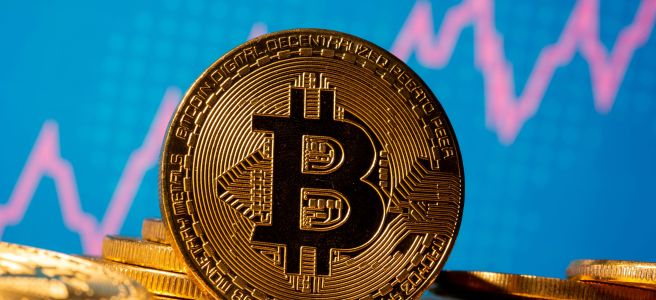
Bitcoin was able to generate an even bigger bubble in the first eleven months of 2013, as its exchange rate against the dollar increased by a factor of 93.5 (see Appendix) without representing even the slightest real value. Ironically, the ideological justifications for cryptocurrencies include talk of the loss of trust in financial markets and central banks, which are contrasted with “reputable” currencies that cannot be manipulated. But behind the backs of the players, the instrument then unexpectedly becomes another object of speculation. After all, some of them get rich in the process.

However, the distrust of central bank money in view of its lack of backing by real values is quite appropriate and also explains the flight into gold as a means of storing value. It remains to be seen whether gold is really a suitable means for this purpose; after all, a bubble has formed here, too, which, like all bubbles, can burst.

In the capitalist sense, money is productive only where surplus value is generated through the valorization of labor. Apparently, there are no longer sufficient investment opportunities for the money available, so that more and more money is merely multiplied fictitiously or simply hoarded, for example as precious metals. Even if Keynesians cannot or do not like to imagine it, this development points to the fact that money as a social relationship has become obsolete in the forty years since the end of the Bretton Woods system.

Appendix: Bitcoin & Co.

Traded since 2009, Bitcoin is the first, most prominent, and weightiest of the so-called cryptocurrencies, nearly a hundred of which now populate the Internet’s marketplaces. A list of the most important ones can be found together with their common characteristics under the Wikipedia entry “cryptocurrency”.

Bitcoins can be exchanged for dollars or euros on the Internet. If one has acquired any, they form an account on one’s own hard drive, integrated into a peer-to-peer network and protected by cryptographic procedures. All Bitcoin transactions are public in this network, but the owners of the Bitcoin accounts remain anonymous. According to the idea, digital currencies are money without banks and without the state. However, apart from its potential use for money laundering, drug trafficking and other covert activities, the utility value of Bitcoins as a means of payment is modest. The few companies that accept Bitcoins (see, for example, http://go-bitcoin.com, also on the grotesque overestimation of the scene) also accept cash and other of the usual payment methods, of course, and paying with them is considerably easier.

Indeed, for electronic payments to be possible without banks, a fixed exchange rate between bitcoin and dollars would be adequate. In fact, this exchange rate is left to the market, and this makes Bitcoins an object of speculation. The vast majority of Bitcoins are not used for purchases, but for currency speculation. Those who hoarded Bitcoins in 2013 could get rich: Between January 1 and November 30, the Bitcoin price rose by a factor of 93.5 from $13 to $1216. It then plummeted by 50 percent before recovering. In January 2014, the price fluctuated between $770 and $900. The high volatility calls bitcoin into question as a means of payment: no one spends bitcoins when they are expected to be 15 percent more valuable in the next week, and no one accepts them when a price collapse is imminent.

Another market is opening up in connection with “bitcoin mining,” the “mining” of new bitcoins. Those who want to produce them and channel them to their account have to solve complex computational tasks in competition with others. In the early days of Bitcoin, a normal PC was enough to do this, but now computing machines are needed whose waste heat could heat an entire house and whose purchase price is that of a mid-range car. And despite this effort, success is not certain because the competition is fierce and the number of new Bitcoins is limited by the underlying algorithm. In the end, as with gold, it is not the prospectors who profit, but those who sell them the prospecting tools.

The maximum amount of Bitcoins is set at 21 million; at the end of January 2014, there were 12.3 million worth a total of about $10 billion. But that can change again quickly.

Originally published in Konkret in 03/2014

Russian Victory in The Economic War?

The invasion of Ukraine is a military disaster for the Kremlin. But in the economic showdown Russia seems to have the upper hand – for now.

Tomasz Konicz

In the first weeks of Russia’s war of aggression in Ukraine, when the Kremlin’s megalomania led to the humiliating Russian retreat from Kiev and northern Ukraine, that military defeat seemed to be accompanied by economic disaster in Russia. The historically unprecedented sanctions imposed by the West in response to the invasion sent Russia’s economy and currency crashing in their initial shock waves. Western derision of the military impotence of Putin’s imperialism was accompanied by derision of the depreciation of the ruble, which briefly plummeted from a dollar exchange rate of 75 rubles at the start of the war of aggression to 135 rubles.

Russia’s inefficient, archaic, and highly corrupt military machine may still be stuck in eastern Ukraine, leaving the Kremlin to celebrate the laborious conquest of Luhansk Oblast as a military victory, but on the economic battlefield the tide has turned – for now. The ruble, which regained its pre-war exchange rate against the dollar back in May, is now trading at 58 rubles per greenback. After barely half a year of war, the Russian currency is worth more than it was before the invasion of Ukraine. Against the euro, this rise of the ruble, which reflects Russia’s economic stabilization, is even more evident: at the beginning of February, around 86 rubles had to be spent for one euro, now it is only 58 rubles. One of the most important goals of the Western sanctions strategy, namely to politically destabilize the Russian “home front” through currency devaluation, which is accompanied by spikes in inflation and losses in prosperity, has thus – so far – failed.

Not only that: now it is the over-indebted Eurozone, dependent on energy imports, that is suffering from the devaluation of its currency, while the skyrocketing prices for raw materials and fossil fuels have given the European currency union a whopping foreign trade deficit of 31.7 billion euros.[1] The further the euro falls, having already reached parity with the dollar,[2] the more expensive the imports of raw materials and energy sources become. The wind has thus shifted. It is now the eurozone that must fear for its stability, as the depreciating euro and high inflation lead to increased political tensions in the currency union. The return of a euro crisis seems likely, while the diverging economic policy interests of the German core and the southern periphery are creating new potential for conflict.

The Eurozone as the “Weakest Link” in the Economic War

With an EU-wide inflation rate of more than eight percent,[3] Italy, which has been in crisis for years,[4] is in debt to the tune of about 150 percent of its economic output,[5] so that any interest rate hikes demanded by Berlin from the European Central Bank (ECB) to combat inflation would quickly make this debt burden south of the Alps unsustainable. This is why the implied conflicts over crisis policy between Germany and the southern periphery are emerging, with Berlin opposing the continuation of expansionary monetary policy and attaching political conditions – such as austerity programs – to aid programs for European countries in crisis.[6] The over-indebted eurozone, plagued by economic imbalances and the place where the dominant German export industry is also increasingly suffering from supply bottlenecks and protectionism, can thus be seen as the West’s “weakest link” in the economic war with Russia. Even the FRG must reckon with a tripling of debt servicing costs due to rising interest rates.[7]

The economic war has thus – by means of the sanction-induced price explosion for fossil fuels – reinforced the already existing inflationary dynamics in the West.[8] The rapid interest rate hikes now being implemented by the US Federal Reserve to combat inflation[9] are causing financial market crises and recession in the US and Europe,[10] and economic collapses and debt crises in the periphery of the world system are likely this year or next as well (more details in the upcoming Konkret 08/2022).

Russia’s Surplus and Economic Slump

The Kremlin, whose military machine is embarrassing itself in Ukraine, has simply chosen the last good strategic moment for its war. The West, especially “German” Europe, has only just begun the already half-hearted, often sabotaged by lobbying, attempt to phase out fossil fuels,[11] so it is still highly dependent on these energy sources, which now gives Russia an advantage in the economic war – the financial fallout of the sanctions thus hits the Western core countries harder than Russia.

This is no exaggeration. Sanctions, which in the West have manifested themselves in widening deficits and an acceleration of inflationary dynamics, have led to rich surpluses for commodity exporter Russia, which has been able to tap new markets. The Russian Federation’s current account surplus (it captures goods, services and remittances) reached a record high of more than $70 billion in the second quarter of this year, as rising export revenues for Russian gas, oil or coal were accompanied by a sanctions-induced slump in imports of Western high-tech or consumer goods.[12] Moscow’s budget surplus is expected to have added up to more than 20 billion euros in the first half of 2022,[13] and this was mainly made possible by export revenues from the sale of oil and gas, which reached the equivalent of 100 billion euros in the first half of the year, around 66 percent of the previously forecasted annual volume.

The Western sanctions, on the other hand, appear to be having the intended effect, at least in terms of economic development. According to current forecasts, Russia’s recession will be far more severe than initially assumed (minus 7.1 percent), at 10.4 percent.[14] Despite all the fears of recession, it is almost certain that neither the USA nor the EU will experience a similarly deep economic slump this year. The situation is similar for the inflation rate. Inflation in the Russian Federation will be in double digits this year at 14.4 percent, significantly higher than in the USA and the EU, which are likely to keep their price increases below the ten percent mark.[15]

And yet these bare numbers can also be deceptive, as they do not simply lead to a proportional political and social fallout depending on their relative magnitude. Authoritarian-ruled Russia, a semi-peripheral country that lives off commodity exports, may ultimately win the economic war despite a more severe economic collapse and higher inflation. The goal of the economic war that accompanies the imperialist war in Ukraine is to shake the enemy’s “home front” through socioeconomic disruption and thereby force it to surrender.

Economic War and Crisis

Here, however, the Russian Federation seems to have a number of advantages that enable the Kremlin to politically survive a far more difficult economic situation than is the case in the West. One is simply the post-democratic character of the Russian state, which tends toward the overtly dictatorial. The possibilities for repression in Russia, where the mere criticism of the Russian invasion of Ukraine can result in prison sentences of several years, are much more far-reaching than in the West, where democratic standards such as the separation of powers and the rule of law still exist – and although they are rapidly eroding, they are still largely valid in substance.

In view of the increasing social and ecological crisis of capital, this authoritarian constitution of Russia or Belarus does not make these societies into discontinued models, but rather into capitalist models of the future. The Belarusian head of state Lukashenko is not Europe’s “last dictator,” as he is often dubbed in the European press. On the contrary: Lukashenko is Europe’s first dictator, he forms the vanguard of the authoritarian capitalist crisis administration, which “west-oriented” countries like Hungary or Poland can also join. The bare, unrestrained state power gives Moscow advantages in manifest crisis situations that the West – as yet – does not have,[16] as was most recently evident in the suppression of the uprisings in Belarus and Kazakhstan.

Moreover, in the entire post-Soviet region – to a lesser extent also in the eastern periphery of the EU – there are still historical and cultural moments that have a stabilizing effect, which are simply not present in the West. The memory of the chaotic and, especially in Russia, catastrophic system transformation in the 1990s is still vivid, so that the current crisis is perceived in a very different contemporary historical context than in the Western core of the world system, where there have been no comparable shocks to the social fabric for more than half a century. While the people of the West feel as if the sky is falling on their heads due to galloping inflation and looming energy crisis, in the East they are confident that things have been much worse before. What’s more, Putin can exploit the memory of the collapse of the Soviet Union, especially among the older generation, to maintain power, because he presents himself as a “factor of order” who can prevent the fall into crisis chaos, which according to Russian state ideology always comes from the West.

Moreover, in the post-Soviet space, subsistence crisis strategies, such as the dacha economy, are still alive, strategies which have been lost in the West due to the complete internal colonization of the core societies by capital under Fordism. In the majority of cases in the EU and the US there are simply no practical conditions for making ends meet by growing one’s own food, selling at informal markets and gathering wood in the forest, as was often the case in Russia in the 1990s. Russian wage earners are far more likely to be able to escape their wage dependency by moving into this informal sector than their Western class counterparts.

No Winners in Crisis Imperialism

And yet it is unlikely that this economic war can be won by Russia – or that it will have any “winners” at all. For one thing, the interaction between the events of the war and the situation on the “home front” is much more pronounced in Russia than in the West. Strategic setbacks on the front in Ukraine can quickly erode any remaining support for the war of aggression, especially given the Russian army’s losses. But crucial is the fact that Putin cannot order a general mobilization to rapidly advance the invasion with a similar manpower level as the Ukrainian army. After all, the most important prerequisite for rule by non-totalitarian authoritarianism is to maintain apathy and de-solidarization among the population, the majority of which somehow opportunistically comes to terms with dictatorial power, seeks its niches, cares only about its own advancement, and so on.

A general mobilization would deprive the population of this option to look the other way, to simply remain inactive and to continue to persist in political apathy. When one’s own life is at stake in a war of imperialist conquest, the people concerned are automatically awakened. In view of the military incapacity of the Russian army, the Kremlin should actually order general mobilization – and at the same time it can’t, if it wants to prevent the emergence of a broad protest movement that can’t be so easily crushed either.

Finally, the military as well as economic war between Russia and the West cannot be understood without taking into account the profound social and ecological crisis process into which the late capitalist world system is sinking. In this respect, it is a crisis imperialism that has entered its bloody, murderous stage in Ukraine.[17] The economic crisis not only formed the decisive factor that contributed to the outbreak of war,[18] it is also executed through economic warfare. The increasing clashes and power struggles of the state monsters, which turned Ukraine into an imperialist battlefield, make the losers of this crisis-imperialist “Great Game” socially and economically relegated, as they become completely trapped by the crisis process. Actually, in the medium term, there are no winners in crisis imperialism. The “winners” only descend more slowly. These power struggles, previously conducted using economic and political means, turn into military conflicts as the crisis intensifies.

Thus, on a systemic level, viewed objectively, the war over Ukraine functions as a crisis accelerator,[19] which further aggravates already existing crisis processes. As inevitably as late capitalism breaks down at its internal and external barriers, the course of the crisis is not set in stone. The impending devaluation of value can take the form of inflation or deflation. In the case of deflation, a fall in prices triggered by interest rate hikes, recession and a collapse in demand, Russia’s wartime fortunes would turn very quickly.

I finance my journalistic work mostly through donations. If you like my texts, then you are welcome to contribute via Patreon.


[1] https://www.sueddeutsche.de/wirtschaft/handel-handelsbilanz-der-eurozone-mit-rekorddefizit-dpa.urn-newsml-dpa-com-20090101-220615-99-672712

[2] https://www.tagesschau.de/wirtschaft/euro-dollar-113.html

[3] https://ec.europa.eu/eurostat/documents/2995521/14636256/2-31052022-AP-EN.pdf/3ba84e21-80e6-fc2f-6354-2b83b1ec5d35

[4] https://www.faz.net/aktuell/wirtschaft/wie-gefaehrdet-ist-italien-wirklich-18126250.html

[5] https://www.ceicdata.com/en/indicator/italy/government-debt-of-nominal-gdp

[6] https://www.faz.net/aktuell/wirtschaft/bundesbank-chef-skepsis-bei-ezb-werkzeug-gegen-rendite-ausschlaege-18166596.html

[7] https://www.handelsblatt.com/politik/deutschland/staatsverschuldung-die-zinsexplosion-warum-sich-lindners-kosten-fuer-schulden-fast-verachtfachen/28496844.html

[8] https://www.konicz.info/2021/08/08/dreierlei-inflation/

[9] https://www.nytimes.com/2022/07/16/business/global-recession-risk.html

[10] https://www.nytimes.com/2022/07/15/business/stock-market-recession-half-year.html

[11] https://www.konicz.info/2021/12/29/der-dealmaker-in-der-sackgasse/

[12] https://finance.yahoo.com/news/soaring-energy-prices-help-russia-164334271.html

[13] https://www.handelsblatt.com/dpa/wirtschaft-russischer-staatshaushalt-erzielt-trotz-sanktionen-deutliches-plus/28501534.html

[14] https://www.spiegel.de/wirtschaft/ukrainekrieg-eu-sanktionen-gegen-russland-zeigen-offenbar-wirkung-a-86078bfd-3b75-4a9c-8719-370d0c5c18c7

[15] https://www.reuters.com/markets/europe/russias-2022-inflation-seen-145-more-rate-cuts-expected-2022-06-30/

[16] https://www.konicz.info/2022/07/13/wahlen-unter-vorbehalt/

[17] https://www.konicz.info/2022/06/23/was-ist-krisenimperialismus/

[18] https://www.akweb.de/politik/russland-ukraine-konflikt-kampf-auf-der-titanic/

[19] https://jungle.world/artikel/2022/10/krieg-als-krisenbeschleuniger

Originally published on konicz.info on 07/17/2022

A New Quality of The Crisis

Why There Will Be No Stable Post-War Order After the End of The War Over Ukraine

Tomasz Konicz

Is this the big one? Is this the big crash that will overturn everything that has been established in global structures and dynamics since the breakthrough of neoliberalism in the 1980s? The war over Ukraine could indeed be seen in retrospect as an epochal break, as a tipping point in the global crisis process, at the crossing of which the crisis of the late capitalist world system has taken on a new quality.

That the world capitalist system is in a severe systemic crisis,[1] after decades of ignorance and marginalization[2] value-critical crisis theory, is now generally accepted even on the German left, but the character of the crisis process still seems to be only partially understood. For the late capitalist systemic crisis is not a one-off event, not merely a “big crash,” but a historical process that unfolds in spurts over decades, eating away from the periphery into the centers of the world system. The debt crises of the Third World, which in the 1980s marked the beginning of the now collapsing neoliberal era and left behind a series of civil wars and “failed states,” have long since spread to the centers of the world system. This is evident, for example, in the increasing tendencies towards stagflation, which are reminiscent of the stagflation period in the 1970s – which at that time helped neoliberalism to achieve its breakthrough.[3]

The systemic crisis is therefore not a “big crash,”[4] but rather a historical process of increasing internal and external contradictions of capital, which, due to competition-mediated rationalization, gets rid of its own substance, the value-creating labor of commodity production[5] and leads to an ecologically devastated world.[6] This historical process of crisis, which gave rise precisely to neoliberalism as a system of “delaying the crisis,” is characterized by phases of latency interrupted by manifest waves of crisis in the centers: such as the dot-com bubble of 2000, the real estate bubble of 2008, the pandemic-induced crisis of 2020, and the upheavals now beginning with war. The crisis was delayed at the expense of increasing instability of the system, which had to cope with ever more violent waves of crisis in the neoliberal decades, and the accumulation of crisis potential.

The Dialectic of The Crisis

The episodes of crisis that gain in intensity and in which the crisis becomes manifest are thus preceded by a long latent phase in which the crisis potential resulting from the self-contradiction of capital accumulates, mostly in the form of rising mountains of debt or financial market bubbles,[7] which still allow the hyper-productive system a kind of zombie-like illusory life through credit-financed demand[8] – and it is precisely this debt tower construction that is reaching its inner limits due to the current inflation dynamics.[9] The quantitative process, the accumulation of debt and the rise of speculative bubbles, leads, after crossing a tipping point, to a qualitative upheaval, to the outbreak of a debt crisis or the bursting of a debt bubble, which are then also publicly perceived as a “crisis.”

The same materialist dialectic of the transformation of quantitative changes into a new quality can also be observed in the capitalist climate crisis.[10][11] Here it is the quantitative increase of greenhouse gases in the atmosphere that leads to a fundamental, qualitative change of the climate system once certain tipping points are passed. (Incidentally, the habituation effects that occurred between the economic or ecological waves of crisis also promoted crisis ignorance, since the consequences of a crisis in the centers or the periphery very quickly sedimented into a new “normality” in the ahistorical public).

The financial market-driven neoliberal variant of capitalism, which took hold in response to stagflation and the end of the great post-war boom in the 1970s, has to a certain extent run capitalism “on credit” in both economic and ecological terms. Since the 1980s, the global debt burden has been rising faster than world economic output, leading to ever stronger financial market quakes in the form of speculative bubbles and debt crises. And ecologically, too, neoliberal capitalist globalization has been accompanied by steadily rising CO2 emissions, which so far could only be reduced in the short term at the price of economic crises. And it is precisely the increasing climatic and economic distortions that make the system in its neoliberal form increasingly unstable.

The neoliberal debt tower construction that is the foundation of this era cannot continue ad infinitum. The same is true of the fossil fuel driven world combustion engine (Weltverbrennungsmaschine),[12] brought about by neoliberal globalization, which is, in effect, a globalization of debt dynamics. The quantitative increase in the potential for crisis, which has created a global debt mountain equal to 356% of world economic output[13] and a CO2 concentration of 419.82 ppm,[14] is leading capitalism to its inner and outer limit, at least to the developmental limit of the neoliberal era of capital. A qualitative shift into another form of capitalist crisis management seems inevitable (overcoming the economic and ecological crisis of capital is impossible within the framework of the capitalist social formation).

This dialectical shift from quantity to quality takes place in particular with regard to the process of globalization, which seems to be turning into its opposite. It is precisely here that the outlines of a new phase of crisis are clearly emerging, which would be characterized by a “fragmentation of the world economy into geopolitical blocs,” in which “distinct technology standards, cross-border payment systems, and reserve currencies” would be used, as the International Monetary Fund (IMF) warned in a paper in April 2022.[15] As early as mid-March, the IMF described the war as a “severe blow to the global economy” that would not only “fundamentally alter the global economic and geopolitical order” but would also be accompanied by the risk of increased instability in peripheral regions such as Africa or Latin America, which would be affected by growing food insecurity.[16]

De-Globalization

The war-related sanctions are disrupting important global trade flows and causing rapid price increases not only for energy but also for food, since Russia, Belarus and Ukraine are among the world’s most important exporters of grain and fertilizer.[17] In the case of essential goods, food and fossil fuels, capitalist globalization has already effectively collapsed. Western sanctions on Russian and Belarusian fertilizers are likely to reduce agricultural production in many countries.[18]

But it is not only the imperialist front between East and West in the Ukraine war that is contributing to the price explosion – even uninvolved countries have long since resorted to protectionist measures to ensure food security and domestic political stability. Due to massively rising prices and the threat of supply shortages, Indonesia, for example, issued an export ban on palm oil, which further exacerbated the supply situation, especially in the global South, as the war had already caused exports of Ukrainian sunflower oil to collapse.[19] India acted similarly with its recent export ban on wheat.[20]

The inflation and supply shortages that were already occurring before the war due to the pandemic are now gaining force in the context of the de-globalization that is abruptly taking hold. But even this big bang, shaking up global flows of goods and finance, is not coming out of the blue. Efforts to revise globalization have been virulent for years, especially in the form of US President Donald Trump, who personifies the contradictions of capitalist commodity production like no other. Elected by sections of the pauperized US middle class, Trump set out to make a deindustrialized America, plagued by a gigantic trade deficit, “great” again – by erecting trade barriers. The goal of Trump’s protectionism: a reindustrialization of the United States.

The debt dynamics that developed during neoliberal financialization, which set in after the end of the great post-war Fordist boom and left the world system increasingly running on credit,[21] did not develop uniformly. There were regions with large deficits, such as the USA or southern Europe, and countries with large export surpluses. This led to the formation of deficit cycles, which became increasingly important during globalization and shaped the course of the episodes of crisis in the first two decades of the 21st century (real estate bubble, Euro crisis). Globalization, and its accompanying disruptions, is thus obviously not the cause of the capitalist crisis process, such as financial market bubbles and debt crises, but is its historical course.

The largest deficit cycle, the Pacific deficit cycle between the United States and China, was characterized by the fact that the People’s Republic, which was emerging as the new “workshop of the world,” exported gigantic quantities of goods across the Pacific to the de-industrializing United States and thus built up enormous trade surpluses, while in the opposite direction flowed a financial market flood of United States debt securities, so that China rose to become Washington’s largest foreign creditor.[22] A similar, smaller deficit cycle formed between the FRG and the southern periphery of the Eurozone in the period from the introduction of the euro up to the euro crisis.[23]

Globalization was thus not only characterized by the construction of global supply chains, but also the corresponding globalization of debt dynamics, realized through deficit cycles, which, as mentioned, have grown faster than world economic output in the past decades – and consequently functioned as a major economic engine by generating credit-financed demand. The globalization that produced these gigantic global trade imbalances was a systemic reaction, a flight forward from the increasing internal contradictions of the capitalist mode of production, which is choking on its own productivity.

What is now unfolding globally could be studied in rudimentary form on the basis of the euro crisis: As long as the mountains of debt grow and the financial market bubbles are on the rise, all the states involved seem to profit from this growth on credit. But as soon as the bubbles burst, the battle over who should bear the costs of the crisis begins. In Europe, as is well known, Berlin has used the crisis to pass on the costs of the crisis to southern Europe in the form of Schäuble’s infamous austerity measures. Now, at the global level, the collapse of the much larger debt-financed deficit economy, which has most recently been kept alive primarily by the central banks’ expansionary monetary policy, is imminent.

The value accumulated in the financial sphere, the “fictitious” capital not generated by the valorization of labor power, will be devalued due to the absence of a new accumulation regime in commodity production.[24] The increasing inflation, in the face of which bourgeois monetary policy finds itself in a crisis trap,[25] is precisely the expression of the inevitable devaluation of value. For many states that were previously chained to globalization by means of deficit cycles and in locational competition, the increasing costs of the crisis exceed the eroding advantages of deficit cycles, so that national and regional centrifugal tendencies gain the upper hand and force the collapse of globalization. This is a crisis-induced contradiction. Capitalism is full of them.

China as The New Hegemon?

It is precisely this exhaustion of the neoliberal debt tower construction of the past decades that has the late capitalist state monsters increasingly seeking refuge from the escalating internal contradictions in external expansion. Turkey, plagued by high double-digit inflation and driven by Erdogan into ever new imperialist campaigns of conquest, is only the blueprint, so to speak, for the manifest crisis imperialism that is rampant in many places. This crisis-driven, neo-imperial flight to war is also evident in the case of Russia, which had to put down a number of uprisings and unrest in its post-Soviet “backyard” in the months before the invasion of Ukraine.[26]

But this causal link between crisis and war is also manifested in the expansive actions of the West in the post-Soviet space, which, with its refusal to agree to neutrality guarantees for Ukraine, clearly provoked the Russian war of aggression in the Kremlin’s geopolitical “backyard.” For the United States, the struggle against Eurasia, as indicated by the alliance of China and Russia, is a struggle for hegemony and the US dollar in its function as the world reserve currency.[27] The United States, because of its extreme trade deficit, acted in a sense as a black hole in the world economy, absorbing much of the surplus production of hyper-productive late capitalist industry. With inflation rapidly accelerating, fueled, after all, not only by the expansionary monetary policies of central banks, but also by resource constraints and the full-blown climate crisis,[28] Washington’s ability to borrow freely in the world’s reserve currency, the measure of value of all things commodity, is on the line.

At the same time, for China, which together with Russia is striving to form a Eurasian power bloc, the looming end of the US deficit economy removes an important incentive to tolerate US hegemony: The extreme Chinese export surpluses, which in the 1990s and at the beginning of the 21st century contributed significantly to the recuperative capitalist industrialization of the People’s Republic, have not played a central role as an economic driver since the outbreak of the real estate crisis in 2008 – and they are also likely to lose weight rapidly vis-à-vis the USA in the future.

And yet it is a fallacy to interpret the current global upheaval as a transition to a new hegemonic system in which China would, in a sense, “inherit” the United States. The Middle Kingdom does appear to be in the process of replacing the United States as the global capitalist hegemonic power – but at the same time, this upheaval is no longer possible within the framework of the capitalist mode of production due to the escalating socio-ecological crisis. The history of the global expansion of the capitalist world system, which began in the 16th century, takes place in hegemonic cycles, such as those described by Giovanni Arrighi in his fascinating work “Adam Smith in Beijing”:[29] An emerging power gains a dominant position within the system, then after a certain period of dominance this hegemonic power goes into imperial decline and is finally replaced by a new hegemon.

According to Arrighi, every hegemonic cycle has two phases: First, a phase of imperial ascent takes place, characterized by a “material expansion,” i.e. by the dominance of the commodity-producing industry of the new hegemonic power. After the outbreak of an economic “signal crisis” – triggered by processes of over-accumulation – the phase of imperial descent sets in, which is accompanied by financial expansion and the dominance of the financial industry, and which once again gives the descending hegemon a final economic and imperial heyday.

And this sequence can be clearly confirmed empirically in the case of both the UK and the US. The English Empire, which rose to become the “workshop of the world” in the context of industrialization in the 18th century, transformed itself into the world’s financial center in the second half of the 19th century, before being replaced in the first half of the 20th century by the economically ascendant USA, which in turn experienced its “signal crisis” during the crisis phase of stagflation in the 1970s. This was followed by the deindustrialization and financialization of the USA, which led to the economic dominance of the financial sector.

Moreover, Arrighi argues that the alternation between two hegemonic cycles is accompanied by the descending hegemonic power becoming indebted to the ascending hegemon, as exemplified in the book by Britain’s increasing economic dependence on the United States during the First World War. Britain built up a huge trade deficit with the U.S. during the World War period, “supplying billions of dollars worth of munitions and food to the Allies but receiving few goods in return.” Incidentally, Britain acted similarly in its role as “banker” to the anti-Napoleonic coalition some one hundred years earlier. And it was precisely this dependency relationship between a declining United States and a rising China that was described in terms of the Pacific deficit cycle, in which Chinese export surpluses contributed to China’s export-driven industrialization and deficit-building in the United States.

So, what is wrong here? What is wrong this time so that a new, Chinese hegemonic cycle is impossible? Why can’t the 20th “American” century be replaced by the 21st “Chinese” century? For one thing, China has obviously already passed its “signal crisis” marking the transition to a financial market-driven growth model in 2008. With the bursting of the real estate bubbles in the US and Europe, China’s extreme export surpluses (with the exception of the US) declined, while the gigantic stimulus packages that Beijing launched at the time to prop up the economy led to a transformation of China’s economic dynamics: exports lost weight, and the credit-financed construction industry and the real estate sector henceforth formed the central drivers of economic growth.

According to official statistics, China, for example, consumed around 6.6 gigatons of concrete between 2011 and 2013, which means that the People’s Republic, condemned to a permanent boom, produced more concrete in three years than the USA did in the entire 20th century. With this amount, the whole of Hawaii could be covered in concrete and turned into one huge parking lot, the Washington Post enthusiastically wrote at the end of March 2015.[30] The United States had used 4.5 gigatons of concrete in the past century, according to the WP, adding that the official figures from Beijing would also stand up to closer scrutiny – which is by no means self-evident. The figures are “surprisingly logical,” given that much of China’s infrastructure was not built until the 21st century and that urbanization in the world’s most populous country is proceeding apace. In 1978, just under one-fifth of all Chinese people lived in cities; by 2020, that figure had risen to 60 percent.

China’s growth is thus also running on credit, the “People’s Republic” is just as highly indebted as the declining Western centers of the world system (even more: China’s rise to become the “workshop of the world” was also based on debt processes in Western Europe and the USA due to Chinese export surpluses within the framework of the aforementioned deficit cycles).[31] And this Chinese deficit cycle produces far greater speculative excesses than in the USA or Western Europe, made evident by the disruptions on the absurdly inflated Chinese real estate market in 2021.[32] This lack of a new accumulation regime in commodity production, in which the inner barrier of capital manifests itself, forms the major difference between China and the US: Washington, after WW2, at the beginning of its hegemony, was able to build on two decades of coming capital expansion under Fordism. China, on the other hand, because of its collapsing towers of debt in an over-indebted late capitalist world system, looks as if it was already in decline before it achieved hegemony.

Another moment that makes a Chinese hegemony in the late capitalist world system impossible from an ecological point of view was described by Arrighi in his aforementioned work as the historical tendency towards progression within the hegemonic cycles: the territory, the population as well as the economic weight of the hegemonic powers increase in the history of the capitalist world system. From the few million subjects of Great Britain to hundreds of millions of US citizens of the continent-like hegemon USA to the last possible increment of the billion-person state China. This, however, also breaks the ecological limits of the capitalist world system,[33] since China is already the largest emitter of greenhouse gases and the climate crisis is already having catastrophic consequences.[34]

Oceania vs. Eurasia?

The collapse of the global deficit economy and the escalating climate crisis stand in the way of a new “world order” shaped by Beijing, a Chinese hegemonic cycle. Hegemony, after all, means that the position of the hegemon is at the very least tolerated, since it is accompanied by advantages for the other states in this hegemonic system. In the case of the US, it was the long post-war Fordist boom and – from the 1980s onwards – the deficit economy based on the world’s reserve currency, the dollar, that enabled Washington to achieve hegemony. China’s rise, by contrast, can no longer be based on such an economic foundation.

The historical hegemonic cycle of the capitalist world system is thus superimposed on the socio-ecological crisis process of capital, it interacts with it and allows China’s hegemonic rise and disintegration to merge. In place of the US hegemonic system, which went into open dissolution with the invasion of Iraq from 2003 onwards, there now seems to be a global bloc formation, in which Eurasia (Russia and China) and Oceania (USA together with its Atlantic and Pacific alliance systems) are in a perpetual conflict in a real dystopia. Yet even this frontline position, reminiscent of the Cold War – which escalated into open conflict in Ukraine – is likely to remain unstable and volatile. It could even be argued that Washington and London, as the driving forces in the Ukraine conflict, are also pursuing the goal of welding together the eroding Western alliance system through a common front against Moscow in the trenches of eastern Ukraine.

The collapse of globalization is synonymous with the collapse of the global deficit economy outlined above, which stabilized the world system in the neoliberal era. This is the decisive factor that will shape the further course of the crisis. The debt tower construction, which was maintained by means of money printing by the central banks and which delayed the manifest outbreak of the crisis in the neo-liberal period, is just collapsing, without a new accumulation regime in sight, which results in the intensification of blind crisis competition at all levels of capitalist socialization. A “post-war order” hardly seems possible any more, due to the increasing impacts of the crisis and the thus increasing crisis competition.

This also applies to crisis imperialism, which, while evoking memories of the 19th century, is driven by an inverted logic of development. While the first imperialist “Great Game” took place in a phase of global expansion of capital, in which ever new peripheral regions were integrated into the capitalist world system by means of fire and sword, its re-enactment in the 21st century takes place against the backdrop of the contraction of the valorization process, which leaves behind more and more economically and ecologically “scorched earth” along with the corresponding “failed states.”

In a nutshell: Since capital can no longer continue its zombie life financed on credit, the late capitalist state monsters are falling over each other, making all current alliances unstable, since the crisis-related competitive pressure is also increasing between the EU and the USA, between Beijing and Moscow. There is a certain inevitability in all this, since the striving for international standing in the world crisis of capital is in fact tantamount to a fight against social and economic decline, a fight on the Titanic of the late capitalist world system, which is in the process of open decay. Exclusion of the economically superfluous and the securing of resources are central moments of this crisis imperialism, while the inferior powers and world regions stagger into state collapse.

This becomes particularly clear in the example of the war over Ukraine, where both sides are in fact endeavoring to instrumentalize tendencies towards state disintegration for their own interests. Moscow is working to establish loyal “people’s republics” in the occupied Russian-speaking regions of Ukraine – following the example of Donetsk and Luhansk – in order to be able to incorporate them into the Russian Federation. Ukraine’s far right, on the other hand, which currently forms the fanatical spearhead of the Ukrainian military, sees the war as an opportunity to accelerate Russia’s state disintegration in order to realize imperial ambitions in its slipstream.[35]

It is a Taliban logic that is unfolding here, in which – similar to Western military aid to Afghanistan’s holy warriors in the 1980s – an extremist movement is being ramped up that will destabilize the region as the crisis progresses and bring the already anomic tendencies in the rotten Ukrainian state apparatus (which is just as corrupt as Russia’s) to full fruition. The Nazis of Ukraine, who are currently gaining influence at a rapid pace[36]– similar to the crisis imperialism described above – only superficially follow their historical model. Having set out to fight for the classic national empire in the form of a state, they are in fact the subject of the anomic barbarism objectively unfolding in the course of the crisis, i.e. of the rapidly advancing decay of the state.

Another moment of the new phase of the crisis, in which the external and internal barriers of capital interact, is also becoming clearly discernible during the Ukraine war: the rapidly spreading shortage of resources and food, which, although currently sold as a consequence of war, will turn into a permanent phenomenon.[37] The late capitalist global agrarian system, which has turned humanity’s natural resources and livelihoods into bearers of value and is burning them for the purpose of rampant value valorization,[38] is unable, in the face of the escalating climate crisis and collapsing globalization, to sustain the food supply for large segments of humanity on the periphery of the world system – even though this would still be possible in a resource-conserving post-capitalist system, despite the escalating climate crisis.

With the ever more clearly emerging collapse of the global deficit economy, including the deficit cycles described above, and with the devaluation of value that is now also imminent in the centers, both in the euro and the dollar area, and which is in all likelihood being heralded by stagflation, global supply chains for raw materials, resources and basic foodstuffs are also likely to collapse or at least be severely damaged. The crisis of scarcity characteristic of the new quality of the crisis, which is already spreading in the periphery,[39] is thus a product of the escalating contradictions that are inherent in the growth compulsion of capital – and here, too, the “supply bottleneck” under which German industry, for example, is groaning, was only the manifestation of this new quality of the crisis of a world system that is moving into open disintegration in the course of the pandemic.

The character of the neo-imperialist “Great Game” over Ukraine has changed since 2014 – when the West intervened[40] to prevent the formation of the “Eurasian Union” propagated by Putin. With the battle over Ukraine’s southern and southeastern regions, which the Kremlin wants to incorporate into its rotten empire, an archaic-looking resource war is now also taking place. These swaths of land have the highest agricultural yields.[41] Moscow, which has failed to modernize the Russian economy, is thus expanding its strategy of an “energy empire,” which seeks extensive control of the “value chain” of energy resources, to include other “scarce” resources: basic foodstuffs. Russia not only wants to be a nuclear-armed gas station, it also wants to be a granary – precisely in anticipation of the climate crisis.

The Russian invasion of Ukraine thus provides a glimpse of the coming period of crisis, in which a capitalist world system in the process of disintegration will no longer allow for a fixed hegemony or bloc formation due to increasing economic and ecological devastation, while openly warlike confrontations over essential resources are likely to increase, even between the great powers that are increasingly sealing themselves off from the periphery. In a sense, everything will become oil – especially since the crisis process does not adhere to the reified form in which it appears in bourgeois crisis discourse, and the individual moments of this dynamic, which are separated in public discourse into “economic crisis,” “climate crisis,” “political instability” or “supply shortages,” will increasingly interact with each other. The vanishing point of this new quality of the crisis on a geopolitical, “neo-imperial” level is ultimately the nuclear exchange of blows, which is becoming more and more likely with the increasing intensity of ecological and economic crises, with ever new, more violent “crisis impacts.”

Authoritarian State Formation and State Collapse

Since de-globalization is accompanied by the collapse of the global deficit economy, which will lead to the devaluation of the neoliberal debt mountain, the most severe economic and social dislocations, as they devastated large parts of the periphery in the form of debt crises and economic collapses in the neoliberal era, seem likely to occur in the centers as well this time. If the capitalist functional elites have no further method of delaying the crisis at their disposal, the crisis process, which has been advancing in stages from the periphery to the centers since the 1980s, would thus reach its logical end point. It is not only the USA, which is groaning under an absurd private and state debt burden, that is facing the economic abyss in view of the necessary turnaround in monetary policy on interest rates; it is precisely export-fixated economies such as that of the FRG that are highly dependent on the global deficit economy by means of their export surpluses, which in fact represent an export of debt – and which could now be hit particularly hard by de-globalization.

Thus, at first glance, a tendency that was already apparent in the final phase of the neoliberal era seems to be advancing to become a central moment of the new crisis period: The state as an economic actor, which in recent years seemingly stabilized the system with stimulus packages and excessive money printing in the context of the last great liquidity bubble, is likely to become a central actor in the new crisis period.[42] The state, which seemingly stabilized the system in recent years with economic stimulus packages and excessive money printing in the context of the last great liquidity bubble, is likely to become the dominant economic actor in the short term due to the new quality of the crisis process – even if these state capitalist reflexes no longer have any prospect of success.

In general, the capitalist state, which already in its absolutist early form in the context of the European “economy of firearms” (Robert Kurz) acted as the most important impulse generator of the initialization of the valorization process, acts as a central economic actor in times of war and crisis. The state is not an alternative to the market, as it often appears in the truncated critique of capitalism, but a necessary corrective to the blind market dynamic, which tends to be auto-destructive. As soon as the contradictions inherent in capital valorization shake the system to its foundations through crisis or war, the state – which is always a capitalist state – must intervene to try to stabilize the system. Most recently, for example, in the period of crisis and war in the 1930s.

Even at present, in the face of climate crisis and war, there are voices calling for an open transition to rationing,[43] to state capitalism, to the war economy.[44] The state is not only supposed to support the “economy” through stimulus programs, the development of the new, “ecological” infrastructure and money printing, as in the final phase of neoliberalism; the state is also expected to be responsible for costly basic research, the subsidization of consumption or production and the organization of commodity distribution in phases of crisis. Strategic state decisions on industrial development are already part of bourgeois policy, for example in the FRG in the form of the promotion of “industrial champions” who are to conquer the world markets with state backing (here too the West is actually only following China and Russia).[45] Also foreseeable are, in reaction to coming crises, renewed nationalizations, especially in the ailing and crisis-prone late capitalist infrastructure sector.

This necessary role of the state as “crisis manager” is, however, undermined by the previously described exhaustion of the financial market-driven globalization of the deficit economy in the neoliberal age, which, in the face of dizzying mountains of debt, overheated financial markets and rapidly increasing inflation, drives politics into a dead end, a crisis trap: On the one hand, capitalist crisis policy should actually lower interest rates, print money and support the economy with stimulus programs in order to minimize the economic consequences of the war in Ukraine, but at the same time it would be necessary to raise interest rates and pursue a consistent austerity course in order to get at least some control over inflation.

This crisis trap, which is becoming ever clearer,[46] and marks the end of the credit-financed neo-liberal delay of the manifest breakthrough of the crisis in the centers, will, when it snaps shut, entail the most severe economic and social dislocations – especially in the centers, and especially in their middle classes. With the wave of impoverishment, the gradual brutalization of the bourgeois metropolitan societies, which has been going on for decades, will turn into open barbarization, driven by an escalating crisis competition at all levels, driving it into the anomic. The crisis-induced socio-political retreat of the state will reduce it to its original role as an instrument of repression. The new crisis thrust will thus entail a corresponding state reaction. Authoritarian state aspirations, present in neoliberalism in the form of the dismantling of democracy and the expansion of the surveillance state, will become openly apparent. The right-wing US President Trump was only a prelude in this respect. And in the Federal Republic, too, the latently fermenting fascist potential is only likely to become fully manifest when the civilizing effect of the high foreign trade surpluses, which compel Germany’s economic and political elites to take account of foreign opinion, disappears in the course of the crisis.

The war over Ukraine in particular makes this interaction of crisis dynamics, brutalization and authoritarian state reflex clear. Lukashenko, once called “Europe’s last dictator,” seems to be the forerunner of all those authoritarian tendencies that are currently spreading in the EU, for example in Hungary or Poland, in NATO, especially in the form of the Islamo-fascist regime in Turkey, or in Ukraine itself, which is already following in Russia’s footsteps with arrests of opposition members and party bans.[47] It is a fundamental mistake to interpret the war in Ukraine as a struggle between democracy and dictatorship, a view which could actually be corrected just by looking at the conditions in Warsaw, Budapest or Ankara. Consequently, the new phase of the crisis is more likely to be marked by the Orwellian struggle of authoritarian or fascist regimes for resources than by a new edition of the “Cold War.”

And yet this tendency towards authoritarian, and in the final analysis openly fascist, crisis management is a surface phenomenon, only externally linked to 20th century fascism. Total and totalitarian mobilization during World War II made the postwar Fordist boom possible, since there was effectively no demobilization after the end of the war and mass tank production passed into the automobilization, the mass production of cars, of postwar capitalist societies; but a similar regime of accumulation in which mass wage labor would be valorized in commodity production is not in sight this time. There is only the abyss of total over-indebtedness in the incipient climatic catastrophe, which gives a different course to the objective function of fascism as a terrorist crisis form of capitalist rule. The moment of fascism that has always existed as the rule of the rackets, that is, of competing communities of looters, as Critical Theory clairvoyantly stated, becomes dominant in the current systemic crisis.

The authoritarian formation of the state, which is increasingly becoming the prey of rackets, thus goes hand in hand with its internal erosion, which is already beginning to unfold in the Federal Republic in particular: especially with regard to the increasing right-wing extremist activities in the state apparatus.[48][49] In Ukraine this process has already progressed much further, where the oligarch rule after the fall of the government and the outbreak of the civil war already turned into right-wing extremist militia formation,[50] which could openly challenge the Ukrainian state in the run up to the war.[51] The disastrous course of the Russian invasion also revealed how far the tendencies towards state erosion had progressed even within the Russian state oligarchy, since even the army, essential for the Kremlin’s projection of power, was fully caught up in this. The division within the German right, which cannot clearly position itself behind the Ukrainian Nazis or Russian pre-fascism in the Ukraine war, points precisely to the omnipresence of these authoritarian-anomic tendencies in this conflict.[52]

A prime example of the fragility of authoritarian rule in capitalism and the transformation of dictatorship into anomie is provided by the Arab Spring, in the course of which seemingly monolithic dictatorships such as those in Syria and Libya collapsed and released their inherent centrifugal forces. Authoritarian structures are not a sign of the inner strength of the capitalist system, which prefers the optimization of the self-valorization of the wage-dependent within the framework of capitalist democracy, but rather its form of crisis, which is nowhere near as efficient at organizing the process of valorization as the typical published discourse in the centers of the world system on ways to optimize and increase growth – but which requires a certain degree of social stability to ensure its ideological foundations.

Amok or Emancipation

The era of openly authoritarian crisis management, which is now being heralded, for example, in the publicly articulated preference of Western oligarchs for right-wing populists,[53] will therefore not be able to bring about a decade-long post-war order in domestic politics either, as it prevailed at least in the centers during the neoliberal era, despite all the creeping processes of erosion and the increasing contradictions. The climatic, economic and geopolitical crisis impacts are coming with increasing frequency, which is why stabilization, which would herald a new historical period of crisis management, is hardly likely, even by means of authoritarian, dictatorial methods. Especially since, as already mentioned, the different moments of the crisis process are increasingly interacting, so that the climate crisis, for example, will have a growing economic and social fallout. The time of the monsters, as Gramsci called the breakthrough crisis to Fordism in the 1930s, no longer seems to have an end in sight.

It could even be argued that – with crisis imperialism and fascism striving towards the anomic as an open death cult[54] – in the phase of capital’s decline, moments of its expansionary dynamics briefly reappear, overlap, interact – entirely in the sense of a dialectical negation of negation, so that seemingly familiar phenomena at a higher stage of the capitalist development of contradiction follow a reversed logic of development driven by the contraction of the valorization process. These are blood-soaked early capitalist mementos from the ascendant phase of capital that the world system, which is passing into agony, once again unleashes upon humanity. Even the mercenary, who is currently celebrating a comeback in the neo-imperialist wars of distribution and collapse, is a product of early capitalism, when the first “wage earners” emerged en masse in the 30 Years War as an embryonic form of the wage-earner and terrorized the population.

Without an emancipatory overcoming of capital in its blind fetishistic flight towards world destruction,[55] the crisis has its final vanishing point in panic, in the capping of all libidinous bonds between the members of society triggered by escalating crisis competition, as already evidenced by the case of the individual run amok, which now occurs regularly.[56] In addition to global nuclear war, which is becoming an ever greater threat in crisis imperialism as the intensity of the crisis increases, it is the climate crisis that is likely to act as the greatest producer of panic: Specifically, the increasingly apparent uninhabitability of vast swaths of the global south,[57] which places objective limits on all, even the most brutal, openly terrorist forms of crisis management. This would mark the transition to sheer civilizational collapse.

From this systemic urge towards self-destruction, which is now blatantly obvious, grows the necessity of survival of the emancipatory overcoming of capital, which forms, so to speak, the last constraint with which the capitalist regime of constraint must be transformed into history. The struggle for the transformation of the system should thus be the central moment of left practice, instead of losing oneself in the jubilant cheering for NATO or Putin, which large parts of the German left are currently practicing in view of the Ukraine war.[58]


[1] https://oxiblog.de/die-mythen-der-krise/

[2] http://www.konicz.info/?p=4136

[3] https://www.xn--untergrund-blttle-2qb.ch/wirtschaft/theorie/stagflation-inflationsrate-6794.html

[4] https://de.wikipedia.org/wiki/Gro%C3%9Fer_Kladderadatsch

[5] https://www.heise.de/tp/features/Freihandel-und-Fluechtlinge-3336741.html

[6] https://www.mandelbaum.at/buch.php?id=962

[7] https://www.xn--untergrund-blttle-2qb.ch/wirtschaft/weltfinanzsystem-finanzmaerkte-notenbanken-6360.html

[8] https://www.xn--untergrund-blttle-2qb.ch/kultur/film/george_andrew_romero_zombie_4234.html

[9] https://www.xn--untergrund-blttle-2qb.ch/wirtschaft/theorie/stagflation-inflationsrate-6794.html

[10] https://www.mandelbaum.at/buecher/tomasz-konicz/klimakiller-kapital/

[11] https://www.xn--untergrund-blttle-2qb.ch/politik/theorie/die-klimakrise-und-die-aeusseren-grenzen-des-kapitals-6832.html

[12] https://www.lunapark21.net/das-kapital-als-weltverbrennungsmaschine/

[13] https://carnegieendowment.org/chinafinancialmarkets/86397

[14] https://www.co2.earth/daily-co2

[15] https://www.imf.org/-/media/Files/Publications/WEO/2022/April/English/text.ashx

[16] https://www.spiegel.de/wirtschaft/iwf-ukrainekrieg-kann-weltwirtschaftsordnung-fundamental-aendern-a-af821a51-222d-42d2-9038-d29180574e3d

[17] http://www.konicz.info/?p=4876

[18] https://www.dw.com/en/high-fertilizer-costs-threaten-farmers-amid-sanctions-on-russia/a-61163444

[19] https://www.reuters.com/business/indonesia-seeks-balance-international-local-palm-oil-demand-official-2022-05-11/

[20] https://twitter.com/spectatorindex/status/1525327269707022336

[21] https://www.heise.de/tp/features/Die-Urspruenge-der-gegenwaertigen-Wirtschaftskrise-4285127.html

[22] http://www.konicz.info/?p=1409

[23] https://www.heise.de/tp/features/Der-Aufstieg-des-deutschen-Europa-3370752.html

[24]  https://lowerclassmag.com/2021/04/13/oekonomie-im-zuckerrausch-weltfinanzsystem-in-einer-gigantischen-liquiditaetsblase/

[25] https://www.heise.de/tp/features/Politik-in-der-Krisenfalle-3390890.html

[26] https://www.xn--untergrund-blttle-2qb.ch/politik/europa/russland-ukraine-krise-konflikt-neoimperialismus-6830.html

[27] https://www.ft.com/content/e5735375-75df-4859-bbf0-ae22e4fe2ff6

[28] http://www.konicz.info/?p=4389

[29] https://www.versobooks.com/books/347-adam-smith-in-beijing

[30] https://www.washingtonpost.com/news/wonk/wp/2015/03/24/how-china-used-more-cement-in-3-years-than-the-u-s-did-in-the-entire-20th-century/

[31] https://www.heise.de/tp/features/Wachstum-der-Schuldenberge-3762292.html

[32] http://www.konicz.info/?p=4643

[33] https://oxiblog.de/klimakrise-und-china/

[34] https://www.buzzfeednews.com/article/kirstenchilstrom/china-flooding-photos

[35] https://www.youtube.com/watch?v=DOBntnuYCMA&t=5s

[36] https://unherd.com/2022/03/the-truth-about-ukraines-nazi-militias/

[37] http://www.konicz.info/?p=4566

[38] https://www.streifzuege.org/2021/das-globale-agrarsystem-wahnsinn-mit-methode/

[39] https://www.tagesschau.de/ausland/asien/sri-lanka-ausnahmezustand-101.html

[40] https://www.heise.de/tp/features/Ost-oder-West-3363061.html

[41] https://ipad.fas.usda.gov/rssiws/al/crop_production_maps/Ukraine/Ukraine_wheat.jpg

[42] https://lowerclassmag.com/2021/04/13/oekonomie-im-zuckerrausch-weltfinanzsystem-in-einer-gigantischen-liquiditaetsblase/

[43] https://www.ft.com/content/d8e565b0-c769-46cc-9be3-4ed9a806d8e8

[44] https://www.spiegel.de/wissenschaft/mensch/ukraine-krieg-und-gas-dann-eben-kriegswirtschaft-aber-richtig-kolumne-a-532bb9fa-15e4-4b9b-8e50-d6e082a93f04

[45] https://www.zeit.de/wirtschaft/2019-05/nationale-industriestrategie-2030-peter-altmaier-industriepolitik-faq

[46] https://www.heise.de/tp/features/Politik-in-der-Krisenfalle-3390890.html

[47] http://www.konicz.info/?p=4832

[48] https://www.heise.de/tp/features/Braun-von-KSK-bis-USK-4355668.html

[49] https://www.heise.de/tp/features/Inflation-der-Einzelfaelle-4259590.html

[50] https://www.streifzuege.org/2014/oligarchie-und-staatszerfall/

[51] https://consortiumnews.com/2022/03/04/how-zelensky-made-peace-with-neo-nazis/

[52] https://www.endstation-rechts.de/news/die-deutsche-rechte-und-ihr-umgang-mit-dem-krieg-der-ukraine

[53] https://winfuture.de/news,129707.html

[54] https://www.heise.de/tp/features/Der-alte-Todesdrang-der-Neuen-Rechten-4509009.html

[55] https://www.heise.de/tp/features/Die-subjektlose-Herrschaft-des-Kapitals-4406088.html

[56] https://www.heise.de/tp/features/Fluchtpunkt-Amok-3263142.html

[57] https://www.spiegel.de/wissenschaft/mensch/extremwetter-und-klimaforschung-klimakrise-macht-hitzewellen-in-indien-100-mal-wahrscheinlicher-a-aa4a67a0-96f2-4be0-911f-a83f33abcaec

[58] Read more: https://www.konicz.info/?p=4868.

Originally published on konicz.info on 05/24/2022

Glory and an Ear of Corn

Tomasz Konicz

The fact that parts of the world are facing a devastating famine cannot be attributed solely to the consequences of the Ukraine war.

Putin did it! This exclamation, which the Kremlin ruler’s auburn-haired German fan base likes to use with a wink to ridicule any criticism of their surrogate leader, actually seems to apply perfectly in the case of the worsening hunger crisis in the global South. Since Russia’s invasion of Ukraine, staple food prices have really skyrocketed. The food index of the Food and Agriculture Organization of the United Nations (FAO), whose calculation takes into account the price of cereals, dairy products, meat, cooking oils and sugar, has risen significantly since the beginning of the war.

Ukraine and Russia, as important exporters of staple foods such as wheat, corn or sunflower oil, supply mainly peripheral states. Belarus and Russia also produce a large share of fertilizers for the global agricultural economy. According to the Federal Office of Economics and Export Control, Ukraine’s wheat production accounts for 11.5 percent of the global market. In 2021, about 33 million tons of wheat were harvested in the country, which has particularly fertile soils, of which 20 million tons were destined for export. This year’s harvest is estimated to be 35 to 42 percent lower due to the war, and exports have already fallen to a third of last year’s volume in May. The food crisis is thus triggered on the one hand by the war in Ukraine and the Russian blockade of Ukraine’s Black Sea ports, and on the other hand by globally looming crop losses due to fertilizer shortages. Russia and Belarus produced around 37 percent of the potash fertilizer used worldwide in 2019.

Before the outbreak of the war, Russian and Ukrainian grain exports went mainly to those peripheral regions that are particularly vulnerable to famine. Among the largest importers of wheat from Russian and Ukrainian production are Egypt, Bangladesh, Nigeria, Yemen, Sudan and Senegal. Of the 25 African countries that source more than a third of their wheat imports from Russia and Ukraine, 15 countries actually met more than half of their import needs from Russia and Ukraine. In the case of Somalia, Egypt, Benin, Sudan, the Democratic Republic of Congo, Senegal and Tanzania, the figure was more than two-thirds. East Africa in particular, where the worst drought in 40 years has already caused a severe famine threatening some 23 million people, to which statistically one person falls victim every 48 seconds, is a major buyer of wheat from the war zone. Since the EU sanctions do not affect Russian sunflower oil and grain exports, and the most important importing countries have not imposed any sanctions against Russia, the price increase and the resulting increase in hunger and malnutrition must be attributed to the imperialist war of aggression which Putin – provoked by Western expansionism in the closest Russian sphere of influence – unleashed in his megalomania.

However, a look at the global development of hunger and malnutrition also shows that the war acts as a crisis amplifier that accelerates already prevailing trends. Indeed, Western public opinion is in part using the Russian invasion of Ukraine as a cheap excuse to distract from the deeper, systemic causes of the crisis.

According to FAO figures, the number of people suffering from hunger and malnutrition in late capitalism has been increasing almost every year since 2014 due to episodic outbreaks of social and environmental crisis. The increase in hunger was most pronounced in 2020, the year of the pandemic – 768 million people were affected. The fight against the pandemic led to a massive collapse in demand in the core countries, which led to an overproduction crisis and a corresponding explosion of misery in the periphery. According to a report in the FAZ, for example, sales of textiles in Europe and North America collapsed by around 16 billion dollars in 2020, which was reflected in income reductions of around 21 percent in the Southeast Asian textile industry. Since wages in the industry in countries such as Bangladesh, Pakistan or Burma are at the subsistence level, millions of workers simply had to go hungry – or get into debt.

According to surveys, 75 percent of the workers were forced to take out loans in order to ensure adequate access to the necessities of life. The market-mediated capitalist destitution mechanism, which had its destructive effect not only in the textile industry during the pandemic, transforms the falling demand of the centers of the world system into empty stomachs in the periphery. The rise of hunger thus affected millions of wage-earners in 2020 precisely because too much material wealth was produced that could no longer be valorized in commodity form. Those wage-dependents who are still allowed to sew clothes for Adidas, Puma and Co. have been “lucky,” according to the capitalist logic of valorization.

In capitalism, only that which directly or indirectly contributes to the valorization process of capital has a right to exist, that is, only that which promotes the boundless multiplication of money by means of wage labor. Natural resources and human life have no value in themselves for capital, but function only as a means to the insane end in itself of boundless capital accumulation. Commodities – and this includes the commodity of labor power – represent a mere cost factor if they cannot be valorized. Since, under capitalist conditions, the massive increase in hunger is accompanied by an equally massive decrease in the market demand for food, the pandemic year 2020 was consequently marked not only by a serious increase in hunger, but also by mass destruction of food. The US agricultural industry, for example, destroyed millions of tons of staple foods, while some 38 million US citizens suffered from “food insecurity” and the queues at soup kitchens and food distribution points, which were frequented by 60 million people in 2020, grew longer and longer.

The destruction of foodstuffs that can no longer be pressed into commodity form is also taking place in this year of war and crisis, when, for example, farmers in Münsterland have their strawberry fields plowed under because the food trade is forcing prices below production costs. However, there are now also signs of famines caused by the climate crisis. This is illustrated by a look at India, for example. In the spring, the country was hit by a historically unprecedented, week-long heat wave with record temperatures of more than 45 degrees Celsius, which led to considerable crop losses. In key crop-growing regions such as Punjab, initial estimates put crop losses at around 25 percent. With India already using up a large part of its grain reserves during the pandemic-induced bouts of pauperization to prevent famine and riots as part of a welfare program, New Delhi decided to pull the emergency brake and impose a ban on wheat exports in the face of skyrocketing prices. India originally wanted to use the shortages triggered by the war in Ukraine to open up new markets, but in view of the collapsing crop yields, which are calling into question the government’s food program, which runs until September, the government felt compelled to resort to protectionist measures.

The climate crisis is thus reinforcing the protectionist tendencies that are already prevalent in the final phase of neoliberal globalization – at the latest since Donald Trump took office. And the impacts, which take the form of extreme weather events, are becoming more frequent: the severe heatwave that hit Spain in May endangered the harvest of several berry varieties. In the USA, prolonged drought in the Midwest is threatening yield losses of eight percent for winter wheat – despite an expansion of the area under cultivation. In Morocco, crop losses of 70 percent are expected due to drought, while Canada and France are also facing significant losses due to unusually warm and dry weather conditions in the spring. And China could also see yield losses due to severe flooding. Overall, according to estimates by the US Department of Agriculture, wheat yields are expected to fall by 0.6 percent in the 2022/23 season, and global reserves by as much as five percent.

The skyrocketing world market prices for staple foods, which are likely to contribute to the 193 million people at risk of starvation worldwide, as stated by the Global Report on Food Crises for 2021, will continue to rise this year, only anticipate future market demand in the face of war and the climate crisis. And it is not only India that is responding to this killer market movement with protectionism. Due to massively rising prices and looming supply shortages, Indonesia, for example, issued a short-term export ban on palm oil in April, which further exacerbated the supply situation, especially in the global South. The export restrictions on the environmentally harmful oil, 60 percent of which is produced in the South Asian island state from oil palms grown in monocultures on the soil of deforested rainforests, were only lifted at the end of May.

Just as the failed global fight against pandemics, due to the unequal distribution of vaccines, leads to the emergence of new mutants and resistances in the periphery, the late capitalist world system is at the same time the cause and intensifier of the hunger crisis, which is gaining momentum. The growth compulsion of the capitalist economies, itself only an expression of the process of valorization, is causing global CO2 emissions to continue to rise in spite of all the ideological assurances of green politicians, which will put ever greater pressure on the food supply of humanity. At the same time, the late capitalist agricultural system is incapable of reacting adequately to the increasing distortions, since it follows only the end in itself of achieving the highest possible profit.

The lamentations of the green political swamp, according to which “we” should finally eat less meat and fill up less biodiesel, ignore precisely this irrational end in itself of capital, which turns the basis of human existence into the mere material of the real-abstract valorization process. The demands raised by the agricultural mafia in the face of the unfolding hunger crisis to lower environmental standards and abandon organic farming after all, in order to push the ecologically disastrous industrialization of food production to the extreme, only illustrate the fundamental inability of the late capitalist agricultural sector to reform, as was already expressed in 2020 in the EU agricultural reform, which was softened beyond recognition by lobbying associations (see konkret 12/20).

In the course of the famine crisis, the internal and external barriers of capital interact with each other – this becomes very clear in the upsurge in prices, which is, after all, not only fueled by war and the climate crisis, but also by the consequences of the massive over-indebtedness of the entire capitalist world system. The gigantic global debt burden – the consequence of a missing accumulation regime simulated in the neoliberal era by credit-financed growth – which also crushes many countries in the global South threatened by famine and makes adequate crisis reactions difficult, could only be maintained in recent years by steadily increased money printing by central banks. Long before the outbreak of war, this “expansive monetary policy” manifested itself in rising inflation, contributing to increased food prices and heralding the inevitable devaluation of global debt mountains. And it was precisely these increasing economic as well as ecological contradictions that put the West and Russia on a collision course in Ukraine. 

The nature of the neo-imperialist Great Game over Ukraine has consequently changed since 2014 – when the West intervened to prevent the formation of the Eurasian Union, propagated by Putin at the time, by means of a government overthrow carried out by Nazi militias. With the fight over Ukraine’s southern and southeastern regions, which the Kremlin wants to incorporate into its resource empire, an archaic-looking resource war is now also taking place. The disputed areas have the highest agricultural yields of cereals such as wheat and rye. Moscow, which failed to modernize the Russian economy, is expanding its strategy of forming an “energy empire”, which seeks extensive control of the “value chain” of energy sources, to include other “scarce” resources: in this case, basic foodstuffs.

Russia not only wants to be a nuclear-armed gas station, it also wants to become the granary of the late capitalist world lurching into climate catastrophe, thereby gaining another geopolitical lever of power. The visit of representatives of the African Union to Moscow in early June to discuss the food crisis illustrates the Russian strategy. Senegalese President Macky Sall said he was “very pleased and very happy” with the exchanges with his Russian counterpart, after the three-hour meeting with Vladimir Putin, as the latter was aware that “the crisis and the sanctions would cause serious problems for weak economies like the African ones.” The New York Times described the meeting as “something of a diplomatic victory” for Putin. It is doubtful, however, that the late capitalist world system, in its current state, even knows such a thing as a victor.

Originally published in konkret in 07/2022

Mountains of Debt on The Move

Tomasz Konicz

The wonderful world of bond markets – currently far more exciting than many functionaries in the state and financial sector might like.

Dull, dreary, mind-numbing – these are usually the words used to describe the bond markets of the core of the world system. When capital needs to be parked safely, when pension funds need to guarantee a secure, albeit low, return, when insurance companies want to park their money, then money flows into US government bonds or into German bonds, which are considered the stable foundation of the world financial system, the backbone of the neoliberal financialization of capitalism in recent decades.

When measuring the concrete on which the neoliberal financial house of cards has been built over the past decades, the trillion is the appropriate unit of measurement: with a volume of more than 22 trillion dollars, the American market for government bonds had the largest volume worldwide at the end of 2020, followed by China (20 trillion) and Japan (12 trillion).[1] Globally, a total of $128.3 trillion worth of bonds were traded during the period, of which 68 percent was public sector debt and 32 percent was corporate debt.

It’s usually more exciting to watch grass grow than to watch the US Treasury bond markets. Usually. The fact that the financial sphere is in the midst of what is, to say the least, an unusual crisis that is eroding its very foundations can be gauged precisely by the fact that bond markets in the US and the EU have been on the move and are in the midst of a nerve-wracking rollercoaster ride for investors large and small. There has seldom been so much tension and action on the bond markets, which are comfortable by capitalist standards and last came under similar pressure in the EU around ten years ago during the euro crisis.

The difference in interest rates, the so-called spread between German and Italian government bonds has risen sharply in recent weeks. Rome has to pay higher interest rates for its government bonds than Berlin, which threatens to make Italy’s enormous debt burden, which stands at around 150 percent of its economic output, unsustainable – and could blow up the entire Eurozone.[2] The ECB finds itself at an impasse due to galloping inflation and unsustainable debt burdens in the southern periphery of the Eurozone, because it would actually have to raise interest rates to fight inflation and at the same time lower them to keep the debt burden in the currency union bearable.

In the US, observers had to look further back to find parallels with the massive shifts in the sovereign debt market. In the market for US government bonds, for so-called Treasuries, a rare constellation known as an inverted yield curve[3] can be observed, which serves as a safe indication of a coming recession. Yields on long-term bonds, such as the 10-year Treasury note, have fallen below yields on short-term T-bonds, such as Treasuries with two-year or even three-month maturities.[4] Usually, long-term bonds carry higher interest rates than shorter-dated notes to compensate for the greater risk.

If bonds with short maturities are now considered just as risky as T-bonds with maturities of ten years, then this points to a coming major shock, to an approaching crisis push. Over the past 50 years, this market constellation has always preceded a recession. According to the Financial Times (FT), this inverse yield curve is as pronounced in the US bond markets as it was in 2000, when the global dot-com bubble burst with internet and high-tech stocks.[5] Thus, the US bond markets in particular seem to be sending a sure recession signal.

On average, US Treasuries, which trade at a market price similar to equities, have lost about nine percent of their value since the beginning of the year,[6] the biggest correction in this typically solid market in about 30 years. The US bond market is all but dead, lamented the Financial Times in mid-July,[7] as Washington’s long-term T-bonds are now being “shunned” by strategic investors such as pension funds, leaving their yields higher than those of 30-year bonds. This, too, is an inversion that is already attracting speculators such as hedge funds to the market to exploit these “distortions” (FT) – and further destabilize the market.

Moreover, the falling prices of US bonds are causing foreign investors to think very carefully about whether Washington’s Treasuries are still a fireproof investment.[8] Japan is now the largest foreign creditor of the United States – ahead of China – with Japanese investors holding $1.2 trillion worth of US bonds. As reported by Bloomberg news agency, net sales of US bonds in Japan have been taking place for seven months in the face of falling prices, setting a new record since record keeping began. The largest foreign creditor to the US is said to have dumped $2.4 billion worth of Treasuries in May alone, with sales as high as $17 billion in April. If these outflows accelerate and more of Washington’s foreign creditors do the same, the Fed could face a full-blown debt crisis.

Falling bond prices go hand in hand with rising interest rates, which tend to approach the interest rate level of the central banks. However, the Fed’s interest rate hikes, which are intended to help fight inflation, are also accompanied by an increase in the cost of servicing sovereign debt. The higher the interest rates, the greater the government’s interest burden. Even in the FRG, the cost of servicing the – relative to the south of the Eurozone – lower and cheaper mountains of debt has increased almost eightfold within a short time: from just under four to just under 30 billion euros.[9] The era of negative interest rates is finally over, although, as explained above, it is precisely the bond markets that are contributing to the destabilization of the currency union due to the increasing differences between the interest rates of the German core and those of the southern periphery of the euro area, and which could lead to it breaking up should the crisis escalate any further.

In the US, right-wing forces within the Democratic Party have already exploited the Fed’s interest rate turnaround to massively cut the Biden administration’s infrastructure and stimulus programs.[10] There is nothing left of the flowery campaign promises of a credit-financed Green New Deal. Conservative think tanks are already arguing[11] that even Biden’s minimal stimulus programs should be sabotaged, as they are pro-inflationary and a burden on the middle class. Inflation has already risen to 9.1 percent, the Heritage Foundation complained, due to the Fed’s “printing” of an incredible amount of money that adds up to some seven trillion dollars.

In addition to this conservative critique of the loose monetary policy of recent years (which was also practiced by the Trump administration) ignoring the environmental and pandemic factors contributing to the current wave of inflation,[12] it omits the simple fact that it was precisely the historically unprecedented period of expansionary monetary policy by central banks that kept the economy and the financial sphere afloat in the context of a gigantic liquidity bubble.[13] The capping of stimulus measures, as is happening in the US, is thus likely to deepen the coming recession.

This dead end of bourgeois crisis policy,[14] where central banks can only choose between recession and inflation, only between the concrete paths to the next episode of crisis, is now being openly addressed by leading officials in the financial industry. Analysts at Bank of America (BoA) stated in a market assessment at the beginning of July that it would take a very “deep recession” to contain inflation.[15] It would take “a long time” to “cool down the labor market” and contain “inflation driven by labor costs,” the BoA forecast said. In plain English, unemployment must rise significantly to depress wages, which rose in the era of “cheap money,” generating demand and exacerbating pandemic supply shortages. The “market equilibrium” between demand and supply, which was shattered by the pandemic and the climate crisis, is thus to be restored via the pauperization of wage earners – so that full supermarket shelves and shop windows can once again be wistfully admired by wretched figures.

The great flood of money from the central banks, which had actually already opened their floodgates wide in 2008 after the bursting of the real estate bubbles in the USA and the EU and hardly closed them since,[16] led to an inflation of securities prices in the financial sphere. And it was precisely this financial bubble economy that provided for the “good” economic development generated on credit, which is now “overheating” in inflationary terms. It is precisely the inflation of the prices of the speculative objects in the financial sphere that is at the core of the definition of a bubble. And since it was the liquidity of the central banks, with which the financial markets were flooded, that led to the formation of this “inflation of securities prices,” this speculative dynamic, which is now bursting, is called a liquidity bubble.

In the Financial Times[17] this connection between the flood of money and the financial market boom is now openly discussed: According to the paper, the liquidity pumped into the markets since the beginning of 2020 has had a “twofold to 2.5-fold” greater impact on the performance of the stock markets than the dismal economy. Investors are thus far more concerned about the drying up of liquidity in the wake of the interest rate turnaround than they are about the growth outlook.

The central banks’ turnaround on interest rates is not only causing the mountains of debt in the bond markets to move, but the stock markets,[18] the currency markets,[19] and the real estate market[20] are also all affected. The liquidity bubble of the central banks, which have been pursuing a zero interest rate policy almost without interruption since 2008 and have pumped trillions into the financial sphere by means of securities purchases, has in fact developed into an everything bubble, which has promoted the formation of bubbles in many areas of the financial sphere – up to and including the absurd excesses of swarm speculation with meme stocks such as Gamestop.[21]

The current upheavals in the financial sphere, the turbulence in many markets, which seem so confusing at a cursory glance, can certainly be reduced to a common denominator that makes these crisis dynamics understandable: the aforementioned liquidity bubble, which has been pumped up by central banks since the financial crisis of 2008. To prevent the economy from crashing after the 2008 and 2020 bouts of crisis, central banks pumped money into the financial sphere by buying up junk securities like mortgage securitizations or the government bonds of their sovereigns, leading the financial sphere into a long speculative boom accompanied by short bouts of shocks. This Everything Bubble is bursting after the outbreak of the pandemic and the war over Ukraine, as the liquidity held in the inflated financial sphere increasingly flows into the “real” economy, accelerating price inflation there, which could reach double-digit rates of increase in the US.

The global turnaround in monetary policy by the central banks is taking place – this is characteristic of capitalism – not in a coordinated approach, but in competition with each other, which is an expression of the usual late-capitalist crisis competition between “economic localities.” According to the Financial Times, there are increasing signs of a “reverse currency war” between central banks, with each country’s monetary policy seeking to contain the “import of inflation.”[22] The Fed’s interest rate hike has put many central banks “under pressure” to follow suit, as it has caused the US dollar to appreciate against the currencies of other currency areas, such as the Eurozone. However, a depreciation of the currency makes imports, such as of energy sources, more expensive, which fuels inflation. This is why the ECB recently decided to keep its key interest rate at 0.5 percent, despite the friction within the economically divided eurozone,[23] so as not to fall behind in the revaluation race with the USA.[24]

The central banks of competing countries must therefore follow suit in this revaluation race if they do not want to literally import inflation. This currency war is in fact the reverse of the devaluation races that were common in the late phase of neoliberal globalization, after the bursting of the real estate bubbles in 2008.[25] At that time, states sought to achieve export surpluses through monetary devaluations in order to literally export the systemic overproduction crisis of capital, following the German model. These devaluation races, in which China and the FRG were so successful, turned into open protectionism when the Trump administration took office.

How far can these revaluation races of the central banks, which begin with a period of inflation, be pushed? The functional elites who are in a dead-end situation,[26] who initiate this revaluation race, are well aware that it will bring great social and economic friction. Actually, monetary policy has no choice but to at least try to let the devaluation process run its course if inflation is not to get completely out of control. The “economy” and especially wage earners will suffer. The turbulences and distortions in the financial sphere are also far from over, the crisis is far from being “priced in.” Much, even the threat of state bankruptcies in the periphery,[27] can certainly be managed and sat out without the collapse of the capitalist world system as a whole. The social fallout of the crisis can, to some extent, be held in check militarily.

But the seemingly boring bond markets in the core of the world system – in the EU, Japan and the US – cannot simply collapse without the current push of crises taking a collapse-like course. That is the objective limit of all appreciation races and all inflation battles. The mountains of debt that have started to move must be prevented from burying the crisis-ridden core beneath them in an uncontrollable avalanche.

I finance my journalistic work mostly through donations. If you like my essays, then you are welcome to contribute via Patreon.


[1] https://www.icmagroup.org/market-practice-and-regulatory-policy/secondary-markets/bond-market-size/

[2] https://www.ft.com/content/2869a8f3-bf59-437f-a795-4a3fbdc35cd4

[3] https://www.ft.com/content/4f4c3414-9249-4347-91e1-6049081ec431

[4] https://www.bruegel.org/blog-post/inverted-yield-curve

[5] https://www.ft.com/content/4f4c3414-9249-4347-91e1-6049081ec431

[6] https://www.onvista.de/news/2022/05-05-anleihemaerkte-schlimmste-korrektur-seit-fast-30-jahren-als-quittung-fuer-die-lockere-geldpolitik-so-koennte-es-fuer-die-maerkte-weitergehen-19-25980629

[7] https://www.ft.com/content/e02705c2-a9b6-4c47-99e2-66924af55bc3

[8] https://finance.yahoo.com/news/exodus-treasuries-hits-record-japan-015240938.html

[9] https://www.handelsblatt.com/politik/deutschland/staatsverschuldung-die-zinsexplosion-warum-sich-lindners-kosten-fuer-schulden-fast-verachtfachen/28496844.html

[10] https://edition.cnn.com/2022/07/15/politics/biden-build-back-better-manchin/index.html

[11] https://www.heritage.org/budget-and-spending/commentary/bidens-newest-build-back-better-boondoggle-would-worsen-inflationary

[12] https://www.konicz.info/2021/08/08/dreierlei-inflation/

[13] https://www.konicz.info/2021/04/13/oekonomie-im-zuckerrausch-weltfinanzsystem-in-einer-gigantischen-liquiditaetsblase/

[14] https://www.konicz.info/2022/06/11/fed-und-ezb-in-geldpolitischer-sackgasse/

[15] https://finance.yahoo.com/news/deep-recession-needed-bring-down-143850758.html

[16] https://www.konicz.info/2015/06/27/auf-ein-neues/

[17] https://www.ft.com/content/c11cee9e-7a09-4bb6-bde0-87f5392e88c7

[18] https://www.nytimes.com/2022/07/15/business/stock-market-recession-half-year.html

[19] https://www.ft.com/content/07cbb91a-5e68-45da-a796-d800cfaf9a2f

[20] https://www.yahoo.com/finance/news/us-housing-market-entering-deep-090501768.html

[21] https://lowerclassmag.com/2021/01/30/hedge-fonds-gamestop-und-reddit-kleinanleger-die-grosse-blackrock-bonanza/

[22] https://www.ft.com/content/d189b2f2-808a-4a9b-a856-234181f98c2f

[23] https://www.konicz.info/2022/07/17/russischer-sieg-im-wirtschaftskrieg/

[24] https://www.tagesschau.de/wirtschaft/finanzen/leitzinserhoehung-ezb-101.html

[25] https://www.heise.de/tp/features/Der-Schwaechste-gewinnt-3397508.html

[26] https://www.konicz.info/2022/06/11/fed-und-ezb-in-geldpolitischer-sackgasse/

[27] https://www.bloomberg.com/news/articles/2022-07-21/warnings-of-sovereign-defaults-in-asia-frontier-markets-flare-up

Originally published on konicz.info on 07/22/2022