Emancipation in Crisis

In the unfolding systemic crisis, a renewed plunge into barbarism seems preordained. But this need not be the case.

Tomasz Konicz

Communism is for us not a state of affairs which is to be established, an ideal to which reality [will] have to adjust itself. We call communism the real movement which abolishes the present state of things.

Karl Marx and Friedrich Engels: The German Ideology[1]

There is a basic premise of emancipatory practice in the unfolding world crisis of capital that simply cannot be abandoned. It is necessary to tell people what is going on. What most people suspect or only vaguely feel must be clearly stated and become the basis of social movements and struggles: Capitalism is at its end – and in its agony it threatens to drag humanity with it into the abyss by depriving it of the social and ecological foundations of life.[2] The capitalist world system has reached its internal[3] and external[4] limits of development. The economic and climate crises[5] are only two moments of the same crisis process, in which capital’s drive for unlimited growth – the endeavor to make more money out of money by exploiting labor in commodity production – produces an ecologically devastated world and an economically superfluous humanity.

Consequently, it is necessary to consciously seek ways out of crisis and catastrophe capitalism in social struggle and discourse, as the world threatens to sink into barbarism. The overcoming of the capital relation is thus the guiding principle of all leftist practical efforts. Social struggles, protests and movements must therefore be understood and led as partial moments of a transformative struggle for a post-capitalist society. This, the overcoming of capital’s drive to valorize itself, which is running amok worldwide, is the absolute minimum, the sine qua non for any development of civilization in the 21st century. To tell it like it is, therefore, means to clearly name the overcoming of a collapsing capitalism as a necessity for the survival of civilization. All progressive practice must be oriented to this reality of system transformation. And it is precisely this insistence on the necessity of emancipatory system transformation[6] that distinguishes emancipatory practice from leftist opportunism, the attempt to make a quick career as crisis manager in the crisis by means of demagogy.[7]

The transformation of capital into history is the final capitalist imperative. Any group or party calling itself leftist that preaches incremental change without addressing the systemic crisis and emphasizing the need for systemic transformation is in fact opportunist, if not reactionary.[8] In the escalating systemic crisis, it’s no longer possible for incremental reforms to “succeed” because the distortions caused by the crisis, which are increasing in intensity, simply stand in the way of this endeavor. Progressive practice can only unfold on the basis of efforts to ensure that the inevitable systemic transformation follows a progressive course. This is not left-wing “radicalism,” but a realism born of insight into the nature of the crisis. The crisis runs through society as a fetishistic, uncontrollable process that unfolds through competition and market mediation, regardless of the views and calculations of the occupants of the capitalist treadmill.[9]

Even if the wage-earners do not want to admit it, even if all the relevant strata of the population cling to capitalism, the system will collapse because of its internal contradictions. What is open, however, is what comes after – and that is precisely why the struggle, the transformation struggle, must be waged. The agony of capital can be seen in the global mountains of debt under which many economies are threatening to collapse, as well as in the ever-increasing CO2 emissions produced by a capitalist world economy caught up in the irrational compulsion to grow.[10] However, an emancipatory movement can only prevent a plunge into barbarism during the now imminent, open-ended transformation process if it reflects on it socially, understands it and consciously shapes it within the framework of the equally inevitable transformation struggle. In order to be able to achieve this, the left, building on radical crisis theory, must tell people what’s what. Otherwise, the fetishistic dynamics of capital will make the world uninhabitable. These introductory theses will be elaborated and justified in the following.

Unconquered Nature

The contradictory capitalist mode of production is thus not only the driving force[11] behind the mounting debt and economic crises,[12] it is also the cause of the unfolding climate catastrophe. And it goes without saying that “man-made” climate change is in large part the result of the social system – the way society is organized and reproduced – in which people are forced to live. This fact is openly obvious. The climate crisis is a capitalist climate crisis, it is “capital-made climate change.” That it nevertheless seems blasphemous to speak this simple, uncomfortable truth is a result of the enormous ideological pressure that weighs on social discourse, and is also an expression of the increasing density and crisis-proneness of capitalist socialization, which seeks to stifle all oppositional thought and action through opportunism or repression.[13][14]

Since the Enlightenment, the core of capitalist ideology has consisted in ideologizing capitalism as a “natural” mode of production, without contradictions in itself and appropriate to human nature, as a social formation that is simply an expression of human nature and – at the latest since the rise of Social Darwinism – unfolds economically according to the same laws as “natural,” ecological systems. Consequently, this synthetic “capitalist nature” of the subjectless domination of capital,[15] with its mediating levels of market, politics, law, culture industry, etc. is always only the basis and never the object of the published discourse of late capitalist societies. And this is precisely why scapegoating, which quickly turns into fascism, gains such popularity in times of crisis,[16] because the “natural” market economy is literally thought of as natural, and free of almost any contradiction. Thus, capitalism appears to the “enlightened” person in bourgeois society as “natural” as feudalism appeared to the medieval person as God-given.

And yet the common ideology of the “natural essence of capitalism” contains a distorted grain of truth. There is a parallel between the processes of ecological and economic crisis that promotes their perception as “natural”: The element of “untamed nature” in society that promotes the illusion of a capitalist state of nature is the uncontrollable valorization process of capital, i.e., the social fetishism mentioned above. Capital’s destructive valorization dynamic, produced unconsciously by market subjects – “behind their backs,” since it is market-mediated – appears as a natural phenomenon running through society. This fetishism comes to the fore especially in episodes of crisis, when the “economy” suddenly runs amok and “waves of crisis” or “market quakes” wreak socio-economic havoc on entire regions – like extreme weather events. The feeling of being at the mercy of quasi-natural, anonymous and overpowering forces then becomes evident.

This irrational momentum of capital, unconsciously generated by market subjects in their seemingly rational pursuit of the greatest possible profit, thus represents the moment of unmastered pseudo-nature, which, due to its increasing internal contradictions, is destroying civilization and its ecological foundations. As long as capital blindly runs through society according to the formula M-C-M’ with ever increasing frictions, neither the climate crisis nor the social crisis can be overcome.

It is therefore necessary to overcome this fetishism, this capitalist pseudo-nature, in order to preserve the natural foundations of human society. In the end, the process of human civilization must be brought to a conclusion, so to speak. The unconscious reproduction of society by means of blindly running processes of valorization must be replaced, in a tremendous process of transformation, by the conscious discussion and organization of social reproduction, which no longer subordinates itself to the boundless, irrational accumulation of ever greater quanta of spent abstract labor in the form of capital, but has as its rational goal the direct satisfaction of needs beyond the commodity form.

What is Capital? What Must Be Overcome?

From these remarks on the social fetishism that seems “natural,” it also becomes clear what we mean by capital, which must be transformed into history. Capital is not just a thing, it is not just money, or the factory and the machinery. Nor is it simply a person, like the capitalist, the manager, or the speculator. This truncated view leads to the reification or personification of capital, which in turn is the basis of all ideology in capitalism.

Capital is a social relation that runs through society only as a transitory stage of its boundless surplus-making in commodity production. It is only within this valorizing movement – the burning of resources by means of labor for the purpose of maximizing profit – that people or things must become capital. The worker and the manager no longer function as capital after work. The same is true of the tools in their hobby cellars, which are simply commodities, whereas in the factory they function as (constant) capital. The capital relation is thus to be understood as this dynamic of valorization, calibrated for permanent growth and encompassing the whole of society. Capital, in all its social and ecological contradictions, is thus a real abstraction that in every cycle of valorization undergoes a change of form from money, to commodity, and finally to more money: concrete things and people are set in motion by it in the most efficient way possible, in order to accumulate ever greater quanta of abstract labor (the source and substance of capital) in an irrational end in itself.

This real-abstract growth compulsion of capital is thus in a sense totalitarian; the capital relation becomes a social totality. In its flight from its internal and external contradictions, it occupies all social spheres and niches – with the exception of the dissociated (femininely connoted) sphere of domestic reproduction – and leads them to valorization.[17] The state apparatus, the legal and political institutions, the political, economic, juridical and ideological levels of mediation of domination – they have all been produced and shaped by the capital relation in a blindly running historical process. Precisely in its agony, capital has thus subjugated the whole of society, as far as this was possible, right down to its subcultural impulses. The subjectless domination of capital is totalized at the historical moment when it suffocates under its own contradictions. And it is precisely all these institutions and levels of mediation produced or shaped by capital that are now collapsing along with the dynamics of capital.

What must be overcome is capital’s blindly running valorization process, which devastates human society and ecosystems. This destructive fetishism must be replaced by a conscious understanding by the members of society of the reproduction process of society, without the division of activities according to gender or the like. This is necessary for survival, precisely because this process of valorization, on whose drip all capitalist societies hang in the form of taxes and wages, is collapsing under the weight of its contradictions. With it, however, the institutions and social structures that capital has historically produced also perish. The post-capitalist reproduction of society cannot therefore take place in the form of “nationalization,” as imagined, for example, by orthodox leftists, since the state in its capacity as the “ideal total capitalist” is a historically developed, necessary institution of capitalism that must be financed by capital through taxes. This is why many over-indebted peripheral states collapsed into “failed states” as early as the 1990s, once the crisis process had exceeded a certain degree of maturity. The state is not the solution, it is part of the problem.

In a historical process that began with the debt crises of the “Third World” in the 1980s, the crisis is gradually moving from the periphery of the world system to the centers. Therefore, the future of the crisis can be predicted from the course of the crisis in the periphery. Without a conscious, emancipatory overcoming of the collapsing capital relation, it will fall into barbaric forms of anomie or crisis dictatorship, as in Somalia, Congo or Eritrea[18] – unless the process of civilization is brought to an end by a catastrophic nuclear war. Mad Max or 1984 – this is the system-immanent alternative that capitalism leaves open in its agony.

Motivation: There Is No Alternative to Transformation

The character of the crisis described here as a fetishistic process of increasing internal development of the contradictions of the capital relation thus leads to the necessity of the struggle for its emancipatory overcoming. As mentioned at the beginning, it is simply a question of the will to survive. Consequently, it is necessary to address people’s survival instinct, which is unconsciously activated in the crisis and contributes to the intensification of crisis competition. And this survival instinct, in its unreflective, quasi-reflexive form, has long been at work on a mass scale. Unconsciously, most of the inhabitants of late capitalism have long since reacted to the increasing crisis-related dislocations with a quasi-instinctive intensification of competition. The survival instinct unconsciously comes to fruition in the intensification of competition in that one’s own survival is to be ensured through the downfall of competitors at all levels (from mobbing to cutthroat competition to location competition to crisis imperialism).  And it is precisely this crisis competition fueled by the naked survival instinct that causally contributes to the barbarization of capitalism and the rise of the New Right – which cloaks this crisis competition in racism, nationalism, anti-Semitism, religious fanaticism, and so on.

This unconsciously practiced survival instinct, caught up in the escalating everyday competition of late capitalism, would have to be “sublimated” within the framework of emancipatory practice. This is to be understood as the conscious, analytical reflection of the unconscious causes of social action, in this case the interaction of competitive behavior and the systemic crisis process, in which the fatal “barbarizing” effect of the individual competitive struggle would be illuminated. Just as the individual, “blind” survival instinct only accelerates the crisis dynamics and opens the door to barbarism, a reflective collective survival instinct, convinced that overcoming capital in society as a whole is necessary for survival, could be a powerful motivating factor for emancipatory forces in the struggle to transform late capitalism. And this is not a question that concerns only leftist “radicals.” Such a consciously established connection between – collective – survival and the necessity of overcoming the system can also very well become the concern of the philistine who wants to leave his children a future worth living.

And that is precisely why it is important to tell people what is going on. It is important to transform the broad masses’ “sense of crisis” into a reflective crisis consciousness – precisely because there is no “revolutionary subject,” the formation of a radical crisis consciousness with mass appeal is indispensable for an emancipatory course of the crisis. And this would not even be the central difficulty in spreading an emancipatory consciousness in the manifest crisis. It would be instilling belief in a viable systemic alternative to collapsing capitalism. The crisis-induced ideological shift, in which blind faith in capital as the natural precondition of human civilization suddenly mutates into fatalistic cultural pessimism, actually represents the standard ideological reaction in manifest crisis situations.

This late capitalist production of panic must therefore be contrasted with the insight, gained through radical theoretical reflection, into the necessity of system transformation, motivated by a sublimated survival instinct that has become aware of its own social and ecological preconditions. The right-wing “prepper” will not save himself; this can only be achieved collectively at the level of society as a whole. Averting the impending ecological and social catastrophe by means of system transformation thus amounts to “influencing” a crisis process that is driven by its fetishistic dynamics and ultimately represents only the crisis-like dialectical reversal of the contradictions inherent in capital. To be more precise: capital is in the process of dissolution; what matters is to steer this process of transformation, which is taking place blindly, in a progressive, emancipatory direction within the framework of a transformation struggle, in order to finally overcome fetishism and move on to the conscious shaping of social reproduction. This, this overcoming of the fetishistic prehistory of humanity, is, as I said, simply a question of survival. Once again: there is no alternative to the struggle for an emancipatory course of the inevitable systemic transformation.

Emancipation and Extremism in The Systemic Crisis

This also opens up the concept of emancipation – it is an emancipation from social fetishism, i.e. from the “alien determination” of the subjects by social dynamics that these subjects themselves unconsciously produce and that are mediated by the market. This can only be achieved by a movement that is aware of its own situation, that is aware of the crisis described above. Only in a conscious struggle for a post-capitalist future, resulting from an understanding of necessity, could moments of emancipation possibly emerge. Consequently, there is a maxim of political practice that emancipatory movements, groups or parties in the 21st century would have to follow if they still want to function as progressive social forces in the current epoch of upheaval and crisis. Capitalism must be transformed into history as quickly as possible, and the capital relation must be abolished. All leftist actions, all tactics, all reform proposals, all strategies should be oriented to this categorical imperative.

And the struggle for a livable post-capitalist future is not “radicalism.” It is precisely the opposite: clinging to the disintegrating forms of capitalist socialization, to the market and the state, leads to barbarism, to extremism of the center. The successes of the New Right in the crisis result precisely from its ability to push the ideology that is effective in the neoliberal center of late capitalist society further toward brutalization. Enriched with fantasies of envy against scapegoats, neoliberal competitive thinking has been taken to a racist-nationalist extreme by the right. The competition of market subjects and economic locations is ideologically exaggerated into a clash of nations, cultures, “races” or religions.

What is decisive here is that in this “racially,” religiously or nationally legitimized competition there is no break with neoliberalism and its implicitly nationalist thinking about location. In these ideological lines of continuity lies the open secret of the success of the conformist rebellion of the New Right. It does not break out of the capitalist thought-prison and its so-called constraints. Instead, the authoritarian characters remain in the well-worn ideological track that leads from the neoliberal center to the barbaric extreme. That’s why it’s mainly the right that benefits from the current crisis. It’s very easy to become a Nazi.

What is crucial, therefore, is precisely the aforementioned mental escape from the capitalist thought-prison, which must go hand in hand with emancipatory practice in order to prevent the drift into an extremism of the center. That’s why it’s important to tell people what’s what. In the face of the deadly crisis of capital, the struggle for a systemic alternative worth living for is the only reasonable, moderate thing to do. Progress can only be realized beyond capital. Once again: this is not necessary because of the will of the subjects or the moods and sensitivities of the population, but because capital as a global fetishistic totality is collapsing.

False Immediacy

And that is precisely why it is important to prevent this objectively ongoing transformation process from drifting into ideological delusion and fascist barbarism, as far as possible, by spreading an adequate crisis consciousness. Perhaps the consciousness of a viable alternative to the collapse of capitalism and the climate could only develop broadly in a struggling movement. There is no shortage of confrontations, uprisings and struggles in the accelerating systemic crisis. In Europe, apart from climate protests, it is often anti-fascist or labor and socio-political defensive struggles that serve as focal points of oppositional mass mobilization – but most of these don’t develop a transformative perspective.

These movements often get stuck in the false immediacy of their direct demands; for example, they want a better redistribution of abstract capitalist wealth, rather than its abolition. Increasing impoverishment leads to demands for a larger welfare state, while inflation is met with demands for its containment through subsidies and price caps. These immediately “plausible” demands are forcefully discredited by the reality of the crisis. Similarly, the discussion of measures to combat the climate crisis – such as carbon taxes, boycotts of airplanes, renunciation of meat or electric cars – is discouragingly inadequate in light of the dramatic acceleration of climate change and the steps that are actually necessary.

This contradiction between system-immanent social struggles and the social consequences of the systemic crisis was already pointed out by the crisis theorist Robert Kurz at the beginning of the 21st century:

“The critique of value is not simply opposed to social struggles that are immanent to capitalism. They are necessary starting points. Nevertheless, the question is to know what direction these struggles are taking. In this respect, their basis plays an important role. The trade unions are accustomed to presenting their demands not as derived from the needs of their members, but as so many contributions to improving the functioning of the system. Thus, they will say that higher wages are needed to strengthen the economy, and that they are possible because capital has high profits. Now, however, that capital valorization has obviously stagnated, this attitude is voluntarily transformed into a willingness to engage in the co-management of the crisis, to serve the “higher interest” of the entrepreneurial economy, of the laws of the market, of the nation, etc. This false consciousness exists not only among the trade union officials, but also among the so-called rank and file. If the wage workers identify with their own function in capitalism and demand what they need only in the name of this function, they transform themselves into “character masks” (Marx) of a particular component of capital, namely, labor power. Thus, they recognize that they only have the right to live if they can produce surplus-value. This gives rise to an embittered competition among the various categories of wage workers and a social-Darwinist ideology of exclusion. This is particularly evident in the defensive struggle for the preservation of jobs, which has no other perspective than the mere preservation of jobs. In this case there is often mutual competition for survival even between the employees of different branches of the same company. It is therefore essentially a good idea, and also much more realistic, besides, for the French workers to threaten to blow up the factories in order to force their employers to give them a reasonable severance package. These new forms of struggle are neither defensive nor positive, but can be combined with other demands, such as, for example, higher unemployment insurance payments. To the extent that such social demands give rise to a social movement, the latter will also be confronted by the experience of its practical limits, if it will confront the questions of a new “categorical critique” of the fetishistic end-in-itself of capital and its social forms. The crystallization of this advanced perspective is the task of our theoretical elaboration, which does not exist in some abstract Beyond, but is understood as a moment of social debate.”[19]

Given the advanced dynamics of the crisis, it seems counterproductive to launch a fundamental critique aimed at building a “new” transformative and emancipatory movement. Emancipatory movements would have to work with what still exists, because time is of the essence, and windows of opportunity are closing. Retreating into the ivory tower of “pure doctrine” in order to work towards a gradual “diffusion” of adequate crisis consciousness within the left is not a viable strategy. Instead, the only option is to use the crisis to try to bring an adequate crisis consciousness directly into the current struggles. As I said, building on crisis theory, people need to tell frightened people what is going on, so that the protest movements can develop in an emancipatory direction.

The chances of this happening are actually not bad, since even ideologically blinded left-wing associations –from the green, left-liberal or traditional Marxist spectrum, for example – can hardly overlook the consequences of the crisis.[20] The crisis is both the enemy and the friend of the progressive movement: it narrows the spaces of social discourse more and more, it causes panic to rise and right-wing extremist delusions to swell. But at the same time it compels all social forces that still have their wits about them to face up to the undeniable necessity of fundamentally overcoming the collapsing mode of socialization based on capital.

The attempt to bring into the current social confrontations and conflicts a crisis consciousness that corresponds to the objective crisis process ultimately amounts to a struggle against the false immediacy that characterizes these confrontations. False immediacy is understood as the tendency of social movements to unconsciously persist in forms of thinking that correspond to the social conditions and contradictions against which they are directed.

The people caught up in the growing crisis-related confrontations are not seized by a “revolutionary automatism” that would give them an anti-capitalist crisis consciousness. On the contrary. The fixation on concrete, seemingly achievable goals within the existing system reinforces its logic even in oppositional struggles. The struggle for the closure of lignite mines, against inflation and against social erosion, for a higher wage or against wage cuts, the windmill struggle of the helpless, social-democratized left against the blithely advancing dismantling of democracy and social welfare, all these solidify the corresponding capitalist social structures and forms of socialization in which and for whose will the struggle takes place. Work, bourgeois democracy, the capitalistically neutered notion of “civil rights,”[21] and the state as the “welfare state” thus become quasi-natural preconditions of human society, even within the movement caught up in social struggles.

The immediate goals pursued within the system are thus “wrong,” they lead to the formation of the aforementioned false immediacy, because firstly, they do not break with the crisis-ridden logic of the system, but further cement it, and secondly since their realization is completely illusory in a collapsing capitalist society. After the inevitable failure of the major social struggles in a wave of crisis – for example in Southern Europe after the outbreak of the euro crisis – resignation and apathy are widespread, since these movements lack the more far-reaching transformative perspective that can only emerge from a crisis consciousness adequate to the crisis process. The forces involved in the crisis-related increase in social protests for the most part want nothing more than what they postulate: Fighting against lignite mining, for jobs, for higher wages, against social cuts, against the destruction of jobs, against the constant erosion of “civil rights,” and so on.

It seems absurd: in the crisis, the left is fighting to maintain the capitalist forms of socialization, which are eroding as a result of the crisis. And at the same time, there is no realistic alternative to these very struggles, since they are mostly more or less open forms of the naked struggle for existence. Under capitalism, the reproduction of one’s own labor power is only possible by means of waged labor. The establishment of starvation wages, which are below the subsistence level, is also progressing in the centers. The loss of a job is increasingly accompanied by a fall into life-threatening poverty. The struggle against the dismantling of democracy and the omnipresent fascization of Europe is necessary in order to keep open as much room for maneuver as possible for emancipatory politics. As long as the capital relation continues to exist as the described social totality, oppositional forces are also chained to its forms of socialization.

This does not mean, however, that these forces have make the demands of the socio-ecological struggle only in these forms, let alone perceive it only in these forms. Thus, the consciousness with which the current protests and struggles are led is indeed decisive, even if their concrete course does not initially differ that much from the system-immanent, reformist struggles. The confrontation with crisis ideology, a truncated critique of capitalism and false immediacy ultimately aims at raising the transformation process into the “political consciousness” of the social movements, in order to understand the unconsciously led transformation struggle as such in the first place and to consciously shape it accordingly.

The focus, the goal of such a consciously led, apparently system-immanent confrontation (climate struggles, wage struggles, Antifa protests, demos against the dismantling of democracy, defensive struggles against social cuts) changes as soon as it is permeated by a transformative consciousness; that is, when it is understood and propagated as an early phase of the transformative struggle that is already raging in the periphery with all its mass-murderous brutality. To stay with the example of social protests: Instead of simply postulating that the rich should pay their fair share, it would instead be necessary to demand that the rich pay for this transformation – as long as money still has value and it makes any sense to make this demand at all. The path becomes the goal: the self-organization of the people in the opposition movements would thus already have to be supported by the effort to form moments of a post-capitalist socialization.

But questions beyond redistribution and expropriation will also be raised: How can health care, food, housing, etc. be organized without adequate funding or profitable jobs? At the latest when inflation devalues money and everything threatens to be closed down or thinned out for lack of profitability, the organization of social reproduction according to criteria other than capitalist ones is on the agenda. Not ‘How can pensions be financed?’ but ‘How can material and social wealth be organized so that old people can live with dignity?’ Not ‘How can jobs be created?’ but ‘How would people and resources have to be mobilized and what would have to be done so that people have access to food, housing, health care etc.?’ (and not just at the level of Hartz IV, a slum or a gulag). Either the left gets involved at this level, or it has to participate in the implementation of system-immanent solutions, which will amount to nothing more than shipping old people off to cheap care gulags or euthanizing them in a ‘socially acceptable’ manner.

The demands and forms of organization in resistance against the impending climate catastrophe, against the impositions of crisis management, must therefore already contain germinal forms of post-capitalist forms of socialization. Central to this should be the effort to shape the system-immanent opposition movements into open spaces for discourse and discussion. Discourse on the crisis, which is no longer possible at the level of society as a whole (and which is sabotaged by the Left Party for opportunistic reasons),[22] must at least be conducted in opposition. Moreover, the desired post-capitalist process of an understanding of the reproduction of society as a whole already emerges from an understanding of strategies for and forms of protest. The spaces of discourse must therefore be kept open as long as possible, even in the face of increasing repression. The open process of discussion, the organization and coordination of transformative resistance, could function as a prefiguration of the global, conscious self-understanding of world society with regard to its reproduction.

By the way, this is why the democratic struggle is so important for maintaining the remaining bourgeois-democratic freedoms as long as possible, in order to be able to influence the transformation process in forms of non-military conflicts for as long as possible. Moreover, the necessity of the transition between democratic struggle and militant-military confrontation is difficult to assess; it depends on the degree of fascization and the tendencies towards disintegration of the state in question and its society. However, such an armed struggle, which can be imposed on emancipatory forces in the course of a crisis, also represents a defeat. The open structure of discourse, the beginnings of self-management, which could form the germ of future societies, threaten to give way to the necessities of military organization. Then, in fact, the Leninist prescriptions of practice become inescapable – and, consequently, there is the danger of an authoritarian “sovietization” of the post-capitalist alternatives.

“The Real Movement Which Abolishes the Present State”

Ultimately, it is necessary to understand the various struggles and social movements as partial moments of one globally raging transformation struggle. The world has been undergoing a systemic transformation for a long time, but the crisis-blind left does not perceive it as such. As already explained several times: This blindly running transformation process is in principle open, it is not predestined, which is why the outcome of this system transformation (should it be completed without a nuclear holocaust) is also totally open. Moreover, because the system is in a state of upheaval, because the once concrete social fabric is in motion, because the formerly fixed social structures are in a sense becoming fluid, collective action has a far greater influence on shaping the future than in periods when capitalism seemed stable. However, these greater possibilities for intervention offered to emancipatory forces in the current systemic crisis have narrow windows of opportunity that may close irreversibly.

This is obvious in the case of climate change with its tipping points. But the unfolding of social crises is also not linear – it is not a gradual development. Within the transformation process there are decisive moments or situations of upheaval that determine the further course of the crisis. As soon as such a culmination point of the inner unfolding of contradictions has been passed without entailing catastrophic consequences (nuclear war, ecological collapse of entire regions, etc.), the further the crisis process proceeds along the lines laid down at this decisive moment – it seems hardly possible to change such a development by subsequent intervention.

“They don’t know it, but they do it.” This famous quote by Karl Marx, which sums up the fetishistic process of total social reproduction under capitalism, also aptly characterizes the process of dissolution of the capitalist world system that is now in full swing. The world system is already in a phase of chaotic upheaval, although the direction and outcome of this process cannot be predicted – simply because it is being shaped (unconsciously for the time being) by the actions of the subjects in the unfolding transformative struggle. Since there is no such thing as a “revolutionary subject,” the decisive factor is precisely whether the character of the crisis is reflected upon in the population on a sufficient scale to allow the corresponding tipping points to be passed here as well.

Emancipation and barbarism thus appear simultaneously in the full-blown global transformation struggle: On the one hand, the brutal late capitalist crisis competition is merging into a post-capitalist transformation struggle, partly overlapping with it, both moments of crisis sometimes interacting, with the late capitalist crisis ideology, which is subject to constant metamorphoses, trying to rationalize this process of dissolution. At the same time, uprisings and mass protests against late capitalism’s lack of prospects are breaking out more and more frequently, sometimes completely unexpectedly, a global environmental and climate movement is forming, spontaneous uprisings are breaking out in countries such as Iran, and so on. When social tipping points are crossed, uprisings can erupt as if out of the blue. As the intensity of the crisis increases, these contradictions and conflicts will intensify and the myriad struggles will turn into a global confrontation that may well lead to nuclear war.

This applies to the crisis imperialism of the eroding late capitalist state behemoths,[23] as well as to the various conflicts in crisis-ridden societies that are intensifying. However, it is important to avoid “ranking” the struggles in such a way that the class struggle becomes primary and all other struggles secondary. The class-struggle conflicts, exemplified by the demands for increased wages, can only serve, on an equal footing with the other social struggles (antifa, climate struggle, antimilitarism, feminism, defense of democracy, sexual self-determination, etc.) of a transformative movement, to overcome their false immediacy in the way indicated above. This would thereby transform the social struggles, protests or struggles for redistribution into moments of a transformative struggle by introducing a radical crisis consciousness.

As soon as the different movements are understood as partial moments of a struggle for an emancipatory transformation of the system, the emerging, destructive “movement competition” – for example between the climate movement and the social justice movement – which is being pushed by the reactionary parts of the Left Party in particular, could also be minimized.[24] Incidentally, with its “social campaign,” the Left Party is pursuing exactly the opposite of an emancipatory transformation movement: social movements are to be hijacked with social demagogy in order to prevent the emergence of a radical crisis consciousness through repressive movement and crisis management.[25] This opportunistic and right-wing friendly social demagogy, which despite the escalating systemic crisis wallows in a cartoonishly obvious false immediacy, must be confronted in all practice with the collective survival necessity of an emancipatory system transformation.

As it is, it does not remain. This insight from Brecht’s praise of the dialectic[26] could become the maxim for action of an emancipatory transformation movement, which would first have to learn how to influence the transformation process. The question always arises as to which political structures, which social configurations of power should prevail in the next wave of crises. After all, the crisis process that unfolds behind the backs of the subjects can encounter very differently structured late capitalist societies. They can be oligarchic, pre-fascist or bourgeois-democratic, more egalitarian or corporative, nationalist or cosmopolitan, secular or religious-fascist.

It is therefore ultimately a matter of thinking in processes, in developments, of perceiving the existing social structures as being in a state of decay, of locating the decisive contradictions and, in anticipation of the enormous shocks of the future, of creating the best social conditions, the optimal starting position for an emancipatory transformation, which can only happen through large-scale cooperation. The difficulty of such a policy of alliances now consists in locating the appropriate forces that would steer the further transformation process in an emancipatory direction, as well as in bringing the radical crisis consciousness described above into these movements.

In reality, it is only the fetishistic, blind movement of the automatic subject of unlimited capital valorization, that, when it breaks through its inner barrier, turns into the threat of ecological self-destruction and escalating social struggles – possibly even nuclear and world civil war. The late capitalist value society is disintegrating, but social fetishism – the powerless surrender of the subjects to the social dynamics they unconsciously produce – remains strong. The actors, especially on the German left, stagger unconcernedly into the impending world civil war as the vanishing point of the transformational conflicts.

So it really does exist, the “real movement which abolishes the present state of things,” that the young Marx, together with Engels, identified in his early work “The German Ideology” and imagined as a progressive movement.[27] Only it is not an automatism of civilization that leads humanity to communism. Marx, through whose entire work is characterized by the split between an outdated belief in progress and an important categorical critique, expresses here the fetishism of capital while at the same time succumbing to a belief in eternal progress, in the Hegelian world spirit. The real movement that shakes late capitalism to its foundations is that of capital’s valorization process blindly running over society, which is killing itself. It is the fetishism that Marx already suspected at that time.

Therefore, despite all the evidence, it is necessary to fight to form this inevitable transformation movement, which will certainly abolish the present state of things and which is still open in its course and outcome, into a consciously acting movement in the transformation struggle. The transformation of the system is inevitable; what matters is to steer it in a progressive, emancipatory direction – in the struggle against the forces of barbarism that capital is sweating out again in its crisis.

If there is one field of struggle that should be prioritized in the current phase of crisis, then it is an anti-fascism that seeks to build the broadest possible alliance, since fascism is already clearly emerging as the openly terrorist crisis form of capitalist rule. The Querfront, which has long been spreading on the German left,[28] the New Right, which is deeply intertwined with the German state apparatus,[29] and pre-fascism, which is on the rise,[30] are already sharpening their hooves in order to answer the crisis of capital with a renewed plunge into barbarism.

I finance my journalistic work largely through donations. If you like my texts, then you are welcome to contribute – either via Patreon, or Substack.


[1] https://www.marxists.org/archive/marx/works/1845/german-ideology/

[2] https://konkret-magazin.shop/texte/konkret-texte-shop/66/tomasz-konicz-kapitalkollaps

[3] https://www.xn--untergrund-blttle-2qb.ch/wirtschaft/theorie/stagflation-inflationsrate-6794.html

[4] https://www.akweb.de/ausgaben/642/kapitalismus-und-klimakatastrophe-zu-effizient-fuer-diese-welt/

[5] https://www.mandelbaum.at/buecher/tomasz-konicz/klimakiller-kapital/

[6] https://www.akweb.de/bewegung/die-klimabewegung-braucht-antikapitalistische-leitplanken-fuer-ihre-kommenden-aktionen/

[7] https://exitinenglish.com/2023/01/23/opportunism-in-the-crisis/

[8] https://exitinenglish.com/2023/01/23/opportunism-in-the-crisis/

[9] https://exitinenglish.com/2023/01/23/the-subjectless-rule-of-capital/

[10] https://www.konicz.info/2022/06/25/schuldenberge-im-klimawandel/

[11] https://exitinenglish.com/2022/08/12/mountains-of-debt-on-the-move/

[12] https://exitinenglish.com/2023/01/03/the-walking-debt/

[13] https://exitinenglish.com/2023/01/23/opportunism-in-the-crisis/

[14] https://www.konicz.info/2021/09/20/telepolis-eine-rotbraune-inside-story/

[15] https://www.konicz.info/2019/04/27/die-subjektlose-herrschaft-des-kapitals/

[16] https://www.konicz.info/2019/08/30/der-alte-todesdrang-der-neuen-rechten/

[17] See on this: Roswitha Scholz, Der Wert ist der Mann, https://exit-online.org/textanz1.php?tabelle=autoren&index=38&posnr=25&backtext1=text1.php

[18] https://www.rnd.de/politik/eritrea-das-nordkorea-afrikas-diktator-mischt-in-tigray-konflikt-mit-UFEFDYU3TZHRJNBTV776QRFO3I.html

[19] https://libcom.org/article/marxs-theory-crisis-and-abolition-capitalism-robert-kurz

[20] https://www.deutschlandfunk.de/ulrike-herrmann-sieht-kapitalismus-am-ende-100.html

[21] Civil rights essentially recognize the human being as a subject capable of capital valorization, whereby recognition ceases if the ability to valorize is absent – as can be seen clearly in the case of refugees. See: https://exit-online.org/textanz1.php?tabelle=autoren&index=20&posnr=554&backtext1=text1.php

[22] https://exitinenglish.com/2023/01/23/opportunism-in-the-crisis/

[23] https://www.konicz.info/2022/06/23/was-ist-krisenimperialismus/

[24] https://www.facebook.com/photo/?fbid=5047254132045984&set=a.1916895028415259

[25] https://exitinenglish.com/2023/01/23/opportunism-in-the-crisis/

[26] https://www.deutschelyrik.de/lob-der-dialektik-1934.html

[27] “Communism is for us not a state of affairs to be established, an ideal to which reality [will] have to adjust itself. We call communism the real movement which abolishes the present state of things.” Source: https://www.marxists.org/archive/marx/works/1845/german-ideology/ch01a.htm#a4

[28] https://www.konicz.info/category/querfront/

[29] https://www.konicz.info/2019/04/01/braun-von-ksk-bis-usk/

[30] https://www.tagesschau.de/inland/niedersachsen-afd-101.html

Originally published on konicz.info on 10/12/2022
Escalation of The World Order War Over Ukraine

Herbert Böttcher

1. The Structuring Social Context of the War

For an assessment of the war against Ukraine, the structuring social context into which the actions of the actors are integrated is crucial: above all, the collapse of the dominant world order[1] and its empires[2] in the crisis of capitalism. This collapse cannot be limited to ‘disintegrating states’ on the periphery. These processes of disintegration also affect the formerly bipolar Eastern and Western empires, which now also have to deal with China as a competitor. Two new blocs seem to be crystallizing: China and Russia on the one hand, and the United States and its allies in Western Europe and the Pacific region on the other.[3] The competition for survival in the crisis of the capitalist world system is being fought out in this geopolitical constellation, as a struggle for access to raw materials, the world’s leading currency and spheres of influence. In this respect, the war over Ukraine is a struggle to determine its membership in newly forming blocs. Unlike the old East-West conflict, which was essentially fought out during the period of Fordist prosperity, the new East-West conflict is about attempts to overcome the crises associated with the disintegrating world system.

In 1989, the capitalist West considered itself the victor over the collapsed East. Nobody realized that it was not a systemic competitor but the ‘twin brother’ of the capitalist West that had met its end: the statist variant of commodity production, which was no longer able to compete with the West and was no longer able to cope with the microelectronic revolution. What was not recognized was that this failure was the harbinger of the deepening crisis of capitalism, in which the internal logical barrier of commodity production marked the limits of development more and more clearly, even in the West. The error to which the West succumbed was not, as is repeatedly claimed, the illusion of an eternal peace, which underestimated Russia’s imperial desire, but the illusion of victory over a supposed systemic competitor, which led the West to rant about the “end of history” (Francis Fukuyama) in its completion in the market and democracy, while ignoring its own processes of crisis and disintegration.

2. Crisis Phenomena in the ‘Victorious’ West

The crisis plays itself out in the familiar phenomena: processes of social division, indebtedness, destruction of the ecological basis of life, disintegration of states, (civil) wars, migration and flight, and violent ideological ‘coping mechanisms.’ The countries in the Western centers were initially able to cushion themselves from these crisis processes by shifting them outwards. The USA did this via deficit cycles in which – mediated by the dollar as world money – its exorbitant indebtedness could be maintained for decades within the framework of a veritable financial bubble economy. Nevertheless, the crisis in the USA could not be ignored. Deindustrialization and high indebtedness also characterized the situation in the USA. As a result, the status of the US dollar as the world reserve currency was no longer an expression of economic strength. The basis for the dollar as the world’s reserve currency and the reason for safe investments in the USA was and still is its military strength. With Hartz IV, the ‘model for success,’ and the associated reduction of labor costs in a place with already existing competitive advantages and growing productivity, Germany was able to rise to the position of export (vice) world champion, financing its export surpluses through the indebtedness of the importing countries in the European and global periphery. This ‘success’ was not an expression of successful capital accumulation, but rather the result of better crisis management. At the global level, the crisis manifested itself, among other things, in the failure of attempts to establish political-economic order through military intervention in the processes of disintegration. It was no longer possible for the USA and its NATO allies, as a coalition of the ‘willing,’ to maintain their role as world police and guarantors of the capitalist order. This has become clear at the latest since the crisis in Syria and the failure in Afghanistan.

The internal disintegration processes since the 1970s have been overshadowed by the West’s seemingly victorious superiority over ‘the East.’ Since 1990, NATO’s territory has expanded by about 1,000 kilometers in the direction of the Russian border. Since then, 14 countries have joined NATO[4] – and two more may soon follow. This broke the verbal promises made by the German government in 1989/90 not to expand NATO eastward. The ‘defeated’ Russia became a negligible factor in the power calculation. Security guarantees demanded by Russia were refused, and at the same time, under Presidents Bush and Trump, important arms control agreements were abandoned and the USA’s own arms build-up continued.

3. The Crisis in Ukraine And the Crisis in Russia

The fear now is that Russia wants to assert itself as a great power and secure its spheres of influence, following the lead of the United States and Europe. It is no coincidence that this effort has been spearheaded by the war against Ukraine. Ukraine was set on a pro-Western course with the support of Europe and the United States. The pro-Western orientation is not simply an expression of free self-determination, but is linked to the global crisis. As an eroding state, Ukraine had become a service shop for oligarchs of various stripes. Some of the oligarchs, and with them the so-called democracy movement, saw a way out of the ‘oligarch and disintegration struggle’ in a liaison with the West. This path promised democracy and human rights and subjected Ukraine, as usual, to a structural adjustment regime that further impoverished the destitute population while trying to keep job-seeking Ukrainians out of European labor markets – with the exception of cheap labor in harvesting, care work and prostitution.

As a result of Western economic and political penetration, Ukraine has become a cheap production site and an indebted consumer of Western goods, similar to other Eastern, but also Southern European countries. While the West increasingly restricted Russia’s sphere of influence with the eastward expansion of the EU and NATO, de-industrialized Russia was economically pushed into the role of a supplier of energy and raw materials. With the war against Ukraine, Russia obviously wants to set an albeit illusory limit to this dynamic and assert its status as a great power in its historical sphere of influence with military force and ideological megalomania.

4 Russian Autocracy versus Western Democracy?

4.1 Russian Autocracy

Russia’s deindustrialization was, among other things, a result of the neoliberal reforms implemented by Yeltsin with Western support, which, as is well known, impoverished large parts of the population. The flip side of this impoverishment was the increased wealth of the so-called oligarchs, who at the same time gained massive political influence. Putin was a key figure in the authoritarian reorganization of Russian capitalism. Certain economic consolidations could not change the fact that Russia had to increasingly assume the role of a supplier of energy and raw materials. In addition, in neighboring Belarus and Kazakhstan, social protests are occurring as a result of economic erosion. In Kazakhstan, the rise in gas prices and the cost-of-living, as well as the growing impoverishment of the population, have triggered social uprisings. Russia’s dreams of an independent Eurasian bloc between the EU and China were thwarted by processes of social and geopolitical disintegration. Russia hoped to consolidate its status as a central power through the sale of raw materials and energy, as well as through military expansionism, as demonstrated on Russia’s borders (Chechnya, Georgia, Kazakhstan, etc.), but also in Syria, Libya and the Sahel.[5]

It is important to note that the ideological ‘accompaniment’ that legitimized a Great Russian Empire was religiously charged in a fundamentalist way. The conquest of Crimea was justified by the sacral and religious significance of the peninsula for Russia, since it was in Crimea that the Grand Prince of Kiev Vladimir had accepted Christianity in 988. The reactionary philosopher Ivan Ilyin (1883-1954) saw the state as an organic community governed and held together by an understanding and caring monarch. At the height of postmodernity, Aleksander Dugin suggests that truth is a matter of faith and that there is a special Russian truth. Such thinking is close to ethnic notions of identity,[6] which were accompanied by genocide in the world order wars waged in the Balkans in the 1990s.

Within the framework of such ideas, the confrontation with the West becomes culturally and religiously charged in a fundamentalist way. Russia defends its own religious and cultural identity against the religious and moral decline of the West. Here the contours of a “clash of civilizations” (Samuel P. Huntington), for which George Bush also had sympathies, become visible. In any case, traditional family structures, ‘values’ and religion are to be upheld as bulwarks of a stable order – accompanied by the demonization of homosexuality and feminism as well as the exaltation of patriarchy. These are probably the reasons why Patriarch Kirill of Moscow supports Putin’s war as a fight against Western arbitrariness and as a protection of “Ukrainian brothers and sisters against the forces of evil.”[7] Against the background of the struggle against decaying values and orientations, one can also understand the sympathy and support of the lateral-thinking scene and extreme right-wing circles.[8] Putin is fighting the “neo-communism of Brussels – an ‘E-USSR’ with an ‘eco-socialist planned economy,’ political correctness, and the destruction of the traditional values of Christianity and family,” according to Jürgen Elsässer.[9] Ukraine, which by virtue of its identity is considered part of Russia, is to be brought back into the empire’ towhich it ‘originally’ belonged. Countries that could be counted as part of a Greater Russian Empire have a cause for concern. This includes Poland, which has been the victim of (Greater) Russian and German interests several times in its history.

4.2 Western Values and Democracy

The Western “narratives” of freedom, democracy and human rights are by no means rational in comparison to such Great Russian fantasies. They’re also identitarian in character. They are inseparable from capitalist relations of domination in their liberal form. These mark the conditions of their validity. The more the crisis progresses, the more capitalist liberalism also relies on authoritarian and repressive structures and ideologies, analogous to the ones deployed throughout the history of the enforcement of capitalism. It’s almost as if it were a film of the same history running backwards, only faster. The commodity-producing system, which has reached its inner logical and outer ecological limits, and to which the supposed socialist alternatives also belonged, is getting more and more out of control. This can be seen in the way it treats those who, as superfluous human material, can no longer be used and are treated as waste and rubbish, and in the way it deals with the climate catastrophe. The political sphere is losing its room for maneuver. State institutions are reaching their functional limits in the face of dwindling possibilities for funding. Anomie is spreading in hard-to-fathom conglomerates of state, oligarchic and mafia connections, up to and including the warlordization that is also evident in the war against Ukraine in the deployment of brutal mercenary armies and gangs on both sides.[10] Ultimately, the processes of disintegration cannot be overcome even by authoritarian-repressive restrictions, because they also lose their foundations in these processes.

Authoritarianism is thus not the opposite of liberalism, but its indispensable flip side.[11] Similar to the post-1989 hallucinations of the West’s victory over communism, the defense of Ukraine against an out-of-control dictator and of the free and democratic West against a Russian-dominated authoritarian East is now one of the West’s ‘life lies’ [Lebenslügen].

The East and the West meet in a twisted way in their respective assessments of Augusto Pinochet. Putin is regarded as an admirer of Pinochet. The Western democracies had no objection to his coup against an elected government, nor to his extermination of people, because it was a matter of defending the market economy against socialism and communism in the implementation of the first neoliberal project with the help of the “economists” of the Chicago School around Milton Friedman. With the dictum “A welfare state enslaves, a police state liberates” Franz Hinkelammert had summed up his critique of this project. In 1993, as the Second Mayor of St. Petersburg, Putin told German businessmen that he considered a Chilean-style military dictatorship a desirable solution to Russia’s current problems. In keeping with the logic of the neoliberal self-image used to justify Pinochet’s dictatorship, he distinguished between “criminal” and “necessary” violence. “Criminal violence” aimed at eliminating the conditions of the market-economy, while “necessary violence” protected private capital investments. He therefore explicitly welcomed possible preparations by Yeltsin and the military for a Pinochet-style dictatorship. The minutes record the  applause of the representatives of German companies present, as well that of the deputy German consul general.[12] Liberal and authoritarian variants of commodity production converge in their willingness to use violent repression that operates ‘over dead bodies.’ The authoritarian-repressive is inherent in the liberal variant of commodity production.

5. Dynamics of Escalation and Madness

It is true that Chancellor Scholz – cheered on by the coalition and the CDU – had proclaimed the ‘historical turning point’ [Zeitenwende] and had subsequently launched a gigantic armament program, which was already an expression of the militarization of politics. However, he was reluctant to increase arms deliveries, especially of so-called heavy weapons, and justified this reluctance with warnings of an escalation to the use of nuclear weapons. However, the initially reluctant Chancellor came under increasing pressure – first through a debate fueled by circles within the Greens and the FDP, and finally through pressure from the USA and the other NATO countries, as became clear at the meeting in Ramstein arranged by the US Secretary of Defense.

5.1 Escalations in A Confused and Insane Debate

The debate over the German Chancellor’s brief reluctance to supply arms shows that restraint is apparently out of the question. The only options seem to be ‘more’ or ‘even more,’ despite the fact that this could lead to a further escalation of the war. The impression is created that only increased arms deliveries can help Ukraine. They are stylized as a moral standard for assuming responsibility and charged as an expression of solidarity with Ukraine. The dangers of escalation to nuclear war are ignored and the use of nuclear weapons is trivialized. Strack-Zimmermann of the FDP does not want to be “constantly influenced by military scenarios.” Anton Hofreiter of the Greens stated with certainty that whoever did not immediately deliver heavy weapons would even risk a “de facto third world war.” Michael Theurer (FDP) ranted on Deutschlandfunk radio,[13] giving the impression that a nuclear war could be waged because it could be controlled. That sounds like a “special operation,” noted Katharina Körting.[14]

The question of when Germany could be considered to be participating in the war became the focal point of the debate on arms deliveries. The liberal Federal Minister of Justice, Mr. Buschmann, who had consulted the handbook of international law, knows how to answer this question. According to him, arms deliveries do not constitute participation in war. This is only the case if the recipients are trained to use them. “Only if, in addition to the delivery of weapons, the instruction of the conflict party or training in the use of such weapons were to take place, would one leave the safe area of non-warfare,” according to an expert opinion of the scientific service of the Bundestag.[15] In other words: ‘Free passage for heavy weapons from Germany.’ Meanwhile, we are already one step further: since mid-May, soldiers from Ukraine have been trained in the use of these weapons at Idar-Oberstein in Rhineland-Palatinate. But even that is not enough. But even that is not enough. Marie-Luise Beck, a member of the Greens, is even calling for a no-fly zone. There is obviously no stopping them. Putin is rightly accused of breaking international law, but on the other hand it is pretended that he will adhere the definitions of international law when it comes to the question of a further entry into the war. Putin is denounced as evil, unpredictable and crazy, while at the same time the agitators of the debate trust him to calculate rationally and not start a ‘nuclear confrontation.’ And if he does, there are options for further escalation.

At the time of the disarmament debates, the peace movement was accused of having an ‘ethics of mind.’ Not without reason, if this meant that moral demands were simply derived from general principles without further ado. Now it is the other way round. The bellicists derive the moral demand for the supply of heavy weapons directly from the suffering of the Ukrainians. There is no limit to what can be gained. In such an upsurge of emotions, the agitated gut feeling driven by anger and indignation ultimately reigns supreme. In this dynamic, the question of the supply of heavy weapons becomes a question of commitment. The current ‘Gretchen question’ is: How do you feel about heavy weapons? At the same time, it functions as a test of loyalty and humanity.

A storm of moral indignation erupted when a letter to Scholz signed by a group of publicists and artists was published. In it, they had warned of an escalation of the war and the suffering it would bring to the people of Ukraine. The writers had failed the loyalty test. They now had to put up with being called “intellectuals with a penchant for paternalism” and (Putin’s, I suppose?) “homeland combatants.” Habermas’ complaint about the “impetuous moralizing urge of the Ukrainian leadership, which is determined to win,” as well as calls for a “compromise,” are seen as an “embarrassment of freedom and humanity” on the part of German intellectuals who “do not strike a good pose in dealing with Russia’s war of aggression.”[16] The expected verdict of the world court was expressed by Jan Böhmermann: “The open letter to Olaf Scholz sends a reassuring signal: If Putin attacks Germany with nuclear weapons, the intellectual damage will at any rate be limited.”[17]

5.2 ‘America Locuta, Causa Finita’?

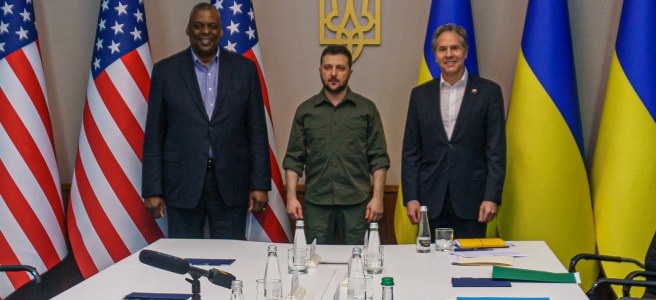
The debate and the Chancellor’s hesitation probably ended in the run-up to the meeting of the US Secretary of Defense with his counterparts from the other NATO countries and 14 non-NATO countries in Ramstein. Now there is more at stake than just the delivery of “German-made” heavy weapons. It was decided to train Ukrainian soldiers in Germany, together with the Netherlands and the USA, regardless of the definitions of international law. At the same time, it became clear at the meeting that the US strategy is not simply about Ukraine’s right to defend itself. As Secretary of Defense Austin made clear during his joint visit to Ukraine with Secretary of State Blinken, it is also about “weakening Russia to the point where it can’t do what it did when it invaded Ukraine. It’s already lost a lot of military capability and, frankly, a lot of its troops. And we don’t want them to be able to restore those capabilities very quickly.”[18] The New York Times said in late April that America’s goals are shifting “from a battle over control of Ukraine to one that pits Washington more directly against Moscow.”[19] This amounts to permanently weakening Russia so that it is eliminated as a competitor in the struggle over the formation of new geopolitical constellations.

So it’s not just about Ukraine’s right to self-determination, but about defending Western liberal normality by weakening Russia, or about a struggle for new geopolitical constellations in which NATO’s borders are pushed as far east as possible. In the process, Ukraine is becoming a battlefield. The war being waged in Ukraine is claiming more and more lives, destroying towns and villages, destroying livelihoods. Those who are supposedly being defended are being sacrificed to Western normality. Those who fuel the war from a (still safe) distance and venerate its protagonists and victims as heroes turn out to be “homeland combatants” who let others fight the war on their behalf. At the same time, they reveal what Western freedom and humanity entail: people become strategic material when they are needed for war. Refugees are welcome if this serves the war and its legitimation – as long as they have the “right” skin color.[20] If they are superfluous because they cannot be used, they can drown in the Mediterranean, bleed to death in barbed wire at the NATO borders, be put in camps or be deported into the hands of any one of the many ‘Putins.’ This logic also includes the fact that the defenders of Western humanitarianism and the moral apostles of war are unaware of their effects in worsening famines, climate disasters, etc. The threat of catastrophic famine only becomes an issue in connection with the Russian blockade of Ukrainian ports, because without reference to the Russian aggressor, the suffering of the ‘merely’ starving remains too remote to stir, let alone outrage, the humane heart and ethical disposition of a ‘homeland combatant,’ and certainly does not provide their brains with ‘food for thought.’ An impending gas embargo, however, does give pause for thought. That’s where the morality based on gut feelings and indignation begins to crack. Arndt Kirchhoff, Vice President of the Confederation of German Employers’ Associations, warns of the economic consequences of an abrupt halt to gas imports from Russia, because according to him: “We must not only show moral strength, but must also be economically stronger than the dictatorships of this world.”[21]

6. Socio-Psychological Considerations

The socio-psychological constitution of the subjects of capitalism is also affected by its crisis.[22] The foundations of their psychic constitution are the internalization of labor and the family as a space for social development. Both instances of socialization, which are interdependent due to their relationship of dissociation, are increasingly collapsing in the crisis of capitalism. As a result, people are being thrown back on themselves. In the face of eroding employment opportunities and social interconnectedness, they are expected to take personal responsibility for not only their happiness, but also for their failures. Self-realization is demanded as a self-adaptation to crisis phenomena such as precarious employment, the imminent danger of falling out of the middle class, or even becoming superfluous and standing alone. Self-responsible self-realization becomes an adaptation to the constraints of being subjected as an “entrepreneurial self” to the permanent stress  of an unattainable self-optimization in order to survive in the competition and, in case of failure, to take ‘personal responsibility’ for it and to start again with the optimization.[23] New ‘lot,’ new happiness. The drive dynamic, which in the structuring social context of an internalization of labor was oriented towards ‘rewarding’ oneself for work or being rewarded for it after the drive surge from the willingness to work and perform, is reaching its limits. With the dissolution of the objective social relationship between work and reward, the possibilities for sublimation collapse at the socio-psychological level.

More and more people who are thrown back on themselves are in danger of losing touch with the world of objects. Self-optimization is associated with the message: ‘You can do anything you set your mind to!’ Regardless of the objective circumstances, people are called to greatness. When they fail, they experience themselves as small and insignificant, but they are expected to rise to new greatness in processes of self-optimization. “Making oneself big when one actually feels small” and “blaming and judging oneself” – that is, the depressive variant of falling back on oneself – go hand in hand. Both variants “find it difficult to relate to the world of objects, they revolve around themselves, and cannot find the way to the objects.”[24] Delusions of grandeur offer a way to ward off the narcissistic mortification experienced in ‘being small.’ In this process, self-destruction can be experienced as the final expression of self-realization, in which one’s own greatness is staged.

How do people, thrown back on themselves in the face of war, deal with its horrors and its threatening escalation? Russia’s war against Ukraine and its threatening escalation into a nuclear world war also coincides with the other crises that leave little room for respite. The Covid crisis is not over and we haven’t seen the last of its economic consequences. The climate collapse is approaching and is manifesting itself, among other things, in ever new catastrophic weather phenomena. War, Covid, and climate change are exacerbating the social situations of the crisis via scarcity, supply chain disruptions, and price increases. Fears of restriction, descent and death are intermingled in all of this. In view of Russia’s war against Ukraine, it is noticeable that people tend to avoid the subject.[25] Is this a kind of depressive paralysis, fed by the powerlessness of being at the mercy of an uncontrollable and inscrutable dynamic? Covid was unpredictable too, but at least there were masks and vaccinations for protection. The climate crisis may be getting closer, but it seems so far away that it has yet to get under the skin of many.

In the public debates, an extreme moralization based on ‘gut feelings’ is conspicuous. It combines the blaming of others with the blaming of oneself, the blaming of Putin with the self-blaming of having underestimated him and of having given in to illusions of peaceful coexistence. The best way to exonerate oneself from guilt seems to be to support an economic boycott of Russia, including a boycott of Russian energy supplies, and to supply Ukraine with ‘heavy weapons.’ Such atonement, especially as far as the supply of ‘heavy weapons’ is concerned, is reminiscent of the sale of indulgences and the possibility of buying oneself free of guilt that it opened up. But alas, the cycle of ‘guilt and indebtedness’ cannot be escaped in this way. Supplying weapons implies that these weapons will be used to kill and destroy. On the one hand, the economic boycott threatens the standard of one’s own quality of life and is inseparable from the fact that poor people would bear a disproportionate share of the costs of such ‘atonement.’ And the morally necessary release from the guilt of having supported Putin through energy purchases leads to dependence on other morally and politically questionable figures and potentates in the search for a responsible energy supply.

“Whatever you do or fail to do, you are inevitably guilty,” says Stephan Grünewald.[26] If this is not simply understood as a reassuring postmodern statement of an insoluble dilemma, one of the many tensions and paradoxes with which we must live and act, the statement could be illuminated with insights from Walter Benjamin’s fragment on “Capitalism as Religion.”[27] In this piece, Benjamin writes that capitalism “is probably the first instance of a cult that creates guilt, not atonement. […] A vast sense guilt that is unable to find relief seizes on the cult, not to atone for this guilt but to make it universal, […] and thereby awaken in Him an interest in the process of atonement.”[28] With the inclusion of God in the capitalist social context of the cycle of guilt and indebtedness that cannot be atoned for, “God’s transcendence” is “at an end.” It is “not dead,” but is “incorporated into human existence,” and has become a “worldwide state of despair” that “is actually its secret hope.”[29] The disposed transcendence thus does not disappear, but becomes the fetish of capitalist immanence.[30] There is immanently no way out of this fetishistic social context and therefore there is permanent indebtedness, but no atonement. No action cannot escape the cycle of guilt and indebtedness.[31]

The subjects, nevertheless condemned to act, are driven back and forth between powerlessness and greatness. Powerless, they are thrown back upon themselves and are always guilty on various levels, economically, when they have mismanaged themselves, and politically, when they have made the wrong choices. They gain greatness in the illusion of being autonomous and able to act as subjects. Political greatness appears in the illusions associated with the fearless and resolute defense of Western freedom and is manifested in the strength not to be blackmailed by the ‘incarnation’ of evil in Putin. In this way, the “authoritarian-anomic erosion” of the ‘East’ can be simplified to “a new empire of evil.”[32]

One reason for the oscillation between powerlessness and megalomania, or the defense against powerlessness in megalomania, is the loss of the object and thus the reference to reality. It disappears in the ‘gut-based’ ethos. Dangerously binding maxims of action are derived from the righteousness that finds expression in general principles, life-wisdom and ‘common sense,’ without reflection on the social conditions as an object of critique. This may temporarily relieve the morally troubled gut and the powerlessness experienced as humiliating. But it is just as impossible to escape the real powerlessness in this way as it is to escape the socially structured indebtedness inherent in the fetishized relations.

The conceptual tools that could help us to understand what is happening have already been dismantled in the name of an “illusionless pragmatism,” as exemplified by the postmodern aversion to large-scale concepts and theories that are capable ofgrasping the totality of social relations, and in a spreading hostility to theory. Thus, the relationship between thought and social reality has been severed. “The real social contradiction, which is no longer manageable in the way it was before, is simply to be banished from thought.”[33] One result of such processes is that anyone who refuses to follow his gut feeling in the current debate must expect to be insulted as an intellectual patron and “homeland combatant” at Putin’s side.

7. The Dangerousness of The Present Situation

The world order wars are an illusory response to the disintegrating “territorial system of sovereignty, which is beginning to dissolve right before our eyes with the involuntary assistance of the democratic-capitalist apparatuses.”[34] With Russia’s war against Ukraine, the struggle over the disintegrating world order is being fought between nuclear-armed ‘blocs,’ whose sovereignty is simultaneously being eroded by the processes of the disintegration of commodity production. In the USA, the processes of socio-economic disintegration are converging with those in Russia. Russia now seems to have its back to the wall militarily as well. The hoped-for quick successes of the ‘special military operationhave not materialized. NATO, which hopes to gain geopolitical advantages by weakening Russia, is driving Russia and itself into a situation from which there is probably no way out without losing face. Territorial concessions by NATO, which Putin could portray as a victory, are diametrically opposed to the goals NATO pursues and promotes as non-negotiable. A return to the pre-war situation would completely delegitimize Putin.

The aporias that open up in the war situation are once again linked to the crisis of capitalism, which is engulfing state sovereignty, including that of Russia and the USA, in its processes of disintegration. In essence, the processes of disintegration are characterized by the fact that the abstract and irrational end in itself, the production of commodities to augment capital for its own sake, is increasingly coming up against its limits, and can be compensated less and less by accumulation simulated on the financial markets. The financial bubbles burst and cause economic crises. The economy and the financial markets are ‘stabilized’ with new money until a new bursting of bubbles occurs, which in the end can no longer be compensated for.

This emptiness of the process of valorization manifests itself at the individual level in the emptiness of subjects who, with the decline of labor, lose their social and socio-psychological basis and threaten to plunge into ‘nothingness.’ “After the bourgeois, enlightened subject has shed its shell, it becomes clear that the core of this subject is a vacuum; that it is a form which ‘in itself’ has no content.”[35] Self-annihilation accompanied by the annihilation of others, as manifested in killing sprees, becomes the last resort of the self-conscious and free subject from the experience of its ‘self-inflicted’ powerlessness and humiliation, its emptiness without perspective. It offers itself as the possibility of demonstrating greatness and power in annihilation. This will to annihilation plays itself out on the individual level as a double annihilation: “On the one hand, it aims at the annihilation of the ‘other’ for the purpose of apparent self-preservation at all costs; on the other hand, it is also a will to self-destruction that carries out the futility of one’s own market-economic existence.”[36]

Similarly to what happens at the level of the subjects, a double potential for destruction is revealed at the level of the overall structuring social context: one owed to capitalist normality and its enforcement, and a final one when this normality comes up against its final limits. “The concept of the democratic rampage is now to be taken quite literally at the level of military action. […] The more untenable and dangerous the world situation becomes, the more the military perspective comes to the fore and the less the inhibition to use high-tech violence on a large scale without hesitation.”[37]

The “unresponsive world” and “the incomprehensibility of the problems” mobilize a diffuse destructive rage. “It repeats on the level of the administrative psyche of the world market what goes on in the psyche of individual spree killers.”[38] Within the framework of this psychodynamic, nuclear annihilation also becomes conceivable and feasible. In the escalating crisis of capitalist commodity production, it is not good and evil, or rationality and irrationality that confront each other, but rather agents and subjects who are caught up in irrational structures of fetishized relations and their normative and symbolic implications. The nation states, which confront each other as blocs in warlike or dangerous constellations, are parts of the insane commodity-producing fetish system that is reaching the limits of its reproductive capacity. There can be no peaceful coexistence of people within the framework of this system. In defense against the experienced emptiness and powerlessness, a last resort could be sought in the search for one’s own greatness in atomic annihilation as the last expression of powerful self-assertion in order to ward off humiliating powerlessness. “In the world of consummate capitalism, only open madness is realistic. Under these conditions, so-called pragmatism itself inevitably takes on eschatological features.”[39]

How such perverse eschatology can present itself theologically was made clear by Gustav Gundlach, a representative of Catholic social teaching, during the ‘Cold War.’ The right and duty of defense apply unconditionally even in the face of self- and world annihilation, for: “Even in a situation where only a manifestation of God’s majesty and his order, which we owe to him as human beings, would remain as success, duty and defense of the highest goods are conceivable. Yes, if the world should perish in the process, that too would be no argument against our reasoning.”[40] Meanwhile, after all, if we follow Walter Benjamin, God’s transcendence has migrated into the immanence of capitalist socialization as its fetishization. As a “‘secularized’ and reified God,” God now stands for the “form of value expressed in money,” for “the objectified metaphysical real abstraction of modern Dasein.”[41] The “downfall of the world” is to be offered as a sacrifice not to a transcendent fetish as the expression of an ontological order, but to the majesty of immanently fetishized relations.[42] Such “religion” is “not the reform of existence but its complete destruction.”[43] Esotericists play their accompanying music in their longings for extinction in fusion with the cosmos – dreams that have not only become ‘modern’ in postmodernity, but were already dreamed of at the beginning of the Enlightenment, and are obviously in vogue in times of crisis, as they were before the beginning of the First World War.

8. What Remains (To Be Done)?

This question leaves us at a loss. No instructions for action can be derived from the theoretical considerations necessary for understanding – certainly none that are unambiguous. Moreover, the aporia that the question of action encounters is due to the ‘progression’ of the crisis conditions in which the globe is being driven to the edge of the abyss. Immanently, there is no way out and yet action is necessary. From my point of view, it is obvious to refrain from supplying more and more weapons. With more and more weapons, the suffering and death of people and the destruction of the living spaces only threaten to continue and to claim more and more victims. All in defense of an empty form of government.

Thus, by refraining from supplying weapons, an attempt could be made to interrupt the dynamics of escalation. This could open the window for something like what Walter Benjamin had in mind with the concept of interruption. He opposes the continuity of the flow of time and prioritizes interruption in order to recognize the present. He wants to interrupt the meaningless progress of modernity, which leads to catastrophe. Interruption instead of ‘Keep it up!’ could open a window of time for critical reflection and interrupt paths that can lead to a global catastrophe that once again goes far beyond what we experience in the ‘normal’ catastrophes of crisis capitalism.

Knowing the present implies for us a “radical critique of society” as a “critique of earthly real metaphysics,” as a “critique of the fetishistic constitution of society.”[44] Without it, it is impossible to grasp what is ‘going on’ as barbarization and annihilation in the worsening crisis of capitalism. “Radical social critique” interrupts the continuum of fetish relations by reflecting upon them. In doing so, it aims at the “complete break(s) with capitalist real metaphysics, with the economic reality principle, and with the nomos of modernity.”[45] If there are to be realistic perspectives, then they will only emerge through the path of an unvarnished and self-critical reflection, interrupting the continuum of normality, upon the socially delusional system of commodity production and its escalating crises, in which the system itself is increasingly running amok.


[1] https://exit-online.org/textanz1.php?tabelle=aktuelles&index=23&posnr=765.

[2] https://exit-online.org/textanz1.php?tabelle=aktuelles&index=2&posnr=805.

[3] Cf. Tomasz Konicz, Auf zum letzten Gefecht, in: Konkret 4/22.

[4] Jan Varwick, Raus aus der Eskalationsspirale mit Russland, Telepolis Jan 14, 2022.

[5] Cf. Sandro Mezzardo, Aus dem Krieg desertieren. Drei Gründe sich dem russischen Angriffskrieg zu widersetzen. Für einen neuen Internationalismus, in: medico international, rundschreiben 01/22, 12-15., 12f.

[6] See also Andreas Umland, Das eurasische Reich Dugins und Putins. Ähnlichkeiten und Unterschiede, 2014, https://www.kritiknetz.de/images/stories/texte/Umland_Dugin_Putin.pdf.

[7] Throalf Cleven, Des Kremls heiliger Krieg, in ‘Kölner Stadt-Anzeiger,’ 4 May 2022.

[8] See Benjamin Bidder, Russlands rechte Freunde, 2016, https://www.spiegel.de/politik/ausland/russland-wladimir-putins-rechtsextreme-freunde-in-europa-a-1075461.html; see also Patrick Gensing, Silvia Stöber, Moskautreue Rechte, 2016, https://www.tagesschau.de/inland/neurechte-russland-101.html.

[9] Cited from: https://taz.de/Querdenker-unterstuetzen-Putin/!5838247/

[10] See also Gerd Bedszent, Zusammenbruch der Peripherie. Gescheiterte Staaten als Tummelplatz von Drigenbaronen, Warlords und Weltordnungsriegern, Berlin, 2014.

[11] Cf. in detail Robert Kurz, Blutige Vernunft: Essays zur emanzipatorischen Kritik der kapitalistischen Moderne und ihrer westlichen Werte, Bad Honnef, 2004; Roswitha Scholz, ‘Die Demokratie frisst immer noch ihre Kinder’ – heute erst recht! In: exit! Krise und Kritik der Warengesellschaft, Spring 2019, no. 16, 30-60.

[12] Cf. Pinochet als Vorbild, Neues Deutschland, 31.12.1993, https://www.nd-aktuell.de/artikel/461493.pinochet-als-vorbild.html.

[13] Quotations from: Katharina Körting, Debatte über Krieg und Aufrüstung: Fortschreitende Verharmlosung, in: der Freitag vom 04/24/2022.

[14] Ibid.

[15] Kölner Stadt-Anzeiger on 05/02/2022.

[16] Markus Decker in the ‘Kölner Stadt-Anzeiger’ of 05/01/2022.

[17] Kölner Stadt-Anzeiger from 05/03/2022.

[18] Quoted from: Florian Rötzer, Ukraine Krieg geht es nicht um die Ukraine, Telepolis 04/29/2022.

[19] Ibid.

[20] Cf. Bernhard Torsch, Refugees welcome, Ausländer raus!, in: Konkret 4/2022; cf. also Ramona Lenz, Die Grenzen der Solidarität, https://www.medico.de/blog/die-grenzen-der-solidaritaet-18565.

[21] Kölner Stadt-Anzeiger from 05/07/2022.

[22] Cf. Leni Wissen, “The Socio-Psychological Matrix of The Bourgeois Subject in Crisis,” online at: https://exitinenglish.com/2022/02/07/the-socio-psychological-matrix-of-the-bourgeois-subject-in-crisis/

[23] Cf. Ulrich Bröckling, Das unternehmerische Selbst. Soziologie einer Subjektivierungsform, Frankfurt am Main 5/2013.

[24] Herbert Böttcher, Leni Wissen, “Between Self-Reference and Solidarity?” online at: https://exitinenglish.com/2022/07/09/between-self-reference-and-solidarity/

[25] Cf. Stephan Grünewald, “Das Thema Krieg wird gemieden,” in: Kölner Stadt-Anzeiger, 4 May 2022.

[26] Ibid.

[27] Walter Benjamin, “Capitalism as Religion,” online at: https://cominsitu.wordpress.com/2018/06/08/capitalism-as-religion-benjamin-1921/.

[28] Ibid.

[29] Ibid.

[30] Cf. Herbert Böttcher, Kapitalismus – Religion – Kirche – Theologie, in Kuno Füssel/Michael Ramminger (eds.), Walter Benjamin’s Prophetic Legacy, Münster 2021, 31 – 48.

[31] Cf. Robert Kurz, Geld ohne Wert: Grundrisse zu einer Transformation der Kritik der Politischen Ökonomie, Berlin, 2012, 389ff.

[32] Cf. Tomasz Konicz, Krieg als Krisenbeschleuniger.

[33] Robert Kurz, Das Ende der Theorie: Auf dem Weg zur reflexionslosen Gesellschaft, in: Robert Kurz, Weltkrise und Ignoranz. Imperialismus im Niedergang, Berlin 2013, 60 – 67, 66.

[34] Robert Kurz, Weltordnungskrieg: Das Ende der Souveränität und die Wandlungen des Imperialismus im Zeitalter der Globalisierung, Spring 2022. Expanded new edition of the original Bad Honnef 2003, 414.

[35] Ibid, 68.

[36] Ibid, 71.

[37] Ibid, 429.

[38] Ibid.

[39] Robert Kurz, Marx lessen: Die wichtigsten Texte von Karl Marx für das 21. Jahrhundert, Frankfurt am Main 2001, 395.

[40] Gustav Gundlach, in: Stimmen der Zeit 164 (1959) 13, quoted from: Rupert Feneberg, Gerechtigkeit schafft Frieden: Katholische Friedensethik im Atomzeitalter, Munich 1985, 126.

[41] Kurz (note 34), 69.

[42] Gundlach (note 40).

[43] Benjamin, (note 27).

[44] Kurz (note 34), 434f.

[45] Ibid, 436.

Originally published on the exit! homepage on 05/27/2022

Opportunism in Crisis

How the Left Party wants to use the current crisis as a career springboard through social demagogy.

Tomasz Konicz

If history is still to be written in the coming decades, 2022 is likely to go down in the annals of human history as the year in which the capitalist climate crisis began to turn into a global climate catastrophe. In Europe, the U.S. and China, rivers or freshwater lakes dry up, while deciduous trees that don’t burst into flames turn brown in midsummer.[1] The number of heat deaths is expected to be in the tens of thousands.[2] In Pakistan, a devastating flood has covered about a third of the country, affecting 30 million people. Large parts of the country, including large areas of cultivated land, have been destroyed.[3] In many countries, the power supply can barely be maintained on a permanent basis, and there is a threat of blackouts during hot spells.[4] In many regions of the USA, the water supply is threatening to collapse.[5]

The impact of this year’s heat and fire season – formerly known as “summer” – on food prices in the northern hemisphere is likely to cause existential hardship for many millions of people, not only in the global South. And it is clear that this is a capitalist climate crisis,[6] as capital, in its drive to valorize, is unable to reduce global CO2 emissions – this has only ever been done in the 21st century during a global economic crisis. Global emissions of greenhouse gases, after falling during the pandemic, will reach a new historic high in 2023, according to the International Energy Agency (IEA) – and this upward trend shows no sign of slowing down or reversing.[7] The pre-crisis level is expected to be reached as early as this year.

It is thus a simple, obvious truth that the capital relation must be transformed into history as quickly as possible if the climate crisis is not to lead to barbarism and social collapse. The fetishistic momentum of capital as infinitely valorizing value is destroying the world.[8] And this truth is factually obvious. It is not secret knowledge. By now many people understand that endless economic growth in a finite world is insanity. The overwhelming majority of the population at least feels that things cannot go on like this, that late capitalist society is heading for an abyss – except for the Left Party, and the now openly reactionary parts of what calls itself the German Left.

Social Demagogy in the Crisis

So what do we need after this year’s summer of horror? If the Left Party has its way, a “hot autumn” of social protests. According to them we need more capitalism, only it should be social. Of the myriad ways to respond to the manifest systemic crisis, to climate collapse, inflation, pauperization, social erosion, fascism, war, and recession, the stock conservative decision-makers in the Karl Liebknecht House chose the anachronistic and opportunistic route that ultimately amounts to social demagoguery. There is no going back to Rhineland capitalism and the social market economy in the face of the unfolding crisis. The “Left” – eyeing coalition options – wants to enrich the crisis ideology of a “green capitalism,” as successfully popularized by the Greens, with a social component.

Social demagogy means telling people sweet, convenient lies in order to make political capital out of them. This is what the Left Party – across all factions– is doing right now: by marginalizing radical crisis theory and criticism of the system within the Left, it is implicitly giving frightened people the impression that the ecological and economic systemic crisis can still be controlled through redistribution and the welfare state, and they do this in order to get votes and posts in the forthcoming regime of crisis administration through this management of the movement, through the de-radicalization of potential resistance. The Left Party in fact wants to create demand for itself among the functional elites, i.e. for opposition management. It is, so to speak, the last opportunistic chance for the Left Party. This campaign is not about the people threatened by the crash, it is about the Left Party, which is in fact lying to them with the comfortable drivel of social capitalism, while our rivers dry up, driving the system into socio-ecological collapse.

Social protests in the escalating systemic crisis, in which people’s only too justified existential fear is instrumentalized for party political purposes in order to distort the manifest systemic question into a mere question of redistribution – this demagogy is not only a caricature-like prime example of false immediacy,[9] but also the result of a critique of capitalism reduced to class struggle and redistribution. It is a reactionary adherence to the old (which is collapsing) that opens up spaces for the Querfront of the old left and the new right,[10] as is already reality in the East German provinces, for example in Brandenburg an der Havel, where on September 17th the Left Party, Wagenknecht’s “Aufstehen,” the peace movement, contrarians, the AfD and Nazis demonstrated together for peace and Russian natural gas. The Left Party is now competing with the AfD in terms of social demagoguery. They are literally at the same demos.[11] The Querfront – as propagated in organs such as Telepolis,[12] is a reality, and it is an expression of the general crisis-induced brutalization, the regression of the German left, that this hardly triggers an outcry, hardly a scandal.

And what is the national-social prominence of the opportunistic imposition called the Left Party doing in this existential crisis? It demands more fossil fuels, of course. Sahra Wagenknecht, the favorite leftist of the German right, who is above all party exclusion proceedings, already demanded in mid-August, together with the FDP right-winger Kubicki, the commissioning of the now sabotaged Nord Stream 2 gas pipeline, because this would benefit “people and industry in Germany” more than Putin.[13] The openly reactionary parts of a “left” that is already literally marching with Nazis are thus calling for a solidification of fossil capitalism in reaction to the escalating systemic crisis of capital. But it must be social!

The leadership of the Left Party is actually telling people that in the incipient climate catastrophe, in the manifest agony of capital, all that is needed is a socially just capitalism. This is not a polemical exaggeration. One only has to listen to the current co-chairman, Martin Schirdewan, in his ARD summer interview, who demanded a “fair distribution of the burdens of the expected crisis” and made the goal of the “hot autumn,” “to put the federal government under pressure and to induce it to act” in order to introduce a “gas price cap” and an “windfall profits tax” for extra profits caused by the crisis.[14]

Even if these hypocritical remarks, grotesquely disproportionate to the unfolding of the crisis, were taken seriously and implemented, they would simply be ineffective. Curtailment of profits, state price controls, nationalization – these demands, which show incredible faith in the state, are strikingly reminiscent of the failed crisis measures implemented in the periphery of the world system, for example in Turkey or Venezuela (and this is precisely a consequence of the advance of the crisis process, which eats its way from the periphery into the centers, so that the social devastation in the global South provides a glimpse into the future of the crisis unfolding in the centers). The Left Party, together with its Keynesian appendage, is in fact walking in the footsteps of Erdogan, the interest rates critic, without even realizing it.[15]

Left Opportunism, Querfront and The New Right

Sometimes, in formulating these anachronistic, social-democratic demands, the causality of the crisis is turned on its head (for example, when inflation is reduced to corporations seeking extra profits). The neo-Keynesian real satire known as “Modern Monetary Theory,” which just a few months ago was preaching unlimited money printing,[16] in the face of double digit inflation, flees from intellectual bankruptcy into simplistic conspiracy theories,[17] and attributes this inflation to corporate greed. As if before inflation – fueled by money glut, the pandemic, the climate crisis and the bursting liquidity bubble in financial markets – capital did not seek to make maximum profits.[18] The consequences of the world crisis of capital dying from its internal contradictions, which in its agony devastates ecosystems and society, are transfigured into its cause by the construction of chief villains (such as foreign energy companies), who are supposed to be responsible for it, in order to then offer higher taxes or redistribution as a solution.

The systemic crisis will be personified through the production of scapegoats, which will ultimately benefit the New Right, which will in effect build on the opportunist “groundwork” of the Left Party. All the New Right has to do is replace the bogeyman image of the evil bigwig, currently being constructed by the Left as the cause of the crisis, with the bogeyman image of the foreign conspiracy and the foreign parasite, which is infinitely more effective in the Federal Republic with its terrible authoritarian tradition. Personification of the causes of crisis in a systemic crisis inevitably leads to crisis ideology. The Left Party – and not only Wagenknecht – thus encourages the rise of fascism.

Both – left and right – thus rely on social demagogy in the “hot autumn.” The Left is playing into the hands of the New Right (not only in East Germany).[19] Who is likely to profit from the social protests based on false basic assumptions which are bound to fail in the reality of the crisis? The reactionary, right-wing, national-socialist left, stuck in false immediacy and truncated class-struggle thinking, which has already been involved with the vigils for peace,[20] with Wagenknecht’s campaigns for the AfD during the refugee crisis,[21] with “Stand Up” and with collaboration with the right in the Corona Cross Front [22] fostered the rise of the AfD and Pegida? Or rather the right, which owes its double-digit election results in the FRG to sheer crisis anxiety and the extremist exacerbation of rampant neoliberal ideology (from social Darwinism to economic location nationalism)?[23]

It is thus obvious: what the Left Party is currently doing is opportunistic window-dressing that prepares the ground for the Right. This ultimately misleads the people threatened by the crash, whose emerging fears are only too justified – and this should be quite clear to the people behind the social campaign in the Karl Liebknecht House. Sometimes party members say openly in direct exchanges of views that it is of no use to them “to simply tell people” what is the matter – manipulation is the program here.

The systemic crisis of capital, which is taking place as a blind world process, manifests itself not only in the incipient climate catastrophe, but also in the danger of major war in Europe, in the resource and energy crisis, in the global debt crisis, in the impending recession, in the devaluation of value that is taking place by means of inflation – while the leadership of the Left Party, following Wagenknecht’s right-wing friendly left conservatism,[24] wants to preach an anachronistic return to the “social market economy.” The systemic crisis has reached a level of maturity where the lights are indeed threatening to go out, as value critic Robert Kurz predicted in 2011[25] – and the crisis-blind left only wants to see the “social question,” as if capitalism were facing a new boom phase like in the 50s and 60s, which after all was the economic foundation of the historically short period of the “social market economy.”

The Crisis as A Career Springboard

The crisis ideology of a green transformation of capitalism, of a Green New Deal,[26] which is the reason for the electoral success of the Greens, is in fact simply being expanded by the Left Party to include a social component. It is simplistic coalition thinking that feels compelled to take to the streets for career reasons and to defuse the potential for protest that is emerging as a result of the crisis: The green chimera of eco-capitalism, which allows the public to cling to capitalism despite an advanced climate crisis, has the social-democratic nonsense of “climate justice” added to it. The crisis as a career springboard – that is the strategy of the “Left Party.”

Thus it is evident that the Left Party – as mentioned at the beginning – is primarily concerned with itself in its “hot autumn,” since this group of opportunistic plunderers [Beutegemeinschaften] and racketeers sees in it what is probably their last chance for a career and a post, for fully air-conditioned official cars and offices within the coming crisis administration. But the social campaign is also intended to ensure that the scandals of recent years – from Wagenknecht’s right-wing rhetoric, to Porsche-Klaus in the climate committee of the Bundestag, to the sexual assaults – are forgotten and that the party remains above the five-percent hurdle in the next elections in order to secure coalition options in the upcoming crisis administration. That’s why the Left’s socio-political attacks are focused not on Scholz, or the SPD, but on the FDP, whose place the Left Party wants to inherit – as if Lindner were chancellor.

What the promoters of this party are currently spouting is pseudo-radical class struggle talk, which at the same time shies away from any fundamental conflict in its concern for its own competitiveness and the “cohesion” of society. This becomes obvious whenever, in the face of the systemic crisis, it is a question of the entire system, a question which all the Left Party celebrities do their best to avoid. This bitterly necessary, conflict-prone breakout from the capitalist thought prison, which would be a basic prerequisite for emancipatory practice, is avoided by the party as much as possible, because this would actually lead to serious conflicts, as isolated, timid attempts in this direction have shown.[27] On the contrary: in the apparatus and environment of this party, every effort is made to ensure that the left remains in a false capitalist immediacy even in the manifest systemic crisis.

Regression and Movement Management

It was the SPD as the party of the “little man” which, with Agenda 2010 and Hartz IV, pushed through the biggest program of disenfranchisement of wage earners in the post-war history of the FRG, it was the pacifist-minded party of the Greens, which was able to lead the war of aggression against the Federal Republic of Yugoslavia in violation of international law – in late capitalism, formally left-wing parties are predestined to implement reactionary policies, since they are particularly well able to paralyze oppositional potential through their close ties with the strata, movements or organizations affected by them. This happens first through the marginalization of radical, categorical critique within the left, which is the usual precondition for government participation. In order to become “fit” for government, the Greens, for example, had to cold-cock their “fundis” in the 90s. A similar process is taking place in the current crisis of the left, since the Left Party can only achieve its desired position as capitalist crisis manager by marginalizing radical crisis theory and critique in the German-speaking left.

In their social campaign, the Left Party is thus simply practicing movement management in order, as already indicated, to increase the demand for itself in the political establishment by intercepting the population’s rising crisis anxiety and willingness to protest and redirecting discontent into a reformist cul-de-sac. The focus on redistribution and class struggle that accompanies muzzling and rhetorical militancy will pursue an ideological personification of the consequences of the crisis, while marginalizing radical critique and crisis theory in order to obscure the fact that overcoming capitalism is necessary for human survival. Opportunism must therefore force theoretical regression within the left, it must push back the previously achieved level of reflection on the crisis in order to be “successful” with its opportunist demagogy of redistribution.

How this movement management, including opportunistically motivated regression into truncated, right-wing friendly pseudo-criticism, takes place in concrete terms can be seen, for example, in the Querfront medium Telepolis, which has been hijacked by a red-brown Left Party syndicate [Beutegemeinschaft] from the environment of the Bundestag faction of the “Left”[28] – in order to suppress the previously possible radical critique of the capitalist climate crisis at the request of the publisher, precisely because the crisis is becoming manifest in, for example, the incompatibility of capital and climate protection, which is now clearly evident. The usual thematization of the systemic crisis at Telepolis – despite all the restrictions of the bourgeois media – the insistence on the necessity of system transformation as a matter of survival, has been suppressed by the Left Party; radical critique has given way to mere grumbling about social inequality, right-wing friendly Querfront propaganda and purely descriptive accounts of the crisis. And it is precisely this theoretical regression, this inverted psychoanalysis, that forms the often unconscious foundation of the Left Party’s opportunist program in the crisis – and it too provides ideological ammunition for the New Right.

In this way, the ability to govern the big picture is practiced on a small, greasy scale. Those forces that see the current crisis surge as a career ticket for red-red-green, that are actually already practicing state repression, have to marginalize or domesticate all the “crisis talk,” because it is – in contrast to the distribution debate – simply not compatible with the political establishment in which they want to become something. And this neutralization of radical critique and practice in the systemic crisis is indeed a practical ability that could make a left party open to the right attractive to capitalist functional elites.

Movement Competition

This applies above all to the shaping of the crisis discourse within the left by means of spokespeople. The non-stop talk about tax policy, redistribution, social benefits, and nationalization silences the discussion about alternatives in the manifest systemic crisis, as these are incompatible with talk show rounds and coalition negotiations. The emphasis on “interest politics,” which has become hollow, thus obscures the auto-destructive fetishism of capital in all its aggregate states. This opportunistic fading out of categorical critique, together with the necessary system transformation, also results in the ever more clearly emerging inner-left movement competition in the crisis, which is not coincidentally affecting the climate movement.[29]

The climate crisis, which is hardly supposed to play a role in the “Hot Autumn,” cannot be pressed into the rough grid of class interests, since here the destructive momentum of capital as well as the powerlessness of the capitalist functional elites becomes obvious. Consequently, groups like “The Last Generation,” who are actually disruptive, are criticized by reactionary leftists for their courageous street blockades, because these blockades keep wage-earners from working – i.e., the process of capital’s valorization is interrupted. These are sometimes the same potential crisis administrators who see nothing wrong with the Left Party and Nazis competing in social demagogy, as they did in Leipzig on September 5th. Or when they march together in demos, as in Brandenburg an der Havel.

But the tensions and frictions between different movement approaches on the left only point to the very real social contradictions in late capitalism: This movement competition, in which the class interest of variable capital – readily hallucinated in the swamp of leftist scenes as the “revolutionary subject” – is quite concretely at odds with climate protection, is not just a result of opportunistic calculation on the part of the national-socialist, trade-union and Wagenknecht-affiliated currents of the Left Party, which have also received an internal party offer of reconciliation with the social campaign in order to overcome the trench warfare of the past in cross-currents of demagogy and careerism.

Twofold Opportunism

From the vigils for peace in 2014, to the years of Wagenkencht’s advertising campaigns for the AfD and the New Right, to the lateral-thinker protests during the pandemic: in recent years, a large, right-wing friendly Querfront scene has formed on the left, which is unlikely to have any fear of contact with the right in the upcoming social protests. How far the deadening and the habituation effects have already reached in this respect, was not only shown in Brandenburg an der Havel,[30] but already at the parallel demonstrations in Leipzig at the beginning of September, where newspaper distributors of the junge Welt quite naturally brought their wares to the German man in the Nazi rally and members of the Querfront troupe Freie Linke were quite visibly participating in the rally of the well-behaved social-democratic Left Party.

Of course, there are different currents in the Left Party, but forces critical of capitalism have long ceased to play a role in the party. Rather, they are different approaches to opportunist politics that are currently vying for dominance in the party. The accelerating erosion of the German left after the outbreak of the Ukraine war,[31] into left-liberal and green forces, as well as into the right-wing friendly Querfront, is also effective in the Left Party. This became obvious during the quarrels in the run-up to the first Left Party Monday demonstration in Leipzig at the beginning of September, when the national-social camp around Wagenknecht came into conflict with the left-liberal current.[32]

Wagenknecht’s attacks in the social networks against Prime Minister Bodo Ramelow,[33] who is said to have prevented the Left Party’s Querfronttante from appearing in Leipzig, thus give no reason to hope for a minimum level of civilization in the Left Party. Mr. Ramelow is the one German prime minister who in 2020 deliberately chose an AfD politician as vice president of the state parliament in order to allow the AfD “parliamentary participation.”[34] Ultimately, these are just internal frictions between various opportunist currents in the party: between the left-liberal currents, which are betting on red-red-green, and simply reactionary forces, in which class-struggle thinking has degenerated into right-wing populism, in which the “people” and their will, which took the place of the proletariat, serves as code for the half-Nazi who hangs around Querdenkern & Co. – and whose delusions are to be served.[35]

Ignorance and Careerism

But it is not all intention in the crisis opportunism of the Left Party. Also at play here is ideological delusion, plain left-wing stupidity.[36] The most important ally of left opportunism is left ignorance, the unwillingness to say goodbye to anachronistic ideology, mostly coupled with an aimless activism: “Don’t babble, do.” Groups from various Left-wing scenes marched with such banners at the social demo in Leipzig at the beginning of September, in order not to be disturbed by any theory in their blind practice, which persists in false immediacy. Sometimes, in conversations, any criticism of the opportunist practice of the Left Party is rejected if it is not itself accompanied by practice (“What are you doing concretely?”). According to this logic, the social demagogy of the Left Party can only be criticized if one practices social demagogy oneself, whereby even fundamental insights into the function of theory formation fall victim to the general leftist regression.

This blind cult of practice goes hand in hand with an increasing hostility to theory and a downright hatred of intellectuals, as is characteristic of pre-fascism. The right-wing compatible ideologems of “simple truth” and “common sense” celebrate triumphs, texts must be kept simple and written in the main sentence style in order not to force people to think – which is actually only an expression of the commodified expectations of this regressive milieu, who are simply too lazy to think and shy away from the effort of thinking or the intellectual examination of complex topics. The dull half-Nazi who runs with lateral thinkers forms the bar to fall below here, which is already an implicit insult to the great “people” of whom these circles make so much fuss.

The general regression also manifests itself in a conservative desire for a return to the old, revolutionary times, so that in the meantime, in the wake of the Left Party’s social campaign, traditional Marxist adherents are simply reanimating slogans of the Bolsheviks from the revolutionary period, suddenly demonstrating for “heating, bread and peace” and imagining themselves as a little junior Lenin, while in fact they are only water carriers of the Left Party’s opportunism. Rockin’ like it’s 1917 – which is only possible as an ideological by-product of the opportunist distortion of the systemic crisis into a question of class struggle and social justice. Ignorance of the crisis and ideological delusion thus form a good basis for the only inner-left movement that has a real interest in marginalizing crisis theory: opportunism.

A Pinch of Class Analysis: The Middle-Class Left

Another moment that unconsciously prepares the ground for social demagogy is, ironically, the social origin, the class composition, of the post holders and functionaries in foundations, the party apparatus and media in the environment of the Left Party. These are mostly members of the middle class, who are now quite simply afraid for their white, German, middle-class asses, which are going up in smoke in the current crisis. In the party apparatus and among those mixed in with the “Left Party,” and in the entire “left-liberal” spectrum of the “Greens,” this stratum is dominant. The German-speaking left is largely a middle-class left, as is evident from its indestructible cult of the proletariat, which has everything to do with wishful thinking and nothing to do with late capitalist reality.

And, as soon as the German middle-class snob is confronted with a crisis surge that concretely questions his previous way of life, he suddenly discovers how beautiful life can be – in the middle class of the centers of the late capitalist world system. The conservative wish for things to remain as they are manifests itself in “left-compatible” forms: in blindness to the crisis and social nostalgia. The social campaign is thus also a doomed attempt by people from the middle class to maintain their own social position in the midst of the systemic crisis. The struggle of the left-liberal middle class for the welfare state, in its false immediacy, comes close to the struggle to maintain the system, which is collapsing because of its contradictions, and which had produced in the centers a narrow, privileged stratum, seen globally, that wants one thing above all: to remain middle class, as part of the “first world,” of course.

Summary: Left-Wing Crisis Opportunism

There are thus a number of factors that lead to this absurdly statist, anachronistic bandwagon being so successful, even though the crisis has now reached such a degree of maturity that even its former deniers on the left can no longer avoid incorporating fragments of crisis theory into their left-liberal, social-democratic or Leninist ideologies in order to form veritable Frankenstein constructs. The stupidity, narcissism, and ideological delusion of leftist scenes form a good basis for the only inner-left movement that has a real interest in marginalizing crisis theory: opportunism.

What results from consistent crisis theory? The idea that the overcoming of capital as an autodestructive totality is simply necessary for survival. Left to its own fetishistic dynamics, the automatic subject running amok will complete the world destruction already set in motion. This maxim of leftist crisis practice is therefore non-negotiable. There is no alternative to attempting an emancipatory systemic transformation. But how can one sell this in the late capitalist media or political establishment, in coalition negotiations or on the talk show? With the marginalization of radical crisis consciousness, however, opportunism can still hope to try its hand at being a doctor at the bedside of capital, which in the final analysis amounts to becoming the subject of the coming crisis administration. It is a panicky logic of “save yourself” that gives opportunism its particular brutality in its last great run for posts and positions. Since bunkers or private islands are not up for grabs, people seek refuge in the eroding and feral state apparatuses, which also forms the basis of the increasing faith in the state among parts of the left – preferring to dish it out inside the apparatus rather than having to take it outside.

Left opportunism in the systemic crisis of capital, which in fact degenerates into capitalist crisis management, can thus build on broad ideological and identitarian tendencies that often operate unreflectively in the eroding German left as a result of the crisis. Theoretical regression, the suppression of categorical critique and theoretical insights that have already been achieved, is not only fueled by left opportunism, it is also part of the general brutalization of late capitalist societies in the crisis, which also produces habituation effects and leads to a blunting of critique. Left-wing conservatism, which in its cult of the proletariat clings to the anachronistic parts of Marxian theory and can only confront even the manifest climate crisis with truncated class struggle thinking, also objectively promotes left-wing opportunism, which distorts the systemic crisis into a question of redistribution. And finally, it is the accompanying personification of the crisis, the search for villains behind the scenes who are blamed for inflation or the climate crisis, that also provides ideological ammunition for the New Right – and which manifests itself quite concretely in the Querfront that is now openly marching.[37] The right in Germany already seems to be emerging as a beneficiary of the crisis.

Antidote to Crisis Opportunism: Say What’s What!

But all this does not have to be – even in Germany with its terrible National Socialist tradition. Regression, the rise of fascism, and the fall into barbarism are not inevitable. How about a new practical approach, instead of reeling off the old, brown-tinged tales of past decades one last time? Like trying to tell people what’s what in the face of crisis? It is obvious by now that the capitalist world system is in agony and threatens to break down because of its internal and external, ecological contradictions – even in the German left this has become known by now. The dull feeling, widespread among the population, that “it can’t go on like this” must be taken up and concretized in concrete practice. The ultimate task of the left is to radicalize the growing unease with capitalism, that is, to go to its roots in order to make it clear that overcoming capital within the framework of a system transformation is necessary for survival. The transformation of the capital relation into history is thus the last capitalist necessity.

Either capital is consciously transformed into history by an emancipatory movement, or it destroys the ecological and social foundations of the process of civilization. It is as simple as that. And this can be explained in an understandable way to people who have long since suspected it, for example by pointing to the absurdity of boundless economic growth in a finite world – but it is a career killer for all the left opportunists who still want to become something in the coming crisis administration in politics and the media. That is why the question of the offensive dissemination of a radical crisis consciousness is crucial in leftist practical efforts. On the one hand, it forms the dividing line separating it from opportunism, but above all, a clear understanding of the character of the crisis is the basic prerequisite for an emancipatory transformation movement. Since there is no “revolutionary subject,” since there is no world spirit secretly helping the “cunning of reason” to break through, the question of crisis consciousness is decisive.

That is why the question of systemic transformation must be addressed offensively in all practice – not because one wants it in a radical attitude, but because it is inevitable for all of us. The self-movement of capital ignored by the truncated critique of capitalism, the fetishism driven by the inner contradictions of the capital relation, clearly emerges in the face of the impending socio-ecological collapse, which also disgraces all Leninist logic of interests. Humanity is powerlessly at the mercy of the destructive dynamics of capital, which it unconsciously produces through market mediation, even in its agony. The hope that must be held on to at all costs, despite all evidence, is that during the open-ended transformation process this fetishism can be overcome and transferred from an emancipatory movement into the conscious shaping of social reproduction.

There is thus a very simple means to distinguish the opportunism of the Left Party from clear, radical opposition in the coming crisis chaos. An emancipatory overcoming of capital is only possible with the formation of a radical, critical crisis consciousness within the population, which is currently being sabotaged by the social demagogy of the Left Party. It is the offensive thematization of this simple, all too evident truth that capitalism is at its end, that a system transformation is inevitable and that it is a question of collective survival to steer the inevitable transformation process in a progressive direction. All concrete left politics should be oriented towards this, towards the upcoming struggle for the transformation of the system, instead of frantically clinging to the categories that are currently in the process of dissolution, in order to still get a place in the government bunker in the looming crisis administration.

Strictly speaking, a revolution, which would mean the establishment of the infamous Leninist “dictatorship of the proletariat,” is no longer necessary, nor is it possible, since the proletariat itself is dissolving. What is inevitably at hand, however, is a transformation struggle, that is, a struggle over the course of the inevitable systemic transformation. And here, especially in its initial phase, moments of the old class struggle may well appear. All concrete struggles – from social protests, to climate strikes, to Antifa demonstrations or civil rights movements – would have to be consciously led and offensively propagated as struggles for a post-capitalist future. It is necessary to think in processes, contradictions, in order to identify those forces and constellations that favor an emancipatory course of transformation. And this consciously led struggle for the post-capitalist future would also be the very real common denominator of concrete social movements, which would prevent competition between various movements – for example between the social justice and climate movements.

The question is simply which late capitalist society should enter the inevitable transformation process: an oligarchic, highly armed police state, or a relatively open bourgeois democracy, etc.? However, the struggles against late capitalist crisis tendencies such as pauperization, de-democratization, the rise of fascism, etc., must be waged offensively as partial moments of the transformation struggle, as I said. This radical crisis consciousness can initially also be articulated in slogans and demands: Social protests and redistribution demands, for example, would aim at making the rich pay for the upcoming transformation – as long as money still has value. For in the end, even in concrete social struggle, we must dare to break out of the capitalist thought prison, instead of clinging to eroding categories such as the welfare state, etc.

For this reason, bourgeois derivatives of the class struggle logic, such as the ecologically motivated critique of consumption and its corresponding ideology of renunciation, are counterproductive. It is not a question of restricting the consumption of commodities, which is only a moment in the process of valorization, but of freeing the satisfaction of human needs from the constraining corset of the commodity form. Once again, the crisis will destroy consumption (including the state!) along with the commodity form, as is already the case for many people vegetating on the brink of starvation in the collapsed areas and “failed states” of the periphery. The question is whether a conscious satisfaction of needs beyond the commodity form can still be fought for in the upcoming transformation struggle within the framework of a process of understanding in society as a whole.

Anti-Fascism as A Struggle Against Impending Barbarism

Progressive practice is thus only possible as a partial moment of the struggle for an emancipatory course of transformation – everything else is opportunism, it leads to crisis ideology and ultimately barbarism. The initial front of the transformation struggle also cuts between the political camps that are eroding due to the crisis, between left and right. The right (together with the Querfront that objectively assists it), which forces the extremism of the center by a reactionary adherence to the collapsing existing, drives the transformation struggle into crisis ideology.[38] The remainder of the left could still counteract this as an emancipatory force, should it acquire a radical crisis consciousness, which would become the basis of a consciously led transformation process. In this respect, it is precisely anti-fascism – similar to the last systemic crisis of the 1930s – that seems to be emerging as the first central battlefield of the transformation struggle.

In contrast to the class struggle, where the workforce remains part of the process of valorization as “variable capital,” the transformation struggle in the course of the crisis can quickly be seized by an eliminatory logic, since with the process of valorization the common economic basis of the classes passing into dissolution collapses. The enemy is no longer economically “needed,” he is only a superfluous competitor. The EU’s willingness to turn the Mediterranean into a mass grave for crisis refugees, for example, offers a glimpse of the barbaric potential of the crisis process. Ultimately, the question is whether the subjectless rule of capital can be overcome in the course of the upcoming transformation, or whether the extreme right, which is already dragging its feet in its networks in the deep state, will succeed one last time in making manifest the barbaric potential inherent in the capital relation.

This is also why, for example, protest movements against de-democratization, the police state and authoritarian aspirations are essential as partial moments of the transformation struggle, as this can help to keep the transformation process on a civilized track for as long as possible before military logic takes hold. The remnants of bourgeois democracy are thus to be defended tooth and nail, in full awareness of their inevitable erosion, in order to preserve free spaces for post-capitalist emancipation, in which freedom would be freed from its deformation and perversion by capital.

I finance my journalistic work largely through donations. If you like my texts, then you are welcome to contribute via Patreon or Substack.


[1] https://www.spiegel.de/wissenschaft/natur/austrocknende-fluesse-in-europa-wir-sind-erst-am-beginn-dessen-was-wir-an-extremen-sehen-werden-a-c40327e2-9e94-44af-be7c-45d1777ecb47

[2] https://berlinergazette.de/hitzewelle-toedliche-logik-des-kapitals/

[3] https://www.zdf.de/nachrichten/politik/pakistan-flut-seuchen-kinder-malaria-100.html

[4] https://www.npr.org/2022/09/07/1121427449/an-intense-heat-wave-in-california-is-stressing-the-states-power-grid

[5] https://www.theguardian.com/us-news/2022/sep/10/running-water-returns-in-mississippi-capital-but-its-still-undrinkable

[6] https://www.konicz.info/2018/06/06/kapital-als-klimakiller/

[7] https://www.cnbc.com/2021/07/20/co2-emissions-will-hit-record-levels-in-2023-iea-says.html

[8] https://www.konicz.info/2022/10/02/die-subjektlose-herrschaft-des-kapitals-2/

[9] False immediacy is understood here as the tendency of social movements to unconsciously persist in forms of thinking that correspond to the social conditions and contradictions against which they are actually directed.

[10] https://www.konicz.info/2018/01/28/querfront-als-symptom/

[11] https://www.flickr.com/photos/195176309@N02/albums/72177720302173237

[12] https://www.konicz.info/2021/09/20/telepolis-eine-rotbraune-inside-story/

[13] https://twitter.com/SWagenknecht/status/1560591239233253378

[14] https://www.tagesschau.de/inland/innenpolitik/sommerinterview-schirdewan-linkspartei-101.html

[15] https://www.konicz.info/2022/01/31/werteverfall/

[16] https://www.nd-aktuell.de/artikel/1146327.modernen-monetaeren-theorie-gelddrucken-bis-zur-vollbeschaeftigung.html

[17] https://www.konicz.info/2021/08/08/dreierlei-inflation/

[18] https://www.konicz.info/2021/08/08/dreierlei-inflation/

[19] https://www.rbb24.de/politik/beitrag/2022/09/brandenburg-havel-demonstration-linke-rechte-energie-lachmann-kritik.html

[20] https://www.heise.de/tp/features/Gemeinsam-gegen-Rothschild-3365791.html?seite=all

[21] https://www.heise.de/tp/features/Nationalsozial-in-den-Wahlkampf-3580672.html?seite=all

[22] https://www.konicz.info/2022/02/01/wahn-wenn-nicht-jetzt/

[23] https://www.kontextwochenzeitung.de/politik/376/neo-aus-liberal-wird-national-5145.html

[24] https://www.konicz.info/2021/06/29/schreiben-wie-ein-internettroll/

[25] https://www.exit-online.org/textanz1.php?tabelle=aktuelles&index=1&posnr=556

[26] https://www.streifzuege.org/2011/die-oekologischen-grenzen-des-kapitals/

[27] https://twitter.com/b_riexinger/status/1455615222098563072

[28] https://www.konicz.info/2021/09/20/telepolis-eine-rotbraune-inside-story/

[29] https://twitter.com/tkonicz/status/1577331336829870081

[30] https://www.rbb24.de/politik/beitrag/2022/09/brandenburg-havel-demonstration-linke-rechte-energie-lachmann-kritik.html

[31] https://www.konicz.info/2022/04/26/krisenimperialismus-und-krisenideologie/

[32] https://www.spiegel.de/politik/leipzig-sahra-wagenknecht-als-rednerin-bei-linke-montagsdemo-ausgeladen-a-e84ae5ef-89e9-436f-8202-0241fe83175a

[33] https://www.t-online.de/nachrichten/deutschland/parteien/id_100045786/sahra-wagenknecht-beschwert-sich-in-wut-sms-ueber-bodo-ramelow.html

[34] https://www.sueddeutsche.de/politik/ramelow-afd-thueringen-1.4834648

[35] https://www.heise.de/tp/features/Haben-die-Querdenker-mitgeschossen-6199358.html

[36] https://www.konicz.info/2020/12/09/der-linke-bloedheitskoeffizient/

[37] https://www.rbb24.de/politik/beitrag/2022/09/brandenburg-havel-demonstration-linke-rechte-energie-lachmann-kritik.html

[38] https://www.konicz.info/2021/08/17/von-gruenen-und-braunen-faschisten-2/

Originally published on konicz.info on 10/06/2022.

The Alternative Imperialists

It is becoming increasingly clear that the capitalist catastrophe is looming. The left should fight for an emancipatory outcome.

Tomasz Konicz

Even before all the ideology, megalomania, and opportunism emerged, many left-wing contributions to the debate on Ukraine suffered from a fundamental logical misconception. Much has been written that assumes an easy way out of this catastrophe. Depending on the political or ideological standpoint, a heroic political party or geopolitical constellation is imagined that, by virtue of itself alone, will defuse the conflict and possibly even promote progress. In ever new variations, either the support of Ukraine and NATO is demanded in order to uphold the victory of bourgeois democracy in its struggle against Eurasian despotism, or it is the defeat of Western imperialism that is invoked instead, to be replaced by a multipolar world order. The left – according to a megalomania common throughout – must seize this mantle of history, must rally behind the forces of the pure, good and true, or else lose a titanic and historical struggle that will shape future decades. And in the background still lingering is the Hegelian Weltgeist with its “cunning of reason,” which needs only its correct interpretation.

But what if there is no progressive or even “neutral” way out of this catastrophe that can restore the pre-war status quo? What if the common assumptions sketched out above are wrong? The following contribution to the debate, drawing on the theoretical basis of the critique of value, describes the war over Ukraine as a qualitative tipping and turning point in an irreversible crisis process of the capitalist world system. It does this to then take a position in the debate within the left. The Ukraine conflict will inevitably shape the coming decades. The war will encourage brutalization and barbarization – it doesn’t matter whether Russia or the West emerges victorious from this imperialist slaughter. We will be lucky – and this is an appropriate generalization – for the war to end without a nuclear exchange of blows, without a breakdown of civilization. Although the reified public discourse on crises loves to neatly separate the individual moments of the crisis process from one another, the reality of the crisis dynamics does not adhere to these conventions, and further economic, geopolitical or ecological distortions could each interact with the war in Ukraine, driving it to a global escalation.

Without the development of an adequate concept of crisis, war simply cannot be understood. That is why the pathetic search for the “rational interests” of the imperialists, in which Germany’s “anti-imperialists” of all shades from red to brown so perfectly disgraced themselves, is always doomed to failure from the start. And that is why it was possible for the critique of value to predict the Russian invasion. The fetishized crisis dynamic is the irrational force driving the rulers of the imperialist powers into conflict. This is obvious in the case of Russia, which faced the erosion of its imperial sphere of influence in the post-Soviet space.

The social disruption within this economically isolated region, wherein former nomenklatura clans have established authoritarian oligarchies and kleptocracies, has created social chaos wherever raw materials and fossil fuels cannot be exported in sufficient quantities to keep enough of the population satisfied. These instabilities provide ample opportunities for Western interests in the region. The Russian war of aggression was preceded not only by the war over Nagorno-Karabakh, but above all by the uprisings in Belarus and Kazakhstan. Here Western interests did not have to intervene at scale, because things were fueled by internal social struggles.

It was the fear of further “revolutions” in its imperial backyard that drove the Kremlin, incapable of modernization, to war. Social tensions in the post-Soviet space – where Russia’s hegemony was rapidly eroding before the outbreak of the Ukraine war – gave rise to a dynamic of protest, insurrection, and external intervention that threatened the balance of power. If Moscow was to remain the capital of an empire, then the West had to be pushed back in Ukraine by force of arms. The Russian invasion of Ukraine is thus a sign of its weakness: all its other means of holding down this key component of its sphere of influence have failed. The invasion is sheer crisis imperialism acting from the defensive, seeking to bridge internal tensions through external expansion. Precisely because of its military and economic inferiority, it acts with its particular brutality.

But the same can be said in the case of the West. It was not only the Kremlin that felt compelled to take an enormous gamble in its invasion of Ukraine. The unwillingness of the West, both the US and the EU, to compromise in the run-up to the invasion reflects a similar dynamic of internal crisis and external expansion – in this case expansion into the post-Soviet space. NATO flatly refused to provide neutrality guarantees for Ukraine, which was of course part of Russia’s sphere of influence. Nonetheless, NATO worked all the while on the modernization of Ukraine’s armed forces, complete with its Nazi elements, and provided the Kremlin with at least a casus belli. Would Russia have attacked Ukraine even in the event of binding neutrality guarantees? We will never know. The only question is whether the West grossly miscalculated or deliberately provoked the invasion in order to bleed Russia dry in the Ukrainian war morass.

The EU’s interest in sabotaging geopolitical competition with a German-dominated Europe was what drove the Western intervention in 2014, when the Yanukovych government was toppled. Berlin and Brussels tolerated no alternative to the over-indebted Eurozone. But the NATO expansion strategy in Russia’s “backyard” is motivated above all by Washington’s efforts to halt US imperial disintegration, to preserve its hegemony and the dollar as the world’s reserve currency. Without the greenback as the measure of value of all commodities, the United States would degenerate into a gigantic, weapons-grade Greece. Rising inflation suggests that the Fed’s money printing is now reaching its limits. While the EU and FRG wanted to prevent the formation of the “Eurasian Union” propagated by Putin, Washington was additionally concerned with driving a wedge between Berlin and Moscow in order to strengthen the eroding Atlantic alliance system. The Russian invasion of Ukraine has anchored the EU more firmly in the Atlantic Alliance, made a German-Russian rapprochement impossible in the medium term, and led to the expansion of NATO in Scandinavia.

It is not only the internal barrier of the capitalist world system, choking on its hyper-productivity, that makes war and external expansion appear to the over-indebted, socially broken state behemoths as the last way out; the crisis presents the stark reality of monetary devaluation and deflation. The external barrier of capital, which in its drive to valorize deprives humanity of the ecological foundations of life, manifests itself concretely in the food crisis escalating through the war over Ukraine, especially in Africa. Control over food is becoming a geopolitical lever of power in the emerging climate crisis, just as it is with fossil fuels.

Not only is the cause of the war rooted in the escalating contradictions of capitalist crisis, the war is itself a crisis accelerator. War intensifies the already existing processes of capitalist disintegration, shifting the entire world system into a new quality of crisis: deglobalization with political isolation and campist political formations, conflict over resources, shortages and supply chain bottlenecks, militarization and the permanent threat of large-scale war, the reciprocal emergence of authoritarian political actors and simultaneously the ongoing erosions of existing social as well as state structures. This tipping point in the crisis process is irreversible, there is no going back to the time before the war. As such, the current era of crisis imperialism is defined by an intensifying dialectical relation between state actors and capital, where states are striving for dominance and the crisis process of capital is following its own market-mediated, fetishistic momentum fueled its internal and external contradictions. Capital has produced a social formation today that simply does not have this blindly running dynamic under control, and will be  driven by it ever further into social and ecological collapse.

The objective crisis process of capital as a system is enacted through the crisis-imperialist confrontations of the corresponding state subjects. This, the concrete execution of crisis dynamics through economic, geopolitical, intelligence or military power struggles, is the objective core of the crisis-imperialist practice. The Kremlin is waging its war in Ukraine to maintain Russia’s status as an imperial power. The US provoked the war to remain a hegemonic power. Thus, the crisis drives the late capitalist state behemoths into confrontation, with both economic and ecological consequences. Since the systemic socio-ecological crisis cannot be solved within the framework of the capitalist world system, crisis imperialism has its vanishing point in a large-scale war. The possible consequences of which, due to the capacity for destruction accumulated in late capitalism, are unfathomable. Without emancipatory systemic transformation, the collapse of civilization is now threatened both by climate catastrophe and by nuclear war.

In the absence of an adequately radical concept of crisis, a large portion of what saw itself as part of the left in Germany has, since the beginning of the Ukraine war, diminished itself to nothing more than squabbling over sides. The war has only accelerated the collapse of these crisis-blind, politically opportunistic aspects of the German left who claim themselves to be the front lines. On the one hand, there are the Putin apologists around Wagenknecht and the [conspiracy theorist] Querfront media such as Telepolis or Nachdenkseiten, who shamelessly excuse Putin despite paying lip service to anti-imperialism. And on the other hand, there are supporters of NATO and hollow Western values who peddle the stale bourgeois-liberal ideology one last time before the Western states sink into barbarism.

While even Bandera finds praise in the left-liberal environment of the Greens, Germany’s anti-imps of all shades act as alternative imperialists, propagating nothing more than the imperial interest of Russia or China. The whole thing culminates in megalomaniacal appeals, always formulated from a safe distance, for Ukrainians to either bravely hold out as cannon fodder for freedom and democracy, or to surrender to Russian imperialism because the gas prices are skyrocketing in Germany.

The new quality of crisis that emerges with the war supersedes the era of neoliberal globalization. As such, it also marks the domestic limits of leftist practice within capitalism. Progressive, emancipatory “politics” can no longer be expressed without a radical concept of crisis, which makes the struggle for full-blown systemic transformation of capitalism the only option. It is the blindly running crisis process of capital that drives destructive dynamics of conflict on the geopolitical level, opening the door to large-scale war. This process itself must be the central pivot of any leftist praxis, not the opportunist parroting of imperialist propaganda or the imagining of any “objectively progressive” constellations of states each perpetuating their own crisis imperialism.

Ultimately, the German left would have to get comfortable with facing up to the evident and for decades stubbornly ignored fact (which also hardly plays a role in the current debate on Ukraine) that capital is in a systemic crisis. This would at least offer the theoretical chance for it to fight its way out of impotence and insignificance.

This would require a politics that could really tell people what’s what, instead of bothering them with anachronistic ideology. How far outdated the anti-imp icon Lenin is, for example, can be seen in the actions of his ever regressing fan club. In the context of the Ukraine debate in Konkret, they were able to spout reactionary rubbish superficially disguised as praise for Wagenknecht and the national minded socialists of the party Die Linke. Ironically, this Querfront darling of the Left, who assiduously advertises for the New Right, is not known to be opportunistic. Only to those whom the concept of an opportunist rebellion is unknown could think in such a way.

Germany’s alternative imperialists – these trivial anti-imps – can spread their anachronistic, reified rubbish, which has long since functioned as apologia for authoritarian capitalist crisis management in countries like Russia or China, in organs more or less open to Querfront tendencies like Telepolis, Nachdenkseiten, Freitag, Berliner Zeitung and Rubikon. It is no coincidence that these media are primarily financed by rich, old, white men from the German upper class, the petit bourgeoisie and the middle classes notoriously receptive to reactionary ideology. The same applies to their newspaper of choice, junge Welt.

Such anachronistic and reactionary ideology is simply not up to the task of confronting the reality of the crisis. People everywhere have long been feeling that the system itself is facing an irreversible crisis, that its transformation has already begun. Leftist political practice can now only be implemented as a partial moment in a wider movement to overcome the systemic capitalist catastrophe that is becoming ever more apparent. The catastrophic threat of large-scale war can only be countered within a struggle for systemic transformation, a struggle which must be formulated offensively. The process of transformation is inevitable, but in the face of the war in Ukraine, emancipatory praxis must aim to ensure that this change is not one that will end in barbarism or world war.

Instead of debating over the imperialist frontlines or parroting bullshit propaganda, leftists would have to anticipate the course of the crisis, name the crucial contradictions, and facilitate a transformation of the collapsing system into something post-capitalist that could salvage as many moments of the historical process of civilization as possible. Struggles against the threat of large-scale war, against crisis driven dictatorships, against chauvinism and reactionary agitation would have to be fought with the aim of creating favorable conditions for an emancipatory course of transformation. These struggles would necessarily unite with others, not least the struggle against climate change. The struggle for systemic transformation would form a common ground on which to bring together seemingly disparate protest movements.

At first, propagating systemic transformation as a necessity for survival might seem to guarantee the marginalization of any movement. But it is precisely the dynamics of the crisis that, with each new episode of crisis, demonstrate so clearly to people everywhere just how urgent it is to overcome capitalism. Clearly, the current Left is useless. But by consistent propagation of a radical and anti-capitalist crisis consciousness in concrete praxis, we could change this very quickly, and indeed preempt the fast approaching waves of oncoming crisis. This praxis would be, of course, an alternative to that of the “anti-imps,” who have withered away to the vanguard of imperialist barbarism, and have left their flank wide open to the far right. In the struggle for transformation, the capitalistically deformed scope of Western bourgeois democracy – so hated in these circles as a mendacious US import – must now be defended against barbarism precisely because it is within this framework that an emancipatory course yet remains open at all.

Originally published in konkret in 09/2022.

The Subjectless Rule of Capital

Who is to blame for the increasing contradictions and distortions of late capitalist societies – and what can be done about it?

Tomasz Konicz

Who are the rulers in capitalism? Preliminary observations seem to confirm what is, for the most part, the core principle of leftist ideology or theory: it is the capitalist class, the owners of the means of production, who seem to hold the reins of power – and they are therefore the ones responsible for the current state of the capitalist world system.

This conclusion seems justified at first sight, given the absurd level of inequality between rich and poor, between the mass of wage earners and the “happy few” of the billionaire caste, which has only been exacerbated by the neoliberal economic and financial policies of recent decades.

The data on the ever-widening gap between rich and poor seems downright bizarre: the 26 richest billionaires now own assets with a face value equal to that of the poorer half of the world’s population – that’s about 3.8 billion people. In the US, it is the wealthiest 20 people whose assets are equivalent to that of the impoverished half of the population.

In the Federal Republic, on the other hand, this ratio between billionaires and the destitute is 45 to 41 million. 45 mega-rich capitalists own just as much as the lower half of the population, and the income divide in the Federal Republic is now even more pronounced than in the United States.

The inequality of late capitalist societies, together with the emergence of a largely segregated caste of billionaires, goes hand in hand with an intensified, increasingly open assertion of the interests of the capitalist class. The ability of this class to successfully lobby has been reflected not least in the financial and tax policies of recent decades, which have almost exclusively favored the super-rich and large corporations.

US billionaires like the notorious Koch brothers finance a veritable political machine that puts their reactionary interests into law in Washington. As a result, there is a debate about whether the US has degenerated into an oligarchy dominated by a few billionaires.

In the Federal Republic, on the other hand, BMW billionaires from the notorious Quandt clan make donations to the CDU before the federal government once again undermines CO2 emissions limits, which directly benefits the German car industry. In addition – with the rise of the New Right – there is the direct financing of right-wing extremists and populists by billionaires, as in the case of US President Trump and the German AfD.

The same applies to political inaction in the face of the escalating climate crisis. For decades, both in the US and in Germany, the lobbying groups of the fossil fuel-driven capitalist economy have spent millions of dollars to torpedo any serious measures to combat climate change, and have largely been successful.

Capitalists, Class Struggle and Crisis

In the face of this informal power of the capitalist class, which can effortlessly put its economic interests into legal form through its lobbying machines, the causes of the current crisis seem clear, especially to the left: it is the increasing socio-economic division of society caused precisely by the seemingly behind-the-scenes ruling class of billionaires, the capitalists. The boundless greed or insatiable hunger for power of the capitalist class has led capitalism into crisis.

It seems to be similar with the ecological crisis: the greed of the corporate bosses of the oil and automobile industries, and their influence on politics, seems to be responsible for the fact that climate change, despite all the soapbox speeches, continues raging on, fueled by constantly rising CO2 emissions.

Economic stagnation and the decades-long social decline of large sections of the population in the centers of the capitalist world system, appear as a consequence of the policies of the super-rich class, which is waging a real class war against the working population, as for example the billionaire and speculator Warren Buffet once said: “There’s class warfare, all right, … but it’s my class, the rich class, that’s making war, and we’re winning.”

The beginning of this “class war” is usually traced to the neoliberal turn of the 1980s, which, after the bloody prelude in 1973 in Chile, was first implemented in the US and Great Britain by Ronald Reagan and Margaret (“There is no such thing as society”) Thatcher.

Meanwhile, the bouts of destitution that followed the housing crash in 2008, which devastated the US middle class, for example, have also contributed to the formation of a strong, class-struggle oriented left. In response to the increased animosity towards minorities which the New Right pushed after the crisis surge in 2008, the left in the USA and Great Britain have been calling for a class struggle, in which the class war waged by the super-rich would now be answered consciously by way of the political mobilization of the “bottom,” the wage-earners. This left is also calling for a massive Keynesian investment program, the Green New Deal, to overcome the climate crisis.

A False Approach and A False Premise

Politicians like Bernie Sanders and Alexandria Ocasio-Cortez thus argue for a redistribution from the top to the bottom, for a strict taxation of large fortunes and for a curtailment of the informal political power of the super-rich, in order to lead out of its ecological and economic crisis through large investment programs. In the face of this renaissance of leftist class struggle, which has now also taken hold of the German left, a progressive counterweight to the reactionary wave of the New Right seems to be forming.

And yet this approach to explaining the crisis, which remains stuck in the dichotomy of proletariat and bourgeoisie, is a distorted consciousness that is ultimately not radical enough to adequately grasp the crisis process. The crisis is more than the result of escalating class struggle. The inherent premise of old, leftist, class struggle thinking, according to which there is a group of people who consciously control social reproduction, is false.

The reality of the unfolding capitalist crisis is far more frightening than any specter of an all-powerful rule of super-rich villains operating behind the scenes of the political establishment – however repulsive and reprehensible the individual egomaniacal actors in these exclusive circles may be.

Fetishism: The Autonomous Movement of Capital

Despite all the conspiracies that actually exist, there is no one behind the curtain who is ultimately pulling the strings, who is somehow “controlling” the course of events of the capitalist system. Humanity under capital is the object of an independent, contradictory dynamic, which it unconsciously produces by way of market mediation. This process of capital’s autonomous movement, called fetishism, is constituted “behind the backs of the producers,” as Karl Marx famously remarked.

Generally speaking, capitalism as a fetishistic social formation is thus characterized by the fact that in capitalism, “the process of production has mastery over man, instead of the opposite,” as Karl Marx wrote in his main work Capital. The fetishistic forms of the valorization of capital, which are independent of the subjects, “appear to the political economists’ bourgeois consciousness” as a “self-evident and nature-imposed necessity.”

This fetishism pervades all the aggregate states that capital passes through in its autonomous movement, its cycle of valorization, in which more money is created from money through the production of commodities and the exploitation of wage labor (M-C-M’): commodity, money, labor.

In the labor process, for example, the wage-dependent market participant (“proletarian”) becomes “variable capital,” the only commodity acquired by capital on the labor market, which through its capacity to work can create more value than it is itself worth. Labor is “external” to the worker, he therefore “only feels himself outside his work, and in his work feels outside himself,” as Marx put it in the Economic-Philosophical Manuscripts.

This being at the mercy of an external labor process over whose goal and course the worker has no control, in which his divestment is a moment of the fetishistic valorization movement of capital, leads to the formation of the well-known, omnipresent sense of alienation in capitalism. This “forced” labor under capital no longer serves the direct “satisfaction of a need; it is merely a means to satisfy needs external to it,” Marx continues. Its strangeness emerges “clearly in the fact that as soon as no physical or other compulsion exists, labor is shunned like the plague. External labor, labor in which man alienates himself, is a labor of self-sacrifice, of mortification.”

The market subjects, isolated from one another by the compulsion of competition, who enter into commodity exchange only through the mediation of the market, appear similarly powerless in the face of commodity fetishism. The social character of their own labor is reflected to the commodity producers in the representational character of the products of their labor, Marx explained in the famous fetish chapter of Capital.

The social property of a commodity as a bearer of value (the quantum of socially necessary labor-time expended in its production process), produced within the framework of the valorization process, appears as a natural property of these things. The individual commodity seems to be endowed with the property of being a bearer of value in the same way as it is endowed with its other physical properties. Since the commodity, as a socially constituted “object of value,” appears only in the exchange of commodities on the market, it appears to the isolated producers as if it were a matter of a “social relation between objects, a relation which exists apart from and outside the producers.”

Things thus become “independent” in a market-mediated way from the market subjects, who literally produce them themselves and offer them for sale in commodity form on the market – and this process is animated by the overall social compulsion of capital to valorize. This independence of capital is particularly evident in the financial markets, where fetishism manifests itself in the abstract form of money, and forms the most important driving force for reactionary crisis ideologies, including anti-Semitism.

Especially in times of crisis, when once again a “market quake” or financial crash threaten the stability of the entire economic system – as most recently in 2008 – it becomes clear that even the capitalist class is by no means “in control” of this fetishistic and destructive dynamic of capital, that the crisis-like course of events under capitalism is by no means controlled by a conspiracy.

The fetishistic reality of capitalism is thus actually scarier than the worst conspiracy ideology. The entire real world, human beings as well as nature, are only transitory stages of a blindly unfolding process of the accumulation of abstract wealth, which is ultimately abstract quanta of spent, “dead” human labor. The whole late capitalist horror consists precisely in the fact that there is no one at the wheel of the valorization train that is constantly hurtling towards the abyss.

Society, however, is a necessary appendage of the real-abstract valorization process of capital running amok, since capital can only be valorized through wage labor and the burning of resources in the production of commodities. In the end, only that which is necessary and financially viable within the framework of this blind cycle of capital multiplication has social existence: that is, only that which contributes directly or indirectly to the expansion of capital.

This applies not only to the category of “jobs” in the economy, but also to the state apparatus in its function as an “ideal total capitalist,” (Marx) and even to cultural production, which has to contribute to location optimization within the framework of neoliberal marketing strategies – social existence under capital is always subject to its ability to be “financed.” On the overall social, global level, capital thus acts as an “automatic subject” of boundless, tautological self-aggrandizement.

The concrete world is thus only the “material” of this independent, real-abstract autonomous movement of capital, which in its boundless growth mania deprives humanity of its social and ecological basis of existence. The global surplus value machine of capital thus burns the world to the ground in order to maintain the irrational end in itself of unlimited capital growth for as long as possible. A growing, economically “superfluous” humanity in the periphery and an escalating ecological crisis are the consequences of this autonomous movement of capital.

In a reversal of the old romanticism of progress, the image of a constantly accelerating train hurtling towards the abyss thus suggests itself, a machine out of control, driven by the autonomous movement of capital, which is produced unconsciously by the market participants, mediated by competition and the market. The transformative act that is necessary for survival is to find and apply the emergency brake, as Walter Benjamin already remarked.

Social structures unconsciously produced by human beings that objectify themselves vis-à-vis individuals; social dynamics that become independent vis-à-vis the subjects that produce them – this absurd form of social reproduction that characterizes the “prehistory of humanity” is illuminated by the concept of fetishism.

Thus the people of “enlightened” bourgeois society are nothing more than sinister fetish servants. Domination in capitalism is thus ultimately subjectless, as the crisis theorist Robert Kurz explained in his text Domination Without a Subject; the capital relation rules as a fetishistic abstraction of reality.

The inner essence of the capital relation, according to Kurz, is not captured by the disdainful greed of all the capitalist philanderers who were able to increase their (largely fictitious) wealth to obscene levels during the neoliberal decades:

Their “individual objectives” are not what they seem: in accordance with their form, they are not individual or voluntary objectives, and for this reason their content is also distorted and flows towards self-destruction. The essential point is not that individuals mutually use one another for their individual objectives, but rather, to the extent that they seem to do so, that they themselves execute a totally different, supraindividual and subjectless objective: the autonomous movement (valorization) of capital.

The subjective, “managerial,” exploitative interests of the capitalists thus form the outward appearance that conceals the fetishistic essence of the irrational, subjectless domination of the capital relation at the “macroeconomic” level. In general, capital can only be understood as a social totality; attempts to project the relations of the reproduction of individual capitals (enterprises, corporations) onto the system as a whole ultimately end up as ideology.

The Question of Guilt and Responsibility in Capitalism

As soon as people act as subjects in the valorization circuit of capital, they become character masks (Marx) of their respective position in the accumulation process – whether as assembly line workers, managers, salespeople or service providers is irrelevant in this respect. They are no longer “within themselves,” but act as the personification of their respective economic function (this is the basis of the feelings of alienation mentioned above).

Marx, for example, describes the capitalist in his function as a character mask “as capital personified and endowed with consciousness and a will,” who functions as the “point of departure and point of return” of the self-purpose of the endless circulation of capital. The “objective content of that circulation – the valorization of value – is his subjective purpose,” according to Marx in Capital.

What emerges here is the absurd position of the market subject within the automatism of capital valorization. On the one hand, capital as an automatic subject turns people into objects of its valorization movement, into things, into commodities that are traded on the labor market – and who have to adapt to this mediated form of subjectless domination as if it were a man-made law of nature, with a subliminal feeling of powerlessness.

At the same time, the only chance to still live out a stale imitation of subjectivity is to cooperate, as the aforementioned economic character mask, in the “subjective” perfection of this automatism of boundless capital valorization – and thus, in turn, to degrade “the others” to objects and “make them equal to things.” Within the all-too-real fetishism that the automatic subject perpetuates, the inmates of the capitalist treadmill are always two things at once: the subject of accumulation as well as its powerless object.

All character masks, as personifications of their respective economic function, therefore function as subject-objects of the autonomous movement of valorization that they themselves perpetuate, whereby the concrete relationship between these two poles depends on their specific hierarchical position in the reproduction process of capital. And it is precisely this hierarchical position of the subjects within the automatism of capital valorization that must also be taken into account in the question of the category of guilt, of personal responsibility. For of course the fetishism of capital does not absolve the actors who carry it out.

While some are obsessed with finding scapegoats, at the other end of the spectrum is a powerless systems theory that exculpates the current actors in business and politics. In this view, it seems as if those responsible can no longer be identified due to systemic constraints and objective structural laws. The concrete perpetrators disappear behind the destructive action of the automatic subject of capital’s collapsing dynamic of valorization.

The fact that the fetishism of capitalist society, in which the market-mediated actions of market subjects confront them as an alien, quasi-objective force, by no means leads to an exculpation of the actions of the perpetrators, was already pointed out by the crisis theorist Robert Kurz at the beginning of the 21st century:

Now, when the common form-context of abstract labor, commodity-form, state-citizenship, etc., moves into the field of vision of critique, where is accountability? Can one make a blind structural connection, can one make the automatic subject responsible for anything, even if it is the greatest crime? And vice versa: if capitalist barbarism is ultimately inherent in the mute compulsions of competition, etc., are not the barbaric acts of the ugly managers, the dirty politicians, the bureaucratic crisis administrators, the bloody butchers of the state of emergency somehow excused, because they are always conditioned and are actually caused by the subjectless structural laws of “second nature”?

Such an argument forgets that the concept of the automatic subject is a paradoxical metaphor for a paradoxical social relation. The automatic subject is not a distinct entity squatting out there somewhere by itself, but it is the social spell under which people subject their own actions to the automatism of capitalized money.

But those who act are always the individuals themselves. Competition, an artificially generated struggle for survival, crises, etc. all increase the potential for barbarism, but practically this barbarism must be carried out by the actions of people, and must pass through their consciousness. And that is why individuals are also subjectively responsible for their actions, the ugly manager and the dirty politician just as much as, on the other hand, the racist unemployed person and the anti-Semitic single mother.

The potential dangers of this society, and the immense anxiety that accompanies them, must be dealt with on a daily basis, and every moment individuals make choices in this process that are never completely without alternatives – neither on a small, daily scale nor on a large, socio-historical scale. No one is simply a puppet, without any agency, but everyone has to deal with the hair-raising contradictions, fears and sufferings of this spell.

Therefore, it is not absurd to direct the necessary critique of society to the level of socially overarching structures, to abstract labor and the automatic subject, but nevertheless to hold the acting individuals responsible for their actions, even if their social character mask leads them to a state of insanity.

Robert Kurz, Marx Lesen

A Donald Trump or Jeff Bezos, as subjects who carry out the contradictory automatism of capital accumulation on a political and economic level, are fully responsible for their actions. This is also true of a Wolfgang Schäuble, who is fully responsible for everything he has done to Greece and Southern Europe during the euro crisis; but it is also true of the little nasty forum troll, who is responsible for all the agitation he spreads on the net – even if these actions only execute the systemic crisis dynamics on a political or ideological level.

Of course, the historical guilt that an egomaniac like Trump or an austerity sadist like Schäuble has brought upon himself weighs far more heavily than the pitiful word-vomit of a single fringe extremist of the New Right in newspaper forums or social networks.

The great question of guilt in relation to the subjectless domination of capital can now also be specified in relation to the dynamics of the crisis and crisis ideology: the crisis as a historical process is a consequence of the increasing internal contradictions of capital, which confront the subjects as ever more severe “factual constraints.”

Specifically, it is the tendency of capital to get rid of its own substance, value-creating wage labor, by automating the production process. This applies not only to the economic crisis, but also to the ecological crisis of capital, which, in its fetishistic compulsion to grow, must burn up the natural foundations of human life at an ever-increasing rate by increasing production.

Therefore, we can simply conclude that absolutely no one is to blame for the crisis of capital. The crisis was certainly not “orchestrated” by any conspirators. The crisis erupted precisely because market subjects are doing more and more efficiently exactly what the system demands of them: exploiting wage labor for the purpose of unlimited capital accumulation. The more effectively wage labor is exploited, the greater the pressure, the tighter the market-mediated noose around the necks of all market subjects.

The first false question, leading to ideological blindness, which imposes itself on the reified consciousness as a matter of course at the outbreak of the crisis, is the question of guilt. But the shoe is on the other foot: personal guilt must be sought in the “everyday life” of capital valorization, in the “normal execution” of the capitalist treadmill, in the concrete economic exploitation, in political oppression and in the production of ideology that keeps the automatism of the system running.

Thus, while no one is “to blame” for the outbreak of the systemic crisis, the dynamics of which unfold quasi “behind the backs of the producers” (Marx), it is precisely the everyday functioning of the system – the market-mediated oppression, exploitation and ideology production – in which all the individuals who consciously execute the systemic constraints as “character masks” of their capitalist functions, are guilty. Even more: in interaction with the dynamics of the crisis, it is precisely the exploitation, the oppression, the production of lies by the system that is taken to the point of absurdity.

If, as in the neoliberal decades, the exploitation of wage dependent workers continues to increase, this points to a systemic process of crisis that is perpetuated on the backs of those same workers. And this is all the more true when a “normal employment relationship” becomes the exception and, globally speaking, more and more people can actually no longer be exploited by capital because they are superfluous and therefore nothing more than “useless eaters.”

Class Struggle as A Struggle for Distribution

The increase in exploitation, impoverishment and precariousness described above, even in the centers of the capitalist world system, must therefore be understood as a systemic reaction to a deep historical process of crisis. This occurred in the 1980s in response to the end of the post-war boom in the 1970s and the crisis period of stagflation. Consequently, neoliberalism prevailed only because Keynesianism was at its wits’ end. In this sense, neoliberalism was not a kind of “coup” against a supposedly ideal world of the welfare state, as many on the left like to imply.

It is precisely the seemingly absurd split between rich and poor, between the masses of precarious and impoverished wage-dependents, and the fictitious millions in largely fictitious capital that a few billionaires seem to possess that points to the systemic crisis, which also brings with it a lack of profitable investment opportunities in the real commodity economy, and a corresponding shift to speculative activities in the financial sphere (“financialization of capitalism”).

It is precisely these consequences of the crisis that confront all actors as increasing, objectified contradictions or “constraints.” The subjects react to this in a system-immanent way with an intensification of competition: politicians and states that enforce social cuts within the framework of the competition for locations, corporations that find ever more brutal forms of exploitation, in the mass media whose opportunism in the production of ideology seems to know no bounds, and wage-earners who increasingly resort to mobbing.

The market-mediated mute compulsion of the ever “tougher” conditions compels the character masks of their respective social functions to execute this compulsion under penalty of their own downfall. The capitalist who is not able to increase the exploitation of his human material in the context of increasing competition on “tighter” markets will perish. The same applies to the capitalist economies as national “locations,” which are also in a race to the bottom due to the crisis.

The Hartz reforms, with their intended strategy of increasing precariousness and fixating on exports, have thus been “successful” in that they have so far been able to pass on the consequences of the crisis to other countries through the export of debt. The same applies to public opinion: the tendency towards opportunism in politics and the media is increasing, and oppositional thinking is being marginalized, especially on the “left.”

Against the background of what has been written above, a clear assessment of the class struggle now also seems possible. Class struggle is thus a struggle for distribution within the process of capital reduction, the intensity of which is determined by the concrete, historical unfolding of its contradictions. In periods of strong economic expansion, as during the post-war boom until the 1970s, forms of “social partnership” can emerge between the functional elites of capital and the trade unions representing the wage-earners (of “variable capital,” as Marx puts it).

As long as markets are expanding strongly, high profits can be agreed upon with wages that turn wage-dependent workers into consumers. This changes relatively quickly in times of crisis, when the main concern of every capitalist is to perpetuate the irrational end in itself of capital accumulation, if necessary at the expense of his own wage-earners.

The class struggle as a struggle for distribution thus has no inherent objective transformative potential. It is a struggle for shares in the real production of value, which is melting away as a result of the crisis, and it does not question this irrational form of social reproduction as such. The class struggle (and this is also historically true of such struggles) thus moves within the forms of capitalist socialization (value, labor, capital, state) and seeks emancipation and recognition within these categories, rather than their abolition.

The intensifying class struggle is therefore a struggle for distribution. The militancy with which this “class war,” (Warren Buffet) which is escalating because of the crisis, is propagated, conceals its lack of radicalism, since the causes of the crisis and the above-mentioned fetishistic form of social reproduction in capitalism are not reflected upon by this movement.

The present social conditions also seem to resemble the impoverishment of earlier times because the historical “ascendant phase” of the working class in the 18th and 19th centuries has social parallels with the present descendant phase of capital and the working class. The current widespread misery within the eroding class of wage-earners in the centers of the world system thus mirrors the misery of its historical formation.

To put it vividly: The foundation on which the class actors operate, the expenditure of wage labor in commodity production, is disintegrating. The one-sided rhetoric of class struggle obscures the fact that the classes themselves are in the process of dissolution as a result of the crisis. The proletariat is disintegrating into precisely that economically “superfluous” layer of people who are desperately fleeing to the core regions of the capitalist world system.

What Do We Do?

To be radical is to grasp a problem at its root in order to find a solution adequate to it. This is precisely what Marxist class struggle thinking does not do. It is not the distribution of commodity wealth that is at the heart of the crisis, but the contradictory form in which wealth is produced for the sake of the irrational self-purpose of unbridled capital accumulation – the commodity form itself. The blatant, ever worsening social division of late capitalist societies is, as explained, precisely the consequence of the escalating internal and external contradictions of capital’s compulsion to grow.

Consequently, the crisis cannot be resolved by social-democratic redistribution. The radical goal should not be to gain “control” (possibly still under the leadership of a dictatorial state and cadre party) over the machinery of capitalist accumulation, but rather to fundamentally transform it in order to finally liberate the production of consumer goods from its commodity form, from the fetishistic end in itself of the valorization of value.

Even the “democratization” of capitalist enterprises, as is currently being discussed in left-liberal circles in the US as direct worker control, would continue to expose these cooperatives to the constraints of the crisis-induced tightening of the markets, and thus change little. The crisis of capital, which is reaching its internal and external limits, can thus only be overcome by overcoming the fetishistic dynamics of the accumulation process – for it is precisely these dynamics of exploitation, unconsciously generated by the market subjects, that are devastating impotent human societies and the global ecosystem.

Ultimately, it is about simplifying social reproduction by organizing it directly, through an all-encompassing process of society-wide communication, rather than – as is currently the case – degrading society to a mere transitory stage of a blind world-burning process run amok. Post-capitalism thus means, at its core, the conscious shaping of the process of social reproduction by the members of society, as opposed to the current state in which people are subjected to a quasi-objective, fetishistic dynamic.

Karl Marx’s seemingly cryptic remark that the overcoming of capitalism would conclude “the prehistory of human society” thus gains clarity. All human history to date has taken place unconsciously, within the framework of fetishistic social systems: from the religious fetishism of early times and the Middle Ages to the secularized religion of capital.

And here is the thing: the crisis is also an irreversible, fetishistic process. It will run its course, and there is no way to stabilize the system in the long run, because the eternal creation of debt will eventually reach its limits, even in the centers. This is not a vision of the future; it is already a reality, especially in the periphery.

The system, choking on its contradictions, is already producing an economically superfluous humanity and collapsing regions known as “failed states,” as the refugee crisis has made clear. The same is true of the climate crisis caused by capitalist growth mania and its monstrous consequences.

Whether the collapsing system will be overcome is therefore not a question of the subjective “will” of the members of society. It is a question of the very survival of human civilization, and ultimately of human existence, how the coming transformation process will proceed: as a chaotic disintegration, in the form of the establishment of a brutal, murderous crisis dictatorship, or in a progressive direction that would open up new emancipatory perspectives for humanity, despite all the climate-related distortions to come.

What is more, this transformation process is already underway – and the increasing political, ideological, and military conflicts are precisely the expression of this upheaval that is unconsciously taking place in humanity, as the sociologist and world-systems theorist Immanuel Wallerstein pointed out at the beginning of the 21st century:

We are living in a transition from our existing world-system, the capitalist world-economy, to another world-system or systems. We do not know whether this will be for the better or for the worse. We shall not know until we get there, which may not be for another fifty years now. We do know that the period of transition will be a very difficult one for all who live in it. […] It will be a period of conflicts and aggravated disorders […]. Not paradoxically, it will also be a period in which the “free will” factor will be at its maximum, meaning that the individual and collective action can have a greater impact on the future structuring of the world than such action can have in more “normal” times, that is, during the ongoing life of an historical system.

Immanuel Wallerstein, Utopistics

Civilization or barbarism – these are the extreme poles in this historical “phase of transition,” whereby it is the New Right, with its extremism of the center, which insists on adhering to the forms of society in decay (nation, “creative” capital, state), that is paving the way towards barbarism.

It is precisely the extreme networks and associations of the New Right that are sometimes consciously preparing for the crisis – which they imagine as the result of a conspiracy against Germany – with death lists and coup plans. A dictatorship planned for the next wave of crisis is supposed to serve to finally “cleanse” the left through mass murder. Thus, neo-fascism is a kind of fire accelerator for barbarism in the crisis.

There is a maxim of political practice that left movements, groups or even parties would have to follow in the 21st century if they still want to function as progressive social forces according to their concept in the current epoch of upheaval and crisis. Capitalism must be consigned to history as quickly as possible, the capital relation as a social totality must be consciously abolished – all practical actions, all tactics, all reform proposals, all broader strategies would have to be oriented towards this categorical imperative.

This is not an expression of leftist “radicalism,” but the formulation of a reasonable bare minimum, that, if not realized, would lead to the end of 21st century civilization in barbarism. Precisely because capital is collapsing, it must be overcome. Progress can only be realized beyond capital, in the transformative struggle to shape a post-capitalist society.

A progressive movement, based on an understanding of the necessity of systemic transformation, would thus fight to create conditions that could steer this transformative dynamic in an emancipatory direction. The maxim of such a post-politics would be, on the one hand, the effort to maintain and further develop the process of civilization, and, on the other hand, the struggle to overcome the inherent destructive dynamics of capitalism.

The goal of a progressive transformation movement would thus be to consciously shape the process of civilization, which is fetishistically carried out by powerless people, within the framework of a process of communication throughout society. The forms in which a self-conscious transformation movement organizes itself in the context of the crisis-related increase in social conflicts would thus possibly become the germinal forms of a post-capitalist society.

Bourgeois politics, the actions of political subjects, are thus “important” again, they have weight. Not because they can solve the crisis, but because they determine the course of the crisis. An example may illustrate this: whether a Schäuble puts Europe on a neoliberal starvation diet (austerity) after the outbreak of the euro crisis, or whether the crisis process unfolds within the framework of a pan-European economic and social policy, is of great importance for the further unfolding of the crisis, as the rise of nationalist and right-wing extremist movements in austerity-ridden “German” Europe shows.

The increasing social struggles against the dismantling of the welfare state, against the dismantling of democracy and police-state tendencies, and for a genuine climate policy should thus be understood as fields in which the social subjects literally fight for the course of the transformation process that is objectively taking place.

And here the class struggle – insofar as it is aware of its role as a means in a struggle for transformation – also has an important role to play. The class struggle is part of the struggle over the concrete course that the transformation process will take.

Which Society Will Undergo Transformation?

For this to happen, the class struggle must look beyond itself and no longer primarily strive for recognition or social satisfaction in a declining capitalism, as the workers’ movement historically did. The historical expansion of capitalism and the wage-labor regime was the precondition for this, which is no longer the case today because of the crisis.

To put it more concretely, understanding the crisis as a maxim of emancipatory praxis means asking in what form late capitalist society will enter the inevitable process of transformation. Will it be an authoritarian, racist, police-state administered oligarchy with absurd social abysses, or a more egalitarian, bourgeois-democratic polity in which there continues to be space for radical critique and praxis?

Superficially, then, an emancipatory left that wants to be progressive in late capitalism resembles an existentialist figure, comparable to Albert Camus’ Sisyphus, who consciously engages in a seemingly absurd practice. The struggle for social improvements against the dismantling of democracy, for the equality of minorities, for the Green New Deal is waged in full awareness of the internal capitalist futility of this struggle – in the face of the escalating economic and ecological systemic crisis.

But this is where the analogy ends. The consciousness and rhetoric with which this “battle for the tea water” is fought is crucial. It is necessary to tell people clearly what is going on, that the old capitalist world is dying, that the new one has not yet been born – and that this is a struggle against social cuts, for redistribution, against racism, climate destruction and warmongering, a struggle for optimal starting conditions for the inevitable system transformation.

Through this openness, which only makes explicit what has long since been unconsciously embedded in society as a dull crisis agenda, coupled with the search for post-capitalist forms of organization within this movement, it would also be possible to overcome the false immediacy that has often led progressive movements to get bogged down in the false whole of late capitalism.

False immediacy is understood here as the tendency of social movements to unconsciously persist in forms of thinking that correspond to the social conditions and contradictions against which they are directed.

A prime example of this is trade union struggles against job cuts, which have to be fought by the actors concerned for the sake of their social survival – but which, without a corresponding awareness of the crisis, reproduce the existing forms of thought – in this case thinking in terms of “jobs” as the only option for individual reproduction – even in times of crisis among the actors.

It is similar with the protests against inflation, a phenomenon which is often reduced to the greed of the capitalists – and which without radical crisis consciousness must end in impotence. It would be crucial to raise the question of the system offensively in the coming crisis confrontations, precisely because capital is perishing from its own contradictions. The concrete protest must be carried out with open eyes as part of a struggle for the transformation of the system.

Such necessary social struggles would thus have to be coupled with a radical emancipatory critique of the capitalist forms of existence and thought that are in the process of disintegration, as Robert Kurz has already pointed out:

The task, then, is to formulate the emancipatory critique of the objectified, socially overarching forms of existence or thought and to assert it from within the social struggle in order to consciously break through this categorical prison. […] What matters is to develop a will against the dominant form of the will and to make conscious its fetishistic character.

The text is an updated version of an article that was published in the magazine Telepolis in 2019, before it was hijacked by a Querfront racket of the Left Party and converted into a Querfront organ. The text can be taken unabridged by anyone interested, with credit to the author.

I finance my journalistic work mostly through donations. If you like my texts, then you are welcome to contribute via Patreon.

Originally republished on konicz.info on 10/02/2022

Turning Point in Ukraine?

A military disaster looms for Russia’s army in northeastern Ukraine

Tomasz Konicz

There is movement in the war in the east – and it is the Ukrainian army that has apparently been able to seize the momentum. While the Western public, to the extent that it still follows the war in Ukraine, which has coagulated into normality, at all, was mainly aware of the offensive around the southern Ukrainian city of Kherson, large territorial gains seem to have been recorded in the northeast by combined Ukrainian units in a rapid attack.

Ukrainian units were able to break through the Russian lines southeast of Kharkov on a broad front and gain dozens of kilometers of ground within a few days, between the 4th and 9th of September. Even pro-Russian propaganda sources openly admit this.[1] Meanwhile, Ukrainian troops are reported to be on the outskirts of Kupyansk,[2] the main Russian-held city in Kharkov Oblast. Moreover, the most important supply route of the Russian army units in the western Donbass around Izium runs through Kupyansk. Consequently, cutting this supply route would be devastating for the Kremlin’s operations in eastern Ukraine. The attacks by Ukrainian troops in the south thus appear to have contributed primarily to weakening the Russian front in the north – and it is precisely these weak points that Kiev’s army leadership – probably evaluating Western information – was able to correctly identify and exploit.

The Russian defense, thinned out by troop deployments to Kherson, sometimes consisting of conscripted reservists from Lugansk and units of barracked police, is said to have literally collapsed. The Ukrainian army, ironically, has successfully employed the same tactics that the Russian army leadership failed to implement at the outset of the war. No mobile units of combined forces have advanced far into enemy territory after breaking through on the front lines without capturing towns and settlements where significant Russian occupation forces are entrenched. The difference so far, at least, is that the demoralized and encircled Russian troops are not leading attacks on Ukrainian supply routes and supply lines, as Ukrainian soldiers did during the Russian advance at the outbreak of war.

Currently, thousands of Russian soldiers are said to be in these cauldrons west of the Oskol River. It’s a disaster for the Russian army that even Western military experts could scarcely have imagined before the war broke out.[3] In the coming days it will be decided whether the Ukrainian forces can maintain these gains in terrain, or whether Kiev overestimated its forces, overstretched its supply routes – and Ukraine faces similar setbacks in Russian counter-offensives as the Russian invasion forces did at the start of the war.

In response to this disaster, in which terrain that had to be painstakingly conquered over months was lost within a few days, the Russian army is supposed to pull together strong formations in the region in order to quickly reverse any of Ukraine’s territorial gains that are not secured by defensive installations, and to dislodge the encircled Russian troops. But this weakens other sections of the front, as Russia attacked Ukraine with a vastly outnumbered army, and the initial military-technical and equipment superiority of Russian forces is increasingly fading due to Western arms deliveries and war-related attrition.

Further attacks by Ukrainian forces thus seem likely. But this would ultimately mean that the strategic momentum in this war would pass to Ukraine after weeks of de facto stalemate. Russia’s invading army would thus be put on the defensive, while Ukrainian formations exploit weak points to break through thinned Russian fronts and make repeated gains in territory. The coming days will show whether this latest offensive by Kiev southwest of Kharkov indeed marked a strategic turning point in the war. The decisive factor will be the extent to which Kiev’s troops will be able to maintain these gains in the face of Russian counterattacks.

On September 10, the first photos of Ukrainian soldiers from the strategically important city of Kupyansk appeared on the web – as mentioned, the most important Russian supply line to the western Donbass runs through here. Apparently, parts of the city were abandoned by Russia without a fight. It takes Russia months to capture Ukrainian cities. Ukraine appears to be taking them in a hand sweep. Russian troops south of Kupyansk, especially near Izium, are now in a very difficult position. Indeed, it seems that Russia is losing all conquered territory west of the Oskil River. Izium is almost surrounded by Ukrainian army, thousands of Russian troops are threatened with capture or death.

But the unexpected aspect of the Ukrainian offensive is its total surprise effect. Russian intelligence and intelligence services (satellites, aerial reconnaissance, informants) seem to have been blind. It’s 2022, every major Russian troop movement is known to the West, and sometimes troop redeployments – as most recently towards Kherson – are discussed on the internet. Russia is apparently hardly able to do this, the Russian army actually seems to have been “in the picture” and not to have noticed the significant deployment, the preparations for the Ukrainian offensive – this in the era of satellite-based reconnaissance.

The desolate state of the Russian army, which suffers not only from corruption and mismanagement but also from an archaic command structure, enormous casualties and rapid wear and tear on material (Putin has made gestures to North Korea to procure ammunition), seems to have put the Kremlin in a similar position to that at the start of the war: When the Russian lightning advance on Kiev and Kharkov failed, Moscow had to choose between withdrawal and escalation. Putin opted for an escalation of the cycle.

The Kremlin will soon face a similar decision if the current Ukrainian offensive is successful: Either the admission of defeat, which will certainly cost Putin his head in the medium term, or further escalation. And Russia certainly has the means to continue following the logic of military escalation – which at the same time increases the danger of a major war.

I finance my journalistic work mostly through donations. If you like my texts, then you are welcome to contribute via Patreon.


[1] https://www.moonofalabama.org/2022/09/the-izium-counteroffensive-success-disaster.html#more

[2] https://twitter.com/IAPonomarenko/status/1568185503962259459

[3] https://www.youtube.com/watch?v=U2QOiMeaYYk

Originally posted on konicz.info on 09/09/2022

Armenian Blood for Azerbaijani Natural Gas

Poor, surrounded by enemies, without allies: Armenia finds itself in a desperate geopolitical situation, as Azerbaijan’s renewed attack shows

Tomasz Konicz

The timing of the large-scale attack launched in the evening hours of September 12 was perfect. At the same time that Russia’s army was suffering its biggest defeat since the implosion of the Soviet Union in eastern Ukraine, Azerbaijan was launching massive attacks on the territory of Armenia. Localities, infrastructure and military facilities in the southern Armenian border region were attacked with heavy artillery and drones. Within a few hours, Yerevan had to report dozens of dead civilians and army personnel.

The intensity of the attacks reportedly eased somewhat on September 14, following appeals from the West and Russia, but artillery attacks on Armenian towns and villages continued to be reported. At the same time, according to unofficial Azerbaijani sources, Baku’s army has managed to capture a number of strategic positions in the Armenian border area, allowing Azerbaijani artillery to exercise fire control over large parts of southeastern Armenia.

The attacks by Azerbaijan, which has the full support of its close ally Turkey, come barely two years after the invasion of the Armenian region of Nagorno-Karabakh, which seceded from Azerbaijan in the 1990s during a bloody war that followed the collapse of the Soviet Union. In the fall of 2020, Baku, which considers Nagorno-Karabakh to be part of Azerbaijan, was able to conquer a large part of this Armenian settlement and expel its population through a successful invasion coordinated with Turkey.

Since that defeat – which rekindled the trauma of the 1915 Turkish genocide of Armenians – Yerevan’s army has been effectively unable to hold its own militarily against the overwhelming Turkish-Azerbaijani alliance. Armenia is poor; it has no mineral resources or energy sources. Azerbaijan, for its part, can not only maintain a military budget larger than Armenia’s entire national budget because of rich natural gas and oil reserves, but can also use the “gas weapon” as diplomatic leverage to isolate Armenia.

This was evident not only in the Azerbaijani-Turkish attack in 2020, when neither the West nor Russia could be persuaded to provide Armenia with substantial support, but also in the present, where a similar geopolitical constellation is emerging. Armenia is a member of the Russian-led post-Soviet military alliance CSTO, which the Kremlin wanted to build into a Eurasian counterpart to NATO. Shortly after Azerbaijan’s initial attacks, which were primarily directed against internationally recognized Armenian territory, Yerevan addressed the alliance, which includes six former Soviet republics, in a video conference requesting assistance. But Moscow, whose archaic military machine is currently reaching its breaking point in eastern Ukraine, responded evasively. Putin only agreed to send a team of CSTO observers.

Abandoned by Putin and the EU

It is not only the military catastrophe of recent days in eastern Ukraine that is forcing Moscow, which has had to reduce its troop presence in Armenia and Nagorno-Karabakh, to exercise military restraint. Azerbaijan, swimming in foreign currency, is one of the Russian arms industry’s most important customers, and Azerbaijani dictator Aliyev maintains great relations with Putin. On the very eve of Russia’s invasion of Ukraine, on February 22, both autocratic leaders signed a comprehensive cooperation agreement.

Armenia, on the other hand, experienced a bourgeois “velvet revolution” in 2018, when the corrupt clique loyal to Putin was ousted and liberal, more Western-oriented forces around President Pashinyan came to power, daring a cautious democratization and rapprochement with the West – which Moscow punished with its cold inaction during the 2020 war.

However, Pashinyan’s biggest mistake was probably to have taken the West’s democratic rhetoric seriously, since the EU now wants to develop Azerbaijan into a central gas supplier –especially against the backdrop of the war over Ukraine. In July, the president of the EU Commission, Ursula von der Leyen, was able to agree with the Azerbaijani autocrat Aliyev on the “expansion” of the southern gas corridor leading via Georgia and Turkey, which, at some point in the future, is supposed to transport twice the amount of gas to the EU. On the day of the attack on Armenia, Azerbaijan’s energy minister affirmed that his highly armed country intends to increase gas supplies to the EU by 30 percent this year alone. Azerbaijan is thus engaged in a similar small-scale geopolitical “seesaw policy” between Moscow and the West as Turkey is, in order to gain maximum concessions from both power blocs.

Moreover, for years Baku has simply bribed the Berlin and Brussels political establishment with millions of euros in order to make his point of view prevail. In initial statements EU representatives called on both sides to de-escalate the conflict, thus obscuring Baku’s clear attack.

Brussels and Berlin seem willing to pay for Azerbaijani natural gas with Armenian blood and territory, so that the valorization process in the EU – the material foundation of all airy European values – does not lose its energetic basis. For the current wave of attacks indicates that Baku and Ankara want to use the favorable opportunity to come close to two strategic goals: coercing Armenia to renounce the Armenian settlement areas in Nagorno-Karabakh and conquering a land connection between Turkey and Azerbaijan that would pass through southern Armenian territory.

Originally posted in analyse & kritik on 09/04/2022

The Walking Debt

Over-indebtedness, inflation, the threat of recession and impotent politicians: the current wave of crises is likely to take full hold even in the western centers of the capitalist world system

Tomasz Konicz

New decade, new crisis? In mid-June, the European currency area, which had already been on the verge of collapse in the course of the euro crisis, once again seemed to switch into panic mode. The European Central Bank (ECB) felt compelled to hold a special meeting on June 15 after European financial markets were hit by rising interest rate differentials, or spreads, between German and southern European government bonds. In particular, the spread between German and Italian government securities is considered a reliable crisis indicator because Italy, the third-largest European economy, has a high level of government debt, at 150 percent of gross domestic product (in 2019, before the outbreak of the pandemic, the country’s debt was 135 percent), which makes the interest burden on Italian government bonds grow particularly quickly in the event of any turmoil. Moreover, Italy has below-average growth rates, so there is little prospect of reducing the debt burden in the foreseeable future. The OECD’s economic forecasts, which are regularly revised downwards anyway, assume growth of 2.5 percent for the country this year and only 1.2 percent next year.

The Italian bond market acts as a kind of early warning bell, which struck hard in mid-June: The yield on Italian government bonds rose to more than four percent, and the spread with the Bund was almost 250 basis points (2.5 percent) at one point. What had happened? The ECB had previously held out the prospect of following the Fed’s lead and countering the eurozone’s runaway inflation of 8.1 percent with a monetary turnaround towards a restrictive monetary policy. The European “currency guardians” thus announced that they would abandon the zero interest rate policy that had effectively been pursued for eleven years, i.e. since the last euro crisis, and raise key interest rates. In addition, a gradual phase-out of the government bond-buying programs, which are used to reduce the interest burden in the South and increase the money supply, was to be initiated. The mere announcement of a departure from the expansionary monetary policy led to an increase in the interest burden in the southern periphery of the eurozone.

At its special meeting, the ECB then decided to continue buying the bonds of “weaker euro countries,” if necessary, in order to keep the gap to German government bonds within tolerable limits, which immediately led to a reduction in the risk premium between Italian and German government securities. One of the ECB’s goals is not to further inflate its balance sheet, which grew to eight trillion euros during the pandemic and was less than five trillion euros before the pandemic began, by buying securities. The revenues generated from maturing government securities are now to be used to buy up new bonds until the end of 2024. With a volume of 1.7 trillion euros, the ECB thus still has plenty of leeway to replace German bonds with Italian ones, for example. But with this the central bank has already partially withdrawn from the expansionary monetary policy that was announced for the purpose of fighting inflation.

With the situation developing in Italy, a member of the Eurozone whose gross domestic product (GDP) is around ten times that of Greece is now threatened with a debt crisis. In the coming year alone, government liabilities south of the Alps amounting to almost 290 billion euros are due for refinancing, while Greece has a GDP of 180 billion euros. For this reason, it is effectively impossible for the Federal Republic, as the dominant power within the Eurozone, to subject Italy to a dictate of austerity, such as that imposed on Greece by former German Finance Minister Wolfgang Schäuble (CDU), without endangering the existence of the entire European currency area. Italy is indeed too big to fail. So if Berlin were to try to drive the country into a similar downward deflationary spiral that once ensnared Greece, it would be tantamount to blowing up the eurozone, as was already favored during the euro crisis by the openly reactionary sections of the German functional elites in the FDP and on the right fringe of the CDU (the “values union”).

Currently, it is Bundesbank President Joachim Nagel that is pushing back against the ECB’s crisis policy, repeating the old German demand that political conditions – mostly austerity programs – be coupled with financial aid for crisis states. In view of high inflation, Nagel spoke of “dangerous waters” into which the ECB was entering if it bought bonds of southern European states as soon as their interest rate differential with German government bonds reached a speculative level. It is not clear at all how a normal market reaction to the high debt burden in the south of the eurozone can be distinguished from a speculative one.

The ECB’s lurching course of action in monetary policy, which consists of cautiously raising key interest rates on the one hand and continuing to print money by buying up government bonds on the other, is an expression of the power-political constellation within the EU. Berlin, where the monetarists call the shots, will get its interest rate hike, while the south of the Eurozone, which favors an expansionary monetary policy, can count on further bond purchases. That’s why the European central bank is much more hesitant about raising key interest rates than the Fed, which has already raised the key rate to 1.75 percent.

So ten years after the euro crisis German Europe is once again at an impasse: the ECB should actually raise interest rates quickly and significantly to curb inflation. And at the same time the “guardians of the currency” would have to keep interest rates low to prevent a new debt crisis in the South and avert the threat of recession. The battle over the course of monetary policy is not a purely European phenomenon; similar disputes between Keynesians and monetarists are also taking place in the US. The connection between the great pandemic-related flood of money and global inflation was most recently discussed, for example, before the US Senate Finance Committee, which the Biden administration’s Treasury Secretary Janet Yellen had to face at the beginning of June. Berlin’s role was played by the Republican opposition, which claims that inflation and the “overheating” of the economy were fueled by the $1.9 trillion stimulus package.

At the same time, these debates between Keynesian advocates of expansionary monetary policy and neoliberal monetarists point to the increasing internal contradictions and tensions of capitalist crisis policy, which can hardly be bridged in the current crisis surge. And an accumulation model that could lead out of the crisis of late capitalism – the economic forecasts for the USA as well as for the euro area are gloomy – cannot simply be conjured up. Basically, both sides in the monetary conflict, which is fueled by national or class interests, are quite right in their diagnoses at the bedside of capitalism, but their “therapeutic proposals” are wrong. Expansionary monetary policy does indeed cause inflation to rise, specifically in the financial sphere, where the “liquidity injections” of central banks in the 21st century led to corresponding speculative bubbles, i.e. to inflation in securities or real estate prices. At the same time, monetarism together with the neoliberal austerity regime – as Schäuble brutally executed on Greece – lead to the economic collapses that are well known from Southern Europe.

The late capitalist crisis policy thus finds itself in a dilemma. Deflation or inflation: there are only different crisis paths along which the unalterable devaluation of value can proceed. Either money is devalued in its capacity as a general equivalent (inflation), or the devaluation process takes hold of capital in its form as constant and variable capital – as factories, machines and wage-dependent people who become economically superfluous.

In the course of the 21st century, not only have global mountains of debt grown faster than world economic output, but interest rates have also declined steadily since the breakthrough of neoliberalism and the financialization of capitalism, because after the bursting of each speculative bubble the world financial system had to be saved from collapse with low interest rates and money printing. The current distortions on the financial markets indicate that the transition to a new speculative cycle is hardly possible. Capitalist crisis policy has ridden its horse to death. And inflation, which previously played out predominantly in the financial sphere, is arriving in the so-called real economy.

It was precisely the failure of Keynesianism at the end of the 1970s that paved the way for neoliberalism, which used a period of extremely high interest rates (the Volcker shock) to get a grip on inflation and lay the foundation for the take-off of the financial markets and the financial market-driven bubble economy of neoliberalism that is currently collapsing. At the time, high interest rates acted as a magnet, attracting investment-seeking capital to the US financial sphere. Now the long-forgotten stagflation is returning on a higher ladder. The most important difference between today’s wave of inflation and the historical period of stagflation is the extreme indebtedness of the world system. A period of high interest rates, as initiated by then Fed Chairman Paul Volcker starting in 1979, no longer offers a way out today.

At present, neo-Keynesians in particular are encouraging the creation of myths that suppress the systemic causes of the crisis in favor of external phenomena. According to them, the causes of increasing inflation are solely the consequences of the pandemic and, even more so, of the Russian war of aggression. This is reminiscent of the interpretation of the historical period of stagflation, which is still popular today, that it was due solely to the oil price shock of 1973. The end of the Fordist boom and thus the structural crisis of capitalism are ignored.

However, the current wave of inflation is not merely war-related “Putinflation.” Even a cursory glance at the development of inflationary dynamics clearly shows that it had already begun before Russia’s invasion of Ukraine in response to the central banks’ pandemic-related flood of money. In order to absorb the first deflationary shock after the pandemic outbreak, global stimulus measures reached a multiple of what was spent to stabilize the world financial system after the bursting of the real estate bubbles in 2007/08. In this sense, the “external” shocks act at best as crisis accelerators. The flood of money, in interaction with the bursting of the global liquidity bubble – the “everything bubble” – must be understood as the primary cause of the devaluation of value that is now setting in.

The capping or disruption of global trade and production chains during the pandemic and the Ukraine war explains, above all, the recent acceleration of price inflation. But even in the case of the Ukraine war, the interaction with the crisis process is obvious, since Moscow, in classic imperialist fashion, launched the attack on Ukraine in response to the growing dislocation and unrest in the post-Soviet space, which was instrumentalized by the West. In addition, the full-blown climate crisis is driving inflation because it leads to production shortfalls – such as crop failures – and increased demand for energy – Brazil, for example, had to import more natural gas because a prolonged drought limited hydroelectric power generation.

The socio-economic consequences of the recent crisis will in all probability no longer be able to be passed on from the centers to the periphery. Particularly in the Federal Republic of Germany, which has so far been largely spared by the crisis, and where the fear of the crisis alone has given Nazi parties double-digit election results, the coming political upheavals could be dramatic.

Originally published in konkret in 08/2022

Against The Wall

On the Common Cause of The Ecological and Economic Crisis

Claus Peter Ortlieb

While the public discussion in the capitalist centers interprets the economic crisis, despite its persistence, as a merely temporary phenomenon, it certainly perceives the ecological crisis as a fundamental problem with the modern way of life. The contradiction between economic growth imperatives on the one hand and the finite nature of material resources and the capacity of the natural environment to absorb civilization’s waste on the other is all too obvious.

The foreground of the discussion for some years has been the climate catastrophe, even if these discussions have become somewhat quieter because of other priorities during attempts to cope with the economic crisis. The two-degree target, which would have just avoided the very worst consequences of the warming of the atmosphere, is now widely regarded as no longer achievable. Apart from the slump in the recession year of 2009, global CO2 emissions continue to rise unabated, and climate change is beginning to reinforce itself, for example by releasing more greenhouse gases through the thawing of permafrost soils or by reducing the return of sunlight through the melting of glaciers.

Yet climate change is only one of the battlegrounds on which the “war of capital against the planet” is taking place, according to U.S. sociologists John Bellamy Foster, Brett Clark and Richard York in their book The Ecological Rift. With ocean acidification, increasing water scarcity, soil erosion, rapid decline in biodiversity, and chemical pollution, there are other interrelated and environmentally destructive developments, each of which has the medium-term potential to make large parts of the earth uninhabitable.

Data collected about climate change have made it clear where the perpetrators of the barely avertable catastrophe, which will primarily affect poorer countries, are located: In 2010, CO2 emissions per capita were 4.4 tons worldwide, 17.3 in the USA, 9.3 in Germany, 7.0 in OECD Europe, 5.4 in China, 1.4 in India and 0.9 in Africa (source: IEA). China has caught up strongly here in recent years; in 2004, its per capita emissions were still below the global average. Obviously, this is due to its continued high economic growth rates, while the OECD countries are struggling with the recession and their CO2 emissions are therefore declining slightly.

It is not only from these figures that we can see that the crossing of natural barriers is strongly correlated with the development of capitalist wealth. There are a few exceptions, but as a general rule it can be said that the more developed and wealthy a state is, the higher the contribution of its citizens to global environmental destruction. Yet the effects of this destruction rarely affect those who caused it in the first place. Once again, the developed countries are waging the “war on the planet,” but the poorer countries are the first to suffer the consequences. This is certainly one reason why measures are implemented to deal with the symptoms, while their causes remain undealt with.

The deeper reason, however, lies in the importance that economic growth seems to have for the well-being of every modern society. Crises are always growth crises. For countries like Portugal, for example, to get out of their misery, the general consensus would be that decades of GDP growth of three percent a year would be required, and no one knows where it is supposed to come from; China, according to the ideas of its leadership, needs annual growth of at least seven percent and is launching one economic stimulus program after another to achieve this; and even every G8 or G20 summit, despite all other differences, agrees that everything must be done to boost global economic growth.

Obviously, we are dealing with a dilemma: A modern society must grow, even in competition with others, otherwise it risks breaking apart like the states of “real existing socialism” at the end of the 1980s or those of the “Arab Spring” in this decade – the democratic or Islamist ideologies that supposedly brought about the overthrow were mere folklore here as well as there. But with the kind of growth we are talking about here, environmental degradation grows along with it in the same way. In the end, the only alternative is between social decay and the overexploitation of society’s natural foundations.

The Capitalist Mode of Production as A Blind Spot in The Environmental Discussion

So the question arises whether there is a way out of this dilemma. The problem is that in the bourgeois public sphere, the capitalist mode of production and its categories – labor, commodity and money, wage and profit, market and state – are sacrosanct. It is easier to imagine the end of the world than the overcoming of this historically specific social formation. But if capitalism is considered to be as natural and self-evident as the air we breathe, which it will soon cut off, it is impossible to find an adequate answer to the question of how to get out of this dilemma. The entire discussion of the environmental crisis therefore necessarily comes to nothing and seems strangely unreal, because all sides are working with fictions and at best producing bogus solutions, which all those involved somehow know.

This is most obvious – apart from the simple denial of the problem – in the case of the economic hardliners, who view such an economically unproductive resource as a rainforest with the same indifference with which they view the future, which lies beyond the current cycles of valorization. As far as the more distant times are concerned, they like to operate with so-called discount rates, with which future costs are made to disappear. In 2006, the former chief economist of the World Bank, Nicholas Stern, calculated the costs of climate change in dollars in the report named after him, which is how the climate debate gained momentum in the first place; after all, money was now at stake. According to the Stern Report, the costs of unchecked climate change will amount to between 5 and 20 percent of global GDP by the end of the century, while the necessary countermeasures would only require investments of 1 percent of global GDP within the next twenty years, to be financed by a carbon tax, for example. The question with such calculations is always how future and present costs are compared. The Stern Review operates at a discount rate of 1.4 percent per year, which means that a cost of $1,000 90 years from now would cost $285 today. In contrast, mainstream economists, most notably William Nordhaus, professor of economics at Yale, argued that this discounting was much too low because the world would be much richer in the future than it is today due to economic growth. Nordhaus then presented a calculation with discounting of about 6 percent annually, in which $1,000 to be paid in 90 years is equivalent to $5 today, making future costs largely negligible. The environmental crisis is thus discounted away; it no longer exists.

A somewhat less brute approach is taken by companies and governments that have to take into account the concerns of their customers or voters. Here, the strategy of “greenwashing” has proven successful, i.e. the mere simulation of environmental and climate protection. In the case of companies, it is clear that the only thing that matters is their green (and social) image, which must be polished up so that their products can be consumed without a guilty conscience. What happens behind the beautiful façade, on the other hand, hardly matters as long as it does not come to light. Governments must first and foremost fulfill their task of ensuring the smoothest possible valorization of capital. This is what they were elected for, and their ability to act depends on this through tax revenue. Environmental protection, the importance of which must of course be emphasized, has to reach for this ceiling, which at best may be dyed green. In Germany, this can be observed particularly well when it comes to the interests of the automotive industry, which is central to the German business model: Of course, it is agreed at international conferences to reduce CO2 emissions from road traffic as well, but as soon as someone wants to get serious about this, like the EU Commission in 2007, which demanded levies for CO2 emissions from sedans of more than 130 grams per kilometer from 2012 onwards, a German environment minister (Sigmar Gabriel in this case) can only see this as a “competitive war against German car manufacturers.” And the 2009 scrappage scheme, a stimulus program for the benefit of the auto industry and an environmental mess of the first order, operated under the green label of an “environmental premium.”

Political parties not in government and extra-parliamentary groups, on the other hand, can afford to set priorities in a more balanced way and propagate the compatibility of economy and ecology, which they themselves believe in as long as they do not have to implement it. What then emerges are concepts of a “Green New Deal” or even an “ecological Kondratieff,” i.e., a new long wave of capitalist accumulation based on “green technology” that is supposed to replace the current “finance-driven capitalism.” In this context, the beneficial effect on new jobs and economic development is emphasized, whereby all of a sudden ecology is not an obstacle for the economy, but on the contrary a direct path to new profits. In the German discussion, of course, this refers to jobs and profits of the German market leaders, and in fact a transfer to the whole world would not be possible at all: As long as green energy is more expensive than fossil energy, it will not be able to assert itself in capitalist competition. And vice versa: It can only become cheaper – if at all – by largely rationalizing away the labor (and thus also the profits) from its production. This will then suffice for new jobs at best in Germany or – more likely – China.

The goal of “sustained economic growth” expressed in these concepts, which was advocated at the 2012 UN Summit on Sustainable Development in Rio de Janeiro, for example, is a contradiction in terms, despite all the elasticity of the concept of sustainability, as long as economic growth means what it does in the current sense. And what else could it mean? Anyone who talks like this is merely obfuscating the environmental and climate problems and trying to convince himself that the incompatible can be reconciled.

From the assessment that a decoupling of economic growth and increasing environmental destruction will not be possible, the representatives of a “post-growth society” finally draw the obvious conclusion to completely abandon the concept of growth. In view of the close connection between the capitalist mode of production and an obsession with growth, one would actually expect an abolitionist program in the relevant anthologies on post-growth. In fact, however, the former German President Horst Köhler is allowed to make the demand for a “social and ecological market economy” without contradiction, as if there were such a thing as a non-capitalist market economy. Hope is placed in entrepreneurs who no longer chase profit but are committed to the sustainability of their production. Money as a medium of socialization is not questioned at all, only the handling of it is supposed to be more serious, i.e. more economical, than in recent years. And of course, the followers of Silvio Gesell, who consider interest to be the cause of all evil and want to get to the bottom of “rapacious capital” (see the text “Elendsselbstverwaltung” by Peter Bierl in KONKRET 4/2013), also cavort in this environment. Despite some clever analyses of the deep-rooted connection between the concept of growth and modernity, in the end it does not seem to be enough for more than an abbreviated critique of capitalism, and that can sometimes be worse than no critique at all.

What is it That is Growing So Compulsively?

If you want to get away from the compulsion to grow, you must first understand what it is. To hold excessive consumption responsible for this compulsion misses the real constraints, because contrary to what the economics textbooks would have us believe, consumption is not the purpose of capitalist production. If that were so, there would be no need for advertising. As is well known, the Protestant ethic of asceticism and renunciation, which is now being propagated again by some post-growth ideologists, was at the beginning of capitalism: Earning money, not in order to squander it, but in order to make more and more money out of it, has since then been the insane end in itself of all economic activity. Capitalism is thus doomed to grow: If it can sell them, it produces goods without end; if it cannot, it falls into crisis. In this process, consumption is a mere means, because the goods have to be sold for the purpose of making money.

For a more precise understanding, a distinction must be made here between surplus value production, material output and resource consumption. To produce more and more surplus value is the very purpose that drives the process of production. The exploitation of labor creates surplus value, and the concrete activity is not important for the abstract wealth produced by labor, but only the labor time in which “muscle, nerve, brain, etc. are expended” (Marx). However, abstract wealth requires a material bearer, and for the realization of surplus value the goods must first be produced, but then also sold, which presupposes a corresponding solvent demand.

The increase of productivity in the course of the history of the capitalist mode of production has dramatically changed the quantitative relationship between the abstract wealth measured in labor time on the one hand and the material effort required for its production. The increase in productivity itself has its origin in the hunt for extra profits, which beckon to those who can produce more cheaply than their competitors. This development leads to labor being increasingly removed from the production process and replaced by machines. With less and less labor, more and more material wealth can be produced. However, since this is not the actual meaning and purpose of production, working time is not reduced, as would be sensible and possible in material terms, but the reverse calculation is made: For the production of the same abstract wealth measured in working time, an ever higher material output and – since labor is replaced by machines – an even more strongly growing consumption of resources is required. There are countervailing trends, such as in increasing energy efficiency, i.e., when the energy input per final product decreases. However, the ratio of material input per unit of working time is clear: It is constantly growing in the sectors producing surplus value, visible, for example, in the material and monetary input per industrial workplace.

In this “moving contradiction” (Marx), which consists in the fact that capital increasingly removes labor from the production process, on whose exploitation its wealth is based, which it must chase, lies the common cause of economic and ecological crisis. The material bearers of abstract wealth, which is forced to grow without measure, are finite, so that expansion must necessarily come up against two barriers: those of limited solvent demand (economic crisis) and those of natural resource exhaustion (ecological crisis).

At the same time, the treatment of the symptoms of the crisis, which is at best still possible within capitalism, comes into contradiction with itself: Every attempt to even mitigate the economic crisis by economic stimulus programs leads to increased environmental destruction. Conversely, to reduce this, the world economy would have to be prescribed a deep permanent depression, with all the social and material consequences this would have for the occupants of the capitalist mode of production. In fact, the only small bend in the growth curve of global CO2 emissions was in the recession year of 2009.

What would be necessary is social planning according to concrete considerations of the production and distribution of material wealth alone. But in capitalism, the dominance of abstract wealth and the compulsion to its permanent increase stand in the way, as Robert Kurz states in the epilogue of his “Black Book Capitalism” in a more general context:

“The problems that must be solved are actually poignantly simple. Firstly, the real and abundantly available resources of natural substances, equipment and not least of human ability must be utilized in such a way that every person is guaranteed a good pleasurable life, which is free of hunger and poverty. There is no need to mention that this would long have been easily possible if the organizational form of society did not systematically deny this fundamental demand. Secondly, there must be an end to the catastrophic misallocation of resources (insofar as these are even capitalistically mobilized) into senseless pyramid projects and destructive production. Needless to say, this equally obvious and dangerous “misallocation” is likewise brought about by none other than the prevalent social order. And thirdly, it is after all of elementary interest that the vast increase in additional time available to society as a result of the productive forces of micro-electronics should be converted into an equal amount of leisure

All this is akin to an insane fairy tale, in which the absurd seems normal and the natural entirely unintelligible: that which is there for all to see and need not actually be mentioned is completely repressed in social consciousness, as though a spell had been cast over it. Despite the blatantly obvious fact that even a reasonably sensible use of common resources has become entirely irreconcilable with the capitalist form, discussions only ever focus on “ideas” and approaches that take for granted precisely this form.”

This does not deny the usefulness of many an individual measure to preserve the environment. However, the often and gladly invoked “peace with nature” will only be available beyond capitalism.

Foster, John Bellamy, Brett Clark, and Richard York. 2010. The Ecological Rift: Capitalism’s War on the Earth. New York: Monthly Review.

Seidl, I., and A. Zahrnt, eds. 2010. Postwachstumsgesellschaft: Konzepte für die Zukunft, Marburg: Metropolis.

Welzer, H.,  and K. Wiegand, eds. 2013. Wege aus der Wachstumsgesellschaft, Frankfurt a. M: S. Fischer.

Kurz, Robert. 2009. Schwarzbuch Kapitalismus. Ein Abgesang auf die Marktwirtschaft, Eichborn, Frankfurt a. M, as PDF at http://www.exit-online.org/pdf/schwarzbuch.pdf.

Originally published in KONKRET in 11/13

The End of The Game

Why A General Demonetization Is Only A Question Of Time

Claus Peter Ortlieb

Still the very recurrence of crises despite all the warnings of the past, in regular intervals, forbids the idea of seeking their final causes in the recklessness of single individuals. If speculation toward the close of a given commercial period appears as the immediate forerunner of the crash, it should not be forgotten that speculation itself was engendered in the previous phases of the period, and is therefore, itself a result and an accident, instead of the final cause and the substance. The political economists who pretend to explain the regular spasms of industry and commerce by speculation, resemble the now extinct school of natural philosophers who considered fever as the true cause of all maladies.

Karl Marx: The Trade Crisis in England, 1857, MECW 15, p. 401

The vast majority of economists still seem to regard “fever as the true cause of all diseases,” even 130 years after Marx. If one follows their logic, the crisis in which we still find ourselves began in 2008 with the financial crash in the wake of the Lehman bankruptcy. The cause, according to their thinking, was a crisis in the banking system, whose financial securities became largely worthless overnight. To save the financial system from complete collapse, governments had to bail out the banks with taxpayers’ money.  The bursting of the speculative bubbles also led to a severe recession in the real economy. To combat it, in the following year alone, 2009, government stimulus programs to the tune of around 3 trillion dollars were launched worldwide, thus preventing a depression like that of the 1930s – with some regrettable exceptions in southern Europe.

Since then, we have been dealing with a “sovereign debt crisis” and a still weakening economy, and “neoliberals” and “Keynesians” are arguing about what to do in this situation. While the prevailing free-market extremist doctrine, ignoring even the history of the crisis that has been shortened to the period after 2008, believes that it must fight government debt according to the microeconomic model of the “Swabian housewife” because “we have lived beyond our means,” Keynesian macroeconomists such as Nobel laureate Paul Krugman point to their textbooks: “The upswing, not the downturn, is the right time for austerity measures. Today, governments would need to spend more money, not less, and to do so until the private sector is again able to sustain the recovery.”

Common Ground Between the Adversaries

These two opposing points of view have more in common than they might like to believe. Their similarities lie in the fact that – unlike Marx – they are not familiar with a systemic concept of crisis and can only ever see the causes of the crisis phenomena (which cannot be overlooked) in the misconduct of economic actors, which is why the way out of the crisis is only a question of time and of choosing the right means.

In the standard neoclassical textbooks, the keyword “crisis” does not appear at all. It cannot exist because, according to this doctrine, markets are always and everywhere in equilibrium, apart from short-term disturbances, and supply and demand therefore coincide; and if empirical evidence shows otherwise, this can only be due to non-market influences, which therefore have to be eliminated, a line of thought that justifies, for example, austerity policies to restore “competitiveness.”

Keynesianism, on the other hand, is acquainted with the situation of crisis, as Keynes defined it for the 1930s, as a “chronic state of subnormal activity which lasts a considerable time without clearly tending toward recovery or complete collapse.” But “thanks to the analyses of contemporary economists like Keynes and the insights of their successors, we now know what actions policymakers should have taken at the time. And these analyses also tell us what we should do in today’s crisis.” Thus, for Paul Krugman, quoted here, the crisis as a permanent condition only exists if policymakers do the wrong thing, or nothing at all, and this is precisely the main accusation he makes of German policymakers in particular in his book Forget the Crisis. It should also be noted that the justification of Keynesian measures is practically devoid of any prior determination of the causes of the crisis. Crises seem to be operational accidents, something that happens from time to time, but can be fixed using knowledge from past experience.

The lack of a systemic concept of crisis has to do with the misconception of the meaning and purpose of capitalist economic activity, as propagated, for example, in the introductions to economics textbooks. There, capitalism is not mentioned, but it is stated that from the Stone Age to the present day, the goal of the economy has been the provision and consumption of goods, which are unfortunately in short supply, and it is for that reason that not everyone can have everything they want. Nowadays, every child knows that it is not the goods that are scarce, but only the money needed to acquire them, and that the purpose of all capitalist economic activity is exclusively to turn money into more money, while the satisfaction of needs is at best a welcome, though not always achievable, side effect. Only economists are ignorant of this fact. In this respect, economics can be understood as an attempt to systematically drive this knowledge out of its students, which has already made many an entrepreneur lament that they should read Marx, who after all knew how capitalism works.

The Systemic Concept of Crisis in Marx

It is left to the Marxian critique of political economy alone to make capitalism recognizable as a mode of production with two forms of wealth: In addition to concrete material wealth, as all social formations have known it, in capitalism there is a second, abstract and dominant form of wealth, expressed in money, measured in labor time, “value” in Marx’s terms. The goal of capital valorization is the multiplication of abstract wealth, whether with the production of bombs or children’s shoes is irrelevant, but the production of material wealth cannot simply be dispensed with. However, it is only a side effect and not the purpose of the activity, which consists solely in the production of surplus value. Political economy before Marx and political economy after him simply identified these two forms of wealth as “wealth par excellence” and thus missed the particular historical specificity of the capitalist mode of production. In particular, they were blind to the crises associated with this mode of production.

The systemic concept of crisis developed by Marx is based, in short, on the fact that the two capitalist forms of wealth can, and do, come into contradiction with each other again and again and to an ever-increasing degree. Since the increase of abstract wealth requires the production and sale of material wealth, successful capital valorization and accumulation presupposes the constant expansion of material production and consumer markets. As soon as the growing and in principle unlimited supply of commodities is confronted with only a limited solvent demand, the valorization process enters a crisis. The consequences are overproduction, i.e. unsellable goods, and over-accumulation, i.e. capacities that can no longer be valorized, mass layoffs, shutdown of production capacities and finally the flight of capital that can no longer be valorized into speculation.

These crises, which occur again and again in the history of capitalism, are not the return of the same thing over and over again; rather, with growing productivity, the two forms of wealth move further and further apart, which Marx characterizes as a “moving contradiction”: “Capital itself is the moving contradiction, [in] that it presses to reduce labor time to a minimum, while it posits labor time, on the other side, as the sole measure and source of wealth” (Grundrisse, 706, translation amended). Capital requires the valorization of labor while at the same time it gradually removes labor from the production process, thus destroying its own basis. Because labor time is the measure of value, the growing productivity has the consequence that, in order to achieve the same abstract wealth, an ever greater material output must be produced and sold. The crises thus increase in space and time and intensify: “Capitalist production continually strives to overcome these immanent barriers, but it overcomes them only by means that set up the barriers afresh and on a more powerful scale. The true barrier to capitalist production is capital itself” (Karl Marx: Capital: Volume III, 358).

The Long-Term Causes of The Crisis

Capital was able to satisfy the compulsion to expand resulting from the boundlessness of abstract wealth on a large scale for the last time in the period of the Fordist boom after World War 2, the “golden age of capitalism” (Eric Hobsbawm) and, at the same time, of Keynesianism. Fordism was based on mass industrial labor on the assembly line and mass consumption and presupposed a corresponding increase in real wages and the expansion of social security systems, as well as state investment in infrastructure and the education system. During this expansionary phase, economic fluctuations could indeed be balanced out by government stimulus programs (“global control” and “concerted action” in the FRG), and it is from this period that the Keynesian textbook recipes draw their justification.

That time has passed. As early as the 1970s, the Fordist boom reached its limits – due in part to the strong growth of productivity – against which Keynesian economic policy proved powerless. The phase of “stagflation” followed: government stimulus programs were no longer able to trigger self-sustaining capital accumulation, but only led to high inflation rates, which in some cases were in the double-digits. Those who, like Krugman, propagate a relaunch of such programs as a way out of the crisis should first and foremost deal with the failure of Keynesianism at the time. For it is here – and not in 2008 – that the origins of the current crisis lie.

Neoliberalism was the answer to this failure, a reaction to the crisis of the real economy with the aim of allowing the generation of profits to continue, even though the real capitalist basis for it began to shrink. One component was the deregulation of the financial sector and thus the expansion of the possibilities for credit-based money creation. It is part of the normal crisis roadmap that already realized profits, in the absence of real investment opportunities, flow into the financial markets and fuel speculation there. Neoliberalism, however, has elevated this crisis-postponing evasion to a program and thus created the illusion of the new mode of regulation, of a “finance-driven capitalism.” The independence of finance capital has always been a symptom of capitalist crises, but never their cause. What is special about the current crisis, which has been going on for almost forty years, is the spatial and temporal scale in which this process is taking place. Historically unprecedented, for example, is the deindustrialization of entire economies – like that of Great Britain under Margaret Thatcher – in favor of the new financial “industry.”

Contrary to its own monetarist doctrine, neoliberalism was, in this respect, a continuation of Keynesianism by other means, namely at the private level. The state was replaced by private lenders, who also financed the real economy through loans and thus kept it going. By shifting large amounts of money from mass consumption to the financial sector, inflation disappeared at the same time; more precisely, it shifted from the consumer goods to the stock and real estate markets (asset inflation), a thoroughly welcome effect, because the owners of the corresponding property titles could count on it to make them rich.

The “most gigantic credit-financed economic stimulus program that has ever existed” (Meinhard Miegel), ultimately the financing of credit by new credit, can of course no more be sustained in the long term than an attempt to generate wealth by chain mail. As a result, global monetary and fixed assets have increased twenty-fold in the last thirty years as if by magic, but without being matched by a corresponding increase in real values. Even the bursting of a small part of these bubbles was enough in 2008 to drive the banking system into a near total collapse, from which it could only be saved by the intervention of the states, which have since been struggling with their own debt crisis and a more or less severe recession.

Tinkering with The Consequences of The Crisis

Because of the unimaginable size of the accumulated money supply, which has been further inflated by the zero-interest rate policy of the central banks, a general demonetization is only a matter of time. The Keynesian argument that all this money apparently does not lead to inflation is likely to prove deceptive. There is no danger of inflation only as long as this money is circling self-sufficiently in financial heaven. As soon as it turns to earthly things, however, it fuels inflation there. This has already been observed on commodity and food markets, as well as on various real estate and housing markets, as a result of which rents in major German cities have recently become unaffordable for many of those affected.

In view of this situation, the proposed countermeasures, if they are really intended as a way out of the crisis, seem strangely unreal. Both sides fail to recognize that for almost forty years the real economy has been kept going only by creating debt. Austerity policies that seek to end this must necessarily lead to depression. Keynesian stimulus programs, on the other hand, amount to a mere continuation of debt policy ad infinitum, because the private sector will never again be able to sustain the upswing.

In the last forty years of crisis (measured as gross value added per hour worked according to German data from the Federal Statistical Office), productivity in industry has tripled once again, and in agriculture it has even increased six-fold. For the production of material wealth, labor becomes more and more unnecessary, and the real surplus value production based on the exploitation of labor thus becomes an impossibility. The inability of the capitalist mode of production to deal with the possibility of a life without labor that appears here is shown, for example, by the fact that, for the sake of the phantasm of “competitiveness,” the siesta is now slated to be abolished in southern Europe, with the Protestant work ethic finally due to be introduced instead.

The exit from the crisis is only possible by overcoming the abstract form of wealth and thus the capitalist mode of production, which would have to be replaced by some kid of social organization that was based solely on material wealth. As long as such a perspective is unrealistic, i.e., as long as we really only seem to have the choice between austerity measures and Keynesian stimulus programs, the latter is admittedly to be preferred. The neoliberal austerity policy amounts to sacrificing the ever increasing number of people who are no longer “systemically relevant” because they have become superfluous to capital valorization in order to maintain a system that has become unsustainable. The Keynesian programs also have the illusory goal of saving the system, but they pursue it in a more compatible way, because they do not completely lose sight of the aspect of material wealth production.

But such programs could possibly be a little more intelligent than they have been up to now: Since the last forty years have been very detrimental to the public infrastructure, the last of the money could be spent wisely on its partial restoration, as well as on the run-down social security systems. But please, no more “scrappage premiums”; after all, there is also the ecological crisis. But that’s a discussion for another time.

Originally published in KONKRET in 08/13