The crisis of the capitalist system is now entering its manifest stage even in the centers of the world system – can the remnants of the left still steer the impending process of transformation in an emancipatory direction?
There is one fundamental prerequisite for emancipatory practice amid the unfolding global crisis of capital that simply cannot be abandoned: we must tell people what is really going on. What most people sense or vaguely feel must be clearly articulated and become the foundation of social movements and struggles: Capitalism is at an end – and in its death throes, it threatens to drag humanity down with it into the abyss by depriving it of the social and ecological foundations of life. The capitalist world system is reaching its internal and external limits of development. The economic and climate crises are merely two aspects of the same crisis process, in which capital’s boundless compulsion for growth – the drive to turn money into more money through the exploitation of labor in commodity production – is producing an ecologically devastated world and an economically superfluous humanity.
It is therefore essential to consciously seek, through social struggle and discourse, ways out of crisis- and disaster-driven capitalism, as the world threatens to sink into barbarism. Overcoming the capitalist mode of production is thus the guiding principle of all leftist practical efforts. Social struggles, protests, and movements must therefore be understood and waged as constituent parts of a transformative struggle for a post-capitalist society. This – the overcoming of capital’s global, runaway drive for valorization – is the absolute minimum, the conditio sine qua non [a legal-philosophical term for a minimum condition, editor’s note] for any development of civilization in the 21st century.
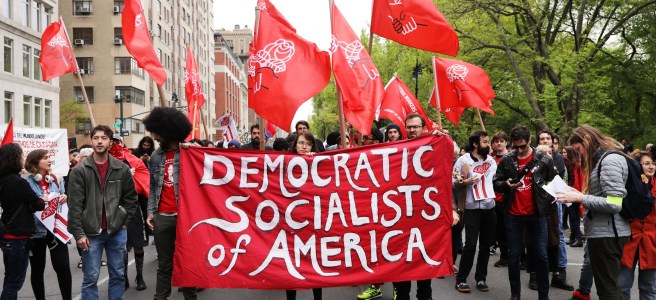
Telling it like it is, therefore, means clearly identifying the overcoming of collapsing capitalism as a necessity for the survival of civilization. All progressive practice must be guided by this reality of systemic transformation. And it is precisely this insistence on the necessity of emancipatory systemic transformation that also draws a clear line of demarcation from left-wing opportunism – from the desire to quickly advance one’s career as a crisis manager through demagoguery, as practiced, for example, by the DSA (Democratic Socialists of America) or the “Left Party” with their populism. Organizations or movements that are blind to the crisis and were once on the left can thus effectively be described as “post-left” – even if they still consider themselves to be on the left.
The consignment of capital to history represents the final capitalist imperative. Any group or party calling itself leftist that preaches gradual change without explicitly addressing the systemic crisis and emphasizing the necessity of systemic transformation is, in fact, opportunistic, if not outright reactionary. In the escalating systemic crisis, there is no longer any possibility of pursuing reformist policies that would be “successful,” since this endeavor is simply thwarted by the crisis-induced upheavals that are growing in intensity. Progressive, emancipatory practice can now only unfold through efforts to steer the inevitable systemic transformation in a progressive direction. This is not left-wing “radicalism,” but rather a realism derived from an understanding of the nature of the crisis. The crisis is unfolding across society as a fetishistic, uncontrollable process, driven by competition and market forces, without regard for the views and calculations of those trapped in the capitalist treadmill.
This is not a popularity contest: even if wage earners refuse to acknowledge it, even if all relevant segments of the population – including the working class – cling to capitalism, the system will collapse under its own internal contradictions. What comes next, however, remains to be seen – and that is precisely why we must wage the struggle, the struggle for transformation. However, a plunge into barbarism during the now imminent, open-ended process of transformation can only be prevented by an emancipatory movement if this upheaval is socially reflected upon, understood, and consciously shaped by that movement within the framework of the equally inevitable struggle for transformation. To achieve this, the Left – building on radical crisis theory – must first and foremost tell people what is really going on. This is the presupposition for all emancipatory transformative practice. Otherwise, the fetishistic momentum of capital will render the world uninhabitable. And since there is in fact no revolutionary subject – no class in and of itself – that could function as a revolutionary subject by virtue of its position in the production process, the only hope that remains is the emergence of a radical crisis consciousness among the population, which would serve as the basis for an emancipatory movement of transformation.
The Fetishism of Capital
But what is capital, and what must be consigned to history before its collapse drags humanity down into the abyss with it? It is money that, through wage labor in commodity production, generates more money – whereby labor is the only commodity that creates more value than it is worth. Capital must be understood as a social relation through which society passes as a mere transitional stage in its boundless pursuit of surplus in commodity production. It is only within this cycle of valorization – the burning up of resources through labor for the purpose of profit maximization – that people or things must become capital. Capital, in all its social and ecological contradictions, is thus also a real abstraction that undergoes a transformation in form – from money to commodity and finally to more money – with every cycle of valorization.
Capital generates a momentum of its own on a societal and global scale: social fetishism. The destructive dynamics of capital’s valorization – unconsciously generated by market actors – “behind their backs,” since they are mediated by the market – appear as a natural phenomenon unfolding across society. This fetishism becomes particularly evident during crisis episodes, when the “economy” suddenly runs amok and “crisis storms” or “market upheavals” – much like extreme weather events – devastate entire regions socioeconomically. The feeling of being at the mercy of quasi-natural, anonymous, and overpowering forces then becomes evident. The same becomes evident in the climate crisis – which, after all, is also increasingly impairing the accumulation of capital itself. What must be overcome, therefore, is this blindly unfolding movement of capital accumulation, which devastates both human society and ecosystems. This destructive fetishism must be replaced by a conscious understanding among members of society regarding the process of social reproduction.
With the crisis of capital, the institutions and social structures that it has historically produced are also collapsing. Post-capitalist social reproduction cannot, therefore, take the form of “nationalization,” as imagined, for example, by the orthodox Left, since the state, in its capacity as the “ideal total capitalist,” is a historically evolved, necessary institution of capitalism that must, after all, be financed by capital through taxes – which is why many heavily indebted peripheral states collapsed into “failed states” as early as the 1990s, once the crisis process had reached a certain stage of maturity. The state is not the solution, but part of the problem. Another dead end is represented by attempts to prove oneself in the crisis-ridden market through self-managed units, enterprises, or agricultural communes, since market forces inevitably prevail here despite self-management. It is thus indeed a matter of the entirety of a society ensnared in the fetish of capital.
Emancipation and Breaking Free from the Capitalist Thought-Prison
The concept of emancipation also arises from the fetishism of capital – it is an emancipation from social fetishism, that is, from the “heteronomy” of subjects through social dynamics that these subjects themselves unconsciously produce via the market. This can only be achieved by a movement that is conscious of its own situation and of the crisis-ridden nature described above. Only through a conscious struggle for a post-capitalist future – arising from an understanding of its necessity – might moments of emancipation still emerge. Consequently, there is a maxim of political practice that emancipatory movements, groups, or parties in the 21st century must follow if they are to continue acting as progressive social forces in the current era of upheaval and crisis – and not degenerate into a “post-left” open to the right. Capitalism must be consigned to history as quickly as possible; the capitalist mode of production must be abolished. All left-wing actions, all tactics, all reform proposals, and all strategies must be guided by this categorical imperative.
And the struggle for a livable post-capitalist future is not “radicalism.” Quite the opposite is true: clinging to the disintegrating forms of capitalist social organization – the market and the state – leads to barbarism, to the fascist extremism of the political center. The right’s successes during the crisis stem precisely from its ability to further exacerbate the ideology that was at work in the neoliberal center of late-capitalist society – such as the culture of competition and social Darwinism – driving it toward increasing brutality.
The key point here is this: In this competition legitimized by “racial,” religious, or nationalist grounds, there is no break with neoliberalism and its implicitly nationalist parochialism. It is in these lines of ideological continuity that the not-so-secret secret of the success of the New Right’s conformist revolt lies. It does not seek to break free from the capitalist thought-prison and its so-called constraints. Instead, authoritarian figures remain stuck on the well-worn ideological track that leads from the neoliberal center to barbaric extremes. That is why the Right, above all, is benefiting from the current crisis. It is very easy to become a Nazi.
What is crucial, therefore, is the intellectual break from the capitalist thought-prison, which must go hand in hand with emancipatory practice in order to prevent a drift toward a fascist extremism of the center. That is why it is essential to tell people what is really going on. In the face of capitalism’s lethal crisis, the struggle for a viable alternative system is the only reasonable, moderate, and balanced course of action. Progress can now only be achieved beyond capitalism. To reiterate: This is not necessary because of the will of individuals or the moods and sentiments of the population, but because capitalism, as a global fetishistic totality, is collapsing under its own weight.
The sense that the system is in a severe crisis is omnipresent. And the intensifying upheavals are giving rise to the usual interplay of social decline and increasing competitive behavior. It is precisely this crisis-driven competition, fueled by the raw instinct for survival, that contributes to the barbarization of capitalism and the rise of the New Right – which cloaks this crisis-driven competition in racism, nationalism, anti-Semitism, religious fanaticism, and so on. This survival instinct – unconsciously practiced and entangled in the escalating everyday competition of late capitalism – must be “sublimated” within the framework of emancipatory practice.
This refers to the conscious reflection on the unconscious causes of social action – in this case, the interplay between competitive thinking and the systemic crisis process. Just as the blind survival instinct of market actors only accelerates the dynamics of the crisis and opens the floodgates to barbarism, so too could a reflective collective drive for survival – one that has come to terms with the necessity of society as a whole overcoming capitalism – serve as a powerful motivating factor for emancipatory forces in the struggle to transform late capitalism. A radical awareness of the crisis thus recognizes the insolubility of the socio-ecological capitalist dual crisis and the necessity of systemic transformation for survival.
And that is precisely why it is essential – as far as possible – to safeguard this objectively unfolding process of transformation from drifting into ideological delusion and fascist barbarism by fostering an adequate awareness of the crisis. Perhaps the awareness of a viable alternative to climate and capitalist collapse can only fully unfold within a militant movement. After all, there is no shortage of conflicts and struggles in the accelerating systemic crisis.
False Immediacy
These movements often get stuck in the false immediacy of their direct demands: For example, they call for a better redistribution of abstract capitalist wealth; increasing impoverishment leads to demands for a stronger welfare state; inflation is met with calls to curb it through subsidies or price caps, and so on. Yet these demands, which seem “obviously reasonable” at first glance, are ultimately discredited by the reality of the crisis.
Given how far the crisis has progressed, it seems counterproductive to now embark on a fundamental critique aimed at building a “new” transformative and emancipatory movement. In light of the pressing urgency and the closing windows of opportunity, emancipatory forces must work with what is still available. Retreating into the ivory tower of “pure doctrine” in order to work toward a gradual “diffusion” of adequate crisis awareness within the Left is not a viable strategy. Instead, the only real option is to use the ever-new waves of crisis to attempt to bring adequate crisis awareness directly into the relevant struggles.
The prospects for this are actually quite good, since even ideologically blinded left-wing circles – such as those from the Green-leaning, left-liberal, or traditional Marxist spectrums – can hardly overlook the consequences of the crisis anymore.
The crisis is both the enemy and the friend of the progressive movement: it is increasingly constricting the spaces for social discourse, fueling panic, and allowing far-right extremist delusions to swell – but at the same time, it compels all social forces that still have their wits about them to confront the undeniable necessity of fundamentally overcoming the collapsing capitalist society.
The attempt to introduce into current social disputes and conflicts an awareness of the crisis that corresponds to the objective crisis process thus ultimately boils down to the struggle against the false immediacy that characterizes these disputes. By “false immediacy,” we mean the tendency of social movements to unconsciously remain stuck in modes of thought that correspond to the very social conditions and contradictions against which they are actually directed.
After all, the people caught up in the increasing crisis-driven conflicts are not, in fact, gripped by a “revolutionary automatism” that would endow them with an anti-capitalist awareness of the crisis. Quite the contrary. By fixating on concrete, seemingly attainable goals within the existing system, the system’s logic itself is reinforced – even within the struggle of opposition. The struggle against inflation and social erosion, for higher wages or against wage cuts, the quixotic struggle of the helpless, social-democratized Left against the steadily advancing dismantling of democracy and the welfare state: these all reinforce the corresponding capitalist social structures and forms of social organization within which and for the sake of which the struggle is waged. Work, bourgeois democracy – including the “civil rights” neutered by capitalism – and the state as a “welfare state” thus solidify, even within the movement entangled in social struggles, into quasi-natural presuppositions of human society.
The immediate goals pursued within the system are thus “false”; they lead to the formation of the aforementioned false immediacy, since, first, they do not break with the crisis-ridden logic of the system but, on the contrary, cement it, and since, second, they are to be fought for within a collapsing capitalist society, making their realization entirely illusory. Following the inevitable failure of major social struggles during crisis episodes – such as in Southern Europe after the outbreak of the euro crisis – resignation and apathy therefore usually set in, since these movements lacked a broader transformative perspective, one that could only arise from an awareness of the crisis commensurate with the crisis process itself. The forces participating in the social protests – which are intensifying due to the crisis – generally seek nothing more than what they demand: the fight for jobs, for higher wages, against cuts to social services, against job destruction, against the constant erosion of “civil rights,” etc.
It seems absurd: in the midst of the crisis, the Left is fighting to preserve the capitalist forms of social organization that are being eroded by the crisis itself. And at the same time, there is no realistic alternative to these very struggles, since they are mostly more or less overt forms of the naked struggle for survival. The establishment of starvation wages – which fall below the subsistence level – is also advancing in the urban centers. Job loss is increasingly accompanied by a plunge into life-threatening pauperism. The struggle against the dismantling of democracy and the pervasive fascistization in Europe is necessary in order to keep the space for maneuver for emancipatory politics open for as long as possible. As long as the capitalist relation persists as the social totality described above, oppositional forces, too, remain chained to its forms of social organization.
The Path as the Goal
This does not mean, however, that these forces must demand the socio-ecological struggle only in these forms, let alone wage it only in these forms. It is therefore indeed crucial with what level of consciousness the current protests and struggles are waged, even if their concrete course initially does not differ greatly from the reformist struggles inherent in the system. After all, the critique of crisis ideology, oversimplified critiques of capitalism, and false immediacy ultimately aims to elevate the process of transformation into the “political consciousness” of social movements, so that the struggle for transformation – which is currently being waged unconsciously – can first be understood as such and then consciously shaped accordingly. The Left must be the force that carries this radical crisis consciousness into social struggles – or it is no longer the Left and degenerates into an opportunistic, reactionary “post-Left.”
The focus and objectives of such a consciously waged struggle – which appears to be inherent to the system (the climate struggle, the wage struggle, Antifa protests, demonstrations against the erosion of democracy, and struggles against social cuts) – change as soon as they are imbued with a transformative consciousness; that is, when they are understood and promoted as an early phase of the struggle for transformation, which is already raging in the periphery with all its genocidal brutality. To stick with the example of social protests: Instead of simply postulating that the rich should pay, it must be made clear that the rich must pay for the transformation – as long as money still has value and it makes any sense at all to make this demand. The path becomes the goal: People’s self-organization within the relevant opposition movements must therefore already be driven by the aspiration to develop moments of post-capitalist socialization. The path of progressive organization in social struggles thus contributes to the goal of a post-capitalist society emancipated from fetishism.
But even beyond measures of redistribution and expropriation, the question will arise: How can healthcare, food, housing, etc., be organized without the necessary financial resources or profitable jobs? At the very latest when inflation devalues money as its value erodes, and everything threatens to be shut down or scaled back due to a lack of profitability, the organization of social reproduction according to criteria other than capitalist ones will be on the agenda. Not along the lines of “How can we finance pensions?” but rather “How can we organize material and social wealth so that older people can live with dignity?” Not “How can we create jobs?” but “How would people and resources need to be mobilized, and what would need to be done, to ensure that food, housing, healthcare, and so on can be provided?” (and certainly not at the level of Hartz IV, slums, or gulags). Either the Left engages with this radical level, or it will become a “post-Left” and be forced to participate in implementing solutions inherent to the system – which will amount to nothing more than shipping elderly people off to cost-effective care gulags or simply killing them off in a “socially acceptable” manner.
The demands and organizational forms of resistance against the looming climate catastrophe and the impositions of crisis management must therefore already contain embryonic forms of post-capitalist forms of social organization. Central to this effort should be the endeavor to first shape the opposition movements inherent to the system as open spaces for discourse – preferably internet-based as well. The crisis discourse, which is no longer possible at the level of society as a whole (and which is being sabotaged by the Left Party or the DSA out of opportunistic calculation), must at least be conducted within the remaining left-wing opposition. Furthermore, the desired post-capitalist process of consensus-building regarding the reproduction of society as a whole is already emerging in the agreement on strategies and forms of protest. These spaces for discourse must therefore be kept open for as long as possible, even in the face of increasing repression. The open process of discussion, along with the organization and coordination of transformative resistance – these, in particular, could serve as a precursor to global, conscious self-understanding within world society regarding its reproduction.
This is also why the democratic struggle to preserve the remaining bourgeois-democratic freedoms for as long as possible is so necessary – to ensure that the process of transformation can be influenced through non-military forms of conflict for as long as possible. Moreover, the necessity of the transition between democratic struggle and militant-military confrontations is difficult to assess; it depends on the degree of fascistization and the tendencies toward disintegration within the state and society in question. Such an armed struggle, which may be forced upon emancipatory forces in the course of a crisis, also represents a defeat. The open structure of discourse and the approaches to self-governance – which could form the embryonic forms of future societies – are in danger of giving way to the necessities of military organization. Then Lenin’s practical guidelines will indeed become inevitable – and there will be a threat of an authoritarian “Sovietization” of post-capitalist alternatives.
The Common Denominator
However, the issue is no longer about repairing the ailing system, but rather about finding optimal paths out of the perpetual capitalist crisis through concrete struggles – precisely because a collapse of capital into barbarism and disintegration would mark the final defeat of the Left. The Left must therefore understand the crisis as a process unfolding in waves; consequently, it must think in terms of processes and developments, perceive existing social structures as being in a state of disintegration, identify the decisive contradictions, and – in anticipation of the massive future upheavals – create the best social conditions and the optimal starting point for emancipatory transformation. In this context, the very concrete question always arises as to which political structures and which social power configurations should prevail during the next wave of the crisis. The crisis process unfolding behind the subjects’ backs can encounter late-capitalist societies structured in very different ways. These societies may be oligarchic, pre-fascist, or bourgeois-democratic; more egalitarian or based on estates; nationalist or cosmopolitan; secular or religiously fascist; and so on.
However, it is essential to avoid hierarchizing these struggles into primary class-struggle contradictions and secondary ones. The class struggle, driven by a radical awareness of the crisis, can function just as much as the climate struggle as an embryonic form and a constituent element of the struggle for transformation. Class-struggle conflicts in wage struggles or social protests can only serve, on an equal footing with other social struggles – such as Antifa, the climate struggle, anti-militarism, feminism, the defense of democracy, sexual self-determination, etc. – within a transformative movement to overcome their false immediacy in the course of these struggles. By introducing a radical awareness of the crisis, these social struggles, protests, or struggles for redistribution would become moments of a struggle for transformation – one that would escalate very rapidly as social or ecological tipping points are crossed, points that are likely to coincide with increasing frequency. The crisis, along with the process of transformation, is the common denominator of nearly all social struggles, which must be waged as struggles for transformation: Where is the crisis dynamic heading? Where are the decisive contradictions to be found? Which forces, which constellations could contribute to an emancipatory course of transformation? The Left must think in terms of processes, dynamics, and contradictions, rather than remaining stuck in the usual reification.
Consequently, despite all evidence to the contrary, we must fight to shape this inevitable transformative movement – which will undoubtedly bring an end to the current state of affairs and whose course and outcome remain open – into a consciously acting movement within the struggle for transformation. There is no alternative: systemic transformation is inevitable; what matters is steering it in a progressive, emancipatory direction – in the struggle against the forces of barbarism that capital is once again unleashing in its crisis.
If there is currently a battleground that should take priority in the present phase of the crisis, it is an anti-fascism that strives to build the broadest possible alliance, since fascism – as the openly terrorist form of capitalist rule in times of crisis – is already clearly emerging. The “Querfront” that has long been gaining ground within the German left, the New Right – which is deeply intertwined with the German state apparatus – and the resurgent pre-fascism are already champing at the bit, ready to respond to the crisis of capital with yet another plunge into barbarism.
Originally published on 09/17/2026 in Direct Action

