“Aspects of the New Right-Wing Extremism” and Totalitarian Democracy

Thomas Meyer

The rise of right-wing populism in recent years demands an explanation. It has been pointed out in various places that the right-wing movements of recent years did not simply fall from the sky, but should rather be seen in the context of neoliberalism and the social distortions it has caused in recent decades. According to Wilhelm Heitmeyer (cf. Heitmeyer 2018), authoritarianism, as expressed and demanded by right-wing populists or right-wing radicals, is already contained in neoliberalism, which is always presented as having no alternative. The erosion of democratic processes, the dismantling of the social safety net, the expansion of the police state, the fundamental social insecurity and the immediate surrender of the individual to the valorization imperatives of capital make the authoritarianism of the neoliberal regime clear (see also Wacquant 2013). Last but not least, the proportion of the population with a racist or otherwise discriminatory worldview has been consistently high over the years. Thus, there has always been a high potential of ‘group-based misanthropy’ and is therefore by no means a novelty of recent years (Heitmeyer 2018).

The strategies of the right aim at ‘pushing the boundaries of what can be said.’ The ‘raw bourgeoisie’ (Heitmeyer) undoubtedly contributed to this, as was evident, for example, in the works of Sloterdijk (cf. Kurz 2005, 387ff., 458ff., as well as Winkel 2010) and Sarrazin (cf. Lux 2012 as well as Konicz 2015a). It is, as Heitmeyer writes, “a fact that hidden beneath a thin layer of civilized, genteel (‘bourgeois’) manners are authoritarian attitudes that are becoming increasingly visible, mostly in the form of rhetoric that is becoming more thuggish” (Heitmeyer 2018, 310). This hiddenness has been broken open continuously in recent years. One occasion (not cause!) was provided by the “foreclosure crisis” (David Goeßmann) in the fall of 2015. The ‘raw bourgeoisie’ thus became apparent in the debate about refugees, in which even so-called opponents of the AfD incorporated right-wing arguments or ‘narratives’ that differed only slightly or not at all from those of the AfD (cf. Goeßmann 2019).[1] Finally, ‘arguments’ of racist agitation were taken up by the mainstream: It is the fine bourgeois center itself that is on the right; it gives birth to the “extremism of the center” (Konicz 2016, 158ff.). As Heitmeyer points out, normality itself is the problem: “It stands to reason that the extreme, with its openly brutal forms of communication and action, is inseparable from the normality of social and political social life, and merely emerges from it. […] the normal [is thus] not to be understood as a guarantee of security, but as potentially dangerous. […] Therefore, the question of how the destructive develops within normality (and not only against it) must be raised” (Heitmeyer 2018, 279, emphasis in original).

Thus, with Heitmeyer, one can speak of the fact that it is bourgeois normality that contains the authoritarian within itself and constantly updates authoritarian attitudes anew. In this context, critical theory and its study of the authoritarian personality gain renewed interest (Ziege 2019, 135ff.). Moreover, in light of the ongoing electoral successes of right-wing populist parties and the strengthening of radical right-wing movements, a publicly delivered lecture by Adorno from 1967 on right-wing radicalism was published in print for the first time. In this lecture, Adorno listed what constitutes modern right-wing radicals and what drives fascist agitation and makes it successful. This little book, “Aspects of the New Right-Wing Extremism,” made quite a splash: It was discussed in bourgeois feuilletons and on state radio. It was pointed out that Adorno’s remarks were very relevant and sounded as if Adorno was talking about the AfD. The background to the lecture was the electoral successes of the NPD at the time.[2] In the lecture text, Adorno emphasized, among other things, that fascism owed its success primarily to the fact that its causes were still present. Adorno saw a central cause of fascist agitation above all in the concentration of capital and the accompanying or threatening declassification of the petty bourgeoisie and others. A threatening crash of the middle class was also ‘processed’ by calls for national sovereignty. This national sovereignty was demanded all the more because its objective conditions no longer existed. Adorno arrived at this assessment against the background of the bloc confrontation and the EEC (European Economic Community) (cf. Adorno 2020, 9-13). The similarities to the present are obvious: today’s right-wing radicals and right-wing populists also strive to regain national sovereignty,[3] especially in their criticism of the European Union. However, the objective conditions for ‘national sovereignty’ are even less present today than in the 1960s, due to the transnationalization of capital, so these demands are, therefore, completely illusory (cf. Kurz 2005).

Although Adorno’s lecture is praised for its analytical soundness, it is also noted that the differences between now and the 1960s should be acknowledged. Volker Weiß, who wrote an epilogue, remarks: “What value do these analyses have for the present? First, it is important to note the differences. Adorno’s warning against simply linking right-wing radicalism to the cyclical movements of the economy must be taken seriously. The effects of the recession of 1966/67, as the immediate background of the developments described, cannot be compared with the consequences of the world economic crisis of 1929, nor with those of current financial and currency crises. […] Nor are the political front lines readily comparable. Unlike anti-Semitism, the confrontation with global jihadism, a key agitational element of right-wing populism, is not purely a matter of pathic projection. Political Islam is a real actor and must itself be seen as the product of a collective narcissistic injury” (cf. Adorno 2020, 65f.).[4]

Indeed, a theory or a critique must always be examined for its ‘time core,’ which Adorno also emphasized. But what this core should consist of remains quite unclear in the current ‘Adorno debate.’ Thus, the current crisis is perceived only superficially. There is no mention of accumulation or crisis theory in liberal publicists like Volker Weiß. Therefore, the differences between the crises of the 1960s and those of 1929 and 2008 have to be guessed at with Weiß more than they are explicity laid out.

Adorno points out the objective anachronism of nationalism already at that time, but Adorno alone would not make clear why nation-state sovereignty as such is eroding today, why the political regulatory capacity of transnationalized capital is reaching its limits, why democracy is continuously de-democratizing itself (police states, free trade agreements), why state apparatuses are going wild (cf. Kurz 1993 as well as Scholz 2019 and Konicz 2018), or why more and more states are disintegrating (cf. Kurz 2003, Bedszent 2014 and Konicz 2016). In this respect, the celebrated topicality of the lecture is exaggerated, not least because the commentators, like Weiß, are far from being able to formulate a critique on the cutting edge.

Weiß also makes it clear that he criticizes the new right primarily because of its anti-liberalism. Now, this criticism is justified, but right-wing anti-liberalism also feeds on a certain ‘discomfort in modernity.’ Instead of making the discomfort in modernity (the impositions of modernization, bourgeois freedom, and equality) an issue, Weiß commits the mistake of “thinking that the world of the global market would be fine if only the brown-fascist (or currently: green-Islamist) ‘barbarians’ did not exist” (Hanloser 2018, 167). Not only would a right-wing ‘anti-modernism’ (which is itself very modern) thus have to be rejected, but also a bourgeois apologetics of ‘freedom and equality,’ not least against the background of police states and states of emergency, which the bourgeois democracies push on their own initiative (one only has to think of the new laws regarding policing). Adorno’s warning that the continuation of fascism in democracy rather than against it is therefore more dangerous has to be considered further.[5] I.e.: Today’s right-wing extremism would have to be seen as an ideology of crisis, as a continuation of democratic crisis management by other and/or the same means.[6]

Ignorance of the crisis is matched by the unconditional claiming of democracy. This can be linked to a problematic and anachronistic side of Adorno’s lecture. This is how Adorno presents the idea that aims at a genuine democracy yet to be realized: “One very often hears, especially when it comes to such categories as the ‘eternally incorrigible’ and similar consolatory phrases, the claim that there is a residue of incorrigibles or fools, a so-called lunatic fringe, as they term it in America, in every democracy. And then there is a certain quietist bourgeois comfort in reciting that to oneself. I think the only response to this is that, yes, something like this can be observed to a varying degree in every so-called democracy in the world, but only as an expression that, in terms of its content, its socio-economic content, democracy has not yet become truly and fully concrete anywhere but is still formal. In that sense, one might refer to the fascist movements as the wounds, the scars of a democracy that, to this day, has not yet lived up to its own concept.” (Adorno 2020, 14f.).

Today, however, it is quite wrong to claim bourgeois ideals against bourgeois reality, especially if one takes a closer look at what these bourgeois ideals consist of and what is the presupposed framework in which they (should) be realized, even more under conditions of crisis. The danger of being blinded by bourgeois ideals has already been described by Marx.[7] Thus it says in the Grundrisse: “What this reveals, on the other side, is the foolishness of those socialists (namely the French, who want to depict socialism as the realization of the ideals of bourgeois society articulated by the French revolution) who demonstrate that exchange and exchange value etc. are originally (in time) or essentially (in their adequate form) a system of universal freedom and equality, but that they have been perverted by money, capital, etc. […] Exchange value is a system of freedom and equality for all. […] The exchange value or, more precisely, the money system is in fact the system of equality and freedom, and that the disturbances which they encounter in the further development of the system are disturbances inherent in it, are merely the realization of equality and freedom, which prove to be inequality and unfreedom. […] What distinguishes these socialists from the bourgeois apologists is, on the one hand, the feeling of the contradictions of the system, and, on the other hand, the utopianism of not grasping the necessary difference between the real and the ideal form of bourgeois society, and therefore of taking on the superfluous business of wanting to realize again for themselves the ideal expression, the transfigured luminous image reflected from reality itself as such” (Marx 1993, 248f).

If, looking back on earlier times, we may perceive even more democratic conditions in contrast to today, this can be explained by the fact that the political ‘ability to shape’ was still present in earlier times, during the Fordist boom, when reforms indeed still opened up the possibility of social advancement and the scope for political action was still much greater. However, if these shrink, not least against the backdrop of a crisis of public finances, then democracy also loses its ‘ability to shape’ (cf. on this Konicz 2016, 180ff.). Thus, when valorization encounters its limits, democracy also erodes. Despite this, more than a few people today are calling for a ‘real democracy,’[8]  without really seeing through democracy’s logic of domination: “The dominant consciousness […] is of course least insightful with regard to the totalitarian character of the sanctified democracy itself” (Kurz 1999, 574). For even the earlier ‘formative capacity’ of democracy was always subject to narrow limits: The subordination of subjects to the valorization imperatives of capital are presupposed in democratic discourse and as such are non-negotiable. All democratic action has to move within this framework. The “democratic thinking of any hue never comes up with the idea of wanting to mobilize and organize resources and social wealth in any other way than in the commodity or money form; and that thus its supposed freedom and humanity always unconsciously sets the systematic laws of the modern commodity form itself as a hard limit” (Kurz 1993, 18). Furthermore, “the abstract freedom of abstract, monadized individuals, who must constantly ‘self-valorize,’ implies the merciless competition of all against all” And: “the real capacity for action as freemen and equals is limited to the ability to pay” (ibid., emphasis in original).

Even when this is only rudimentarily and selectively questioned in practice, the bloodhounds line up and democracy reveals its repressive core. This is the realized democracy and it is therefore not only a formal or formally limited one that has merely not yet realized itself. Its realization consists precisely in formally granting rights, but also in suspending or limiting them again when they prove dysfunctional for crisis management and capital valorization (or devaluation). Therefore, police state terror is not a contradiction to democracy. Since one can realize oneself as a free and equal only when one has proven oneself as a capital-productive subject, realized democracy is also compatible with enormous social inequalities. The opposite of freedom and its contradictions thus belong to this freedom itself, as Marx already pointed out. Surprisingly, this is not denied at all. Friedrich August von Hayek, for example, formulated that freedom includes the freedom “to starve,” and even that “voluntary conformity is a condition for the beneficent effects of freedom.” Consequently, according to Hayek, a “democracy […] can exercise totalitarian violence, and it is conceivable that an authoritarian government will act according to liberal principles” (Hayek 1960, 25, 82, 132). Liberal homages to Pinochet!

When there is a crisis, social protests and any dissent at all can prove to be ‘disruptive.’ It is no coincidence that during the Greek crisis there was talk that Germany’s austerity dictate should not be negotiated democratically (Konicz 2015b). Not coincidentally, Merkel said that democracy must be ‘market-compliant.’ If the ‘market’ no longer allows immanent decision-making possibilities, then all decisions boil down to ‘save and die,’ and democratic freedom then consists of nothing more than helping to shape one’s own execution by decree and parliament.

In a democracy, legal capacity is tied to the ability to valorize. If labor contracts can no longer be entered into, the right itself erodes (cf. Kurz 2003, 324ff.). People who lose the ability to valorize by devaluing their labor power or the like become de facto citizens of lesser rights, as the Hartz IV regime proves (cf. Rentschler 2004). People whose devaluation is more advanced, such as refugees, end up being denied the mere right to live, or having their deaths accepted. This is shown not only by the foreclosure policy of the ‘free and democratic West’ and the ongoing death in the Mediterranean, but also by the more or less ‘final storage’ of people in concentration camp-like facilities, in so-called ‘reception camps.’ The roughest pig work is gladly left to others.[9]

Since democracy as a state form is bound to the form of value and dissociation and thus erodes in the crisis of valorization, it neither makes sense to lament the loss of democracy nor to sue for the realization of an ‘actual’ democracy. In no way, therefore, would it suffice to denounce democracy as merely formal in order to demand that it finally be realized: perhaps through more ‘direct democracy,’ as right-wing populists also demand. It is therefore not enough to criticize insufficient participation or representation or unequally distributed wealth. Rather, the object of critique would have to be the bourgeois subject’s form of interest and will, and thus the capitalist form of wealth and (re)production itself. It would have to be made clear that democracy is not a free discourse, not an “association of free men” (Marx), in which all are required to come to an agreement about the meaningful use of resources. On the contrary: this is just as little a subject of democratic discourse as it is of an authoritarian command economy or of a folkish ethno-regime. The submission to the fetish constitution of the value-dissociation society, to the commodity form and the valorization movement of capital is precisely the basis of every democracy. This repeatedly occurring false juxtaposition of liberal democrats and authoritarian, crude or even fascist bourgeoisie must therefore be rejected.[10] If, as Marx said, the truth of bourgeois society is to be seen in its colonies,[11] the truth of real democracy is to be seen in the crisis and in the state of emergency. A critical theory at the height of the times must take note of this, or it is none.

References

Adorno, Theodor W.: Aspects of the New Right-Wing Extremism, 1st ed. Wiley 2020

Adorno, Theodor W.: Bemerkungen zu ‘The Authoritarian Personality,’ Berlin 2019.

Bedszent, Gerd: Zusammenbruch der Peripherie – Gescheiterte Staaten als Tummelplatz von Drogenbaronen, Warlords und Weltordnungskriegen, Berlin 2014.

Davis, Mike: Die Geburt der Dritten Welt – Hungerkatastrophen und Massenvernichtung im imperialistischen Zeitalter, Berlin/Hamburg/Göttingen 2011, 3rd ed. first London/New York 2001.

Feit, Margret: Die Neue Rechte in der Bundesrepublik – Organisation, Ideologie, Strategie, Frankfurt/New York 1987.

Goeßmann, David: Die Erfindung der bedrohten Republik – Wie Flüchtlinge und Demokratie entsorgen werden, Berlin 2019.

Hanloser, Gerhard: Die libertäre und die liberale Linke und die Neue Rechte – Bemerkungen zu einer drängenden Frage, in: Ne znam: Zeitschrift für Anarchismusforschung, No.7, Lich 2018, 157-168.

Hayek, Friedrich A. von: Die Verfassung der Freiheit (Gesammelte Schriften Bd. 3), Tübingen 2005.

Heitmeyer, Wilhelm: Autoritäre Versuchungen – Signaturen der Bedrohung I, 3rd edition, Berlin 2018.

Jäger, Margarete; Wamper, Regina (eds.): Von der Willkommenskultur zur Notstandsstimmung – Der Fluchtdiskurs in deutschen Medien 2015 und 2016, Duisburg 2017, online: http://www.diss-duisburg.de/wp-content/uploads/2017/02/DISS-2017-Von-der-Willkommenskultur-zur-Notstandsstimmung.pdf.

Konicz, Tomasz: Failed State BRD, 2018, online: https://www.heise.de/tp/features/Failed-State-BRD-4232674.html.

Konicz, Tomasz: Generation Sarrazin – Eine kurze Skizze der Genese der neuen deutschen Rechten, 2015a, online: https://www.streifzuege.org/2015/generation-sarrazin/.

Konicz, Tomasz: Kapitalkollaps – Die finale Krise der Weltwirtschaft, Hamburg 2016.

Konicz, Tomasz: Welcome to Postdemocracy, 2015b, online: https://www.heise.de/tp/features/Willkommen-in-der-Postdemokratie-3374458.html.

Kurz, Robert: Das Weltkapital – Globalisierung und innere Schranken des modernen warenproduzierenden Systems, Berlin 2005.

Kurz, Robert: Die Demokratie frisst ihre Kinder – Bemerkungen zum neuen Rechtsradikalismus, in: Rosemaries Babies – Die Demokratie und ihre Rechtsradikalen, Unkel/Bad Honnef 1993, 11-87.

Kurz, Robert: Schwarzbuch Kapitalismus – Ein Abgesang auf die Marktwirtschaft, Frankfurt 1999.

Kurz, Robert: Weltordnungskrieg – Das Ende der Souveränität und die Wandlungen des Imperialismus im Zeitalter der Globalisierung, Bad Honnef 2003.

Lenin, V.I.: The Proletarian Revolution and the Renegade Kautsky, in: Selected Works Volume III, Berlin 1970, 69-163.

Lux, Vanessa: Verschiebungen in der biologistischen Diskussion: das Beispiel Sarrazin, in: Schulze, Annett; Schäfer, Thorsten: Zur Re-Biologisierung der Gesellschaft – Menschenfeindlichen Konstruktion im Ökologischen und im Sozialen, Aschaffenburg 2012, 129-152.

Marx, Karl; Engels, Friedrich: MEW Vol. 9, Berlin 1960.

Marx, Karl: Grundrisse: Foundations of the Critique of Political Economy, Penguin 1993.

Rentschler, Frank: Der Zwang zur Selbstunterwerfung – Fordern und Fördern im aktivierenden Staat, in: exit! – Krise und Kritik der Warengesellschaft, No.1, Bad Honnef 2004, 201-229.

Scholz, Roswitha: ‘Democracy still eats its children’ – today even more so, in: exit! – Krise und Kritik der Warengesellschaft, No. 16, Springe 2019, 30-60.

Trenkle, Norbert: Der Demokratische Mauerbau – Elendsmigration und westlicher Abgrenzungswahn, in: Rosemaries Babies – Die Demokratie und ihre Rechtsradikalen, Unkel/Bad Honnef 1993, 227-262.

Wacquant, Loic: Bestrafen der Armen – Zur neoliberalen Regierung der sozialen Unsicherheit, Berlin/Toronto 2013, first Paris 2004.

Weiß, Volker: Die autoritäre Revolte – Die Neue Rechte und der Untergang des Abendlandes, Stuttgart 2018.

Winkel, Udo: Der Geist geistloser Zustände – Sloterdijk u. Co.: Zum intellektuellen Abstieg der postkritischen deutschen Elitedenker, in: exit! – Krise und Kritik der Warengesellschaft, No.7, Bad Honnef 2010, 251-259.

Ziege, Eva-Maria: Nachwort der Herausgeberin, in: Adorno, Theodor W.: Bemerkungen zu ‘The Authoritarian Personality,’ Berlin 2019b, 133-160.


[1] This is shown, for example, by shifts in discourse in the wake of the end of the ‘welcome culture,’ cf. Jäger; Wamper 2017.

[2] The NPD then narrowly missed entering the Bundestag in 1969. The consequence was a ‘change of strategy’ by parts of the right, which ‘modernized’ the right, cf. Weiß 2018, 27ff, and in more detail Feit 1987, 23ff.

[3] It is no coincidence that Jürgen Elsässer’s radical right-wing magazine has the subtitle “Magazine for Sovereignty.”

[4] Volker Weiß emphasizes the similarities between right-wing radicalism and Islamism. For example, the relationship between the two is clear in their hatred of women and their masculinity mania. The neo-fascist masculinity mania is exemplified in the book “Der Weg der Männer” (The Way of Men) by Jack Donovan, published by the radical right-wing Antaios-Verlag, cf. Weiß 2018, 227ff. Jack Donovan could in principle also join the IS, as Weiß noted in an interview: “Tacheles: Volker Weiß über Akteure, Ideologie und Entwicklung der Neuen Rechten”, https://www.youtube.com/watch?v=5xtMdgVayOw, 7:50 min.

[5] In Adorno’s lecture from 1959: What does Aufarbeitung der Vergangenheit mean, from about 3 min: https://www.youtube.com/watch?v=ioj9UPuP374.

[6] The continuity of both becomes particularly clear in racist exclusionary imperialism and democratic wall-building, cf. Kurz 2003 esp. 190ff. and Trenkle 1993.

[7] It is worth mentioning in this context that Lenin, in his polemic against Karl Kautsky, referred to the mendacity of the bourgeois democracies and addressed what today would be called the ‘state of emergency.’ Thus it says: “Take the fundamental laws of modern states, take the methods by which they are governed, take the freedom of assembly or of the press, the ‘equality of citizens before the law’ – and you will see at every turn the hypocrisy of bourgeois democracy, well known to every honest and class-conscious worker. There is not a single state, even the most democratic, where there are not in the constitution back-doors or clauses which secure for the bourgeoisie the possibility ‘in case of violations of peace and order’ – in reality, however, when the exploited class ‘violates’ its being a slave and tries to stop behaving like a slave – to use military force against the workers, to impose a state of siege, and so on. Kautsky shamelessly glosses over bourgeois democracy by concealing how, for example, the most democratic and republican bourgeois in America or Switzerland act against striking labor” (Lenin 1970, 87).

[8] Due to the obvious discrepancy between the ‘claim and reality of democracy,’ naturally, fewer and fewer people believe in the Western democratic propaganda. Thus, in various places, there is talk of ‘post-democracy,’ ‘façade democracy,’ ‘(financial) oligarchy,’ etc.; terms which, according to the claim, are supposed to capture democratic reality. These critiques, however, remain phenomenological, do not go beyond a ‘critique of neoliberalism,’ criticize the lack of ‘representation,’ insufficient ‘direct democracy,’ the ‘deep state’ and call for nonsense like a ‘democratic financial system’ and the like.

[9] In early 2017, the German Foreign Office spoke of concentration camp-like conditions in the camps in Libya. The report states, among other things, that “executions of non-paying migrants, torture, rape, extortion, and abandonment in the desert are the order of the day there.” cf. https://www.welt.de/politik/deutschland/article161611324/Auswaertiges-Amt-kritisiert-KZ-aehnliche-Verhaeltnisse.html.  

[10] So as not to be misunderstood: Of course, democracy and fascism are not simply the same thing, and it is by no means irrelevant whether a corrupt social democrat is at the levers of power or a fascist like Bolsonaro. It would therefore be reactionary indeed to accept, for example, a synchronization or dismantling of bourgeois justice with a shrug of the shoulders or to declare it irrelevant.

[11]Thus, Marx’s article The Future Results of British Rule in India, 8/8/1853, states, “The profound hypocrisy of bourgeois civilization and the barbarism inseparable from it lie unveiled before our eyes as soon as we turn our gaze from their homeland, where they appear under respectable forms, to the colonies, where they show themselves in all their nakedness” in: Marx; Engels 1960, 225. How blatant this barbarism was is shown, for example, by Mike Davis (Davis 2011).

Originally published on Exit! homepage on 03/25/2020

Math Delusion

Claus Peter Ortlieb

The following text is a written elaboration and extension of a lecture given at the conference “ General Mathematics: Mathematics and Society. Philosophical, Historical and Didactical Perspectives” in Schloss Rauischholzhausen from June 18 to 20, 2015. The invitation to the lecture was based on older epistemological texts, which therefore reappear – partly in spirit, partly verbatim – as set pieces in the present text.

If I look at the world through rose-colored glasses, it appears to me as rose-colored. And accordingly, who looks at the world through mathematical glasses, sees mathematical structures everywhere.[1] Now obviously the color pink is not a property of the world, but one of the glasses. One could add that the world must have pink components so that one can see anything at all through the pink glasses. But nobody would claim that the world consists only of these components, just because all others are blanked out by the glasses. In contrast, Enlightenment reason has managed to confuse reality with the glasses through which it views it, that is, to declare the approach to the world specific to modern science to be a property of reality itself, and thus to declare it to be essentially mathematical.

As a typical and prominent representative of this view, Max Tegmark, physicist at MIT, was quoted in a Spiegel interview on the occasion of the translation of his book “Our Mathematical Universe” (Tegmark 2015) into German:

Spiegel: Professor, if a fairy godmother promised to answer any question about the nature of our world, what would you ask?

Tegmark: Let me think. Hmm, I would probably ask them: What set of formulas provides an accurate description of our world?

Spiegel: And you are convinced that such world formulas exist?

Tegmark: I suspect so. But if the fairy were to shake her head and say, “Sorry, there are no such formulas,” that would also be very exciting to know.

Spiegel, 4.4.2015, 113

In this essay, to stay in the picture, I would like to take the position of the bad fairy and justify why Tegmark’s question is nonsensical, not to say crazy. In his book, Tegmark argues that the “essence of reality” is mathematical and that the universe is pure mathematics, a mathematical structure in which we humans live but whose physical reality is completely independent of us (cf. Tegmark 2015, 370). At least he can be credited for admitting the possibility that the question of the world formula cannot be answered. There are even tougher dogmatists, people who consider themselves particularly enlightened, dismiss religious ideas as “God delusion” (Dawkins 2007), and for their part adhere to the belief that reality follows mathematical laws. But if one knows that the religious forms have sprung from the human head – I am also of this opinion – it should make one think that this is just as valid for mathematics. To locate it so easily in the world, as a property that is independent of us, could therefore be analogously described as “math delusion.”

Unlike mathematics, mathematical – and thus “exact” – natural science and the access to the world associated with it is an invention of modern times. When thinking about the causes and consequences of the mathematization of modern society, for which there was nothing comparable in pre-modern times, one should therefore pay attention to this hinge between mathematics and society. Beyond its original subject area, the mathematical-scientific method has now gained a foothold as a method of “mathematical modeling” in almost all other branches of science and in many non-scientific disciplines. Apparently, the success of this method in physics, chemistry, and recently biology, as well as in the technical subjects related to these natural sciences, leads to its unreflective adaptation, even in those areas where the use of mathematical methods should at least be met with doubts, because they do not fulfill certain prerequisites of the “exact” sciences.

For example, the preface to a standard textbook of economics states:

Economics combines the strengths of political science and natural science. […] By applying scientific methods to political issues, economics seeks to make progress on the fundamental challenges facing all societies.

Mankiw and Taylor (2012, VIII)

Here it is implicitly assumed that scientific methods can be applied to political questions, even if it cannot be claimed that such attempts are crowned with success (cf. Ortlieb 2004), in which they differ from their “exact” models. But even where the idea of making the use of mathematical methods a badge of “scientificity” is not particularly successful, it does help to increase the importance of mathematics for modern society even further, to a certain extent beyond what is necessary.

The thesis put forward here is therefore that mathematics owes its importance in our society on the one hand to the undeniable success of the mathematical natural sciences, but on the other hand also to a false understanding of this success, as expressed for example in the question of the world formula, the belief that reality follows mathematical laws. I would first like to make clear why this belief is unfounded, then venture to explain where it comes from, and finally suggest what harmful consequences it has.

Mathematics as Positivist Magic

The blindness of mathematical-scientific thinking for its own form jumps almost regularly into the eye whenever scientists start to think publicly about the relation of their own science and its mathematical instruments to the real world:

Real science, on the other hand, remains real magic. It is fascinating to see how many physical phenomena adhere to theories and formulas with uncanny accuracy, which has nothing to do with our desires or creative impulses, but with pure reality. It makes one completely speechless when it turns out that phenomena, which were initially only theoretically justified and calculated with formulas, subsequently turn out to be reality. Why should the reality be like this? It is pure magic!

Dewdney (1998, 30)

Why does mathematics, which comes from our own heads, fit so well to nature, which actually has nothing to do with it? Among those who are practically active in positive science, this question, as here with the mathematician Dewdney[2], regularly triggers reverential astonishment, depending upon location either over mathematics, which can accomplish such great things, or over nature, which is so rationally arranged. The only way out of this aporia seems to be to resort to magical notions. However, if even professional science theorists do not get beyond this level, they rightly attract ridicule:

Carnap, one of the most radical positivists, once called it a stroke of luck that the laws of logic and pure mathematics apply to reality. A thinking which has all its pathos in its enlightenment quotes in a central place an irrational – mythical – concept like that of the stroke of luck, only to avoid the insight, which admittedly shakes the positivist position, that the supposed circumstance of luck is none, but product of the nature-dominating … ideal of objectivity. The rationality of reality, registered by Carnap with a sigh of relief, is nothing but the reflection of subjective reason.

Adorno (1969, 30)

Adorno’s criticism covers all the ideas belonging to positivism, that mathematical regularity is a property of external reality, and that science simply consists in grasping the facts and this regularity of things themselves, according to the positivist program of Comte 1844/1994, 17.

In contrast, Adorno insists on the statement – which I will follow here and elaborate on – that mathematics and its laws are not a property of external nature, but part of our instruments of cognition.

An example: Galileo’s laws of falling bodies

The laws of the free fall of heavy bodies are at the beginning of modern physics. They state:

G1 All bodies fall at the same rate.

G2 In a fall from rest, the distances traveled behave like the squares of the times.

With these laws Galileo Galilei (1564-1642) came into contradiction with the Aristotelian science prevailing in his time, whose doctrine said:

Ar Every body has the aspiration to take its rightful place. Light bodies move up, heavy ones fall down. The heavier the body, the faster it falls.

In fact, this is one of the rare cases in which modern physics can be directly confronted with medieval ideas, because it usually deals with questions that people in other or earlier societies did not even ask themselves. It is all the more interesting to see how Galileo’s laws of falling bodies prevailed.

An integral part of the image that modernity in general, and Western science in particular, have of themselves is the idea that they are oriented towards facts, while past cultures followed their myths and other fantasies and have therefore logically and quite rightly passed away. Galileo’s argument with the authority of Aristotelian science and the Catholic Church still serves as a paradigm for this, although mechanics, which goes back to Galileo and Newton, has long since had to give up its claim to general validity. Bertolt Brecht’s play “Life of Galileo,” written around 1945, thrives on the enlightenment pathos of this struggle of the “cold eye of science,” revealing the facts against the “thousand-year-old mother-of-pearl haze of superstition and old words,” through which the reign of “selfish rulers” could continue to be maintained. Brecht’s criticism, which is unavoidable against the background of the dropping of the first atomic bomb, is then also presented exclusively on the moral level, namely that Galileo had allowed himself to be intimidated and had handed over his knowledge to those in power, “to use it, not to use it, to misuse it, just as it served their purposes.” Every well-behaved natural scientist can rightly counter that Galileo’s teachings, despite his retraction, have finally become common knowledge, that truth cannot be stopped, even if this seems to have been of little use to mankind.

Mechanics, associated with the names of Galileo and Newton and today called “classical,” played the role of a leading science from the beginning of modern times until the 19th century. In a certain respect it still is today, even if its results had lost their universal claim by the “modern” physics of the 20th century. For the mathematical-scientific method developed in it and applied with resounding success has gained further importance in the last century and has taken on a model function for Western science of all faculties, at least of their respective mainstreams, so that even the critics of its transfer to the social sciences, for example, still have to deal with it. As correct as their argument is that a method must adapt to its object and that “society” is not the same as “nature,” such discussions often suffer from the fact that positivist empiricism, i.e. the “fact faction,” has won the hegemony of interpretation as to what this method actually does and what kind of results it can achieve. The assertion that these are objective facts, verifiable by everyone, is no longer even questioned.

The Myth of Pisa

An example of this phenomenon is the following story, which the historiography of science had to offer as assured knowledge for almost three centuries. It concerns the free fall of heavy bodies, the first part of the Galilean law of fall, and figured as the “blow from which Aristotelian science never recovered”:

At this point we must refer to the famous experiments on the fall of bodies, which are closely connected with the Leaning Tower of Pisa, one of the most curious architectural monuments in Italy. Almost two thousand years earlier, Aristotle had claimed that in the case of two different weights of the same material falling from the same height, the heavier one would reach the ground before the lighter one, according to the ratio of their respective weights. The experiment is certainly not difficult; nevertheless, no one had thought of carrying out such a proof, which is why this assertion was included among the axioms of the science of motion by virtue of Aristotle’s word of power. Galileo, invoking sense perception, now challenged Aristotle’s authority and claimed that the balls fell in the same time, except for an insignificant difference based on the difference in air resistance. The Aristotelians scoffed at this idea and refused to listen to it. Galileo, however, was not intimidated and decided to force his opponents to face the fact like him. Therefore, one morning, in front of the assembled university – professors and students – he climbed the leaning tower, carrying two balls, one ten-pounder and one one-pounder. He placed them on the edge of the tower and dropped them at the same time. And they fell together and hit the ground together.

J.J. Fahie. Galilei, His Life and Work, London 1903, 24 f., quoted after Koyré (1998, 124).

Almost 300 years after Galileo’s death, Alexandre Koyré[3] has finally put an end to the story of his free fall experiments at the Leaning Tower of Pisa, so that no historian of science who wants to be taken seriously can still tell it today. The only truth in the story is that Galileo held a poorly paid, three-year position as professor of mathematics at the University of Pisa around 1590. The legend first appeared 60 years after the incident described and has been embellished by later historians of science. What strikes one without further historical knowledge is its inconsistency: what could possibly have caused the Aristotelian professors, here reproached for their dogmatism, to run together when one of their most insignificant colleagues staged an insane experiment? The story contradicts all customs at universities of that time and probably still of today’s universities. It was never mentioned by Galileo himself, [4]and finally: the experiments would have gone wrong, respectively they were made (1640, 1645, 1650), with big and small iron balls, with clay balls of the same size, one solid, the other hollow, with balls made of different materials, and they all went wrong (in the sense of the legend).[5]

What is really exciting about this modern fairy tale is that for 300 years it belonged to the general educational heritage, to a certain extent to the secured stock of our scientific knowledge. Like all fairy tales, this one also conveys a message, namely that of modern rationality, which lets the facts speak without bias, while the dark Middle Ages only referred to authorities and passed on textbook knowledge. The late proof that this is a myth, the myth of empiricism, does not change its effectiveness. More than 350 years after Galileo, this worldview has become so self-evident that it no longer needs justification. And as a glance at a standard textbook of experimental physics shows, even the fairy tale associated with it is too good to be omitted simply because it is a fairy tale:

First, let us investigate whether the falling motion depends on the type of falling body, e.g. on its size or weight. We make the following experiments: Two balls of the same size, made of aluminum and lead, which therefore have very different weights, are let fall to the ground simultaneously from the same height. We find that they hit the ground at the same time, as Galileo (1590) already found out by drop experiments at the leaning tower of Pisa. If we take three identical spheres made of the same material, they will naturally arrive at the ground at the same time. If we now connect two of these spheres firmly with each other (for example by a passing pin), and if we let this double sphere fall with the third single sphere at the same time, then also these bodies of different size and different weight hit the ground at the same time. However, the following experiment seems to contradict the conclusion that all bodies, independent of shape, type and weight, fall at the same rate: If we let a coin and a piece of paper of the same size fall, we observe that the coin arrives at the bottom much earlier than the piece of paper falling at the same time from the same height; the latter flutters to the ground in irregular motion and needs a longer time to fall through. The contrast, however, is only apparent. In this last experiment, the resistance of the air becomes disturbingly noticeable. The air flowing past the body during the fall inhibits the falling movement, and more strongly the larger the surface of attack of the air on the body in question. If we clench the piece of paper into a small ball, it falls just as quickly as the coin. The disturbing influence of the air resistance on the free fall can be shown by an experiment given by Newton. A glass tube about 2 m long and several centimeters wide, fused at both ends, contains a lead ball, a piece of cork and a down feather. If the three bodies are at the bottom of the tube and the tube is turned rapidly through 180°, the lead ball, then the piece of cork and finally the downy feather are observed to arrive at the bottom. But if we pump the air out of the tube and repeat the experiment, we see that the three bodies hit the bottom of the tube at the same moment. We may therefore state the law of experience: In a vacuum, all bodies fall at the same rate.

Bergmann-Schaefer (1974, 40)

Why only in a vacuum? After all, it worked in Pisa, too. The conclusion remains as opaque as the reasoning. The reason lies in the fact that statements with completely different methodological status are wildly mixed up here:

  • The text contains wrong and right assertions about everyday observations, whereby the right ones are just those which contradict the Galilean law of falling. They are simply interpreted away with reference to the “disturbing” air resistance.
  • A thought experiment is carried out (sphere and double sphere), from which the law of falling is logically compelling, but without recourse to any observational results.
  • Finally, an experiment is described which requires a high technical effort (pumping the tube empty). Only in the artificial situation thus produced can the claimed law also be observed.

To then call the whole thing an “empirical law” is already strong and indeed presupposes the confusion that first had to be created. Empiricism lives from this confusion.

The text is an example of how little most natural scientists know about the history and method of the science they themselves practice. This was by no means always so, but what can be stated here, rather, has the character of a decay. Galileo himself, at any rate, was quite aware of his approach, unlike most of his epigones – not all of them. It is therefore worth going back to the sources.

What brought the Galilean law of falling into the world, if it could not be the experience, neither the direct observation, because this teaches something else, nor an experiment in the vacuum, which Galilei could not carry out already because he lacked the technical means for it? The simple answer is this: The law of falling bodies results from a logical argument, a mathematical proof or, as one would say today, a thought experiment. The argument had already been published in 1585 by the mathematician Benedetti in Venice and is also contained in the text from the physics textbook quoted above, although there it is completely deprived of its methodical significance.

Proof of the First Law of the Case

Benedetti argued: Two identical bodies fall at the same speed, at least that seems to be undisputed. If they are now connected by a light (ideally massless) rod, their velocity does not change, but it is the same for a body of double mass (cf. Fig. 1). The same can be argued with three, seven or even a hundred thousand bodies, in any case the same velocity results for bodies of arbitrarily different mass.

Fig.1: Benedetti’s argument

Galileo (1638/1995, 57/58) used this as a proof of contradiction: If Aristotle’s law of falling bodies Ar were correct, a heavier body would have to move ahead of a lighter one. If both are now connected with a string, the heavier body would have to pull the lighter one behind it, but the lighter one would have to slow down the heavier one (cf. Fig. 2). The result would be a smaller speed than that of the original heavier body, but for an altogether heavier body, a contradiction.

Fig. 2: Galileo’s argument

Both proofs of the First Law of Fall G1 abstract from the shape of the bodies, and thus refer only to their mass.[6] So it was shown: If the falling speed does not depend on the shape of the bodies, their mass distribution, then all bodies must fall equally fast. This result, however, is in obvious contradiction to empiricism, because the bodies do not fall at the same speed. If now logic and empiricism would be considered equally, then the conclusion would be to be drawn from it that from the shape of the bodies just may not be abstracted. But Galileo does not draw this conclusion, and exactly here lies the revolutionary novelty of his view of nature: He decides in favor of logic and mathematics and against direct empiricism and thus for a view of nature which antiquity or the Middle Ages could only have regarded as crazy.

The Mathematical-Scientific Method

The connection of the natural laws thus obtained to empiricism lies in the experiment, the second great innovation of modern natural science, whose difference from simple observation cannot be emphasized enough. An experiment is the production of a situation in which the condition of the derived law is fulfilled, in this case: one can abstract from the shape of the bodies, e.g. by vacuum, which Galilei was not yet able to do.

In this respect it can be said that mathematical laws of nature are not based on observation, but are produced. To be more precise: They are instructions for the production of situations (in experiments) in which they are valid.[7] Here lies the reference to the nature-controlling technology of modern times.

The mathematical-scientific method constituted in this way is based on the basic assumption that there are universally valid laws of nature, independent of place and time, which can be described mathematically (the concept of measurement would otherwise be meaningless). For this, a linear flowing, continuous time and a homogeneous space, i.e. not subdivided into different spheres, is presupposed.

The objection that the universal form of laws of nature has long been proven by modern natural science misses the point: The lack of form of laws in any area would never be blamed on nature, but would be justified by the fact that science is not yet ready to recognize them.

The procedure then consists first of all in the formulation of ideal conditions, from which conclusions are drawn in the thought experiment in an ultimately mathematical way. The subsequent experiment then consists in the production of these ideal conditions and the verification of the conclusions by measurements. Care must be taken that the measurement procedure, i.e. the physical effort of the experimenter, does not disturb the ideal process. Experiments must be repeatable, and in this respect they also differ from mere observations.[8]

Thus, there can be no question of modern science, in contrast to the Middle Ages, being oriented to “the facts”; rather, the opposite is true. Koyré makes this very clear with the example of the principle of inertia, which as a (mathematical) principle has no direct correspondence in empiricism and nevertheless founded modern physics:

This principle seems to us completely clear, plausible, yes, it is obvious. It seems obvious to us that a body at rest will also remain in it… And once it gets in motion, then it will continue to move in its original direction. And always with the same speed. We don’t really see a reason or cause for why it should happen differently. This appears to us not only as plausible, but also completely natural. Yet it is nothing less than that. The natural, tangible evidence, which these views enjoy, is comparatively recent. We owe it to Galileo and Descartes. In the Greek antiquity as well as in the Middle Ages the same views would have been classified as ‘obviously’ wrong, even absurd.

Koyré (1998, 72)

The question remains to be answered why this misjudgment of the actual mathematical-scientific procedure is so widespread. Koyré explains this by habituation:

We know the basic notions and principles too well, or more correctly, we are too accustomed to them to be able to correctly assess the hurdles that had to be overcome to formulate them. Galileo’s concept of motion (and that of space) seems so ‘natural’ to us that we believe to have derived it ourselves from experience and observation. Although probably none of us has ever encountered a uniformly persisting or moving body – and this simply because such a thing is quite impossible. Equally familiar to us is the application of mathematics to the study of nature, so that we hardly grasp the audacity of the one who claims: ‘The book of nature is written in geometrical symbols.’ We miss Galileo’s audacity in deciding to treat mechanics as a branch of mathematics, that is, to replace the real world of daily experience with a merely imagined reality of geometry and to explain the real from the impossible.

Koyré (1998, 73)

The explanation remains unsatisfactory: The fact that we consider a “manifestly absurd” procedure to be completely “natural” does jump to the eye. Why we do it, however, remains ultimately unexplained here.

Revolution of the Way of Thinking

Immanuel Kant, himself active in the natural sciences for ten years, summarizes the mathematical-scientific method in the preface to the 2nd edition of his Critique of Pure Reason in 1787 in the language peculiar for him:

When Galileo rolled balls of a weight chosen by himself down an inclined plane, or when Torricelli made the air bear a weight which he had previously thought to be equal to that of a known column of water, or when in a later time Stahl changed metals into calx and then changed the latter back into metal by first removing something and then putting it back again, a light then dawned on all natural scientists. They understood that reason has insight only into that which it itself produces according to its design; that it must take the lead with principles for its judgments according to constant laws and compel nature to answer its questions, rather than letting nature guide its movements by keeping reason, as it were, in leading-strings; for otherwise accidental observations, made according to no previously designed plan, can never connect up into a necessary law, which is yet what reason seeks and requires. Reason, in order to be taught by nature, must approach nature with its principles in one hand, according to which alone the agreement among appearances can count as laws, and, in the other hand, the experiments thought out in accordance with these principles – yet in order to be instructed by nature not like a pupil, who has recited to him whatever the teacher wants to say, but like an appointed judge who compels witnesses to answer the questions he puts to them. Thus even physics owes the advantageous revolution in its way of thinking to the inspiration that what reason would not be able to know of itself and has to learn from nature, it has to seek in the latter (though not really ascribe to it) in accordance with what reason itself puts into nature. This is how natural science was first brought into the secure course of a science after groping about for so many centuries.

Kant (1787/1990, B XIII)

On the one hand, it becomes clear here what an important role Kant ascribes to the “principles of reason,” which cannot be derived from empiricism (the Kantian a priori). He thus solves the problem that still troubles modern positivism, namely how objective knowledge is possible.

On the other hand, a typical contradiction of Enlightenment thinking comes through in Kant, which considers “reason” to be a general human quality or ability, but nevertheless claims it exclusively for itself and denies it to other or earlier societies. If this prejudice is brushed aside, it can be said that the mathematical and scientific method did indeed first have to prevail against medieval thinking, and talk of the “revolution of the way of thinking” thus hits the point that this revolution helped a reason to break through which is specific to the bourgeois epoch, against the reason of the Middle Ages, which was completely different, but not therefore unreasonable as such.

The concept of “objective knowledge” thus receives a different meaning than the one that is usual in our linguistic usage, an ahistorical one, independent of the form of society and equally valid for all people, which is why Greiff 1976 also speaks of the “objective form of knowledge.A representative of another or earlier culture, who does not recognize the basic assumptions of the mathematical-scientific method, the principles of bourgeois reason, would also not be able to be convinced of the truth of scientific knowledge. The only component of natural science which one could demonstrate to him credibly is the experiment: If I carry out this action A, determined to the smallest detail (which probably seems ritualistic or bizarre to the other person), then the effect B regularly occurs. But nothing else follows from this as long as my counterpart does not share my basic assumption of the universal laws of nature that are supposed to be expressed in the experiment.[9]

Fetishism and Gender Dissociation

A fetish is a thing onto which supersensible qualities are projected and which is thus able to exert power over those who fall prey to it. The Enlightenment knows itself to be above such fetishism, as it was attached to West African religions at the beginning of colonialism. Marx, as is well known, saw it differently:

A commodity is therefore a mysterious thing, simply because in it the social character of men’s labor appears to them as an objective character stamped upon the product of that labor; because the relation of the producers to the sum total of their own labor is presented to them as a social relation, existing not between themselves, but between the products of their labor… There it is a definite social relation between men, that assumes, in their eyes, the fantastic form of a relation between things. In order, therefore, to find an analogy, we must have recourse to the mist-enveloped regions of the religious world.  In that world the productions of the human brain appear as independent beings endowed with life, and entering into relation both with one another and the human race. So it is in the world of commodities with the products of men’s hands.  This I call the Fetishism which attaches itself to the products of labor, so soon as they are produced as commodities, and which is therefore inseparable from the production of commodities.

Marx (1867/1984, 86/87)

The analogy to the positivistic idea of mathematical-scientific knowledge jumps to the eye. It is the attempt to apply products of the human head, specifically numbers and other mathematical forms, to reality, and to form it according to their image, or at least perceive it through them. The end of this story consists in the belief that reality or “nature” itself is law-like, and that the success of natural science is definitive proof of this.

But it is not a mere analogy, and not the coincidental parallelism of two independent fetishisms. Since the late publication of Sohn-Rethel’s approach in 1970, there have been repeated attempts to address the question that was blanked out by the Enlightenment and finally tabooed by positivism, i.e. to illuminate the connection between “commodity form and thought form,” “social form and cognitive form,” “money and mind,” for instance by Greiff 1976, Müller 1977, Bolay/Trieb 1988, Ortlieb 1998. The matter is complex and cannot be clarified in a few pages. The most direct way is taken by Bockelmann 2004, which I briefly sketch here. One of the difficulties on which Sohn-Rethel’s first attempt ultimately failed is to clearly distinguish the modern form of knowledge, as well as that of commodity society, in its specificity from its precursors in antiquity. It is not the mere existence of money or the exchange of the surplus products that set the modern form of thought on its way, rather it was necessary for money to become the determining generality and the actual purpose of production,

when, for the first time historically, it can be said that “all things came to be valued with money, and money the value of all things.” Then money begins – in this sense that is concise for us – to be money, in that it still functions as money alone. The fixed existence, which it had until then only in the material thought to be valuable, then passes over into the fixed generality of the reference of all things to the value of money – and thus into its fixed existence taken for itself. When the acts of buying and selling for provision acquire determining generality, there arises the general necessity to continue the market that must have arisen for it, as the web of these buying acts, simply so that the provision that depends on it does not break off in turn. The necessity to dispose generally of money thus translates into the generality with which the money function continues to be necessary; and thus translates into the solidity of this function as an entity existing for itself.

Bockelmann (2004, 225)

The historically new situation consists of a real abstraction. It demands from the market participants a performance of abstraction which they must carry out without doing so as a conscious mental effort; in Marx’s formulation:

Hence, when we bring the products of our labor into relation with each other as values, it is not because we see in these articles the material receptacles of homogeneous human labor. Quite the contrary: whenever, by an exchange, we equate as values our different products, by that very act, we also equate, as human labor, the different kinds of labor expended upon them. We are not aware of this, nevertheless we do it.

Marx (1867/1984, 88)

It should be pointed out that Bockelmann does not refer to Marx at any point; the concept of (abstract) labor does not appear anywhere in his work. Regarding the question of what commodity production, i.e. production for the sole purpose of acquiring other commodities, mediated by money, brings about in the people subjected to it, however, both explanations are compatible. The subjects of commodities must develop a reflex for the sake of their survivability, which henceforth, as a compulsion of which they are not aware, determines not only their monetary actions, but their access to the world in general:

This is the form in which no one had to think and therefore no one had been able to think, the synthetic performance conditioned by modern times, which people must perform within it: two units related to contents, but themselves not-content-related, in the pure relation of determined against not-determined. This synthesis, thus conditioned, becomes a necessity and a compulsion for thinking… This synthesis has its genuine area in dealing with money, and it is there that people must apply it to everything, regardless of contents, they have to relate the pure unit ‘value’ to any content… The new, functional performance of determining value using non-content-related units lies above the older and likewise synthetic performance of a material way of thinking, which involved thinking value into things and relating them to each other according to this inherently thought value.

Bockelmann (2004, 229/230)

It is not difficult to see how closely the approach to the world, abstractly described here and enforced by the commodity form, corresponds to that of mathematical natural science, and is still found in the details of its method:

The experiment is the medium for the transformation of nature into function. The modernly changed view on the empirically given is no longer one of observation, but penetrates to find in it what it must presuppose, the lawful behavior.

Bockelmann (2004, 354)

Furthermore, positivistic science’s missing or fetishistic awareness of its method and its object can be easily explained in this way:

World and nature are thought of in a functional way: that is – as long as the genesis of the functional form of thought remains unrecognized – they are thought of as if the functionally conceived form was its real form. After that, the laws of nature must really exist as we think and presuppose them, really in this form of functional non-content.

Bockelmann (2004, 358)

The fact that knowledge of the genesis of its form is necessary for overcoming this consciousness does not mean – and is not claimed by Bockelmann – that it alone will suffice, if it is not accompanied at the same time by the overcoming of the commodity fetish that underlies it.

It should have become clear that any explanation of the connection between the form of society and the form of knowledge must take into account the subject of knowledge, which is always at the same time a citizen of the state and a monad of money, shaped by the society in which knowledge takes place. Even if the aim is only to better understand the phenomenon characterized here as math delusion, independent studies on the constitution of the subject form can certainly be helpful, cf. for example Ulrich 2002, Kurz 2004. One fundamental moment that has not been touched upon so far should be highlighted here, namely the split nature of the modern subject and the (related) gendered connotation of value-shaped socialization, as well as that of the mathematical-scientific form of knowledge.

Objective knowledge, as it takes place for example in the physical experiment, can be described as a process of dissociation, namely the dissociation of those aspects of reality which would disturb the law-like process. One of the “disturbing factors” to be eliminated is the experimenter himself. His physicality and his sensations could disturb the “ideal” course of events and are therefore to be eliminated as far as possible without endangering his observer status, which Greiff (1976) elaborates on the basis of the common, imperatively formulated regulations in textbooks of experimental physics on the execution of experiments. The active intervention in nature carried out in the experiment is thus first and foremost an action of the experimenter on himself, namely his splitting into a mind and a body being. This form of knowledge presupposes a subject that can be split in this way.

Such subjects are by no means to be found in all forms of society, but are rather a specific feature of only one, namely bourgeois society, in which the division into feeling and mind, body and spirit, private and public, together with the corresponding gender connotations, is constitutive. In the public sphere, which is oriented towards abstract calculations, only the “male” parts are in demand, while the “female” parts are to be dissociated. The latter, since they are nevertheless necessary for individual survival and for social reproduction, have not disappeared, but have been delegated to women (“value dissociation,” cf. Scholz 2000, 13 ff. and 107 ff.). Where else, one could object, but these parts become “female” – and the others “male” – only through the corresponding attribution, they are not so by nature. It should also be noted that we are dealing here with a schema that is often broken in individuals; after all, we are not talking about biological determinants, but about social conditions. Thus, not every man is equally “male,” not every woman equally “female,” but the compulsion is great to conform to the gender attributes codified by commodity society, so that still, statistically speaking, the positive correlation between social and biological gender is high.

In this sense, the experimenter, the subject and the bearer of objective knowledge aiming at mathematical laws of nature is “male,” not only structurally but also empirically, and the higher his rank in the scientific hierarchy, the more pronounced this is. It is therefore no coincidence that criticism of the seemingly unassailable mathematical sciences has come almost exclusively from the feminist side in recent decades. Representative of many such critiques are Scheich 1993 and Keller 1995, cf. and also Bareuther 2014. The profound dimension of the problem can, of course, hardly be reached without reference to value dissociation as an equally comprehensive as “in itself broken formal principle of social totality” (Scholz 2004, 19). Those who only consider the institutionalized acquisition of knowledge and its mechanisms for themselves can at best scratch its surface.

Models

If the fetishistic way of thinking about mathematical regularity as a property of things were not so deeply anchored in the social unconscious of modernity, it should have become obsolete at the latest with the emergence of the concept of a model at the end of the 19th century (cf. Ortlieb 2008). Because this term contains – in contrast to Galileo’s idea of the book of nature written in geometric symbols – an ambiguity: Mathematical models do not emerge clearly from the matter, but their development is always subject to arbitrary aspects of expediency (cf.Hertz 1894/1996). The same object of investigation allows different mathematical models that can exist side by side, even if they contradict each other because they cover different aspects. This forbids combining model and reality into one.

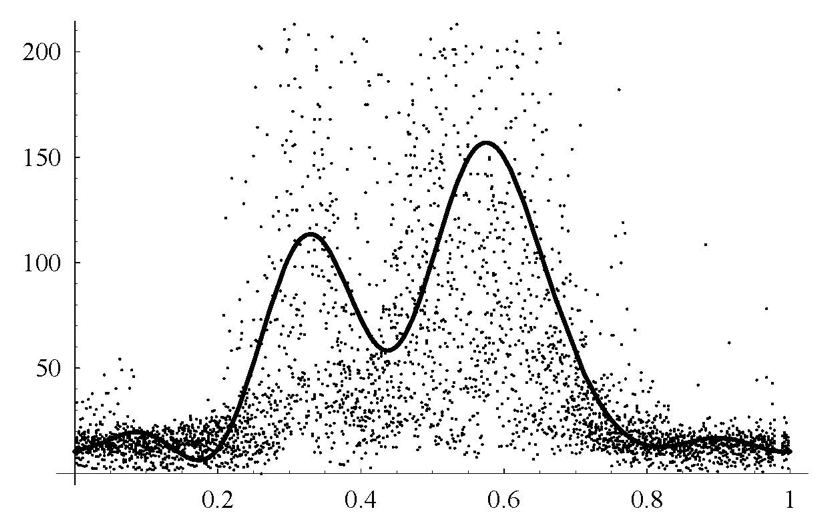
That “certain correspondences (must) exist between nature and our mind,” what Hertz (1894/1996, 67) also speaks of, is guaranteed in physics by the fact that nature is adapted to our mind, i.e. to the mathematical ideal conditions, in the experiment and the said correspondence is produced with it first. If, on the other hand, the ideal conditions assumed in the model cannot be produced or can be produced only insufficiently, the laws of nature to be observed remain mathematical fictions in the end, as everybody who has “fitted” models and data at least once knows well. The regularity is only in the mathematical function of the model, while the deviations of the observed data from it are explained by “external disturbances,” which escape the modeling. Fig. 3 gives an arbitrary example for this.

Fig. 3: Observational data and “regularity,” here using the example of the mean annual variation of a phytoplankton density, Helgoland Reede data 1976-1991.

Under the assumption that reality follows mathematical laws, we try to find out the mathematical structure and regularity which best fits the controlled observations. Obviously, this works in many areas, but this is not due to the correctness of the underlying assumption. Conversely, it becomes conclusive that:

By choosing a certain set of instruments – that of the exact sciences – we focus and limit ourselves to the knowledge of those aspects of reality that can be grasped with this set of instruments. And there is nothing to suggest that this is or could become our reality.

This does not define the limits of mathematical knowledge of nature, but at least names them. The unity of nature and mathematics, as Newton and Galileo postulated it, is finally gone, and not least because of the historical development of mathematics and the natural sciences themselves.

As an ideological self-image, however, it is still stuck in many people’s heads. There is no other way to understand why terms such as “artificial intelligence” or “world formula” are used not only for self-promotion and the acquisition of research funds, but also in an emphatic sense, as if they were to be understood literally, as if mathematical machines could really be intelligent and thus possess consciousness, or as if we could have the world “under control” if only we had a formula for it.[10] The mathematical-scientific method is thought to be boundless: there is no question which we would not eventually be able to answer with it, no problem which would be inaccessible to it.

Not being able to see the limits of one’s own instruments – in this case those of the exact sciences, of mathematical modeling – is a sure sign of the unconsciousness with which they are used. In view of the obvious impossibility of being able to solve the great problems of mankind with scientific means alone, a certain modesty would be quite appropriate, as it can only arise – in the sense of the Socratic phrase, “that what I do not know, I do not think I know” (Plato 1994, 18) – from a self-reflective awareness of one’s own thinking and doing.

References

Adorno, Theodor W.: Der Positivismusstreit in der deutschen Soziologie. Introduction, Neuwied 1969

Bareuther, Johannes: Zum Androzentrismus der naturbeherrschenden Vernunft, in: exit! – Krise und Kritik der Warengesellschaft, No. 12, Berlin 2014, 18-52.

Bergmann-Schaefer: Lehrbuch der Experimentalphysik, Band I, Mechanik, Akustik, Wärme, 9th improved edition, Berlin 1974.

Bockelmann, Eske: Im Takte des Geldes. Zur Genese des modernen Denkens, Springe 2004.

Bolay, Eberhard / Trieb, Bernhard: Verkehrte Subjektivität. Kritik der individuellen Ich-Identität, Frankfurt/Main 1988.

Comte, Auguste: Rede über den Geist des Positivismus, 1844, new edition of the German language edition, Hamburg 1994.

Dawkins, Richard: Der Gotteswahn, 9th edition, Berlin 2007.

Dewdney, Alexander K.: Alles fauler Zauber? Basel 1998.

Fölsing, A.: Galileo Galilei. Process without End. Eine Biographie, Reinbek 1996.

Galilei, Galileo: Discorsi e dimostrazioni matematiche, intorno a due nove scienze, 1638, Übersetzung von A. v. Oettingen 1890, Nachdruck, Frankfurt/Main 1995.

Greiff, Bodo von: Gesellschaftsform und Erkenntnisform. Zum Zusammenhang von wissenschaftlicher Erfahrung und gesellschaftlicher Entwicklung, Frankfurt/Main 1976.

Hertz, Heinrich: Die Prinzipien der Mechanik in neuem Zusammenhange dargestellt. Introduction, Leipzig 1894, reprint, Frankfurt/Main 1996.

Kant, Immanuel: Critique of Pure Reason, 1781, 2nd edition 1787, reprint, Hamburg 1990.

Keller, Evelyn Fox: Geschlecht und Wissenschaft: Eine Standortbestimmung, in: Orland, Barbara / Scheich, Elvira (eds.): Das Geschlecht der Natur, Frankfurt/Main 1995, 64-91.

Koyré, Alexandre: Leonardo, Galilei, Pascal. Die Anfänge der neuzeitlichen Naturwissenschaft, Frankfurt/Main 1998.

Kurz, Robert: Bloody Reason. Essays on the Emancipatory Critique of Capitalist Modernity and its Western Values, Bad Honnef 2004.

Mankiw, N. Gregory / Taylor, Mark P.: Grundzüge der Volkswirtschaftslehre, 5th ed.

Marx, Karl: Das Kapital. Erster Band, 1867, MEW 23, Berlin 1984.

Mehrtens, Herbert: Moderne – Sprache – Mathematik, Frankfurt/Main 1995.

Müller, Rudolf-Wolfgang: Geld und Geist. Zur Entstehungsgeschichte von Identitätsbewußtsein und Rationalität seit der Antike, Frankfurt/Main 1977.

Ortlieb, Claus Peter: Bewusstlose Objektivität, in: Krisis Nr. 21/22, 1998, 15-51.

Ortlieb, Claus Peter: Methodische Probleme und methodische Fehler der mathematischen Modellierung in der Volkswirtschaftslehre, in: Mitteilungen der Mathematischen Gesellschaft in Hamburg 23, 2004, 1-24.

Ortlieb, Claus Peter: Die Zahlen als Medium und Fetisch, in: J. Schröter / G. Schwering / U. Stäheli (eds.): media marx. Ein Handbuch, Bielefeld 2006, 151-165.

Ortlieb, Claus Peter: Heinrich Hertz und das Konzept des Mathematischen Modells, in: G. Wolfschmidt (ed.): Heinrich Hertz (1857-1894) and the Development of Communication, Norderstedt bei Hamburg 2008, 53-71.

Ortlieb, Claus Peter / Ulrich, Jörg: Die metaphysischen Abgründe der modernen Naturwissenschaft. Ein Dialog, in: exit! – Krise und Kritik der Warengesellschaft No. 4, Bad Honnef 2007, 145-176.

Plato: Sämtliche Werke, Übersetzt von Friedrich Schleiermacher, Vol. 1, Hamburg 1994.

Scheich, Elvira: Naturbeherrschung und Weiblichkeit, Pfaffenweiler 1993.

Scholz, Roswitha: The Gender of Capitalism. Feminist Theories and the Postmodern Metamorphosis of Patriarchy, Bad Honnef 2000.

Scholz, Roswitha: Neue Gesellschaftskritik und das Dilemma der Differenzen, in: exit – Krise und Kritik der Warengesellschaft, Nr. 1, Bad Honnef 2004, 15-43.

Sohn-Rethel, Alfred : Geistige und körperliche Arbeit. Zur Theorie der gesellschaftlichen Synthesis, Frankfurt/Main 1970.

Tegmark, Max: Unser mathematisches Universum – Auf der Suche nach dem Wesen der Wirklichkeit, Berlin 2015.

Ulrich, Jörg: Individuality as Political Religion. Theologische Mucken und metaphysische Abgründe (post-)moderner Individualität, Albeck bei Ulm 2002.


[1] For example, David Hilbert, inventor of the “axiomatic method,” in a lecture of 1918 (quoted after Mehrtens 1990, 133): “Indeed, whatever occurrences or phenomena we encounter in nature or in practical life, everywhere the mathematically minded and attuned person will find a mathematical kernel.”

[2] Alexander K. Dewdney is a Canadian mathematician and was responsible for the “Mathematical Recreations” column in Scientific American from 1984 to 1991.

[3] Galileo and the experience of Pisa: About a legend, Annals of the University of Paris 1937, Koyré (1998, 123-134.

[4] In a tract of Galileo from the same year 1590 there is even the opposite hint: If balls of wood and lead are dropped from a high tower, the lead moves far ahead, cf. Fölsing (1996, 85).

[5] see Koyré (1998, 129-132).

[6] Another implicit assumption is that the massless connection of the respective two bodies does not change the velocities.

[7] This is not to say that an experiment can not also show completely unexpected results, namely if the mathematical derivation is based on wrong presuppositions. In the case of Galileo’s law of falling bodies, this would have been the case if the inertial mass was not equal to the heavy mass, i.e. if the doubling of the one would not lead to the doubling of the other. In this respect, an experiment tests whether the assumptions underlying the mathematical considerations are correct.

[8]           The law of falling bodies G2, which is not presented here in more detail, is also introduced in the Discorsi according to this scheme: It is proved as a mathematical theorem (Galilei 1638/1995,159), which states that a uniformly accelerated body satisfies the law G2. Galilei comes to the uniform acceleration because of its simplicity, there is no other argument. Only then the experiments follow (Galilei 1638/1995,162). Whether Galileo actually carried them out or only described them is disputed (cf. Koyré 1998,129).

[9] Intentionally manipulated and therefore technically usable effects already existed in antiquity. In contrast, the idea of universal – always and everywhere valid – mathematical laws of nature is modern.

[10] This criticism is not directed against the goal of unifying scientific theories, which is sometimes also subsumed under the term “world formula.”

The Decline of The Middle Class

Robert Kurz

From the Classic Petty Bourgeoisie to Universal Human Capital

Since the mid-1980s, postmodern discourse has dominated global theoretical discussion for almost two decades, especially on the left. The critique of political economy was replaced by the critique of language, and the analysis of objective material relationships by the arbitrariness of subjective interpretation; Traditional left economism was replaced by an equally abbreviated left culturalism, and social conflict was replaced by media simulation. In the meantime, however, the situation has changed radically. The economic crisis is now also affecting large social classes in the West that had previously been spared. That is why the social question returns to the intellectual discourse.

But the interpretations remain strangely pale and seem downright anachronistic. The polarization between rich and poor, which is inexorably increasing, has not yet found a new term. If the traditional Marxist concept of “class” suddenly has a boom, it is more a sign of helplessness. In the traditional understanding, the “working class,” which produces surplus value, was exploited by the “capitalist class” through “private ownership of the means of production.” Not a single one of these terms can accurately represent today’s problems.

The new poverty does not arise through exploitation in production, but through exclusion from production. Anyone who is still employed in regular capitalist production is one of the relatively privileged. The problematic and “dangerous” mass of society is no longer defined by its “position in the production process”, but by its position in secondary, derived areas of circulation and distribution. They are permanently unemployed, recipients of welfare payments or cheap service providers in the areas of outsourcing, right up to wretched entrepreneurs, street vendors and waste collectors. These forms of reproduction are increasingly irregular, unsecured and often illegal by legal standards; employment is irregular; incomes are at the limit of the subsistence level or even fall below it.

Conversely, a “capitalist class” can no longer be defined in the old sense according to the standards of the classic “private ownership of the means of production.” In the form of the state apparatus and infrastructures as well as in the form of the large (today transnational) stock corporations, capital appears in a certain way as socialized and anonymized; it has turned out to be an abstract form of society as a whole that can no longer be personalized. “Capital” is not a group of legal owners, but the common principle by which the life and actions of all members of society are determined not only externally, but also in their own subjectivity.

In the crisis and through the crisis, a structural change in capitalist society takes place once again, which dissolves the old, apparently clear social situations. The core of the crisis consists precisely in the fact that the new productive forces of microelectronics are melting down labor and with it the substance of capital itself. With the increasing reduction of the industrial working class, less and less real surplus value is being created. Money capital is fleeing into the speculative financial markets because investments in new factories have become unprofitable. While growing sections of society outside of production become impoverished or even go into poverty, there is only a simulative accumulation of capital through financial bubbles.

Logically, this is nothing new, because this development has shaped global capitalism for two decades. What is new, however, is that the middle class in western countries is now also being hit by the wheels. The American essayist Barbara Ehrenreich had already published a book in 1989 on “The Fear of the Middle Class before the Fall”. The problem then shifted for a full decade because the speculative financial bubble boom of the 1990s, along with the upswing in information technology and the commercialization of the Internet, once again sparked new blossoming dreams. The collapse of the New Economy and the bursting of the financial bubbles in Asia and Europe, partly also in the USA, have now, since 2000, brutally started to bring about the previously feared collapse of the middle class.

But who is this middle class and what role does it play in society? In the 19th century the world of social classes was still simple and transparent. The class of the so-called petty bourgeoisie stood between the class of capitalists, that is, the private owners of the social means of production, and the class of wage workers, who have nothing but their labor power. This old middle class was characterized by having its own small means of production (workshops, shops, etc.), in which they mainly had to use their own labor and that of their families in order to sell their products on the market themselves. The expectation of the orthodox Marxists was that these “petty bourgeoisie” would gradually disappear through the competition of the big capitalist enterprises and sink into the class of industrial wage workers, until society was completely polarized into the two main classes, bourgeoisie and proletariat.

But already at the beginning of the 20th century there was the famous debate between Bernstein and Kautsky about the “new middle class” in German social democracy. This meant certain technical, economic and intellectual functions as they emerged from the process of capitalist socialization. With the increasing scientification of production and the corresponding expansion of infrastructures (administration, engineering, education and training, health care, communication and media public, institutions of research, etc.) a new social category arose, which according to the old scheme was “neither fish nor meat.” They were not capitalists because they did not represent great money capital; just as little were they classic petty bourgeoisie, because they did not have their own means of production and were largely wage-dependent or only formally independent; but they were not proletarians, because they were not employed as “direct producers,” but as functionaries of the capitalist development of the productive forces in all areas of life.

As early as the 19th century there were teachers and other state officials as well as those business functionaries whom Marx described as “officers and sergeants of capital.” But these social categories were numerically so negligible that they could not be called a “class” in their own right. Only with the new demands of capitalism in the 20th century did the corresponding functions become so massive that they constituted a new middle class. While in the Marxist debate at the beginning of this development Kautsky tried to press the new middle classes into the old scheme and somehow to classify them into the proletariat, Bernstein wanted to see in this social phenomenon a stabilization of capitalism that would make a moderate reform policy possible.

At first, Bernstein seemed to be right for a long time. The new middle class increasingly emerged as a social category distinct from the traditional working class; not only in terms of the content and location of the activity, but also in economic terms. Barbara Ehrenreich mentions as a criterion that for these people their “social status is based more on education than on ownership of capital or other assets”. The higher qualifications, the training of which takes a long time up to the age of 30 or beyond and devours large resources, increased the value of the labor far beyond the other average fluctuations.

In this context, a momentous term emerged, namely that of “human capital.” White-collar workers, engineers, marketing specialists or human resource planners, self-employed doctors, therapists or lawyers, and teachers, scientists and social workers paid by the state ‘are’ capital in two ways under certain circumstances: On the one hand, because of their own qualifications, they behave strategically, in a guiding or organizing manner in relation to the labor of other people in the sense of capital utilization; on the other hand, they partly relate (especially as self-employed or managerial employees) to their own qualifications and thus to themselves as ‘human capital,” like a capitalist, in the sense of ‘self-exploitation.’ The new middle class does not represent capital on the level of the external material means of production or money, but on the level of the organizational qualification for the process of exploitation with a high level of use of science and technology.

Numerous new functions of this type emerged in the course of the 20th century, and the new middle class continued to increase in number. Especially the development after the Second World War, together with the new forms of Fordist production and the leisure industries, brought an additional push in this direction; This can be seen from the fact that in most countries the proportion of students rose from generation to generation. The worldwide student movement of 1968 showed the growing importance of this social sector; but it was also a first signal of the crisis. If up to then the emergence of the new middle class had actually stabilized capitalism in Bernstein’s sense and was connected with advancing reforms, a process of destabilization now began.

It is true that the new structural mass unemployment in the wake of the third industrial revolution and the globalization of capital primarily affected the immediate industrial producers. But it was already becoming apparent that the new middle class would not be spared either. The rise of this class had in many respects been accompanied by the expansion of state infrastructures, education, and the bureaucracy of the welfare state. The crisis of real industrial exploitation, however, led ever deeper into the state’s financial crisis. Suddenly, many areas that had previously been considered proud achievements appeared as unnecessary luxuries and ballast.

The catchphrase of the “lean state” made the rounds; funds for education and culture, health care and numerous other public institutions have been cut; the dismantling of the welfare state began. In large companies too, entire sectors of skilled activity fell victim to rationalization. The crash of the New Economy even devalued the qualifications of many high-tech specialists. Today it can no longer be overlooked that the rise of the new middle class had no independent capitalist basis, but was dependent on the social redistribution of surplus value from the industrial sectors. To the same extent as the real social production of surplus value gets into a structural crisis as a result of the 3rd Industrial Revolution, the secondary areas of the new middle class are gradually being deprived of their breeding ground.

The result is not just growing unemployment among academics. Through privatization and outsourcing, the “human capital” of qualifications is devalued and degraded in status even within employment. Intellectual day laborers, cheap workers and wretched entrepreneurs as “freelancers” in the media, private universities, law firms or private clinics are no longer the exception, but the rule. Nevertheless, in the end, Kautsky is not right either. The new middle class is falling, but not into the classic industrial proletariat of the immediate producers, who have become a slowly disappearing minority. Paradoxically, the “proletarianization” of the qualified classes is connected with a “deproletarianization” of production.

The devaluation of qualifications goes hand in hand with an objective expansion of the concept of “human capital”. Contrary to the decline of the new middle class, a new kind of general “downsizing” of society takes place, the more the industrial and infrastructural resources appear as anonymous mega-structures. The “independent means of production” shrinks down to the skin of the individual: everyone becomes their own “human capital,” even if this is only the naked body. A direct relationship arises between the atomized people and the economy of value, which can only be reproduced in a simulative manner through deficits and financial bubbles.

The greater the income differences between rich and poor in the context of this financial bubble economy, the more the structural differences between the classes in the structure of capitalist reproduction disappear. It is therefore pointless for some ideologues of the formerly falling new middle class to want to claim for themselves the earlier “class struggle of the proletariat,” which no longer exists. Social emancipation today requires overcoming the social form common to all. Within the commodity-producing system there is only the quantitative difference of abstract wealth, which is existential up to the question of survival, but remains emancipatorily sterile. A Bill Gates is as petty-bourgeois as a wretched entrepreneur, both have the same attitude towards the world and use the same phrases. With these phrases of the universal market and of “self-realization” on their lips, they cross the gate to barbarism together.

Post Comment: This text has sparked debate among Brazilian intellectuals. Dieter Heidemann (São Paulo) writes about a letter to the editor in the Folha de São Paulo that uses the expression “Boias-frilas”: “The expression ‘Boias-frilas’ makes a joke to equate temporary sugar cane cutters and the perspectives of academics. The sugar cane migrants are called ‘boias frias.’ Boia is the ‘lunchbox’ and fria is cold. The expression refers to the cold lunch they take to the sugarcane field when they are carted to work at 4 a.m. by ‘sub-contractors’ (called ‘gatos’ = cats!). ‘Boia fria’ became a general metaphor in Brazil for the most precarious working conditions. The letter to the editor calls the jobbing academics ‘boias frilas’ = boias freelancers…”


Published in the Folha de São Paulo in September 2004

Big Data and The Smart New World as the Highest Stage of Positivism

Thomas Meyer

1. Introduction: The Mediation of Theory and Empiricism as a Concrete Totality

An individual never constitutes themselves directly, but is conditioned by the fetishistic process dynamics of capitalist society, mediated by the fetishistic whole. Immediacy of facts indicates that no critique of them is attempted, but a critique is evaded, for example, to make oneself comfortable in the scientific establishment. Empirical findings cannot be understood without theoretical concepts, and both concepts and empirical facts are in a dialectical relationship to each other. Adorno wrote in his critique of an empirically oriented sociology: “Theoretical reflections upon society as a whole cannot be completely realized by empirical findings […]. Each particular view of society as a whole necessarily transcends its scattered facts. The first condition for construction of the totality is a concept of the object [Sache], around which the disparate data are organized. From the living experience, and not from one already established according to the societally installed control mechanisms, from the memory of what has been conceived in the past, from the unswerving consequence of one’s own reflection, this construction must always bring the concept to bear on the material and reshape it in contact with the latter. But if theory is not to fall prey to the dogmatism over whose discovery skepticism—now elevated to a prohibition on thought—is always ready to rejoice, then theory may not rest here. It must transform the concepts which it brings, as it were, from outside into those which the object has of itself, into what the object, left to itself, seeks to be, and confront it with what it is. It must dissolve the rigidity of the temporally and spatially fixed object into a field of tension of the possible and the real: each one, in order to exist, is dependent upon the other.” (Adorno 1976)

Thus, empirical facts are to be applied to theoretical concepts, which themselves should be sharpened in confrontation with these facts. For every theory has its “time core” and concepts themselves have a history. Not taking note of empirical facts can result in an “anachronistic train of thought,” and theory building is then reduced to nostalgia and the exegesis of “holy writings.” At worst, one then ends up with an ahistorical and existentialist seeming “conceptualism.”[1] On the other hand, empiricism is not to be referenced with an immediacy such that every fact stands for itself as a positively given fact and its historical constitution and mediation with the social process dynamics is left out. For example, there are undoubtedly many studies that clearly describe the insanity of the capitalist mode of production (such as those on plastic production or industrial agriculture), but can only inadequately explain these empirical facts due to a lack of economic and social theoretical grounding; accordingly, the practical conclusions then often turn out to be helpless and abbreviated. If in such studies even the socio-critical impetus is still missing, one ends up “fact hoarding,” only wanting to acknowledge what can be expressed by graphs, statistics and numbers.

In contrast to the fact- and concept-mania, however, there must be an insistence on relating empirical facts to the fetishistic process-dynamics of capital, speaking to the totality; and at the same time the concepts, by which totality is to be expressed, must be related to empirical findings, so that the concepts grasp with sharpness that to which they are to refer, and make it possible to recognize the inner and historical connection of the empirical. The totality is thus to be thought of concretely (Scholz 2009). In this context, it must be noted that the empirical does not merge into the concepts, and in the context of the value-dissociation critique, it must be emphasized in particular that the various subject areas must also be accorded a quality of their own, which cannot be subsumed under a totality; rather, a fractured, historically dynamic totality must be assumed.

In the following, the aim is to outline facets of Big Data, social physics, and the Internet of Things, as well as the subsequent, rather left-wing criticism on a largely phenomenological or empirical level, which is also to be taken note of and not simply incidental. However, it should not stop with this critique; beyond this, the view of the overall social context of form and process should be unfolded.

2. Some Critical Thoughts on the Use of Mathematics in the (Social) Sciences

Mathematics is given the status of objectivity, stringency and freedom from personal values in (developed) modernity. This status is also given to those who express themselves through it. A statement that can be expressed by a number is regarded in our modern world as the epitome of truth. An argument has all the more power of statement and persuasion if it can refer to quantities, i.e. numbers and graphs (Ortlieb 2011). Thus, the sciences that are written mathematically, of which physics is a prototypical example, are considered “exact,” and those that are not are tainted with the stigma of non-exactness, of mere opinion, even of ideology.

Throughout the course of the 19th century and then at the latest in the 20th, various sciences have endeavored to orient themselves on the methodology of physics, on mathematical modeling and experiment, to thereby also attain the status of exactness and objectivity, with the goal of transferring the success of physics to their métier as well. The idea of being able to simply replicate the success of one subject by adopting its methodology to another is not without problems. This is because success (however it may be evaluated) has certain prerequisites that may not exist in another subject area. As a rule, there is no reflection on this either, because this would require dealing with the functional logic of the sciences and their “epistemic interests” (Habermas) or their “epistemic ideals” (K. M. Meyer-Abich). As we will see, an unreflective approach to mathematics is anything but stringent.[2]

A particularly clear case of this is the emergence of neoclassicism since the 1870s. Its goal was to overcome classical bourgeois economics and establish itself as an “exact” university discipline. It took its cue from physics, more specifically from classical mechanics. As the neoclassicist Irving Fisher (1867-1947) pointed out, the aim was to develop a formalism based on Hamiltonian mechanics[3] by establishing certain conceptual analogies (particle = individual, energy = utility, etc.) (Mirowski 1989, 222f.). However, this claim and its realization has already experienced some criticism (even more than 100 years ago, as described by Mirowski).

The impossibility of an experiment that could verify or falsify a mathematically formulated theory or even establish the situation in which the model assumes validity is a decisive argument for why this transfer cannot work in this way. It does not follow from this that mathematics cannot be used in economic theory in a meaningful and insightful way; however, it must be noted that mathematical models in economic theory generally cannot have the same explanatory power and scope as those in physics. However, a serious problem can already be observed at the level of model building itself: If one looks at common textbooks in economics, one sees that the assumptions of a given model are often not accounted for or verified when that model is applied to a new situation. Moreover, model assumptions are always made to fit the concept of market equilibrium: a rigid equilibrium scheme is thus imposed on all conceivable phenomena. The model assumptions are therefore chosen in such a way that we always get an intersection of two opposing tendencies, represented by the so-called Marshall cross[4] (if model assumptions were chosen a little more realistically, we might get no intersection, i.e. no equilibrium, cf. Ortlieb 2004a). Furthermore, these models and their assumptions convey an economic picture that has nothing to do with real capitalism, with industrial mass production, etc. They are little more than “market fairy tales” (Ortlieb 2004b). Therefore, neoclassical economic theory is rightly described as “mathematized charlatanry” (Ortlieb 2006). A possible reason to explain why a whole scientific discipline proceeds in such a methodologically questionable way was provided by Alan Freeman (Freeman 2006). According to him, neoclassicism is not so much a science that investigates and establishes facts of the external world, but rather a quasi-religious doctrine that has the dogma of the theory of harmony of the market equilibrium as its content, and therefore justifies capitalism. According to Freeman, this dogma is comparable to “heaven” in the Middle Ages. But this already indicates that if the aim is to criticize the sciences, it would be insufficient to limit oneself only to an immanent critique, to a critique of only methods and claims.

However, objectivity in the modern sense, as claimed by the natural sciences in particular, is not synonymous with truth, certainty, or fact-orientation. As Lorraine Daston and Peter Galison have noted, to be objective is to be “intent on knowledge that bears no marks of the knower” (Dasten; Galison 2007, 17). Objectivity, then, is a form of practice designed to eliminate subjectivity from the process of knowing. Objectivity understood in this way is thus an expression of social relations and the cognitive practice of the bourgeois subject form. The appearance of this objectivity consists precisely in the fact that scientific practice apparently has nothing to do with the cognizing subject.

Typically, objectivity and its historical or social genesis is not or is hardly reflected upon in the scientific community, and it is certainly not questioned.[5] The same goes for the term “exactness,” whose meaning is just as infrequently made clear.

According to Herbert Auinger, there is no reason why a non-mathematical language should not be exact, i.e. exact in the sense that the language hits what it refers to with clear words and conceptual sharpness. Ironically, philosophers such as Gottlob Frege (1848-1925) complain about the imperfection or lack of clarity of language with very clear words (Auinger 1995).

When talking about exactness of mathematical language, the focus is on the compactness of the mathematical expression and its convenient handling. A mathematical language is therefore precise and unambiguous and a non-mathematical one is not (necessarily).

However, it must be emphasized that this exactness can only be associated with those phenomena that are accessible to a mathematical description or quantitative approach (cf. the article “Math Delusion” by Claus Peter Ortlieb in this issue).

However, a switch to mathematics and the handling of social science or economic issues through mathematics, even if it is done in a methodologically clean way, is not to be confused with a profound examination of those issues that are to be given a mathematical form: According to Auinger, various social scientists who aspired to mathematization, or tried to justify it, complained that there are too many different theories in the social sciences, a complaint that says nothing against them in terms of content in the first place. Mathematization is thus seen as a way to put a stop to this confusing diversity; mathematics and formal logic then vouch for the truth of the rest. A mathematization can therefore find its reason in the fact that one does not want to (or can no longer) deal with the content of these different theories and their problems. Calculation can therefore possibly also be seen as a substitute for thinking (or thinking is limited to what can be quantified or is to be quantified). Certainly, the application of mathematics is useful in certain areas and appropriate to that corresponding subject area. But the number faith of our time can also lead to overestimating mathematics and its application, labelling everything else that might not be calculated as subjective and dismissing it as mere “speculation.”

The objection that mathematics and the mathematical sciences, quantitative thinking, are not to be overestimated, has been raised before. This was expressed by Hegel[6] himself in his Encyclopedia of the Philosophical Sciences: “This is followed by the further consideration that, since quantity, without being mediated by thinking, is taken up directly from the imagination, it easily happens that it is overestimated with respect to the extent of its validity, and even increased to an absolute category. This is indeed the case if only those sciences whose objects can be subjected to mathematical calculation are recognized as exact sciences. […] It would indeed be bad for our cognition, if of such objects as freedom, right, morality, even God himself, because they cannot be measured and calculated or expressed in a mathematical formula, we would have to content ourselves with renunciation of an exact cognition, in general merely with an indeterminate idea, and then, as far as the closer or particulars of the same are concerned, it would be left to the discretion of each individual to make of it what he wills.” (HW 8, 210f., here quoted after Auinger 1995, 16)

After Hegel, too, there were critical comments on the overestimation of the quantitative way of thinking, for example, by Friedrich Nietzsche, who wrote in “The Gay Science”: “So, too it is with the faith with so many materialistic natural scientists rest content: the faith in a world that is supposed to have its equivalent and measure in human thought, in human valuations – a ‘world of truth’ that can be grasped entirely with the help of our four-cornered little human reason – What? Do we really want to demote existence in this way to an exercise in arithmetic and an indoor diversion for mathematicians? Above all, one shouldn’t want to strip it of its ambiguous character: that, gentlemen, is what good taste demands – above all, the taste of reverence for everything that lies beyond your horizon! That the only rightful interpretation of the world should be one to which you have a right […], one that permits counting, calculating, weighing, seeing, grasping, and nothing else – that is a crudity and naiveté, assuming it is not a mental illness, an idiocy. […] Suppose one judged the value of a piece of music according to how much it could be counted, calculated, and expressed in formulas – how absurd such a ’scientific’ evaluation of music would be! What would one have comprehended, understood, recognized? Northing, really nothing of what is ‘music’ in it! (Nietzsche 2001, 238f.)

Hegel and Nietzsche hereby collect points that are mentioned in a critique of an overestimation of mathematical science.[7] However, they argue purely epistemologically, and do not relate to the level of society as a whole, and thus remain on the surface. It is important not only to criticize the unreflective and possibly methodologically impure application of mathematics or quantitative thinking, but also to criticize the social context in which this application takes place.

Claus Peter Ortlieb formulated a critique of the mathematical natural sciences on a socio-theoretical level in his essay “Unconscious Objectivity” (Ortlieb 1998). There it is argued, among other things, with reference to Evelyn Fox Keller, “that for some reason we have forgotten to bring our own survival into the objectives of scientific knowledge.” The basic problem, then, lies not so much in a merely unreflective approach to mathematics and the “hard sciences,” but in a socially produced objectivity, i.e., the fetishistic dynamics of capital, which is indifferent to the vital interests of human beings and nature and sees all the world only as a substrate for its valorizing movement.

A specific form of technological development is associated with the mathematical sciences, and the progress in knowledge that follows from them, which as a rule consists in the application of those structures, principles, or laws of nature that are discovered and investigated by the corresponding sciences. However, this technical development itself stands in a specific social context: This consists, among other things, in the fact that the fetishistic dynamics of capital favors technical developments which lead to a saving of abstract labor, so that their corresponding application results in a cheapening of the products and/or an opening up of new markets (not to be forgotten are the military: war research, etc.).[8] Technical development, together with the associated basic research, takes place in such a way that, for the most part, developments correspond to the valorization imperative of capital, or at least meet it. This also includes the establishment of the dissociated sphere, which forms the mute prerequisite of valorization; Fordism, for example, would hardly have been possible without the corresponding enforcement of a petty-bourgeois family structure.

Thus, with a quite understandable critique of technology, it must be insisted that the causal issue here is not “technology” per se, as alluded to, for example, in the works of Günther Anders (especially in Antiquity of Man I/II), but rather the fetishistic dynamics underlying it. For instance, a rejection of individual transportation does not necessarily mean that the internal combustion engine as such would be abolished. And the fact that the whole world is being filled up with microelectronics does not necessarily follow from the invention of the transistor; rather, the cause and justification lies in the commodity-producing patriarchy itself and its indifference to the material content, the inherent logics of nature and its boundlessness, which finds expression in Marx’s formula M-C-M’ etc. (Cunha 2016, Heintz 1992). This “technological totalitarianism,” as it is called in places in the bourgeois feuilleton, is therefore itself an expression and consequence of the totalitarianism of the value-dissociation relation. This does not mean, however, that technology would only have to be “liberated” from the fetish of capital without undergoing significant changes itself, since its development and realization are already shaped by the valorization requirements of capital. This can be seen in the sometimes-nonsensical business implementation of a so-called utility value: Thus, to increase sales, emphasis is placed on planned wear and tear, or planned obsolescence. For example, tear-resistant pantyhose or long-life light bulbs were withdrawn from circulation when it became clear that the market would otherwise be saturated much too quickly (Reuß & Dannoritzer 2013).

Through the fetishistic dynamics of the value-dissociation relation, a specific purpose is baked into technology, which of course will change or even become obsolete when the social relations and the corresponding subject form of people in capitalism are overcome. For some use values or technologies it may seem difficult to imagine or even absurd that they could find use in a liberated society, be it individual transport or nuclear weapons. For others, however, from our current perspective, it is not necessarily clear. This means that while technologies and their implementation are form poisoned, their potentialities do not necessarily merge in the social form into which they are squeezed. The issue is also complex because the precursor to technology is a socially mediated relationship of engagement with inanimate and/or animate nature that finds expression in contemporary natural sciences and their forms of thought and practice; it is a relationship to an external substrate of nature, but one that must be accorded an autonomy, a non-identicalness that cannot be reduced to discourse, human interpretation, and purpose. Otherwise, there would be claimed a total availability of nature, which, however, expresses nothing else than that nature is to be handed over to the capitalist imperative of valorization. A critique of technology is thus linked to a critique of the natural sciences, and both are to be related to the social context in which they take place. An acknowledgement of an autonomy of nature (which, however, is not to be confused with a “romanticism of nature”), together with a critique of the social form that negates it, leads to a kind of “dialectical realism” (Roswitha Scholz); in contrast to a “new materialism” or a “new realism” that, although it distances itself from poststructuralism and its fixation on discourse, does not take note of the social totality and therefore does not arrive at a critique of the value-dissociation relation (cf. Roswitha Scholz’s article in this issue).

Just as mathematical economic theory has already been criticized, the following will do the same regarding a recent trend in the scientific landscape: Big Data and the social physics based on it. To this end, the claim and the justification of this discipline will first be examined and then subjected to a critique.

3. The Social Physics of Alex Pentland

Alex Pentland is probably one of the best-known and most influential computer scientists currently working on Big Data. Big Data is the collection and analysis of data to an extent that has never been available before in history and is therefore no longer manageable with traditional statistics. In his book “Social Physics – How Social Networks Can Make Us Smarter”, Alex Pentland explains in a generally understandable way all the wonderful things that Big Data can do and what can be researched with it.

The use of Big Data aims to understand the social; and the corresponding scientific discipline is called “social physics.” However, as Pentland notes, because it abstracts from the human interior, its statements are fundamentally only probabilistic (Pentland 2015, 16). Nonetheless, the goal is “to build quantitative, predictive models of human behavior in complex, everyday situations” (Pentland 2015, 12).

But how exactly does this work and what promises are made?

It is initially quite simple: Vast amounts of data are gathered “by collecting digital bread crumbs from the sensors of cell phones, postings on social media, purchases with credit cards, and more” (Pentland 2015, 9). To this end, as Pentland repeatedly points out, special programs which record all sorts of things are installed on the “smartphones” of the subjects of the studies conducted. In this way, subjects can be observed in real time over an extended period, producing countless gigabytes of data in the process. This data is then used to help understand how an idea circulates between people and how this flow of ideas (idea flow), along with information, causes human behavior to change (or how it can be changed). To do this, a device was built to bring together the many sources of information: the “socioscope.” According to Pentland, this is expected to revolutionize the study of human behavior in the same way that, say, the microscope revolutionized biology (Pentland 2015, 10).

The crucial difference to conventional statistical sociology is that here, in principle, millions of people can be observed in real time over a longer period.

Furthermore, social physics should make one understand “how this flow of ideas ends up shaping norms, productivity, and creative output of our companies, cities, and societies. It enables us to predict the productivity of small groups, of departments within companies, and even of entire cities. It also helps us tune communication networks so that we can reliably make better decisions and become more productive” (Pentland 2015, 4).

In social physics based on Big Data, the aim is to filter out correlations from the data and then model them mathematically. In this way, human behavior (or traffic), among other things, can be predicted and optimized. This is accomplished by looking at the data of many individuals and their respective “peer group,” i.e., the immediate social environment, cliques, etc.

Pentland shows unbounded optimism about the expected results of social physics: “For the first time, we will have the data required to really know ourselves and understand how our society evolves. By better understanding ourselves, we can potentially build a world without war or financial crashes (!), in which infectious disease is quickly detected and stopped, in which energy, water, and other resources are no longer wasted, and in which government are part of the solution rather than part of the problem” (Pentland 2015, 18f.).

We will also owe “[a] much better government” to social physics (Pentland 2015, 138), and in doing so, if I understand Pentland correctly, we can dispense with the traditional means of a political discourse. Pentland’s point of view can therefore be seen as an indication that capitalism’s “ability to shape” through political discourse has historically reached its limits, and thus political discourse as such has become irrelevant, since it moves within capitalist real categories that today reach their absolute limit and can therefore mobilize “potential for shaping” only in their wildness. Robert Kurz thus consequently spoke of an “end of politics” (Kurz 1994).

By an “idea,” already mentioned above, Pentland means the following: “An idea is a strategy (an action, outcome, and feature that identify when to apply the action) for instrumental behavior. Compatible, valuable ideas become ‘habits of action’ used in ‘quick thinking’ responses” (Pentland 2015, 20). There is no clearer way to express the instrumental nature of this whole charade. It is also not surprising, as stated in various places in the book, that incentives are meant to get people to change or optimize their behavior. Critics see this as an intentional manipulation of behavior. The intentional manipulation can be seen in the fact that data collection and the study of the dynamics in social networks make it possible to intervene “to change the social network” (Pentland 2015, 5).

It is already easy to see here that social physics, due to the rather narrow horizon of its concepts and methods, will never (be able to) think about emancipation; and even less about a fetishism-critical analysis of society, which would be necessary for an adequate and critical understanding of this society. Only the allegedly objectively directly present individual is considered, who is thereby only seen as an information and stimulus processing system. The approach through which the individual is claimed to be understood is thus a reified one, one that has a tendency toward the totalitarian. It is also assumed that humans, as mere stimulus-processing machines, can be passively manipulated or steered in a desired direction (both by social physics and by some of its critics). But this would mean assuming that domination is only external to the subject, and has nothing to do with an active intrinsic part of himself. By this elision of the socio-psychological level and capering on the individual and his data, the social totality, which for people like Pentland is surely nothing but metaphysical nonsense, is completely lost from view. It is also consistent, as mentioned above, to abstract from the human interior, since this could hardly be modeled or formalized mathematically. It is similar to the behaviorism of earlier days, in which the human being was also regarded only as a collection of flesh to be steered and controlled. It is not by chance that Pentland advocates for conducting corresponding larger field experiments: “We need to construct living laboratories – communities willing to try a new way of doing things or, to put it bluntly, to be guinea pigs (!) – in order to test and prove our ideas” (Pentland 2015, 186). This hubris is not too surprising for a technocratic worldview wherein people are bluntly and openly referred to as guinea pigs! This  is hardly to be understood as a colorful metaphor, but rather much more as a threat. To call humans guinea pigs, to dehumanize them, however, means nothing other than that one claims to also treat them as such. This phenomenon is also known from medical studies in which people who participated in experiments were collectively referred to as “material,” and usually treated accordingly (Pappworth 1967, XI). In particular clarity, this dehumanization of human beings supported by science was evident in psychiatry, where people were (or are[9]) effectively reduced to a vegetable.

Pentland’s social physics, as already indicated, is primarily concerned with productivity and how this can be optimized. Studies have shown that the more people communicate or interact with each other, the better the flow of ideas, which has a positive effect on the productivity of a company (Pentland 2015, 93f.). Who would have thought that? The book also stands out for other groundbreaking findings: For example, a family is more mobile and interacts with a greater variety of people when it has more money (Pentland 2015, 164). These exceedingly profound research findings already seem somewhat ridiculous and trivial in light of the élan and pretension with which Pentland promotes Big Data social physics. This phenomenon is nevertheless striking and in need of explanation, that sciences, when they claim with élan to finally be able to understand humans and society with their technical and mathematical instruments, often end up with rather trivial results, if they do not even produce more or less “mythology,” as it has been noted for instance in the case of neuroscience (Hasler 2012). This was also already noticed by Stanislaw Andreski (1919-2007), who at the time wrote a polemic against the social sciences of the time, specifically against Skinner’s behaviorism, which, in my opinion, could also be used against Pentland’s digital behaviorism: “The problem of how to control the behavior of humans and animals by punishments and rewards has been treated in innumerable treatises on penology, legislation, education, management and animal training, starting from the works of Aristotle and Confucius, not to mention the countless proverbs and wisdoms of the vernacular. It is always possible to say something important and new about this subject, but it is also very difficult. But a bit of pseudoscientific terminology can confuse and intimidate people into thinking a highly simplified and therefore less valid version of ancient folk wisdom is a significant development” (Andreski 1977, 72).

One reason why a high standard ends up in rather trivial results may be that a technocratic and mathematically oriented approach does not do justice to its subject matter. Pentland refuses to look at structural social contexts. He rejects categories such as “market” and “class” because they are too simplistic for him. Of course, the point here is not to demand that categories like class or market be made strong again; at best, that would only result in a social analysis and critique of traditional Marxist provenance. But it is nevertheless important to note that parts of the bourgeois intelligentsia are in the process of saying goodbye to social conceptualizations for good. We thus see that there is a clearly pronounced methodological individualism in Pentland. Through this, the ability to consider social relations as having become historical is reduced, and it becomes impossible to analyze and question social relations and, a fortiori, the fetishistic constitution of them. Consequently, the understanding that  social physics gives access to is a technocratic and domination-affirmative one, since it makes, above all, any historical thinking impossible. Social physics does not allow us to see the historical development of “social facts,” which would be a basic prerequisite for their critique and thus also the possibility of overcoming them in an emancipatory way.

This also strikes some representatives of the bourgeois intelligentsia. The journalist and Internet critic Nicholas Carr, for example, writes about this approach that “[a] statistical model of society that ignores issues of class, that takes pattern of influence as givens rather than as historical contingencies, will tend to perpetuate existing social structures and dynamics. It will encourage us to optimize the status quo rather than challenge it” (Carr 2014).

The left also criticizes the fact that social physics would make “relations of domination invisible” (Wagner 2016, 149).

However, a concept of domination, as it is used by many leftists in particular, which is often understood as an external or personal one, must be rejected. This is also echoed in various left critiques, such as Wagner’s, against Big Data, and so on. However, relations of domination ought to be understood as fetish relations. Thus, in the text “Subjectless Domination,” Robert Kurz writes: “The ‘domination of man by man’ must not, therefore, be understood in the crude external and subjective sense, but as the all-embracing constitution of a compulsive form of human consciousness itself. […]The concept of domination must therefore not be merely rejected so as to raise the concept of the constitution of the fetish in its place, which would reduce the subject and his declarations to a simple marionette. Rather, the concept of domination and its mediating concept “power” must be deduced as concepts from the universal phenomenal form of the constitutions of the fetish, which in turn are manifested both practically and sensibly as the spectrum of repression or self-repression in diverse forms and on various planes. The in-itself unconscious form manifests itself to consciousness as domination on all planes. In the figure of domination, the subject as a being constituted by the fetish makes real contact with himself and with others. The objectivized categories of the constitution thus form the (respective) pattern or matrix of domination. (Kurz 2004, 206f.).

Criticism of domination, whether in the abbreviated sense or as criticism of the fetish constitution, is of no interest to Pentland and other social physicists. However, Pentland at least (!) sees that the data sets could also be abused and used against the people. This also applies to anonymized data, as they can usually be deanonymized relatively easily (Pentland 2015, 228, 204). That is why he, in all seriousness, proposes a “New Deal on Data” (Pentland 2015, 180f.). In other words, a series of measures to ensure that individuals remain sovereign over their data, i.e. that each individual decides what is to be done with their own data. However, he does not mention the possibility of questioning this exorbitant data collection in principle and at least making it conceivable to possibly end it (just as questioning individual transportation makes its abolition conceivable). Instead, one gets the impression that technical and scientific developments are to be accepted as an inevitable fact of nature that could at best be regulated by the state.

In principle, the protection measures outlined by Pentland make sense and a commitment to them should be acknowledged. However, his plea for a defense of privacy (which is eroding anyway due to technological and social developments) is not very credible when one looks at some of the possible applications: In principle, everything can be monitored. These techniques are virtually predestined for such things, and an important motivation for their development is precisely this type of monitoring. In an interview with “Spiegel-Online,” he answers the question of whether he would intervene if, in a family being monitored, the father was drinking too much: “No, never. But we might in the future. The more science is moving forward and the better we understand human behavior, the more you get the obligation to act” (Pentland 2014). This suggests what might be called “digitized paternalism,” a mindset that also plays a large role in so-called “nudging.” I’ll come back to this later.

One thing that could be done with Big Data, which is probably actually meaningful (or rather negatively meaningful), would be to follow the existing material paths of industrial production. Not, however, with the aim of “optimizing” them in a capitalistic way, but rather to determine and denounce their utter madness: The absurd material distribution chains capitalism manages due to its processual dynamics, for example in the cultivation of apples, or the production of yogurt, has already been investigated in some places, such as in a study by Stefanie Böge (Böge 1992, 2001).

As is well known, the goal of the capitalist mode of production is the successful valorization of capital. An individual capital achieves this by trying to attract to itself as large a share as possible of the mass of value produced by society as a whole through competition. The consequence is, as Marx already described it, a growing concentration of capital. He put in a nutshell with “one capitalist always strikes down many others” (Marx 2005, 929). Today, this phenomenon must be seen specifically in the context of the globalization of the past few decades, i.e. unlike in Marx’s time, capital concentrations and mergers are not to be understood as an expression of an expanding total capital, but as a rationalization investment due to a contraction of total capital, as a mode of its crisis course (cf. Kurz 2005, 288f.).

However, it also follows from this merging dynamic that the “winner” takes over the market share of the dead beat, which means that the victorious apple producer then supplies the whole world with apples that could just as easily be grown “locally.” This leads to ever greater transport distances, and the corresponding consumption of resources, which are fatalistically accepted with a shrug of the shoulders. This madness exists in material terms, not in economic terms: In terms of the logic of valorization, this absurdity is not absurd at all; it has its origin in economic “reason,” and in accordance with it, this world is being productively disfigured.

In a critique of the material results of capitalism, it is therefore necessary to insist that it is not the material level per se that leads to environmental destruction, waste of resources, etc., but the social form in which the “use values” must move, whereby the material content is adapted to the form. The growing concentration of capital and even more the “contradiction between matter and form” (Ortlieb 2009) do not come into view if only the data scrap of many individuals is analyzed and the whole world has only “optimization” in mind.

As we will see in the following, the function of Big Data and its applications is obviously a socially repressive one (on the part of the state and on the part of individual capital), as Pentland has already openly and bluntly indicated. Big Data has accordingly been used as an instrument of repression for a long time, as the mathematician Cathy O’Neil shows phenomenologically in her book “Weapons of Math Destruction.”[10]

4. Applied Mathematics as A Means of Repression

In our digital brave new world, all kinds of data are collected and stored in huge databases. The data are then evaluated by certain algorithms or mathematical models. In this way, a person’s credit-worthiness, a job applicant’s fitness for hiring, the probability of a criminal recidivating (!) (and court decisions are made accordingly), or the likelihood of crimes occurring in a certain neighborhood (!) can be calculated. Algorithms are also used to make evaluations that determine whether a person will continue to be employed as a teacher. O’Neil brings up all sorts of examples in her book. The perfidious thing about algorithms is that what they do and how they do it usually remains a trade secret. So the algorithm’s judgment is absolute, and no contradiction is possible. This typically remains the case because these algorithms rarely have “error feedback” (O’Neil 2016, 133) (or they just positively feedback on themselves, a “pernicious loop feedback”) that could cross-check whether an algorithm was actually correct. Thus it is clear that these algorithms have extremely repressive consequences for many people, which is why O’Neil calls them “weapons of math destruction” (WMD). These “weapons” are “by design, inscrutable black boxes; they define their own reality and use it to justify their results. This type of model is self-perpetuating, highly destructive – and very common” (O’Neil 2016, 29, 7).

One problem here is that (applied) mathematics is not accessible to many people and they are therefore often helpless in the face of the judgments of such a model. This helplessness is also the result of the contemporary belief in numbers and the uncritical perceptions of the “objective sciences.” But models of this kind are anything but objective: “A model’s blind spots reflect the judgements and priorities of its creators. […] Models are opinions embedded in mathematics. […] these models are constructed not just from data but from the choices we make about which data to pay attention to – and which to leave out” (O’Neil 2016, 21, 218, emphasis TM).

O’Neil writes: “Nevertheless, many of these models encoded human prejudice, misunderstanding […] Like gods, these mathematical models are opaque, their workings invisible to all but the highest priests in their domain: mathematicians and computer scientists. Their verdicts, even when wrong or harmful, are beyond dispute or appeal” (O’Neil 2016, 3).

Moreover, the actual predictive power of some of these models is extremely poor. For example, Andreas von Westphalen points out that: “An elaborate study by ProPublica […] proves that at least one frequently used algorithm discriminates on the basis of skin color. The study also shows that accuracy of the risk calculation leaves much to be desired: Only 20 percent of people predicted to commit a violent crime actually committed a violent crime in the next two years. ProPublica ironically judges that-even if all felonies and misdemeanors were included – the prediction is only marginally more accurate than a coin flip” (von Westphalen 2016, 63f.).[11]

The crucial problem of such algorithms or models is that they are often self-referential. This is the case, for example, in the preventive fight against crime. The databases show that a high number of crimes, especially so-called “drug crimes,” have been detected in black “problem neighborhoods.” The algorithm predicts a high probability of crime in these neighborhoods. The police react with appropriate presence – and lo and behold – numerous crimes are detected and the algorithm is deemed a “success.” So the algorithm creates an interpretation of the world that always confirms itself. It is clear that there is a positive feedback loop here which will lead to even more police presence. In this way, those affected are punished for their very existence, their poverty is criminalized: “In this system, the poor and nonwhite are punished more for being who they are and living where they live. […] The result is that we criminalize poverty, believing all the while that our tools are not only scientific but fair” (O’Neil 2016, 97, 91).

Racist structures and social relations are therefore reproduced and cemented by Big Data and algorithms, although these algorithms claim to be  “objective” or even “fair,” as is strived for above all in the judiciary; an algorithm cannot possibly, for example, “judge” in a racist way. However, what is forgotten here is that it is humans, who may well be racist, that develop them; and even if they are not explicitly so, a racist and socially repressive reality is mathematically modeled through them, and with certain assumptions made, is thereby reproduced (O’Neil 2016, et al. 24-27). For example, risk assessment algorithms calculate the likelihood of a delinquent recidivating using methods such as  questionnaires. However, these questionnaires are constructed in such a way that someone who grew up in a “problem neighborhood” is inevitably calculated to be at higher risk. It may be argued that racist results do not necessarily follow from this methodology; but – and this is crucial – whatever assumptions and questionnaires are used, the goal of these methods is to model a racist reality, with the aim of more efficient and less costly law enforcement.

Thus, I think Big Data and its applications are probably only of secondary importance at this point; for high police presence in black “problem neighborhoods,” a “war on drugs,” mass incarceration of the poor (cf. Wacquant 2013, Meyer 2017), etc., existed before the times of Big Data. O’Neil’s focus is not on a clear analysis of the social causes of racism and crime; she does complain that Big Data and its applications, or some of them, i.e., the “weapons of math destruction,” would endanger democracy; but she does not question whether democracy is itself already a system of domination and to what extent applied algorithms are only the technical means by which a struggling capitalism deals with its delinquents, poor, and fallen out.

The extremely conservative character that data collection assigns to people because of their social behavior is similar. As a result of all their data being collected, people become fixed to their past: “Big Data processes codify the past. They do not invent the future. Doing that requires moral imagination, and that’s something only humans can provide” (O’Neil 2016, 204). This is due to the fact that “mathematical models, by their nature, are based on the past, and on the assumption that patterns will repeat” (O’Neil 2016, 38).

For example, someone could not get a job just because he had a stay in a psychiatric hospital a few years ago. A corresponding algorithm would filter out such candidates. However, it should be noted that such practices were just as common in earlier times and so an algorithm cannot be the primary problem here. Today this may be even more blatant, since much more data from much more people is available much faster. However, according to the logic of valorization, it is quite understandable why people with (formerly) severe emotional problems are rejected as applicants, since they are indeed dysfunctional for the company, or could be. Every single capital has to compete, but this also means that personnel costs, like all others, should be kept as low as possible. The problem, then, is not an algorithm in the causal sense (no matter how accurately it may “judge”), but the requirement to exist as a labor container and to be filtered out or put away (even with “well-meaning” pedagogical and re-socializing goals) if this requirement cannot be met.

This practice of filtering applicants with the use of algorithms is now common: “Such tests now are used on 60 to 70 percent of prospective workers in the United States, up from 30 to 40 percent about five years ago […]” (O’Neil 2016, 108).

Interestingly, however, it is often not at all a matter of finding the best candidate by sorting them out, but of quickly and cheaply getting rid of as many as possible (O’Neil 2016, 109).

The reduction of costs is the driving force behind the application of these algorithms: “For most companies, those WMD’s are designed to cut administrative costs and to reduce the risk of bad hires […]. The objective of the filters, in short, is to save money. […] Replacing a worker earning $50,000 a year costs a company about $10,000, or 20 percent of that worker’s yearly pay, according to the Center for American Progress. Replacing a high-level employee can cost multiples of that – as much as two years of salary” (O’Neil 2016, 118).

However, O’Neil remains at this phenomenological level and does not attempt to explain why job mobilization demands ever-increasing up-front costs, or why a seemingly excessive number of job applications flood companies and prove disruptive.

As explained, O’Neil points out the socially repressive character of Big Data and subsequently writes that Big Data threatens to go the same way as phrenology did a few centuries ago (O’Neil 2016, 121f.), i.e. to develop further into a repressive machine (or, to be more precise: to digitally upgrade the previous repression machine). This is not only because the whole procedure is opaque (trade secrets[12]), but also because many algorithms or models include questionable assumptions or prejudices that ultimately have socially repressive consequences. Big Data can therefore rightly be described, at least in part, as “mathematized charlatanry” (Ortlieb 2006).

Although O’Neil criticizes the questionable applications of Big Data, denounces its repressive consequences, makes the claimed “objectivity” of mathematical modeling highly questionable through her remarks (“Models are opinions embedded in mathematics.”), and suggests the inappropriateness of these models for describing human behavior, she nevertheless does not arrive at a principled questioning of the positivist way of thinking.

Let’s assume that algorithms and models are developed that are actually correct and accurately reflect the behavior of people: What would be gained by this with regard to the critique of social repression? At this point, at the latest, it should be obvious that an immanent critique of science, for all its necessity, has its limits and must be extended by a critique that goes beyond it. This must include a critique of the social subject-object dialectic, which one will look for in vain in such immanent critiques. For example, in a critique of the model of homo economicus, critics argue that people cannot be reduced to this conception of man, and that it is therefore not realistic; on the other hand, it is countered that many people actually behave in many situations exactly as if they acted according to this model (otherwise they would have to accept economic disadvantages) (Baumbach 2015, 297f.). Now how is this “fact” to be understood? The positivist scientific establishment would only feel confirmed, the model assumptions would be true and this external fact would thus be as certain as the former existence of the dinosaurs or the spherical shape of the earth. However, it is a fact, although people are not absorbed in this, which was produced only by the social action of the people themselves, and influences them as a compulsion, i.e. an act-thing which confronts them as objectivity.

However, if one restricts oneself to an immanent critique and concludes from this only that naively or incorrectly applied methods should simply be corrected with better or more stringently applied ones, then this almost inevitably leads to a continued affirmation of existing conditions. Thus, it is known that various critics of neoclassicism ultimately ended up in “post-autistic” or “heterodox” economics, which, according to their claim, want to develop more realistic modeling, but just like neoclassicism do not question the bourgeois forms of circulation, labor, etc., and the usual scientific forms of thought.

The danger of increasing social control emanating from Big Data is also increasingly being discussed in other places. Some time ago, several scientists published the “Digital Manifesto.”[13] This manifesto aims to draw attention to the totalitarian development paths made possible by Big Data. It looks admonishingly at China and Singapore, which give us an idea of where the journey of digitalization could lead: “The concept of a Citizen Score, which is now being implemented in China, gives us an idea of this: By measuring citizens on a one-dimensional ranking scale, the plan is not only comprehensive surveillance. Since the score on the one hand depends on clicks on the Internet and political good behavior, but on the other hand determines credit conditions, possible jobs and travel visas, it is also about the patronization and social control of the population” (Digital Manifesto 17).

Thereby it is noted that if similar things would also come about in the western democracies, it would be irrelevant whether it would come through the state or through private companies (like Google![14]). Unfortunately, these people seem to miss the fact that in the West the things indicated in the quote have been going on for a long time, which Cathy O’Neil was not the first to point out (von Becker 2017). Of course, it is also not taken into account that the so-called democracies have long been “post-democracies” (Colin Crouch), surveillance state-of-emergency regimes in which everyone tends to be given criminal status qua existence, a development that can be seen very clearly in all the manifold measures that have been tackled after 9/11 (cf. Kurz 2003b, Trojanow; Zeh 2010).

Two explosive and extremely clear examples from the wonderful world of democracy should be cited. Since 2009, the EU has been working and researching on a project called INDECT: “The computer-based surveillance system is to automatically detect ‘abnormal behavior’ and identify suspects by facial recognition and database matching. To do this, the Internet and primarily urban space will be seamlessly monitored. Information from social and private networks will be linked with other databases, such as police records, using automated facial recognition through camera surveillance, and biometric data from identity cards and passports, which will be available in digitalized form, and will also be used. […] INDECT is thus another form of artificial intelligence. The concrete networking and evaluation of the data happens – how could it be otherwise – behind closed doors. Those responsible for the project equate ‘abnormal behavior’ with ‘criminal behavior.’“

This consists not only of looking into the camera screaming “Allahu Akbar” shortly before pressing the button, but also, among other things, “walking too fast or too slow, screaming or swearing, moving in the wrong direction, ‘loitering,’ meeting with many people, staying too long in the direct vicinity of a certain object […]. Once a suspect – and who wouldn’t be a suspect given the behaviors labeled ‘abnormal’? – come into the sights of INDECT, the smallest remote-controlled surveillance drones with built-in high-performance cameras are to be used to identify and track the suspect. These drones are networked with each other and are supposed to cooperate with each other ‘intelligently and autonomously,’ thus forming drone swarms” (Jansen 2015, 109f.).

The next logical step would be to arm such drones and continue automated warfare, as is being waged in Afghanistan and elsewhere, in the Golden West itself.

The “world’s most populous democracy” – India – has come up with the following: “The world’s largest biometrics project by a single state is being carried out in India. An estimated 1.2 billion people, one-sixth of the world’s population, are being digitally enrolled on the Asian subcontinent. The project is called ‘Aadhaar’ […]. Specifically, the biometrics project envisions that every Indian, whether pariah or social elite, will have digital scans of their ten fingerprints and both irises, as well as a photo of their face, taken, processed and stored in a digital database. Each Indian is also to be given a twelve-digit ‘Unique Identification Number’. […] Not only biometric, but also demographic information, such as name, age, gender or even caste (!) is linked to the number. This only further cements the still racist separation of Indians into different castes […]” (Jansen 2015, 105f.).

The numerous surveillance possibilities of Big Data in combination with “artificial intelligence” are wonderfully suited for the permanent state of emergency, social control and (preventive) counterinsurgency. The difference between the EU and China, for example, is only a gradual one. However, it does not occur to the authors that digitalized capitalism is virtually predestined for the purposes described above and that a digital capitalism without them would probably not be possible – in view of the real existing social disruptions and the crisis-like conditions in which these technologies and their developments are situated. But none of this is taken into account. It is always the others who are totalitarian! (cf. Kurz 2001, 2002a)

However, the following should be emphasized here: Although these numerous surveillance technologies suggest the realization of a total state à la George Orwell’s 1984, this moment should not be overestimated either. First of all, these technologies are used primarily by private companies, thus also playing a major role at the level of individual capital, and second, state sovereignty itself is in the process of erosion and barbarization. This can be seen, on the one hand, in the fact that the state security apparatus is decaying by aligning itself with private terror gangs, as can be clearly seen, for example,  in the Third World.[15] On the other hand, the apparatus of force is also subject to funding constraints that can hardly leave its ability to function untouched: Thus, the expansion of camera surveillance coincides with constant talk of a lack of personnel, i.e., to some extent the techniques of surveillance, etc., can also be understood as rationalization measures. In the military, this is even clearer: In recent years, for example, “drone warfare” has been pushed because it is cheaper than regular intervention, since “world order wars” are apparently reaching the limits of their financial viability.

If the worst came to the worst, these technologies would be used to put down uprisings and maintain “security,” at least according to the intention; but whether it would really work out that way is more than questionable; after the uprising, the state of emergency would only continue, a civic normality of “law and order” would hardly come about, rather, a molecular civil war, a state of emergency dictatorship, or something similar is to be expected. The omnipotence of Big Brother ends in its inability to be financed.

Furthermore, the Digital Manifesto, like Pentland, criticizes the use or misuse of data against the interests of its owners, as is evident in personalized advertising, nudging and the phenomenon of the “filter bubble.” The latter is about search engines sending the “user” specifically what corresponds to their (supposed) preferences. The consequence is a self-referentiality, “a kind of digital thought prison” (Digital Manifest 15), which consists of someone only being fed the news, films, or books that a corresponding algorithm has determined from their media consumption past; there would then be no more surprises, no things to rub up against and argue about together with others (Simanowski 2014, 78f.); in this way, “personalized information can unintentionally destroy social cohesion” (Digital Manifesto 11).

It is clear, however, even if the authors do not say so, that these “filter bubbles” are very congenial to neoliberalism and its ideology, according to which there is no society anyway, but only individuals who move about consuming on markets. And this technology also offers the narcissistic social character some feel-good advantages; namely, not having to deal with the world outside of the parallel universe knitted together by oneself. It should be emphasized that here, too, technology should not be causally blamed for this effect, it reinforces and continues it; however, people are already narcissistic and incapable of conflict, and it is precisely this that enables them to exist in their virtual world, in their “echo chamber” as “users” without throwing up.[16]

Despite some criticism, the authors of the “Digital Manifesto” do not question digitization in principle (or capitalism); because, as a certain Professor Weikum says in an interview, “digitization itself […] is an evolutionary phenomenon that has been emerging for a long time.” Although others see and criticize totalitarian tendencies above all (!) and therefore advocate a debate for some “regulation,” Weikum speaks out against it: “Science must not be regulated; that would be like censorship in journalism or the prohibition of anatomical studies by the church in the Middle Ages” (Digital Manifesto 49f.).

Evolution and the Middle Ages are exactly the catchwords that are mobilized when the scientific establishment does not know how to justify itself otherwise. Of course, “regulation” is not the answer, but it is clear how quickly the limit of reasonable criticism is reached with some.

However, a fundamental questioning of digitization is not the same as a consistent rejection of digital technology altogether. There may be sensible applications, or they may be able to be developed, but to do so, the corresponding substantively determined criteria for meaning and purpose would first have to be established. But this is only possible in the context of a radical critique of capitalism; because the only standard or criterion that capitalism can think of and implement is the valorization of value and the maximum expansion of markets, etc.; and it is clear that this standard cannot be suitable for judging the meaning and purpose of a (possible) technology, since the material and social levels are fundamentally abstracted from. If they do appear, then they do so as a business cost or disruptive factor. There is no doubt that this is nothing new in principle: If rationalization threatens an older technology due to “moral wear and tear,” it has always been replaced by the more cost-effective and logically more efficient technology, and this has happened wherever a corresponding market has opened up. The resulting social and ecological catastrophes were then accepted and played down as alleged necessities of “progress.”

Thus, digitization de facto means the implementation of digital technology on all levels of society (subject to financial feasibility). This “technological totalitarianism” fueled by the fetishistic dynamics of capitalism must be fundamentally questioned and rejected!

5. The Internet of Things and The Idiocy of The Abstract Individual

Another field of activity for Big Data is the so-called “Internet of Things,” which includes all kinds of devices that are characterized by their “smartness.” Due to the enormous reduction in the cost of sensors, it is now possible to equip all conceivable devices in industry and private life with sensors (billions of them!). These sensors scout out the status of the device and its environment and record everything that can be detected by them (or by cameras). A corresponding connection to the Internet results in the “Internet of Things.”

This results in smart watches, smart trash cans and smart kettles, smart refrigerators, etc. Indeed, the development of such devices serves to make consumption as “sustainable” as possible, at least according to their manufacturers. For example, Evgeny Morozov writes about smart trash cans in his book Smart New World: “BinCam, a new project by British and German researchers, aims to modernize the way we deal with trash by making our trash cans smarter and – you guessed it – more socially conscious. Here’s how it works: A small smartphone is attached to the inside of a trash can lid that snaps a photo every time someone closes the lid – to document what was just thrown away, of course. A group of poorly paid people recruited through Amazon’s Mechanical Turk website then evaluates each photo. How many things are on it? How many of them can be recycled? How much food was thrown away? Along with this information, the photo is uploaded to the Facebook page of the person who owns the garbage can. There, other users can view it. The creators of BinCam hope that when there are smart trash cans in many households, with the help of Facebook, recycling could be turned into a fun competition. Weekly results are calculated, and when the amounts of food and recyclable material decrease, the owners receive (symbolic) leaves and gold bars. Whoever collects the most leaves and bars is the winner. Mission accomplished, planet saved!” (Morozov 2013, 20)

Not only is everyone’s every expression of life documented, but everyone is also required to optimize themselves and their own consumption in terms of sustainability (and health). Because that is not enough, an infantile little game is made of it. Morozov calls the latter phenomenon “gamification.” What should actually be the subject of critical discourse is translated into an infantile game, for example, by encouraging people to save electricity through a “’dialogue without words’ […] cast in technology. One of these is the Caterpillar – an extension cord (in the shape of a small caterpillar) designed to make its user think about how much energy is wasted by appliances in stand-by mode. The caterpillar has three modes of operation: When the plugged-in device […] is turned on, the caterpillar breathes slowly and steadily; when it is turned off, it does nothing; but when it is in stand-by mode, the caterpillar begins to writhe and twitch as if in pain. Will the owners meet the caterpillar’s needs as if it were a living being?” (Morozov 2013, 539)

Morozov brings up even more examples. Like smart kettles that light up red when they shouldn’t be used because the load on the power grid would otherwise be too great at that moment. So smart things help us save electricity and, on top of that, do something good for the environment! Thank goodness!

Morozov called such a technology-reductionist and at the same time socially and historically ignorant view, as it shines through in what is mentioned here, “solutionism”: The narrow-mindedness of the solutionist makes itself clear by the fact that he only knows his hammer and sees only nails everywhere (Morozov 2013, 25f.).

Similarly, people optimize their consumption through “self-tracking,” i.e., recording personal data, life functions, such as sleep, etc., which should then allow us to monitor our personal “carbon footprint and minimize our own carbon dioxide emissions by buying more efficient products and using greener transportation” (Morozov 2013, 546).[17]

That consumption is not “optimal,” not necessarily healthy, is well known. However, it is no longer left up to the individual to decide what and how much to consume; there is a tendency, which has long since taken the form of political action or agitation, to “nudge” people in the supposedly “right direction” (for example, by making “unhealthy” candy bars difficult to reach on the shelves, as opposed to “healthy” lettuce, so that the former is presumably bought less) by “subtle manipulation” (nudging). Its supporters justify it by asserting that humans typically make the “wrong” decisions and because they are mere fools, who are meant to be guided in order to be protected from themselves! The justifications could be summarized so openly and bluntly at any rate. In this way, as critics complain, a new “gentle” or “libertarian” paternalism emerges, which “incapacitates” the citizen and imposes a neo-Protestant asceticism on them (with savings on health insurance, if it is proven by self-tracking that one lives healthily and walks at least 1000 steps every day). A paternalism which wants to make people reject everything that is allegedly or actually unhealthy (such as fatty currywurst or cigarettes). So-called “public health” is therefore only a matter of individual consumption, not of production and certainly not of the conditions and social relations in the world of work and reproduction!

This directly abstract-individual perspective, as it shines through in nudging, is not only found in social physics or in behavioral economics, but also in the critiques of nudging, which are often liberal. Thus, to summarize, they usually insist on the “maturity” of the individual, on the “freedom of choice”; instead of “manipulation” they call for “political discourse” and “enlightenment”: the individual would then be fully aware of what is best for him.[18] But even these positions usually suffer from the fact that consumption and its contents are broken down to the supposed freedom of choice of the individual, the “responsible consumer,” i.e. to the idiocy of the abstract individual. Unfortunately, what liberals do not see is that this wonderful bourgeois “maturity” also consists precisely in internalizing the coercive relations of capitalism and acting according to their imperatives, without the need for a state apparatus of force. The freedom of choice of the “responsible consumer” is ultimately the freedom of the enslaved.

This upheld bourgeois freedom is on the one hand arbitrary in content and at the same time profoundly one-dimensional: “The freedom of thinking, producing and consuming contains […] on the one hand an absolute arbitrariness […]. Once again, the content does not matter at all. In this respect, freedom, thinking, opinion and criticism are always already qualitatively empty; or their content is accidental, external and, in the truest sense of the word, unessential. On the other hand, however, the same abstract freedom contains a merciless limitation and exclusion. Its social form is in no way arbitrary, but completely one-dimensionally fixed; it defines all relations, for it is, as Marx just rightly said, at once the form of existence and the form of thought in this mode of production and life. Not even the slightest criticism of it is permitted. Whoever violates it is imprisoned; whoever questions it is declared insane. One is only allowed to do almost everything because one is not allowed to do precisely one thing, namely to break open this ‘cage of bondage’ (Max Weber), the iron form of being allowed. The arbitrariness of the content of commodity and money relations forms a coercive relationship without parallel. This is the secret of all democracy and freedom in modernity.” (Kurz 2017, 78)

The form and content of consumption, energy usage, transportation, etc. should indeed be the subject of critical discourse. With smart technology and the accompanying nudging, however, these problems are shifted to the level of the individual and individual consumption, thus removed from any critique; no other level comes into view for these highly unsmart people. A critique of consumption or, more precisely, a critique of the material results of capitalism can, however, only be meaningfully developed by including the level of society as a whole, in which the determination of form and the arrangement of content by the capital relation, by the valorization of value and by the gender dissociation, must be taken into account.

A critique of the consumption of the individual leads nowhere if one does not even look at how production actually takes place. For example, the technical progress in agriculture in the United States, more precisely in the corn industry, since the 1970’s, not only led to a cheapening of corn, but also resulted in “mountains of corn” which “had” to find a market somehow. So, from then on, a sugar concentrate was produced from corn and added to a vast amount of food. This is said to be responsible for the high level of obesity and diabetes in the US population. As Tomasz Konicz writes, “Productivity increases in capitalist agribusiness thus lead not to conservation of limited natural resources, but to efforts to create, by hook or by crook, new fields of demand to sustain the valorization process – even if this means using the human body as a fructose dump” (Konicz 2013, 19).

The southwestern United States has been suffering from water shortages for years. However, agriculture continues to grow the very crops (such as almonds) that require a lot of water. Instead of reducing the production of these crops due to the drought and switching to other, less water-intensive crops, they are still grown because they are the most profitable! (cf. Konicz 2014)

Therefore, it is obvious that it is completely pointless, in the pursuit of sustainability, health, etc., to look only at the consuming individual or the end product to be purchased, without including the societal level. An orientation towards the individual, the “consumer,” misses the point.

In her critique of the anthropology of the bourgeois individual, Franziska Baumbach, referring to Marx, writes the following: “To understand society as a stringing together of individuals overlooks the fact that social structure is determined precisely by the form of intercourse in which people deal with one another. In a society of free competition, in which the isolated private producers encounter one another socially through the exchange of their commodities, the person appears as a completely independent individual. This result of the capitalist mode of production, isolated individuals, leads to a worldview that, misjudging cause and effect, seeks to form a picture of the individual human being without taking social circumstances into account” (Baumbach 2015, 160, emphasis TM).

Beyond Baumbach’s remarks, Robert Kurz notes that: “If, however, this whole or the ‘total process’ as capital fetish or ‘automatic subject’ [is] the real precondition and thus forms the determination of the essence of their relations made is independent of its own actors and has slipped away from them, then the apparently ‘independent from each other’ private producers or individual capitals are in reality already socialized ‘behind their backs’ before they empirically enter into a relationship on the market. As the real actors, they can only accomplish afterwards through the market what exists objectively in advance, namely the all-round mediation, mutual dependence and deeply stratified division of the functions of social reproduction. It is a comprehensive concatenation of multiply structured, interlocking partial productions, supply relations and infrastructures, which has emerged through capital as an a priori total complex. […] For on the level of individual capital, it still seems to be a matter of an event that can be grasped in terms of action theory and is to some extent absorbed in subjective calculation, in which actors of interest directly confront each other. That which constitutes these actors themselves and which does not appear as a distinct object in their narrow-minded perception, namely the presupposed entity of the ‘total process,’ disappears in an immediate factual world. […] What transcends the acting subjects and constitutes the real valorizing movement, however, is the whole of the ‘automatic subject,’ the constitutive and transcendental a priori, which only appears in individual capital, but is not categorical” (Kurz 2012, 173, 177f.).

The sociality of the individual and its determination of form by the fetishistic whole must be insisted on, especially when every responsibility is given to the individual as an individual and the social totality is dropped under the table, as is so obvious in the debates about nudging, sustainability, etc.

The potential uses of smart products seem inexhaustible, Morozov goes on to write: “Nowadays, sensors alone, without a connection to social networks or data storage, can do quite a lot. For the elderly, for example, smart carpets and smart doorbells that detect and report when a person has fallen can be a great help” (Morozov 2013, 23).

This also indicates another area for the use of digital and smart technology: the care and reproductive sector. As Gisela Notz puts it: “Nursing robots developed by Japanese companies with strong arms and big googly eyes that can lift elderly people out of bed and put them in wheelchairs are already in use. There are teddy bears with electronic cores that dementia patients can cuddle, humanoid dolls equipped with artificial intelligence and voice recognition technology, and stuffed animals that can sing, stroke and speak which, according to reports from interested parties, are loved by the elderly. If there are problems, the nursing robot can inform the nursing staff” (Cf. the article by Andreas Urban in this issue.). There is also talk of smart kitchens “for the cook(!).” However, this does not dismantle “stereotypical gender images […] but modernizes and fixes them anew” (Notz 2016, 31).

Of course, industry in particular is also interested in equipping as many devices as possible with sensors. Once again, the point is to cut costs, because real-time monitoring of equipment allows companies to “squeeze their assets harder. Secondly, there is […] the possibility to predict the future reliability of machines and components and thus better ensure their maintenance” (Woudhuysen; Birbeck 2016).

Morozov also notes that cutting costs is a primary motivation for the introduction of smart products: “A start-up company with the pretty name BigBelly Solar wants to revolutionize garbage disposal with trash cans that use solar energy and built-in sensors to inform disposal companies how full they are and when they need to be emptied. This will allow garbage trucks to optimize their routes, saving gasoline. The city of Philadelphia has been experimenting with such trash cans since 2009. It has since reduced the number of garbage pickups from 17 to 2.5 per week and the number of employees from 33 to just 17. In a single year, this yielded savings of $900,000” (Morozov 2013, 23f.).

However, it should not stop at such specific points. The vision is that we will all live in “smart cities” at some point (Alex Pentland also raves about “data-rich cities”). However, as Rainer Fischbach points out, it is very questionable whether a society equipped with smart devices would actually reduce energy consumption, because their production and the corresponding infrastructure would also have to be included in the calculation. Apart from that, a smart world would be vulnerable to attacks from hackers, and the corresponding protection, which does not yet exist, would be very costly (cf. Fischbach 2015).

However, parts of the infrastructure are already “smart,” as Morozov also points out: “Cars that no longer start when the driver is drunk; closed-off communities that do not tolerate intruders; bridges from which one cannot jump; exact fare systems in public buses, thanks to which the driver no longer needs change and is therefore less likely to be robbed […]” (Morozov 2013, 320f.). Or the full body barriers in the subway system of New York that deny access to anyone without a ticket; fare evasion thus becomes impossible (Morozov 2013, 319f.). Ultimately, the goal of smarting up cities lies primarily in “situational crime prevention.” Thanks to smart technology, crime and deviant behavior are supposed to be abolished once and for all, although of course nothing is supposed to change in the social conditions that may underlie them. From this, one can see with clarity that Big Data technologies arise in the context of a security discourse and its corresponding bludgeoning practice. The consequences of a smart infrastructure, as Morozov emphasizes with clarity, would simply be that deviant behavior and thus lawbreaking would become ever-more structurally impossible. This, according to Morozov, would severely limit the possibility for a human being to act morally (compare the following excursus on ethics or morality in social criticism). The possibility for lawbreaking and deviant behavior are, however, on the other hand, as Morozov points out, necessary, as they can stimulate discourse and political change, as history shows, many changes have been made possible by civil disobedience and resistance[19]: in a smart city, for example, there could not have been a Rosa Parks,[20] as Morozov notes (Morozov 2013, 342f.).

Of course, it is not enough to counter the smarting of the infrastructure and the accompanying restriction of human possibilities for action by referring to a morally free or autonomous subject, as Morozov suggests. The smarting of infrastructure, the Internet of Things, and the digitalization of politics are rather to be seen in terms of their functions in crisis-ridden capitalism. Smarting has a lot to do with cost savings and the famous “security.” Without digitalization, given the crisis, there would be nothing but police truncheons without acceleration sensors, which would hardly improve the overall situation.[21]

The situation is similar with the envisaged “automation of politics.” The fact that political decisions are to be passed on to Big Data and corresponding computer simulations has to do primarily with the fact that the political sphere as a capitalist regulatory entity has long since reached its limits in the crisis and has lost its effective impact. As already mentioned, we must therefore speak of an “end of politics” (Robert Kurz).

Big Data also seems to be associated with the hope that the “sciences” would provide politicians with recipes that may have been overlooked thus far, and/or test these recipes for effectiveness through computer simulations (whether anything useful comes out of this, however, is another matter). This approach is also somewhat reminiscent of the ideology of transhumanists, who, in order to solve the world’s problems, are calling for the development of artificial intelligence to surpass humans and seriously replace them as a species at some point (cf. Meyer 2016).

A critique of the delegation of “social responsibility” to Big Data, as formulated by Westphalen (von Westphalen 2016), is understandable, but will lead nowhere if in the end only an old-fashioned (left-wing) Keynesianism is demanded. The Keynesianism is then expected to have a certain “ability to shape policy.” Apart from the fact that Keynesianism, too, only served to regulate and maintain the capitalist machinery, this perspective has long been obsolete and has nothing to do with meaningful social responsibility and planning. This is shown especially well by the absurd economic policy in China, which wanted to deal with the crisis in “political responsibility” by an investment policy in infrastructure which consumed more concrete in a few years than did the USA in the whole 20th century! (cf. Konicz 2015)

Ultimately, however, such a development as we can observe is only consistent for a fetishistic society that is all too blind to itself and that does not know how to justify and substantiate itself (and no longer even tries). The smart new world is, in the final analysis, nothing more than a digitalized state of emergency, a smart emergency order that wants to deal with every problem or pseudo-problem[22] with even more security, surveillance and digital technology. Digitization is little more than the reproduction of capitalist madness on a higher rung of the ladder.

6 Excursus: On the Problem of Ethics or Morality in Social Criticism

Even if the problem of morality during the smarting of infrastructure resonates with Morozov, he can nevertheless hardly be said to have a moralizing point of view, since he is quite aware of the complexity of social problems in his confrontation with “solutionism” (even if not in the sense of a radical questioning of capitalism in general).

Nevertheless, on this basis, we can also point to a fundamentally problematic mode of argumentation, namely the appeal to ethics or morality.

This appeal can be seen, for example, in the debates about “business ethics”, can be found again in all kinds of “ethics committees” (cf. von Bosse 2010) and culminates in absurd plans to program morality into an “artificial intelligence.”[23]

Ethics debates should always be treated with skepticism. In these debates, “responsibility” is transferred to the individual or an institution and ethically correct actions are suggested, while the constraints and comprehensive impositions of capitalism are completely dropped under the table. Ethics thus functions, as it were, as an “indispensable lubricant” (Scholz 2013, 30) for the preservation of commodified patriarchy and has the consequence of concealing or repressing relations of domination and their fetishistic constitution: For ethics, in the sense of propagating moral maxims of action, scandalizes the badness of certain human actions or certain technical developments or applications of the same, without, however, speaking out about the social relations on which these are based. However, this does not necessarily exclude that ethical discourses and what they intend to aim at in terms of content could show moments of correctness.

Ethics committees, however, usually assess the results of technical development and propose regulations or restrictions, provided they do not have a legitimizing, if not trivializing function from the outset. This confirms and reinforces the idea that research and development should first be regarded as neutral, that ethical concerns are only external to them and that they have no place there.

The situation is similar with debates or discourses that deal with justice or the lack of its implementation. There, too, a critique of capitalism and its real basic categories is left out, and a critique is usually limited to lamenting the lack of participation of certain social strata, neither taking note of the crisis of the labor society nor questioning in principle and content that which the disadvantaged intend to participate in.

Robert Kurz formulates the following in his critique of such a “democratic ethics”: “The call for justice derives in its very name from the concept of a functioning legal subjectivity. A ‘right’ to life, food, housing, etc., however, is absurd in itself; it only makes sense in a social frame of reference which, according to its tendency, does not take all these elementary foundations of human reproduction for granted, but, on the contrary, constantly and objectively calls them into question. The legal form and the rights of the democratic subject are only the complementary other side of the ‘wolfish’ economic subject with its interest in money, which is barred from every other human movement. To the same extent, however, as more and more people cease to be economic subjects of this system with the totalization of the commodity form and its simultaneously manifesting functional reproductive incapacity, they also cease to be legal subjects and thus to be people at all qua system definition. It is true that in the relative winner economies the appearance of legal states may still be maintained for a while; but this appearance is bound to the functioning of social redistribution networks and thus to the ‘successful’ competing down of other world market economies. Substantively, every person who can no longer constitute a market economic subject in the long run is just a dead man on leave. Conditions in loser and collapsing economies confirm this barbaric logic on a daily basis and in ever more brutal forms” (Kurz 2013, 18).

Ethical or moral debates, discourses on justice, etc., can thus be understood as helpless attempts to come to terms with barbarities that have not been conceptualized and are thus not understood precisely because such debates displace the social causes of those barbarities.

The schizoid character of ethical debates occasionally becomes very clear: On the one hand, neoliberal self-entrepreneurship is always propagated, the work on the project “I,” the permanent self-optimization in order to perhaps be able to prove oneself better in competition, and on the other hand, there is moral criticism that people are extremely self-centered, narcissistic and always completely indifferent to the other. In this society, the other person is not a fellow human being, not a friend whom one does not yet know, but just another competitor on the journey to Jerusalem. But hardly anyone dares to say this: everyone is supposed to always be “nice” to each other.

However, a “pre-theoretical apriori” (Robert Kurz) precedes the theoretical understanding and radical questioning of capitalism.[24] This apriori consists of a disagreement with the conditions, with the suffering and the comprehensive impositions that capitalism brings with it. However, the development of a radical critique does not necessarily follow from this disagreement. It is to be criticized, for example, if this disagreement itself takes the form of an ethical or moral claim. If, however, an ethical claim were to be formulated, then in my opinion the sting of critique, while not necessarily completely withdrawn, would be quite blunted; an ethical claim would capriciously focus on the individual and his or her actions (or on institutions and their members), thus considerably narrowing the horizon of critique; ultimately, one would arrive at, among other things, “ethically correct nutrition,” “politically correct language,” local communes and contexts, “lifestyle anarchism,”[25] etc., in which supposed alternatives are allegedly “lived free of domination.”

To sharpen the thought: Even to ethically underpin a disagreement with Auschwitz is nothing other than a perversion. It is true that a certain practice follows from Auschwitz, as Adorno explained, i.e. to arrange thinking and acting in such a way that Auschwitz or something similar does not repeat itself, but this is not an ethical claim (Adorno 2014, 358). Ethical claims are typically addressed to people as individuals, presupposing the social forms of intercourse and relations by which they are compelled to move within according to their form; the failure to come to terms with these, however, demands their radical critique and practical overcoming. Adorno’s “categorical imperative” should be understood in this way.

As Marx already formulated, all relations in which man is a subjugated and humiliated being are to be overturned. For in radical critique, it is not the individual or an institution that is the main concern, ignoring all social relations, but rather the current actions of people, i.e. their practice, is seen in the context of a destructive social objectivity, which is (re)produced precisely by this practice, and it is the claim of this critique that precisely this objectivity, i.e. the fetishistic dynamics of capitalism together with the subject form on which it is based, must be abolished. Only then could the idea of a “peaceful coexistence” of man and nature be realized.

7. Big Data and the “End of Theory”

With “Big Data,” some have already proclaimed the “end of theory,” and thus the highest and last stage of positivism has presumably dawned: Due to the incredible amounts of data made possible by Big Data and the smart new world, correlations will be sufficient; in the future, the numbers could speak for themselves; theory and model building could thus be disposed of. This is the viewpoint of Chris Anderson, the former editor-in-chief of Wired magazine (cf. Anderson 2013). Of course, there was opposition from the scientific establishment: As in physics, it makes no sense to just “go ahead and measure”; there must already be some theoretical thinking that determines what should be measured and with what goal (cf. e.g. Mazzocchi 2015, Boyd; Crawford 2012). In addition, Gerhard Lauer (a representative of the “Digital Humanities”) also argues that the more data are available, the more theory is needed (Lauer 2013).

As commendable as such objections against the alleged end of theory may be, generally speaking, methodological individualism, modern objectivity, alleged neutrality and freedom from ideology remain unquestioned. To be sure, there are niches, individuals, and small groups that do this to some extent, but it certainly does not happen in large-scale scientific projects. For example, billions are invested in neuroscience to research mental disorders that are supposedly only caused by the brain of the individual and have nothing to do with structural conditions in society (Schleim 2016). It would therefore not be surprising if, in the course of the digitalization of thinking, the science enterprise or the entrepreneurial university (and, of course, all private companies that research and develop) were to fall prey to a bottomless ignorance and thus say goodbye once and for all to any critical reflection, or even the mere possibility of it. However, critical reflection has never been hegemonic in the scientific landscape anyway.

Critical objections, which do exist against Big Data and its applications (see the Digital Manifesto), are consequently easily concealed when the prospect of how many oh-so-great new jobs will become possible as a result is held out (e.g., Helbing; Pournaras 2015). Critical reflection and a fundamental questioning of social relations are unfortunately not self-evident and do not automatically result from methodologically clean applied mathematics or from formal, logically flawless manipulations of strings. That theoretical (immanent) reflection is disappearing at all suggests the suspicion, as Robert Kurz once wrote, “that theoretical reflection falls silent because the social dynamics underlying it disappear” (Kurz 2002b).[26] This would make it understandable why the various prophets of science and technology evangelism have abandoned the possibility of a discourse on the meaning and content of technology and think that everything can be dealt with by technology and a quantitative way of thinking alone.

The proclamation of the end of theory is fatally reminiscent of the end of history proclaimed by Francis Fukuyama. After postmodernism, late bourgeois society seems to have entered a new stage of organized stultification with Big Data. However, in my opinion, this is not surprising: For in postmodernism, the possibility of critical reflection had already evaporated to such an extent that it was largely limited to the linguistic level, and “grand theories” were refused because of alleged totalitarianism. Postmodern arbitrary thinking, the switch to culturalist modes of argumentation, the hypostasizing of differences, etc. were little more than the expression of intellectual capitulation to the misunderstood social conditions.

The basic problem with the forced digitalization of science, the presumed “end of theory,” is therefore not so much a naïve belief in mathematics, technology and the abundance of data that can supposedly solve all problems, but rather the fact that critical reflection is in bad shape anyway due to the crisis-ridden conditions. Even in places where socially critical Marxist theory has become fashionable again, because of the precarious conditions that have long since prevailed, the university refrains from a radical questioning of social conditions in accordance with the flowery saying “publish or perish,” so as not to ruin a possible academic career. In this way, a science that has become thoroughly economized and devoid of reflection is also well qualified for digital foolishness: It is important, however, not to confuse cause and effect here, but rather, to emphasize it once again, to criticize Big Data, the smart new world, not only on a level intrinsic to science, but also, as was the case here, in relation to society as a whole. The critique would then point beyond the scientific community and its limitations.

References

Adorno, Theodor W.: Negative Dialectics, London 2014.

Adorno, Theodor W.: Sociology and Empirical Research (1976), available online at: http://www.autodidactproject.org/other/positivismusstreit/adorno-empirical.html

Allex, Anne: “Wenn es der Wahrheitsfindung dient…” – Zu rechtswidrigen Gründen und Verfahren bei ‘psychologischen Gutachten’ bei Erwerbslosen, in: Cora Schmechel u. a. (eds.): Gegendiagnose – Beiträge zur radikalen Kritik an Psychiatrie und Psychologie, Münster 2015, 102-124.

Anderson, Chris: Das Ende der Theorie – Die Datenschwemme macht wissenschaftliche Methoden obsolet, in: Big Data – Das neue Versprechen der Allwissenheit, Berlin 2013, 124-130.

Andreski, Stanislaw: Die Hexenmeister der Sozialwissenschaften – Mißbrauch, Mode und Manipulation einer Wissenschaft, Munich 1977, first London 1972.

Auinger, Herbert: Mißbrauchte Mathematik – Zur Verwendung mathematischer Methoden in den Sozialwissenschaften, Frankfurt 1995.

Bächle, Thomas Christian: Mythos Algorithmus: Die Fabrikation des computerisierbaren Menschen, Wiesbaden 2014.

Baumbach, Franziska: Die Natur des Menschen und die (Un)möglichkeit von Kapitalismuskritik – Menschenbilder als Ideologie, Münster 2015.

Becker, Matthias Martin: Automatisierung und Ausbeutung, Wien 2017.

Bedszent, Gerd: Zusammenbruch der Peripherie – Gescheiterte Staaten als Tummelplatz von Drogenbaronen, Warlords und Weltordnungsriegern, Berlin 2014.

Bedürftig, Thomas & Murawski, Roman: Philosophie der Mathematik, 3rd expanded edition, Berlin/Boston 2015 [2010].

Böge Stefanie: Erfassung und Bewertung von Transportvorgängen. Die produktbezogene Transportkettenanalyse, Dortmund 1992, at stefanie-boege.de.    

Böge, Stefanie: Äpfel – Vom Paradies bis zur Verführung im Supermarkt, Kassel 2001, at stefanie-boege.de.

Bookchin, Murray: Social Anarchism or Lifestyle Anarchism: An Unbridgeable Chasm, Edinburgh/San Francisco 1995, online at theanarchistlibrary.org.

Boyd, Danah; Crawford, Kate: Critical Questions for Big Data (2012), online at: http://dx.doi.org/10.1080/1369118X.2012.678878.

Braun, Kathrin; Kremer, Elisabeth : Asketischer Eros und die Rekonstruktion der Natur zur Maschine, 1987 Oldenburg.

Carr, Nicholas: The Limits of Social Engineering, MIT Technology Review on 16.04.2014.

Cremer-Schäfer, Helga; Steinert, Heinz: Straflust und Repression – Zur Kritik der populistischen Kriminologie, 2nd revised edition, Münster 2014 [1998].

Daniel Cunha: Das Anthropozän als Fetischismus, in exit! – Krise und Kritik der Warengesellschaft Nr. 13, Berlin 2016, 25–45.

Dasten, Lorraine; Galison, Peter: Objektivität, Frankfurt 2007, first New York 2007.

Edel, Geraldine: Ideologie der Technologie – Google als Motor globaler sozialer Ungleichheit und Steuerung, Vienna 2016.

Fischbach, Rainer: Viel zu smart, in: Luxemburg – Gesellschaftsanalyse und linke Praxis No. 3/2015, Berlin 2015, 16-21.

Freeman, Alan: Die Himmel über uns – Über die Bedeutung des Gleichgewichts für die Wirtschaftswissenschaft, in: exit! – Krise und Kritik der Warengesellschaft No. 3, Bad Honnef 2006, 212-241.

Hasler, Felix: Neuromythologie – Eine Streitschrift gegen die Deutungsmacht der Hirnforschung, Bielefeld 2012.

Heintz, Bettina : Die Innenwelt der Mathematik – Zur Kultur und Praxis einer beweisenden Disziplin, Vienna/New York 2000.

Heintz, Bettina: Die Herrschaft der Regel – Zur Grundlagengeschichte des Computers, Frankfurt/New York 1992.

Helbing, Dirk & Pournaras, Evangelos: Build digital democracy (2015), http://www.nature.com/news/society-build-digital-democracy-1.18690.

Jansen, Markus: Digitale Herrschaft – Über das Zeitalter der globalen Kontrolle und wie Transhumanismus und Synthetische Biologie das Leben neu definiert, Stuttgart 2015.

Konicz, Tomasz: All you can eat, in: Konkret 3/2013.

Konicz, Tomasz: Droht China ein Kollaps? – Dem schuldenfinanzierten Wachstum der chinesischen Wirtschaft geht die Puste aus (2015), at exit-online.org.

Konicz, Tomasz: Durststrecke XXL, in: Konkret 9/2014.

Konicz, Tomasz: Kapitalkollaps – Die finale Krise der Weltwirtschaft, Hamburg 2016.

Kurz, Robert: The End of Politics: Theses on The Crisis of The Regulatory System of the Commodity Form (1994), online at: https://libcom.org/article/end-politics-theses-crisis-regulatory-system-commodity-form-robert-kurz.

Kurz, Robert: Das Ende der Theorie – Auf dem Weg zur reflexionslosen Gesellschaft (2002b), at exit-online.org.

Kurz, Robert: Das Weltkapital – Globalisierung und innere Schranken des modernen warenproduzierenden Systems, Berlin 2005.

Kurz, Robert: Die antideutsche Ideologie – Vom Antifaschismus zum Krisenimperialismus des neusten linksdeutschen Sektenwesen in seinen theoretischen Propheten, Münster 2003a.

Kurz, Robert: Die Aufhebung der Gerechtigkeit – Realitätsverlust und Krise der demokratischen Ethik, in: ders. Weltkrise und Ignoranz – Kapitalismus im Niedergang, Berlin 2013, 7-20, first in Widerspruch No. 23 (1992).

Kurz, Robert: Faule Dissidenz – Merkmale eines Syndroms destruktiver Opposition in der kritischen Theorie, in: exit! – Krise und Kritik der Warengesellschaft No. 14, Angermünde 2017, 70-94.

Kurz, Robert: Geld ohne Wert – Grundrisse zu einer Transformation der Kritik der politischen Ökonomie, Berlin 2012.

Kurz, Robert: Domination Without a Subject (2004), Online in two parts: https://libcom.org/article/domination-without-subject-part-one-robert-kurz and https://libcom.org/article/domination-without-subject-part-two-robert-kurz.

Kurz, Robert: Weltordnungskrieg – Das Ende der Souveränität und die Wandlungen des Imperialismus im Zeitalter der Globalisierung, Bad Honnef 2003b.

Kurz, Robert: Wer ist Big Brother? – George Orwell und die Kritik der Moderne (2002a), auf exit-online.org.

Kurz, Robert: Wer ist totalitär? – Die Abgründe eines ideologischen Allzweckbegriffs (2001), auf exit-online.org.

Lauer, Gerhard: Die digitale Vermessung der Kultur – Geisteswissenschaften als Digital Humanities, in: Big Data – Das neue Versprechen der Allwissenheit, Berlin 2013, 99-113.

List, Elisabeth: Vom Darstellen zum Herstellen – eine Kulturgeschichte der Naturwissenschaften, Weilerswist 2008.

Lupton, Deborah: The Quantified Self, Cambridge/Malden 2016.

Marx, Karl: Capital Volume 1, London 1990.

Mazzocchi, Fulvio: Could Big Data be the end of theory in science? (2015), http://embor.embopress.org/content/16/10/1250

Meyer, Thomas: Überwachen und Strafen – Zum demokratischen Staatsterror in Zeiten des Neoliberalismus, in: exit! – Krise und Kritik der Warengesellschaft No. 14, Angermünde 2017, 331-341.

Meyer, Thomas: Zwischen Ignoranz und Dummdreistigkeit – Wissenschaftsapologetik als herrschaftsaffirmative Praxis (2016), at exit-online.org.

Mirowski, Philip: More Heat than Light – Economics as Social Physics, Physics as Nature’s Economics, Cambridge 1989.

Montseny, Olga: Polizei und Ausnahmezustand, in: Art, Spectacle and Revolution No. 5, Hamburg 2016, 15-23.

Morozov, Evgeny: To Save Everything, Click Here: the Folly of Technical Solutionism, New York 2013.

Nietzsche, Friedrich: The Gay Science, Cambridge 2001.

Notz, Gisela: Roboter-Küchen sind Frauen-Küchen, in: Lunapark 21 – Zeitschrift zur Kritik der globalen Ökonomie, No. 35 (Fall 2016), 29-31.

O’Neil, Cathy: Weapons of math destruction – How big data increases inequality and threatens democracy, London 2016.

Ortlieb, Claus Peter: Bewusstlose Objektivität – Aspekte einer Kritik der mathematischen Naturwissenschaft (1998), on exit-online.org.

Ortlieb, Claus Peter: A Contradiction Between Matter and Form: On the Significance of the Production of Relative Surplus Value in the Dynamic of Terminal Crisis, in Marxism and the Critique of Value, Chicago 2014.

Ortlieb, Claus Peter: Markt-Märchen – Zur Kritik der neoklassische akademischen Volkswirtschaftslehre und ihrer Gebrauch mathematischer Modelle, in: exit! – Krise und Kritik der Warengesellschaft No. 1, Bad Honnef 2004b, 166-183.

Ortlieb, Claus Peter: Mathematisierte Scharlatanerie – Zur ‘ideologiefreien Methodik’ der neoklassischen Lehre, in: Thomas Dürmeiner, Tanja v. Egan-Krieger and Helge Peukert (eds.): Die Scheuklappen der Wirtschaftswissenschaft – Postautistische Ökonomik für eine pluralistische Wirtschaftslehre, Marburg 2006, 55-61.

Ortlieb, Claus Peter: Methodische Probleme und methodische Fehler der mathematischen Modellierung in the Volkswirtschaftslehre (2004a), online at:  www.math.uni-hamburg.de/home/ortlieb/hb18MethFehlerVWL.pdf.

Ortlieb, Claus Peter:, “Die Welt lässt sich nicht berechnen”, in: brand eins 11/2011.

Pappworth, M. H.: Human Guinea Pigs – Experimentation on Man, London 1967.

Penrose, Roger: The road to reality – A complete guide to the laws of the universe, New York 2007 [2004].

Pentland, Alex: Can we use Big Data to make society better?, Spiegel-Online 05.26.2014.

Pentland, Alex: Social Physics – how social networks can make us smarter, New York 2015 [2014].

Pernkopf, Elisabeth: Unerwartetes erwarten – Zur Rolle des Experimentierens in naturwissenschaftlicher Forschung, Würzburg 2006.

Pohrt, Wolfgang: Brothers in Crime – Die Menschen im Zeitalter ihrer Überflüssigkeit – Über die Herkunft von Gruppen, Cliquen, Banden, Rackets und Gangs, Berlin 1997.

Reuß, Jürgen & Dannoritzer, Cosima: Kaufen für die Müllhalde – Das Prinzip der geplanten Obsoleszenz, Freiburg 2013.

Rießinger, Thomas : “Wahrheit oder Spiel – Philosophische Probleme der Mathematik”, in: Aufklärung und Kritik 2/2010.

Schaupp, Simon: Digitale Selbstüberwachung – Self-Tracking im kybernetischen Kapitalismus, Heidelberg 2016.

Schleim, Stephan: Wenn Psychologie politisch wird: Milliarden zur Erforschung des Gehirns, Telepolis, 10.5.2016.

Scholz, Roswitha: Feminismus – Kapitalismus – Ökonomie – Krise: Wert-Abspaltungskritische Einwände gegenüber einigen Ansätzen feministischer Ökonomie heute, in: exit! – Krise und Kritik der Warengesellschaft Nr. 11, Berlin 2013, 15–63.

Scholz, Roswitha: Gesellschaftliche Form und konkrete Totalität – Zur Dringlichkeit eines dialektischen Realismus heute, in : in exit! – Krise und Kritik der Warengesellschaft Nr. 6, Bad Honnef 2009, 55-100.

Selke, Stefan: Lifelogging – Wie die digitale Selbstvermessung unsere Gesellschaft verändert, Berlin 2014.

Simanowski, Roberto: Data Love, Berlin 2014.

Späth, Daniel: Form- und Ideologiekritik der frühen Hegelschen Systeme I, in: exit! – Krise und Kritik der Warengesellschaft No. 11, Berlin 2013, 195-205.

Späth, Daniel: Ideologiekritik der frühen Hegelschen Systeme II – “Das System der Sittlichkeit,” in: exit! – Krise und Kritik der Warengesellschaft No. 12, Berlin 2014, 118-141.

Spektrum der Wissenschaft (ed.): Digital Manifesto (2015), http://www.spektrum.de/pdf/digital-manifest/1376682.

Trojanow, Ilja; Zeh, Juli: Angriff auf die Freiheit – Sicherheitswahn, Überwachungsstaat und der Abbau bürgerlicher Rechte, Munich 2010 [2009].

von Becker, Philipp: Im Panoptikum des Datenkapitalismus, Telepolis, 01.01.2017.

von Bosse, Hanns-Friedrich: Mit Ethik gegen die Krise, in: exit! – Krise und Kritik der Warengesellschaft No. 7, Bad Honnef 2010, 189-200.

von Westphalen, Andreas: Die Automatisierung der Politik – Gesellschaftliche Verantwortung soll zukünftig an Big Data delegiert werden, in: Background, 4th Quarter 2016.

Wacquant, Loic: Bestrafen der Armen – Zur neoliberalen Regierung der sozialen Unsicherheit, Opladen 2013, first Paris 2004.

Wagner, Thomas: Robokratie – Google, das Silicon Valley und der Mensch als Auslaufmodell, 2nd ed. Auflage, Cologne 2016 [2015].

Wissen, Leni: The Socio-Psychological Matrix of the Bourgeois Subject in Crisis, online at: https://exitinenglish.com/2022/02/07/the-social-psychological-matrix-of-the-bourgeois-subject-in-crisis/

Woudhuysen, James; Birbeck, Mark: Das Internet der Befürchtungen, novo-argumente.com, 08.18.2016.


[1] Cf. Robert Kurz’s discussion of the anti-Germans: Kurz 2003.

[2] A reflective approach to mathematics would involve acknowledging its limitations and engaging with it epistemologically and in the history of philosophy, but usually these approaches are marginalized in contemporary scholarship, see, for example, Rießinger 2010; in detail, Bedürftig; Murawski 2015, and Heintz 2000.

[3] In Hamiltonian mechanics, named after William Rowan Hamilton (1805-1865), a mechanical system is defined by the Hamiltonian function, which in a sense represents the total energy of the system, expressed in generalized position and generalized momentum, cf. Penrose 2007, 471f.

[4] Named after the economist Alfred Marshall (1842-1924).

[5] This point could be elaborated further. For reasons of space and because it would become a separate text, it cannot be done here. To justify the elimination of the subjective factor, personal prejudice is usually brought up, but in fact it goes far beyond that: among other things, the externalization of ethical concerns; a (Cartesian) subject-object split, the dissociation of the “feminine” (feelings, body), and so on. Cf. Ortlieb 1998, as well as, for example: List 2008, Braun; Kremer 1987 and Pernkopf 2006.

[6] Cf. on Hegel: Späth 2013 and 2014.

[7] The Nietzsche quote is also used by Evgeny Morozov in his book “Smart New World”, which will be discussed in more detail later.

[8] There are other objectives that arise from the imperative of capital valorization but cannot simply be subsumed under the aspect of saving abstract labor, cf. Becker 2017.

[9] It may be that, due to reforms, the conditions in psychiatric wards are no longer as they were depicted in the film “One Flew Over the Cuckoo’s Nest” (1975). Nevertheless, psychiatry is still an instrument of repression today: for example, when psychiatric reports are drawn up against Hartz IV recipients who are not “employable,” see Allex 2015.

[10] It should be mentioned and criticized that O’Neil is (was) an activist of Occupy Wall Street. Nevertheless, I take note of her critical remarks on Big Data here.    

[11] See also the radio interview: http://www.freie-radios.net/79689.

[12] Of course, the criticism is not about demanding that people should have free access to the programming code itself, which non-experts cannot comprehend anyway. However, O’Neil’s point is to criticize the fact that it is usually not clear according to which criteria and standards an algorithm sorts and judges in the first place.

[13] http://www.spektrum.de/pdf/digital-manifest/1376682.

[14] On the criticism of Google, see Edel 2016.

[15] Cf. Konicz 2016, esp. 51-80: “The Collapse of the Periphery,” and data in footnote 21.

[16] On narcissistic social character, see Wissen 2017.

[17] For more on self-tracking, life-logging, and the quantified self movement, see, for example: Selke 2014, Lupton 2016, and Schaupp 2016, all of which remain on a more empirical level, but Schaupp also analyzes the gendered connotations of self-tracking.

[18] Cf. various texts at: http://www.novo-argumente.com/thema/nudging. Cf. also the “12 Theses for the Responsible Consumer,” http://www.novo-argumente.com/unser_leben_gehoert_uns/manifest_fuer_den_muendigen_verbraucher.

[19] To prevent misunderstandings, it should be emphasized here explicitly once again: Morozov is not concerned here with illegal acts which aim at bringing about social change! It is about the fact that a smart or automated infrastructure restricts the human possibilities of action to the effect that certain “everyday sins” become impossible; or violations of the “racial order” or the like. Such violations could enable a discourse on whether certain laws could not be meaningfully changed after all. For example, poverty-related fare evasion could lead to tax subsidies for public transport or the like, or illegal alcohol or cannabis consumption led or could lead to a change in a prohibition policy.

That does not mean, however, that this is to be understood as a call to criminal behavior, although it was or would be quite reasonable to question or abolish the criminal nature of certain acts; as was (or is, depending on where) the case with homosexuality, for example; until 1994, as is well known, §175 StGB applied in this country.

Critical objections to the existing (criminal) law should, however, be linked with a fundamental critique of this society, especially if the aim is to counter a “populist criminology” (Cremer-Schäfer; Steinert 2014) on the one hand and, at the same time, the social conditions and the social identities ofcriminals on the other, with criticism. Criminal behavior (such as property crimes, fare evasion) are anything but “subversive,” but rather are nothing more than the continuation of competition by other means.

[20] Rosa Parks (1913-2005) was arrested on 12.1.1955, because she did not want to leave her seat, which was reserved for white people, in a bus. If the bus had been “smart” at that time, she might not have been able to sit down in a “white seat,” because such a thing would be technically impossible, e.g. by the seat recognizing the skin color of the person who intends to sit down with appropriate sensors. Direct violations of the “racial order” (and the infrastructure that was designed around it) were an important practical component of the civil rights movement.

[21] A tendency toward a state of emergency has already been established through the designation of a “danger area,” cf. http://www.cilip.de/2014/10/05/gemeingefaehrlich-gefahrengebiete-bescheren-der-polizei-sonderbefugnisse, cf. also Montseny 2016. As is well known, something like this also works without smart technology. Smart technology in the police sector should be seen as a technical rationalization measure to support, speed up and cheapen “law and order.” Without these techniques, however, the police state and the state of emergency would not disappear, because the “security problem” is an expression of the crisis of capital. This can be seen in the formation of gangs and rackets in problem neighborhoods of the socially superfluous, all the way to the “failed state,” etc., cf. Pohrt 1997, as well as Bedszent 2014.

[22] Morozov also gives examples of pseudo-problems, i.e. problems that exist only in the minds of the “solutionists.” For example, self-tracking, Big Data, etc. make it possible in principle to record almost every detail of a life. In this way, suddenly the possibility of forgetting at all (!) is seen as a problem that should be abolished! Here the authoritarian claim of a totalitarian and androcentric will of availability over everything becomes clear. It is therefore also no coincidence that the agitators of the “life-logging movement,” like Garry Wolf, Steve Mann or Gordon Bell, are men.

[23] Reification cannot be clearer than when human qualities are attributed to a machine. However, this also has to do with the fact that the scientific view of humans is in any case extremely reductionist, see Bächle 2014.

[24] Cf. the lecture by Robert Kurz and the discussion “The History of the Critique of Value – On the Historical Conditional Context of Theory Formation” (2010).

[25] However, this was sharply criticized by the wiser of the anarchists: Thus, by Murray Bookchin (1921-2006) in: Bookchin 1995. Bookchin also criticized, among other things, the hostility to theory of large parts of the anarchist scene, the kitschification of supposedly pristine and domination-free “primitive peoples,” and an ahistorical “critique of technology,” such as John Zerzan’s, which rejects technology as such andseriously wants to go back to the Neolithic Revolution (!).

[26] The fact that critical (immanent) reflection is disappearing, however, does not mean that the same is happening to ideology production: on the contrary, it can be observed that the scientific establishment itself is becoming increasingly ideologically neglected or wild. This assertion can be seen, for example, in the case of such people as Franz Hörmann, an economist who is now the financial policy spokesman for the “Deutsche Mitte” party (as of summer 2017). A party, by the way, with ethical claims (!).

Originally published in Exit! no. 15 on 04/01/2018

It’s the Class, Stupid?

Declassification, Degradation, and the Renaissance of the Concept of Class

Roswitha Scholz

1. Introduction

At least since the election of Trump and the rise of AfD, Pegida, etc., the question of class is on everyone’s lips again. It is precisely in the industrial wastelands that Trump was elected, mostly by industrial workers. The criticism is that the left has been too concerned with culture, women, and migrants. Class and social issues have been neglected. Since the 1980s, sociological research has focused on Ulrich Beck’s individualization thesis and on theories of milieu, subculture and lifestyle. Today, after the crash of 2008 and what followed, there is a return to “class” – and by no means only in traditional Marxist circles – after the middle class was brought to the fore in the noughties (not least as a result of Hartz IV). In the meantime, the literature on the topic of “classes” has really mushroomed. In my presentation I will deal with the approach of Oliver Nachtwey’s “Descent Society” from a value-critical point of view on the one hand, which reflects recent developments against the background of Ulrich Beck’s concept, which was hegemonic in the 1980s and 1990s, and, on the other hand, with the booklet “Middle Myth” by Ulf Kadritzke, who, as the title suggests, himself still vehemently questions the reckoning of the middle (which was the very foundation of Beck) and determines capitalist society as a class society par excellence. These books reflect the basic tenor of today’s debate, which is why Kadritzke, as the seemingly stupid one, should also be given a due, relatively brief place here.

2. Class and the Middle in Value-Critical Contexts

For the first time, Kurz / Lohoff deal critically with the so-called class question in post-Fordism in the text “The Class Struggle Fetish.” According to them, class struggle Marxism does not penetrate to the critique of the commodity fetish as the basic constituent of capitalism. In Fordist socialization, class antagonism as the potential of a transformation of capitalism comes to its end. Through the development of artificial intelligence, computer technology, corresponding expert systems, etc., human labor is substituted on a large scale for the first time in history: “The deepest contradiction of the capital relation consists precisely in the fact that, on the one hand, it binds social reproduction into the form of value and thus chains it to the process of spending abstract labor of immediate producers, but on the other hand, in the competitive mediation, it also annuls these immediate producers in the process of the scientification of labor” (Kurz/Lohoff 1989: 34). In doing so, they argue for the formation of an “anticlass.” Its place is seen in the developed areas of the scientification process, in which “wage-dependents today seek to decouple themselves from subsumption under abstract labor through the negation of family reproduction (‘family refusal’), part-time work, conscious exploitation of welfare state networks, etc., in open opposition to the traditional workers’ movement as well as to ‘alternative’ reactionaries of the crude ‘self-maker’ and self-exploitation scene” (ibid.: 39f). As is well known, the “anticlass” propagated here has not yet formed. Instead, precarious self-entrepreneurship constitutes the “new spirit of capitalism” (Boltanski/Chiapello). Individuals have to be flexible under the threat of Hartz IV while being forced to work at the same time. Old anti-authoritarian impulses of the 1968 movement, which in my impression still appear in the Kurz/Lohoff text, now become a crisis-management imperative.

Such developments are reflected in the 2004 text “The Decline of the Middle Class” (Kurz 2004). In it, Kurz first refers to the famous Kautsky-Bernstein debate. Orthodox Marxists in the 19th century initially assumed that the old middle class, which had modest means of production (workshops, stores, etc.), would be absorbed by competition from large enterprises and that this petty-bourgeois class would eventually be absorbed into the proletariat. The discussion between Bernstein and Kautsky centered on the “new middle class” (as opposed to the “old”), which was associated with an increasing scientization of production. It involved “functionaries of capitalist development in all spheres of life,” i.e., administration, law, media publicity, engineering, health care, etc. (ibid.: 51). Kautsky argued that the new middle classes belonged to the proletariat. Bernstein, on the other hand, discovered a consolidation of capitalism and took a reformist standpoint. Education and knowledge, not capital ownership or ownership of the means of production, were the resources of these strata, he argued, which grew more and more in the course of the 20th century, especially with the implementation of Fordism and thus of the leisure industry. “In this context,” Kurz says, “a momentous concept emerged, namely that of ‘human capital.’ White-collar workers, engineers, marketing specialists or human resource planners, self-employed doctors, therapists or lawyers, and teachers, scientists and social workers paid by the state ‘are’ capital in two ways under certain circumstances: On the one hand, because of their own qualifications, they behave strategically, in a guiding or organizing manner in relation to the labor of other people in the sense of capital utilization; on the other hand, they partly relate (especially as self-employed or managerial employees) to their own qualifications and thus to themselves as ‘human capital,” like a capitalist, in the sense of ‘self-exploitation’ (ibid.: 52). The 68er movement was also a result of this development in the postwar period.

At the same time, the first signs of decline in the new crisis epoch, which had been manifest since the 1980s, were already becoming apparent. Initially, the microelectronic revolution primarily affected the reproduction sector; gradually, however, it extended to the middle classes or new middle classes. The crisis of industrial exploitation was accompanied by the financial crisis of the (social) state. Funds for education, culture, social welfare, health care, etc. were successively cut and eliminated. Qualified activities were also increasingly rationalized away in large companies. In the course of the crash of the “new economy,” even high-tech specialists were laid off.

Kurz sees here that the obsolescence of the old industrial worker not only gives rise to potentials for emancipation, but also calls into question the new middle classes (together with the old ones) in post-Fordism: “Through privatization and outsourcing, the ‘human capital’ of qualification is also devalued within employment and degraded in status. Intellectual day laborers, cheap laborers and misery entrepreneurs as ‘freelancers’ in the media, private universities, law firms or private clinics are no longer the exception but the rule. Nevertheless, even Kautsky is not right in the end. For the new middle class is crashing, but not into the classical industrial proletariat of the immediate producers, who have become a slowly dwindling minority.

Paradoxically, the “proletarianization” of the qualified strata is connected with the “de-proletarianization” of production” (ibid.: 54). The division between rich and poor can no longer be explained today with the capitalist-worker class opposition and the power of disposal over the means of production. Instead, social positions today become precarious in the derived areas of production, circulation and distribution, which are still irregular and unsecured according to legal criteria. These include the long-term unemployed, low-wage workers qua outsourcing (also in the centers), recipients of state transfer payments, up to street vendors, waste collectors, etc.

Capital, according to Kurz, has become more anonymous today in an increasingly socialized society, it includes joint-stock companies, state apparatuses, infrastructures, and so on. Today, the substance of capital is gradually melting away, less and less real surplus value is being created, capital is fleeing into the financial markets, thus creating financial bubbles that are threatening to burst or have already burst (the 2008 crash being the high point so far). The middle classes are now threatened with descent/crash. “The ‘independent means of production’ is shrinking down under the skin of the individuals: everyone is now becoming their own ‘human capital,’ even if this is just the naked body. An immediate relationship emerges between atomized individuals and the economy of value, which reproduces itself only simulatively through deficits and financial bubbles” (ibid.: 55).

3. The Descent Society

Oliver Nachtwey has written a book that has received much attention – not only on the left: “The Descent Society. On Rebellion in “Regressive Modernity” (Nachtwey 2017). Together with Ulrich Beck, he starts out from the so-called elevator effect. According to this, the entire society was driven one floor higher. Social differences remained, but there was a collective increase in income, education, law, science, and mass consumption. This was the prerequisite for individualization processes and a diversification of lifestyles. Upward mobility for working-class children had increased, with traditional class milieus dissolving and distance from the family of origin growing. Nachtwey subsumes this phase under the term “social modernity.” Since the 1990s, however, we have been living in “regressive modernity,” meaning that incomes, education, mass consumption, etc. are shrinking. Nachtwey prefers the image of the “escalator” instead of the image of the elevator. “Some of the affluent have already reached the next floor on the escalator … For most of those who have not yet reached the top floor, the direction of travel is now changing. While it was going up for a long time, they are now going down.” But that also means that people now have to struggle to maintain the level they have reached. “Individual descents or crashes have not yet become a mass phenomenon … Viewed collectively, however, things are going downhill again for employees” (ibid.: 127).

Nachtwey sees the background for such tendencies in economic developments. After the Second World War, there was economic growth of about 4% per year until the 1970s, but in the last boom years in Germany this was only 1.5 – 1.8%. Due to the high growth rates, there was also the chance for redistribution, and new consumer goods were produced (washing machines, refrigerators etc.). Mass consumption became possible. Nachtwey sees the background for the decline in growth in a fall in the rate of profit (although he does not consider theoretical discussions on the rate of profit to be very important) and in an over-accumulation crisis. As rationalization measures reduce the surplus value created compared to the capital employed, companies go to the financial markets.

Nachtwey provides empirical evidence for net incomes, among other things, that they have fallen since the early 1990s (even if there was an outlier in 2005, for example), although it is necessary to differentiate between different industries and companies. They are twice as high in the financial sector as in the restaurant industry or temporary work. Since then, the rich have been getting richer and the poor poorer, which is the central characteristic of the descent society for Nachtwey. Since 2000, descent has not increased, but it is more difficult to rise. This shows, among other things, that almost 17% of those at risk of poverty have problems heating their homes (ibid.: 128).

Precarious work, another feature of the descent society, is expanding and becoming institutionalized; the normal employment relationship (characteristic of men in social modernity) is no longer a given. Nachtwey proves with figures that marginal employment relationships (part-time work, temporary employment, solo self-employment, etc.) have increased overall. Precarious employment is particularly prevalent among poorly educated young people. There are more and more breaks in the employment biography. There are status inconsistencies, e.g., when an academic works in a cleaning crew for more than just a short time. One reason for the obsolescence is that women are working more than they once were, not only for reasons of self-fulfillment, but also because men can no longer be the sole breadwinners of the family. In the case of core workforces, which have hardly eroded in recent years and for which, in contrast to the low-skilled marginal workforces, the normal employment relationship usually applies, advancement is becoming more arduous; marginal workforces are usually assigned the unpleasant jobs. Temporary workers are paid less than internal workers even if they have the same qualifications; they are a constant reminder to the core workforce that they are at risk of relegation. Nachtwey writes: “The unemployed industrial reserve army (the unemployed) was reduced in size at the price that the underemployed (part-time work) and overemployed (low-wage workers who have to do several jobs at once) … has grown” (ibid.: 147). Services and service workers are particularly at risk of low wages, although Nachtwey still assumes an industrial service society. The share of personal services (nurses, educators, qualified personnel at the level of sales, consulting, catering) has increased.

In particular – and this has been extensively debated since the mid-2000s – the middle has been destabilized. Nachtwey counts craftsmen, traders, merchants, farmers – in other words, the old middle class – as well as civil servants, freelancers and, more recently, white-collar workers and skilled workers as part of the middle class. Nachtwey says that “the middle is polarizing. While the lower middle is at risk of falling off, the upper middle exhibits stability, yet feelings of precarity are growing in it as well. This promotes a willingness to conform and a readiness for self-optimization. Competition is also growing among highly qualified workers, e.g., engineers and IT experts. In particular, people are afraid of what will become of their children. Social stabilization comes much later for many academics’ children than in previous generations. A higher level of education no longer necessarily guarantees a higher status – a self-employed lawyer is worse off than one in a renowned law firm. A media precariat is spreading among journalists. In particular, the up-and-comers of social modernity, i.e., working-class children of the lower middle, are now again at risk of falling away. In addition, there has been a fundamental devaluation of qualifications, with 40% of one cohort now graduating from high school. For men, there is a downward trend, for women an upward trend, but within given gender-specific inequalities. Women and men are now in a competition for advancement. In eastern Germany, the downward tendencies have increased more than in the west.

Nachtwey also sees tendencies toward a new underclassification, which is particularly evident in Hartz IV recipients, low-wage earners and top-up workers. This primarily affects women and migrants, who work in call centers, the food industry, the cleaning and care sector, and retail, for example. Nachtwey’s main thesis here is that “In a very contradictory way, at least, the refutation of Marx has been refuted. Indeed, in a broad sense, class society in the Marxian sense has only emerged today. For Marx, class is a relational concept: the exclusion of ownership of the means of production implies a fundamental asymmetry of power and distinguishes workers from capitalists … Seen in this light, Marx’s concept of class is certainly relevant again today, for never before have more people been in wage-dependent employment, primarily because they do not own the means of production … At the international level, social differences between nations have … diminished, but within states they are increasing immensely. Nevertheless, there can be no talk of a dichotomous class society. The importance of the middle classes is great despite the descents” (ibid.: 171 ff.) Here Nachtwey complements Marx with Weber, according to whom class situations are primarily “related to property and employment situations”; with Weber, resources, market opportunities and the way of life can thus be included. Nachtwey thus uses class and stratum synonymously. As middle and upper classes again insist more on themselves, according to him, a “ständisches Prinzip” also returns, in that distinctions about degrees, nutrition, culture are again emphasized more. Poverty and wealth are also increasingly inherited again.

In this context, Nachtwey does not speak of “classes in the sense of homogeneous life situations” from which interests can be formulated, because “the new class relations are fragmented and complicated … The salaried teacher who is laid off during the summer vacations has more in common in some dimensions with the qualified temporary worker than with the civil servant senior teacher … In terms of their job requirements and their lifestyles, however, they differ considerably. Below the classes of asset owners, top managers, etc., there is a growing highly qualified service class, which in turn does not have the same security prospects” (ibid.: 174 f.).

As far as the inequality dimensions of “race” and gender are concerned, Nachtwey comes to the following conclusion: “While higher up the hierarchy one can observe increased equality of opportunity and a reduction in the horizontal disparities of men and women as well as migrants, at the other end of the ladder various dimensions of class disparities accumulate. Women are the most discriminated against, and horizontal disparities are the most pronounced. A female manager has a completely different chance of equality than a female migrant cleaner; in short, gender and ethnicity merge at the bottom of the descent society into a conglomerate of mechanisms of oppression and exploitation” (ibid.: 177).

Nachtwey sees Pegida and AfD as an expression of this rebellion, in which outsiders and a middle class threatened by relegation are gathering. Together with Honneth, he assumes a “savagery of social conflict,” which also speaks of a “crisis of representation,” which means that the political position of the parties can no longer be relied upon. According to Nachtwey, a lack of solidarity as a result of processes of singling out combined with a struggle for status, whereby, as one moves down the escalator, one has to make an effort to maintain one’s status, thus leads to a “market-conformist extremism.” AfD voters and Pegida supporters are not concerned with the expansion of the welfare state, but they are definitely market believers and blame their fears on migrants, etc. (cf. ibid.: 218).

I think that Nachtwey phenomenologically paints a reasonably accurate picture of social inequalities since the 1990s in their contradictions and dislocations. It is all the more surprising that he again makes the commonplace of class society, class antagonism, and ownership of the means of production his overarching framework for doing so. He goes so far as to claim that class society is only coming true today. What is interesting about Nachtwey in this context is that he does not speak of service society, but of an industrial service society. The basic tendency that capitalism necessarily tears itself away from production and becomes more virtual is perhaps meant to be understated in this way; it is thus suggested that production and the worker are still the basis of capital. The anonymity of capital is basically an alien idea for him, that today it has just taken the form of joint-stock companies, state apparatuses, infrastructures. The social structure of inequality, which no longer fits into the old pigeonholes, is to be imprisoned in old crude explanatory patterns, regardless of the new quality, even if they contradict these in their own description. In his view, all wage earners are workers, while the superfluous and the precarious belong to the reserve army, i.e. he remains within the interpretive framework of labor society. The basic tendency that abstract labor is becoming obsolete does not play a role for him, or he leaves it open whether digitization in the course of Industry 4.0 will lead to a corresponding thinning out.

Otherwise, Nachtwey, who is an economic sociologist, refers to Marx and works with Marxian concepts (accumulation, M-C-M’, etc.). The central category for him is the fall in the rate of profit – I will not go into a special discussion here as to whether or not this is true. Nachtwey sees that another financial crash is imminent, but does not penetrate to the fetishism of capitalism and that it undermines its own preconditions, which leads to the obsolescence of abstract labor, to financialization and to the bubble economy. Against this background, however, the development from social to repressive modernity would have to be considered, which has descent tendencies as its central content (assuming one wants to make this phase division); instead, Nachtwey remains primarily on an economic and sociological surface.

Robert Kurz writes in 2004: “The greater the income differences between rich and poor become in the context of the financial bubble economy, the more the structural differences of the classes in the structure disappear. That is why it is pointless when some ideologists of the crashing new middle class want to claim for themselves the former ‘class struggle of the proletariat’, which no longer exists. Social emancipation today demands the overcoming of the social form common to all” (Kurz 2004). In this context, Kurz states an overarching petty-bourgeois thinking that leads to barbarism. Today, this can be seen in a massive shift to the right and a “market-conformist extremism,” to speak with Nachtwey, although Kurz already stated this in 2004.

Andreas Reckwitz, in his book “The Society of Singularities” (2017), a book that also received a lot of media attention, comes out more culturally mediated/postmodern than Nachtwey, likewise in recourse and simultaneous negation of postmodernism to a new class society in the sense of Bourdieu, which is why it will not be debated again here in all its retrospect in relation to the culturalist 1980s and 1990s.

4. Myth of the Middle

Like Nachtwey, Ulf Kadritzke also wants to point out that we live in a class society today (Kadritzke 2017). He laments the focus on the middle classes in recent years and the fear that they are at risk of falling away, whereas the lower classes are no longer an issue. Kadritzke begins by noting that, despite all the differentiations in the Weimar Republic, the middle classes were placed in a class context in various approaches; he speaks of a wage-earning class. I will not go into this further here. Then, after the Second World War, the part of wage-dependents working not only in the production sector but for the overall reproduction process grew relevantly (I think he alludes to services). According to Kadritzke, the class point of view was now largely abandoned. Thus, in contrast to his work in the Weimar Republic, Theodor Geiger spoke in 1949 of a “class society in the melting pot.” Helmut Schelsky came to the diagnosis of a “leveled middle-class society.” According to this, class antagonism is weakened precisely by leveling, caused by increased consumer opportunities and an increase in living standards. Kadritzke states that in most studies inequalities have increased again since 1989. In sociological discourse, vertical differentiation is being pursued on the one hand, but on the other hand, there is an even more intense debate about the middle and its vulnerability to fall, with the assumption that the majority belongs to the middle. At the same time, an underclass is created, although everyone is wage-dependent. In this context, he also criticizes Heinz Bude’s assessment that there are no common interests when, for example, precarious people look down on the lower class. The overarching class interests are thus lost from view.

He criticizes the fact that modern stratification models, in contrast to class theories, do not start from production relations. Although new lines of differentiation that went through the wage-dependent class indeed made the formulation of a common interest more difficult, according to Kadritizke, a focus nevertheless emerges with regard to the demands for fair wages, good work, social security and the struggle for the welfare state. Kadritzke thus speaks with Dörre of the “end of the integrated class society.” Different wage labor fractions are thus played off against each other (for example, the core workforce and temporary/precarious workers). This is an expression of the “modified, but by no means ‘new relations of production’ with which the social movements have always had to deal” (ibid.: 75). Furthermore, he writes: “The dividing lines between workers and the majority of white-collar workers have long since faded; far more important is the differentiating view of the role of gender and milieu, of habitus and ways of life, which are influenced by present changes AND by the past” (ibid.: 77, emphasis in original). In addition to gender, this should include gays and refugees. He notes this, at least in an endnote, because poverty, for instance, is intertwined with gender (cf. ibid.: 94, note 55). Thus, he argues for “grasping the socioeconomic dimension of modern class society …even if questions remain unanswered. Working on this involves the use of new, mediating categories if one wants to grasp the historical-political and cultural, gender- and occupation-specific manifestations of concrete class relations and the milieus, some of which differ dramatically” (ibid.: 8). Kadritzke claims that talk of the middle “works toward the bourgeoisie of contemporary society” (ibid.: 81).

In Kadritzke’s opinion, the class concept is bent until it fits into the present time. It does not really need to be mentioned that Kadritzke has nothing to do with a fetish critique. With him, there is nothing going on behind people’s backs; his considerations take place solely within a class sociologism. Economic relations and the processual contradiction, the melting of the surplus value mass combined with a development of productive forces (microelectronic revolution, Industry 4.0), the de-substantialization of capital, the obsolescence of abstract labor, financialization and the formation of bubbles, which today culminate in the fundamental crisis, have no meaning for him. History as a capitalist process does not exist for him; capitalism is always the same. Changes occur only externally; he cannot imagine an end of capitalism. Nachtwey, on the other hand, at least includes economic and social changes and also gives a place to the middle, even if he then strangely defines today’s society as a class society. Race and gender are included only externally in both. Both from a perspective that Ulrich Beck wants to push beyond himself and from a traditional Marxist class perspective, allowing for major distortions, one ultimately comes down rather vulgarly to the good old class perspective, disregarding the whole false past suspension of the class problem that took place in “real existing socialism.” One does not care about that.

It is particularly hypocritical when Kadritzke today presents the class problem in the wake of the labor movement as a blanket partisanship for the poor and weak. Thus Kronauer writes with regard to the old workers’ movement: “(The) trade union and political organizations of the workers as well as the institutions of self-help (were) based primarily on the skilled workers. The unskilled, on the other hand, were underrepresented or not represented at all as risk factors (as in the case of self-help). However, those who had permanently dropped out of the work process or who at best still found work occasionally had no place in that milieu from the outset. They no longer represented a power factor in the struggle of the social classes and were excluded in two respects: from bourgeois society anyway, but also from the ‘counter-society’ of the organized labor movement” (Kronauer 2002: 86 f.). Kadritzke’s view, by the way, could thus also feed a structural anti-Semitism by making personalizations possible again. There are all kinds of contradictions in Kadritzke’s work: on the one hand, the middle classes are supposed to exist, but on the other hand they have always been negated in his understanding of class society.

5. Value Dissociation as a Social Form Principle, Class, Middle Class and the Social Question Today

So far, the starting point on the topic of “class and the social question today” here has only been “value.” In conclusion, I would like to discuss what it means for this topic, if one determines not only value, but value-dissociation, as a social principle of form. According to this view, not only is (surplus) value constitutive of totality, but it is equally to be assumed that under capitalism there are also reproductive activities that are primarily performed by women. Thus, value-dissociation means in essence that certain reproductive activities, but also related feelings (sensuality, emotionality, caring activities, and the like) are separated from value/surplus-value and abstract labor. Female reproductive activities thus have a different character from abstract labor, which is why they cannot be subsumed without circumstance under the term “labor”; it is a side of capitalist society that cannot be captured by the Marxian conceptual toolkit. Value and dissociation stand in a dialectical relation to each other. One cannot be derived from the other; rather, the two emerge apart. In this respect, the value-dissociation can also be understood as a metalogy that transcends the capitalist internal categories. In this context, the cultural-symbolic and psychosocial side of this value-dissociation must also be taken into account in order to grasp the social whole, but I will not go into this in detail here.

The “fundamental critique of value” now assumes with Marx that a contradiction of substance (commodities) and form (value) is, in crisis theory, ultimately something like the law that leads to crises of reproduction and the disintegration/collapse of capitalism. Schematically expressed, the mass of value per single product becomes smaller and smaller. The decisive factor here is the development of productive power, which in turn is closely related to the formation and application of (natural) science in the context of the overall capitalist context. With the microelectronic revolution and today, Industry 4.0, abstract labor is increasingly becoming obsolete. There is a devaluation of value and ultimately a collapse of the value relation, with Robert Kurz writing as early as 1986 that “one must not imagine the collapse as a one-time act (although sudden collapses and collapses, e.g. bank crashes, mass bankruptcies, etc., will certainly be part of it), but a historical process, a whole epoch of perhaps several decades, in which the capitalist world economy cannot get out of the maelstrom of crisis and devaluation processes, swelling mass unemployment and the like” (Kurz: 1986, on: exit-online.org). Today, it has long since become clear that not only the very impossibility of achieving returns through the extraction of surplus value, mediated by this process, has led to a softening at the speculative level, but that the overall dynamic culminating in it is actually leading to the decay of capitalism. This structure and dynamic must now be decisively modified with respect to the critique of value-dissociation. The “dissociation” is not, as it might appear, a static quantity, while the value logic represents the dynamic moment, but it is in a dialectical way also upstream of it and makes this dialectical process possible in the first place, which is why a processive value-dissociation logic must also be assumed. The dissociation is thus deeply involved in the elimination of living labor. In the process, it also changes itself in the historical process. Today, the housewife-nurturer model that was characteristic of the Fordist phase has long since dissolved. Today, women must stand their ground in gainful employment, although they are still primarily responsible for reproductive activities. Despite better educational qualifications, they earn less than men and have fewer opportunities for advancement. For men, this results in status inconsistencies because they no longer play the role of family breadwinner and are themselves exposed to precarious employment conditions. At the same time, care activities that are performed professionally today are, in Marx’s terms, dead costs; they do not generate surplus value, but are rather sponsored by the state from a redistribution of surplus value, which today, however, can be skimmed off less. Patriarchy is running wild today as the institutions of family and gainful employment erode in the face of increasing tendencies toward economic pauperization. The principle of surplus value, which goes hand in hand with the striving for a constant increase in money, leads to competition and the desire to be better than others. In this context, the achievement principle has primarily male connotations. Thus, Frigga Haug, referring to the symbolic gender order in capitalism, writes: “The man … is hero and laborer … The idea of competition as distinction and identity formation also determines notions of the polity in the history of Western social theory” (Haug 1996: 146). It is the dynamic mediated by surplus value that the achievement principle has thus always been inherent in and that must be thought together with the dissociation of the feminine.

Here, the problem of capital-productive labor is crucial for the crisis process. At the level of individual capitals, unproductive labor can also be profitable, for example in the form of an outsourced accounting firm. As mentioned, this also applies to professional care activities, although women cannot simply be subsumed under these activities, but must be available everywhere from an exploitation point of view. In this context, the unproductive costs, as mentioned earlier, are mostly borne by the state, which finances qua taxes what would be too costly for companies (infrastructure, highways, education, etc.). (Because the state itself has less money today, such areas were to be partially privatized in recent decades).

It is obvious that Fordism and state-interventionist Keynesianism corresponded with the leveled middle-class society in Schelsky’s sense. State activity, expansion and the sponsorship of services were mutually conditional. Thus, in contrast to the classical petty bourgeoisie, new middle classes emerged in administration, the media public sphere, health and education, etc., and student numbers rose.

Since the 1970s, the microelectronic revolution has made large amounts of labor superfluous. This led to a crisis of real utilization. The inflation of fictitious capital is a consequence of this, which was first unleashed in the crash of 2008. Such tendencies are at the expense of the welfare state, but also at the expense of e.g. bankers, high-tech specialists, insurance employees. After the financial crash of 2008, rescue packages had to be put together for systemically important banks to prevent them from collapsing.

From the subjective side, it is the “male”-connoted scientification and development of productive forces, which is centrally based on the dissociation of value as a basic context, which undermines the capitalist-patriarchal form of socialization, individualizes women, allows them to become employed on a large scale, etc. Precarization of the middle classes in more recent times is a consequence of these processes. Equality of opportunity, as it is always called, and opportunities for advancement, which always imply competitive intentions, were thus produced in the Fordist phase by a welfare state sponsorship. Underclasses remained and consisted primarily of guest workers and migrants. In the transition to post-Fordism since the 1970s, the leveled middle-class society was transformed into a fragmented and pluralized middle-class society, which is why sociology turned to research on milieus and lifestyles. At the latest with Hartz VI, this kind of middle-class society was accompanied by the fear of relegation, of falling into the abyss. Since then, at the latest, people have had to struggle to stay in the same place on the downward-moving escalator. As Nachtwey has shown, it is initially the lower middle classes that are at risk of descent, i.e. skilled workers, middle employees, etc. However, in the event of another financial crash and the successive implementation of Industry 4.0, occupational groups in the upper middle classes could also be massively affected, i.e., even well-saddled doctors, lawyers and the like. The segment of marginalized groups could then increase: Hartz IV recipients, the long-term unemployed and solo entrepreneurs, people lacking vocational training, single women, the disabled, migrants and the elderly could expand massively, with social benefits then being thinned out even further. Existing right-wing extremist resentments could increase massively, as right-wing extremism researcher Heitmeyer has been showing for years. Migrants without a German passport have always been marginalized, since citizenship basically presupposes marginalization.

6. Conclusion

Capitalism has always depended on social inequalities with the extreme vanishing point of exclusion and falling out, and I have not even gone into the processes of exclusion and slum existences in the so-called Third World. In capitalism, by the way, the “gypsy” is the excluded par excellence. He was always covered with special laws, even if he had, for example, a German passport; as the epitome of the lawless, superfluous, expendable in the social internal space, he is considered the “very last one,” whereby the attribution of “asociality” and “foreign racialization” are united in the Gypsy stereotype (I cannot go into this in more detail here, see Scholz 2007).

If today the concept of class is no longer valid with regard to socioeconomic inequalities, this must not lead to leaving the complexity of inequality relations to stand for themselves and to see an everyman declassification at work, in which everyone is, so to speak, equally at risk of descent/fall. It can be assumed that a class society led via a class compromise to a leveled middle class society in Fordism, which via Keynesian interventions finally led to a fragmented and pluralistic middle class society, until mediated via the microelectronic revolution, an Industry 4.0 and an inflation of the financial markets with corresponding crash developments descent tendencies and descent fears of the middle classes emerged. The background to this development is the litigious contradiction, which in turn has its basis in a contradictory dissocation of value as a basic social context. Ownership of the means of production and position in the production process are no longer suitable for determining inequality, if, as it were, the proletarian is now deproletarianized, if “the labor society has run out of work.” In this context, bourgeois stratification models say more than Marxist class definitions, which convulsively believe that they have to subsume every development under class categories. Today’s complex inequalities are thus themselves historically mediated by collective social inequalities and corresponding gradients into the present. Those who have academic parents and parents with dough still have greater educational opportunities than children of poor parents; even if they are devalued today, they are minimum requirements for maintaining status. The decisive factor here is the “Fordist bacon” that one had accumulated, which is no longer easily available to younger poor people today.

Other relations of inequality, however, which are distinguished from this, are already out of the question from the outset. It must by no means be assumed that socio-economic disparities were solely determined by class relations in the sense of the capitalist-worker antagonism, rather learned workers and their organizations tried to exclude weaker ones, the lumpenproletariat, once again, as becomes clear in the Kronauer quote above. A “native” middle class and class standpoint today is thereby decisive for the resentment against “others” who come “to us.”

It is to be assumed that the recourse to the concept of class is again used by ideologists of the middle class today because they do not want to accept the danger of descent or falling into the “lumpenbürgertum” (Claudio Magris), and because the society of descent is meanwhile actually threatening to change into a society of crash. Hence the differentiation of upper, middle, and lower middle, as in Nachtwey’s work, which has long since become blurred. This is to be countered with the class category as a concept of order; in this way, one still wants to take a place in the albeit hierarchical structure, instead of falling out of it and being the “very last”. The discussion about social inequalities has become more vulgar Marxist in recent years, one could say, in that everything is to be bent back into the class category, the more a yoga-middle increases. On the other hand, the concept of class is still understated and inadequate in the context of a downward movement of value-dissociation-society, because it is about degradation, declassification, exclusion and being superfluous.

The insistence on the generic concept of class thus expresses not least the convulsive evasion of the insight that the classical patriarchal working subject might have had its day, as Claudia von Werlhof already wrote in the early 1980s in the essay “The proletarian is dead, long live the housewife!” (even if she must otherwise indeed be reproached for life-philosophical/reactionary tendencies), namely that the man must descend from his high horse of the free and equal by eroding the normal employment relationship and by making him a woman, so to speak, in unsecured conditions, by tying an apron around him and cutting off his wiener (Werlhof 1983).

Today there are strong tendencies to subsume “race” and gender again under the class category and to declare this more or less implicitly as the main contradiction, instead of considering different dimensions of inequality in their own logic and placing them in the inherently broken context of the value dissociation. This would have to be investigated more closely not only on a socio-structural, but not least also on a socio-psychological level. This becomes clear, for example, when Demirovic titles an article: “Gender Relations and Capitalism. A Plea for a Class-Political Understanding of the Multiple Contexts of Domination” (Demirovic 2018). In this context, by the way, it was not the case that race/ethnicity and gender had ever been in the foreground in recent decades, as is often suggested or claimed today; it is downright ridiculous to declare this mainstream; rather, an individualization, milieu, and lifestyle orientation against the backdrop of the male working individual, beyond all these dimensions of inequality, were prevalent in the social sciences. I could not go into detail here on the connection between “class”/economic inequalities, “race,” gender, anti-Semitism, and antiziganism from the point of view of the value-dissociation critique, but I have done so elsewhere (Scholz 2005).

References

Demirovic, Alex: Die Geschlechterverhältnisse und der Kapitalismus. Plädoyer für ein klassenpolitisches Verständnis des multiplen Herrschaftszusammenhangs, in: Pühl, Katharina/Sauer, Birgit (eds.): Kapitalistische Gesellschaftsanalyse, Münster, 2018.

Haug, Frigga: Knabenspiele und Menschheitsarbeit. Geschlechterverhältnisse als Produktionsverhältnisse, in: Haug Frigga: Frauen-Politiken, Berlin 1996.

Kadritzke, Ulf: Mythos Mitte, Berlin 2017.

Kronauer, Martin: Exklusion, Frankfurt/Main, 2002.

Kurz, Robert: The Crisis of Exchange Value 1986 ( www.exit-online.org)

Kurz, Robert/Lohoff, Ernst: The Class Struggle Fetish 1989 ( www.exit-online.org).

Kurz, Robert: The Decline of the Middle Class 2004 (Exit! in English)

Nachtwey, Oliver: Die Abstiegsgesellschaft, Frankfurt/Main 2017.

Reckwitz, Andreas: Die Gesellschaft der Singularitäten, Frankfurt/Main 2017.

Scholz, Roswitha: Homo Sacer and the Gypsies 2007 ( www.exit-online.org).

Scholz Roswitha: Überflüssigsein und Mittelschichtsangst, in: Exit! No. 5, Bad Honnef 2008.

Werlhof, Claudia: Der Proletarier ist tot. Long live the housewife? in: v. Werlhof/Mies, Maria/Bennholdt-Thomsen: Frauen die Letzte Kolonie, Hamburg, 1983.

Scholz, Roswitha: Differenzen der Krise – Krise der Differenzen, Bad Honnef 2005.


This paper was originally presented at the Exit! seminar “Class and Social Question” on Oct. 6, 2018. Parts of the paper were taken from the article “Überflüssig sein und Mittelschichtsangst,” in Exit! No. 5, 2008. Thus, the text predates the Corona crisis.