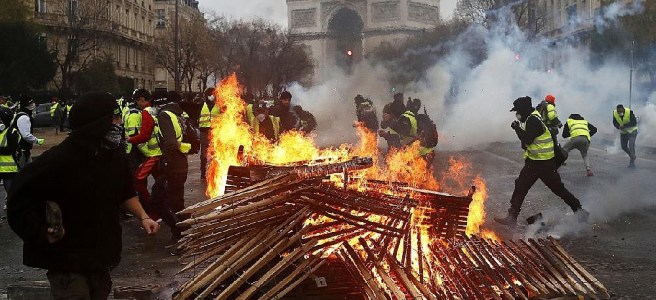
The bourgeois discourse on violence is dominated by the attitude of condemning violence from the left. This can be seen very clearly in the condemnation of the climate protests of Last Generation, where the call for the heavy hand of state violence cannot be extreme enough (Konicz 2022). In contrast, violence legitimized by the state is not an object of critique. This applies all the more to structural violence (such as against refugees and Hartz IV recipients) or social catastrophes imposed by the IMF’s structural adjustment measures. Right-wing violence is trivialized, reduced to so-called individual cases or equated with left-wing violence, i.e. no significant distinction is made between violence against people (which often ends fatally) and violence against things or against the bourgeois property order (blockades & occupations). Naturally, such an attitude is suitable for preventing practical social critique and limiting “freedom” & “self-determination” to the approval of the existing. Right-wing violence appears to be less of a threat to the bourgeois order, especially as neo-Nazis often “improperly” do what the state does anyway through official channels – for example in the case of refugee deterrence (“properly” picking up and deporting “foreigners,” burning them in prison,[1] shooting them,[2] etc., instead of chasing them through the park and murdering them). In bourgeois discourse, the violence that appears to pose a threat to the bourgeois order is criticized, while the violent structures of bourgeois society are “taken for granted.” The violence legitimized by the rule of law does not even appear linguistically as such, or it is claimed to be “proportionate” or “necessary.” If violence is then exaggerated, it is once again only “regrettable individual cases.” The police powers acts passed in recent years are increasingly transforming the bourgeois constitutional state into a police state. Preventative detention was used against climate protests on the basis of these laws, i.e. the imprisonment of people who could presumably commit a “criminal offense” or participate (!) in climate protests (which are not even punishable in and of themselves). It should only be a matter of time before climate activism is equated with terrorism![3]
Riots cause particular outrage in the bourgeois discourse on violence, i.e. the usually “relatively spontaneous” uprisings (triggered by certain individual events, such as police violence, price increases for essentials such as bread, but also for petrol, tickets, etc.), which often appear pointless and aimless and are characterized by looting and excesses of destruction of other people’s property. Riots are therefore of a different quality than strikes, in the sense of orderly and formalized struggles for interests (as can be wonderfully observed in collective bargaining disputes). Their social causes are therefore often not understood or they are only interpreted as irrational excesses of violence, which are to be “dealt with” by even more police batons and early warning systems.
This irrationality is an expression of the irrationality of social rationality. “Rioting” people, often young people, are people who live within this society but cannot participate in it. They may be formally equal in legal terms, but they are treated differently (for example, if you come from a “problem neighborhood” or have a “foreign” name, you are more likely not to be invited to a job interview, despite having the same qualifications). They usually share the ideals and goals of society (work, consumption, family), but are excluded from their realization. That the promises of equality and happiness of bourgeois society can be fulfilled or that opportunities for advancement can be realized is increasingly becoming an illusion. The social catastrophes in so-called problem neighborhoods (“ghettos” or suburban settlements) are not understood as the result of the social upheavals of crisis capitalism and its neoliberal crisis regime since the 1970s, but are racialized: There is agitation and claims that they are a “cultural problem” of black people, the result of “lack of integration,” represent a “foreigner and migrant problem” and/or a problem of “Islam.” Instead of understanding the social causes of the riots and the specific historical constellation in which they take place, they are externalized as a “problem.” A problem that is allegedly being brought into bourgeois society from “outside.” This unwillingness to understand is obviously far more irrational than torching cars or looting supermarkets. Robert Castel, for example, explains against the backdrop of the youth riots in the banlieues in France in 2005: “The problem with these young people is not that they are outside society. This is neither the case in terms of the space they inhabit (the suburban settlement is not a ghetto) nor in terms of their status (many are French citizens and not foreigners). But they are not within society either, because they do not occupy a recognized position in it and many of them are obviously not in a position to obtain such a position. If there has been a revolt of despair, it is in the conviction of having no future, of being deprived of the means necessary to be considered full members of society” (Castel 2009, 36, emphasis added).
In his book Riot Strike Riot, Joshua Clover examines this phenomenon and attempts to contextualize it theoretically and historically. He makes it clear that the bourgeois concept of violence that comes into play in the condemnation of riots is highly problematic: “That property damage equals violence is not a truth but the adoption of a particular set of ideas about property, one of relatively recent vintage, involving specific identifications of humans with abstract wealth of the sort that culminate in, for example, the legal holdings that corporations are people.” (Clover 2016, 11.). The violence to which those who are marginalized and made superfluous are exposed is ignored: “However, this insistence on the violence of the riot effectively obscures the daily, systematic, and ambient violence that stalks daily life for much of the world. The vision of a generally pacific sociality that only in exception breaks forth into violence is an imaginary accessible only to some. For others – most – social violence is the norm. The rhetoric of the violent riot becomes a device of exclusion, aimed not so much against ‘violence’ but against specific social groups.” (ibid., 12).
Clover distinguishes riot from riot prime. The former refers to riots before the labor movement, before the implementation of industrial capitalism (moral economy, resistance of the Luddites, etc., see also Kurz 1999, 125ff.). The historical background is, among other things, the destruction of the commons accompanying “original accumulation” (Marx) and the simultaneously increasing dependence on the market. While the strike sought to enforce the highest possible price for labor power in the factory as well as better and more tolerable working conditions, a rise in the price of goods on the market (bread riots) was a more frequent cause of a riot. Riots did not set the price of labor, but the market price of consumer goods (or they prevented exports so that bread would be sold here and now at a “fair” price and not at a higher price elsewhere). They did not interrupt production, but circulation; the riots were, in a sense, circulation struggles (Clover 2016, 15f.). They did not take place in industry, but in public space, in markets. This is to be distinguished from “riots” (hereafter “riot” again), i.e. those riots that have become more and more important since the 1970s, which is related to the never-ending crisis of capital since the 1970s. They are therefore qualitatively different from the riots in the early days of capitalism. What riot and “riot” have in common is the looting of goods, the spontaneity and disorderliness of their actions. The difference is that today the production of goods is fragmented across the globe, whereas in early capitalism everything necessary for life was still produced in close proximity. This change makes it impossible for a riot to “appropriate and take over” production. If riots are playing a greater role again today, in contrast to the declining importance of strikes, this does not mean that there is a return to older forms of protest. Clover emphasizes that the historical dynamics of the valorization of value are of decisive importance in the theoretical assessment of riots. Even if riots interrupt circulation today, this is not the same as the circulation of the 18th century. With Clover, we can establish the fact that concepts themselves have a history (as, of course, does the thing to which they are supposed to refer), that similar phenomena that occur in the history of capitalism are not a recurrence of the same thing. This must be taken into account in the analysis.
Clover’s explanations have been criticized (Armstrong 2021) that his historical “tripartite division” (“riot-strike-riot prime”) is too schematic, that he does not, for example, address the militant struggles of slaves (which did not take place in the sphere of circulation) and that his distinction between riot and strike is not tenable, look at past mass strikes or wildcat strikes where there was an overlap between struggles in circulation and production (sabotaging trains, disrupting “supply chains” to support striking factory workers).
He was also criticized for focusing on Western countries. If one looks at the world as a whole, then there can be no question of the significance and number of strikes decreasing. Two of Clover’s critics therefore seem to conclude that Clover was apparently mistaken when he said that the crisis of capital has been insoluble since the 1970s, because “the global industrial proletariat has never been as large as it is today, and there have probably never been as many strikes as there are today” (Arps & García Doell 2021). For the two authors, this essentially puts an end to the discussion on crisis theory (see Kurz 2005 & 2012 and, specifically on China, Ming 2023 and the article by Tomasz Konicz in this exit!)
The historical-concrete context that Clover is elaborating is equally applicable to strikes. Fortunately, an increase in strikes has been observed in recent years (see for example Scholz 2022 and Autorenkollektiv 2023). The authors of Analyse & Kritik are undoubtedly right with this observation. However, it should be borne in mind that they are taking place against the backdrop of a tightening space for shaping the value-dissociation form and therefore have a completely different range of possibilities than strikes of previous generations (even if they are also more necessary than ever). It is therefore a little cheap to think that by counting strikes we have refuted Clover’s comments on the crisis.
Clover points out that workers” struggles are tied to the precondition of successful capital valorization and that they become obsolete when the valorization of value enters a systemic crisis (i.e. not a mere cyclical crisis). These are therefore struggles within the capitalist formal context, which as such is not called into question. In the crisis, such struggles then become more and more irrelevant, which makes their defensive and affirmative character clear. As Clover writes: “Labor’s historical power has rested on a growing productive sector and its ability to seize a share of expanding surplus. Since the turn of the seventies, labor has been reduced to defensive negotiations, compelled to preserve the firms able to supply wages, affirming the domination of capital in return for its own preservation. The worker appearing as worker in the period of crisis confronts a situation in which ‘the very fact of acting as a class appears as an external constraint.’ […] We might find a decisive moment by returning […] to Detroit and to 1973, where ‘for the first time in the history of the UAW, the union mobilized to keep a plant open.’ This will swiftly become the paradigm for labor organizing, wanted or not. […] Capital and labor find themselves now in collaboration to preserve capital’s self-reproduction, to preserve the labor relation along with the firm’s viability. […] We might call it ‘the affirmation trap,’ in which labor is locked into the position of affirming its own exploitation under the guise of survival” (Clover 2016, 30, 146f.).
A strike is dependent on economic growth. If certain factories or entire production sectors are no longer profitable, (surplus) value shrinks, there is also less surplus value to distribute that the workers could appropriate. In such a situation, trade unions – since they only represent people in their function as variable capital – advocate that the jobs are retained, usually under worse conditions, so that the factory remains profitable for the time being (possibly in contrast to a competing “location”), provided the workers accept all the necessary conditions. The scope for action within the value form narrows, the room for maneuver becomes narrower. As long as one does not question the wage system as such, but only ever stands up for higher wages (or for lower wages so that the store is not closed down), one participates in the organization of one’s own social decline (or that of other workers). Clover points out that since the 1970s, utilized labor in the production sector has increasingly declined and accumulation has shifted to the financial sphere. The result is the production of a “surplus population” (ibid., 26), which forms the social substance of the riots. People are released into superfluousness, yet they remain forced to reproduce themselves capitalistically: “Capital may not need these workers, but they still need to work. They are thus forced to offer themselves up for the most abject forms of wage slavery in the form of petty production and services – identified with informal and often illegal markets of direct exchange arising alongside failures of capitalist production” (ibid..).
If “normal” working conditions become the exception, the order that “well-behaved citizens” understand as “orderly” disintegrates. The surplus population becomes a “security problem.” In contrast to the 18th and early 19th century, this population is at the mercy of a highly armed police force “as a standing army within.” The state is waging a “war against drugs and terror” (ibid., 36). No wonder that riots are often sparked by police killings.
The shift of value realization to the financial sector and at the same time the intensification of transport and logistics (which shorten the turnover period of capital) could not stop the “stagnation and decline of global profitability” (ibid., 31). Clover sees no contradiction in the fact that individual companies are able to make a profit for themselves, prevail in competition, are extremely successful according to capitalist criteria and do not appear to be in crisis. Clover distinguishes the system as a whole and its crisis from the level of individual capital. He therefore does not make the serious mistake often made by many of today’s remaining Marxists (or followers of the New Marx Lekture) of inferring the state of the system as a whole from the characteristics of individual capitals (cf. Kurz 2012). The conclusion is then drawn: Yes, work is indeed being done, things are being produced, and exploitation is taking place! Where is the systemic crisis? On the contrary: “For Marx’s value analysis, the movements of profits are surface phenomena corresponding to an underlying shift in the balance of constant to variable capital: means of production to waged labor, or dead to living labor. Despite countervailing forces, this so-called organic composition of capital tends to rise over time as competition compels increasing productivity, iteratively replacing labor with more efficient machines and labor processes […]. Over time, however, the rise in the ratio of dead to living labor undermines the capacity for value production […]. The same dynamic that originally drives accumulation […] also undermines it, until manufacturing capacity and labor capacity can no longer be brought together, and instead empty factories and unemployed populations pile up side by side. […] Crisis and decline come not from extrinsic shocks but from capital’s internal limits” (Clover 2016, 133f.).
The inner barrier of capital has made emancipation within the barriers of capital (which is dubious anyway) more and more irrelevant. As a result, strikes are thinning out, almost disappearing from the scene, or are just spreading hot air, as what is being struck is becoming increasingly unprofitable (apart from the fact that strikes, which are not aimed at abolition, do not address the destructive nature of the capitalist mode of production and its catastrophic effects on the climate). When more and more people are put out of work, factories stand empty, suburbs and workers’ housing estates turn into “problem neighborhoods,” there is simply nothing left for many people to strike about. In order to “make their voices heard,” the circulation of goods is interrupted (looting, sabotage, blockade of highways, etc.), their own hated neighborhoods or police stations are torched.
A riot triggered by a singular event can spread within weeks to become a “conflagration” that expresses a fundamental rejection of the “ancien régime” and possibly seeks (and implements) its overthrow. As Clover emphasizes, a riot, just like a strike, does not have to be emancipatory as such (ibid., 191). This point is particularly important to emphasize following Clover, as it is now perfectly clear that the “practice of the riot” (or that which seems similar to it) is also one of right-wing radicals and conspiracy ideologues, as can be seen in the storming of the Capitol in the United States (01/06/2021) and the Parliament in Brazil (01/08/2023) (although this did not exactly happen spontaneously).
Since the Arab spring and Occupy Wall Street in the early 2010s,[4] riots have repeatedly involved the occupation of public spaces (although there is no necessary link) or the occupation of infrastructure (which is central to the circulation of goods), such as the occupation of the Port of Oakland (Occupy Oakland). In their dynamics, the riots obviously point to something that goes beyond looting and torching. The occasion may seem singular and the course of a riot chaotic and spontaneous. The question is what becomes or could become a “conflagration.”
A social struggle that seeks to improve the position of people or workers will come to nothing if more and more people can no longer really participate in the valorization process, but on the contrary exist more and more in an informal economy with no prospect of their lot in life ever improving. This by no means only affects people from the former factory proletariat, but also knowledge workers from universities (the internship generation, ongoing fixed-term contracts, etc.), i.e. also qualified workers. A riot that sets itself the goal of redefining prices is anachronistic today, given the global crisis of capital: “The public whose modality is riot must eventually encounter the need to pursue reproduction not just beyond the wage but beyond the marketplace” (ibid., 173). This necessity is all the more pressing because “attempts at appeasement” of all kinds are no longer effective today. While the riots of the 1960s in the USA could still be “pacified,” admittedly also by police batons and lead bullets, but also by integrative measures such as social programs etc., which could certainly improve the social situation, this effect has failed to materialize today. Social programs cannot erase the superfluousness of those who “benefit” from them. This is all the more tragic when a regime is actually successfully overthrown, but nothing changes in the social and material situation of the people, those who are “rioting” remain a surplus population and one gang is just replaced by another. As Clover writes, these attempts at appeasement were possible because in the era of Keynesianism, i.e. the expansion of the mass of value, social programs were initiated and could take effect. This has now definitely come to an end: “One could perhaps imagine demands in the present that would, if met, alter in substance the circumstances of the excluded. But the swelling ranks of the excluded is the same fact as the inability to meet such demands—the two faces of crisis. Just as the U.S. can no longer deliver accumulation at a global level, and thus must order the world-system by coercion rather than consent, the state can no longer provide the kinds of concessions won by the Civil Rights movement, can no longer purchase the social peace. It is all sticks and no carrots. […] The prolongation of the riots and of their fury is doubtless a measure of social pressures building around racialized policing and around the immanent violence applied to the management of surplus populations in general. It is also a measure of the fading appeal of moderation and optimistic compliance. This approach still retains some charisma […]. At the same time, the argument that the bottomless violence and subordination is structural, and cannot be resolved either practically or theoretically through redistributive participation, grows ever harder to refute” (ibid., 186).
So if the compulsion remains that the surplus population must of necessity reproduce itself capitalistically, the crucial question is how to initiate material reproduction beyond wage labor and beyond “just” prices. It would be important to create a different kind of “public sphere” that interrupts the “normal course” and addresses precisely this. Public space and infrastructure occupations could be a means to this end (the latter are becoming increasingly important in the course of climate protests: from road blockades to the sabotage of pipelines a la Malm 2021). The aim would therefore be to break open the formal shell of the economy and politics, i.e. to transcend both the riot and the strike in order to develop the reproduction of society beyond wage labor and the market. Clover uses the “Commune” as an institutional metaphor for this (ibid., 187ff., on the Paris Commune see also Kurz 1999, 237ff.). However, the problem, as became clear during the Arab Spring and elsewhere, is that the addressee may remain the state due to a lack of alternatives, thus reproducing a problematic orientation towards the state. The tragedy of this is that at best a regime change is achieved, i.e. a replacement of the functional elites or gangs, without this changing the social situation of the surplus population in any way (not to mention the meaning and content of production and consumption).
The material side of all this shit, i.e. the fragmentation of the production of all the necessities of life across half the world, makes “appropriation” impossible. Even an alternative public sphere or a general interruption of normality will not be able to change this (at least not immediately or in the short term), although they could at least address the problem “on a large scale.”[5] Unfortunately, Clover does not elaborate on the “material” side in his book (which is undoubtedly very difficult and because no one really has definitive answers). In theoretical terms, and in practical terms too obviously, there is still much to be done. In any case, Joshua Clover’s book on riots (the next ones are sure to come) makes an important contribution to understanding this phenomenon and placing it in its historical context.
Literature
Armstrong, Amanda: Die vergessenen Massenstreiks – Zu “Riot.Strike.Riot” von Joshua Clover – eine Kritik, in: Analysis and Critique No. 670, 20.4.2021, https://www.akweb.de/bewegung/joshua-clover-kritik-riot-streik-strike/
Arps, Jan Ole; García Doell, David Ernesto: Riots für Kommunist*innen – Joshua Clover bietet eine Theorie des Aufstands – hilft das für die politische Praxis in Deutschland?, in: Analysis & Critique No. 669, 16.3.2021, https://www.akweb.de/bewegung/joshua-clover-theorie-aufstand-praxis-fuer-deutschland/
Collective of authors: “The situation is serious – time to strike,” in: Wildcat No. 111 (Spring 2023), 42-49.
Castel, Robert: Negative Discrimination: Youth Revolts in the Paris Banlieues, Hamburg 2009.
Clover, Joshua: Riot. Strike. Riot: The New Era of Uprisings, London 2016.
Konicz, Tomasz: No weather for climate protests, 2022, on exit-online.org.
Kurz, Robert: Das Weltkapital – Globalisierung und innere Schranken des modernen warenproduzierenden Systems, Berlin 2005.
Kurz, Robert: Geld ohne Wert – Grundrisse zur einer Transformation der Kritik der Politischen Ökonomie, Berlin 2012.
Kurz, Robert: Schwarzbuch Kapitalismus – Ein Abgesang auf die Marktwirtschaft, Frankfurt 1999.
Kurz, Robert: Weltordnungskrieg – Das Ende der Souveränität und die Wandlungen des Imperialismus im Zeitalter der Globalisierung, 2nd edition, Springe 2021.
Malm, Andreas: How to Blow Up a Pipeline, London 2021.
Ming, Shi: Fierce storms, terrible waves – The CP leadership prepares for social upheaval, in: Le Monde Diplomatique 4/2023.
Scholz, Nina: Die wunden Punkte von Google, Amazon, Deutsche Wohnen & Co – Was tun gegen die Macht der Konzerne?, Berlin 2022.
[1] https://en.wikipedia.org/wiki/Death_of_Oury_Jalloh
[2] Aydemir, Fatma: Police violence in Germany, taz.de from 12.8.2022.
[3] This text was written at the beginning of 2023.
[4] See also: Feuerherdt, Alex: Das Volk gegen ein Prozent – Der Antisemitismus der “Occupy” -Bewegung, jungle.world from 1.12.2011.
[5] By this I do not mean the “state of exception,” which is merely a continuation of normality by other means, with the aim of establishing a capitalist normality at a higher level by force or keeping the surplus population in check (see Kurz 2021, 320ff.).
 EXIT! in English