The world undergoes a new kind of “disenchantment”
The modern world defines ancient societies’ relationship with nature as irrational. The notion that mountains and rivers, animals and plants have souls seems to modern consciousness as ugly as the idea that someone can be bewitched by magic. Max Weber, as we know, spoke of the “disenchantment of the world” by Enlightenment reason, by the rationality of science and technology.
However, this contrast between modern rationality and pre-modern irrationality in dealing with nature is far too simplistic. Firstly, ancient societies were not at all irrational in their “process of metabolism with nature” (Marx), as they had to provide for themselves. In addition, they created admirable artifacts and bequeathed knowledge that modern people still use. Secondly, modern society is not guided by strict rationality in relation to natural objects. The scale on which the current mode of production destroys its own natural foundations of life leaves us in doubt about Max Weber’s statement.
Rather, we should be referring to a “second disenchantment” of the world by modern society. This disenchantment, in fact, surpasses all the previous ones, because its magical pretension is total and unconsidered. The splitting up of feelings, sensitive experiences and dreams by abstract reason has given rise to a sphere of “irrationalism” divorced from rational ends and ideas – and this both in individuals and in society in general. Autonomized abstract reason itself is only rational in its means, not in its end.
That end is the “economization” of man and nature under the dictates of money, which in turn has no rational origin, only a magical one. Not only are the social relations of modernity permeated by the modern magic of money and its irrational end in itself, but also modern science and technology as well. The instrumental rationality of economized consciousness is therefore in eternal danger of turning into irrational affections.
This modern irrationalism doesn’t just make itself known in the guise of religious movements. Just as often, it can be seen in the rational guise of political ideas and even supposed scientific knowledge. This correlation is expressed most clearly when human society and history are reduced to semi-natural objects. Now, if nature is in itself more than it appears to be to the objectifying gaze of the natural scientist, man is also more than just nature, otherwise he would be incapable of conceiving of it. The reductionism of the natural sciences can only know nature unilaterally; human society, however, is entirely ignored. The apparent objectivity of scientific rationality comes across as wild irrationalism as soon as it tries to dissolve social relations into semi-physical or semi-biological factors.
But it is precisely towards this reductionism that modern science tends. Unable to solve “metaphysical” questions, it has thrown philosophy into the dustbin of the history of ideas. The philosophical and revolutionary 18th century still devised reckless critical thinking in order to give a certain legitimacy to the nascent capitalist society. The 19th century, as the “century of the natural sciences,” sought to trim the claws of social theory and placate its mordacity with pseudo-scientific doctrines. At a time of relentless and widespread misery, it was urgent to lend capitalism the dignity of natural laws in order to make it invulnerable and snatch it out of its historical context. Thus, economics became the “physics” of the total market and its supposedly eternal laws, and sociology began to conceive of itself as the “biology” of social relations, in order to cover up the social contradictions of modernity under the cloak of natural necessities.
The universal competition between individuals, social groups and nations, that existed because of capitalism, was increasingly given a biological interpretation backed up by these “scientific” ideologies. Count de Gobineau, a French diplomat, created the so-called “races” of humanity and elaborated a theory about their “natural” inequalities – evidently a pseudo-scientific legitimization of European colonialism, whose empire over the colored population was to be founded on the alleged biological superiority of the “white race.”
When Darwin discovered the history of biological evolution, his theory of natural selection in the “struggle for existence” was immediately transposed to human society. Darwin himself did not fail to take sides. In some of his letters, he criticized the then incipient trade union movement, since its demands for solidarity hindered the process of natural selection and burdened society with specimens unfit for competition.
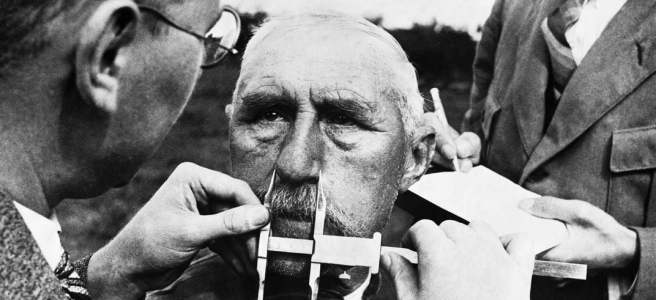
This social Darwinism maintained an obscene link with the “physics” of the market. At the end of the 19th century, they were joined by what was known as eugenics or “racial hygiene,” which advocated the hereditary transmission of social qualities. The lower classes of criminals and disqualified people were labeled as “hereditarily inferior” men who should be prevented from reproducing. On the other side of the coin was the acclaimed “victorious type” of the beautiful, strong man with a “healthy heritage.”
At eugenics exhibitions held in Germany, England and the United States, entire families were paraded like farm animals as specimens of good stock and “pure blood.” Not even the workers’ movement escaped such madness. Karl Kautsky, the social-democratic theoretician, wrote with all candor in favor of “social hygiene,” and the already well-off specialized workers based their repudiation of the “sloppy lumpen-proletariat” on biological and eugenic arguments.
In this pseudo-scientific imbroglio of ideologies that permeated the whole of Western society around the turn of the century, two distinct sociobiological images gradually gained prominence. On the one hand, a social racism developed that labeled people of color, the sick, criminals, the disabled, the ragged, etc. as “inferior men.” The construction of industrial society fell exclusively to strong white workers, and all superfluous “ballast” had to be thrown away. This malevolent irrationalism went hand in hand with the contempt and degradation of women, who were accused of a certain “physiological imbecility.”
On the other hand, a new anti-Semitism began to spread, without any religious basis. “The Jew” was imagined as the “negative superman,” as a kind of prince of darkness and the antipode of the nouveau prince of labor. This Manichean conception reduced the perniciousness and catastrophes of the monetary economy to the biological constitution of “Jewish finance capital,” which the “good” money of venerable white labor had to confront. The anonymous and non-subjective laws of the expanding world market were therefore translated into the folly of the alleged global conjuring of a “foreign race.”
As everyone knows, National Socialism took the dual biological ideology of the “inferior man” and the “negative superman” to the extreme consequence of annihilation on an industrial scale. After the horrors of Auschwitz, no one wanted to commit themselves to such ideas, which then slipped into the historical background. In the period of great prosperity that followed the Second World War, they flickered only as specters of an inauspicious past that was believed to be banished forever. The economic and social sciences, however, were in fact only superficially cleansed of the conceptual dross of biologism and social Darwinism. More than ever, political economy used a type of social science that was averse to “dim lights,” setting itself up as a “rigorous” semi-natural science.
While growth and evolution beckoned with a global perspective of well-being, the lemurs of social biologism remained locked away in the netherworld. From this perspective, the flowering of critical sociology and neo-Marxism in the 1960s and 1970s was illusory, as it merely repeated the emancipatory ideas of the past and found itself unable to survive periods of economic boom. When the economic crisis made its comeback, left-wing social critique disappeared significantly from the big public stages in Western countries. At that time, the theory of post-modern deconstructivism based on Foucault, which suited the casino capitalism speculation of the Reagan and Thatcher era, was all the rage. The world – including the market system – seemed to dissolve into “discourse” that could be played with at will.
But in the refuge of the jovial and neurasthenic “risk society,” as German sociologist Ulrich Beck called it – referring to the development of the 1980s – the turbulence of a new racism erupted. Since then, racist power has spread around the world in a torrent of bloody excesses. In Germany too, immigrants and refugees have been coldly killed by mobs of right-wing radicals in arson attacks. To this day, the public sphere downplays such crimes as the work of a few disaffected youths. In reality, however, the racist power loose in the streets is the harbinger of a turnaround in the world’s atmospheric conditions.
In the factories of ideas themselves, other winds are blowing. The last decade has seen the biologism of a new “natural science” creep wolfishly into academic discourse, which increasingly mirrors the legacy of the playful, “post-sociological” fashion of deconstructivism. At first glance, it seemed that genetic research would be able to debunk racist nonsense with scientific arguments. Researchers such as the Swedish molecular geneticist Svante Pããbo proved that men from the most diverse nations, by virtue of their DNA sequences, can be genetically more “related” to each other than to their closest neighbors. But these findings are now increasingly strained under the weight of a new “biologization” of social conduct, for which, incidentally, the geneticists themselves are ready to provide the ammunition. American neurologist Steven Pinker claims that language is “congenital to man like an elephant’s trunk,” and that there must therefore be a certain “grammar gene.” For Nobel Prize winner Francis Crick, from San Diego, free will itself is nothing more than “neurological reactions.” Scientists at the Robert Koch Institute in Berlin say they have found a virus that supposedly triggers melancholy and is transmitted by domestic cats. And Dean Hammer, an American molecular biologist, attributes homosexuality to the Xq28 gene, located at the end of the X chromosome.
As is always the case, these are unproven hypotheses that say less about nature than they do about the ideological preferences of scientists. These scholars are often naïve from a social point of view and so perhaps don’t realize how their “purely objective” research is influenced by ideological currents that undermine society. It goes without saying that the reduction of human culture and sociability to the standard of molecular biology provides arguments for the legitimization of a renewed barbarism. The American social scientists Richard Herrnstein and Charles Murray, in their study entitled The Bell Curve, had already created a correlation between “race, genes and IQ” that excluded black Americans from the “cognitive elite” in a pseudo-biological way. Soon, the ill-fated scientists will provide us with a “crime gene” or a “poverty gene.”
The discovery of genetic underpinnings to people’s social destiny fits the neoliberal policy of cutting costs like a glove. The new academic discipline of “medical economics” is gradually providing carte blanche for the poor, sick and disabled in Western countries to be given “aid in dying” for cost reasons. Debates on the subject are taking place in broad daylight in Germany, the Netherlands and Scandinavia. The Australian philosopher Peter Singer, whose grandparents died in German concentration camps, now advocates the National Socialist thesis that defective newborns should be immolated for being “unworthy of life.” In China today, a bill is being passed to legalize euthanasia.
This social-Darwinian brutalization on a global scale is matched by a new wave of anti-Semitism in all corners of the globe. Half a century after Auschwitz, synagogues are once again being burnt down in Germany; from the Atlantic to the Urals and even in Japan, the smear campaign against Jewish communities is flourishing; and to top it all off, Louis Farrakhan, the leader of the “Black Muslims” in the United States, is exercising his defamation in anti-Semitic tirades. All social groups, including civil rights movements, are succumbing more and more to biological arguments in the fierce battle of competition, in order to differentiate themselves from humanity. Under the influence of the globalization of capital and based on the academic arguments of geneticists, we may be facing the threat of a “universalist” biologism that considers all people inept at competing within monetary society to be “inferior individuals” and that, at the same time, wants to blame the future catastrophes of the market economy on a “Jewish conspiracy.”
Neoliberalism, with its ideological pseudo-physics of market laws, has loosened the shackles of all the demons of modern barbarism and thus harked back to the irrationality of 19th century “social scientism.” The naturalization of the economy, however, has the logical consequence of bestializing social relations. Neoliberal thought leaders are not only responsible for the advent of fundamentalism, but also for the current return to social Darwinism and anti-Semitism.
Originally published on 07/07/96
 EXIT! in English