6 Theses on the Character of the New World Order Wars
Robert Kurz
1
Capitalism is not a Buddhist event; it cannot be understood in an ahistorical way. The logic of the principle of valorization, which remains consistent, does not bring about the eternal return of the same, but rather an irreversible historical process with qualitatively different relations. The respective world constellation can only be explained with reference to the development of world capital. When a certain stage of valorization has been exhausted, the associated political institutions, concepts and ideologies also become obsolete. This is all the more true when the world system has reached the level of maturity that it did at the end of the 20th century.
Since the 1980s, the third industrial revolution of microelectronics has begun to set an internal historical limit to the valorization of living labor. Capital is becoming “incapable of valorization” in the sense that at the level of the irreversible productivity and profitability standards it has itself produced, no further real-economic expanded reproduction (an expansion of valorization) is possible. This “structural over-accumulation” of world capital leads to structural mass unemployment in the metropolitan areas through the application of microelectronics, to global overcapacity and a flight of money capital into the financial superstructure (financial bubbles). In the periphery, the lack of capital power prevents microelectronic rearmament; but precisely because of this, entire national economies and world regions collapse all the faster, because they fall so far below the standards of capital-logic that their social reproduction is declared “invalid” by the world market.
The result is a cost-cutting and shutdown race. Globalization is nothing other than transnational rationalization and, in this respect, is actually something qualitatively new. The traditional export of capital in the form of expansive investments abroad according to modular design is being replaced by the outsourcing of business functions in order to exploit global cost differentials. This, on the one hand, creates transnational value chains, while at the same time growing parts of social reproduction dry up and die off. This process is shaped and controlled by equally globalized financial bubble capital.
However, the old gap between metropolises and the periphery remains even under the crisis conditions of globalization; now no longer as a gap in the degree of capitalist development, but as a gap in the degree of social decay. Transnational value creation is becoming more concentrated in the areas of the “triad” (U.S./North America, EU, Japan/South East Asia), while it is becoming ever thinner in the rest of the world. The dynamics of economic globalization in the context of transnational financial markets are breaking up national economic regulatory spaces.
The state in the metropolises is not disappearing, but it is ceasing to be an “ideal total capitalist” in the classical sense. Because, unlike the business economy, it cannot disperse transnationally, it loses one regulatory function after another and mutates into purely repressive crisis management. However, this is not merely a matter of the social degradation of growing sections of society; capital is also involuntarily destroying a whole series of its own structural conditions of existence. This is reflected not least in a contradiction of a new quality between the transnational valorization of capital and the national form of money (currency).
In the periphery, the state apparatuses are dissolving to a far greater extent – along with the majority of capitalist reproduction. Public services are almost completely disappearing, the administration is capitulating, and the repressive apparatuses are running wild. All that remains are small islands of productivity and profitability in an ocean of disorganization and impoverishment. All national economic development comes to a standstill; the globally active corporations snatch up these insular sectors as components of their transnational business economy. At the same time, an economy of plunder emerges in which the physical substance of the collapsed national economy is exploited, and population groups attack each other according to ethnic or religious criteria in a continuation of competition by other means. Marauding groups take the place of social institutions. A large part of the elite is transformed into the leadership of ethnic or religious bandits and clan militias, into warlords and princes of terror.
These conditions are only a transitional stage of the world crisis at the historical limit of the valorization process. For the time being, the economy of plunder can still dock onto the world market and make the exploitation of economic ruins appear to be a continuing process of valorization, just as, on the other hand, it does through the constant inflation of financial bubbles in the core. But both phenomena are approaching complete exhaustion.
2
Against this background, classical imperialism has come to an end. Just as the business economy can no longer be formed and regulated on a national basis, the subjugation and incorporation of capitalistically superfluous population masses no longer makes sense. The territorial form of domination and expansion has become obsolete. The “hands,” which make up the majority of the world’s population, are no longer useful, but are unable to break free from the capitalist logic which, as a negative world-socialization, is maintained at all costs.
In the post-war period, the competition between the old (mainly European) national expansionist powers had already been replaced by the bipolar competition between two superpowers: the U.S. and the Soviet Union. Here, what was decisive was no longer the struggle for national zones of influence, but the question of the regulating principles and modalities of capitalist reproduction. It was about the competition between the historical latecomers on the world market, the societies of “recuperative modernization” in the reference area of the Pax Sovietica, and the societies of the developed capitalist core in the reference area of the Pax Americana. The U.S. had already matured into the sole leading power of the West on the basis of continental resources and the largest domestic market in the world; it had pulled away unassailably thanks to the dynamics of its military-industrial complex after the Second World War.
After the collapse of the Soviet Union and the end of “recuperative modernization” in the crisis of the third industrial revolution, there is no going back to the old intra-imperialist conflicts of national expansionist powers. Instead, we are faced with the planetary unification of the Pax Americana, but this in the context of a precarious minority capitalism based on financial bubbles and an economy of plunder. It is ridiculous to talk of a new intra-imperial competition between the U.S. and the FRG or EU. The U.S. military apparatus built up in the decades of the post-war boom is unrivaled; year after year, the U.S. armaments budget is more than twenty times that of Germany. There are neither military nor political and economic conditions for a new rival power.
Despite a certain relevant rhetoric and individual moments of interest, the U.S. is not acting in the name of national territorial expansion, but as a kind of global protective power of the valorization imperative and its laws under conditions of crisis in the world system. Everyone operates in a context of transnational processes of valorization, while simultaneously feeling the pressure of a growing mass of “superfluous” people. Therefore, the role of the U.S. as the last monocentric superpower is not only to be explained externally by its military weight, but also by the deterritorialized conditions of globalization itself. The entirety of transnational capital, the financial markets, and what remains of the state apparatuses in the core are dependent on the ability of the U.S. to police the world.
What has thus emerged is an “ideal total imperialism” under the sole leadership of the U.S., extended via NATO and other world-capitalist institutions. The image of the enemy is clearly not one of internal imperialist national interests, but one of a democratic, total imperialism against the crisis ghosts of the unified world system. The state capitalist empire of failed “recuperative modernization” has been replaced by a diffuse complex of disruptive potentials, ethno- and religious terrorism, anomic conditions, etc. as a new “realm of evil.”
“Ideal total imperialism” essentially acts as a security and exclusion imperialism of the democratic capitalist core against the crisis conditions created by capital itself, without ever being able to overcome them. Security is to be established in order to guarantee the smooth flow of capitalist transactions, even in the precarious islands of valorization on the periphery. This includes, first and foremost, guaranteeing the supply of fuel for the capitalist world machine. Here too, however, it is not a question of specifically national oil interests, but of the process of transnational valorization. The core’s common interest in excluding the mass global migration movement emanating from the collapsing zones of the periphery lies even farther beyond national territorial claims to power.
3
The contradictions within the framework of democratic imperialism as a whole (such as the current dispute between the FRG, France, Belgium etc. on the one hand and the leading power, the U.S., on the other) are of merely secondary importance. To deduce from this the logic of a new major intra-imperial conflict along the lines of the World War II era would be about as intelligent as trying to declare the differences between, say, Nazi Germany and Franco’s Spain (which, as we know, stayed out of the Second World War) to be the “real” conflict of that time.
It is not old-style national competition that determines the current intra-imperial conflicts, but some subaltern governments’ fears of consequences that may no longer be controllable. NATO and the rest of the world are dividing themselves into submissive and hesitant vassals, without the latter being able or even willing to openly rebel against the U.S. The procrastination stems more from the fear of those who do not have their own finger on the trigger, while the compliant are more likely to be those who have nothing more to lose, but also nothing to say anyway.
While up to now, including the Afghanistan intervention, there has been no opposition to the world wars under the aegis of the U.S. and the Red-Green government has sent its Germanic auxiliary troops into the field with oorah-democratic ideology, the announced pre-emptive strike against Iraq is now raising concerns because international law, the UN and sovereignty – the guarantees of the much-invoked capitalist community of states and “peoples” – are being openly disregarded. The FRG, France and the rest of the world are afraid that they will soon be treated in a similar way and that the existing legitimizing construct could give up the ghost.
The fact that the U.S. is so rudely trampling on the rules of the game of the capitalist world of states that it itself installed after 1945 is a formal consequence of the internal contradiction between the national constitution of the last world power on the one hand and its transnational “mission” as a protective power of the globalized valorization process on the other. The deeper substantive reason, however, is that the principle of sovereignty itself, which consists precisely in uniting populations territorially as a “total labor force,” has become obsolete. Even the core states, including the U.S. itself, are relinquishing more and more internal functions of sovereignty through “privatization,” including the apparatus of force. By declaring the sovereignty of “rogue states” null and void in foreign relations as well, the U.S. is only executing the world crisis on the political-legal level, which heralds the end of all civil contractual relationships (and ultimately the end of the sovereignty of the U.S. itself). The conservative resistance to this dynamic on the part of some European states is doomed to failure. Old anti-American resentments may also play a role here, but no longer a decisive one.
4
The problem faced by the all-imperial world police force is that it can only act on the level of sovereignty, which it must, on the other hand, destroy with its own hands. This also applies to the high-tech weapons systems that are geared towards classic territorial conflicts. The ghosts of crises, potential troublemakers, terrorist gangs, etc. cannot be reached in this way because they themselves operate in the folds of globalization. Al Qaeda is structured exactly like a transnational corporation. Military superiority is becoming useless, the “war on terror” is becoming a big swing and a miss. At the same time, the end of the financial bubble economy threatens a severe crisis for the capitalist core, especially for its heart, the U.S. economy itself, and consequently a severe world depression. This would also call into question the continued ability to finance the high-tech apparatus of the last world power.
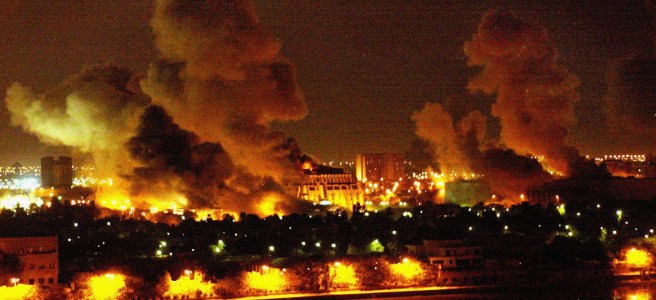
This is why the U.S. administration has switched back from the “war on terror” to the paradigm of “rogue states.” The pre-emptive strike against Iraq signals a double flight forward. On the one hand, the ruin of Iraqi sovereignty with its exhausted army is to be “defeated” as an easy opponent of a classic state-territorial character in order to show the world who is master of the house. On the other hand, the impending economic collapse is to be cushioned by immediate access to the Iraqi (perhaps also the Saudi) oil fields and the dismantling of OPEC. This is less about the material flow of oil, which would be guaranteed even without military intervention, and more about saving the financial markets in the short term. The dwindling recycling from the financial bubbles must be renewed, and this is not possible without a “future option” for a new secular prosperity. After the “Pacific century” option proved to be just as much a flop in this respect with the collapse of the Japanese and South-East Asian models as the new economy of internet and telecoms capitalism, the “oil at pre-OPEC prices” option is now to bring it under direct U.S. control.
However, this could backfire. The Iraqi army is not a serious opponent, but a possible urban battle for Baghdad and other centers with high casualty figures, major destruction and millions of refugees would morally discredit the U.S. around the world. Above all, however, it would certainly not be possible to install a stable regime; Milosevic and Saddam are in any case obsolete models of sovereignty. However, a U.S. military administration of Iraq and the entire oil region in constant confrontation with guerrillas and terror would be neither affordable nor politically and militarily sustainable and, moreover, anything but a signal of euphoria for the financial markets. The “victory” over Iraq will inevitably be a Pyrrhic victory that can only exacerbate the overall crisis of the world system.
5
However, it is not just about the pseudo-rationality of certain “interests,” which are always subordinated to the irrational end in itself of the principle of valorization. The vulgar materialism of interests fails to recognize the real metaphysics of capital as a secularized religion whose irrationality overwhelms the internal rational interests at the boundaries of the system. The valorization imperative, which is indifferent to all sensual content, ultimately demands the dissolution of the physical world into the empty form abstraction of value, i.e. its annihilation. In this respect, we can speak of an almost gnostic death drive of capital, which expresses itself in the logic of destruction in business management as well as in the potential for violence in competition. Because the contradictions can no longer be resolved in a new model of accumulation, this death drive is now manifesting itself directly and globally.
The self-preservation of the system at all costs turns into the self-destruction of its actors. Mass shooters, suicide cults, and suicide bombers are executing the objective madness to an unprecedented extent as a reaction to the crisis devoid of any prospects. Closely linked to this is the anti-Semitic syndrome as the last crisis-ideological resort of the capitalist subject form, which breaks out again and no longer concentrates on a specific national-imperial constitutional history (such as the German-Austrian one in the past), but floods the world in diffuse post-modern and post-national amalgamations, especially of religious provenance.
Because the capitalist internal rationality of the bourgeois subject of enlightenment cannot represent itself in a new model of accumulation, it no longer forms an immanent potency against the systemic death drive, but itself immediately turns into a moment of this irrationality. Enlightenment and counter-enlightenment, reason and delusion, democracy and dictatorship fall into one. Democratic imperialism as a whole is unable to pacify its own world of crises, but instead becomes the “ideal total mass shooter,” right up to the use of nuclear weapons against the zones of insecurity, the intangible specters of crisis and the masses of the “superfluous,” as the U.S. administration has already openly threatened.
6
There is no longer an immanent alternative. But because the left knows nothing other than to occupy immanent alternatives on the ground of capitalist ontology and developmental history, it largely flees into the past and engages in an absurd argument about whether we are writing 1914 or 1941. Both factions are intellectually stuck in the era of a capital based on national economies and national-imperial powers of expansion, both are illiterate in terms of crisis theory and, more generally, with respect to the critique of political economy, and both cling to the capitalist internal rationality of the bourgeois enlightenment subject.
The nostalgics of 1914 and followers of Lenin’s mummy conjure up the phantasm of an “anti-imperialist” alliance of left-wing pacifists in the metropolises with the “sovereignists” and “peoples” of the Third World, who are supposed to defend their bourgeois independence against Western imperialism. The nostalgics of 1941, on the other hand, are delirious with the idea of an “anti-Hitler” coalition led by the “good” Western powers against “Islamic fascism” and its German accomplices to protect Israel and “civilization.”
But Saddam’s regime is neither a world-threatening Nazi empire nor a hopeful force for national development, and bin Laden is neither a Hitler nor a Che Guevara. The Palestinian state is disintegrating even before it can be founded, because statehood is no longer an emancipatory option at all; conversely, the barbarism of intifada and suicide attacks cannot be equated with the factory extermination of Jews at Auschwitz. The false friends of the Third World subsume Israel under imperialism and ignore its essential quality as a result of global anti-Semitism; the false friends of Israel glorify the reactionary-ultra-religious forces responsible for the murder of Rabin and themselves fall into primitive racist agitation. Some negate Israel as a place of refuge, others ignore the fact that its existence is more endangered by its own internal crisis barbarism than by external military threats.
The zombies of 1914 accept the völkisch-anti-Semitic, culturalist-anti-American neglect of “class struggle” and “anti-imperialism.” The zombies of 1941 abandon any critique of the imperial war for world order, unrestrainedly denouncing both the beleaguered Israeli as well as the U.S. left-wing opposition and distorting the necessary criticism of anti-Semitism and anti-Zionism to legitimize democratic bombing terror. What is needed instead is a radical opposition to war that confronts the real world situation and develops a categorical critique of capitalist modernity beyond the false immanence of pseudo-alternatives, which only represent different forms of the same cosmopolitan crisis barbarism.
Originally published on exit-online.org on 03/01/2003.


 EXIT! in English