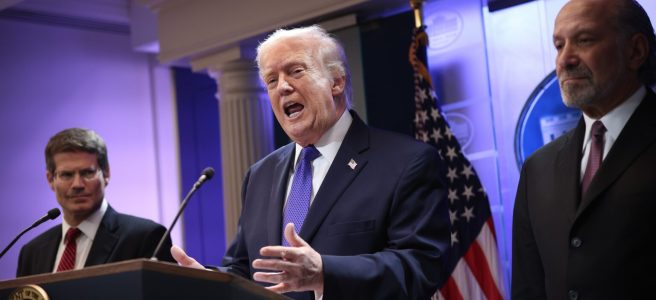
Trump at the Inner Barrier of Capital

The reindustrialization of the USA, which Trump wants to force through his protectionism, is being undermined by automation trends in industry.

Tomasz Konicz

What does Donald Trump want? Since the so-called “Liberation Day” at the beginning of April, when the right-wing populist announced the introduction of comprehensive tariffs for almost the entire late capitalist world, Washington’s specific regulations, tariff rates and exemptions have been changing almost on a weekly basis. The economic uncertainty that Trump’s protectionism brings with it is considered by economists to be an important factor that could contribute to an economic slowdown or even recession in the US. Companies and corporations cannot calculate reliably, the flow of trade between the US and China has largely come to a standstill, and supply bottlenecks in the US can hardly be avoided despite the latest postponement in the trans-Pacific trade war.

First and foremost, it is around seven million industrial jobs that Donald Trump wants back. For more than 40 years, employment in the industrial sector in the United States has been declining, from just under 20 million industrial workers in 1978 to just under 13 million in 2023.[1] Between 2002 and 2022, the number of industrial companies in the United States fell by 45,000, which corresponds to a decline of around 14% within two decades.[2] This deindustrialization of the US has led to the very social disruption that has once again propelled Trump into office – and the White House must confront this misery, precisely because the increasingly authoritarian Trump administration can hardly afford to be voted out of office without ending up in prison due to multiple obvious violations of the law. The consolidation of an authoritarian regime in the United States can only be achieved by socially immobilizing broad sections of the population, similar to what Putin was able to do in Russia.

And, from a narrow-minded national perspective, the connections are clear: the deindustrialization of the US goes hand in hand with the creation of massive trade deficits with China and German Europe in the age of globalization. Last year, the United States recorded a new record deficit of $1.21 trillion,[3] which is far above the highs during the US housing bubble in 2006 (786 billion) and the post-Covid era in 2022 (971 billion).[4] Last year, the US recorded a deficit of $295 billion with the People’s Republic of China alone,[5] while the figure for the EU was $235 billion, of which Germany accounted for $84 billion.[6] Trade surpluses are used to export deindustrialization and debt, which also formed the core of the German beggar-thy-neighbor economic model at the height of globalization. This correlation is also manifested in the share of industrial production in total GDP,[7] which in 2023 was around 26% in China, 18.5% in the FRG and only around 10% in the US (in the 1970s it was still just under 25%).[8]

So is this a big scam, as the Trump administration is postulating in order to legitimize its protectionism? The relationship between job losses in the industrial sector and the actual output of US industry makes it clear that it was primarily competition-mediated productivity increases that led to the deindustrialization of the US. Between 1980 and 2000, during the same period in which the industrial workforce in the United States fell from just under 19 million to 17 million,[9] US industrial output roughly doubled (percentage figures from the Fed, in inflation-adjusted 2017 prices).[10]

Rising industrial production with declining employment in the industrial sector is an expression of the rationalization push in commodity production in the course of the IT revolution from the 1980s onwards; it is the empirically verifiable consequence of the inner barrier of capital – the competition-mediated tendency of the capitalist valorization process to get rid of its own substance, the value-forming labor in commodity production. Even in the 21st century, when the US industrial workforce shrank massively (from 17 million to just under 13 million), the output of this shrinking industrial workforce stagnated without a corresponding decline (the crisis-related slumps in industrial output in 2009 and 2020 were quickly reversed).[11]

What’s more, according to the National Association of Manufacturers,[12] value added in the United States amounted to around $2.93 trillion in 2024 (in 2010 it was just under $1.8 trillion, in 1997 only $1.38 trillion),[13] with the United States paradoxically growing primarily in foreign trade. Manufacturing exports have more than doubled in the last two decades, from $622.3 billion in 2002 to $1.63 trillion in 2024. What is Trump and his entourage upset about? Well, in the same period – the heyday of globalization – the volume of world trade has more than tripled: from $4.9 trillion in 2000, to $9.8 trillion in 2010, to $15.7 trillion in 2023. The US’ share of world trade has thus fallen – to 7.9% in 2023.

The opposing trends in capitalist commodity production – which lacks new labor-intensive fields of valorization – were also noticed and addressed by US monetary policy. As early as 2014, the US Federal Reserve noted that industrial production in the United States was continuing to grow (with the exception of short-term slumps caused by the crisis), while employment was not, meaning that “industrial growth is not synonymous with growth in industrial jobs.”[14] The Fed offered “productivity growth” and a shift in sectoral focus towards “computers and electronics” as explanations.  

Trump’s protectionist policy thus appears to be failing due to the increasingly clear inner barrier of capital, the relentless melting away of the mass of spent labor in commodity production as a result of competition-mediated rationalization (the idea that capitalism could be reproduced as a financial market-driven service society was already disgraced in 2008). This is particularly evident in the development in China, where Trump’s protectionism believes it has recovered its lost industrial jobs. Even in the state capitalist workshop of the world, which owes its economic rise to millions of mercilessly exploited cheap workers, automation tendencies are spreading ever faster.

China is now the global leader in the installation of industrial robots. By 2023, the People’s Republic had already overtaken Japan and Germany in the automation of goods production: 470 industrial robots per 10,000 wage earners were in use in China, compared to 419 in Germany and 429 in Japan.[15] The dynamics of this automation push are dizzying: in 2023, more than twice as many robots were put into operation in the People’s Republic than in the next five industrialized countries combined. The world’s automating workshop accounted for more than 50% of global demand for robots in 2023.[16] Meanwhile, forecasts predict that the People’s Republic will become the center of robotics, with more than half of humanoid robot production predicted to be based there this year.[17]

And it is precisely Trump’s protectionism that is tempting capital to further boost automation in reshoring in the United States. According to the US automation service provider Formic, which specializes in the leasing of industrial robots, the general uncertainty caused by the trade disputes led to a 17% increase in the use of robots at the beginning of 2025. The new settlements of industrial companies, which Trump’s capricious customs regime is intended to provoke, would also be built at the globally applicable productivity level, which would entail a high degree of automation. Chinese robotics manufacturers in particular are likely to sense new market opportunities here. Trump’s crazy idea that millions of US wage earners would manufacture smartphones by hand is becoming obsolete, even in China, due to rapidly advancing automation.

Ultimately, however, Trump’s reshoring fantasies are milquetoast calculations that overlook the connection between declining industrial production and the inflated global financial markets. Hyper-productive global industrial production – especially in China – was dependent on a global deficit economy with the US at the center of deficit cycles in which global debt has risen faster than global economic output since the 1980s. And it is precisely this deficit economy, realized by means of increasing financial bubbles, that has been extinguished since the major inflationary surge of 2020, after the central banks had to curb their expansive monetary policy. According to the IMF, global debt fell between 2021 and 2023, contributing to the global economic slowdown, the widening of the US deficit and the increasing destabilization of the globalized world economy through deficit cycles.[18]

The erratic, contradictory behavior of the White House mentioned at the beginning is above all an expression of this contradiction: the US trade deficit is exploding because its trading partners are having to rely more heavily on exports due to the economic slowdown, while Trump’s protectionist measures are jeopardizing the dollar’s position as the world’s reserve currency and causing turmoil on the US bond markets. Trump expected turbulence with his protectionist turnaround, which is why he wanted to initiate it as soon as he took office – but it was the rapid rise in interest rates on US government bonds that forced him to reverse course. In the meantime, US trading partners such as Japan are threatening to sell US government bonds during negotiations.[19] It is effectively the nuclear option in the trade war, which also highlights the absurd state of late capitalist commodity production, whose production surpluses are exported to the US, which can borrow in the world’s reserve currency as the measure of value of all commodities.


[1] https://www.bls.gov/opub/btn/volume-9/forty-years-of-falling-manufacturing-employment.htm

[2] https://www.visualcapitalist.com/the-decline-of-u-s-manufacturing-by-sector/

[3] https://www.bea.gov/news/2025/us-international-trade-goods-and-services-december-and-annual-2024

[4] https://www.macrotrends.net/global-metrics/countries/USA/united-states/trade-balance-deficit

[5] https://ustr.gov/countries-regions/china-mongolia-taiwan/peoples-republic-china

[6] https://www.fool.com/research/us-trade-balance/

[7] https://ourworldindata.org/grapher/manufacturing-value-added-to-gdp

[8] https://fred.stlouisfed.org/series/USAPEFANA

[9] https://fred.stlouisfed.org/series/MANEMP

[10] https://fred.stlouisfed.org/series/IPMAN

[11] https://fred.stlouisfed.org/series/OUTMS

[12] https://nam.org/mfgdata/facts-about-manufacturing-expanded/

[13] https://www.macrotrends.net/global-metrics/countries/USA/united-states/manufacturing-output

[14] https://fredblog.stlouisfed.org/2014/12/manufacturing-is-growing-even-when-manufacturing-jobs-are-not/

[15] https://archive.ph/bL8tt#selection-1101.15-1101.47

[16] https://ifr.org/downloads/press2018/2024-SEP-24_IFR_press_release_World_Robotics_2024_-_China.pdf

[17] https://www.asiamanufacturingreview.com/news/china-to-manufacture-half-of-world-s-humanoid-robots-by-2025-nwid-1613.html

[18] https://www.imf.org/en/Blogs/Articles/2024/12/02/persistent-fall-in-private-borrowing-brings-global-debt-down

[19] https://thediplomat.com/2025/05/how-japans-1-1-trillion-in-us-treasuries-became-a-strategic-lever-in-the-new-tariff-war/

Originally published on konicz.info on 05/26/2025

Into the Crisis One Tariff at a Time

With its protectionist tariff policy, the new U.S. government is ushering in the end of the age of neoliberal globalization.

Tomasz Konicz

Protectionism is likely to become the new normal. The first foreign policy reflex of the new U.S. administration was to instigate trade wars. At the beginning of February, just a few days after taking office, President Donald Trump imposed punitive tariffs on goods from China, Canada and Mexico.

At 25%, the import duties on goods from Mexico and Canada were much higher than for China, whose goods were subject to additional import duties of just 10%. The U.S. is by far the most important trading partner for all three countries, with each of them recording trade surpluses.

However, while the tariffs against China actually came into force, Trump suspended the implementation of protectionist measures against neighboring countries to the north and south of the U.S. for 30 days on February 3rd. At this point, the U.S. government entered into negotiations with Mexico and Canada, during which the threat of punitive tariffs remains in place. In fact, Trump has already been able to secure significant concessions: both Canada and Mexico agreed to tighten controls on their borders with the U.S. Mexico wants to mobilize around 10,000 troops to secure the border so as not to jeopardize the economic position of its northern border region as an extension of the U.S. workbench.

In fact, Trump’s alleged economic protectionism is a geopolitical instrument of power that can be used to extort concessions. In the case of Mexico, which is particularly susceptible to economic pressure from the U.S. because of its increased economic dependency on them as a result of the U.S. nearshoring strategy, the aim is for better defense against migration movements. Canada, on the other hand, is apparently actually being forced to integrate more closely into the U.S. economy – the foreseeable struggle for the resources in and trade routes through the rapidly thawing Arctic make Trump’s bizarre annexation demands regarding Canada and Greenland at least understandable.

China immediately announced retaliatory measures: Tariff increases now introduced there include 15% on energy sources and 10% on agricultural machinery, spare parts for trucks and similar products from the U.S. However, the Chinese government has the short end of the stick in such trade wars. In 2024, the U.S. trade deficit amounted to the gigantic sum of $918.4 billion, of which China alone accounted for $295.4 billion. Even if both sides initially suffer economic disadvantages in a trade war, especially in the current stagflative crisis phase, for example in the form of higher inflation, an escalation would always hit the economy with the export surpluses harder than the deficit country, which can at least hope to substitute imports burdened by tariffs through increased domestic production.

The European Union is in a similar situation, having aligned itself with the export-focused German economic model since the euro crisis and achieving a trade surplus of 235.5 billion euros with the U.S. in 2024. Around 20 percent of all EU exports go to the U.S., its most important sales market. The special tariffs of 25 percent on steel and aluminum, which Trump issued in mid-February, were immediately described by the EU as illegal. It saw “no justification for imposing tariffs on its exports,” according to the EU Commission, which threatened countermeasures to “protect the interests of European companies, workers and consumers from unjustified measures.”

Only Trump’s First Salvo in the Transatlantic Trade War

This was effectively only Trump’s first salvo in the coming transatlantic trade war, as only a few manufacturers in the EU are substantially affected by this. The EU’s trade surplus is primarily generated with cars made in Germany, machinery and pharmaceutical products – on February 18th, Trump consequently threatened punitive tariffs of 25% on cars, semiconductors and pharmaceutical products. Added to this is the EU’s agricultural sector, which is incurring the wrath of the U.S. government due to some EU trade restrictions – for example against the infamous chlorinated chicken. The EU agricultural sector knows exactly what to expect. At the turn of the year, agricultural exports from the EU to the U.S. climbed to their highest level in 15 years. “Mountains of butter, pyramids of cheese and lakes of milk” are currently being laid out for export in anticipation of the coming trade barriers, reported the Austrian newspaper Der Standard.

Trump has already indicated to media representatives that his government is working on a comprehensive protectionist offensive that is likely to hit the EU particularly hard. In principle, the upcoming U.S. tariffs are to be imposed on individual EU countries and not on the entire economic area in order to promote divisive tendencies in the EU, make a joint EU counter-strategy more difficult and reward countries governed by Trump’s ideological allies, such as Hungary, with exemptions. The U.S. Department of Commerce is currently drawing up a list of countries that use “unfair trade practices” in order to impose “reciprocal tariffs” on them.

It is almost certain that Germany’s beleaguered car manufacturers will face new burdens, as the EU car import tariffs of 10% are far higher than those in the U.S. (2.5%). The spreading panic was already evident in the public announcement by VW CEO Oliver Blume that he intends to hold direct talks with the U.S. government. The German mechanical engineering industry is also likely to face tariff increases. If the trade conflict with the U.S. escalates, forecasts predict an additional economic slump of up to 1.5% of gross domestic product for Germany in particular.

What Retaliatory Measures Remain for the EU?

Bourbon, jeans, Harley-Davidsons, peanuts – what retaliatory measures are left for the EU? Brussels and Berlin are certainly aware that the EU is at a disadvantage in trade disputes due to its export surplus. So far, leaders have signaled a compromise proposal and a counter-threat to the U.S. government. The EU appears to be prepared to buy larger quantities of liquid gas from the U.S. and to reduce tariffs on U.S. vehicles in order to reduce the U.S. deficit.

Building on the protectionist experience gained during Trump’s first presidency, the EU had already issued a regulation at the end of 2023 that allows for swift retaliatory measures should “economic coercion” be used against the currency area. This time, it is not just about the import of goods, but also services. This could cause difficulties for U.S. IT giants such as Alphabet, Meta and Amazon in particular, who have very quickly come to terms with Trump’s authoritarian efforts.

However, in terms of economic policy, one can hardly speak of an about-face turn in U.S. policy. It is more a further intensification of the previous restrictive trade tendencies, as Joe Biden’s administration also continued the protectionist measures from Trump’s first term in office in a modified form – especially in the form of the economic stimulus programs that benefited domestic producers. And it is precisely in the increasing protectionism that the crisis process becomes evident. The fight for trade surpluses is a concrete expression of the inner barrier of capital choking on its productivity, which has so far been overcome within the framework of neoliberal deficit economies, especially in the U.S.

Trump now appears to be ushering in the final break with the era of neoliberal globalization, which gave rise to gigantic deficit cycles fueled by speculative bubbles. The U.S., with the dollar as the world’s reserve currency, forms the center of this financial bubble economy, in which U.S. trade deficits act as a global economic stimulus program – until the accompanying deindustrialization led to widespread social disruption and political instability in the U.S., which in turn elevated right-wing populist forces to the White House. In their second attempt, they now seem more determined than ever not only to drive forward fascization in domestic policy, but also to stage a revival of the devastating protectionism of the 1930s, which exacerbated the crisis at the time.

Originally published in jungle world on 02/27/2025