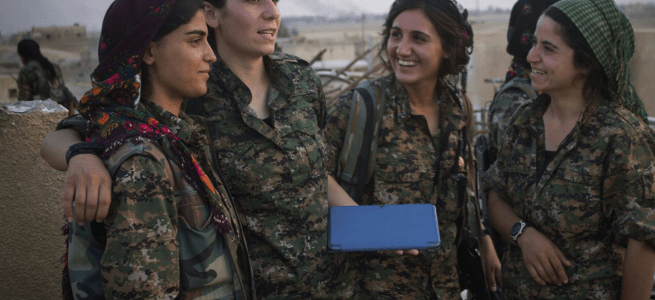
A look back and ahead at the crisis-imperialist constellations within which the self-administration in northern Syria’s Rojava region must assert itself.
To understand the current catastrophe facing the Kurdish freedom movement in Rojava, it helps to look back at its geopolitical context during the height of the Syrian civil war. The United States, in the midst of its hegemonic decline, was the central factor here. There were two interventionist approaches toward Syria, which was sinking into civil war, that competed with one another within U.S. foreign policy. During the Obama administration, this conflict was also played out relatively openly.[1] While the CIA sought to instrumentalize “moderate” Sunni Islamist militias, the Pentagon relied on the Syrian Kurds in the emerging Rojava to break the advance of the Islamic State (IS).[2]
As is well known, the Pentagon prevailed. And this happened for one simple reason: The Kurdish self-defense forces were highly effective in the fight against the genocidal Islamofascism of the IS, as they were fighting for an emancipatory society.[3] Neither of these qualities could truly be said of the CIA’s Islamist-influenced militias, which mostly viewed IS as mere competition. The intense, militarily successful phase of cooperation between the Pentagon and Rojava spanned from the defense of Kobane in September 2014 to the liberation of Raqqa in October 2017.[4] This took place amid constant tensions with Ankara, as Turkey acted as one of IS’s most important supporters and was determined to destroy Kurdish autonomy in Syria.
Yet Washington’s support for the Kurds of Syria had always been fragile, rendering their geopolitical situation precarious. Even during the Obama administration, the decline of American hegemony was already underway, a process that Trump is now carrying through to its bitter imperial end. The deployment of American forces against the Islamic State took place during a phase in which Washington, as part of its pivot to Asia intended to focus more intensely on the struggle for hegemony against China and the containment of the People’s Republic in Southeast Asia.[5] Washington thus only reluctantly assumed its role as “world policeman” in response to the regional collapse in Syria’s “war of state decomposition” (Robert Kurz).
Washington’s reluctance had its reasons: The disastrous U.S. invasion of Iraq, perpetrated by the neocons as part of their intended democratization of the Middle East, constituted the most significant tipping point, which immensely accelerated the gradual process of erosion of American hegemony. The rapid military victory over Saddam Hussein’s poison gas regime was followed by state collapse and a murderous civil war between Sunnis and Shiites. The neocons’ idea of cementing American hegemony in the oil-rich region through democratization backfired – accelerating the decline of American hegemony.
The crisis-driven surge of state decomposition in the region, in which Libya and Syria also collapsed in the wake of the Arab Spring, was thus effectively initiated by the U.S. invasion of Iraq. Western hegemonic nation-building, which was forced through as part of the “wars for world order” (Robert Kurz) of globalization, failed across the board, as the global crisis of capital had long since stripped the ailing ruins of modernization in the periphery of their economic foundation: from Somalia, through Afghanistan and Libya, to Iraq. However, the chaos of state collapse also opened up spaces for the only significant emancipatory impulse that was able to hold its ground in the general process of disintegration in Northern Syria. What the neocons failed to achieve in Iraq suddenly seemed to be working in Rojava.
The remnants and ideological vestiges of this democratization approach within the U.S. state apparatus consequently supported Kurdish self-administration for tactical reasons, but these forces very quickly lost all relevance due to the disaster in Iraq. Rojava was only significant to the U.S. in the context of containing the Islamic State. Especially since the neocons’ democratization strategy was a democratic means to a hegemonic, imperial end aimed at the region’s fossil fuel resources: Democratization – which would effectively have been financed by oil exports – was intended to go hand in hand with the region’s integration into the United States’ hegemonic system, which meant Washington’s indirect, mediated control. This was intended to cement the dominance of the petrodollar. Rojava, with its marginal local oil reserves, could not serve this purpose; all that remained was the ideology of democratization, without the economic foundation of the neocons’ hegemonic calculus still being in place.
An Early Farewell to Human Rights Imperialism
In other words: The geopolitical value of the Syrian Kurds was rapidly declining following their victory over the Islamic State, especially as the old hegemonic mindset within the U.S. ruling elites gave way to a new, openly imperialist calculus personified by Donald Trump. As early as May 2017, Trump had his then-Secretary of State Rex Tillerson deliver a keynote speech on foreign policy in which human rights were rejected as an ideological factor in American foreign policy, so that American interests could henceforth be pursued openly without the “ballast of human rights.”[6] Much of what Trump is currently practicing in terms of naked imperialist policy was already announced in 2017.[7] The betrayal of former geopolitical “partners” is thus the new principle of American power politics, whose open imperialism no longer needs to take into account the institutional and democratic façade of the old U.S. hegemony (under Obama, Washington still made an effort to appear as a “reliable” power factor in foreign policy in order to find willing proxies in the future as well).
About six months after this speech by the U.S. Secretary of State, which effectively initiated the U.S. transition from hegemonic policy to naked crisis imperialism – a transition completed by early 2026,[8] Turkey, with NATO backing attacked the Syrian Kurds in Afrin,[9] which was then under Russian influence. Shortly thereafter, a second Turkish invasion followed in the American sphere of influence in Rojava. The self-governing regions in northern Syria were practically sold off in an imperialist haggle: in early 2018, Vladimir Putin gave the green light for the invasion of the canton of Afrin, which was within Russia’s sphere of influence.[10] In October 2019, Donald Trump gave free rein to Turkey’s expansionist ambitions in northeastern Syria, allowing Ankara to establish another occupation zone in Rojava.[11]
These two military campaigns by Turkish Islamofascism in northern Syria, which were accompanied by ethnic cleansing, illustrate Erdogan’s imperialist expansion strategy, in which he played a high-stakes game, oscillating between Russia and the West to extract concessions from both sides for further land grabs.[12] Erdogan’s imperial leverage, as the controller of a strategically important country, is far greater than that of the Syrian Kurds, who were needed only to contain the Islamic State and serve as a counterweight to the Assad regime. Putin sold out the Kurdish region of Afrin for a nuclear and pipeline deal; with Trump, it was likely just an affinity for authoritarian figures and an effort to keep Ankara within the Western alliance.
With the collapse of the Assad regime in late 2024, the regional balance of power shifted further to Rojava’s disadvantage. The Islamist alliance – backed by Turkey, the U.S., and, to a limited extent, Israel – which swept away the shell of the Syrian state apparatus within days, achieved a strategic objective of the West and Israel in the region. The Shiite corridor, through which the Iranian mullah regime had been able to project its military power to the border of Israel, was severed; Hezbollah’s logistics were severely disrupted, and following its defeat by Israel, it was thus no longer capable of intervening in Syria.
In effect, this is where the CIA’s intervention strategy – mentioned at the outset – prevailed, as the agency ultimately struck a deal with the ideological and/or organizational successors to al-Qaeda in order to achieve a geopolitical objective. With the remnants of the Syrian state, the Islamists merely destroyed what was already in the process of disintegrating due to the crisis. And they were also so successful because they did not have to fight against their own kind, against the Islamic State, which had previously been defeated by the military forces of Rojava at great cost.
The al-Qaeda State
About a quarter of a century after the attacks on the World Trade Center, organized by an al-Qaeda leader named Osama bin Laden who had been nurtured by the CIA in Afghanistan, the United States brought the political heirs of this Islamofascist terrorist group to power in Damascus. For the U.S., this is part of its struggle for dominance against China. Washington views al-Qaeda’s Sunni extremism as a bulwark against Shiite Iran, which is part of the Eurasian alliance system centered on Beijing. Russia has indeed been pushed out of the region, and Iran has been weakened.
The biggest beneficiary of this al-Qaeda state – which will be just as unstable as the Assad regime – is Turkey, which has been able to massively expand its power base in the region as a result. The Europeans (especially Berlin), in turn, hope to soon be able to deport refugees back to Syria. That is why Berlin remains just as adamantly silent about the massacres and ethnic cleansing currently taking place in Rojava as it did previously regarding the jihadist mass murders on the Alevi coast or in the Druze region in the south. The country would thus become an open-air prison guarded by Islamists for the region’s economically superfluous population.[13]
There is no longer any talk of democratization or free elections in Syria; the human rights imperialism of the neoliberal era has also receded into the background in Europe. Brussels, Berlin, and Paris are following Washington with a time lag. The only goal now is to ascribe some sort of legitimacy and stability to the emerging al-Qaeda in Syria in order to be able to deport people there. In effect, this constitutes collaboration with fascism in its Islamic-clerical form; it is an effort to somehow pacify the crisis-ridden region through the murderous terror of the jihadists, to bring about a deathly silence. And – this prediction can already be made – of course, this European hope for Islamist graveyard silence will be shattered by Islamist terror (one might even ask whether Washington does not in fact intend this destabilizing factor as part of its now relatively open struggle against the EU).
After December 2024, there was effectively only one regional power left with an interest in Rojava’s existence: Israel. Tel Aviv appeared to support the overthrow of the Assad regime, at least tactically, yet at the same time, Israel immediately sought to limit the power of the Islamists in Syria. Sunni extremism was to be largely neutralized by autonomous regions controlled by minorities: the Druze in the southwest, the Alevis on the coast – and the Kurds in the north and northeast. Support for the Kurds thus stemmed primarily not from political or ideological sympathies, but from geopolitical calculation. Moreover, Israel finds itself in confrontation with Erdogan’s Turkey over supremacy in the region, where Ankara seeks to expand in the tradition of the Ottoman Empire. By the end of 2025, for instance, Greece, Cyprus, and Israel had formed an alliance clearly directed against Ankara, intended to neutralize Turkey’s quest for dominance in the eastern Mediterranean.[14]
So what has happened? Why is Tel Aviv now silent as an unstable, Islamist state closely intertwined with Ankara forms on its northeastern flank? For one thing, Washington has simply prevailed – it is U.S. soldiers who are stationed in Rojava. And Trump already sided with Erdogan and against the Kurds during his first presidency. The fascists in the White House feel closer to Erdogan, with his authoritarian hybrid ideology of nationalism and Islamism, than to the Kurdish self-administration focused on emancipation. Especially since Turkey, as mentioned above, represents an important – albeit increasingly problematic – link for the US and the EU in the region. Just how quickly the Kurds are being sold out to secure other concessions was made clear, for example, by French President Macron’s email to Donald Trump, which the latter simply made public. Macron, who had often spoken out publicly in support of the Syrian Kurds, suddenly found himself on the same page as Trump regarding Syria and Iran – only to then contradict him during the Greenland conflict.[15]
Iran as the new Syria?
Iran is the key word here. Today’s Iran exhibits a structure similar to that of Syria during the Arab Spring: an authoritarian, internally hollowed-out state in ruins, effectively in the throes of economic and ecological collapse (which is why it was easy for Israeli intelligence agencies to comprehensively infiltrate this eroding state apparatus). The last major wave of uprisings and protests, which could only be crushed through state-sponsored mass murder, claiming the lives of likely tens of thousands of demonstrators, was supported by broad segments of the population.[16] In addition to the usual suspects – the liberal bourgeoisie, which has long hated the moral terror – impoverished wage earners and small business owners, who are suffering from the currency collapse and inflation, also participated in the protests.[17] In parts of the country, the water supply is collapsing simply due to the manifest climate crisis.[18]
Washington – and Israel in particular – therefore want to seize the moment and overthrow the mullah regime. Although “overthrow” might be the wrong word, given the U.S. approach toward Venezuela.[19] There is no talk of democratization or elections in the case of Iran either; instead, the archaic institution of the Shah of Persia (of all things) is to be revived – that is, precisely the repressive, murderous regime that swept away the 1979 revolution, which failed due to fundamentalist mass terror.[20] The U.S. effectively wants to replace a hostile Islamic-fascist regime with one subservient to the U.S. After Venezuela, Iran would thus neutralize another of China’s supply hubs. For Israel, however, a central security policy objective is at stake. The regime that has elevated the annihilation of the Jewish state to a state doctrine, that publicly cheered and militarily supported the Hamas pogroms and massacres of October 7, could be overthrown.
And this regime reshaping, this regime design – as was made clear in the case of Venezuela – is far more cost-effective than the resource-draining efforts of the neocons to establish democratization and U.S. hegemony in the region through regime change. The goal is simply to eliminate the fundamentalist forces within the Iranian regime, while at the same time making appropriate offers to factions and cliques willing to cooperate in order to retain power.[21] The mass murderers within the Iranian repressive apparatus, on whose orders thousands of demonstrators were recently shot down, could thus retain their positions of power even after the intended “overthrow of the government,” provided they show themselves to be cooperative.
The crisis-induced erosion of state structures makes this approach toward individual cliques within the apparatus conceivable, after all – Venezuela serves as the blueprint for this new form of U.S. crisis imperialism, which has long since forgotten its isolationist campaign promises. Yet this by no means implies that this approach, which has been successful in Venezuela (at least in the short term), will also work against a regional power like Iran – at least not without war.
This “regime design” intended by the U.S. – the reshaping of the Iranian regime to align with U.S. interests – would most likely not proceed without prolonged military conflict. A brief Delta Force operation, like the one in Caracas, will not suffice. And this is precisely what Washington appears to be working toward. Shortly after the Syrian state Islamists launched their attacks against Rojava, representatives of the Kurdish self-administration reported that they had been urged by U.S. officials to fight against the Shiite militias in Iran, which would be mobilized in the event of a conflict. A mobilization of Iranian-Kurdish forces is already underway for a potential conflict in Iran, forces that would have to navigate between their geopolitical instrumentalization and the Kurdish struggle for liberation.
And this is precisely what brings Turkey into the picture, as it acts as one of the most important regional opponents of an overthrow of the mullah regime, since Iran – like Syria – has a large Kurdish minority, whose autonomy or self-governance, modeled after Rojava, Ankara seeks to prevent. It thus appears that Trump’s repeated betrayal of the Syrian Kurds is a geopolitical price paid to soften Ankara’s resistance to the intended overthrow of the regime in Iran. Furthermore, it can be assumed that Turkey has also been promised a buffer zone on Iranian territory, similar to its occupation zone in northern Iraq.[22] Once again, the Kurds are paying the price for imperialist deals between great and regional powers.
The crisis of the capitalist world system unfolds as a historical process in waves; following the wave of state decomposition triggered by the Arab Spring, Iran now stands on the brink. The Trump administration’s new crisis imperialism could be understood as a form of crisis adaptation by late-capitalist functional elites, in which economic upheavals in the semi-periphery are exploited to justify military intervention by the core.[23] Driven by unbearable socio-ecological contradictions, a new violent upheaval is looming in the region, though its outcome remains fundamentally open – just as it was in Syria and will continue to be, provided the Rojava project can somehow be kept alive. Those opposition forces in Iran that managed to survive the recent wave of massacres could thus soon find themselves in a situation where they are confronted not only with the eroding mullah regime, but also with crisis-imperialist efforts to establish a new dictatorial Shah regime amid the chaos.
The disintegration of the late-capitalist world system, the systemic transformation, and the resulting struggle for transformation are, however, inevitable. For what remains of the Left – despite all regression, repression, and opportunism – there is consequently no alternative to the struggle for an emancipatory course of this transformation process. In Rojava as in Iran. And in the core whose neo-imperialism is fueled by the same crisis process that is ravaging the semi-periphery.
I finance my journalistic work largely through donations. If you appreciate my writing, you are welcome to contribute – either via Patreon or Substack.
[1] https://www.latimes.com/world/middleeast/la-fg-cia-pentagon-isis-20160327-story.html
[2] https://www.kritiknetz.de/images/stories/texte/Islamischer_Staat.pdf
[3] https://www.telepolis.de/article/Allianzen-Almosen-Massaker-3366580.html
[4] https://archiv.telepolis.de/features/Kobane-in-Truemmern-Tuerkei-in-Flammen-3367844.html
[5] https://www.cnas.org/publications/commentary/obama-tried-to-pivot-to-asia-in-2011-we-must-succeed-this-time
[6] https://www.telepolis.de/article/Abschied-vom-Menschenrechtsimperialismus-3713257.html https://www.konicz.info/2017/12/11/abschied-vom-menschenrechtsimperialismus/
[7] https://medium.com/@ascentreact/everything-must-burn-862b983914a6
[8] https://exitinenglish.com/2026/03/19/what-is-crisis-imperialism/
[9] https://ednews.net/en/news/politics/240234-turkey-has-right-to-act-in-self-defense-in-afrin-nato-chief-stoltenberg-says
[10] https://www.konicz.info/2018/01/21/afrin-erdogans-werk-und-putins-beitrag/
[11] https://www.konicz.info/2019/10/26/der-krieg-der-neuen-rechten/
[12] https://www.konicz.info/2022/12/29/das-vergessene-morden/
[13] https://www.telepolis.de/article/Outsourcing-der-Barbarei-3336631.html
[14] https://www.dw.com/en/greece-cyprus-israel-military-cooperation-explained-turkey-reaction/a-75394974
[15] https://www.politico.eu/article/emmanuel-macron-decoded-text-message-donald-trump/
[16] https://www.t-online.de/nachrichten/ausland/krisen/id_101098128/massenproteste-im-iran-neue-opfer-zahlen-offenbaren-dramatisches-ausmass.html
[17] https://news.sky.com/story/why-are-people-protesting-in-iran-everything-you-need-to-know-13490639
[18] https://www.theguardian.com/world/2026/jan/15/how-day-zero-water-shortages-in-iran-are-fuelling-protests
[19] https://www.konicz.info/2026/01/11/die-herrschaft-der-terror-clowns/
[20] https://therealnews.com/how-irans-theocrats-allied-with-and-then-crushed-the-left
[21] https://www.msn.com/en-us/politics/international-relations/as-us-forces-build-up-trump-weighs-limited-strikes-to-shake-iran-s-regime/ar-AA1V1Ksq
[22] https://www.konicz.info/2022/12/29/das-vergessene-morden/
[23] https://exitinenglish.com/2026/03/19/what-is-crisis-imperialism/
Originally posted on konicz.info on 01/28/26

