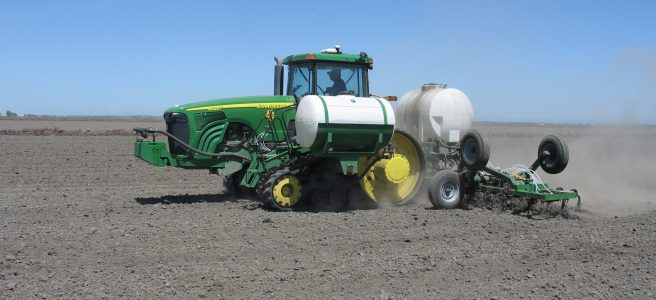
The blockade of the Strait of Hormuz, skyrocketing fertilizer prices, and climate change threaten to trigger a global food crisis. Late-capitalist agriculture is existentially dependent on fossil fuels and produces not only food but also the very conditions of its own destabilization.
At first glance, it seems absurd, but the inhabitants of the late-capitalist world system are, in a sense, feeding themselves on fossil fuels. Without artificial fertilizer – which has played a central role in the agricultural industry since at least the so-called Green Revolution in the second half of the 20th century – global crop yields, which have risen sharply since then, would plummet. Most scientists agree that more than 40% of the world’s population could not be fed without synthetic fertilizers.
Three components are essential in mineral fertilizers: nitrogen, phosphorus, and potassium. Nitrogen fertilizers are based on ammonia, which is produced from natural gas using the energy-intensive Haber-Bosch process – a process responsible for about three percent of global CO₂ emissions. Sulfur, which is necessary for processing phosphate rock and on which phosphate fertilizer production depends, is a byproduct of oil and gas extraction. The production of mineral fertilizers is thus linked to the extraction of fossil fuels. About 50% of food production costs are now attributable to the energy consumption of the highly automated agricultural industry. As a result, rising oil prices are also driving up the production and distribution costs of food – for example, due to more expensive diesel.
The Gulf states, which are now suffering from the blockade of the Strait of Hormuz, have managed – as part of their diversification strategy – to emerge over the past decades as a major production hub for synthetic fertilizers and their precursors, as well as a central transshipment point for essential goods in the agricultural industry. In this so-called vertical integration, raw material-producing countries strive to dominate as large a portion of the industrial production chain as possible. And they have succeeded: About 43% of one of the most widely used nitrogen fertilizers, urea, is exported through the Strait of Hormuz. The Gulf states were also responsible for about 45% of global sulfur exports. About 30% of ammonia production takes place in the region, primarily in Saudi Arabia and Oman. In total, the now-blocked region produces about one-fifth of all fertilizer used worldwide.
According to the Financial Times in April, a global food crisis is consequently unfolding that couldn’t even be mitigated if the Strait of Hormuz were to be opened immediately. For one thing, production capacities at competing fertilizer industry sites – such as in Russia and Belarus – are not large enough to compensate for these enormous shortfalls. Setting up new production sites would take years. The rapprochement between the U.S. and Belarus in March, which was accompanied by prisoner releases and a lifting of U.S. sanctions, was specifically aimed at promoting the production and export of Belarusian fertilizer to alleviate this supply crisis.
However, the decisive factor in the crisis lies in the simple fact that food cultivation is a seasonal industry. The time for sowing and the corresponding application of fertilizer has already arrived or passed in many regions of the world. And in many impoverished regions on the periphery or semi-periphery of the world system, agricultural producers are simply unable to cope with the rise in fertilizer prices. By mid-April, fertilizer prices had skyrocketed by 20% – and in the case of urea, by as much as 49% – compared to just before the closure of the Strait of Hormuz. This means that simply less fertilizer will be used, which will inevitably lead to a slump in expected crop yields. The poorer the region, the greater the crop losses.
Sub-Saharan Africa is particularly affected, where financially strapped farmers can barely afford enough fertilizer to optimize their yields anyway. Here, fertilizer price increases almost automatically lead to reduced consumption and, consequently, falling yields. Regionally, the East African countries of Kenya, Somalia, and Tanzania are particularly dependent on overseas fertilizer shipments from the Gulf region, where transportation costs have risen by up to 300%.
Sudan, a devastated post-state entity, on the other hand, is the epicenter of the coming hunger crisis – though due to the civil war: About 21 million people there are threatened by acute food insecurity, and approximately 375,000 residents are starving. According to the United Nations World Food Program, the number of extremely poor people suffering from acute hunger could rise by 45 million this year to a record 363 million due to the war on Iran and the blockade of the Strait of Hormuz. Billions of people are likely to be affected by a deterioration in the nutritional situation, such as an increase in malnutrition.
In the semi-periphery of the capitalist world system, India and Brazil are suffering most from the war-induced cut in fertilizer exports: More than half of the fertilizer imported by India has so far been transported through the Strait of Hormuz; for Brazil – one of the world’s most important agricultural producers – the figure was 45% before the war broke out. Australia even imported 70% of its fertilizers from the Gulf region. In the case of India, the world’s most populous country, the situation is particularly dire: Domestic fertilizer production relies heavily on natural gas, which currently cannot be transported through the Strait of Hormuz in the fragile liquefied natural gas tankers – where attacks or sea mines would result in massive explosions. In early May, Indian Prime Minister Narendra Modi called on his fellow citizens to reduce their consumption of cooking oil, fossil fuels, and fertilizers. Similar dependencies on Gulf gas also exist in fertilizer production in Pakistan and Bangladesh.
In the core of the world system, the situation appears less dramatic at first glance: If the blockade drags on into the summer, the Financial Times estimates that food price inflation in the U.S. – currently around four percent and already factored into prices – could rise into the “double digits.” A similar scenario is likely to unfold in the EU. The U.S. agricultural sector – which is essential for global food security and whose workers, if they are U.S. citizens, form part of Donald Trump’s core electorate – is already suffering from the tariff and trade wars waged by its far-right president, and now also from rising energy and fertilizer prices in the wake of the war with Iran. The former alone led to a 46% year-over-year increase in farm bankruptcies in 2025. In 2024, the U.S. was the largest exporter of agricultural goods, ahead of Brazil, and it leads the world in corn and soybean production.
And then there’s global warming
These consequences of the geopolitical crisis are intertwined with the climate crisis caused by capitalism, which, although largely ignored by now, nevertheless increasingly undermines the ecological foundations of civilization. Meanwhile, historical records for maximum temperatures and the duration of droughts are being broken one after another – as was most recently the case in March in the U.S. – without this even being widely acknowledged by the public anymore. Capital’s fetishistic compulsion to accumulate value – which fuels the ceaseless clamor for growth and jobs – has long since prevailed in public opinion over the real physical constraints of the climate crisis – from Trump to the Left Party.
The rise in food prices in recent years has already been driven by increasingly frequent and prolonged extreme weather events – such as droughts and heavy rains – that are characteristic of the manifest climate crisis: Affected crops include cocoa in Africa and South America, olive oil in Europe, vegetables in the western United States, rice in Japan, and onions and potatoes in India – extreme weather events have been increasing in frequency over the past half-decade.
At the same time, the United States is currently experiencing a historically unprecedented spring drought that has affected about 60% of its farmland. The southeastern United States has been hit particularly hard, especially Alabama, Georgia, and Florida, where farmers have in some cases stopped planting due to the high costs of diesel and fertilizer, as well as the Midwest, where, according to the U.S. Department of Agriculture, wheat acreage is expected to shrink this year to its lowest level since 1919, resulting in a smaller harvest. In Kansas and Oklahoma, more than 40% of wheat-growing areas are reportedly in “poor or very poor condition.”
In the EU, after years of prolonged droughts, the situation is not much better: nearly half of the cropland is threatened by drought, and an additional 17% is even experiencing acute drought. Nearly all EU member states, as well as the southeastern part of the United Kingdom, are affected to varying degrees. Following a historic lack of rainfall in March and April, Poland is emerging as a drought hotspot, where crop yields are likely to plummet due to low soil moisture. The same is true for eastern Germany, southeastern Europe, Spain, and France. In fact, Europe is in a prolonged phase of drying out – the climate crisis is a reality.
In April, the UN Food and Agriculture Organization (FAO) warned that rapidly increasing periods of “extreme heat” were pushing the global food system to the brink of collapse. Further climate shocks are on the horizon in the short and medium term. According to scientific forecasts, this year’s El Niño event could be particularly intense. During such events, water temperatures in the eastern Pacific rise at an above-average rate, which can lead to droughts in countries bordering the western Pacific, in South Africa, or in the Amazon region, while causing flooding in western Latin America – with corresponding consequences for crop yields. Extreme drought in many regions of the world has already led to wildfires consuming more and more forest area each year.
In the long term, the weakening Gulf Stream – part of the Atlantic Meridional Overturning Circulation (AMOC) – is also likely to become one of the most significant factors contributing to climate crises in Europe and North America. Scientific studies have confirmed the long-standing rule in climate science that the most pessimistic forecasts are usually the ones that most accurately reflect climate reality. The Gulf Stream carries warm Caribbean water into the North Atlantic, where it slowly sinks and flows back southward like an assembly line, giving Europe its relatively mild climate – compared to the same latitude in Siberia, for example. The melting of the Greenland ice sheet threatens to weaken this already waning circulation – which is based on density differences between saltwater and freshwater – by introducing freshwater; according to studies, this could happen as early as the end of the century. However, there is a high degree of uncertainty. The consequences would be severe climatic upheavals, such as a drop in temperature and desertification – particularly in Western Europe – to which the ailing late-capitalist agricultural system would be barely able to adapt.
Capital vs. The Climate
Capital, with its boundless drive for valorization, is not only the cause of the climate crisis, as evidenced by CO2 emissions rising almost in parallel with global economic growth. The increase in productivity of the agricultural capital machine does not lead to the conservation of remaining agricultural soils and resources, but rather to the establishment of an agricultural system that is not only ecologically ruinous but also harmful to health. It is a system that, for example, responded to the explosion in corn yields with the invention and widespread use of high-fructose corn syrup – a sugar concentrate that has replaced ordinary sugar in food production and is considered partly responsible for the obesity epidemic in the United States.
The orientation of food production toward the irrational end in itself of maximizing profits is making the agricultural sector increasingly unstable and vulnerable to crises: monocultures, soil depletion, low genetic variability in livestock populations, and the near-extinction of insect populations in many intensively farmed regions are the consequences.
The climate crisis is a capitalist climate crisis in two respects: Capital is the cause, and it exacerbates the social consequences of its own ecological crisis. All of the factors mentioned above increase the system’s vulnerability to crisis, which actually necessitates a rapid course correction. Even the Financial Times has recognized this, advocating for a shift toward sustainable agriculture in which monocultures would be replaced by crop rotation. Increased use of natural fertilizers would be just as necessary as prioritizing “soil health” over short-term yield increases. Added to this would be the necessary extensive debt relief for all peripheral countries, which will be hit particularly hard by the coming food crisis.
Just how likely such a reformist shift is in a late-stage capitalist system – one that, not only in Germany, is responding to its manifest crisis with an intensified flight into the fossil-fuel-driven growth delusion – was made clear by the EU’s most recent major agricultural reform in 2020, which, despite some marginal ecological concessions, clung to the fundamentals of existing agricultural practices: 25% of EU agricultural subsidies were tied to farmers’ participation in climate measures, while member states were largely given free rein to define what they consider “climate programs.” This is arguably less than a drop in the bucket: According to the German Federal Environment Agency, emissions from agriculture in the EU declined more slowly (down 25% between 1990 and 2023) than the average for society as a whole (down 36% over the same period). Globally, CO2 emissions continue to rise.
Originally published in Jungle World No. 22 in 06/2026.

