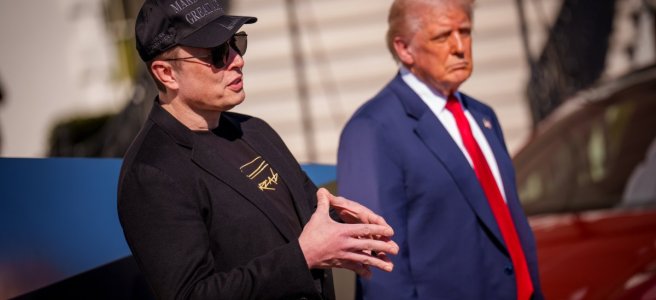
The purges and deportations threatened by Trump have already begun.
It seems that what follows neoliberalism is based on the methods that neoliberalism used in previous decades to implement its infamous structural adjustment programs. They are fascistoid decay products of neoliberalism that are now unwinding the neoliberally deformed constitutional state in the U.S. The shocking implementation of controversial neoliberal austerity programs, taking the public by surprise with far-reaching deregulation measures; these tactics find their equivalent in the shock strategy that Trump and Musk are now using to eliminate any potential for opposition in the state apparatus. It’s all happening in quick succession – and these are just the first steps.
Immediately after taking power, in its first week in office, the Trump administration abolished all equality programs (DEI or Diversity, Equity and Inclusion) and introduced a whistleblower system in the U.S. administration.[1] Not only have all programs that were intended to give minorities greater representation in the state apparatus been abolished without replacement. The White House has also set up an email address where whistleblowers can report incidents that “circumvent” the new regulations, as the New York Times (NYT) put it.
What does this mean in concrete terms? The DEI programs, hated by the racist U.S. right, ultimately amounted to giving preference to candidates from socially disadvantaged or underrepresented minority groups in applications, provided they had the same qualifications as their fellow applicants. If this continues to happen, it could be interpreted as a continuation of the DEI measures, which could prompt losing applicants to report this to the Trump administration. Ultimately, this means that it is safer for decision-makers in the U.S. public administration and state apparatus to hire white men in the future in order to avoid career-damaging accusations of “woke” activities.
It is a thinly disguised racist regulation designed to expand the dominance of white America in its power apparatus. At the same time, it creates an atmosphere of tattle-tailing and suspicion based on racism, which is conducive to the control of large power apparatuses. At the beginning of February, lists of “targets” in the public sector were published online, containing names and photos of mainly black public sector healthcare employees who are accused of “woke” thought crimes, such as using pronouns, supporting Democrats or working on DEI initiatives. It is unclear where these right-wing denunciation sites (“DEI Watch List”) get their information from.[2]
The fight against the “woke” DEI measures functions as a versatile ideological vehicle for the return of racism – and climate change denial. Meanwhile, in response to climate disasters (fire in Los Angeles) and accidents (plane collision in Washington), the White House has even established the narrative of blaming the DEI programs.
Everything Must Go!
On the surface, Trump and Musk want to implement an extreme form of neoliberal austerity policy. The Orwellian construct of the “Department of Government Efficiency” (DOGE), led by Elon Musk in a legal gray area, wants to cut the U.S. budget, which totaled 6.7 trillion dollars in 2024, by two trillion dollars.[3] To this end, the Trump administration has sent emails to all 2.3 million public sector employees asking them to look for “higher productivity jobs” and to accept a severance package by February 6th that provides for continued pay until September 2025.[4] Shortly before the deadline, only 20,000 employees agreed to this arrangement.[5] In a first step, ten percent of public sector jobs – more than 200,000 jobs – are to be eliminated, which points to tough disputes in the coming months that are likely to provide the Trump administration with further opportunities for the reactionary politicization of the shrinking state apparatus.
The richest man in the world also had his crosshairs on the U.S. aid organization, USAID, which Elon Musk described as a “viper’s nest of radical-left marxists.”[6] For decades, USAID not only acted as a humanitarian aid organization, it also flanked U.S. interests globally as part of a standard “soft power” approach. The imperialists in the White House clearly want to do without this in the future. Nearly all 10,000 employees of the U.S. government’s aid agency have been laid off, and most programs in developing countries have been discontinued.[7] The U.S. State Department will now only directly control and manage a few selected aid programs.[8] In addition, around 60 U.S. foreign policy front organizations involved in promoting civil society and democratic structures in authoritarian states such as China, Russia, Iran and Hungary have lost their funding, according to the NYT.[9] Hungarian ruler Viktor Orban in particular – who was granted an audience with Trump in mid-September – has vehemently criticized these projects.
Another priority of the Trump administration is the education sector and the Department of Education, which he wants to deprive of most of its funding – not that it is particularly necessary. According to the report, the Department of Education is not only to be stripped of funding, but all its functions that are “not explicitly stipulated in its statute” are expected to be distributed to other departments, according to reports in the U.S. media.[10] This is expected to happen as early as the end of February. In addition to alleged cost-cutting constraints, the Biden administration’s programs for equality and tolerance in education appear to be the main motivating factors behind this move. Trump seems to be seeking a fundamental, authoritarian-reactionary new beginning here.
U.S. universities, which often have a liberal reputation, are also already in the Trump administration’s crosshairs. Hundreds of millions in state funds are on the hit list, so university leaders are avoiding public criticism of the previous revision of equality programs. Professors and university leaders prefer “not to provoke the president,” according to the NYT, as the financial screws are already being tightened.[11]
Hand on the Money Lever
Elon Musk’s biggest coup to date came in his capacity as a “special government employee” (the White House’s official term for the oligarch) in his attack on the Treasury Department’s payment system, which handles a large proportion of U.S. payments.[12] The so-called Bureau of the Fiscal Service is a mere executive body run by civil servants who are not political appointees. It handles nearly 90 percent of all federal government payments, such as social programs and tax refunds. It stores data on more than 100 million U.S. citizens and most government employees, which previously only a “handful of top non-political officials” had access to, according to the Independent.[13]
But now Musk has managed to access the data stream using his DOGE construct, and he has the support of Trump’s Treasury Department. The oligarch seems to be less concerned with the efficient processing of payments than with controlling them and possibly blocking any payments. This would simply mean that Congress, which provides the legislative basis for the payment office, would be undermined by the Trump administration. Musk has wanted to gain access to the payment system since December, but was refused by the now resigned head, with his team exploring the possibilities of payment stops in particular. In disputes with recalcitrant parts of the state apparatus, in repression against “ideological enemies,” as Rolling Stone put it, the Trump administration and its oligarch are now in the driver’s seat.[14] Anyone who doesn’t do their part is – without an ounce of bureaucracy – cut off.
If Musk’s actions are reminiscent of oligarchies such as Ukraine or Russia, where it is common to abuse state power to enforce particular interests, then this is because late capitalism in the United States is entering its oligarchic stage as part of crisis-induced brutalization.[15] In the meantime, a number of lawsuits have been filed against these actions by – let’s say – the Trump administration,[16] but these proceedings will be carried out in a judicial system that has been deliberately infiltrated by Republicans and right-wing groups for many years by means of political appointment campaigns.[17] The staunchly right-wing Supreme Court, which has already granted Trump general immunity for his second term in office as a precaution, is only the tip of the reactionary iceberg in the judicial system.[18] And it is precisely here that many of the Trump administration’s plans will be decided, as they operate in a legal gray area. For this reason, the Biden administration tried to fill as many judgeships as possible by the end of 2024 in order to counter the right-wing offensive in the coming judicial war.[19]
Fight For the “Deep State”
The fight against the so-called “deep state,” against informal networks in the ministries of power, which Trump has taken up the cause of,[20] is a classic right-wing projection.[21] The U.S. right wants to seize the “deep state” as part of its fascist impulse and, if necessary, build it from scratch so that it never has to leave power again. The Trump administration’s attacks on the FBI and CIA serve this very purpose. It is not about destroying or weakening these state agencies, such as the Department of Education or USAID. Trump wants to turn them into his personal instruments of power – another characteristic of oligarchic, authoritarian systems.
The capitalist rule of law is practically on the brink of collapse. The subjectless form of capitalist domination mediated by the state and judicial apparatus, as implemented by the FBI and CIA at home and abroad, is thus degenerating into potential prey for particular interests. Which oligarch will win the next “elections” by spending billions to push through his interests via the FBI and CIA? This is the future that threatens the U.S. if Trump succeeds in his grab for the “deep state.” The suppression of any opposition movements by the United States’ highly trained and militarized repressive apparatus would be possible almost without interruption, regardless of the rule of law.
Trump is planning a comprehensive purge of the FBI, in which FBI officials who have investigated Trump and his supporters are on the hit list. This right-wing “cancel culture” targets all those who appear to be disloyal. Here, too, there is formal talk of “cuts”[22] to which six FBI leaders have already fallen victim.[23] The purges could affect “hundreds, if not thousands” of agents, according to U.S. media.[24] Every FBI investigator involved in the investigation following Trump’s attempted coup d’état in January 2021 is effectively at risk. In the meantime, FBI agents have even gone to court to obtain an emergency court order to deny the Trump administration access to their identities.[25]
At the CIA, however, which has a tense relationship with Trump due to his preference for despots, the usual threatening emails with severance offers were sent out – this applied to all CIA people without exception.[26] A spokesperson for the notorious intelligence agency explained that this approach was intended to bring the CIA into line with the goals of the new administration. As early as November 2024, CIA insiders warned that Trump wanted to politicize the intelligence service and transform it into a personal “weapon” to be used unlawfully against political opponents, for example.[27] Musk’s empire is already closely intertwined with the U.S. state apparatus, for example with space programs and intelligence services.[28]
Guantanamo For Migrants
This Trump crusade, in which the separation of powers and all checks and balances of the U.S. political system are to be undermined in the fascist tradition, is taking place against the backdrop of extensive deportations of migrants by the new administration. The United States Immigration and Customs Enforcement (ICE) was instructed at the end of January to achieve a daily arrest rate of 1200 to 1500 “illegal” migrants.[29] Countries such as Colombia, which refused to grant landing permits to deportation flights from the United States, were threatened with tariffs by Washington and brought into line. The same applies to Mexico, which is deploying around 10,000 soldiers to the border to secure it following comprehensive U.S. tariffs, which have been suspended by Trump for a month. The Trump administration is also deploying Army and Marine units to the southern border.[30]
The ICE migrant hunt, which is supported by large sections of the U.S. population,[31] is now proving too successful:[32] At the beginning of February, interned migrants sometimes had to be released because the detention centers were overcrowded.[33] But the Trump administration seems to have found a solution for this too. The infamous military base at Guantanamo, which served as a detention and torture center for Islamist terrorists during the “war on terror,” is to become a – well – concentration camp for all the migrants detained by ICE who cannot simply be deported. The capacity of this camp is said to be up to 30,000 people.[34]
I finance my work mainly through donations. If you like my texts, you are welcome to contribute – either via Patreon or Substack.
[1] https://www.nytimes.com/2025/01/25/us/politics/trump-immigration-climate-dei-policies.html
[2] https://www.nbcnews.com/health/health-news/federal-health-workers-terrified-dei-website-publishes-list-targets-rcna190711
[3] The White House stated that Musk was a “special government employee.” https://www.golem.de/news/doge-weisses-haus-aeussert-sich-zu-elon-musk-2502-193042.html
[4] https://www.nytimes.com/2025/01/31/us/politics/federal-workers-opm.html
[5] https://eu.usatoday.com/story/news/politics/2025/02/04/trump-buyout-offer-federal-workers-deadline/78208851007/
[6] https://www.counterpunch.org/2025/02/04/usaid-marxists-once-again-elon-musk-again-displays-his-invincible-ignorance/
[7] https://time.com/7212938/trump-administration-pulling-almost-all-usaid-workers-off-job-worldwide/
[8] https://www.nytimes.com/2025/02/03/us/politics/usaid-trump-musk.html
[9] https://www.nytimes.com/2025/02/03/us/politics/democracy-human-rights-fired.html
[10] https://www.msn.com/en-us/news/us/trump-administration-to-take-steps-to-defund-education-department/ar-AA1ylYd4
[11] https://www.nytimes.com/2025/02/04/us/trump-executive-orders-universities.html
[12] https://slate.com/news-and-politics/2025/02/elon-musk-us-aid-social-security-data-heist-trump.html
[13] https://www.independent.co.uk/news/world/americas/us-politics/elon-musk-doge-treasury-payments-b2691375.html
[14] https://www.msn.com/en-us/money/companies/elon-musks-attempt-to-control-the-treasury-payment-system-is-incredibly-dangerous/ar-AA1yka77
[15] https://www.konicz.info/2014/12/05/oligarchie-und-staatszerfall/
[16] https://www.politico.com/news/2025/02/03/unions-sue-block-musk-treasury-payment-00202243
[17] https://www.konicz.info/2021/12/25/amerikas-justizkrieg/
[18] https://exitinenglish.com/2025/02/26/a-country-for-old-men/
[19] https://www.nbcnews.com/politics/joe-biden/senate-confirms-bidens-235th-judge-beating-trumps-record-rcna182832
[20] https://www.uspresidentialelectionnews.com/2024/11/donald-trumps-10-point-plan-to-dismantle-the-deep-state-revisited/
[21] https://www.konicz.info/2019/02/11/ich-will-wo-es-ist/
[22] https://www.yahoo.com/news/fbi-launches-wide-ranging-round-202334950.html
[23] https://edition.cnn.com/2025/01/30/politics/senior-fbi-leaders-demoted-wray/index.html
[24] https://www.theatlantic.com/politics/archive/2025/01/trump-fbi-revenge-firings/681538/
[25] https://www.nytimes.com/2025/02/04/us/politics/fbi-names-trump-jan-6-lawsuit.html
[26] https://www.msn.com/en-ca/money/topstories/cia-offers-buyouts-to-entire-workforce-to-align-with-trump-priorities-sources-say/ar-AA1ytjkq
[27] https://www.nbcnews.com/politics/national-security/former-cia-officials-worry-trump-politicize-weaponize-intelligence-age-rcna179024
[28] https://www.yahoo.com/news/retired-general-no-idea-got-222433140.html
[29] https://www.forbes.com/sites/saradorn/2025/02/04/everything-to-know-about-trumps-mass-deportation-plans-first-flights-to-guantnamo-bay-underway-white-house-says/
[30] https://taskandpurpose.com/news/army-marines-southern-border/
[31] https://abcnews.go.com/538/americans-support-trumps-mass-deportations/story?id=118194123
[32] https://www.pbs.org/newshour/show/fear-spreads-in-immigrant-communities-as-raids-and-deportations-escalate
[33] https://www.cbsnews.com/news/ice-releases-some-migrant-detainees-detention-facilities-reach-109-percent-capacity/
[34] https://www.pbs.org/newshour/politics/trump-wants-to-hold-up-to-30000-detained-migrants-at-guantanamo-bay-heres-what-to-know
Originally published on konicz.info on 02/06/2025


 EXIT! in English