Crisis, Riots and What Next?

Thomas Meyer

The bourgeois discourse on violence is dominated by the attitude of condemning violence from the left. This can be seen very clearly in the condemnation of the climate protests of Last Generation, where the call for the heavy hand of state violence cannot be extreme enough (Konicz 2022). In contrast, violence legitimized by the state is not an object of critique. This applies all the more to structural violence (such as against refugees and Hartz IV recipients) or social catastrophes imposed by the IMF’s structural adjustment measures. Right-wing violence is trivialized, reduced to so-called individual cases or equated with left-wing violence, i.e. no significant distinction is made between violence against people (which often ends fatally) and violence against things or against the bourgeois property order (blockades & occupations). Naturally, such an attitude is suitable for preventing practical social critique and limiting “freedom” & “self-determination” to the approval of the existing. Right-wing violence appears to be less of a threat to the bourgeois order, especially as neo-Nazis often “improperly” do what the state does anyway through official channels – for example in the case of refugee deterrence (“properly” picking up and deporting “foreigners,” burning them in prison,[1] shooting them,[2] etc., instead of chasing them through the park and murdering them). In bourgeois discourse, the violence that appears to pose a threat to the bourgeois order is criticized, while the violent structures of bourgeois society are “taken for granted.” The violence legitimized by the rule of law does not even appear linguistically as such, or it is claimed to be “proportionate” or “necessary.” If violence is then exaggerated, it is once again only “regrettable individual cases.” The police powers acts passed in recent years are increasingly transforming the bourgeois constitutional state into a police state. Preventative detention was used against climate protests on the basis of these laws, i.e. the imprisonment of people who could presumably commit a “criminal offense” or participate (!) in climate protests (which are not even punishable in and of themselves). It should only be a matter of time before climate activism is equated with terrorism![3]

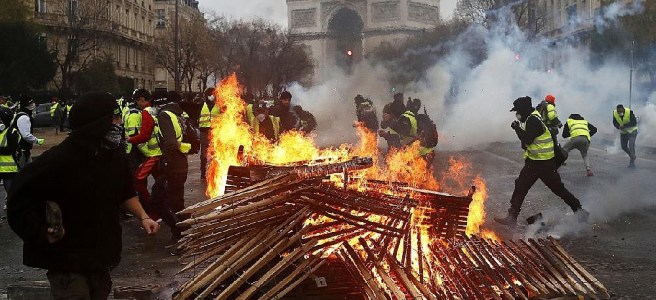
Riots cause particular outrage in the bourgeois discourse on violence, i.e. the usually “relatively spontaneous” uprisings (triggered by certain individual events, such as police violence, price increases for essentials such as bread, but also for petrol, tickets, etc.), which often appear pointless and aimless and are characterized by looting and excesses of destruction of other people’s property. Riots are therefore of a different quality than strikes, in the sense of orderly and formalized struggles for interests (as can be wonderfully observed in collective bargaining disputes). Their social causes are therefore often not understood or they are only interpreted as irrational excesses of violence, which are to be “dealt with” by even more police batons and early warning systems.

This irrationality is an expression of the irrationality of social rationality. “Rioting” people, often young people, are people who live within this society but cannot participate in it. They may be formally equal in legal terms, but they are treated differently (for example, if you come from a “problem neighborhood” or have a “foreign” name, you are more likely not to be invited to a job interview, despite having the same qualifications). They usually share the ideals and goals of society (work, consumption, family), but are excluded from their realization. That the promises of equality and happiness of bourgeois society can be fulfilled or that opportunities for advancement can be realized is increasingly becoming an illusion.  The social catastrophes in so-called problem neighborhoods (“ghettos” or suburban settlements) are not understood as the result of the social upheavals of crisis capitalism and its neoliberal crisis regime since the 1970s, but are racialized: There is agitation and claims that they are a “cultural problem” of black people, the result of “lack of integration,” represent a “foreigner and migrant problem” and/or a problem of “Islam.” Instead of understanding the social causes of the riots and the specific historical constellation in which they take place, they are externalized as a “problem.” A problem that is allegedly being brought into bourgeois society from “outside.” This unwillingness to understand is obviously far more irrational than torching cars or looting supermarkets. Robert Castel, for example, explains against the backdrop of the youth riots in the banlieues in France in 2005: “The problem with these young people is not that they are outside society. This is neither the case in terms of the space they inhabit (the suburban settlement is not a ghetto) nor in terms of their status (many are French citizens and not foreigners). But they are not within society either, because they do not occupy a recognized position in it and many of them are obviously not in a position to obtain such a position. If there has been a revolt of despair, it is in the conviction of having no future, of being deprived of the means necessary to be considered full members of society” (Castel 2009, 36, emphasis added).

In his book Riot Strike Riot, Joshua Clover examines this phenomenon and attempts to contextualize it theoretically and historically. He makes it clear that the bourgeois concept of violence that comes into play in the condemnation of riots is highly problematic: “That property damage equals violence is not a truth but the adoption of a particular set of ideas about property, one of relatively recent vintage, involving specific identifications of humans with abstract wealth of the sort that culminate in, for example, the legal holdings that corporations are people.” (Clover 2016, 11.). The violence to which those who are marginalized and made superfluous are exposed is ignored: “However, this insistence on the violence of the riot effectively obscures the daily, systematic, and ambient violence that stalks daily life for much of the world. The vision of a generally pacific sociality that only in exception breaks forth into violence is an imaginary accessible only to some. For others – most – social violence is the norm. The rhetoric of the violent riot becomes a device of exclusion, aimed not so much against ‘violence’ but against specific social groups.” (ibid., 12).

Clover distinguishes riot from riot prime. The former refers to riots before the labor movement, before the implementation of industrial capitalism (moral economy, resistance of the Luddites, etc., see also Kurz 1999, 125ff.). The historical background is, among other things, the destruction of the commons accompanying “original accumulation” (Marx) and the simultaneously increasing dependence on the market. While the strike sought to enforce the highest possible price for labor power in the factory as well as better and more tolerable working conditions, a rise in the price of goods on the market (bread riots) was a more frequent cause of a riot. Riots did not set the price of labor, but the market price of consumer goods (or they prevented exports so that bread would be sold here and now at a “fair” price and not at a higher price elsewhere). They did not interrupt production, but circulation; the riots were, in a sense, circulation struggles (Clover 2016, 15f.). They did not take place in industry, but in public space, in markets. This is to be distinguished from “riots” (hereafter “riot” again), i.e. those riots that have become more and more important since the 1970s, which is related to the never-ending crisis of capital since the 1970s. They are therefore qualitatively different from the riots in the early days of capitalism. What riot and “riot” have in common is the looting of goods, the spontaneity and disorderliness of their actions. The difference is that today the production of goods is fragmented across the globe, whereas in early capitalism everything necessary for life was still produced in close proximity. This change makes it impossible for a riot to “appropriate and take over” production. If riots are playing a greater role again today, in contrast to the declining importance of strikes, this does not mean that there is a return to older forms of protest. Clover emphasizes that the historical dynamics of the valorization of value are of decisive importance in the theoretical assessment of riots. Even if riots interrupt circulation today, this is not the same as the circulation of the 18th century. With Clover, we can establish the fact that concepts themselves have a history (as, of course, does the thing to which they are supposed to refer), that similar phenomena that occur in the history of capitalism are not a recurrence of the same thing. This must be taken into account in the analysis.

Clover’s explanations have been criticized (Armstrong 2021) that his historical “tripartite division” (“riot-strike-riot prime”) is too schematic, that he does not, for example, address the militant struggles of slaves (which did not take place in the sphere of circulation) and that his distinction between riot and strike is not tenable, look at past mass strikes or wildcat strikes where there was an overlap between struggles in circulation and production (sabotaging trains, disrupting “supply chains” to support striking factory workers).

He was also criticized for focusing on Western countries. If one looks at the world as a whole, then there can be no question of the significance and number of strikes decreasing. Two of Clover’s critics therefore seem to conclude that Clover was apparently mistaken when he said that the crisis of capital has been insoluble since the 1970s, because “the global industrial proletariat has never been as large as it is today, and there have probably never been as many strikes as there are today” (Arps & García Doell 2021). For the two authors, this essentially puts an end to the discussion on crisis theory (see Kurz 2005 & 2012 and, specifically on China, Ming 2023 and the article by Tomasz Konicz in this exit!)

The historical-concrete context that Clover is elaborating is equally applicable to strikes. Fortunately, an increase in strikes has been observed in recent years (see for example Scholz 2022 and Autorenkollektiv 2023). The authors of Analyse & Kritik are undoubtedly right with this observation. However, it should be borne in mind that they are taking place against the backdrop of a tightening space for shaping the value-dissociation form and therefore have a completely different range of possibilities than strikes of previous generations (even if they are also more necessary than ever). It is therefore a little cheap to think that by counting strikes we have refuted Clover’s comments on the crisis.

Clover points out that workers” struggles are tied to the precondition of successful capital valorization and that they become obsolete when the valorization of value enters a systemic crisis (i.e. not a mere cyclical crisis). These are therefore struggles within the capitalist formal context, which as such is not called into question. In the crisis, such struggles then become more and more irrelevant, which makes their defensive and affirmative character clear. As Clover writes: “Labor’s historical power has rested on a growing productive sector and its ability to seize a share of expanding surplus. Since the turn of the seventies, labor has been reduced to defensive negotiations, compelled to preserve the firms able to supply wages, affirming the domination of capital in return for its own preservation. The worker appearing as worker in the period of crisis confronts a situation in which ‘the very fact of acting as a class appears as an external constraint.’ […] We might find a decisive moment by returning […] to Detroit and to 1973, where ‘for the first time in the history of the UAW, the union mobilized to keep a plant open.’ This will swiftly become the paradigm for labor organizing, wanted or not. […] Capital and labor find themselves now in collaboration to preserve capital’s self-reproduction, to preserve the labor relation along with the firm’s viability. […] We might call it ‘the affirmation trap,’ in which labor is locked into the position of affirming its own exploitation under the guise of survival” (Clover 2016, 30, 146f.).

A strike is dependent on economic growth. If certain factories or entire production sectors are no longer profitable, (surplus) value shrinks, there is also less surplus value to distribute that the workers could appropriate. In such a situation, trade unions – since they only represent people in their function as variable capital – advocate that the jobs are retained, usually under worse conditions, so that the factory remains profitable for the time being (possibly in contrast to a competing “location”), provided the workers accept all the necessary conditions. The scope for action within the value form narrows, the room for maneuver becomes narrower. As long as one does not question the wage system as such, but only ever stands up for higher wages (or for lower wages so that the store is not closed down), one participates in the organization of one’s own social decline (or that of other workers). Clover points out that since the 1970s, utilized labor in the production sector has increasingly declined and accumulation has shifted to the financial sphere. The result is the production of a “surplus population” (ibid., 26), which forms the social substance of the riots. People are released into superfluousness, yet they remain forced to reproduce themselves capitalistically: “Capital may not need these workers, but they still need to work. They are thus forced to offer themselves up for the most abject forms of wage slavery in the form of petty production and services – identified with informal and often illegal markets of direct exchange arising alongside failures of capitalist production” (ibid..).

If “normal” working conditions become the exception, the order that “well-behaved citizens” understand as “orderly” disintegrates. The surplus population becomes a “security problem.” In contrast to the 18th and early 19th century, this population is at the mercy of a highly armed police force “as a standing army within.” The state is waging a “war against drugs and terror” (ibid., 36). No wonder that riots are often sparked by police killings.

The shift of value realization to the financial sector and at the same time the intensification of transport and logistics (which shorten the turnover period of capital) could not stop the “stagnation and decline of global profitability” (ibid., 31). Clover sees no contradiction in the fact that individual companies are able to make a profit for themselves, prevail in competition, are extremely successful according to capitalist criteria and do not appear to be in crisis. Clover distinguishes the system as a whole and its crisis from the level of individual capital. He therefore does not make the serious mistake often made by many of today’s remaining Marxists (or followers of the New Marx Lekture) of inferring the state of the system as a whole from the characteristics of individual capitals (cf. Kurz 2012). The conclusion is then drawn: Yes, work is indeed being done, things are being produced, and exploitation is taking place! Where is the systemic crisis? On the contrary: “For Marx’s value analysis, the movements of profits are surface phenomena corresponding to an underlying shift in the balance of constant to variable capital: means of production to waged labor, or dead to living labor. Despite countervailing forces, this so-called organic composition of capital tends to rise over time as competition compels increasing productivity, iteratively replacing labor with more efficient machines and labor processes […]. Over time, however, the rise in the ratio of dead to living labor undermines the capacity for value production […]. The same dynamic that originally drives accumulation […] also undermines it, until manufacturing capacity and labor capacity can no longer be brought together, and instead empty factories and unemployed populations pile up side by side. […] Crisis and decline come not from extrinsic shocks but from capital’s internal limits” (Clover 2016, 133f.).

The inner barrier of capital has made emancipation within the barriers of capital (which is dubious anyway) more and more irrelevant. As a result, strikes are thinning out, almost disappearing from the scene, or are just spreading hot air, as what is being struck is becoming increasingly unprofitable (apart from the fact that strikes, which are not aimed at abolition, do not address the destructive nature of the capitalist mode of production and its catastrophic effects on the climate). When more and more people are put out of work, factories stand empty, suburbs and workers’ housing estates turn into “problem neighborhoods,” there is simply nothing left for many people to strike about. In order to “make their voices heard,” the circulation of goods is interrupted (looting, sabotage, blockade of highways, etc.), their own hated neighborhoods or police stations are torched.

A riot triggered by a singular event can spread within weeks to become a “conflagration” that expresses a fundamental rejection of the “ancien régime” and possibly seeks (and implements) its overthrow. As Clover emphasizes, a riot, just like a strike, does not have to be emancipatory as such (ibid., 191). This point is particularly important to emphasize following Clover, as it is now perfectly clear that the “practice of the riot” (or that which seems similar to it) is also one of right-wing radicals and conspiracy ideologues, as can be seen in the storming of the Capitol in the United States (01/06/2021) and the Parliament in Brazil (01/08/2023) (although this did not exactly happen spontaneously).

Since the Arab spring and Occupy Wall Street in the early 2010s,[4] riots have repeatedly involved the occupation of public spaces (although there is no necessary link) or the occupation of infrastructure (which is central to the circulation of goods), such as the occupation of the Port of Oakland (Occupy Oakland). In their dynamics, the riots obviously point to something that goes beyond looting and torching. The occasion may seem singular and the course of a riot chaotic and spontaneous. The question is what becomes or could become a “conflagration.”

A social struggle that seeks to improve the position of people or workers will come to nothing if more and more people can no longer really participate in the valorization process, but on the contrary exist more and more in an informal economy with no prospect of their lot in life ever improving. This by no means only affects people from the former factory proletariat, but also knowledge workers from universities (the internship generation, ongoing fixed-term contracts, etc.), i.e. also qualified workers. A riot that sets itself the goal of redefining prices is anachronistic today, given the global crisis of capital: “The public whose modality is riot must eventually encounter the need to pursue reproduction not just beyond the wage but beyond the marketplace” (ibid., 173). This necessity is all the more pressing because “attempts at appeasement” of all kinds are no longer effective today. While the riots of the 1960s in the USA could still be “pacified,” admittedly also by police batons and lead bullets, but also by integrative measures such as social programs etc., which could certainly improve the social situation, this effect has failed to materialize today. Social programs cannot erase the superfluousness of those who “benefit” from them. This is all the more tragic when a regime is actually successfully overthrown, but nothing changes in the social and material situation of the people, those who are “rioting” remain a surplus population and one gang is just replaced by another. As Clover writes, these attempts at appeasement were possible because in the era of Keynesianism, i.e. the expansion of the mass of value, social programs were initiated and could take effect. This has now definitely come to an end: “One could perhaps imagine demands in the present that would, if met, alter in substance the circumstances of the excluded. But the swelling ranks of the excluded is the same fact as the inability to meet such demands—the two faces of crisis. Just as the U.S. can no longer deliver accumulation at a global level, and thus must order the world-system by coercion rather than consent, the state can no longer provide the kinds of concessions won by the Civil Rights movement, can no longer purchase the social peace. It is all sticks and no carrots. […] The prolongation of the riots and of their fury is doubtless a measure of social pressures building around racialized policing and around the immanent violence applied to the management of surplus populations in general. It is also a measure of the fading appeal of moderation and optimistic compliance. This approach still retains some charisma […]. At the same time, the argument that the bottomless violence and subordination is structural, and cannot be resolved either practically or theoretically through redistributive participation, grows ever harder to refute” (ibid., 186).

So if the compulsion remains that the surplus population must of necessity reproduce itself capitalistically, the crucial question is how to initiate material reproduction beyond wage labor and beyond “just” prices. It would be important to create a different kind of “public sphere” that interrupts the “normal course” and addresses precisely this. Public space and infrastructure occupations could be a means to this end (the latter are becoming increasingly important in the course of climate protests: from road blockades to the sabotage of pipelines a la Malm 2021). The aim would therefore be to break open the formal shell of the economy and politics, i.e. to transcend both the riot and the strike in order to develop the reproduction of society beyond wage labor and the market. Clover uses the “Commune” as an institutional metaphor for this (ibid., 187ff., on the Paris Commune see also Kurz 1999, 237ff.). However, the problem, as became clear during the Arab Spring and elsewhere, is that the addressee may remain the state due to a lack of alternatives, thus reproducing a problematic orientation towards the state. The tragedy of this is that at best a regime change is achieved, i.e. a replacement of the functional elites or gangs, without this changing the social situation of the surplus population in any way (not to mention the meaning and content of production and consumption).

The material side of all this shit, i.e. the fragmentation of the production of all the necessities of life across half the world, makes “appropriation” impossible. Even an alternative public sphere or a general interruption of normality will not be able to change this (at least not immediately or in the short term), although they could at least address the problem “on a large scale.”[5] Unfortunately, Clover does not elaborate on the “material” side in his book (which is undoubtedly very difficult and because no one really has definitive answers). In theoretical terms, and in practical terms too obviously, there is still much to be done. In any case, Joshua Clover’s book on riots (the next ones are sure to come) makes an important contribution to understanding this phenomenon and placing it in its historical context.

Literature

Armstrong, Amanda: Die vergessenen Massenstreiks – Zu “Riot.Strike.Riot” von Joshua Clover – eine Kritik, in: Analysis and Critique No. 670, 20.4.2021, https://www.akweb.de/bewegung/joshua-clover-kritik-riot-streik-strike/

Arps, Jan Ole; García Doell, David Ernesto: Riots für Kommunist*innen – Joshua Clover bietet eine Theorie des Aufstands – hilft das für die politische Praxis in Deutschland?, in: Analysis & Critique No. 669, 16.3.2021, https://www.akweb.de/bewegung/joshua-clover-theorie-aufstand-praxis-fuer-deutschland/

Collective of authors: “The situation is serious – time to strike,” in: Wildcat No. 111 (Spring 2023), 42-49.

Castel, Robert: Negative Discrimination: Youth Revolts in the Paris Banlieues, Hamburg 2009.

Clover, Joshua: Riot. Strike. Riot: The New Era of Uprisings, London 2016.

Konicz, Tomasz: No weather for climate protests, 2022, on exit-online.org.

Kurz, Robert: Das Weltkapital – Globalisierung und innere Schranken des modernen warenproduzierenden Systems, Berlin 2005.

Kurz, Robert: Geld ohne Wert – Grundrisse zur einer Transformation der Kritik der Politischen Ökonomie, Berlin 2012.

Kurz, Robert: Schwarzbuch Kapitalismus – Ein Abgesang auf die Marktwirtschaft, Frankfurt 1999.

Kurz, Robert: Weltordnungskrieg – Das Ende der Souveränität und die Wandlungen des Imperialismus im Zeitalter der Globalisierung, 2nd edition, Springe 2021.

Malm, Andreas: How to Blow Up a Pipeline, London 2021.

Ming, Shi: Fierce storms, terrible waves – The CP leadership prepares for social upheaval, in: Le Monde Diplomatique 4/2023.

Scholz, Nina: Die wunden Punkte von Google, Amazon, Deutsche Wohnen & Co – Was tun gegen die Macht der Konzerne?, Berlin 2022.


[1] https://en.wikipedia.org/wiki/Death_of_Oury_Jalloh

[2] Aydemir, Fatma: Police violence in Germany, taz.de from 12.8.2022.

[3] This text was written at the beginning of 2023.

[4] See also: Feuerherdt, Alex: Das Volk gegen ein Prozent – Der Antisemitismus der “Occupy” -Bewegung, jungle.world from 1.12.2011.

[5] By this I do not mean the “state of exception,” which is merely a continuation of normality by other means, with the aim of establishing a capitalist normality at a higher level by force or keeping the surplus population in check (see Kurz 2021, 320ff.).

The State of Feminist Theory

“Sexism is once again being declared a secondary contradiction”

Konkret: Your new book is called Back to the Roots.

Roswitha Scholz: As the subtitle suggests, the title refers to the regression in Marxist-feminist theory formation, or rather in left-wing theory formation as a whole, since this often forms the basis for feminist theories. And here we can observe a return to the old Marxism of the labor movement with class struggle and labor ontology, and to the hard-working and willing average citizen. There is an attempt to explain sexism, racism, anti-Semitism, anti-Gypsyism, homophobia, and transphobia simply in terms of class conflict. That, in a nutshell, is my criticism of current left-wing theory.

How did this regression come about?

This is taking place against the backdrop of general regression in global society—the shift to the right, the turn to nationalism, the nationalization of capital through tariffs, and so on, which are responses to the failure of globalization, even though it is clear that this will not work and will only exacerbate the crisis. The left’s return to class struggle Marxism and the ontology of labor must also be seen against this backdrop. It is a reflex response to these crisis-ridden social conditions and the left-wing counterpart to right-wing regression.

So what is the problem with the concept of class?

The problem with the concept of class is that it no longer applies today. The concept of class as found in Marx’s work can no longer accurately describe current conditions, because society has evolved from an industrial society to a service society with a broad middle class. The central cause of the regression lies here: in the middle classes’ fear of social decline. In this context, Marx speaks of a dynamic contradiction: as productive forces develop, more and more jobs are being rationalized away, while production output is increased. The key point here is that abstract labor is not something ontological, but rather a historical product of capitalism and patriarchy that must be questioned. Therefore, workers can no longer be the ones to whom one simply appeals.

Were they ever?

That’s precisely the joke. As we know, the proletariat also veered toward fascism, as early as the 1930s. Marx’s entire concept of class in and of itself has been thoroughly discredited. And it continues to be discredited today. One could refer back to the Frankfurt School, where Dialectic of Enlightenment states that in the course of self-preservation, humans become amphibians. In other words, they become stimulus-response beings who no longer question their existence and instead just conform to their circumstances.

And what is the problem with Marxist-feminist analysis?

Take, for example, Lise Vogel’s Social Reproduction Theory. The book was published back in 1983, but is currently the subject of heated debate. Vogel takes Marx as he is – that is, the class struggle Marx, not my fetish Marx – and then simply paints the sphere of reproduction in feminist colors. What she does not do is to conceive of women as the other, as active participants in an undervalued sphere of reproduction. For me, this other encompasses the socio-psychological aspect: that is, the split within the male subject, which designates female characteristics as inferior, and the fact that this can also be demonstrated in scientific, theological, and philosophical discourses. Furthermore, value-dissociation is a process. In the past, there was a polarization of gender characteristics: men were rational with a strong superego, and women were emotional and sensual, and so on. But that has not remained the case. Since the 1970s, more and more women have been entering the workforce and the level of education has risen. Today, more women than men graduate from high school. They are no longer considered just housewives, but, as Regina Becker-Schmidt says, are doubly socialized. Nevertheless, women still have a lower status than men.

In your book, you write that social regression has been evident in mainstream society for decades, but has accelerated in recent years. When was that? With the crisis of globalization in 2007 and 2008?

Wilhelm Heitmeyer described this regression back in the 1980s, when the Republicans were winning elections. And the “individualization” described by Ulrich Beck, which began during this period, led to great uncertainty and the conservative shift of the Kohl years. After “reunification,” there were the events in Rostock, Mölln, and Solingen. But it really took off in 2007 and 2008 with the financial crash. This was followed by the euro crisis, the Greek crisis, and, in the mid-2010s, the refugee movements. The result is figures like Trump and the rise of right-wing parties throughout Europe. To my knowledge, only two people on the left foresaw the financial crash: the American sociologist Immanuel Wallerstein, based on his world-systems analysis, and Robert Kurz with his crisis theory. Before that, he was ridiculed for it. They called him collapse Kurz.

Why is left-wing theory formation regressing in the crisis of capitalism? Shouldn’t the opposite actually be the case?

Over the past 30 years, especially after 2008, many Marx reading circles formed. There was a new philosophical reading of Marx, and anthology after anthology was published. But that was a relatively short-lived trend, and with the rise of the right, the left has reverted to this class struggle Marxism and, to a not inconsiderable extent, to vulgar Marxism, because what applies to society as a whole also applies to the left, namely that in times of crisis, people orient themselves toward old certainties or stupidities.

Does left-wing regression also mean believing that one no longer needs to be concerned about sexism, racism, etc.?

The juxtaposition of class and identity politics resonates with anti-woke sentiment. This is embodied, for example, by the BSW. Another example is the attempt by “Z,” the magazine for Marxist renewal, to explain and solve the problem of intersectionality through class struggle. This isn’t necessarily crude sexism on display, but racism, sexism, and so on are once again declared to be secondary contradictions. The sexism isn’t direct, but it is already an inherently sexist line of argumentation. Of course, it must also be said that identity politics is also open to criticism. It is not entirely innocent, but has itself become authoritarian. I wrote a decidedly anti-antiziganist text in which the word “gypsy” appeared frequently. And then, at an event, someone actually counted how often I used this term. Like an old grammar school teacher who constantly marks spelling mistakes in the margins. Totally formalistic. In a text about anti-Gypsyism, the negative connotation commonly used in the dominant society must also appear. Critiques of language only makes sense if they take context and intention into account.

Roswitha Scholz: Back to the Roots. Zur Regression marxistisch-feministischer Theoriebildung heute. Texte aus 30 Jahren. Zu-Klampen-Verlag, Springe 2025, 334 pages, 32 euros.

Originally published in Konkret No. 11 (2025)

Fetish Labor

Marxism and the Logic of Modernization

Robert Kurz

1. “Labor” as the Historical Identity of Modernity

A theory that has become historically powerful can no longer be dismissed as “error and mistake,” not even when certain historical manifestations that were related to it have exhausted themselves and disappear into the abyss of the past. For history is not a scientific process of falsification of a dead objectivity, but a human development. Real history is “overcoming” [Aufhebung] in Hegelian terminology, not falsification. This also applies to all great theories as inner moments of this history. In this respect, Marx’s theory can only be overcome, not declared false. The current manner of historical opportunism, which hastens to put an end to Marx, Marxism and any critique of capitalism at all under the pressure of an external history of events that has not yet been grasped, and to proclaim the positive “end of history” (Fukuyama 2006), has already immortally disgraced itself after a short time. After the collapse of a state socialism legitimized by Marxism in the East, we are not experiencing the worldwide upswing of market-based democracy, but the embarrassing crisis of the West itself: not only economically and socially, but also ideologically and in terms of legitimization.

In dialectics as well as in mysticism and in the esoteric, cabalistic systems, there is the doctrine of the identity of opposites. This identity of opposites can be deciphered in real history and theory as the overarching, general social form that determines the essence of a historical configuration of society that is common to all participants and factions “within” this form, relativizes their opposites and presents them as polar determinations within an identical whole. Such an insight, however, is only possible when the gun smoke of the immanent battles has cleared, when the formation becomes visible as an identical whole only at the moment of its sinking, whereas before, this identity had to remain hidden from the participants: otherwise they would not have been able to fight their battles, to drive the historical formation to its maturity and eventual “abolition.”

In this sense, the epochal rupture that is taking place before our eyes could be understood in a perhaps surprising way that is quite different from what our consciousness, still caught up in the declining epoch, is capable of imagining; namely not as the victory of capitalism over socialism, not as the triumph of liberal over dogmatic principles or of the political right over the political left, but rather as the historical barrier and crisis of the common reference system, the common historical-social form, the development and implementation of which has determined not only post-war history since 1945, but at least the last 200 years. Seen in this light, Marxism, which has become historically powerful in this period, can only really be buried together with all its opponents.

On closer inspection, it becomes apparent that the category of “labor” represents the identity of opposites in modernity, not only as a theoretical concept, but also as an objectified real category of historical-social existence. The objectifications of “labor” in the form of economic “value,” in the incarnation of commodities and commodity relations, money and money relations, competition and profitability, rationalization and economization of the world, determined the life of modernity in an ascending line and to an increasing degree. And it was only through these unfolding objectifications of “labor” that modern political forms emerged: the oppositions of market and state, capitalism and socialism, right and left, nationalism and internationalism, dictatorship and democracy. Such a view may initially cause an incredulous shaking of the head; but only because theoretical consciousness, like everyday consciousness, has instinctively de-historicized and ontologized its own social forms of existence in the process of modernization: they appear in their most abstract determinations as human forms of existence in general.

It could be illuminating that this applies equally to the immanent opponents of the history of modernization, only the accentuations and the occupation of the poles are different. This becomes clear when the various socializing moments of modernity are aligned with their opposites. The liberal moment of the market, capitalism, internationalism and democracy is consistently contrasted with the illiberal moment of the state, socialism, nationalism and dictatorship. However, just as the illiberal moment could always be occupied by both the left and the right and thus refers to the identity of the left-right opposition (ideological liberalism has never been able to represent an independent axis that broke with the left-right scheme of the political coordinate system, but has always only colored the respective course of the results), the liberal and illiberal series of concepts also have their identity: these categories are not in a dualistic relationship, but in a relationship of historical-genetic opposition to one another. Dictatorship is not the external opponent of democracy, but the other of democracy itself: Its historical-genetic form of enforcement, as it appears unequally in the different regions of the world. Similarly, nationalism is both a conditional factor and a product of internationalization itself and not its external negation; the same could also be said about the opposition of market and state or of capitalism and socialism.

A comparison with other historical formations shows that the core identity of all these oppositions is “labor” with its objectified categories. The pre-modern agrarian societies from the Neolithic to the take-off of industrialization knew neither “labor” in the modern sense as a social category of totality nor its form-abstractions (commodity, money) and laws of motion (competition, profitability) in our sense. The abstract concept of “labor,” insofar as it existed at all, referred solely to the existence of the underage and dependent (slaves, clients, serfs); it therefore did not possess the dignity of social universality, but on the contrary expressed degradation per se (Arendt 1981). A social sphere of “labor” and thus of the abstract economic had not yet been differentiated; material reproduction was still interwoven with religion, social traditions, etc. Consequently, commodities and money had neither a central nor even an independent, abstracted existence, but remained embedded in a system of reciprocal obligations; or was there a qualitatively completely different set of social rules of mutual “gifting” (Mauss 2002)?

The fact that “labor” and its reified, independent categories (“value,” commodity, money, capital, wages, “valorization process”) are the identical of modernity is also shown by the fact that they, together with their forms of representation, have been equally endorsed, affirmed in terms of identity, and ontologized by every ideological and political manifesto writer of our age. Marxism, as we know, is not only no exception here, but has identified itself with the “workers’ point of view” and has fundamentally claimed the point of view of “labor” as the supposed antithesis of “capital.” Significantly, however, the right-wing conservative and even the right-wing extremist counterparts also did this by elevating the “figure of the worker” (Jünger 1982) to a figure of light and identification. But the representatives of capital themselves followed this identification no less. Anyone who considers the demand for the “right to work” and the slogan “Push aside the idlers!” to be a privilege of the Marxist International must be proven wrong by the symbolic figure of U.S. capitalism during its ascendance: “The moral fundamental is man’s right in his labor. […] In my mind nothing is more abhorrent than a life of ease. None of us has any right to ease. There is no place in civilization for the idler” (Ford 2008, 5f.).

Certainly, in the course of the historical process of modernization, the various functionaries and ideological positions of this identical process have played off the different manifestations, modes of existence, and spawns of the emerging “labor” system against each other: The living form of action “labor” against its dead, reified form “money” (capital), the nation as a coherent form of reproduction of “labor” (which only emerged in the modernization process in the first place) against the incoherent reference form of the world market and world society, etc. But the central sun of all identifications (apart from a few hedonistic dissidents in all camps) was and always remained the ontologized axiomatically defined “labor,” without any reflection on the change in meaning this term underwent in the course of real history.

If we view the opposites in modernity not as a battle of eternal metaphysical principles, but as complementary and genetic moments of a single historical process, then the path taken by modernity can be reconstructed as the unleashing of “labor”: The system of the old agrarian societies, based on religion and traditions, was replaced by the system of abstract economization, in which “labor” in the form of the capital form has set itself as a paradoxical end in itself. The tautological feedback of money on itself (“valorization,” profit) is identical with a corresponding feedback of “labor” on itself, insofar as money and thus capital is nothing other than the dead, reified form of representation of “labor.”

However, this transformation of life activity into the abstract, inherently absurd social end in itself of “labor” was only possible by detaching this “labor” from the coherent life process and thus differentiating the abstract economic sphere of the market and its criteria; the elements of religion, tradition, personal obligation, “gift,” etc. were eliminated as forms and criteria of social relations, and humanity was subjected to the “economistic” labor fetishism. Only through its separation and differentiation from the rest of the life process could “labor” become independent and rise to the category of totality by subordinating the separated areas of life to itself as an abstract, dominant principle, coloring them and gradually making them conform to its image.

This process was undoubtedly not a conscious and reflective one, but rather always proceeded through particular and limited subjective motivations. The inherently absurd, self-serving character of the “labor” formation that emerged in irrational spurts and the lack of self-reflexivity of the process are mutually dependent. One can say about modernization what Melville has his Captain Ahab express: “All my means and methods are reasonable; only my goal is mad.” The “madness” of the goal, namely the self-serving accumulation of dead “labor,” naturally also had to have a long-term effect on the “means and methods,” because there can be no mere internal rationality in itself. In this respect, modernization as the unleashing of “labor,” its forms of representation and functional forms, is ultimately nothing other than secularized religion. On the one hand, Max Weber illuminated this in his The Protestant Ethic (Weber 2001), but did not grasp it deeply enough; on the other hand, he describes the same process as the “disenchantment of the world” (Weber 1978), although one could just as well speak of a merely new kind of negative world enchantment through modern labor fetishism.

Just as the rationality of modernity proves to be irrational at its core and abstract reason is derived from the abstract, non-substantive character of “labor,” the history of the implementation of this formation is also marked by severe irrational upheavals, outbreaks of violence and new coercive relations. It was only against fierce resistance, not only from the old agrarian powers but also from the “direct producers” of peasant and artisan provenance in their pre-modern form, that the new “labor” system with its absurd demands was violently imposed. For example, one of these demands was the meaningless, denatured time discipline of factories and offices: “The imperatives and behavioral impositions of wage labor: to be independent of biological and climatic rhythms, to repeat the same monotonous hand movements day after day, to arrive at the factory on time and not to leave it before the end of the working day, were alien to pre-industrial people. Their lives followed a different rhythm and did not yet know the strict separation of work and life” (Eisenberg 1990, 105).

On the other hand, the same compulsively and pathologically emerging “labor” system has also produced its own new enticements, gratifications and moments of emancipation. In this continuous ambivalence, the history of the assertion of “labor” can be roughly divided: From the still corporative, feudal and agrarian imprints or mixtures in the industrialization history of the 19th century, through the “ideologization of the masses,” the class struggle, the modernization dictatorships, and the thrust of two world wars, to the general “democratization,” “de-ideologization,” and increasing “individualization” (Beck 1992) in the second half of the 20th century. Just as dictatorship is in a historical-genetic relationship with democracy and is itself its form of implementation, collectivism in its Marxist and also in its nationalist-radical-right variant proves to be a transitional stage of the later abstract individualization itself, directed against the old agrarian “community” (Tönnies 1979), even if this was not conscious or was formulated in an ideologically contradictory way (for example through the inherently contradictory National Socialist term “national community”), with “de-ideologization” also being the genetic result of the previous stage of ideological development that produced Marxism and nationalism, not its mere opposite.

This historical unleashing of abstract “labor” and the associated separation of life and productive activity had a gendered aspect from the outset; the history of the assertion of “labor” was identical to the development of modern gender relations. A peculiar structural reversal can be observed in comparison to pre-modern societies. In the latter, productive activity was not public and did not have a general social form; it was largely part of the domestic economy and thus of the “oikos,” the “whole house,” in whose space housewives had an incomparably greater social significance than they do in modernity. At the same time, from the point of view of the male “polis” and its public, productive activity in the domestic context was something inferior and degraded, reinforced by a concept of labor based on slavery. In modernity, this relationship is turned on its head: “labor” as a sphere released from the context of life, represented abstractly in the money-form, becomes a new kind of public terrain and thus a “masculine” matter. The sphere of the male “polis” public sphere is “economized” (in stark contrast to antiquity) and only then does it become ideologically positive in the sense of modern patriarchy.

On the other hand, this means that “oikonomia” is taken away from women in order to make them responsible in the reduced private household for everything that cannot be covered by the now public-social “labor economy” and its abstract end in itself (money valorization): “housework” in the reductionist modern sense, child-rearing, “love.” Modernization through “labor” therefore does not initially mean improving the position of women in society, but on the contrary, exclusion and devaluation of the “feminine” to an even greater extent; the ungrateful activities assigned to women now only serve “to secure and rationalize instrumental striving for achievement as the pattern of male socialization” (Eckart 1988, 202f.), i.e. as a dumping ground for systemic suffering. Insofar as women, following the false promise of the universalism of “labor,” seek to assert themselves in its sphere, they remain fundamentally structurally disadvantaged to this day as “strangers or […] as a historical group of latecomers on the labor market” (ibid., 206). It is therefore no exaggeration to claim that the “dissociation” and modern coding of the “feminine” has become the “condition of possibility for the male principle of abstract ‘labor’” (Scholz 1992, 24).

In this sense, both the labor movement of the West and the state-socialist accumulation regimes of “catch-up modernization” in the East and South can be understood as structurally “male” dominated carriers of the internal development of capitalism itself, which they only superficially fought against in its empirically found, as yet undeveloped form. In the one case, their immanent goal was the equality of “working men” as modern monetary and legal subjects, and in the other case it was the self-assertion of the historical latecomers as modern nations and as participants in the world market: both logically necessary in the sense of the total “labor” system.

If Marx and Marxism have been regarded as “finished” since the epochal rupture of 1989 at the latest, then this designation is unintentionally ambiguous. For Marxism, seen from the “outside,” is not “finished” as the loser in the battle, leaving someone else as the shining victor; rather, it is “finished” as the completed and thus irrelevant task of the modernization process itself. This task was the social generalization and global implementation of modern “labor.” Marxism was the pacemaker of this process, especially against the narrow-minded powers of representation of the still immature stages of capitalist development. For the system-immanent thinking that clings to past conflicts, the result can only be formulated as a paradox: Marxism is at an end because “labor” can no longer be enforced and because the history of capitalist development, of which it was a part, has reached its absolute limits.

Of course, this surprising result also sheds new light on the question of Marx’s theory. It has often been stated that Marx, with his immense theoretical oeuvre, is not absorbed by Marxism; on the other hand, no one would want to claim that Marx had nothing to do with Marxism. In fact, Marx’s theory can be read for long stretches as an immanent theory of modernization, which certainly takes a positive view of capitalism and argues openly in terms of the labor ontology, even occasionally in a directly “Protestant” way. In this respect, Marx is compatible with Marxism and its immanent “task.” And by no means surprisingly, he proves to be a “man of the 19th century,” for whom the “dissociation” of the complementary female sphere and the separation of “labor” from the life process is not a central theme of critique; it is precisely in this respect that Marx remains affirmative.

On the other hand, Marx also contains a somewhat hidden, “esoteric” line of argument that goes beyond Marxism as well as the modern mode of socialization in general. Despite his affirmation of “labor,” Marx had no doubt that its fetishistic, reified forms of representation, commodities and money, were to be abolished in a revolutionary process of transformation. This contradiction in his theory, which points beyond modernity, was always a nuisance for all Marxisms, all of whom remained caught up in the immanent task of modernization and were treated like a family shame. Marx can be read in such a way that, in contrast to Marxism, he did not affirm “labor” unconditionally and, so to speak, unconsciously. Rather he affirmed labor as a historically unconsciously produced means by which the “sources of wealth are opened up” (Marx 1993, 135) and that acts as a kind of “pedagogy of history,” i.e. he didn’t necessarily view it in the absolute Protestant sense.

Seen in this way, “labor” would only be a historical ladder that can be pushed away when the pre-modern poverty of needs has been overcome with its help. Despite his statements to the contrary, Marx was always on the verge of breaking with the labor ontology; but he probably felt that the time was not yet ripe for such a break and that the historical movement of his epoch could not yet jump over this shadow. Today, however, it is precisely the Marx that is no longer compatible with Marxism that could prove to be fruitful and surprisingly contemporary. For the crisis of the common reference system of the previous combatants is emerging ever more clearly as a crisis of the world system of “labor” itself; and thus it leads us to a much more fundamental crisis of capitalism than the Marxists could ever have dreamed of. When the final curtain of an epoch is drawn, history once again lapses into deep objective irony.

2. Marx’s Crisis Theory and the Marxist Labor Utopia

In the shadow of the major global crisis at the end of the modernization process and on the threshold of the 21st century, Marxism’s ideas about the end of the capitalist mode of production are also bathed in a peculiar twilight. In the phantasmatic crisis, as it appeared in Marxist theories and ideas, the (supposed) limit of capital had to be identical with a generalization and maximum expansion of “labor.” In the real crisis, as it is beginning to emerge before our eyes, the opposite is the case. The negative identity of “labor” and capital becomes visible precisely in this crisis, which appears as a “crisis of the labor society.”

The contradiction, in which Marxism ironically reaches its absolute limits together with capitalism, can still be found undisguised in Marx himself. Insofar as he himself is a labor fetishist and thus a labor ontologist, he must of course insist that capitalism perishes precisely because of the massification and totalization of the “working class,” which is not one of capitalism’s functional social categories, but is supposed to be its “gravedigger.” The “classic” formulation for Marxism in the sense of this view is the famous passage in the 24th chapter of Capital (vol. 1) on the original accumulation of capital. “The number of capitalist magnates falls continuously, and the remaining ones monopolize and usurp for themselves all the advantages that this process of transformation holds. Meanwhile, misery increases, as does the amount of pressure, subjugation, degradation, and exploitation inflicted upon the constantly growing working class. But the outrage felt by the members of that class also increases, and they are brought together and are trained and organized by the mechanism of capitalist production itself. Capital’s monopoly now shackles the very mode of production that had flourished because of and under it. The concentration of the means of production and the socialization of labor reach the point where neither process is compatible with its capitalist shell. This bursts, and now the bell tolls for capitalist private property. The expropriators are expropriated.” (Marx 2024, 691).

This passage, which has long sent a kind of holy shiver down the spine of Marxists, argues entirely within the historically still expanding fetishism of labor. The social contradiction appears in a sociologically truncated form. The “capitalists” are becoming fewer and fewer, and the “proletarians” are becoming more and more; Marxism has been content with this simple calculation, misjudging its historical role and concluding its “inevitable victory” from it. In this understanding, it is not the abolition of “labor” that marks the boundary of capitalism, but its “socialization” at a high level. And the strange concept of the “capital monopoly,” which must be broken, suggests precisely the common Marxist idea that it is not the form of capital or the capital fetish as such that must be overcome, but merely its unjustified “monopolization” by a particular social class. The concept of “private property” is extremely truncated here; it does not appear to be linked to the subjectless social form of commodities or money, but to the subjective, sociologically defined “power of disposal” of a certain group of people over the material means of production. This is where we hear the Marxist Marx and all Marxisms have never gotten beyond this barrier of consciousness.

In the Grundrisse, on the other hand, Marx sometimes returns to his original and much more consistent “esoteric” intention, and here we find an almost diametrically opposed view of the historical end of capital: “But to the degree that large industry develops, the creation of real wealth comes to depend less on labor time and on the amount of labor employed than on the power of the agencies set in motion during labor time, whose ‘powerful effectiveness’ […] depends rather on the general state of science and on the progress of technology, or the application of this science to production” (Marx 1993, 592). Quite openly, we are talking here about a historical situation in which the “productive workers” are by no means becoming more and more numerous, but on the contrary, the scientification of production is making them positively superfluous on a massive scale. The real end of capital is thus characterized by the fact that, together with the “capitalists,” the “proletarians” in the sense of mass reproductive activity organized by capital are also becoming fewer and fewer, and that both classes together are thus reaching the limits of their reference system.

Marx smells a rat here, so to speak; in order to avoid an open break with the labor ontology, he tries to reduce the problem to a mere superfluousness of “immediate labor.” But can the activities of scientificized production still be subsumed under the concept of “labor”? If the Grundrisse had already been published in the 19th century, Marxism would have had to recognize this as a fundamental problem and reject this statement by its master just as fundamentally, because at that time the concept of “labor” was still much more closely tied to “immediate productive activity.” Since then, however, the very history of the assertion of “labor” itself has also inflated its concept; all and every activity or expression of human life is defined as “labor.” This inflation of the term expresses the totalitarian character of the “labor” system, which has made all spheres differentiated or “dissociated” in the course of its development similar to its image and has blurred the trace of its genesis. However, this does not alter the fact that this system is objectively based on mass repetitive “immediate productive labor,” which can be transformed into mass purchasing power and only thereby enables the valorization cycle of capital. The concept of “labor” as such, which emerged from this mode of production in the first place, stands and falls with this systemic context.

Under the conditions of a socially comprehensive inflation of the concept of “labor,” Marxism was initially able to interpret away the unpleasant problem that emerged in the Grundrisse with some contortions, insofar as it took note of it at all. The fact that “productive labor” is becoming less and less instead of more and is being rendered superfluous by scientification was conjured away into a distant science fiction future, far beyond the “proletarian revolution” (communists) or the “socialist transformation” (social democrats), although Marx pretty much says the opposite. For the historically foreseeable future, however, the process of scientification should, if you please, continue at such a leisurely pace that it would further diminish “labor” instead of making it superfluous. The old Marxist idea of the end of capital thus seemed to be firmly established for the time being.

There remained the small problem of how to carry over the “labor” ontology, as a supposedly “eternal natural necessity,” into that distant post-capitalist future. The Marxists also found what they were looking for in Marx. “Labor” was to be reduced, as a so-called “necessity,” to ever smaller scraps for everyone. Marxism neither posed the question of how a “labor” ontology could still be derived from a vanishing remnant, nor did it consider the idea that “labor,” instead of being reduced to an ever smaller remnant (to which labor fetishism must then cling), could be reintegrated into the life process at a higher level and abolished as a differentiated, abstracted sphere. Instead, the “superstructure” of a “realm of freedom” would apparently rise on the absurd “basis” of a shrinking residual amount of “necessary labor,” in which humanity could then indulge in solving crossword puzzles or even higher pleasures. Some very daring people also wanted to further define this area as “labor,” but as its playful side, so to speak (in the sense of the utopian Fourier, for example). And the “women” were then to be graciously accepted into this male labor utopia on an “equal footing,” with the secret awareness that this whole construct is always already structurally defined in male terms.

3. The Real Crisis of the Labor Society

The collapse of Marxist ideology is determined precisely by the fact that the end of capital, and thus of the labor fetishism in the second version of Marx that was interpreted away, has come closer. As is well known, it was the microelectronic revolution, with its new control, automation and rationalization techniques, that for the first time made more “labor” superfluous than can be reabsorbed by the expansion of the markets. According to a survey recently published in Washington by the International Labor Organization (ILO) in Geneva, global unemployment has reached historically unprecedented proportions: “In the wake of the biggest labor market crisis since the depression of the 1930s, 820 million people worldwide, or 30 percent of the entire workforce, were out of work at the beginning of 1994” (Handelsblatt, March 7, 1994). This means that the stage has finally been reached in which “productive labor” is shrinking inexorably as a result of the process of scientification. Neither the new fields of activity in the “tertiary sector” nor the low-wage campaigns can change this. The former are largely dependent, derivative sectors that remain indirectly dependent on industrial incomes; the latter result in one-sided export offensives that can only exacerbate the global crisis through predatory competition.

It is therefore no coincidence that since the early 1980s there has been periodic talk of the “crisis of labor society” as rationalization progresses. However, this way of speaking only applies if the “labor society” is understood as identical to the capital relation. For “capital” and “labor” are only two sides of the same coin. Any logic based on the formula pars pro toto must lead itself to absurdity. Just as it was an illusion to allow “labor” to supposedly triumph over “capital” unilaterally and “continue to work” on its own without its own abolition through state socialism, it is just as much and even more of an illusion to see “labor,” which has been rationalized away, unilaterally plunged into crisis, while “capital” would continue to accumulate merrily. In both cases, the reciprocity of the relationship is misjudged. The flip side of structural mass unemployment is inevitably the structural end of capital accumulation. On the empirical surface, this problem appears as a global collapse of the purchasing power of the masses, which is, however, the last mediating instance of the valorization cycle. Capital has therefore begun to dissolve its own social substance. Although this barrier can be pushed out through state credit, speculative money creation, printing press inflation and debt crises, this cannot be done permanently and is only possible at the cost of financial crises.

This is exactly what Marxism never expected and could not have expected in its ideology. The supposed “labor” ontology breaks down within capitalist development itself. “Labor” loses its power of social generalization, even in its reified monetary form. As a result, the consciousness based on it, including and especially the Marxist consciousness, falls into disrepair. “Labor” loses its dignity; it can no longer be canonized ideologically as the creator of the necessities of life. On the contrary, precisely in its crisis, it reveals itself as a blindly running social machine that is unable to make sense of anything except its own tautological end in itself, to turn “labor” into more “labor” and thus money into more money. In this way, it ultimately produces world destruction for its own sake.

At the same time, the crisis of its differentiation as an abstract, separate sphere comes to light. The male universe of modernity is collapsing. The dissociated areas that were delegated to women are beginning to dissolve because the new productive forces enable women to increasingly distance themselves from their roles and allow them to flow into the official sphere of the “labor” system, especially as it nears its end. This not only intensifies competition on the collapsing labor markets, but the previously separated areas of activities that cannot be integrated into the process of creating “labor” money (including childcare, care of the elderly, affection, “love,” etc.) are abandoned and fall into decay. It is not women’s emancipation per se that is the cause of this society-wide “relationship crisis,” but the structure of the male “labor” system itself, which presupposes the society-wide gender dissociation as its secret functional basis, but can no longer maintain this. The hopes of being able to publicly organize or even commercialize the dissociated areas as “work” themselves prove to be an illusion. This is where the dependent character of the tertiary or service sector becomes most apparent: not only has the monetary subsidization of public childcare in state socialism collapsed, but the corresponding institutions (or mere promises) in Western “labor” societies are also failing due to a lack of funding. However, apart from the problem of psychological inadequacy and alienation, such activities can only be commercialized for a small minority of those able to pay.

This shows that emancipation is not possible on the basis of “labor.” The double crisis of the “labor” economy and gender relations also points to the end of the common reference system in this context. The problem is already being formulated to some extent by isolated voices in feminist theory: “The expansion of the concept of work has made it possible to make women’s burdens conscious and tangible in words. However, the expansion of the concept of work has reached its limits, which are expressed in word monsters such as ‘relationship labor’ or ‘emotional labor.’ These artificial words make use of the analogy to the concept of labor with critical intent and thereby run the risk of reducing human conditions to labor […]. It is precisely the consistent discussion about the content of housework that has made the limits of the analogies of the concept of work clear […]. The offers are reflexes to a narrowed discussion about emancipation, which concentrated too one-sidedly on work and surreptitiously subjected women to the ascetic Protestant work ethic” (Eckart 1988, 206f.). From this problematization, it is only a step to the complete rejection of a positive, perpetuated concept of “labor,” as feminism had also inherited from the Marxists: “In this respect, the women’s movement need not even set out to redefine female activity as “labor” to prove its (moral and economic) value; for “labor” in this sense is itself, so to speak, the ‘root of all evil’” (Scholz 1992, 20). This does not mean that the ascribed “feminine” areas of activity should be affirmed as such or even be a kind of manifestation of transcendence, since they represent nothing other than the flip side of abstract “labor.”

The fact that the concept of “labor” is softening and disintegrating has also become clear in the ecological debate and in the debate about the reduction of working hours, as well as in (albeit marginal) sectors of feminism. The problem here, however, is that we generally don’t see a systemic link with the crisis of capital and therefore the mediation of everything by money. Marxism is, of course, least suitable for establishing this link. Its ideological substance is exhausted in the idea that is still contained in point 8 of the proposed direct measures in the Communist Manifesto: “Equal liability of all to work. Establishment of industrial armies” (Marx & Engels). Insofar as the Marxists have not defected to the Western market economy in droves anyway, they reproduce this historical labor fetishism all the more militantly. It is not the “other” Marx who is discovered, for whom “labor” could be deciphered as a historically temporary “pedagogy of history” in order to unleash social wealth and then be stripped away, but rather the bias in this form petrifies to the point of unconsciousness.

Today, no one clings more fiercely to a fantasized further and perpetuated ability of capital to accumulate than the remnants of demoralized Marxism. This is by no means a reflection of earlier predictions of collapse that did not come true, which were themselves always formulated in terms of labor ontology anyway (insofar as they existed at all). Rather, this almost greedy expectation of a new “accumulation model” reveals the inner identity of the time-honored oppositions. This also applies to the fossilized powers of the former labor movement. The slogan of the German Trade Union Confederation for May Day 1994 consisted of a single word, actually a cry: “Work!” And the slogan of the SPD in the super-election year 1994 tripled this cry: “Work! Work! Work!” It is fitting that the seven leading industrial nations of the West held an inconclusive “employment summit” in March 1994, sensibly enough in the old automobile metropolis of Detroit.

The end of the modern working society, which is also the logical end of the valorization of capital, obviously finds a moment of inertia in all of modernity’s ideological camps. While the alternative left positions are hopelessly entangled in the categories of labor fetishism and still want to represent the “utopia” in the reified monetary form of “labor,” the massive terminal moraines of the labor movement exhaust themselves in a completely unrealistic emergency program of unadulterated “labor” ideology. The dominant neo-liberal and market-radical positions in academia and in the old bourgeois parties, on the other hand, share the basic ideology of labor ontology, but they only want to represent “labor” (in accordance with the real logic of the system, which is its strength) at the level of the microelectronic productivity and profitability standards achieved, i.e. to cut off a growing mass of people from the ability to reproduce themselves in accordance with market-economic “natural law,” shrugging their shoulders regretfully and relegating them to the ghetto of misery. From this paralysis arises the ghostly revival of a third form of bourgeois labor fetishism, i.e. the neo-right, neo-patriotic, neo-nationalist revenants. This strange return is based on an absurd promise that cannot be kept under the current world market conditions, namely the false hope of being able to reconstitute the systemic forms of “labor” on a national or even ethnic-tribal basis. The accompanying music to this is the helpless invocation of old conservative “virtues” that have long since been worn out by the corrosive market process itself, as if the globally objectified crisis of the (blindly assumed) “labor” economy could be countered and overcome by ethical and national ideological campaigns. This would mean wanting to extinguish the conflagration of a supermarket (which the world has become) through wistful memories of corner stores, through hymns to Kaiser Wilhelm (or worse) and through pious prayers. Just as the neoliberal program in fact amounts to a perverse democratic administration of misery, the neo-nationalist program, as a mere decaying form of another historical ideology of “labor,” which is just as substantially “finished” as Marxism, amounts to nothing more than a pseudo-ethnic gang war and irrational pseudo-political outbursts of delusion.

It can therefore be seen that the end of Marxism is also the end of capitalism, the end of the left is also the end of the right and the liberals. It is the common reference system of “labor,” the one-sided “male” structure and thus the mediation of the entire society by money that is inexorably decaying. The question is no longer which of the past and generally obsolete ideologies of “labor” will be victorious, but whether the common basis can be overcome. The question is therefore, firstly, whether people can reoccupy autonomous reproductive activities beyond the market and the state (i.e. beyond “labor” and money), and secondly, whether the (capitalist) socialization potentials and scientific potentials produced by “labor” can be transformed beyond the system of “labor.”

The problem is not the alleged threat of “bear skinning” (the common phantasmatic negative figure of Marxist, liberal and right-wing nationalist work fetishism) or the notorious “collective leisure park” fantasized by conservatives today, but the decoupling of human life and reproductive activity from the self-purposeful fetish of “labor” and the reintegration of this abstracted, independent sphere into the entire life process. An abolition of “labor” understood in this way would also be identical with an abolition of modern gender roles. Only when people organized in new forms of communal communication have regained control over their own lives from the objectified, anonymous and now untenable powers of alienation of the state and the market can they ask themselves unbiasedly what they want to do with the productive forces left behind by historical labor fetishism in a material and sensual way, without destroying the world and themselves in the process.

Literature

Arendt, Hannah: Vita Activa or On the Active Life, Munich 1981.

Beck, Ulrich: Risk Society, New York 1992.

Eckart, Christel: Verschlingt die Arbeit die Emanzipation?, in: Ann, Anders: Autonome Frauen – Schlüsseltexte der Neuen Frauenbewegung seit 1968, Frankfurt 1988.

Eisenberg, Götz: “Wer nicht arbeitet, soll auch nicht essen,” in: Psychosozial, 13. Jhg., Nr. 13, Munich 1990.

Ford, Henry: My Life and Work, Whitefish 2008.

Fukuyama, Francis: The End of History and the Last Man, New York 2006.

Jünger, Ernst: Der Arbeiter – Herrschaft und Gestalt, Stuttgart 1982.

Marx, Karl; Engels, Friedrich: Manifesto of the Communist Party, online at https://www.marxists.org/archive/marx/works/1848/communist-manifesto/.

Marx, Karl: Grundrisse, London 1993.

Marx, Karl: Capital Vol 1., Princeton 2024.

Mauss, Marcel: The Gift: The form and reason for exchange in archaic society, London 2002.

Scholz, Roswitha: “Der Wert ist der Mann – Thesen zu Wertvergesellschaftung und Geschlechterverhältnis,” in: Krisis – Beiträge zur Kritik der Warengesellschaft No. 12, Bad Honnef 1992, 19-52.

Tönnies, Ferdinand: Gemeinschaft und Gesellschaft, Darmstadt 1979.

Weber, Max: The Protestant Ethic and the Spirit of Capitalism, London 2001.

Weber, Max: Economy and Society, Berkeley 1978.