Cancel Culture USA

The purges and deportations threatened by Trump have already begun.

Tomasz Konicz

It seems that what follows neoliberalism is based on the methods that neoliberalism used in previous decades to implement its infamous structural adjustment programs. They are fascistoid decay products of neoliberalism that are now unwinding the neoliberally deformed constitutional state in the U.S. The shocking implementation of controversial neoliberal austerity programs, taking the public by surprise with far-reaching deregulation measures; these tactics find their equivalent in the shock strategy that Trump and Musk are now using to eliminate any potential for opposition in the state apparatus. It’s all happening in quick succession – and these are just the first steps.

Immediately after taking power, in its first week in office, the Trump administration abolished all equality programs (DEI or Diversity, Equity and Inclusion) and introduced a whistleblower system in the U.S. administration.[1] Not only have all programs that were intended to give minorities greater representation in the state apparatus been abolished without replacement. The White House has also set up an email address where whistleblowers can report incidents that “circumvent” the new regulations, as the New York Times (NYT) put it.

What does this mean in concrete terms? The DEI programs, hated by the racist U.S. right, ultimately amounted to giving preference to candidates from socially disadvantaged or underrepresented minority groups in applications, provided they had the same qualifications as their fellow applicants. If this continues to happen, it could be interpreted as a continuation of the DEI measures, which could prompt losing applicants to report this to the Trump administration. Ultimately, this means that it is safer for decision-makers in the U.S. public administration and state apparatus to hire white men in the future in order to avoid career-damaging accusations of “woke” activities.

It is a thinly disguised racist regulation designed to expand the dominance of white America in its power apparatus. At the same time, it creates an atmosphere of tattle-tailing and suspicion based on racism, which is conducive to the control of large power apparatuses. At the beginning of February, lists of “targets” in the public sector were published online, containing names and photos of mainly black public sector healthcare employees who are accused of “woke” thought crimes, such as using pronouns, supporting Democrats or working on DEI initiatives. It is unclear where these right-wing denunciation sites (“DEI Watch List”) get their information from.[2]

The fight against the “woke” DEI measures functions as a versatile ideological vehicle for the return of racism – and climate change denial. Meanwhile, in response to climate disasters (fire in Los Angeles) and accidents (plane collision in Washington), the White House has even established the narrative of blaming the DEI programs.

Everything Must Go!

On the surface, Trump and Musk want to implement an extreme form of neoliberal austerity policy. The Orwellian construct of the “Department of Government Efficiency” (DOGE), led by Elon Musk in a legal gray area, wants to cut the U.S. budget, which totaled 6.7 trillion dollars in 2024, by two trillion dollars.[3] To this end, the Trump administration has sent emails to all 2.3 million public sector employees asking them to look for “higher productivity jobs” and to accept a severance package by February 6th that provides for continued pay until September 2025.[4] Shortly before the deadline, only 20,000 employees agreed to this arrangement.[5] In a first step, ten percent of public sector jobs – more than 200,000 jobs – are to be eliminated, which points to tough disputes in the coming months that are likely to provide the Trump administration with further opportunities for the reactionary politicization of the shrinking state apparatus.

The richest man in the world also had his crosshairs on the U.S. aid organization, USAID, which Elon Musk described as a “viper’s nest of radical-left marxists.”[6] For decades, USAID not only acted as a humanitarian aid organization, it also flanked U.S. interests globally as part of a standard “soft power” approach. The imperialists in the White House clearly want to do without this in the future. Nearly all 10,000 employees of the U.S. government’s aid agency have been laid off, and most programs in developing countries have been discontinued.[7] The U.S. State Department will now only directly control and manage a few selected aid programs.[8] In addition, around 60 U.S. foreign policy front organizations involved in promoting civil society and democratic structures in authoritarian states such as China, Russia, Iran and Hungary have lost their funding, according to the NYT.[9] Hungarian ruler Viktor Orban in particular – who was granted an audience with Trump in mid-September – has vehemently criticized these projects.

Another priority of the Trump administration is the education sector and the Department of Education, which he wants to deprive of most of its funding – not that it is particularly necessary. According to the report, the Department of Education is not only to be stripped of funding, but all its functions that are “not explicitly stipulated in its statute” are expected to be distributed to other departments, according to reports in the U.S. media.[10] This is expected to happen as early as the end of February. In addition to alleged cost-cutting constraints, the Biden administration’s programs for equality and tolerance in education appear to be the main motivating factors behind this move. Trump seems to be seeking a fundamental, authoritarian-reactionary new beginning here.

U.S. universities, which often have a liberal reputation, are also already in the Trump administration’s crosshairs. Hundreds of millions in state funds are on the hit list, so university leaders are avoiding public criticism of the previous revision of equality programs. Professors and university leaders prefer “not to provoke the president,” according to the NYT, as the financial screws are already being tightened.[11]

Hand on the Money Lever

Elon Musk’s biggest coup to date came in his capacity as a “special government employee” (the White House’s official term for the oligarch) in his attack on the Treasury Department’s payment system, which handles a large proportion of U.S. payments.[12] The so-called Bureau of the Fiscal Service is a mere executive body run by civil servants who are not political appointees. It handles nearly 90 percent of all federal government payments, such as social programs and tax refunds. It stores data on more than 100 million U.S. citizens and most government employees, which previously only a “handful of top non-political officials” had access to, according to the Independent.[13]

But now Musk has managed to access the data stream using his DOGE construct, and he has the support of Trump’s Treasury Department. The oligarch seems to be less concerned with the efficient processing of payments than with controlling them and possibly blocking any payments. This would simply mean that Congress, which provides the legislative basis for the payment office, would be undermined by the Trump administration. Musk has wanted to gain access to the payment system since December, but was refused by the now resigned head, with his team exploring the possibilities of payment stops in particular. In disputes with recalcitrant parts of the state apparatus, in repression against “ideological enemies,” as Rolling Stone put it, the Trump administration and its oligarch are now in the driver’s seat.[14] Anyone who doesn’t do their part is – without an ounce of bureaucracy – cut off.

If Musk’s actions are reminiscent of oligarchies such as Ukraine or Russia, where it is common to abuse state power to enforce particular interests, then this is because late capitalism in the United States is entering its oligarchic stage as part of crisis-induced brutalization.[15] In the meantime, a number of lawsuits have been filed against these actions by – let’s say – the Trump administration,[16] but these proceedings will be carried out in a judicial system that has been deliberately infiltrated by Republicans and right-wing groups for many years by means of political appointment campaigns.[17] The staunchly right-wing Supreme Court, which has already granted Trump general immunity for his second term in office as a precaution, is only the tip of the reactionary iceberg in the judicial system.[18] And it is precisely here that many of the Trump administration’s plans will be decided, as they operate in a legal gray area. For this reason, the Biden administration tried to fill as many judgeships as possible by the end of 2024 in order to counter the right-wing offensive in the coming judicial war.[19]

Fight For the “Deep State”

The fight against the so-called “deep state,” against informal networks in the ministries of power, which Trump has taken up the cause of,[20] is a classic right-wing projection.[21] The U.S. right wants to seize the “deep state” as part of its fascist impulse and,  if necessary, build it from scratch so that it never has to leave power again. The Trump administration’s attacks on the FBI and CIA serve this very purpose. It is not about destroying or weakening these state agencies, such as the Department of Education or USAID. Trump wants to turn them into his personal instruments of power – another characteristic of oligarchic, authoritarian systems.

The capitalist rule of law is practically on the brink of collapse. The subjectless form of capitalist domination mediated by the state and judicial apparatus, as implemented by the FBI and CIA at home and abroad, is thus degenerating into potential prey for particular interests. Which oligarch will win the next “elections” by spending billions to push through his interests via the FBI and CIA? This is the future that threatens the U.S. if Trump succeeds in his grab for the “deep state.” The suppression of any opposition movements by the United States’ highly trained and militarized repressive apparatus would be possible almost without interruption, regardless of the rule of law.

Trump is planning a comprehensive purge of the FBI, in which FBI officials who have investigated Trump and his supporters are on the hit list. This right-wing “cancel culture” targets all those who appear to be disloyal. Here, too, there is formal talk of “cuts”[22] to which six FBI leaders have already fallen victim.[23] The purges could affect “hundreds, if not thousands” of agents, according to U.S. media.[24] Every FBI investigator involved in the investigation following Trump’s attempted coup d’état in January 2021 is effectively at risk. In the meantime, FBI agents have even gone to court to obtain an emergency court order to deny the Trump administration access to their identities.[25]

At the CIA, however, which has a tense relationship with Trump due to his preference for despots, the usual threatening emails with severance offers were sent out – this applied to all CIA people without exception.[26] A spokesperson for the notorious intelligence agency explained that this approach was intended to bring the CIA into line with the goals of the new administration. As early as November 2024, CIA insiders warned that Trump wanted to politicize the intelligence service and transform it into a personal “weapon” to be used unlawfully against political opponents, for example.[27] Musk’s empire is already closely intertwined with the U.S. state apparatus, for example with space programs and intelligence services.[28]

Guantanamo For Migrants

This Trump crusade, in which the separation of powers and all checks and balances of the U.S. political system are to be undermined in the fascist tradition, is taking place against the backdrop of extensive deportations of migrants by the new administration. The United States Immigration and Customs Enforcement (ICE) was instructed at the end of January to achieve a daily arrest rate of 1200 to 1500 “illegal” migrants.[29] Countries such as Colombia, which refused to grant landing permits to deportation flights from the United States, were threatened with tariffs by Washington and brought into line. The same applies to Mexico, which is deploying around 10,000 soldiers to the border to secure it following comprehensive U.S. tariffs, which have been suspended by Trump for a month. The Trump administration is also deploying Army and Marine units to the southern border.[30]

The ICE migrant hunt, which is supported by large sections of the U.S. population,[31] is now proving too successful:[32] At the beginning of February, interned migrants sometimes had to be released because the detention centers were overcrowded.[33] But the Trump administration seems to have found a solution for this too. The infamous military base at Guantanamo, which served as a detention and torture center for Islamist terrorists during the “war on terror,” is to become a – well – concentration camp for all the migrants detained by ICE who cannot simply be deported. The capacity of this camp is said to be up to 30,000 people.[34]

I finance my work mainly through donations. If you like my texts, you are welcome to contribute – either via Patreon or Substack.


[1] https://www.nytimes.com/2025/01/25/us/politics/trump-immigration-climate-dei-policies.html

[2] https://www.nbcnews.com/health/health-news/federal-health-workers-terrified-dei-website-publishes-list-targets-rcna190711

[3] The White House stated that Musk was a “special government employee.” https://www.golem.de/news/doge-weisses-haus-aeussert-sich-zu-elon-musk-2502-193042.html

[4] https://www.nytimes.com/2025/01/31/us/politics/federal-workers-opm.html

[5] https://eu.usatoday.com/story/news/politics/2025/02/04/trump-buyout-offer-federal-workers-deadline/78208851007/

[6] https://www.counterpunch.org/2025/02/04/usaid-marxists-once-again-elon-musk-again-displays-his-invincible-ignorance/

[7] https://time.com/7212938/trump-administration-pulling-almost-all-usaid-workers-off-job-worldwide/

[8] https://www.nytimes.com/2025/02/03/us/politics/usaid-trump-musk.html

[9] https://www.nytimes.com/2025/02/03/us/politics/democracy-human-rights-fired.html

[10] https://www.msn.com/en-us/news/us/trump-administration-to-take-steps-to-defund-education-department/ar-AA1ylYd4

[11] https://www.nytimes.com/2025/02/04/us/trump-executive-orders-universities.html

[12] https://slate.com/news-and-politics/2025/02/elon-musk-us-aid-social-security-data-heist-trump.html

[13] https://www.independent.co.uk/news/world/americas/us-politics/elon-musk-doge-treasury-payments-b2691375.html

[14] https://www.msn.com/en-us/money/companies/elon-musks-attempt-to-control-the-treasury-payment-system-is-incredibly-dangerous/ar-AA1yka77

[15] https://www.konicz.info/2014/12/05/oligarchie-und-staatszerfall/

[16] https://www.politico.com/news/2025/02/03/unions-sue-block-musk-treasury-payment-00202243

[17] https://www.konicz.info/2021/12/25/amerikas-justizkrieg/

[18] https://exitinenglish.com/2025/02/26/a-country-for-old-men/

[19] https://www.nbcnews.com/politics/joe-biden/senate-confirms-bidens-235th-judge-beating-trumps-record-rcna182832

[20] https://www.uspresidentialelectionnews.com/2024/11/donald-trumps-10-point-plan-to-dismantle-the-deep-state-revisited/

[21] https://www.konicz.info/2019/02/11/ich-will-wo-es-ist/

[22] https://www.yahoo.com/news/fbi-launches-wide-ranging-round-202334950.html

[23] https://edition.cnn.com/2025/01/30/politics/senior-fbi-leaders-demoted-wray/index.html

[24] https://www.theatlantic.com/politics/archive/2025/01/trump-fbi-revenge-firings/681538/

[25] https://www.nytimes.com/2025/02/04/us/politics/fbi-names-trump-jan-6-lawsuit.html

[26] https://www.msn.com/en-ca/money/topstories/cia-offers-buyouts-to-entire-workforce-to-align-with-trump-priorities-sources-say/ar-AA1ytjkq

[27] https://www.nbcnews.com/politics/national-security/former-cia-officials-worry-trump-politicize-weaponize-intelligence-age-rcna179024

[28] https://www.yahoo.com/news/retired-general-no-idea-got-222433140.html

[29] https://www.forbes.com/sites/saradorn/2025/02/04/everything-to-know-about-trumps-mass-deportation-plans-first-flights-to-guantnamo-bay-underway-white-house-says/

[30] https://taskandpurpose.com/news/army-marines-southern-border/

[31] https://abcnews.go.com/538/americans-support-trumps-mass-deportations/story?id=118194123

[32] https://www.pbs.org/newshour/show/fear-spreads-in-immigrant-communities-as-raids-and-deportations-escalate

[33] https://www.cbsnews.com/news/ice-releases-some-migrant-detainees-detention-facilities-reach-109-percent-capacity/

[34] https://www.pbs.org/newshour/politics/trump-wants-to-hold-up-to-30000-detained-migrants-at-guantanamo-bay-heres-what-to-know

Originally published on konicz.info on 02/06/2025

Handing Over the Keys

How the democratic center of crisis-ridden Germany is paving the way for fascism

Tomasz Konicz

The ease and smoothness with which the fascization of Germany is taking place in the 2025 election campaign is downright dizzying. It is happening in rapid succession, and it is almost impossible to take a breather or pause for reflection. Erich Kästner compared the fascist dynamic before the transfer of power in 1933 to a snowball that grows over time into an avalanche that can hardly be stopped. Germany has now been caught up in such a brown avalanche. Last year’s large-scale anti-fascist demonstrations, which were initiated in response to unconstitutional deportation plans in AfD strongholds, remained ineffective.[1] Banning the AfD via legislation is pretty much inconceivable now – and the AfD has now openly included the mass deportations known as “remigration” in its election manifesto.[2]

A decidedly fascist regime seems quite realistic from the 2029 legislative period after next, as the AfD also envisages in its strategy papers. In the land of the perpetrators, their political heirs are getting ready to “seize power” again. But this is not actually the decisive factor. For it is precisely the forces of the democratic center that enable an effortless, frictionless transition to fascist crisis management. The womb from which this crawled is still fertile – but this time there don’t even seem to be any birth pangs.

On the one hand, there are the democratic right-wing parties such as the conservative CDU and the economically liberal FDP, which have long been in a fascistic competition to outdo the AfD. But the other parties, such as the SPD, the Greens and the Left Party, have also long since capitulated to right-wing hegemony and adapted their rhetoric accordingly. The ridiculous figure of FDP leader Christian Lindner, who writes quasi-right-libertarian love letters to Elon Musk[3] only to see himself ousted from the limelight by the AfD, is just one symptom of the general trend towards fascism in the neoliberal center – which is ultimately devouring it.[4]

The CDU is expanding the fascist demand for mass deportations of people with a migration background to include demands for the revocation of citizenship for dual nationals who have committed criminal offenses.[5] The permanent tightening of the internment regime for refugees, which is being pursued by all parties under pressure from the AfD, has now arrived at the motto “bed, bread, soap.”[6] Criminal responsibility starting at age 12,[7] forced labor for the unemployed, which has already been introduced jointly by the CDU and AfD in Schwerin,[8] public attempts to rehabilitate the SS, etc. – these things are no longer scandalous when civilizational taboos are broken on a daily basis after German society has been fully engulfed by the fascist avalanche.[9]

The AfD was able to achieve its final ideological victory after the Islamist attack in Solingen in the fall of 2024 when Federal President Steinmeier declared not extremism, but the refugee to be public enemy number one.[10] In doing so, the Federal Republic’s supreme greeter was simply following fascist logic, the personification of the causes of the crisis – and this in a year in which right-wing extremist crimes reached a new historic high, far above the level of Islamist crimes (not to mention the fact that Islamism is just a form of fascist crisis ideology specific to the Islamic cultural sphere, which is triggered in times of crisis using similar mechanisms – extremism of the center, identity mania, crisis competition).[11] The slogan “Refugees out!” is now German state doctrine.

All of this has its evil internal capitalist crisis logic. The global crisis process is causing the capitalist valorization machine to increasingly stutter in the core, including in the FRG – and among the ranks of the functional elites, an almost frictionless handover of the keys is being organized, ultimately changing the mode of crisis management. This time, frothing fascism, as a terrorist crisis form of capitalist rule, is accompanied by an opportunistic transformation of the entire political system, which is trying to adapt to it through authoritarianism, resentment production and populism. The fascist “handing over of the keys,” to stay with the metaphor, is also taking place within the democratic parties.

How Democracy Feeds on its Children

It is particularly shocking to the liberal middle classes and democracy-believing constitutional patriots that the transition from democratic to authoritarian-fascist crisis management is so seamless. This applies not only to the FRG, but above all to the U.S. The crisis theorist Robert Kurz already described this development at the turn of the millennium in his essay “Democracy Feeds on its Children.”[12] Capitalist democracy is based on universal market competition, which ultimately perfects the fetishistic process of boundless capital valorization. The whole democratic discourse of “competition between democratic parties,” revolves mainly around the economy, i.e. the optimization of capital valorization. The absurd, Orwellian constitution of capitalist democracy is based precisely on the fact that the occupants of the capitalist treadmill perfect their exploitation and submission to the premises of capital’s valorization process on their own initiative.

However, as soon as the system begins to stutter due to the intensifying internal and external contradictions of the valorization process, as soon as the material gratifications of its subjugation cease to exist for substantial parts of the middle classes, corresponding efforts to drive the logic of valorization to a barbaric extreme begin almost naturally – out of the inner logic of democratic discourse. Increased subjugation to the crisis-induced intensification of the constraints of capital then goes hand in hand with the exclusion, and ultimately the eradication, of competitors or economically superfluous sections of the population – who are ideologized as personifications of the crisis process.

Two population groups are caught in the crosshairs of these permanent right-wing smear campaigns: In addition to refugees and people with a migration background, it is primarily the unemployed and marginalized sections of the population who are once again turned into enemy stereotypes – as was the case at the beginning of the 21st century with the application of the infamous Hartz IV labor laws.[13] The tightening and increasing repression that has been practiced on refugees, especially during the smear campaign at the end of 2023, is now also to be used against marginalized “locals.”[14] Potentially, however, all economically “superfluous” groups will be targeted.

The renewed dynamization of fascism in the Federal Republic, the now almost blurred boundaries between the center and the “extremists,” can therefore only be understood in the context of the recent surge of crises in the Federal Republic – fascism is above all a crisis ideology.[15] Germany is in an economic crisis that is being exacerbated by its export-fixated economic model.[16] The crisis surge triggered by the pandemic has shaken the globalization on which Germany’s export world championships were based.

The stubborn inflation that emerged from 2020 onwards meant that central banks had to end their expansionary monetary policy, which had been the basis of the neoliberal financial bubble economy and the corresponding global deficit cycles for decades. The global system entered the crisis era of stagflation.[17] With the supply bottlenecks and the overloading of globalized production chains, tendencies towards protectionism and deglobalization were finally able to assert themselves during the pandemic – with the U.S. at their center, which increasingly relied on vertical integration,[18] nearshoring[19] and reindustrialization. The Ukraine crisis acted as a further disruptive shock to the globalization process.[20]

German Ideology in Crisis

The German economic model, which since the introduction of the euro and the implementation of Hartz IV had been aimed at achieving export surpluses – i.e. exporting debt, unemployment and deindustrialization – has thus run out of steam. The crisis of globalization, to which Germany, Inc. adapted, forms the actual background to the accelerating economic crisis in the Federal Republic. However, with the export industry on the defensive, those forces within the German ruling elite that opposed the rise of the extreme right out of their own economic interests are also on the defensive.[21] Trump’s election victory is particularly devastating in this context, as it largely removes the external pressure to combat fascist tendencies in the Federal Republic.

Until now, the ideology of the AfD has been in conflict with the interests of the export industry, which has always had to ensure a good international reputation for the Made in Germany brand –which was damaged in 2018, for example, by the crystal meth-fueled Nazis in Chemnitz during their pogrom-like riots against migrants.[22] This has largely come to an end since the crisis in the German export industry and the ongoing economic malaise: while neoliberalism preached the blessing of open markets, all relevant players are currently outdoing each other with calls for border closures, isolation and immigration restrictions after the long-standing export boom has collapsed.

It is obvious that this is simply an ideological reflection of the upheaval in the unfolding global crisis, which is giving a boost to German pre-fascism.[23] Seen from a distance, the whole thing looks downright ridiculous. For years, Germany benefited from globalization due to enormous trade surpluses as part of its beggar-thy-neighbor policy of exporting debt and unemployment.[24] The contradictions of the crisis of capital were simply exported, while German economists were outraged by the mountains of debt abroad that German trade surpluses inevitably produce. Now that these export surpluses and global trade imbalances have brought with them the corresponding protectionist fallout, the crisis is also returning to the former export surplus world champion – and a feeling of betrayal is spreading among the crisis-ignorant middle classes, the causes of which are in turn being located outside the German meritocracy and now also outside the national community.

Germany has suffered, tightened its belt, starved itself to death in order to adapt perfectly to the rat race of neoliberal globalization – and now it will suffer particularly badly from the major turnaround towards deglobalization. The right-wing hatred of ideological personifications of the rapidly intensifying crisis dynamics triggered by this paradigm shift focuses, in the tried and true tradition, on refugees, people with a migration background, the unemployed and the socially disadvantaged. In the context of the fascist extremism of the center, which bubbles up in times of crisis, the social Darwinist, nationalist and sometimes simply racist crisis competition now largely coincides with the reality of the late capitalist crisis. While the entire liberal discourse, according to which Germany needs many immigrants, is increasingly disappearing from the public sphere as the economic crisis progresses.

Almost all forces across the political spectrum in Germany have now followed the AfD’s line in order to hallucinate migration and refugees as a fundamental evil of the ailing Germany, Inc. –which means that the capitalist systemic crisis and the role of the Federal Republic in its development can be conveniently ignored. This also applies to the Greens, whose candidate for chancellor openly wants to deport unemployed refugees.[25] And it also applies to the so-called Left Party, which is trying to copy Wagenknecht’s populism – which was the mere ideological accompaniment to the formation of the Querfront – in all opportunistic seriousness in the form of social demagogy.[26] On the refugee issue, the uniformity within the entire political spectrum seems to have taken on a downright totalitarian flavor. There is hardly anything left that could stop the AfD’s path to power now that the civilizing effect of large trade surpluses on German domestic politics is increasingly dwindling.

However, the agitation against the second major enemy after the outbreak of the economic crisis – the unemployed – will no longer be able to contribute to the development of a sustainable economic policy: The provisional and timid abolition of forced labor in the Federal Republic, which was implemented by the so-called traffic light coalition of the SPD, the Greens and the FDP, is to be reversed again under pressure from the right. In fact, the Hartz IV labor laws will be reintroduced in 2025 if the CDU, SPD, FDP, AfD or BSW have their way.

The Subject in Crisis

The crisis reflex, which is being promoted by the right in a number of smear campaigns against the socially marginalized – from the FDP to the CDU to the AfD – consists of a resurgence of the sadistic methods of disciplining and lowering the costs of the commodity of labor power, as implemented at the beginning of the 21st century as part of the Hartz IV program and Agenda 2010.[27] The fascization of the Federal Republic is in fact returning to its place of origin on an even higher level, because the German right instinctively senses that this subjugation program was at the beginning of its political ascent. And it is indeed an authoritarian reflex that is surfacing in broad sections of the population in the face of the economic crisis, as it did around a quarter of a century ago.

The social psychologist Oliver Decker summed up this economization of authoritarian and right-wing ideologies, which was fueled by Agenda 2010, as follows:

“The constant focus on economic goals – or more precisely: the demand for submission to their premises – reinforces an authoritarian cycle. It leads to an identification with the economy, in which the demands for renunciation in its favor lead to the kind of authoritarian aggression that erupts against the weakest.”[28]

The greater the pressure on the authoritarian wage-earner, the greater his need to see weaker people squeezed and exploited in the same way as he himself is. This “authoritarian cycle” also forms the quagmire that, in mediation with the crisis surges of the 21st century, paves the way for German fascism. The causal connection between the impoverishment and disenfranchisement of the unemployed and the worsening of their own working conditions is ignored and gives way to irrational reflexes of hatred and sadism, which prepare the ground for neo-fascist crisis ideologies.

The neoliberal “renunciation policy” at the beginning of the 21st century – submission to the premises of the valorization process – thus promoted the authoritarian aggression against the victims of the crisis, on which right-wing populist and right-wing extremist ideologies are equally based. The neoliberal ideology of subjugation, which often instrumentalized a hollow concept of freedom, formed the breeding ground for right-wing crisis ideologies. The concepts of extremism of the center and conformist rebellion are therefore indispensable for understanding the success of the New Right and neo-nationalism as the heirs of neoliberalism. This is precisely where the right wants to return to in the face of the worsening crisis of 2025. And this program of subjugation will cost them something – the tightening of the “citizen’s income” already decided at the end of 2024 will not lead to savings, but to additional costs in the hundreds of millions.[29] The talk of widespread fraud being committed by the unemployed is just an ideological chimera.

Capitalism as a death cult animated by the fetishism of capital,[30] as a secular religion demanding human sacrifice, comes fully into its own.[31] Through suffering, through the sacrifice – preferably of the weakest, most defenseless members of society – Germany is to regain the favor of capital in its contradiction-driven movement as an automatic subject, which socially and ecologically devastates humanity and the world in its endless compulsion to valorize. Forced labor, starvation, abolition of paid sick leave, labor camps, reduction of wage costs – the whole old program, the same talk that was based on agitation against the lazy unemployed when Hartz IV was implemented, can be heard again.

And it’s not just the right-wing parties, here too we are dealing with an almost totalitarian uniformity. Again, the whole thing has a touch of the ridiculous, for example when SPD politicians use exactly the same phrases to incite hatred against the unemployed as their predecessors did at the beginning of this millennium. “There is no right to be lazy,” this inflammatory phrase, which was spouted by then Chancellor Gerhard Schröder[32] was also repeated by SPD leader Lars Klingbeil in autumn 2024.[33] Of course, the SPD can also imagine supporting the total reduction of citizens’ benefits and the reintroduction of forced labor, as demanded by the CDU.

New German Dysfunction

The internal capitalist problem with this knee-jerk resort to labor sadism is that – from a purely economic perspective – it is now dysfunctional. Hartz IV and Agenda 2010 were successful because they lowered the average price of labor in Germany during the rise of globalization, thereby reducing unit labor costs in the Federal Republic. In the era of globalization, this enabled the veritable explosion of German trade surpluses at the beginning of the 21st century – especially with the introduction of the euro. However, this way out of the crisis, in which economies seek refuge in a beggar-thy-neighbor policy, has been blocked in the face of increasing protectionism and the deglobalization of Germany, Inc.

These measures will only exacerbate the social crisis, without any “return” in the form of an export boom. Neither the non-European sales markets nor the countries of the eurozone, which are suffering under Germany’s top austerity sadist Wolfgang Schäuble, will allow such extreme German trade surpluses again. What this sadistic repetition of the Hartz IV system will certainly bring about, however, is the final establishment of forced labor in the FRG – with which another characteristic of fascist crisis management is likely to find its way into the manifest systemic crisis.

As already explained several times, this fascist dynamic, which is growing into an avalanche, gains its apparent inevitability from the fact that it arises quite naturally from the prevailing late neoliberal ideology[34] and the late capitalist national identity.[35] Ignoring the irreversible social and ecological crisis, which capital cannot address because it is its cause, the ideology and practice of German pre-fascism seems almost inevitable; it also seems to take into account the interests of the wage earners, who can hope that it will affect the others – the marginalized, the foreigners, the refugees, the minorities, the elderly, those unable to work, the gays, the transgender people, etc., etc., who are reviled as “anti-social.”

The monstrous, simply suicidal lies on which this fascist extremism of the center is based only become visible through radical reflection on the crisis process – which must always go hand in hand with an escape from the ideological and identitarian thought prison of late capitalism. Deportations, repression, border closures and authoritarian state formations will not overcome the crisis of capital in either its economic or ecological dimension.[36] The crisis does not come from outside, it is home-made. The global productivity level, the climate crisis – they cannot be locked out or deported at the borders.

Even the calculation on which the European and American isolationist mania is based, according to which the global South will become uninhabitable first in the climate crisis and the North will therefore have to isolate itself now, is illusory in view of the many unknowns of the coming climate catastrophe. A collapse of the Gulf Stream, which could happen within a few years, would hit Europe and North-East America particularly hard – the very regions in which the right has been particularly successful in popularizing its potentially mass-murderous isolationist delusions.[37]

If there were still a left that acted as a progressive force in accordance with its own concept, it would address this simple, obvious truth and make it the basis of an emancipatory transformation practice: Any hope of maintaining the process of civilization can only be sustained if capital, which is in agony, is overcome.[38] This is the Archimedean point that would enable a successful anti-fascist mobilization based on the reality of the crisis. Only through this could the fascist death cult be successfully combated. The only interest that can be rationally formulated in the permanent crisis of late capitalism is the interest in a rapid transformation of the system.

I finance my work mainly through donations. If you like my texts, you are welcome to contribute – either via Patreon or Substack.


[1] https://www.konicz.info/2024/01/31/ein-letztes-mal-antifa/

[2] https://www.t-online.de/nachrichten/deutschland/innenpolitik/id_100571646/afd-parteitag-in-riesa-alice-weidel-laesst-die-maske-fallen.html

[3] https://nachrichten.ag/deutschland/lindner-verteidigt-musk-deutschland-braucht-mut-wie-milei/

[4] https://www.tagesschau.de/inland/bundestagswahl/parteien/weidel-musk-100.html

[5] https://www.focus.de/politik/deutschland/pass-weg-fuer-kriminelle-cdu-legt-nach-laesst-aber-entscheidende-fragen-offen_2de31ee3-ca90-435a-9f8d-ead567469fdc.html

[6] https://www.zdf.de/nachrichten/politik/deutschland/merz-asylpolitik-migration-cdu-csu-wahlprogramm-100.html

[7] https://www.n-tv.de/ticker/CDU-fordert-schaerferes-Jugendstrafrecht-article25055763.html

[8] https://www.focus.de/politik/deutschland/nach-thueringer-vorbild-schwerin-verhaengt-arbeitspflicht-fuer-buergergeld-empfaenger_id_260607674.html

[9] https://www.morgenpost.de/politik/article242439534/Nach-Krah-Aussagen-AfD-Politiker-normalisiert-SS-Verbrechen.html

[10] https://www.tagesschau.de/inland/gesellschaft/anschlag-solingen-104.html

[11] https://www.konicz.info/2021/08/17/von-gruenen-und-braunen-faschisten-2/

[12] https://exit-online.org/textanz1.php?tabelle=autoren&index=29&posnr=49

[13] https://www.konicz.info/2013/03/15/happy-birthday-schweinesystem/

[14] https://www.kontextwochenzeitung.de/debatte/667/die-extreme-mitte-9310.html

[15] https://exitinenglish.com/2023/03/08/radicalism-vs-extremism/

[16] https://www.konicz.info/2024/01/25/leerlauf-der-exportdampfwalze/

[17] https://www.konicz.info/2021/11/16/zurueck-zur-stagflation/

[18] https://www.konicz.info/2024/01/09/vertikal-gewinnt/

[19] https://www.konicz.info/2023/11/20/neue-kapitalistische-naehe-2-0/

[20] https://exitinenglish.com/2022/08/12/a-new-quality-of-crisis/

[21] https://www.konicz.info/2023/12/26/konjunktur-fuer-faschismus/

[22] https://www.saechsische.de/kultur/5-jahre-nach-den-ausschreitungen-neonazi-achse-chemnitz-dortmund-ist-eine-einbahnstrasse-YBFWXIHAFEKUJYZXU3RS2674SY.html

[23] https://www.konicz.info/2022/05/24/eine-neue-krisenqualitaet/

[24] https://www.konicz.info/2012/12/21/der-exportuberschussweltmeister/

[25] https://www.msn.com/de-de/nachrichten/politik/robert-habeck-macht-klare-ansage-an-syrer-ohne-arbeit/ar-AA1x1UyM

[26] https://www.konicz.info/2022/11/07/rockin-like-its-1917/

[27] https://www.konicz.info/2013/03/15/happy-birthday-schweinesystem/

[28] https://www.welt.de/politik/deutschland/article10442527/Wirtschafts-Fixierung-schuert-autoritaere-Aggression.html

[29] https://www.welt.de/wirtschaft/plus254289756/Buergergeld-351-Millionen-Euro-fuer-Zusatz-Termine-der-heikle-Preis-der-neuen-Haerte.html?utm_source=pocket_reader

[30] https://www.konicz.info/2022/10/02/die-subjektlose-herrschaft-des-kapitals-2/

[31] https://www.konicz.info/2014/01/07/die-prophezeiung/

[32] https://www.manager-magazin.de/unternehmen/artikel/a-126811.html

[33] https://web.de/magazine/politik/spd-chef-buergergeld-ansage-recht-faulheit-40110276

[34] https://www.kontextwochenzeitung.de/politik/376/neo-aus-liberal-wird-national-5145.html

[35] https://konicz.substack.com/p/europa-im-identitaetswahn

[36] https://www.konicz.info/2022/01/14/die-klimakrise-und-die-aeusseren-grenzen-des-kapitals/

[37] https://www.konicz.info/2024/02/23/von-oekonomischen-und-oekologischen-sachzwaengen/

[38] https://exitinenglish.com/2023/02/22/emancipation-in-crisis/

Preprint of passages from the essay “The Crisis Economy of German Fascism. Observations on the Interaction of Economic Crisis Development and the Fascization of Germany in the 21st Century,” which will appear in the upcoming issue of the value-critical theory journal Exit! Crisis and Critique of the Commodity Society in Spring 2025. (see: exit-online.org)

Originally published on konicz.info on 01/28/25 and updated on 02/01/25

Mindfulness: Propaganda and Narcotic

Thomas Meyer

1. Submission as Freedom: Happiness in the “Best of All Worlds” (Candide/Voltaire)

In the neoliberal regime, people are forced to see themselves as entrepreneurs of their own labor power so that they can properly satisfy the imperatives of the market, with the ultimate aim of “self-determined” submission to the capitalist valorization process and its constraints. In Western democracies, such self-enslavement is understood as freedom. Here democracy, of course, means nothing other than that everyone is formally subjected to the same coercive freedom. Neoliberalism was only the most recent form taken by the “cage of bondage” (Max Weber) that capitalism has always been (cf. Kurz 1999). In the “commodity-producing patriarchy” (Roswitha Scholz), one’s freedom of personality is about as free as a corset. You are supposed to fit in perfectly to the demands of the market, while of course reserving the freedom to tie your own noose however you would like. Everyone has the freedom to strive for their own happiness, which implies nothing less than the fact that failure and falling behind are also one’s own responsibility. Success and failure, suffering and stress are privatized. Subjectivization in neoliberalism throws the individual back on themselves. Social structures are ignored, while collective thinking and action are denied or suppressed. Collective struggle and solidarity seem impossible. Being flexible and remaining resilient is the type of freedom forced upon every individual (see Graefe 2019). Bad health becomes private guilt. Unhealthy people have allegedly eaten the wrong food and exercised too little. According to neoliberal propaganda, this is also the sole responsibility of the individual and is not due to the stress caused by work or the restriction that having a low income places on one’s “freedom of choice” (cf. Mayr 2021). Diseases are becoming a purely medical problem. The so-called diseases of civilization, such as cardiovascular diseases, have a lot to do with the fact that many people are permanently “in overdrive,” or must be, which physiologically results in higher blood pressure. The long-term consequences of higher blood pressure are damage to the blood vessels, which contributes massively to cardiovascular diseases (see Cechura 2018). Furthermore, mental illnesses also become a privatized ailment. Their causes are supposedly located in one’s own brain, and not in the circumstances of life, so that the cure, according to neuroscientific vulgar materialism, is the consumption of psychotropic drugs (cf. Schleim 2021 & Hasler 2023).

This “musical chairs” that everyone is exposed to in varying degrees in the capitalist regime, which is sold as freedom by the dominant propaganda, does not have to end in a psychiatric hospital or a morgue. However, universal competition leads to more and more people being crushed by it, which has negative socio-psychological and health consequences. Those affected by capitalism, especially those who are lonely and isolated, nevertheless try to “somehow” process what is happening to them. There are plenty of self-help books and paid courses that help individuals cope with themselves and the world: You just have to believe in yourself, think positively, be optimistic, change your diet, accept economic or personal crises as opportunities, discover unrecognized potential in and beside yourself, etc. It is a mixture of adaptation to the market, denial of reality and self-abuse. Those who are “realists” transfigure reality and subordinate themselves to it. Esotericism is also part of this context of individual self-optimization. Esotericism promises many people meaning and direction in their lives, seemingly offering a holistic perspective much different from the “cold rationality” of objective science (or medicine). However, instead of placing life crises in a social context and enabling a collective defenseagainst capitalism’s impositions (e.g. through strikes and sabotage), esotericism serves as an opportunity to constantly reinvent oneself as a neoliberal subject through withdrawal into the private sphere and inwardness, through passivation and gobbledygook, through “wholeness” and health, or it helps one endure the stress (cf. Barth 2012). Esotericism often appears to be harmless promotion of the self, but it has always been and still is linked to reactionary and fascist thinking (cf. Kratz 1994, Speit 2021). Of course, esotericism here has nothing to do with its original meaning from antiquity, namely secret or hard-to-access knowledge that not everyone can or should share. What I mean here is the esotericism that is a billion-dollar business. Naturally, elements or aspects of various religious or philosophical traditions are exploited for this purpose and instrumentalized for neoliberal propaganda and self-indoctrination.

2. Meditation as the “Opium of the Masses” (Marx)

A few years ago, Zen Buddhist and management professor Ronald Purser criticized the neoliberal instrumentalization and exploitation of Buddhist meditation practice in his book McMindfulness: How Mindfulness Became the New Spirituality of Capitalism[1] (Purser 2021). In Western countries, so-called mindfulness has become a widespread fad. Mindfulness, which can be achieved through a certain form of meditation practice, is primarily intended to reduce stress and strengthen concentration. This meditation practice is called Mindfulness-Based Stress Reduction (MBSR). A key agitator and preacher of this method is Jon Kabat-Zinn, who Purser repeatedly refers to in the book. This practice says that you should do things like stay in the here and now, not be attached, not judge, have neither negative nor positive feelings, breathe in and out constantly, eat a raisin mindfully, etc. Corresponding courses are used and offered almost everywhere: at schools, at universities, for stressed managers, for stressed employees, for entrepreneurs, at all kinds of conferences, in Davos, and even in the military (so that the soldiers take a deep breath beforehand and don’t fire at random). The mindfulness preachers claim that if everyone just practiced mindfulness, the world could be changed and everything would be fine. Everything is therefore up to the individual. Nothing else needs to be done (such as getting involved in politics, trade unions or, above all, social critique). Just stay mindful in the now. Do Kabat-Zinn & Co really believe their own propaganda? Either way, this idea is based on a bottomless ignorance that doesn’t have or want to have a clue about how the world really works, how other people really live, or the problems marginalized people face. The mindfulness apostles “assume a false unity of human experience” (ibid., 249) and apparently do not even realize from what social filter bubble they are arguing. On the one hand, the mindfulness preachers emphasize that the meditation practice they offer has nothing to do with Buddhism, but is secular (and therefore legal in U.S. public schools), and that its effectiveness is supposedly (neuro)scientifically proven (the evidence, however, as Purser summarizes, is rather thin, statistically insignificant, indistinguishable from placebo or simply non-existent). On the other hand, the same people emphasize, depending on the occasion and situation – which further underlines the instrumental and intellectually dishonest character of the whole thing – that MBSR is supposedly the essence of the Dharma, i.e. fundamentally and essentially related to Buddhism, and that everything else that makes Buddhism Buddhism is more or less superfluous or nonsense. A certain western-white arrogance comes through here. Buddhism is devalued, and there is no serious engagement with it, since this would apparently be detrimental to the commercialization of meditation in the neoliberal regimes of the West. The title of the book was not chosen by chance: McMindfulness.

According to Purser, none of this really has anything to do with Buddhism. It’s not really accurate to say that a Western school of Buddhism is emerging here (just as Chan Buddhism, for example, gave rise to an independent Chinese Buddhism). On the contrary: the mindfulness programs are a product of neoliberal U.S. society; they are therefore situated in a specific context that is not usually made obvious. Mindfulness, on the other hand, as Purser makes clear, is just one aspect of Buddhist practice that cannot be isolated and certainly cannot be seen as a panacea. Purser therefore has no objections in principle to mindfulness and the meditation practices that cultivate it. The decisive factor, as he always emphasizes, is the social context and the objective to be achieved. Meditation is instrumentalized because it is stripped of its context, because the ethical foundations on which it is based and the goal it strives for are excluded (this is what makes its use in the military possible in the first place).[2] Mindfulness is not solely and certainly not primarily about reducing stress and passively breathing in the now; rather, meditation is part of a cultivation of ethics (sila). Right mindfulness as part of the eightfold path has as its goal compassion, a widening of the gaze and not a narrowing of this gaze and fixation on oneself. It is not the individual as an individual who becomes mindful and “compassionate,” but as part of a community (sangha). Mindfulness, stripped of its ethical context and reduced to the sole purpose of coping with stress, ties in perfectly with the neoliberal ideology mentioned above. Buddhism reduced to the consumption of fast food as a means of coping with stress in the neoliberal regime is, as Adorno would probably say in horror, not even Halbbildung.” Instead of looking for the causes of stress, such as working conditions that we could fight against together, stress is individualized and turned into a private problem. The aim of reducing stress is to remain or become a productive worker and to simply cope better with stress, to simply endure it and to fit in ina good mood and relaxed manner. The purpose of this is to keep the capitalist machinery running smoothly. Lenin is definitely to be agreed with here when he writes that “religion […] is a kind of spiritual fusel in which the slaves of capital drown their humanity and their claims to a halfway decent life” (Lenin 1974, 7). The booze with which reality is drowned here consists of sucking on a raisin for minutes on end and allowing yourself to be persuaded that your problems could be solved or your life improved by focusing on the here and now. The aim of “mindfulness-based stress reduction” is not to criticize stress and its causes, but to adapt to working conditions and life circumstances. Of course, this also has nothing to do with socially committed Buddhism (such as that of Thich Nhat Hanh). And certainly nothing to do with a critique of capitalism. Mindfulness agitators such as Kabat-Zinn are, so to speak, among the priests of neoliberalism.

3. Critique & Solidarity Instead of Self-Anesthetization

Just as one can find content in the Judeo-Christian tradition that supports a critical stance toward capitalism and its ideology, content that makes it possible to spark collective solidarity against the impositions and presumptions of capitalism (see Böttcher 2023 & 2022, Ramminger; Segbers 2018 & King 2022), a properly understood Buddhism has the potential to also contribute to the practical and theoretical critique of capitalism. If mindfulness as a moment of Buddhist practice is not instrumentalized and vulgarized for neoliberal propaganda and used as a wellness narcotic for resilience and the suppression of reality, so that through it “oppressive systems work more gently” (Purser 2021, 237), i.e. if it is not reduced to making the individual more resilient and compliant, a proper mindfulness can broaden our view and help us to stand firm, clear-minded, and of good heart together. In the words of Ronald Purser: “Because liberation is a systemic process, it cannot rely on individual methods. Social mindfulness starts with the widest possible lens, focusing collective attention on the structural causes of suffering. Groups work together to establish shared meanings and common ground, developing a socially engaged motivation before turning inwards. Clearly, this is different to an eight-week program in a boardroom. It goes much deeper and has longer-term objectives, combining resistance with meditative practice. The aim is not to de-stress for more business as usual. It’s to overcome alienation by working with others in a common struggle, using inner resources to seek social justice, resisting unjust power both to liberate oppressors and oppressed” (ibid., 254.).

However, a critique of neoliberalism will hardly suffice to adequately grasp and criticize capitalism as a “concrete totality” (Scholz 2009) with its fetishistic valorizing movement M-C-M’ and the gender-specific bourgeois subject form as well as the manifold manifestations of crisis (cf. e.g. Jappe 2023, Kurz 1999 & Scholz 1992). Nevertheless, Purser’s contribution to a critique of neoliberal ideology in the form of “mindfulness” is no minor matter, as the size of the esoteric and self-optimization scene shows. As is well known, the Christian churches also have esoteric self-management in their “pastoral offerings” (cf. Böttcher 2022, 73ff.). Naturally, the church does not want to miss out on any potential market share, which is why it is chumming up to the prevailing zeitgeist. Without a collective solidarity that liberates the individual from their lethargy and isolation and their futile attempts to cope using all kinds of psycho-techniques and medication, any attempt to defend themselves against the anti-social impositions and the terror of the economy is doomed to failure. Religious or pseudo-religious practices that confirm the individual in his isolation and do not even dream of having the “whole” in view are not an alternative to the “cold rationality” of capitalism, but its realization.

Literature

Barth, Claudia. 2012. EsoterikDie Suche nach dem Selbst: Sozialpsychologische Studien zu einer Form moderner Religiosität. Bielefeld: transcript.

Böttcher, Herbert. 2022. “Auf dem Weg zu einer ‚unternehmerischen Kirche’ in Anschluss an die abstürzende Postmoderne.” Available online at: https://www.oekumenisches-netz.de/wp-content/uploads/2024/04/Druck_Unternehmerische-Kirche.pdf.

Böttcher, Herbert. 2023. “Weltvernichtung als Selbstvernichtung: Was im Anschluss an Walter Benjamin ‚zu denken’ gib.” In: exit! – Krise und Kritik der Warengesellschaft 20: 159-207.

Cechura, Suitbert. 2018. Unsere Gesellschaft macht krank: Das Leiden der Zivilisation und das Geschäft mit der Gesundheit. Baden-Baden: Tectum Wissenschaftsverlag.

Graefe, Stefanie. 2019. Resilienz im Krisenkapitalismus: Wider das Lob der Anpassungsfähigkeit. Bielefeld: transcript.

Hasler, Felix. 2023. Neue Psychiatrie – Den Biologismus überwinden und tun, was wirklich hilft. Bielefeld: transcript.

Jappe, Anselm. 2023. The Adventures of the Commodity: For a Critique of Value. London: Bloomsbury.

Kratz, Peter. 1994. Die Götter des New Age: Im Schnittpunkt von “Neuem Denken,” Faschismus und Romantik. Berlin: Elefanten.

King Jr., Martin Luther. 2022. I have a dream. San Francisco: HarperOne.

Kurz, Robert. 1999. Schwarzbuch Kapitalismus. Frankfurt: Eichborn.

Lenin. 1974. On Religion. Moscow: Progress Publishers

Mayr, Anna. 2020. Die Elenden: Warum unsere Gesellschaft Arbeitslose verachtet und sie dennoch braucht. Berlin: Hanser.

Purser, Ronald E. 2019. McMindfulness: How Mindfulness Became the New Spirituality of Capitalism. London: Repeater.

Ramminger, Michael and Franz Segbers. 2018. “Alle Verhältnisse umwerfen… …und die Mächtigen vom Thron stürzen” – Das gemeinsame Erbe von Christen und Marx. Hamburg.

Schleim, Stephan. 2021. Gehirn, Psyche und Gesellschaft – Schlaglichter aus den Wissenschaften vom Menschen. Berlin: Springer.

Scholz, Roswitha. 1992. “Der Wert ist der Mann – Thesen zur Wertvergesellschaftung und Geschlechterverhältnis.” In: Krisis – Beiträge zur Kritik der Warengesellschaft 12:19-52.

Scholz, Roswitha. 2009. “Gesellschaftliche Form und konkrete Totalität – Zur Dringlichkeit eines dialektischen Realismus heute.” In: exit! – Krise und Kritik der Warengesellschaft 6: 55-100.

Speit, Andreas. 2021. Verqueres Denken – Gefährliche Weltbilder in alternativen Milieus. Berlin: Ch. Links.


[1] For reasons of space, page references and citations are largely omitted in the following.

[2] This also applies to the neoliberal use of ancient philosophy, such as the Stoa or Plato.

Originally published on Ökumenisches Netz in 10/2024.

Crisis Imperialism

6 Theses on the Character of the New World Order Wars

Robert Kurz

1

Capitalism is not a Buddhist event; it cannot be understood in an ahistorical way. The logic of the principle of valorization, which remains consistent, does not bring about the eternal return of the same, but rather an irreversible historical process with qualitatively different relations. The respective world constellation can only be explained with reference to the development of world capital. When a certain stage of valorization has been exhausted, the associated political institutions, concepts and ideologies also become obsolete. This is all the more true when the world system has reached the level of maturity that it did at the end of the 20th century.

Since the 1980s, the third industrial revolution of microelectronics has begun to set an internal historical limit to the valorization of living labor. Capital is becoming “incapable of valorization” in the sense that at the level of the irreversible productivity and profitability standards it has itself produced, no further real-economic expanded reproduction (an expansion of valorization) is possible. This “structural over-accumulation” of world capital leads to structural mass unemployment in the metropolitan areas through the application of microelectronics, to global overcapacity and a flight of money capital into the financial superstructure (financial bubbles). In the periphery, the lack of capital power prevents microelectronic rearmament; but precisely because of this, entire national economies and world regions collapse all the faster, because they fall so far below the standards of capital-logic that their social reproduction is declared “invalid” by the world market.

The result is a cost-cutting and shutdown race. Globalization is nothing other than transnational rationalization and, in this respect, is actually something qualitatively new. The traditional export of capital in the form of expansive investments abroad according to modular design is being replaced by the outsourcing of business functions in order to exploit global cost differentials. This, on the one hand, creates transnational value chains, while at the same time growing parts of social reproduction dry up and die off. This process is shaped and controlled by equally globalized financial bubble capital.

However, the old gap between metropolises and the periphery remains even under the crisis conditions of globalization; now no longer as a gap in the degree of capitalist development, but as a gap in the degree of social decay. Transnational value creation is becoming more concentrated in the areas of the “triad” (U.S./North America, EU, Japan/South East Asia), while it is becoming ever thinner in the rest of the world. The dynamics of economic globalization in the context of transnational financial markets are breaking up national economic regulatory spaces.

The state in the metropolises is not disappearing, but it is ceasing to be an “ideal total capitalist” in the classical sense. Because, unlike the business economy, it cannot disperse transnationally, it loses one regulatory function after another and mutates into purely repressive crisis management. However, this is not merely a matter of the social degradation of growing sections of society; capital is also involuntarily destroying a whole series of its own structural conditions of existence. This is reflected not least in a contradiction of a new quality between the transnational valorization of capital and the national form of money (currency).

In the periphery, the state apparatuses are dissolving to a far greater extent – along with the majority of capitalist reproduction. Public services are almost completely disappearing, the administration is capitulating, and the repressive apparatuses are running wild. All that remains are small islands of productivity and profitability in an ocean of disorganization and impoverishment. All national economic development comes to a standstill; the globally active corporations snatch up these insular sectors as components of their transnational business economy. At the same time, an economy of plunder emerges in which the physical substance of the collapsed national economy is exploited, and population groups attack each other according to ethnic or religious criteria in a continuation of competition by other means. Marauding groups take the place of social institutions. A large part of the elite is transformed into the leadership of ethnic or religious bandits and clan militias, into warlords and princes of terror.

These conditions are only a transitional stage of the world crisis at the historical limit of the valorization process. For the time being, the economy of plunder can still dock onto the world market and make the exploitation of economic ruins appear to be a continuing process of valorization, just as, on the other hand, it does through the constant inflation of financial bubbles in the core. But both phenomena are approaching complete exhaustion.

2

Against this background, classical imperialism has come to an end. Just as the business economy can no longer be formed and regulated on a national basis, the subjugation and incorporation of capitalistically superfluous population masses no longer makes sense. The territorial form of domination and expansion has become obsolete. The “hands,” which make up the majority of the world’s population, are no longer useful, but are unable to break free from the capitalist logic which, as a negative world-socialization, is maintained at all costs.

In the post-war period, the competition between the old (mainly European) national expansionist powers had already been replaced by the bipolar competition between two superpowers: the U.S. and the Soviet Union. Here, what was decisive was no longer the struggle for national zones of influence, but the question of the regulating principles and modalities of capitalist reproduction. It was about the competition between the historical latecomers on the world market, the societies of “recuperative modernization” in the reference area of the Pax Sovietica, and the societies of the developed capitalist core in the reference area of the Pax Americana. The U.S. had already matured into the sole leading power of the West on the basis of continental resources and the largest domestic market in the world; it had pulled away unassailably thanks to the dynamics of its military-industrial complex after the Second World War.

After the collapse of the Soviet Union and the end of “recuperative modernization” in the crisis of the third industrial revolution, there is no going back to the old intra-imperialist conflicts of national expansionist powers. Instead, we are faced with the planetary unification of the Pax Americana, but this in the context of a precarious minority capitalism based on financial bubbles and an economy of plunder. It is ridiculous to talk of a new intra-imperial competition between the U.S. and the FRG or EU. The U.S. military apparatus built up in the decades of the post-war boom is unrivaled; year after year, the U.S. armaments budget is more than twenty times that of Germany. There are neither military nor political and economic conditions for a new rival power.

Despite a certain relevant rhetoric and individual moments of interest, the U.S. is not acting in the name of national territorial expansion, but as a kind of global protective power of the valorization imperative and its laws under conditions of crisis in the world system. Everyone operates in a context of transnational processes of valorization, while simultaneously feeling the pressure of a growing mass of “superfluous” people. Therefore, the role of the U.S. as the last monocentric superpower is not only to be explained externally by its military weight, but also by the deterritorialized conditions of globalization itself. The entirety of transnational capital, the financial markets, and what remains of the state apparatuses in the core are dependent on the ability of the U.S. to police the world.

What has thus emerged is an “ideal total imperialism” under the sole leadership of the U.S., extended via NATO and other world-capitalist institutions. The image of the enemy is clearly not one of internal imperialist national interests, but one of a democratic, total imperialism against the crisis ghosts of the unified world system. The state capitalist empire of failed “recuperative modernization” has been replaced by a diffuse complex of disruptive potentials, ethno- and religious terrorism, anomic conditions, etc. as a new “realm of evil.”

“Ideal total imperialism” essentially acts as a security and exclusion imperialism of the democratic capitalist core against the crisis conditions created by capital itself, without ever being able to overcome them. Security is to be established in order to guarantee the smooth flow of capitalist transactions, even in the precarious islands of valorization on the periphery. This includes, first and foremost, guaranteeing the supply of fuel for the capitalist world machine. Here too, however, it is not a question of specifically national oil interests, but of the process of transnational valorization. The core’s common interest in excluding the mass global migration movement emanating from the collapsing zones of the periphery lies even farther beyond national territorial claims to power.

3

The contradictions within the framework of democratic imperialism as a whole (such as the current dispute between the FRG, France, Belgium etc. on the one hand and the leading power, the U.S., on the other) are of merely secondary importance. To deduce from this the logic of a new major intra-imperial conflict along the lines of the World War II era would be about as intelligent as trying to declare the differences between, say, Nazi Germany and Franco’s Spain (which, as we know, stayed out of the Second World War) to be the “real” conflict of that time.

It is not old-style national competition that determines the current intra-imperial conflicts, but some subaltern governments’ fears of consequences that may no longer be controllable. NATO and the rest of the world are dividing themselves into submissive and hesitant vassals, without the latter being able or even willing to openly rebel against the U.S. The procrastination stems more from the fear of those who do not have their own finger on the trigger, while the compliant are more likely to be those who have nothing more to lose, but also nothing to say anyway.

While up to now, including the Afghanistan intervention, there has been no opposition to the world wars under the aegis of the U.S. and the Red-Green government has sent its Germanic auxiliary troops into the field with oorah-democratic ideology, the announced pre-emptive strike against Iraq is now raising concerns because international law, the UN and sovereignty – the guarantees of the much-invoked capitalist community of states and “peoples” – are being openly disregarded. The FRG, France and the rest of the world are afraid that they will soon be treated in a similar way and that the existing legitimizing construct could give up the ghost.

The fact that the U.S. is so rudely trampling on the rules of the game of the capitalist world of states that it itself installed after 1945 is a formal consequence of the internal contradiction between the national constitution of the last world power on the one hand and its transnational “mission” as a protective power of the globalized valorization process on the other. The deeper substantive reason, however, is that the principle of sovereignty itself, which consists precisely in uniting populations territorially as a “total labor force,” has become obsolete. Even the core states, including the U.S. itself, are relinquishing more and more internal functions of sovereignty through “privatization,” including the apparatus of force. By declaring the sovereignty of “rogue states” null and void in foreign relations as well, the U.S. is only executing the world crisis on the political-legal level, which heralds the end of all civil contractual relationships (and ultimately the end of the sovereignty of the U.S. itself). The conservative resistance to this dynamic on the part of some European states is doomed to failure. Old anti-American resentments may also play a role here, but no longer a decisive one.

4

The problem faced by the all-imperial world police force is that it can only act on the level of sovereignty, which it must, on the other hand, destroy with its own hands. This also applies to the high-tech weapons systems that are geared towards classic territorial conflicts. The ghosts of crises, potential troublemakers, terrorist gangs, etc. cannot be reached in this way because they themselves operate in the folds of globalization. Al Qaeda is structured exactly like a transnational corporation. Military superiority is becoming useless, the “war on terror” is becoming a big swing and a miss. At the same time, the end of the financial bubble economy threatens a severe crisis for the capitalist core, especially for its heart, the U.S. economy itself, and consequently a severe world depression. This would also call into question the continued ability to finance the high-tech apparatus of the last world power.

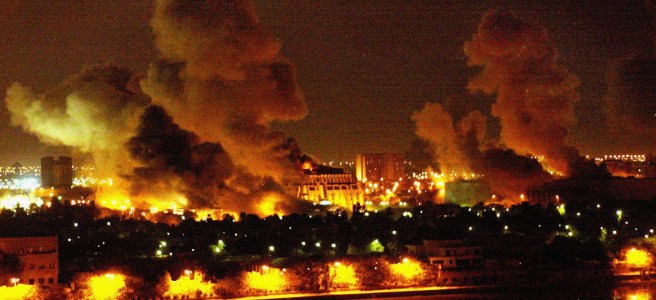
This is why the U.S. administration has switched back from the “war on terror” to the paradigm of “rogue states.” The pre-emptive strike against Iraq signals a double flight forward. On the one hand, the ruin of Iraqi sovereignty with its exhausted army is to be “defeated” as an easy opponent of a classic state-territorial character in order to show the world who is master of the house. On the other hand, the impending economic collapse is to be cushioned by immediate access to the Iraqi (perhaps also the Saudi) oil fields and the dismantling of OPEC. This is less about the material flow of oil, which would be guaranteed even without military intervention, and more about saving the financial markets in the short term. The dwindling recycling from the financial bubbles must be renewed, and this is not possible without a “future option” for a new secular prosperity. After the “Pacific century” option proved to be just as much a flop in this respect with the collapse of the Japanese and South-East Asian models as the new economy of internet and telecoms capitalism, the “oil at pre-OPEC prices” option is now to bring it under direct U.S. control.

However, this could backfire. The Iraqi army is not a serious opponent, but a possible urban battle for Baghdad and other centers with high casualty figures, major destruction and millions of refugees would morally discredit the U.S. around the world. Above all, however, it would certainly not be possible to install a stable regime; Milosevic and Saddam are in any case obsolete models of sovereignty. However, a U.S. military administration of Iraq and the entire oil region in constant confrontation with guerrillas and terror would be neither affordable nor politically and militarily sustainable and, moreover, anything but a signal of euphoria for the financial markets. The “victory” over Iraq will inevitably be a Pyrrhic victory that can only exacerbate the overall crisis of the world system.

5

However, it is not just about the pseudo-rationality of certain “interests,” which are always subordinated to the irrational end in itself of the principle of valorization. The vulgar materialism of interests fails to recognize the real metaphysics of capital as a secularized religion whose irrationality overwhelms the internal rational interests at the boundaries of the system. The valorization imperative, which is indifferent to all sensual content, ultimately demands the dissolution of the physical world into the empty form abstraction of value, i.e. its annihilation. In this respect, we can speak of an almost gnostic death drive of capital, which expresses itself in the logic of destruction in business management as well as in the potential for violence in competition. Because the contradictions can no longer be resolved in a new model of accumulation, this death drive is now manifesting itself directly and globally.

The self-preservation of the system at all costs turns into the self-destruction of its actors. Mass shooters, suicide cults, and suicide bombers are executing the objective madness to an unprecedented extent as a reaction to the crisis devoid of any prospects. Closely linked to this is the anti-Semitic syndrome as the last crisis-ideological resort of the capitalist subject form, which breaks out again and no longer concentrates on a specific national-imperial constitutional history (such as the German-Austrian one in the past), but floods the world in diffuse post-modern and post-national amalgamations, especially of religious provenance.

Because the capitalist internal rationality of the bourgeois subject of enlightenment cannot represent itself in a new model of accumulation, it no longer forms an immanent potency against the systemic death drive, but itself immediately turns into a moment of this irrationality. Enlightenment and counter-enlightenment, reason and delusion, democracy and dictatorship fall into one. Democratic imperialism as a whole is unable to pacify its own world of crises, but instead becomes the “ideal total mass shooter,” right up to the use of nuclear weapons against the zones of insecurity, the intangible specters of crisis and the masses of the “superfluous,” as the U.S. administration has already openly threatened.

6

There is no longer an immanent alternative. But because the left knows nothing other than to occupy immanent alternatives on the ground of capitalist ontology and developmental history, it largely flees into the past and engages in an absurd argument about whether we are writing 1914 or 1941. Both factions are intellectually stuck in the era of a capital based on national economies and national-imperial powers of expansion, both are illiterate in terms of crisis theory and, more generally, with respect to the critique of political economy, and both cling to the capitalist internal rationality of the bourgeois enlightenment subject.

The nostalgics of 1914 and followers of Lenin’s mummy conjure up the phantasm of an “anti-imperialist” alliance of left-wing pacifists in the metropolises with the “sovereignists” and “peoples” of the Third World, who are supposed to defend their bourgeois independence against Western imperialism. The nostalgics of 1941, on the other hand, are delirious with the idea of an “anti-Hitler” coalition led by the “good” Western powers against “Islamic fascism” and its German accomplices to protect Israel and “civilization.”

But Saddam’s regime is neither a world-threatening Nazi empire nor a hopeful force for national development, and bin Laden is neither a Hitler nor a Che Guevara. The Palestinian state is disintegrating even before it can be founded, because statehood is no longer an emancipatory option at all; conversely, the barbarism of intifada and suicide attacks cannot be equated with the factory extermination of Jews at Auschwitz. The false friends of the Third World subsume Israel under imperialism and ignore its essential quality as a result of global anti-Semitism; the false friends of Israel glorify the reactionary-ultra-religious forces responsible for the murder of Rabin and themselves fall into primitive racist agitation. Some negate Israel as a place of refuge, others ignore the fact that its existence is more endangered by its own internal crisis barbarism than by external military threats.

The zombies of 1914 accept the völkisch-anti-Semitic, culturalist-anti-American neglect of “class struggle” and “anti-imperialism.” The zombies of 1941 abandon any critique of the imperial war for world order, unrestrainedly denouncing both the beleaguered Israeli as well as the U.S. left-wing opposition and distorting the necessary criticism of anti-Semitism and anti-Zionism to legitimize democratic bombing terror. What is needed instead is a radical opposition to war that confronts the real world situation and develops a categorical critique of capitalist modernity beyond the false immanence of pseudo-alternatives, which only represent different forms of the same cosmopolitan crisis barbarism.

Originally published on exit-online.org on 03/01/2003.

Crisis Management in Times of Change

The end of neoliberal globalization is giving a boost to neo-fascist crisis management – especially in the former “export world champion”

Tomasz Konicz

It would be wrong, and reminiscent of the bad Marxist tradition, to postulate a one-sided causal inevitability between the development of the economic base and the political-ideological superstructure. Economic development, the unfolding of the internal contradictions of capital, does not unilaterally determine the political system. There are clearly interactions between the two, and the capitalist functional elites have various options open to them when reacting to the consequences of the crisis. Here – and this is crucial – the further course of the crisis can actually be influenced by politics, even if it is, of course, not in a position to overcome the systemic crisis from within capitalism. Many of the emergency measures discussed by politicians in response to crisis episodes can be implemented by governments or regimes of various political orientations. This is particularly evident in the severe crisis phase of the 1930s, when protectionism, labor programs and statism were pursued by states as diverse as Roosevelt’s U.S. and Nazi Germany.

Nevertheless, the latest phase of the crisis, which began at the latest with the pandemic and the surge in inflation, makes a fascist option at least viable, especially in countries with corresponding “traditions.” The fundamental upheaval in the process of crisis and its handling of contradictions was initiated by the pandemic-induced crisis surge. The war in Ukraine is in fact a reaction to this new crisis phase, which is putting an end to neoliberal globalization. This phase is characterized by stagflation, deglobalization, protectionism, active industrial policy, nearshoring and vertical integration.

The four decades of neoliberalism – from the 1980s to around 2020 – were in fact a reaction to the crisis, and they prolonged the unfolding of the internal contradiction of capital. This fundamental contradiction of the capitalist mode of production unfolds as follows: Productive wage labor forms the substance of capital, but at the same time the process of capital valorization strives to displace wage labor from the production process through competitive rationalization measures.

Marx introduced the ingenious term “moving contradiction” for this auto-destructive process. This contradiction of capitalist commodity production, in which capital minimizes its own substance, wage labor, through competition-mediated thrusts of rationalization, can only be maintained by “moving,” by the continuous expansion and further development of new fields of exploitation in commodity production. The same scientific and technological progress that leads to the melting away of the mass of expended wage labor in established branches of industry also gives rise to new branches of industry or production methods.

The result of this is precisely the kinds of change to the overall industrial structure – the ability of capital to constantly “reinvent itself” – that the bourgeois apologists of capitalism are so proud. Since the beginning of industrialization in the 18th century, the capitalist economy has been characterized by a structural change in which the textile industry, heavy industry, the chemical industry, the electrical industry and, most recently, Fordist vehicle manufacturing served as leading sectors that exploited wage labor on a massive scale. With the advent of automation and the IT revolution, the process of changing the structure of industry began to fail in the 1970s and 1980s. These new technologies created far fewer jobs than were rationalized away by their application to the economy as a whole. The productive forces thus burst “the fetters of the relations of production” (Marx) and capital came up against an “inner barrier” (Robert Kurz) to its ability to develop.

How Neoliberalism “Rescued” Capitalism

That capital as a moving contradiction had reached its inner limit was demonstrated very concretely in the crisis period of stagflation that followed the post-war boom, as no new leading industrial sector with mass valorization of wage labor could be developed. The late 1970s and early 1980s were characterized by anemic economic growth, frequent recessions, rapidly rising mass unemployment and an inflation rate that sometimes reached double digits. From a historical perspective, the stagflation of the 1970s – a portmanteau formed from the words stagnation and inflation – was precisely the period of crisis that paved the way for neoliberalism, as Keynesian crisis coping strategies has failed.

In addition to destroying or disempowering the labor movement (Great Britain, U.S.), which led to a long-term stagnation of wage levels in the U.S., neoliberalism reacted to the crisis by removing the “safety nets” from capitalism, with a flight forward in which the markets – especially the financial sector – were deregulated. In order to avoid collapsing due to its internal contradictions, capitalism effectively left the ground of labor exploitation during the neoliberal turn of the 1980s in order to take to the lofty heights of an economic structure dominated by financial markets. The system reacted to the failure of a change to the industrial structure by establishing the financial system as the “lead sector.”

Capital valorization was thus increasingly simulated on the financial markets under neoliberalism. Since no real capital valorization can be carried out within the financial sphere in the long term, growth in the four neoliberal decades was ultimately fueled by a historically unique boom in the most important commodity that the financial sector has to offer: credit. The capitalist world system thus runs on credit, on the anticipation of future utilization, which is pushed further and further into the future through lending. Credit generates the demand that sustains capitalist commodity production, which is choking on its productivity. This can be seen in concrete terms in global debt, which has risen much faster than global economic output in the neoliberal era: from around 120% in the 1970s to 238% in 2022.[1]

The central mechanism that transformed the increasing financial market-generated debt into real economic growth was the speculative bubble. Since the 1980s, the system has thus been increasingly based on the “hot” air of various speculative bubbles that are constantly forming anew: from the dot-com bubble at the turn of the millennium, when the emergence of the Internet led to wild speculation in high-tech stocks that crashed in 2000, to the real estate bubble in Europe and the U.S., to the large liquidity bubble maintained by central banks, which was only brought to an end by inflation in 2020. When a bubble would burst, there would be a threat of a more widespread crash, which would then be prevented by the emergence of a new speculative bonanza. One could speak here of a veritable transfer of bubbles, in which all the fiscal and monetary policy measures used to combat the consequences of a burst speculative dynamic contribute to laying the foundations for the formation of a new bubble. Ultimately, capitalist financial policy can only put out the speculative fire with gasoline.

The End of Neoliberalism

However, this was not a linear process, but a dynamic one. The costs of stabilizing the global financial system increased more and more as each bubble burst until, in the inflationary phase of monetary policy, outside of the U.S. with its world reserve currency, there was no alternative but to stop the expansionary monetary policy that had been at the root of the boom in the financial markets. Capitalist crisis policy has ridden its financial market-driven, neoliberal horse to death after using this horse to flee from the inner barrier of capital for over four decades. The neoliberal postponement seems to be coming to an end, and the stagflation that has been forgotten for decades is returning on a much higher level. The most important difference between today’s wave of inflation and the historical phase of stagflation is that a phase of high interest rates, such as that initiated by Fed Chairman Volcker from 1979, no longer offers a way out in view of the unstable financial sphere.

With the end of the global deficit economy, the global deficit cycles, which in fact formed the base of neoliberal globalization, were also damaged. Not all economies became equally indebted in the neoliberal era; export-oriented locations were able to export their production surpluses to deficit countries as part of these cycles. The largest, namely the Pacific deficit cycle between the U.S. and China, was characterized by the fact that the People’s Republic, which was rising to become the workshop of the world, exported gigantic quantities of goods across the Pacific to the de-industrializing U.S., thus creating enormous trade surpluses, while a financial market flow of U.S. debt securities flowed in the opposite direction, so that for a time China became Washington’s largest foreign creditor. A similar, smaller deficit cycle developed between Germany and the southern periphery of the eurozone in the period from the introduction of the euro to the euro crisis.

Globalization was thus not only characterized by the establishment of global supply chains, it also consisted of a corresponding globalization of debt dynamics in the form of deficit cycles, which, as mentioned, grew faster than global economic output – and consequently acted as an important economic engine by generating credit-financed demand. The globalization that brought about these gigantic global imbalances was a systemic reaction, a flight forward from the increasing internal contradictions of the capitalist mode of production, which is choking on its own productivity.

The Return of Protectionism

The euro crisis is, to some extent, a good case study for what is now unfolding globally: As long as the mountains of debt are growing and the financial market bubbles are on the rise, all of the countries involved seem to benefit from this credit-based growth. However, as soon as the bubbles burst, the battle over who should bear the costs of the crisis begins. In Europe, as we know, Berlin has used the crisis to pass on the costs of the crisis to southern Europe in the form of Schäuble’s infamous austerity dictates. Now, on a global level, the collapse of the much larger debt-financed deficit economy, which has recently been kept alive primarily by the expansive monetary policy of the central banks, is imminent. Rising nationalism and neo-fascism, the acute threat of world war: they are an expression of this very crisis process. An analogy can therefore be drawn with the pre-fascism of the 1930s, when the fallout from the global economic crisis that broke out in 1929 was exacerbated by a rapid rise in protectionism.

Which brings us to Germany’s misery. With the erosion of globalization, the long-term economic strategy of strict export orientation pursued since the introduction of the euro by the Federal Republic, whose economic “business model” was based on achieving the highest possible trade surpluses within the framework of the aforementioned deficit cycles, is also failing. With this so-called beggar-thy-neighbor policy, debt, deindustrialization and unemployment are exported to the target countries of the export surpluses. After Berlin had ruined the European crisis states through draconian austerity policies, this export strategy was directed at non-European countries – such as the U.S.[2]

However, this export-focused strategy is increasingly coming into conflict with the protectionist tendencies in Washington, where the Biden administration is effectively continuing Trump’s economic nationalism aimed at reindustrialization. Washington is no longer prepared – precisely because of increasing domestic political instability – to continue accepting the high trade deficits that stabilized the hyper-productive world system during neoliberal globalization. These deficits were, of course, only made possible by the dollar serving as the world’s reserve currency. As early as mid-2023, the Financial Times described this change in Washington’s economic policy strategy, which was initiated by the Trump administration and further promoted by Biden. At its core, it is a protectionist rejection of globalization. By means of a “foreign policy for the middle class,” the White House wanted to counteract the “hollowing out of the industrial base,” the emergence of “geopolitical rivals” and the increasing “inequality” that threatens democracy.[3]

A visible expression of the full onset of deglobalization is nearshoring, in which the U.S. is seeking to replace its economic dependence on the Chinese export industry by building up industrial capacities in Mexico. In addition, German automotive suppliers continue to face the threat of exclusion from U.S. production chains due to provisions of the U.S. Inflation Reduction Act. A substantial concession from Washington is also unlikely, as protectionism appears to be working. German companies in particular are increasingly investing in the U.S. in order to benefit from Washington’s subsidies. In effect, there is an economic decoupling between the U.S. and the EU, with Washington pulling away economically while the Europeans in particular have to bear the consequences of the crisis.

The Danger of “Authoritarian Revolt”

Berlin thus spent the 21st century orienting the Federal Republic – and from 2010, in the wake of the euro crisis, the eurozone – towards an export-fixated economic model aimed at achieving trade surpluses in the globalized world economy of the neoliberal era. With the onset of deglobalization, the former export surplus world champion has found itself in an economic policy impasse, which in the medium term not only calls into question the political stability of the Federal Republic of Germany, but also the continued political existence of the eurozone. And it is precisely this return of protectionism that is giving the New Right an additional boost. The properly functioning export economy acted as a kind of civilizational safety mechanism in Germany, with its terrible authoritarian-fascist tradition, as it provided a solid economic argument against nationalism. After all, Germany was a “winner” during the process of globalization.

However, it is the German export industry that is currently experiencing a downturn, which is actually just the beginning of the end of the export-focused German economic model. The sharp decline in exports in 2023 has contributed significantly to the poor economic development in Germany, with little improvement expected in the coming years. This also means, however, that the prosperous years made possible by export surpluses will inevitably come to an end for the Federal Republic. The power-political weight of the German export industry will therefore diminish at a time when, for the first time in a long time, Germany will also enter a long-lasting crisis phase, from which the New Right once again threatens to benefit.

Yet it was precisely the functionaries of the large-scale export industry who repeatedly took a stand against the New Right. The AfD and the dull Nazis were seen as an image problem that was damaging the “Made in Germany” brand in its quest for global success. The BDI (Federation of German Industries) and top managers such as Siemens CEO Joe Kaeser were able to cite real economic interests in their arguments against the right. The capital faction that is most resolutely opposed to AfD participation in government is therefore the German large-scale export industry, which is currently losing influence due to the crisis. The reactionary avant-garde within the functional elite, which made pacts with the AfD and the Querfront very early on, consists of small business owners and SMEs, as can be seen from the links between the association of “family entrepreneurs” and the AfD. Capitalists focused on the domestic market (“Müller Milch”) also appear to be more inclined to consider far-right options.

The AfD is already the second strongest force at federal level. The fact that the rise of the AfD took place during a phase of relative economic prosperity shows just how thin the civilizational ice has become in Germany; it was fueled by German fear of crisis, not by an actual outbreak of crisis, such as the one southern Europe had to endure during the euro crisis. Since the refugee crisis, the entire bourgeois-liberal anti-fascism, which was largely in line with the arguments of the export industry, has emphasized the economic “usefulness” of globalization, open borders for the movement of goods and immigration: refugees are economically useful due to the ageing of the Federal Republic, the export country must remain attractive for skilled workers, at least according to the common arguments. However, these narratives cultivated in the liberal mainstream will disappear as soon as stagnation and recession become entrenched in Germany, while exports will continue to decline in order to give further impetus to the “German fear” that so readily turns into hatred of the socially disadvantaged.

The crux of the matter is that this authoritarian revolt will never come to power unless a substantial part of the ruling elite opts for this fascist option. And there are signs of an open split within the German ruling elite regarding the participation in government of a party that is drifting towards the extreme right. This is the decisive breach in the dam: will entire factions follow the previous AfD sympathizers such as Mr Müller von der Müllermilch or the Mövenpick billionaire Baron August von Finck? In the middle class? Among family entrepreneurs?

Fascist movements only come to power in times of crisis when the shocks and upheavals have reached such an extent that functional elites perceive these movements as the “lesser evil.” To put it vividly: only when capital managers are so deeply mired in the crisis that they are up to their necks in water do they hold their noses and reach out to the extreme right. And then there is no stopping them, as the fascist authoritarian revolt, which always craves the approval of the authorities, is further fanned by this (which, incidentally, also defeats the left-wing intention of shaking up their supporters by unmasking the powerful fascist backers. Authoritarian characters are not deterred but attracted by the cronyism of AfD functionaries and billionaires).


[1] https://www.imf.org/en/Blogs/Articles/2023/09/13/global-debt-is-returning-to-its-rising-trend

[2] https://www.census.gov/foreign-trade/balance/c0003.html

[3] https://www.ft.com/content/77faa249-0f88-4700-95d2-ecd7e9e745f9