The Subjectless Rule of Capital

Who is to blame for the increasing contradictions and distortions of late capitalist societies – and what can be done about it?

Tomasz Konicz

Who are the rulers in capitalism? Preliminary observations seem to confirm what is, for the most part, the core principle of leftist ideology or theory: it is the capitalist class, the owners of the means of production, who seem to hold the reins of power – and they are therefore the ones responsible for the current state of the capitalist world system.

This conclusion seems justified at first sight, given the absurd level of inequality between rich and poor, between the mass of wage earners and the “happy few” of the billionaire caste, which has only been exacerbated by the neoliberal economic and financial policies of recent decades.

The data on the ever-widening gap between rich and poor seems downright bizarre: the 26 richest billionaires now own assets with a face value equal to that of the poorer half of the world’s population – that’s about 3.8 billion people. In the US, it is the wealthiest 20 people whose assets are equivalent to that of the impoverished half of the population.

In the Federal Republic, on the other hand, this ratio between billionaires and the destitute is 45 to 41 million. 45 mega-rich capitalists own just as much as the lower half of the population, and the income divide in the Federal Republic is now even more pronounced than in the United States.

The inequality of late capitalist societies, together with the emergence of a largely segregated caste of billionaires, goes hand in hand with an intensified, increasingly open assertion of the interests of the capitalist class. The ability of this class to successfully lobby has been reflected not least in the financial and tax policies of recent decades, which have almost exclusively favored the super-rich and large corporations.

US billionaires like the notorious Koch brothers finance a veritable political machine that puts their reactionary interests into law in Washington. As a result, there is a debate about whether the US has degenerated into an oligarchy dominated by a few billionaires.

In the Federal Republic, on the other hand, BMW billionaires from the notorious Quandt clan make donations to the CDU before the federal government once again undermines CO2 emissions limits, which directly benefits the German car industry. In addition – with the rise of the New Right – there is the direct financing of right-wing extremists and populists by billionaires, as in the case of US President Trump and the German AfD.

The same applies to political inaction in the face of the escalating climate crisis. For decades, both in the US and in Germany, the lobbying groups of the fossil fuel-driven capitalist economy have spent millions of dollars to torpedo any serious measures to combat climate change, and have largely been successful.

Capitalists, Class Struggle and Crisis

In the face of this informal power of the capitalist class, which can effortlessly put its economic interests into legal form through its lobbying machines, the causes of the current crisis seem clear, especially to the left: it is the increasing socio-economic division of society caused precisely by the seemingly behind-the-scenes ruling class of billionaires, the capitalists. The boundless greed or insatiable hunger for power of the capitalist class has led capitalism into crisis.

It seems to be similar with the ecological crisis: the greed of the corporate bosses of the oil and automobile industries, and their influence on politics, seems to be responsible for the fact that climate change, despite all the soapbox speeches, continues raging on, fueled by constantly rising CO2 emissions.

Economic stagnation and the decades-long social decline of large sections of the population in the centers of the capitalist world system, appear as a consequence of the policies of the super-rich class, which is waging a real class war against the working population, as for example the billionaire and speculator Warren Buffet once said: “There’s class warfare, all right, … but it’s my class, the rich class, that’s making war, and we’re winning.”

The beginning of this “class war” is usually traced to the neoliberal turn of the 1980s, which, after the bloody prelude in 1973 in Chile, was first implemented in the US and Great Britain by Ronald Reagan and Margaret (“There is no such thing as society”) Thatcher.

Meanwhile, the bouts of destitution that followed the housing crash in 2008, which devastated the US middle class, for example, have also contributed to the formation of a strong, class-struggle oriented left. In response to the increased animosity towards minorities which the New Right pushed after the crisis surge in 2008, the left in the USA and Great Britain have been calling for a class struggle, in which the class war waged by the super-rich would now be answered consciously by way of the political mobilization of the “bottom,” the wage-earners. This left is also calling for a massive Keynesian investment program, the Green New Deal, to overcome the climate crisis.

A False Approach and A False Premise

Politicians like Bernie Sanders and Alexandria Ocasio-Cortez thus argue for a redistribution from the top to the bottom, for a strict taxation of large fortunes and for a curtailment of the informal political power of the super-rich, in order to lead out of its ecological and economic crisis through large investment programs. In the face of this renaissance of leftist class struggle, which has now also taken hold of the German left, a progressive counterweight to the reactionary wave of the New Right seems to be forming.

And yet this approach to explaining the crisis, which remains stuck in the dichotomy of proletariat and bourgeoisie, is a distorted consciousness that is ultimately not radical enough to adequately grasp the crisis process. The crisis is more than the result of escalating class struggle. The inherent premise of old, leftist, class struggle thinking, according to which there is a group of people who consciously control social reproduction, is false.

The reality of the unfolding capitalist crisis is far more frightening than any specter of an all-powerful rule of super-rich villains operating behind the scenes of the political establishment – however repulsive and reprehensible the individual egomaniacal actors in these exclusive circles may be.

Fetishism: The Autonomous Movement of Capital

Despite all the conspiracies that actually exist, there is no one behind the curtain who is ultimately pulling the strings, who is somehow “controlling” the course of events of the capitalist system. Humanity under capital is the object of an independent, contradictory dynamic, which it unconsciously produces by way of market mediation. This process of capital’s autonomous movement, called fetishism, is constituted “behind the backs of the producers,” as Karl Marx famously remarked.

Generally speaking, capitalism as a fetishistic social formation is thus characterized by the fact that in capitalism, “the process of production has mastery over man, instead of the opposite,” as Karl Marx wrote in his main work Capital. The fetishistic forms of the valorization of capital, which are independent of the subjects, “appear to the political economists’ bourgeois consciousness” as a “self-evident and nature-imposed necessity.”

This fetishism pervades all the aggregate states that capital passes through in its autonomous movement, its cycle of valorization, in which more money is created from money through the production of commodities and the exploitation of wage labor (M-C-M’): commodity, money, labor.

In the labor process, for example, the wage-dependent market participant (“proletarian”) becomes “variable capital,” the only commodity acquired by capital on the labor market, which through its capacity to work can create more value than it is itself worth. Labor is “external” to the worker, he therefore “only feels himself outside his work, and in his work feels outside himself,” as Marx put it in the Economic-Philosophical Manuscripts.

This being at the mercy of an external labor process over whose goal and course the worker has no control, in which his divestment is a moment of the fetishistic valorization movement of capital, leads to the formation of the well-known, omnipresent sense of alienation in capitalism. This “forced” labor under capital no longer serves the direct “satisfaction of a need; it is merely a means to satisfy needs external to it,” Marx continues. Its strangeness emerges “clearly in the fact that as soon as no physical or other compulsion exists, labor is shunned like the plague. External labor, labor in which man alienates himself, is a labor of self-sacrifice, of mortification.”

The market subjects, isolated from one another by the compulsion of competition, who enter into commodity exchange only through the mediation of the market, appear similarly powerless in the face of commodity fetishism. The social character of their own labor is reflected to the commodity producers in the representational character of the products of their labor, Marx explained in the famous fetish chapter of Capital.

The social property of a commodity as a bearer of value (the quantum of socially necessary labor-time expended in its production process), produced within the framework of the valorization process, appears as a natural property of these things. The individual commodity seems to be endowed with the property of being a bearer of value in the same way as it is endowed with its other physical properties. Since the commodity, as a socially constituted “object of value,” appears only in the exchange of commodities on the market, it appears to the isolated producers as if it were a matter of a “social relation between objects, a relation which exists apart from and outside the producers.”

Things thus become “independent” in a market-mediated way from the market subjects, who literally produce them themselves and offer them for sale in commodity form on the market – and this process is animated by the overall social compulsion of capital to valorize. This independence of capital is particularly evident in the financial markets, where fetishism manifests itself in the abstract form of money, and forms the most important driving force for reactionary crisis ideologies, including anti-Semitism.

Especially in times of crisis, when once again a “market quake” or financial crash threaten the stability of the entire economic system – as most recently in 2008 – it becomes clear that even the capitalist class is by no means “in control” of this fetishistic and destructive dynamic of capital, that the crisis-like course of events under capitalism is by no means controlled by a conspiracy.

The fetishistic reality of capitalism is thus actually scarier than the worst conspiracy ideology. The entire real world, human beings as well as nature, are only transitory stages of a blindly unfolding process of the accumulation of abstract wealth, which is ultimately abstract quanta of spent, “dead” human labor. The whole late capitalist horror consists precisely in the fact that there is no one at the wheel of the valorization train that is constantly hurtling towards the abyss.

Society, however, is a necessary appendage of the real-abstract valorization process of capital running amok, since capital can only be valorized through wage labor and the burning of resources in the production of commodities. In the end, only that which is necessary and financially viable within the framework of this blind cycle of capital multiplication has social existence: that is, only that which contributes directly or indirectly to the expansion of capital.

This applies not only to the category of “jobs” in the economy, but also to the state apparatus in its function as an “ideal total capitalist,” (Marx) and even to cultural production, which has to contribute to location optimization within the framework of neoliberal marketing strategies – social existence under capital is always subject to its ability to be “financed.” On the overall social, global level, capital thus acts as an “automatic subject” of boundless, tautological self-aggrandizement.

The concrete world is thus only the “material” of this independent, real-abstract autonomous movement of capital, which in its boundless growth mania deprives humanity of its social and ecological basis of existence. The global surplus value machine of capital thus burns the world to the ground in order to maintain the irrational end in itself of unlimited capital growth for as long as possible. A growing, economically “superfluous” humanity in the periphery and an escalating ecological crisis are the consequences of this autonomous movement of capital.

In a reversal of the old romanticism of progress, the image of a constantly accelerating train hurtling towards the abyss thus suggests itself, a machine out of control, driven by the autonomous movement of capital, which is produced unconsciously by the market participants, mediated by competition and the market. The transformative act that is necessary for survival is to find and apply the emergency brake, as Walter Benjamin already remarked.

Social structures unconsciously produced by human beings that objectify themselves vis-à-vis individuals; social dynamics that become independent vis-à-vis the subjects that produce them – this absurd form of social reproduction that characterizes the “prehistory of humanity” is illuminated by the concept of fetishism.

Thus the people of “enlightened” bourgeois society are nothing more than sinister fetish servants. Domination in capitalism is thus ultimately subjectless, as the crisis theorist Robert Kurz explained in his text Domination Without a Subject; the capital relation rules as a fetishistic abstraction of reality.

The inner essence of the capital relation, according to Kurz, is not captured by the disdainful greed of all the capitalist philanderers who were able to increase their (largely fictitious) wealth to obscene levels during the neoliberal decades:

Their “individual objectives” are not what they seem: in accordance with their form, they are not individual or voluntary objectives, and for this reason their content is also distorted and flows towards self-destruction. The essential point is not that individuals mutually use one another for their individual objectives, but rather, to the extent that they seem to do so, that they themselves execute a totally different, supraindividual and subjectless objective: the autonomous movement (valorization) of capital.

The subjective, “managerial,” exploitative interests of the capitalists thus form the outward appearance that conceals the fetishistic essence of the irrational, subjectless domination of the capital relation at the “macroeconomic” level. In general, capital can only be understood as a social totality; attempts to project the relations of the reproduction of individual capitals (enterprises, corporations) onto the system as a whole ultimately end up as ideology.

The Question of Guilt and Responsibility in Capitalism

As soon as people act as subjects in the valorization circuit of capital, they become character masks (Marx) of their respective position in the accumulation process – whether as assembly line workers, managers, salespeople or service providers is irrelevant in this respect. They are no longer “within themselves,” but act as the personification of their respective economic function (this is the basis of the feelings of alienation mentioned above).

Marx, for example, describes the capitalist in his function as a character mask “as capital personified and endowed with consciousness and a will,” who functions as the “point of departure and point of return” of the self-purpose of the endless circulation of capital. The “objective content of that circulation – the valorization of value – is his subjective purpose,” according to Marx in Capital.

What emerges here is the absurd position of the market subject within the automatism of capital valorization. On the one hand, capital as an automatic subject turns people into objects of its valorization movement, into things, into commodities that are traded on the labor market – and who have to adapt to this mediated form of subjectless domination as if it were a man-made law of nature, with a subliminal feeling of powerlessness.

At the same time, the only chance to still live out a stale imitation of subjectivity is to cooperate, as the aforementioned economic character mask, in the “subjective” perfection of this automatism of boundless capital valorization – and thus, in turn, to degrade “the others” to objects and “make them equal to things.” Within the all-too-real fetishism that the automatic subject perpetuates, the inmates of the capitalist treadmill are always two things at once: the subject of accumulation as well as its powerless object.

All character masks, as personifications of their respective economic function, therefore function as subject-objects of the autonomous movement of valorization that they themselves perpetuate, whereby the concrete relationship between these two poles depends on their specific hierarchical position in the reproduction process of capital. And it is precisely this hierarchical position of the subjects within the automatism of capital valorization that must also be taken into account in the question of the category of guilt, of personal responsibility. For of course the fetishism of capital does not absolve the actors who carry it out.

While some are obsessed with finding scapegoats, at the other end of the spectrum is a powerless systems theory that exculpates the current actors in business and politics. In this view, it seems as if those responsible can no longer be identified due to systemic constraints and objective structural laws. The concrete perpetrators disappear behind the destructive action of the automatic subject of capital’s collapsing dynamic of valorization.

The fact that the fetishism of capitalist society, in which the market-mediated actions of market subjects confront them as an alien, quasi-objective force, by no means leads to an exculpation of the actions of the perpetrators, was already pointed out by the crisis theorist Robert Kurz at the beginning of the 21st century:

Now, when the common form-context of abstract labor, commodity-form, state-citizenship, etc., moves into the field of vision of critique, where is accountability? Can one make a blind structural connection, can one make the automatic subject responsible for anything, even if it is the greatest crime? And vice versa: if capitalist barbarism is ultimately inherent in the mute compulsions of competition, etc., are not the barbaric acts of the ugly managers, the dirty politicians, the bureaucratic crisis administrators, the bloody butchers of the state of emergency somehow excused, because they are always conditioned and are actually caused by the subjectless structural laws of “second nature”?

Such an argument forgets that the concept of the automatic subject is a paradoxical metaphor for a paradoxical social relation. The automatic subject is not a distinct entity squatting out there somewhere by itself, but it is the social spell under which people subject their own actions to the automatism of capitalized money.

But those who act are always the individuals themselves. Competition, an artificially generated struggle for survival, crises, etc. all increase the potential for barbarism, but practically this barbarism must be carried out by the actions of people, and must pass through their consciousness. And that is why individuals are also subjectively responsible for their actions, the ugly manager and the dirty politician just as much as, on the other hand, the racist unemployed person and the anti-Semitic single mother.

The potential dangers of this society, and the immense anxiety that accompanies them, must be dealt with on a daily basis, and every moment individuals make choices in this process that are never completely without alternatives – neither on a small, daily scale nor on a large, socio-historical scale. No one is simply a puppet, without any agency, but everyone has to deal with the hair-raising contradictions, fears and sufferings of this spell.

Therefore, it is not absurd to direct the necessary critique of society to the level of socially overarching structures, to abstract labor and the automatic subject, but nevertheless to hold the acting individuals responsible for their actions, even if their social character mask leads them to a state of insanity.

Robert Kurz, Marx Lesen

A Donald Trump or Jeff Bezos, as subjects who carry out the contradictory automatism of capital accumulation on a political and economic level, are fully responsible for their actions. This is also true of a Wolfgang Schäuble, who is fully responsible for everything he has done to Greece and Southern Europe during the euro crisis; but it is also true of the little nasty forum troll, who is responsible for all the agitation he spreads on the net – even if these actions only execute the systemic crisis dynamics on a political or ideological level.

Of course, the historical guilt that an egomaniac like Trump or an austerity sadist like Schäuble has brought upon himself weighs far more heavily than the pitiful word-vomit of a single fringe extremist of the New Right in newspaper forums or social networks.

The great question of guilt in relation to the subjectless domination of capital can now also be specified in relation to the dynamics of the crisis and crisis ideology: the crisis as a historical process is a consequence of the increasing internal contradictions of capital, which confront the subjects as ever more severe “factual constraints.”

Specifically, it is the tendency of capital to get rid of its own substance, value-creating wage labor, by automating the production process. This applies not only to the economic crisis, but also to the ecological crisis of capital, which, in its fetishistic compulsion to grow, must burn up the natural foundations of human life at an ever-increasing rate by increasing production.

Therefore, we can simply conclude that absolutely no one is to blame for the crisis of capital. The crisis was certainly not “orchestrated” by any conspirators. The crisis erupted precisely because market subjects are doing more and more efficiently exactly what the system demands of them: exploiting wage labor for the purpose of unlimited capital accumulation. The more effectively wage labor is exploited, the greater the pressure, the tighter the market-mediated noose around the necks of all market subjects.

The first false question, leading to ideological blindness, which imposes itself on the reified consciousness as a matter of course at the outbreak of the crisis, is the question of guilt. But the shoe is on the other foot: personal guilt must be sought in the “everyday life” of capital valorization, in the “normal execution” of the capitalist treadmill, in the concrete economic exploitation, in political oppression and in the production of ideology that keeps the automatism of the system running.

Thus, while no one is “to blame” for the outbreak of the systemic crisis, the dynamics of which unfold quasi “behind the backs of the producers” (Marx), it is precisely the everyday functioning of the system – the market-mediated oppression, exploitation and ideology production – in which all the individuals who consciously execute the systemic constraints as “character masks” of their capitalist functions, are guilty. Even more: in interaction with the dynamics of the crisis, it is precisely the exploitation, the oppression, the production of lies by the system that is taken to the point of absurdity.

If, as in the neoliberal decades, the exploitation of wage dependent workers continues to increase, this points to a systemic process of crisis that is perpetuated on the backs of those same workers. And this is all the more true when a “normal employment relationship” becomes the exception and, globally speaking, more and more people can actually no longer be exploited by capital because they are superfluous and therefore nothing more than “useless eaters.”

Class Struggle as A Struggle for Distribution

The increase in exploitation, impoverishment and precariousness described above, even in the centers of the capitalist world system, must therefore be understood as a systemic reaction to a deep historical process of crisis. This occurred in the 1980s in response to the end of the post-war boom in the 1970s and the crisis period of stagflation. Consequently, neoliberalism prevailed only because Keynesianism was at its wits’ end. In this sense, neoliberalism was not a kind of “coup” against a supposedly ideal world of the welfare state, as many on the left like to imply.

It is precisely the seemingly absurd split between rich and poor, between the masses of precarious and impoverished wage-dependents, and the fictitious millions in largely fictitious capital that a few billionaires seem to possess that points to the systemic crisis, which also brings with it a lack of profitable investment opportunities in the real commodity economy, and a corresponding shift to speculative activities in the financial sphere (“financialization of capitalism”).

It is precisely these consequences of the crisis that confront all actors as increasing, objectified contradictions or “constraints.” The subjects react to this in a system-immanent way with an intensification of competition: politicians and states that enforce social cuts within the framework of the competition for locations, corporations that find ever more brutal forms of exploitation, in the mass media whose opportunism in the production of ideology seems to know no bounds, and wage-earners who increasingly resort to mobbing.

The market-mediated mute compulsion of the ever “tougher” conditions compels the character masks of their respective social functions to execute this compulsion under penalty of their own downfall. The capitalist who is not able to increase the exploitation of his human material in the context of increasing competition on “tighter” markets will perish. The same applies to the capitalist economies as national “locations,” which are also in a race to the bottom due to the crisis.

The Hartz reforms, with their intended strategy of increasing precariousness and fixating on exports, have thus been “successful” in that they have so far been able to pass on the consequences of the crisis to other countries through the export of debt. The same applies to public opinion: the tendency towards opportunism in politics and the media is increasing, and oppositional thinking is being marginalized, especially on the “left.”

Against the background of what has been written above, a clear assessment of the class struggle now also seems possible. Class struggle is thus a struggle for distribution within the process of capital reduction, the intensity of which is determined by the concrete, historical unfolding of its contradictions. In periods of strong economic expansion, as during the post-war boom until the 1970s, forms of “social partnership” can emerge between the functional elites of capital and the trade unions representing the wage-earners (of “variable capital,” as Marx puts it).

As long as markets are expanding strongly, high profits can be agreed upon with wages that turn wage-dependent workers into consumers. This changes relatively quickly in times of crisis, when the main concern of every capitalist is to perpetuate the irrational end in itself of capital accumulation, if necessary at the expense of his own wage-earners.

The class struggle as a struggle for distribution thus has no inherent objective transformative potential. It is a struggle for shares in the real production of value, which is melting away as a result of the crisis, and it does not question this irrational form of social reproduction as such. The class struggle (and this is also historically true of such struggles) thus moves within the forms of capitalist socialization (value, labor, capital, state) and seeks emancipation and recognition within these categories, rather than their abolition.

The intensifying class struggle is therefore a struggle for distribution. The militancy with which this “class war,” (Warren Buffet) which is escalating because of the crisis, is propagated, conceals its lack of radicalism, since the causes of the crisis and the above-mentioned fetishistic form of social reproduction in capitalism are not reflected upon by this movement.

The present social conditions also seem to resemble the impoverishment of earlier times because the historical “ascendant phase” of the working class in the 18th and 19th centuries has social parallels with the present descendant phase of capital and the working class. The current widespread misery within the eroding class of wage-earners in the centers of the world system thus mirrors the misery of its historical formation.

To put it vividly: The foundation on which the class actors operate, the expenditure of wage labor in commodity production, is disintegrating. The one-sided rhetoric of class struggle obscures the fact that the classes themselves are in the process of dissolution as a result of the crisis. The proletariat is disintegrating into precisely that economically “superfluous” layer of people who are desperately fleeing to the core regions of the capitalist world system.

What Do We Do?

To be radical is to grasp a problem at its root in order to find a solution adequate to it. This is precisely what Marxist class struggle thinking does not do. It is not the distribution of commodity wealth that is at the heart of the crisis, but the contradictory form in which wealth is produced for the sake of the irrational self-purpose of unbridled capital accumulation – the commodity form itself. The blatant, ever worsening social division of late capitalist societies is, as explained, precisely the consequence of the escalating internal and external contradictions of capital’s compulsion to grow.

Consequently, the crisis cannot be resolved by social-democratic redistribution. The radical goal should not be to gain “control” (possibly still under the leadership of a dictatorial state and cadre party) over the machinery of capitalist accumulation, but rather to fundamentally transform it in order to finally liberate the production of consumer goods from its commodity form, from the fetishistic end in itself of the valorization of value.

Even the “democratization” of capitalist enterprises, as is currently being discussed in left-liberal circles in the US as direct worker control, would continue to expose these cooperatives to the constraints of the crisis-induced tightening of the markets, and thus change little. The crisis of capital, which is reaching its internal and external limits, can thus only be overcome by overcoming the fetishistic dynamics of the accumulation process – for it is precisely these dynamics of exploitation, unconsciously generated by the market subjects, that are devastating impotent human societies and the global ecosystem.

Ultimately, it is about simplifying social reproduction by organizing it directly, through an all-encompassing process of society-wide communication, rather than – as is currently the case – degrading society to a mere transitory stage of a blind world-burning process run amok. Post-capitalism thus means, at its core, the conscious shaping of the process of social reproduction by the members of society, as opposed to the current state in which people are subjected to a quasi-objective, fetishistic dynamic.

Karl Marx’s seemingly cryptic remark that the overcoming of capitalism would conclude “the prehistory of human society” thus gains clarity. All human history to date has taken place unconsciously, within the framework of fetishistic social systems: from the religious fetishism of early times and the Middle Ages to the secularized religion of capital.

And here is the thing: the crisis is also an irreversible, fetishistic process. It will run its course, and there is no way to stabilize the system in the long run, because the eternal creation of debt will eventually reach its limits, even in the centers. This is not a vision of the future; it is already a reality, especially in the periphery.

The system, choking on its contradictions, is already producing an economically superfluous humanity and collapsing regions known as “failed states,” as the refugee crisis has made clear. The same is true of the climate crisis caused by capitalist growth mania and its monstrous consequences.

Whether the collapsing system will be overcome is therefore not a question of the subjective “will” of the members of society. It is a question of the very survival of human civilization, and ultimately of human existence, how the coming transformation process will proceed: as a chaotic disintegration, in the form of the establishment of a brutal, murderous crisis dictatorship, or in a progressive direction that would open up new emancipatory perspectives for humanity, despite all the climate-related distortions to come.

What is more, this transformation process is already underway – and the increasing political, ideological, and military conflicts are precisely the expression of this upheaval that is unconsciously taking place in humanity, as the sociologist and world-systems theorist Immanuel Wallerstein pointed out at the beginning of the 21st century:

We are living in a transition from our existing world-system, the capitalist world-economy, to another world-system or systems. We do not know whether this will be for the better or for the worse. We shall not know until we get there, which may not be for another fifty years now. We do know that the period of transition will be a very difficult one for all who live in it. […] It will be a period of conflicts and aggravated disorders […]. Not paradoxically, it will also be a period in which the “free will” factor will be at its maximum, meaning that the individual and collective action can have a greater impact on the future structuring of the world than such action can have in more “normal” times, that is, during the ongoing life of an historical system.

Immanuel Wallerstein, Utopistics

Civilization or barbarism – these are the extreme poles in this historical “phase of transition,” whereby it is the New Right, with its extremism of the center, which insists on adhering to the forms of society in decay (nation, “creative” capital, state), that is paving the way towards barbarism.

It is precisely the extreme networks and associations of the New Right that are sometimes consciously preparing for the crisis – which they imagine as the result of a conspiracy against Germany – with death lists and coup plans. A dictatorship planned for the next wave of crisis is supposed to serve to finally “cleanse” the left through mass murder. Thus, neo-fascism is a kind of fire accelerator for barbarism in the crisis.

There is a maxim of political practice that left movements, groups or even parties would have to follow in the 21st century if they still want to function as progressive social forces according to their concept in the current epoch of upheaval and crisis. Capitalism must be consigned to history as quickly as possible, the capital relation as a social totality must be consciously abolished – all practical actions, all tactics, all reform proposals, all broader strategies would have to be oriented towards this categorical imperative.

This is not an expression of leftist “radicalism,” but the formulation of a reasonable bare minimum, that, if not realized, would lead to the end of 21st century civilization in barbarism. Precisely because capital is collapsing, it must be overcome. Progress can only be realized beyond capital, in the transformative struggle to shape a post-capitalist society.

A progressive movement, based on an understanding of the necessity of systemic transformation, would thus fight to create conditions that could steer this transformative dynamic in an emancipatory direction. The maxim of such a post-politics would be, on the one hand, the effort to maintain and further develop the process of civilization, and, on the other hand, the struggle to overcome the inherent destructive dynamics of capitalism.

The goal of a progressive transformation movement would thus be to consciously shape the process of civilization, which is fetishistically carried out by powerless people, within the framework of a process of communication throughout society. The forms in which a self-conscious transformation movement organizes itself in the context of the crisis-related increase in social conflicts would thus possibly become the germinal forms of a post-capitalist society.

Bourgeois politics, the actions of political subjects, are thus “important” again, they have weight. Not because they can solve the crisis, but because they determine the course of the crisis. An example may illustrate this: whether a Schäuble puts Europe on a neoliberal starvation diet (austerity) after the outbreak of the euro crisis, or whether the crisis process unfolds within the framework of a pan-European economic and social policy, is of great importance for the further unfolding of the crisis, as the rise of nationalist and right-wing extremist movements in austerity-ridden “German” Europe shows.

The increasing social struggles against the dismantling of the welfare state, against the dismantling of democracy and police-state tendencies, and for a genuine climate policy should thus be understood as fields in which the social subjects literally fight for the course of the transformation process that is objectively taking place.

And here the class struggle – insofar as it is aware of its role as a means in a struggle for transformation – also has an important role to play. The class struggle is part of the struggle over the concrete course that the transformation process will take.

Which Society Will Undergo Transformation?

For this to happen, the class struggle must look beyond itself and no longer primarily strive for recognition or social satisfaction in a declining capitalism, as the workers’ movement historically did. The historical expansion of capitalism and the wage-labor regime was the precondition for this, which is no longer the case today because of the crisis.

To put it more concretely, understanding the crisis as a maxim of emancipatory praxis means asking in what form late capitalist society will enter the inevitable process of transformation. Will it be an authoritarian, racist, police-state administered oligarchy with absurd social abysses, or a more egalitarian, bourgeois-democratic polity in which there continues to be space for radical critique and praxis?

Superficially, then, an emancipatory left that wants to be progressive in late capitalism resembles an existentialist figure, comparable to Albert Camus’ Sisyphus, who consciously engages in a seemingly absurd practice. The struggle for social improvements against the dismantling of democracy, for the equality of minorities, for the Green New Deal is waged in full awareness of the internal capitalist futility of this struggle – in the face of the escalating economic and ecological systemic crisis.

But this is where the analogy ends. The consciousness and rhetoric with which this “battle for the tea water” is fought is crucial. It is necessary to tell people clearly what is going on, that the old capitalist world is dying, that the new one has not yet been born – and that this is a struggle against social cuts, for redistribution, against racism, climate destruction and warmongering, a struggle for optimal starting conditions for the inevitable system transformation.

Through this openness, which only makes explicit what has long since been unconsciously embedded in society as a dull crisis agenda, coupled with the search for post-capitalist forms of organization within this movement, it would also be possible to overcome the false immediacy that has often led progressive movements to get bogged down in the false whole of late capitalism.

False immediacy is understood here as the tendency of social movements to unconsciously persist in forms of thinking that correspond to the social conditions and contradictions against which they are directed.

A prime example of this is trade union struggles against job cuts, which have to be fought by the actors concerned for the sake of their social survival – but which, without a corresponding awareness of the crisis, reproduce the existing forms of thought – in this case thinking in terms of “jobs” as the only option for individual reproduction – even in times of crisis among the actors.

It is similar with the protests against inflation, a phenomenon which is often reduced to the greed of the capitalists – and which without radical crisis consciousness must end in impotence. It would be crucial to raise the question of the system offensively in the coming crisis confrontations, precisely because capital is perishing from its own contradictions. The concrete protest must be carried out with open eyes as part of a struggle for the transformation of the system.

Such necessary social struggles would thus have to be coupled with a radical emancipatory critique of the capitalist forms of existence and thought that are in the process of disintegration, as Robert Kurz has already pointed out:

The task, then, is to formulate the emancipatory critique of the objectified, socially overarching forms of existence or thought and to assert it from within the social struggle in order to consciously break through this categorical prison. […] What matters is to develop a will against the dominant form of the will and to make conscious its fetishistic character.

The text is an updated version of an article that was published in the magazine Telepolis in 2019, before it was hijacked by a Querfront racket of the Left Party and converted into a Querfront organ. The text can be taken unabridged by anyone interested, with credit to the author.

I finance my journalistic work mostly through donations. If you like my texts, then you are welcome to contribute via Patreon.

Originally republished on konicz.info on 10/02/2022
Turning Point in Ukraine?

A military disaster looms for Russia’s army in northeastern Ukraine

Tomasz Konicz

There is movement in the war in the east – and it is the Ukrainian army that has apparently been able to seize the momentum. While the Western public, to the extent that it still follows the war in Ukraine, which has coagulated into normality, at all, was mainly aware of the offensive around the southern Ukrainian city of Kherson, large territorial gains seem to have been recorded in the northeast by combined Ukrainian units in a rapid attack.

Ukrainian units were able to break through the Russian lines southeast of Kharkov on a broad front and gain dozens of kilometers of ground within a few days, between the 4th and 9th of September. Even pro-Russian propaganda sources openly admit this.[1] Meanwhile, Ukrainian troops are reported to be on the outskirts of Kupyansk,[2] the main Russian-held city in Kharkov Oblast. Moreover, the most important supply route of the Russian army units in the western Donbass around Izium runs through Kupyansk. Consequently, cutting this supply route would be devastating for the Kremlin’s operations in eastern Ukraine. The attacks by Ukrainian troops in the south thus appear to have contributed primarily to weakening the Russian front in the north – and it is precisely these weak points that Kiev’s army leadership – probably evaluating Western information – was able to correctly identify and exploit.

The Russian defense, thinned out by troop deployments to Kherson, sometimes consisting of conscripted reservists from Lugansk and units of barracked police, is said to have literally collapsed. The Ukrainian army, ironically, has successfully employed the same tactics that the Russian army leadership failed to implement at the outset of the war. No mobile units of combined forces have advanced far into enemy territory after breaking through on the front lines without capturing towns and settlements where significant Russian occupation forces are entrenched. The difference so far, at least, is that the demoralized and encircled Russian troops are not leading attacks on Ukrainian supply routes and supply lines, as Ukrainian soldiers did during the Russian advance at the outbreak of war.

Currently, thousands of Russian soldiers are said to be in these cauldrons west of the Oskol River. It’s a disaster for the Russian army that even Western military experts could scarcely have imagined before the war broke out.[3] In the coming days it will be decided whether the Ukrainian forces can maintain these gains in terrain, or whether Kiev overestimated its forces, overstretched its supply routes – and Ukraine faces similar setbacks in Russian counter-offensives as the Russian invasion forces did at the start of the war.

In response to this disaster, in which terrain that had to be painstakingly conquered over months was lost within a few days, the Russian army is supposed to pull together strong formations in the region in order to quickly reverse any of Ukraine’s territorial gains that are not secured by defensive installations, and to dislodge the encircled Russian troops. But this weakens other sections of the front, as Russia attacked Ukraine with a vastly outnumbered army, and the initial military-technical and equipment superiority of Russian forces is increasingly fading due to Western arms deliveries and war-related attrition.

Further attacks by Ukrainian forces thus seem likely. But this would ultimately mean that the strategic momentum in this war would pass to Ukraine after weeks of de facto stalemate. Russia’s invading army would thus be put on the defensive, while Ukrainian formations exploit weak points to break through thinned Russian fronts and make repeated gains in territory. The coming days will show whether this latest offensive by Kiev southwest of Kharkov indeed marked a strategic turning point in the war. The decisive factor will be the extent to which Kiev’s troops will be able to maintain these gains in the face of Russian counterattacks.

On September 10, the first photos of Ukrainian soldiers from the strategically important city of Kupyansk appeared on the web – as mentioned, the most important Russian supply line to the western Donbass runs through here. Apparently, parts of the city were abandoned by Russia without a fight. It takes Russia months to capture Ukrainian cities. Ukraine appears to be taking them in a hand sweep. Russian troops south of Kupyansk, especially near Izium, are now in a very difficult position. Indeed, it seems that Russia is losing all conquered territory west of the Oskil River. Izium is almost surrounded by Ukrainian army, thousands of Russian troops are threatened with capture or death.

But the unexpected aspect of the Ukrainian offensive is its total surprise effect. Russian intelligence and intelligence services (satellites, aerial reconnaissance, informants) seem to have been blind. It’s 2022, every major Russian troop movement is known to the West, and sometimes troop redeployments – as most recently towards Kherson – are discussed on the internet. Russia is apparently hardly able to do this, the Russian army actually seems to have been “in the picture” and not to have noticed the significant deployment, the preparations for the Ukrainian offensive – this in the era of satellite-based reconnaissance.

The desolate state of the Russian army, which suffers not only from corruption and mismanagement but also from an archaic command structure, enormous casualties and rapid wear and tear on material (Putin has made gestures to North Korea to procure ammunition), seems to have put the Kremlin in a similar position to that at the start of the war: When the Russian lightning advance on Kiev and Kharkov failed, Moscow had to choose between withdrawal and escalation. Putin opted for an escalation of the cycle.

The Kremlin will soon face a similar decision if the current Ukrainian offensive is successful: Either the admission of defeat, which will certainly cost Putin his head in the medium term, or further escalation. And Russia certainly has the means to continue following the logic of military escalation – which at the same time increases the danger of a major war.

I finance my journalistic work mostly through donations. If you like my texts, then you are welcome to contribute via Patreon.


[1] https://www.moonofalabama.org/2022/09/the-izium-counteroffensive-success-disaster.html#more

[2] https://twitter.com/IAPonomarenko/status/1568185503962259459

[3] https://www.youtube.com/watch?v=U2QOiMeaYYk

Originally posted on konicz.info on 09/09/2022

Armenian Blood for Azerbaijani Natural Gas

Poor, surrounded by enemies, without allies: Armenia finds itself in a desperate geopolitical situation, as Azerbaijan’s renewed attack shows

Tomasz Konicz

The timing of the large-scale attack launched in the evening hours of September 12 was perfect. At the same time that Russia’s army was suffering its biggest defeat since the implosion of the Soviet Union in eastern Ukraine, Azerbaijan was launching massive attacks on the territory of Armenia. Localities, infrastructure and military facilities in the southern Armenian border region were attacked with heavy artillery and drones. Within a few hours, Yerevan had to report dozens of dead civilians and army personnel.

The intensity of the attacks reportedly eased somewhat on September 14, following appeals from the West and Russia, but artillery attacks on Armenian towns and villages continued to be reported. At the same time, according to unofficial Azerbaijani sources, Baku’s army has managed to capture a number of strategic positions in the Armenian border area, allowing Azerbaijani artillery to exercise fire control over large parts of southeastern Armenia.

The attacks by Azerbaijan, which has the full support of its close ally Turkey, come barely two years after the invasion of the Armenian region of Nagorno-Karabakh, which seceded from Azerbaijan in the 1990s during a bloody war that followed the collapse of the Soviet Union. In the fall of 2020, Baku, which considers Nagorno-Karabakh to be part of Azerbaijan, was able to conquer a large part of this Armenian settlement and expel its population through a successful invasion coordinated with Turkey.

Since that defeat – which rekindled the trauma of the 1915 Turkish genocide of Armenians – Yerevan’s army has been effectively unable to hold its own militarily against the overwhelming Turkish-Azerbaijani alliance. Armenia is poor; it has no mineral resources or energy sources. Azerbaijan, for its part, can not only maintain a military budget larger than Armenia’s entire national budget because of rich natural gas and oil reserves, but can also use the “gas weapon” as diplomatic leverage to isolate Armenia.

This was evident not only in the Azerbaijani-Turkish attack in 2020, when neither the West nor Russia could be persuaded to provide Armenia with substantial support, but also in the present, where a similar geopolitical constellation is emerging. Armenia is a member of the Russian-led post-Soviet military alliance CSTO, which the Kremlin wanted to build into a Eurasian counterpart to NATO. Shortly after Azerbaijan’s initial attacks, which were primarily directed against internationally recognized Armenian territory, Yerevan addressed the alliance, which includes six former Soviet republics, in a video conference requesting assistance. But Moscow, whose archaic military machine is currently reaching its breaking point in eastern Ukraine, responded evasively. Putin only agreed to send a team of CSTO observers.

Abandoned by Putin and the EU

It is not only the military catastrophe of recent days in eastern Ukraine that is forcing Moscow, which has had to reduce its troop presence in Armenia and Nagorno-Karabakh, to exercise military restraint. Azerbaijan, swimming in foreign currency, is one of the Russian arms industry’s most important customers, and Azerbaijani dictator Aliyev maintains great relations with Putin. On the very eve of Russia’s invasion of Ukraine, on February 22, both autocratic leaders signed a comprehensive cooperation agreement.

Armenia, on the other hand, experienced a bourgeois “velvet revolution” in 2018, when the corrupt clique loyal to Putin was ousted and liberal, more Western-oriented forces around President Pashinyan came to power, daring a cautious democratization and rapprochement with the West – which Moscow punished with its cold inaction during the 2020 war.

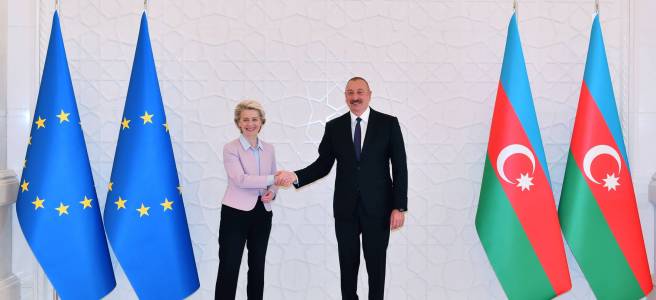
However, Pashinyan’s biggest mistake was probably to have taken the West’s democratic rhetoric seriously, since the EU now wants to develop Azerbaijan into a central gas supplier –especially against the backdrop of the war over Ukraine. In July, the president of the EU Commission, Ursula von der Leyen, was able to agree with the Azerbaijani autocrat Aliyev on the “expansion” of the southern gas corridor leading via Georgia and Turkey, which, at some point in the future, is supposed to transport twice the amount of gas to the EU. On the day of the attack on Armenia, Azerbaijan’s energy minister affirmed that his highly armed country intends to increase gas supplies to the EU by 30 percent this year alone. Azerbaijan is thus engaged in a similar small-scale geopolitical “seesaw policy” between Moscow and the West as Turkey is, in order to gain maximum concessions from both power blocs.

Moreover, for years Baku has simply bribed the Berlin and Brussels political establishment with millions of euros in order to make his point of view prevail. In initial statements EU representatives called on both sides to de-escalate the conflict, thus obscuring Baku’s clear attack.

Brussels and Berlin seem willing to pay for Azerbaijani natural gas with Armenian blood and territory, so that the valorization process in the EU – the material foundation of all airy European values – does not lose its energetic basis. For the current wave of attacks indicates that Baku and Ankara want to use the favorable opportunity to come close to two strategic goals: coercing Armenia to renounce the Armenian settlement areas in Nagorno-Karabakh and conquering a land connection between Turkey and Azerbaijan that would pass through southern Armenian territory.

Originally posted in analyse & kritik on 09/04/2022

The Walking Debt

Over-indebtedness, inflation, the threat of recession and impotent politicians: the current wave of crises is likely to take full hold even in the western centers of the capitalist world system

Tomasz Konicz

New decade, new crisis? In mid-June, the European currency area, which had already been on the verge of collapse in the course of the euro crisis, once again seemed to switch into panic mode. The European Central Bank (ECB) felt compelled to hold a special meeting on June 15 after European financial markets were hit by rising interest rate differentials, or spreads, between German and southern European government bonds. In particular, the spread between German and Italian government securities is considered a reliable crisis indicator because Italy, the third-largest European economy, has a high level of government debt, at 150 percent of gross domestic product (in 2019, before the outbreak of the pandemic, the country’s debt was 135 percent), which makes the interest burden on Italian government bonds grow particularly quickly in the event of any turmoil. Moreover, Italy has below-average growth rates, so there is little prospect of reducing the debt burden in the foreseeable future. The OECD’s economic forecasts, which are regularly revised downwards anyway, assume growth of 2.5 percent for the country this year and only 1.2 percent next year.

The Italian bond market acts as a kind of early warning bell, which struck hard in mid-June: The yield on Italian government bonds rose to more than four percent, and the spread with the Bund was almost 250 basis points (2.5 percent) at one point. What had happened? The ECB had previously held out the prospect of following the Fed’s lead and countering the eurozone’s runaway inflation of 8.1 percent with a monetary turnaround towards a restrictive monetary policy. The European “currency guardians” thus announced that they would abandon the zero interest rate policy that had effectively been pursued for eleven years, i.e. since the last euro crisis, and raise key interest rates. In addition, a gradual phase-out of the government bond-buying programs, which are used to reduce the interest burden in the South and increase the money supply, was to be initiated. The mere announcement of a departure from the expansionary monetary policy led to an increase in the interest burden in the southern periphery of the eurozone.

At its special meeting, the ECB then decided to continue buying the bonds of “weaker euro countries,” if necessary, in order to keep the gap to German government bonds within tolerable limits, which immediately led to a reduction in the risk premium between Italian and German government securities. One of the ECB’s goals is not to further inflate its balance sheet, which grew to eight trillion euros during the pandemic and was less than five trillion euros before the pandemic began, by buying securities. The revenues generated from maturing government securities are now to be used to buy up new bonds until the end of 2024. With a volume of 1.7 trillion euros, the ECB thus still has plenty of leeway to replace German bonds with Italian ones, for example. But with this the central bank has already partially withdrawn from the expansionary monetary policy that was announced for the purpose of fighting inflation.

With the situation developing in Italy, a member of the Eurozone whose gross domestic product (GDP) is around ten times that of Greece is now threatened with a debt crisis. In the coming year alone, government liabilities south of the Alps amounting to almost 290 billion euros are due for refinancing, while Greece has a GDP of 180 billion euros. For this reason, it is effectively impossible for the Federal Republic, as the dominant power within the Eurozone, to subject Italy to a dictate of austerity, such as that imposed on Greece by former German Finance Minister Wolfgang Schäuble (CDU), without endangering the existence of the entire European currency area. Italy is indeed too big to fail. So if Berlin were to try to drive the country into a similar downward deflationary spiral that once ensnared Greece, it would be tantamount to blowing up the eurozone, as was already favored during the euro crisis by the openly reactionary sections of the German functional elites in the FDP and on the right fringe of the CDU (the “values union”).

Currently, it is Bundesbank President Joachim Nagel that is pushing back against the ECB’s crisis policy, repeating the old German demand that political conditions – mostly austerity programs – be coupled with financial aid for crisis states. In view of high inflation, Nagel spoke of “dangerous waters” into which the ECB was entering if it bought bonds of southern European states as soon as their interest rate differential with German government bonds reached a speculative level. It is not clear at all how a normal market reaction to the high debt burden in the south of the eurozone can be distinguished from a speculative one.

The ECB’s lurching course of action in monetary policy, which consists of cautiously raising key interest rates on the one hand and continuing to print money by buying up government bonds on the other, is an expression of the power-political constellation within the EU. Berlin, where the monetarists call the shots, will get its interest rate hike, while the south of the Eurozone, which favors an expansionary monetary policy, can count on further bond purchases. That’s why the European central bank is much more hesitant about raising key interest rates than the Fed, which has already raised the key rate to 1.75 percent.

So ten years after the euro crisis German Europe is once again at an impasse: the ECB should actually raise interest rates quickly and significantly to curb inflation. And at the same time the “guardians of the currency” would have to keep interest rates low to prevent a new debt crisis in the South and avert the threat of recession. The battle over the course of monetary policy is not a purely European phenomenon; similar disputes between Keynesians and monetarists are also taking place in the US. The connection between the great pandemic-related flood of money and global inflation was most recently discussed, for example, before the US Senate Finance Committee, which the Biden administration’s Treasury Secretary Janet Yellen had to face at the beginning of June. Berlin’s role was played by the Republican opposition, which claims that inflation and the “overheating” of the economy were fueled by the $1.9 trillion stimulus package.

At the same time, these debates between Keynesian advocates of expansionary monetary policy and neoliberal monetarists point to the increasing internal contradictions and tensions of capitalist crisis policy, which can hardly be bridged in the current crisis surge. And an accumulation model that could lead out of the crisis of late capitalism – the economic forecasts for the USA as well as for the euro area are gloomy – cannot simply be conjured up. Basically, both sides in the monetary conflict, which is fueled by national or class interests, are quite right in their diagnoses at the bedside of capitalism, but their “therapeutic proposals” are wrong. Expansionary monetary policy does indeed cause inflation to rise, specifically in the financial sphere, where the “liquidity injections” of central banks in the 21st century led to corresponding speculative bubbles, i.e. to inflation in securities or real estate prices. At the same time, monetarism together with the neoliberal austerity regime – as Schäuble brutally executed on Greece – lead to the economic collapses that are well known from Southern Europe.

The late capitalist crisis policy thus finds itself in a dilemma. Deflation or inflation: there are only different crisis paths along which the unalterable devaluation of value can proceed. Either money is devalued in its capacity as a general equivalent (inflation), or the devaluation process takes hold of capital in its form as constant and variable capital – as factories, machines and wage-dependent people who become economically superfluous.

In the course of the 21st century, not only have global mountains of debt grown faster than world economic output, but interest rates have also declined steadily since the breakthrough of neoliberalism and the financialization of capitalism, because after the bursting of each speculative bubble the world financial system had to be saved from collapse with low interest rates and money printing. The current distortions on the financial markets indicate that the transition to a new speculative cycle is hardly possible. Capitalist crisis policy has ridden its horse to death. And inflation, which previously played out predominantly in the financial sphere, is arriving in the so-called real economy.

It was precisely the failure of Keynesianism at the end of the 1970s that paved the way for neoliberalism, which used a period of extremely high interest rates (the Volcker shock) to get a grip on inflation and lay the foundation for the take-off of the financial markets and the financial market-driven bubble economy of neoliberalism that is currently collapsing. At the time, high interest rates acted as a magnet, attracting investment-seeking capital to the US financial sphere. Now the long-forgotten stagflation is returning on a higher ladder. The most important difference between today’s wave of inflation and the historical period of stagflation is the extreme indebtedness of the world system. A period of high interest rates, as initiated by then Fed Chairman Paul Volcker starting in 1979, no longer offers a way out today.

At present, neo-Keynesians in particular are encouraging the creation of myths that suppress the systemic causes of the crisis in favor of external phenomena. According to them, the causes of increasing inflation are solely the consequences of the pandemic and, even more so, of the Russian war of aggression. This is reminiscent of the interpretation of the historical period of stagflation, which is still popular today, that it was due solely to the oil price shock of 1973. The end of the Fordist boom and thus the structural crisis of capitalism are ignored.

However, the current wave of inflation is not merely war-related “Putinflation.” Even a cursory glance at the development of inflationary dynamics clearly shows that it had already begun before Russia’s invasion of Ukraine in response to the central banks’ pandemic-related flood of money. In order to absorb the first deflationary shock after the pandemic outbreak, global stimulus measures reached a multiple of what was spent to stabilize the world financial system after the bursting of the real estate bubbles in 2007/08. In this sense, the “external” shocks act at best as crisis accelerators. The flood of money, in interaction with the bursting of the global liquidity bubble – the “everything bubble” – must be understood as the primary cause of the devaluation of value that is now setting in.

The capping or disruption of global trade and production chains during the pandemic and the Ukraine war explains, above all, the recent acceleration of price inflation. But even in the case of the Ukraine war, the interaction with the crisis process is obvious, since Moscow, in classic imperialist fashion, launched the attack on Ukraine in response to the growing dislocation and unrest in the post-Soviet space, which was instrumentalized by the West. In addition, the full-blown climate crisis is driving inflation because it leads to production shortfalls – such as crop failures – and increased demand for energy – Brazil, for example, had to import more natural gas because a prolonged drought limited hydroelectric power generation.

The socio-economic consequences of the recent crisis will in all probability no longer be able to be passed on from the centers to the periphery. Particularly in the Federal Republic of Germany, which has so far been largely spared by the crisis, and where the fear of the crisis alone has given Nazi parties double-digit election results, the coming political upheavals could be dramatic.

Originally published in konkret in 08/2022

The Necessary Break

The Climate Movement Needs Anti-Capitalist Guardrails for Its Coming Actions

Tomasz Konicz

The climate movement should not be afraid of being accused of radicalism. Given the civilization-threatening dimensions of the climate crisis, solving this monstrous problem is a matter of sheer collective will to survive. It is obvious that global capitalism, in its unbridled compulsion to grow, is incapable of reducing resource consumption and emissions. This has long been empirically proven, since in the 21st century global emissions of CO2 could only be reduced in the short term at the cost of world economic crises, only to rise again all the more rapidly as a result of subsequent economic stimulus measures. The entire world is being turned into the mere fuel of this irrational cycle of valorization.

Moreover, since wage labor forms the substance of capital, increases in productivity increase the hunger for resources of the capitalist profit machine, since the value of the individual commodity decreases and more commodities have to be produced in order to successfully complete the cycle of valorization (this results in the tendency towards many products being produced in such a way that they break down faster). The climate crisis is a capitalist climate crisis. Without overcoming capital, there is no hope of averting the impending climate catastrophe.

Being radical means first and foremost saying what’s what. The fight against the capitalist climate crisis must be waged with open sights, given the fact that we are rapidly running out of time. It is necessary to tell people openly that sustainable climate protection, i.e. the alleviation of the climate crisis, is only possible if the capitalist compulsion to grow is overcome. The climate struggle must thus be waged as a struggle for transformation into a post-capitalist society. The absolute minimum is to overcome capital’s valorization compulsion, which is running amok.

With this confrontation, the ideological hex that makes the discussion of alternative systems impossible would finally be broken. Most people already suspect that late capitalism is heading for the abyss; the apocalypse is omnipresent in the culture industry, in films and video games. But the difficulty would be to convince people who are lapsing into resignation that an apocalyptic climate catastrophe is not inevitable. The demand for a transformation of the current system would also put a stop to the opportunism rampant among the left-leaning political parties, who still see even the climate crisis as a vehicle for their career aspirations in crisis management.

What Does Anti-Capitalist Climate Policy Mean?

The vision of a climate-friendly and resource-conserving post-capitalist society, which seems so abstract, results from the concrete necessities of climate protection. The demands of an anti-capitalist climate policy must not be concerned with the irrational coercive logic of eroding and ailing late capitalism; they must be oriented towards the objective, scientific necessities of climate protection, as well as towards the technological possibilities of society. The productive forces that capitalism developed would break the fetters of capitalist production relations.

In concrete terms, this also means countering the current fears of wage earners: The killer argument of job preservation in fossil industries would have to be countered, for example, by saying that the reproduction of people must no longer be linked to the reproduction of capital via their jobs. For this confronts wage-earners in late capitalism with the tragic choice between social survival and the threat of climate collapse. The same applies to the admonitions about the financial viability of climate protection measures, which could be countered by intensifying and extending the debate about socialization and expropriation.

The ideological constraints that capital has erected in the neoliberal era must be countered by the very real constraints of climate protection. Such a transformational climate policy, linking concrete actions with demands that clearly go beyond the logic of capital, would be tantamount to a first breakout from the capitalist thought prison.

But what actually needs to be overcome? Even the most powerful capitalists are helplessly vulnerable to the inherent dynamics of capital, which it generates via market mediation. The uncontrollable self-movement of money functioning as capital in its forms of commodity, money and labor power is called fetishism. This is why capitalists cannot“save the world,” even though the impending social and ecological collapse ultimately threatens their businesses as well. For it is precisely this dynamic of valorization, unconsciously generated by market subjects, that devastates powerless human societies and the global ecosystem.

Marx’s seemingly cryptic remark that the overcoming of capitalism would conclude “the prehistory of human society” thus acquires its clarity. All previous human history took place unconsciously, within the framework of fetishistic social systems: from the religious fetishism of early times and the Middle Ages to the secularized religion of capital.

The Systemic Crisis of Capital Is Irreversible

Overcoming this state of affairs would mean simplifying social reproduction. The organization of society would then be organized directly through an egalitarian process of direct communication by the members of society. This goal would also have to appear in the organizational structure of the transformational movement, which plans its course of action in open discourse – thereby at the same time rehearsing for the post-capitalist future.

And here is the crux of the matter: the systemic crisis of capital is also an irreversible, fetishistic process, as it chokes on its increasing economic and ecological contradictions and passes into transformation. It is not a question of the subjective will of the members of society whether the collapsing system will be overcome. It is a question of the very survival of human civilization, ultimately of human existence, in which way the coming transformation process will proceed: as a chaotic disintegration, in the form of the establishment of a brutal crisis dictatorship, or in a progressive direction that would open up new emancipatory perspectives for humanity in spite of all the coming climate-related disasters. What lies ahead is a struggle over the course of how the system will be transformed.

What’s more, this process of transformation is already underway – and the increasing political, ideological and military conflicts are precisely the expression of this upheaval that is unconsciously taking place over humanity. Civilization or barbarism – these are the extreme poles in this historical “phase of transition.” The struggle for transformation toward a post-capitalist future worth living in should be the common denominator of many seemingly disparate movements and struggles.

As the system is in upheaval and the formerly fixed social structures – from the eroding state, to the political landscape in disintegration, to the constantly crumbling economy – are in a certain sense liquefying, collective actions have a far greater influence on shaping the future than in periods when capitalism seemed more stable. Bourgeois politics, the actions of political subjects, are thus also important again, they carry weight. Not because they solve the crisis, but because they can determine the course of the crisis. Whether Donald Trump or Bernie Sanders sits in the White House is certainly relevant to the course of the crisis process.

Tasks for Radical Movements

The task for radical movements is thus to understand even seemingly reformist decisions as setting the course for transformation and to position themselves accordingly. Here, too, it is important to emphasize the necessity of system transformation in order to finally anchor a discourse on social alternatives in society as a whole. Even protest movements like Fridays for Future and uprisings like the “Arab Spring” are similar in that they can erupt spontaneously when social tipping points are crossed. However, these very different movements, which have erupted in reaction to the same socio-ecological crisis process, are only able to take an emancipatory course if they are supported by an adequate crisis consciousness that is broadly anchored in society.

To understand the crisis as a maxim of emancipatory praxis, then, is to ask in what form late capitalist society will enter the inevitable process of transformation. Should it be an authoritarian, racist, police-state administered oligarchy with absurd social abysses in which the fossil fuel industry buys its parties, or a more egalitarian, bourgeois-democratic polity in which there continues to be space for radical critique and praxis? A progressive movement, borne of an understanding of the necessity of systemic transformation, would thus struggle to establish conditions that could steer this transformational dynamic in an emancipatory direction. The maxim of such a post-politics would consist, on the one hand, in the effort to maintain and further develop the process of civilization, and, on the other hand, in the struggle to overcome the destructive inherent dynamics of capitalism.

There is a maxim of political practice that left movements, groups or even parties must follow in the 21st century if they want to act as progressive social forces in the current epoch of upheaval and crisis. Capitalism must be transformed into history as quickly as possible, the capital relation as a social totality must be consciously abolished – all practical actions, all tactics, all reform proposals, all broader strategies would have to be oriented towards this categorical imperative.

This is not an expression of leftist “radicalism,” but the formulation of a reasonable bare minimum, which, if not realized, would lead to 21st century civilization ending in barbarism. It is precisely because capital is collapsing that it must be overcome. Progress can only be realized beyond capital, in the transformational struggle to shape a post-capitalist society.

Originally published in analyse & kritik on 08/12/2022

Embrace the Chaos

The cruel lobbying and business practices of the app-based ­transport service ­Uber are in line with its brutal business model. And they are an expression of the processes of barbarism in the ­centers ­caused by the crisis.

Tomasz Konicz

Some 124,000 internal documents comprise the so-called Uber Files, leaked to the press by Mark MacGann, the transport service’s former chief lobbyist for Europe, the Middle East and Africa. The corporate correspondence, analyzed by the UK’s Guardian, exposes the cruel, early-capitalist methods used by arguably the best-known company in the internet-based gig economy to pursue its aggressive expansion strategy between 2013 and 2017.

Uber’s core business consists of organizing and exploiting day laborers who are placed on a digital marketplace for passenger transportation. The group collects a commission of 25 percent of the fare on ­all transport provided through its app, although in many countries the providers of this service are pseudo self-employed workers who have to bear all the risk and provide their own vehicles.

In some cases, it was perfectly clear to Uber’s management that the transport service was simply operating beyond the applicable laws and regulations. Senior management correspondence stated, for example, that the group should refrain from making “antagonistic statements” because its business model was “not legal in many countries.” Managers joked in internal emails that they had now “officially become pirates.” The company’s head of communications explained in a 2014 email that the company often gets in trouble simply because its practices are “illegal as fuck.”

In order to secure its own legal position, according to the correspondence analyzed, Uber made efforts to press for corresponding changes in the law as part of an elaborate lobbying campaign. In 2016 alone, the company, which is endowed with lavish venture capital, is said to have budgeted around 90 million US dollars for greasing the political machine. Leading politicians from the US and the EU are said to have been receptive to the demands of the rapidly expanding gig company, which, according to the Guardian, liked to seek “unofficial routes to power” by acting on “friends and intermediaries” of decision-makers and preferred to seek out politicians for intimate talks “without the presence of advisers.” Influential officials were turned into “strategic investors” to ensure their support in countries such as Russia and Italy. In addition, Uber bought academics who ­gave the company a good report on ­its business practices in commissioned reports.

Hundreds of politicians are said to have been worked on by Uber lobbyists. Among the prominent targets of the lobbying campaign is even the current US president ­Joe Biden, who according to the leaks had a meeting with Uber co-founder Travis Kalanick on the sidelines of the World Economic Forum in Davos in 2016 when he was vice president. In an email, Kalanick complained that Biden was running late and that he let the vice president know that “every minute he is late will be one less minute with me.” Biden, who supported Uber at the time, gushed after the Davos meeting that Uber gives millions of workers the freedom to “work as many hours as they want, live their own lives as they want.”

Another prominent Uber supporter currently resides in the Élysée Palace. The Uber Files reveal that French President Emmanuel ­Macron met several times with representatives of the transport service during his tenure as Minister of Economics and intervened on its behalf in 2015 in the southern French port city of Marseille, where a ­de facto transport ban was to be imposed on Uber ­following ­disputes and protests by taxi drivers. Macron reportedly agreed to “look into the matter personally” after MacGann intervened. Shortly ­after, the ­Marseille ­police prefect’s order was defused. In an assessment by the group, ­this was chalked up as a success achieved through “massive pressure from Uber.” According to internal correspondence, the meetings between Macron and Uber representatives took place in a “warm, friendly and constructive atmosphere.”

How the notorious revolving door between politics and business works in concrete terms is made clear by company correspondence about former EU Competition Commissioner Neelie Kroes, who informally lobbied for Uber while still on maternity leave after leaving office – even though the EU Commission ­had forbidden her to do so. According to the group’s email correspondence, Kroes, who is Dutch, allegedly intervened with the Dutch government during a police raid on Uber in Amsterdam to “force the authorities to back down.” However, the ­email went on to say that the ­cooperation with the former EU commissioner was “strictly confidential” and should not be ­mentioned in ­company documents.

Due to legal conflicts with authorities and frequent police raids, ­Uber branches are even reported to have installed “kill switches” in their IT systems, which can be activated to make all sensitive data inaccessible. This software is also said to have been used in searches in several countries, including France, Belgium and the Netherlands. Moreover, the ­company’s management is ­said to have been ­prepared to risk or even provoke violent clashes between Uber drivers and taxi drivers. After riots by taxi drivers in Paris, Kalanick called for counter-protests to be organized. Kalanick downplayed warnings of attacks that could come from “far-right thugs,” saying that “violence would guarantee the success” of the protests.

Uber’s strategy, according to the Guardian, has been to use drivers as “weapons” and to exploit the violence directed against them in order to gain political concessions on rules and regulations. This method was used in Italy, Spain, Belgium, Switzerland and the Netherlands. The “violence narrative should be allowed to run for a few days,” emails about riots in the Netherlands said, “before offering a solution.” Internal correspondence sometimes encouraged management to “embrace the chaos” of a crisis-ridden late-capitalist world in which even legal business practices were becoming increasingly brutal and mafia-like. Uber needs to generate growth even when “fires are breaking out,” Kalanick said in a ­motivational email to managers; that’s “a normal part” of the Uber business: “Embrace the chaos. It means you’re doing something meaningful.”

Although this forced ­expansion did not succeed in all countries and cities, the lobbying investments were successful overall: Uber is now valued at 43 billion US dollars with an annual turnover of 17 billion US dollars and handles 19 million rides in 72 countries every day. Tens of thousands of pseudo self-employed workers, who sometimes have to sleep in their cars because of their wretched wages, eke out a living as day laborers for the internet platform.

Uber’s meteoric rise was hardly slowed down by legal regulations and a political establishment that was always open to lobbying money – only the pandemic, which led to a decline in sales and heavy losses, did that. In addition, the critique of digital day labor, on which the platform economy of Uber & Co. is based, has received new ammunition with the publication of the Uber Files. In Italy, taxi drivers protested against the corporation and the liberalization plans of Prime Minister Mario Draghi’s government in response to the revelations. At the same time, in the Swiss canton of Geneva, trade unions called on the state to intervene, as Uber was effectively continuing to circumvent the labor regulations according to which Uber drivers are employees.

Originally published in jungle world on 07/28/2022

Russian Victory in The Economic War?

The invasion of Ukraine is a military disaster for the Kremlin. But in the economic showdown Russia seems to have the upper hand – for now.

Tomasz Konicz

In the first weeks of Russia’s war of aggression in Ukraine, when the Kremlin’s megalomania led to the humiliating Russian retreat from Kiev and northern Ukraine, that military defeat seemed to be accompanied by economic disaster in Russia. The historically unprecedented sanctions imposed by the West in response to the invasion sent Russia’s economy and currency crashing in their initial shock waves. Western derision of the military impotence of Putin’s imperialism was accompanied by derision of the depreciation of the ruble, which briefly plummeted from a dollar exchange rate of 75 rubles at the start of the war of aggression to 135 rubles.

Russia’s inefficient, archaic, and highly corrupt military machine may still be stuck in eastern Ukraine, leaving the Kremlin to celebrate the laborious conquest of Luhansk Oblast as a military victory, but on the economic battlefield the tide has turned – for now. The ruble, which regained its pre-war exchange rate against the dollar back in May, is now trading at 58 rubles per greenback. After barely half a year of war, the Russian currency is worth more than it was before the invasion of Ukraine. Against the euro, this rise of the ruble, which reflects Russia’s economic stabilization, is even more evident: at the beginning of February, around 86 rubles had to be spent for one euro, now it is only 58 rubles. One of the most important goals of the Western sanctions strategy, namely to politically destabilize the Russian “home front” through currency devaluation, which is accompanied by spikes in inflation and losses in prosperity, has thus – so far – failed.

Not only that: now it is the over-indebted Eurozone, dependent on energy imports, that is suffering from the devaluation of its currency, while the skyrocketing prices for raw materials and fossil fuels have given the European currency union a whopping foreign trade deficit of 31.7 billion euros.[1] The further the euro falls, having already reached parity with the dollar,[2] the more expensive the imports of raw materials and energy sources become. The wind has thus shifted. It is now the eurozone that must fear for its stability, as the depreciating euro and high inflation lead to increased political tensions in the currency union. The return of a euro crisis seems likely, while the diverging economic policy interests of the German core and the southern periphery are creating new potential for conflict.

The Eurozone as the “Weakest Link” in the Economic War

With an EU-wide inflation rate of more than eight percent,[3] Italy, which has been in crisis for years,[4] is in debt to the tune of about 150 percent of its economic output,[5] so that any interest rate hikes demanded by Berlin from the European Central Bank (ECB) to combat inflation would quickly make this debt burden south of the Alps unsustainable. This is why the implied conflicts over crisis policy between Germany and the southern periphery are emerging, with Berlin opposing the continuation of expansionary monetary policy and attaching political conditions – such as austerity programs – to aid programs for European countries in crisis.[6] The over-indebted eurozone, plagued by economic imbalances and the place where the dominant German export industry is also increasingly suffering from supply bottlenecks and protectionism, can thus be seen as the West’s “weakest link” in the economic war with Russia. Even the FRG must reckon with a tripling of debt servicing costs due to rising interest rates.[7]

The economic war has thus – by means of the sanction-induced price explosion for fossil fuels – reinforced the already existing inflationary dynamics in the West.[8] The rapid interest rate hikes now being implemented by the US Federal Reserve to combat inflation[9] are causing financial market crises and recession in the US and Europe,[10] and economic collapses and debt crises in the periphery of the world system are likely this year or next as well (more details in the upcoming Konkret 08/2022).

Russia’s Surplus and Economic Slump

The Kremlin, whose military machine is embarrassing itself in Ukraine, has simply chosen the last good strategic moment for its war. The West, especially “German” Europe, has only just begun the already half-hearted, often sabotaged by lobbying, attempt to phase out fossil fuels,[11] so it is still highly dependent on these energy sources, which now gives Russia an advantage in the economic war – the financial fallout of the sanctions thus hits the Western core countries harder than Russia.

This is no exaggeration. Sanctions, which in the West have manifested themselves in widening deficits and an acceleration of inflationary dynamics, have led to rich surpluses for commodity exporter Russia, which has been able to tap new markets. The Russian Federation’s current account surplus (it captures goods, services and remittances) reached a record high of more than $70 billion in the second quarter of this year, as rising export revenues for Russian gas, oil or coal were accompanied by a sanctions-induced slump in imports of Western high-tech or consumer goods.[12] Moscow’s budget surplus is expected to have added up to more than 20 billion euros in the first half of 2022,[13] and this was mainly made possible by export revenues from the sale of oil and gas, which reached the equivalent of 100 billion euros in the first half of the year, around 66 percent of the previously forecasted annual volume.

The Western sanctions, on the other hand, appear to be having the intended effect, at least in terms of economic development. According to current forecasts, Russia’s recession will be far more severe than initially assumed (minus 7.1 percent), at 10.4 percent.[14] Despite all the fears of recession, it is almost certain that neither the USA nor the EU will experience a similarly deep economic slump this year. The situation is similar for the inflation rate. Inflation in the Russian Federation will be in double digits this year at 14.4 percent, significantly higher than in the USA and the EU, which are likely to keep their price increases below the ten percent mark.[15]

And yet these bare numbers can also be deceptive, as they do not simply lead to a proportional political and social fallout depending on their relative magnitude. Authoritarian-ruled Russia, a semi-peripheral country that lives off commodity exports, may ultimately win the economic war despite a more severe economic collapse and higher inflation. The goal of the economic war that accompanies the imperialist war in Ukraine is to shake the enemy’s “home front” through socioeconomic disruption and thereby force it to surrender.

Economic War and Crisis

Here, however, the Russian Federation seems to have a number of advantages that enable the Kremlin to politically survive a far more difficult economic situation than is the case in the West. One is simply the post-democratic character of the Russian state, which tends toward the overtly dictatorial. The possibilities for repression in Russia, where the mere criticism of the Russian invasion of Ukraine can result in prison sentences of several years, are much more far-reaching than in the West, where democratic standards such as the separation of powers and the rule of law still exist – and although they are rapidly eroding, they are still largely valid in substance.

In view of the increasing social and ecological crisis of capital, this authoritarian constitution of Russia or Belarus does not make these societies into discontinued models, but rather into capitalist models of the future. The Belarusian head of state Lukashenko is not Europe’s “last dictator,” as he is often dubbed in the European press. On the contrary: Lukashenko is Europe’s first dictator, he forms the vanguard of the authoritarian capitalist crisis administration, which “west-oriented” countries like Hungary or Poland can also join. The bare, unrestrained state power gives Moscow advantages in manifest crisis situations that the West – as yet – does not have,[16] as was most recently evident in the suppression of the uprisings in Belarus and Kazakhstan.

Moreover, in the entire post-Soviet region – to a lesser extent also in the eastern periphery of the EU – there are still historical and cultural moments that have a stabilizing effect, which are simply not present in the West. The memory of the chaotic and, especially in Russia, catastrophic system transformation in the 1990s is still vivid, so that the current crisis is perceived in a very different contemporary historical context than in the Western core of the world system, where there have been no comparable shocks to the social fabric for more than half a century. While the people of the West feel as if the sky is falling on their heads due to galloping inflation and looming energy crisis, in the East they are confident that things have been much worse before. What’s more, Putin can exploit the memory of the collapse of the Soviet Union, especially among the older generation, to maintain power, because he presents himself as a “factor of order” who can prevent the fall into crisis chaos, which according to Russian state ideology always comes from the West.

Moreover, in the post-Soviet space, subsistence crisis strategies, such as the dacha economy, are still alive, strategies which have been lost in the West due to the complete internal colonization of the core societies by capital under Fordism. In the majority of cases in the EU and the US there are simply no practical conditions for making ends meet by growing one’s own food, selling at informal markets and gathering wood in the forest, as was often the case in Russia in the 1990s. Russian wage earners are far more likely to be able to escape their wage dependency by moving into this informal sector than their Western class counterparts.

No Winners in Crisis Imperialism

And yet it is unlikely that this economic war can be won by Russia – or that it will have any “winners” at all. For one thing, the interaction between the events of the war and the situation on the “home front” is much more pronounced in Russia than in the West. Strategic setbacks on the front in Ukraine can quickly erode any remaining support for the war of aggression, especially given the Russian army’s losses. But crucial is the fact that Putin cannot order a general mobilization to rapidly advance the invasion with a similar manpower level as the Ukrainian army. After all, the most important prerequisite for rule by non-totalitarian authoritarianism is to maintain apathy and de-solidarization among the population, the majority of which somehow opportunistically comes to terms with dictatorial power, seeks its niches, cares only about its own advancement, and so on.

A general mobilization would deprive the population of this option to look the other way, to simply remain inactive and to continue to persist in political apathy. When one’s own life is at stake in a war of imperialist conquest, the people concerned are automatically awakened. In view of the military incapacity of the Russian army, the Kremlin should actually order general mobilization – and at the same time it can’t, if it wants to prevent the emergence of a broad protest movement that can’t be so easily crushed either.

Finally, the military as well as economic war between Russia and the West cannot be understood without taking into account the profound social and ecological crisis process into which the late capitalist world system is sinking. In this respect, it is a crisis imperialism that has entered its bloody, murderous stage in Ukraine.[17] The economic crisis not only formed the decisive factor that contributed to the outbreak of war,[18] it is also executed through economic warfare. The increasing clashes and power struggles of the state monsters, which turned Ukraine into an imperialist battlefield, make the losers of this crisis-imperialist “Great Game” socially and economically relegated, as they become completely trapped by the crisis process. Actually, in the medium term, there are no winners in crisis imperialism. The “winners” only descend more slowly. These power struggles, previously conducted using economic and political means, turn into military conflicts as the crisis intensifies.

Thus, on a systemic level, viewed objectively, the war over Ukraine functions as a crisis accelerator,[19] which further aggravates already existing crisis processes. As inevitably as late capitalism breaks down at its internal and external barriers, the course of the crisis is not set in stone. The impending devaluation of value can take the form of inflation or deflation. In the case of deflation, a fall in prices triggered by interest rate hikes, recession and a collapse in demand, Russia’s wartime fortunes would turn very quickly.

I finance my journalistic work mostly through donations. If you like my texts, then you are welcome to contribute via Patreon.


[1] https://www.sueddeutsche.de/wirtschaft/handel-handelsbilanz-der-eurozone-mit-rekorddefizit-dpa.urn-newsml-dpa-com-20090101-220615-99-672712

[2] https://www.tagesschau.de/wirtschaft/euro-dollar-113.html

[3] https://ec.europa.eu/eurostat/documents/2995521/14636256/2-31052022-AP-EN.pdf/3ba84e21-80e6-fc2f-6354-2b83b1ec5d35

[4] https://www.faz.net/aktuell/wirtschaft/wie-gefaehrdet-ist-italien-wirklich-18126250.html

[5] https://www.ceicdata.com/en/indicator/italy/government-debt-of-nominal-gdp

[6] https://www.faz.net/aktuell/wirtschaft/bundesbank-chef-skepsis-bei-ezb-werkzeug-gegen-rendite-ausschlaege-18166596.html

[7] https://www.handelsblatt.com/politik/deutschland/staatsverschuldung-die-zinsexplosion-warum-sich-lindners-kosten-fuer-schulden-fast-verachtfachen/28496844.html

[8] https://www.konicz.info/2021/08/08/dreierlei-inflation/

[9] https://www.nytimes.com/2022/07/16/business/global-recession-risk.html

[10] https://www.nytimes.com/2022/07/15/business/stock-market-recession-half-year.html

[11] https://www.konicz.info/2021/12/29/der-dealmaker-in-der-sackgasse/

[12] https://finance.yahoo.com/news/soaring-energy-prices-help-russia-164334271.html

[13] https://www.handelsblatt.com/dpa/wirtschaft-russischer-staatshaushalt-erzielt-trotz-sanktionen-deutliches-plus/28501534.html

[14] https://www.spiegel.de/wirtschaft/ukrainekrieg-eu-sanktionen-gegen-russland-zeigen-offenbar-wirkung-a-86078bfd-3b75-4a9c-8719-370d0c5c18c7

[15] https://www.reuters.com/markets/europe/russias-2022-inflation-seen-145-more-rate-cuts-expected-2022-06-30/

[16] https://www.konicz.info/2022/07/13/wahlen-unter-vorbehalt/

[17] https://www.konicz.info/2022/06/23/was-ist-krisenimperialismus/

[18] https://www.akweb.de/politik/russland-ukraine-konflikt-kampf-auf-der-titanic/

[19] https://jungle.world/artikel/2022/10/krieg-als-krisenbeschleuniger

Originally published on konicz.info on 07/17/2022

A New Quality of The Crisis

Why There Will Be No Stable Post-War Order After the End of The War Over Ukraine

Tomasz Konicz

Is this the big one? Is this the big crash that will overturn everything that has been established in global structures and dynamics since the breakthrough of neoliberalism in the 1980s? The war over Ukraine could indeed be seen in retrospect as an epochal break, as a tipping point in the global crisis process, at the crossing of which the crisis of the late capitalist world system has taken on a new quality.

That the world capitalist system is in a severe systemic crisis,[1] after decades of ignorance and marginalization[2] value-critical crisis theory, is now generally accepted even on the German left, but the character of the crisis process still seems to be only partially understood. For the late capitalist systemic crisis is not a one-off event, not merely a “big crash,” but a historical process that unfolds in spurts over decades, eating away from the periphery into the centers of the world system. The debt crises of the Third World, which in the 1980s marked the beginning of the now collapsing neoliberal era and left behind a series of civil wars and “failed states,” have long since spread to the centers of the world system. This is evident, for example, in the increasing tendencies towards stagflation, which are reminiscent of the stagflation period in the 1970s – which at that time helped neoliberalism to achieve its breakthrough.[3]

The systemic crisis is therefore not a “big crash,”[4] but rather a historical process of increasing internal and external contradictions of capital, which, due to competition-mediated rationalization, gets rid of its own substance, the value-creating labor of commodity production[5] and leads to an ecologically devastated world.[6] This historical process of crisis, which gave rise precisely to neoliberalism as a system of “delaying the crisis,” is characterized by phases of latency interrupted by manifest waves of crisis in the centers: such as the dot-com bubble of 2000, the real estate bubble of 2008, the pandemic-induced crisis of 2020, and the upheavals now beginning with war. The crisis was delayed at the expense of increasing instability of the system, which had to cope with ever more violent waves of crisis in the neoliberal decades, and the accumulation of crisis potential.

The Dialectic of The Crisis

The episodes of crisis that gain in intensity and in which the crisis becomes manifest are thus preceded by a long latent phase in which the crisis potential resulting from the self-contradiction of capital accumulates, mostly in the form of rising mountains of debt or financial market bubbles,[7] which still allow the hyper-productive system a kind of zombie-like illusory life through credit-financed demand[8] – and it is precisely this debt tower construction that is reaching its inner limits due to the current inflation dynamics.[9] The quantitative process, the accumulation of debt and the rise of speculative bubbles, leads, after crossing a tipping point, to a qualitative upheaval, to the outbreak of a debt crisis or the bursting of a debt bubble, which are then also publicly perceived as a “crisis.”

The same materialist dialectic of the transformation of quantitative changes into a new quality can also be observed in the capitalist climate crisis.[10][11] Here it is the quantitative increase of greenhouse gases in the atmosphere that leads to a fundamental, qualitative change of the climate system once certain tipping points are passed. (Incidentally, the habituation effects that occurred between the economic or ecological waves of crisis also promoted crisis ignorance, since the consequences of a crisis in the centers or the periphery very quickly sedimented into a new “normality” in the ahistorical public).

The financial market-driven neoliberal variant of capitalism, which took hold in response to stagflation and the end of the great post-war boom in the 1970s, has to a certain extent run capitalism “on credit” in both economic and ecological terms. Since the 1980s, the global debt burden has been rising faster than world economic output, leading to ever stronger financial market quakes in the form of speculative bubbles and debt crises. And ecologically, too, neoliberal capitalist globalization has been accompanied by steadily rising CO2 emissions, which so far could only be reduced in the short term at the price of economic crises. And it is precisely the increasing climatic and economic distortions that make the system in its neoliberal form increasingly unstable.

The neoliberal debt tower construction that is the foundation of this era cannot continue ad infinitum. The same is true of the fossil fuel driven world combustion engine (Weltverbrennungsmaschine),[12] brought about by neoliberal globalization, which is, in effect, a globalization of debt dynamics. The quantitative increase in the potential for crisis, which has created a global debt mountain equal to 356% of world economic output[13] and a CO2 concentration of 419.82 ppm,[14] is leading capitalism to its inner and outer limit, at least to the developmental limit of the neoliberal era of capital. A qualitative shift into another form of capitalist crisis management seems inevitable (overcoming the economic and ecological crisis of capital is impossible within the framework of the capitalist social formation).

This dialectical shift from quantity to quality takes place in particular with regard to the process of globalization, which seems to be turning into its opposite. It is precisely here that the outlines of a new phase of crisis are clearly emerging, which would be characterized by a “fragmentation of the world economy into geopolitical blocs,” in which “distinct technology standards, cross-border payment systems, and reserve currencies” would be used, as the International Monetary Fund (IMF) warned in a paper in April 2022.[15] As early as mid-March, the IMF described the war as a “severe blow to the global economy” that would not only “fundamentally alter the global economic and geopolitical order” but would also be accompanied by the risk of increased instability in peripheral regions such as Africa or Latin America, which would be affected by growing food insecurity.[16]

De-Globalization

The war-related sanctions are disrupting important global trade flows and causing rapid price increases not only for energy but also for food, since Russia, Belarus and Ukraine are among the world’s most important exporters of grain and fertilizer.[17] In the case of essential goods, food and fossil fuels, capitalist globalization has already effectively collapsed. Western sanctions on Russian and Belarusian fertilizers are likely to reduce agricultural production in many countries.[18]

But it is not only the imperialist front between East and West in the Ukraine war that is contributing to the price explosion – even uninvolved countries have long since resorted to protectionist measures to ensure food security and domestic political stability. Due to massively rising prices and the threat of supply shortages, Indonesia, for example, issued an export ban on palm oil, which further exacerbated the supply situation, especially in the global South, as the war had already caused exports of Ukrainian sunflower oil to collapse.[19] India acted similarly with its recent export ban on wheat.[20]

The inflation and supply shortages that were already occurring before the war due to the pandemic are now gaining force in the context of the de-globalization that is abruptly taking hold. But even this big bang, shaking up global flows of goods and finance, is not coming out of the blue. Efforts to revise globalization have been virulent for years, especially in the form of US President Donald Trump, who personifies the contradictions of capitalist commodity production like no other. Elected by sections of the pauperized US middle class, Trump set out to make a deindustrialized America, plagued by a gigantic trade deficit, “great” again – by erecting trade barriers. The goal of Trump’s protectionism: a reindustrialization of the United States.

The debt dynamics that developed during neoliberal financialization, which set in after the end of the great post-war Fordist boom and left the world system increasingly running on credit,[21] did not develop uniformly. There were regions with large deficits, such as the USA or southern Europe, and countries with large export surpluses. This led to the formation of deficit cycles, which became increasingly important during globalization and shaped the course of the episodes of crisis in the first two decades of the 21st century (real estate bubble, Euro crisis). Globalization, and its accompanying disruptions, is thus obviously not the cause of the capitalist crisis process, such as financial market bubbles and debt crises, but is its historical course.

The largest deficit cycle, the Pacific deficit cycle between the United States and China, was characterized by the fact that the People’s Republic, which was emerging as the new “workshop of the world,” exported gigantic quantities of goods across the Pacific to the de-industrializing United States and thus built up enormous trade surpluses, while in the opposite direction flowed a financial market flood of United States debt securities, so that China rose to become Washington’s largest foreign creditor.[22] A similar, smaller deficit cycle formed between the FRG and the southern periphery of the Eurozone in the period from the introduction of the euro up to the euro crisis.[23]

Globalization was thus not only characterized by the construction of global supply chains, but also the corresponding globalization of debt dynamics, realized through deficit cycles, which, as mentioned, have grown faster than world economic output in the past decades – and consequently functioned as a major economic engine by generating credit-financed demand. The globalization that produced these gigantic global trade imbalances was a systemic reaction, a flight forward from the increasing internal contradictions of the capitalist mode of production, which is choking on its own productivity.

What is now unfolding globally could be studied in rudimentary form on the basis of the euro crisis: As long as the mountains of debt grow and the financial market bubbles are on the rise, all the states involved seem to profit from this growth on credit. But as soon as the bubbles burst, the battle over who should bear the costs of the crisis begins. In Europe, as is well known, Berlin has used the crisis to pass on the costs of the crisis to southern Europe in the form of Schäuble’s infamous austerity measures. Now, at the global level, the collapse of the much larger debt-financed deficit economy, which has most recently been kept alive primarily by the central banks’ expansionary monetary policy, is imminent.

The value accumulated in the financial sphere, the “fictitious” capital not generated by the valorization of labor power, will be devalued due to the absence of a new accumulation regime in commodity production.[24] The increasing inflation, in the face of which bourgeois monetary policy finds itself in a crisis trap,[25] is precisely the expression of the inevitable devaluation of value. For many states that were previously chained to globalization by means of deficit cycles and in locational competition, the increasing costs of the crisis exceed the eroding advantages of deficit cycles, so that national and regional centrifugal tendencies gain the upper hand and force the collapse of globalization. This is a crisis-induced contradiction. Capitalism is full of them.

China as The New Hegemon?

It is precisely this exhaustion of the neoliberal debt tower construction of the past decades that has the late capitalist state monsters increasingly seeking refuge from the escalating internal contradictions in external expansion. Turkey, plagued by high double-digit inflation and driven by Erdogan into ever new imperialist campaigns of conquest, is only the blueprint, so to speak, for the manifest crisis imperialism that is rampant in many places. This crisis-driven, neo-imperial flight to war is also evident in the case of Russia, which had to put down a number of uprisings and unrest in its post-Soviet “backyard” in the months before the invasion of Ukraine.[26]

But this causal link between crisis and war is also manifested in the expansive actions of the West in the post-Soviet space, which, with its refusal to agree to neutrality guarantees for Ukraine, clearly provoked the Russian war of aggression in the Kremlin’s geopolitical “backyard.” For the United States, the struggle against Eurasia, as indicated by the alliance of China and Russia, is a struggle for hegemony and the US dollar in its function as the world reserve currency.[27] The United States, because of its extreme trade deficit, acted in a sense as a black hole in the world economy, absorbing much of the surplus production of hyper-productive late capitalist industry. With inflation rapidly accelerating, fueled, after all, not only by the expansionary monetary policies of central banks, but also by resource constraints and the full-blown climate crisis,[28] Washington’s ability to borrow freely in the world’s reserve currency, the measure of value of all things commodity, is on the line.

At the same time, for China, which together with Russia is striving to form a Eurasian power bloc, the looming end of the US deficit economy removes an important incentive to tolerate US hegemony: The extreme Chinese export surpluses, which in the 1990s and at the beginning of the 21st century contributed significantly to the recuperative capitalist industrialization of the People’s Republic, have not played a central role as an economic driver since the outbreak of the real estate crisis in 2008 – and they are also likely to lose weight rapidly vis-à-vis the USA in the future.

And yet it is a fallacy to interpret the current global upheaval as a transition to a new hegemonic system in which China would, in a sense, “inherit” the United States. The Middle Kingdom does appear to be in the process of replacing the United States as the global capitalist hegemonic power – but at the same time, this upheaval is no longer possible within the framework of the capitalist mode of production due to the escalating socio-ecological crisis. The history of the global expansion of the capitalist world system, which began in the 16th century, takes place in hegemonic cycles, such as those described by Giovanni Arrighi in his fascinating work “Adam Smith in Beijing”:[29] An emerging power gains a dominant position within the system, then after a certain period of dominance this hegemonic power goes into imperial decline and is finally replaced by a new hegemon.

According to Arrighi, every hegemonic cycle has two phases: First, a phase of imperial ascent takes place, characterized by a “material expansion,” i.e. by the dominance of the commodity-producing industry of the new hegemonic power. After the outbreak of an economic “signal crisis” – triggered by processes of over-accumulation – the phase of imperial descent sets in, which is accompanied by financial expansion and the dominance of the financial industry, and which once again gives the descending hegemon a final economic and imperial heyday.

And this sequence can be clearly confirmed empirically in the case of both the UK and the US. The English Empire, which rose to become the “workshop of the world” in the context of industrialization in the 18th century, transformed itself into the world’s financial center in the second half of the 19th century, before being replaced in the first half of the 20th century by the economically ascendant USA, which in turn experienced its “signal crisis” during the crisis phase of stagflation in the 1970s. This was followed by the deindustrialization and financialization of the USA, which led to the economic dominance of the financial sector.

Moreover, Arrighi argues that the alternation between two hegemonic cycles is accompanied by the descending hegemonic power becoming indebted to the ascending hegemon, as exemplified in the book by Britain’s increasing economic dependence on the United States during the First World War. Britain built up a huge trade deficit with the U.S. during the World War period, “supplying billions of dollars worth of munitions and food to the Allies but receiving few goods in return.” Incidentally, Britain acted similarly in its role as “banker” to the anti-Napoleonic coalition some one hundred years earlier. And it was precisely this dependency relationship between a declining United States and a rising China that was described in terms of the Pacific deficit cycle, in which Chinese export surpluses contributed to China’s export-driven industrialization and deficit-building in the United States.

So, what is wrong here? What is wrong this time so that a new, Chinese hegemonic cycle is impossible? Why can’t the 20th “American” century be replaced by the 21st “Chinese” century? For one thing, China has obviously already passed its “signal crisis” marking the transition to a financial market-driven growth model in 2008. With the bursting of the real estate bubbles in the US and Europe, China’s extreme export surpluses (with the exception of the US) declined, while the gigantic stimulus packages that Beijing launched at the time to prop up the economy led to a transformation of China’s economic dynamics: exports lost weight, and the credit-financed construction industry and the real estate sector henceforth formed the central drivers of economic growth.

According to official statistics, China, for example, consumed around 6.6 gigatons of concrete between 2011 and 2013, which means that the People’s Republic, condemned to a permanent boom, produced more concrete in three years than the USA did in the entire 20th century. With this amount, the whole of Hawaii could be covered in concrete and turned into one huge parking lot, the Washington Post enthusiastically wrote at the end of March 2015.[30] The United States had used 4.5 gigatons of concrete in the past century, according to the WP, adding that the official figures from Beijing would also stand up to closer scrutiny – which is by no means self-evident. The figures are “surprisingly logical,” given that much of China’s infrastructure was not built until the 21st century and that urbanization in the world’s most populous country is proceeding apace. In 1978, just under one-fifth of all Chinese people lived in cities; by 2020, that figure had risen to 60 percent.

China’s growth is thus also running on credit, the “People’s Republic” is just as highly indebted as the declining Western centers of the world system (even more: China’s rise to become the “workshop of the world” was also based on debt processes in Western Europe and the USA due to Chinese export surpluses within the framework of the aforementioned deficit cycles).[31] And this Chinese deficit cycle produces far greater speculative excesses than in the USA or Western Europe, made evident by the disruptions on the absurdly inflated Chinese real estate market in 2021.[32] This lack of a new accumulation regime in commodity production, in which the inner barrier of capital manifests itself, forms the major difference between China and the US: Washington, after WW2, at the beginning of its hegemony, was able to build on two decades of coming capital expansion under Fordism. China, on the other hand, because of its collapsing towers of debt in an over-indebted late capitalist world system, looks as if it was already in decline before it achieved hegemony.

Another moment that makes a Chinese hegemony in the late capitalist world system impossible from an ecological point of view was described by Arrighi in his aforementioned work as the historical tendency towards progression within the hegemonic cycles: the territory, the population as well as the economic weight of the hegemonic powers increase in the history of the capitalist world system. From the few million subjects of Great Britain to hundreds of millions of US citizens of the continent-like hegemon USA to the last possible increment of the billion-person state China. This, however, also breaks the ecological limits of the capitalist world system,[33] since China is already the largest emitter of greenhouse gases and the climate crisis is already having catastrophic consequences.[34]

Oceania vs. Eurasia?

The collapse of the global deficit economy and the escalating climate crisis stand in the way of a new “world order” shaped by Beijing, a Chinese hegemonic cycle. Hegemony, after all, means that the position of the hegemon is at the very least tolerated, since it is accompanied by advantages for the other states in this hegemonic system. In the case of the US, it was the long post-war Fordist boom and – from the 1980s onwards – the deficit economy based on the world’s reserve currency, the dollar, that enabled Washington to achieve hegemony. China’s rise, by contrast, can no longer be based on such an economic foundation.

The historical hegemonic cycle of the capitalist world system is thus superimposed on the socio-ecological crisis process of capital, it interacts with it and allows China’s hegemonic rise and disintegration to merge. In place of the US hegemonic system, which went into open dissolution with the invasion of Iraq from 2003 onwards, there now seems to be a global bloc formation, in which Eurasia (Russia and China) and Oceania (USA together with its Atlantic and Pacific alliance systems) are in a perpetual conflict in a real dystopia. Yet even this frontline position, reminiscent of the Cold War – which escalated into open conflict in Ukraine – is likely to remain unstable and volatile. It could even be argued that Washington and London, as the driving forces in the Ukraine conflict, are also pursuing the goal of welding together the eroding Western alliance system through a common front against Moscow in the trenches of eastern Ukraine.

The collapse of globalization is synonymous with the collapse of the global deficit economy outlined above, which stabilized the world system in the neoliberal era. This is the decisive factor that will shape the further course of the crisis. The debt tower construction, which was maintained by means of money printing by the central banks and which delayed the manifest outbreak of the crisis in the neo-liberal period, is just collapsing, without a new accumulation regime in sight, which results in the intensification of blind crisis competition at all levels of capitalist socialization. A “post-war order” hardly seems possible any more, due to the increasing impacts of the crisis and the thus increasing crisis competition.

This also applies to crisis imperialism, which, while evoking memories of the 19th century, is driven by an inverted logic of development. While the first imperialist “Great Game” took place in a phase of global expansion of capital, in which ever new peripheral regions were integrated into the capitalist world system by means of fire and sword, its re-enactment in the 21st century takes place against the backdrop of the contraction of the valorization process, which leaves behind more and more economically and ecologically “scorched earth” along with the corresponding “failed states.”

In a nutshell: Since capital can no longer continue its zombie life financed on credit, the late capitalist state monsters are falling over each other, making all current alliances unstable, since the crisis-related competitive pressure is also increasing between the EU and the USA, between Beijing and Moscow. There is a certain inevitability in all this, since the striving for international standing in the world crisis of capital is in fact tantamount to a fight against social and economic decline, a fight on the Titanic of the late capitalist world system, which is in the process of open decay. Exclusion of the economically superfluous and the securing of resources are central moments of this crisis imperialism, while the inferior powers and world regions stagger into state collapse.

This becomes particularly clear in the example of the war over Ukraine, where both sides are in fact endeavoring to instrumentalize tendencies towards state disintegration for their own interests. Moscow is working to establish loyal “people’s republics” in the occupied Russian-speaking regions of Ukraine – following the example of Donetsk and Luhansk – in order to be able to incorporate them into the Russian Federation. Ukraine’s far right, on the other hand, which currently forms the fanatical spearhead of the Ukrainian military, sees the war as an opportunity to accelerate Russia’s state disintegration in order to realize imperial ambitions in its slipstream.[35]

It is a Taliban logic that is unfolding here, in which – similar to Western military aid to Afghanistan’s holy warriors in the 1980s – an extremist movement is being ramped up that will destabilize the region as the crisis progresses and bring the already anomic tendencies in the rotten Ukrainian state apparatus (which is just as corrupt as Russia’s) to full fruition. The Nazis of Ukraine, who are currently gaining influence at a rapid pace[36]– similar to the crisis imperialism described above – only superficially follow their historical model. Having set out to fight for the classic national empire in the form of a state, they are in fact the subject of the anomic barbarism objectively unfolding in the course of the crisis, i.e. of the rapidly advancing decay of the state.

Another moment of the new phase of the crisis, in which the external and internal barriers of capital interact, is also becoming clearly discernible during the Ukraine war: the rapidly spreading shortage of resources and food, which, although currently sold as a consequence of war, will turn into a permanent phenomenon.[37] The late capitalist global agrarian system, which has turned humanity’s natural resources and livelihoods into bearers of value and is burning them for the purpose of rampant value valorization,[38] is unable, in the face of the escalating climate crisis and collapsing globalization, to sustain the food supply for large segments of humanity on the periphery of the world system – even though this would still be possible in a resource-conserving post-capitalist system, despite the escalating climate crisis.

With the ever more clearly emerging collapse of the global deficit economy, including the deficit cycles described above, and with the devaluation of value that is now also imminent in the centers, both in the euro and the dollar area, and which is in all likelihood being heralded by stagflation, global supply chains for raw materials, resources and basic foodstuffs are also likely to collapse or at least be severely damaged. The crisis of scarcity characteristic of the new quality of the crisis, which is already spreading in the periphery,[39] is thus a product of the escalating contradictions that are inherent in the growth compulsion of capital – and here, too, the “supply bottleneck” under which German industry, for example, is groaning, was only the manifestation of this new quality of the crisis of a world system that is moving into open disintegration in the course of the pandemic.

The character of the neo-imperialist “Great Game” over Ukraine has changed since 2014 – when the West intervened[40] to prevent the formation of the “Eurasian Union” propagated by Putin. With the battle over Ukraine’s southern and southeastern regions, which the Kremlin wants to incorporate into its rotten empire, an archaic-looking resource war is now also taking place. These swaths of land have the highest agricultural yields.[41] Moscow, which has failed to modernize the Russian economy, is thus expanding its strategy of an “energy empire,” which seeks extensive control of the “value chain” of energy resources, to include other “scarce” resources: basic foodstuffs. Russia not only wants to be a nuclear-armed gas station, it also wants to be a granary – precisely in anticipation of the climate crisis.

The Russian invasion of Ukraine thus provides a glimpse of the coming period of crisis, in which a capitalist world system in the process of disintegration will no longer allow for a fixed hegemony or bloc formation due to increasing economic and ecological devastation, while openly warlike confrontations over essential resources are likely to increase, even between the great powers that are increasingly sealing themselves off from the periphery. In a sense, everything will become oil – especially since the crisis process does not adhere to the reified form in which it appears in bourgeois crisis discourse, and the individual moments of this dynamic, which are separated in public discourse into “economic crisis,” “climate crisis,” “political instability” or “supply shortages,” will increasingly interact with each other. The vanishing point of this new quality of the crisis on a geopolitical, “neo-imperial” level is ultimately the nuclear exchange of blows, which is becoming more and more likely with the increasing intensity of ecological and economic crises, with ever new, more violent “crisis impacts.”

Authoritarian State Formation and State Collapse

Since de-globalization is accompanied by the collapse of the global deficit economy, which will lead to the devaluation of the neoliberal debt mountain, the most severe economic and social dislocations, as they devastated large parts of the periphery in the form of debt crises and economic collapses in the neoliberal era, seem likely to occur in the centers as well this time. If the capitalist functional elites have no further method of delaying the crisis at their disposal, the crisis process, which has been advancing in stages from the periphery to the centers since the 1980s, would thus reach its logical end point. It is not only the USA, which is groaning under an absurd private and state debt burden, that is facing the economic abyss in view of the necessary turnaround in monetary policy on interest rates; it is precisely export-fixated economies such as that of the FRG that are highly dependent on the global deficit economy by means of their export surpluses, which in fact represent an export of debt – and which could now be hit particularly hard by de-globalization.

Thus, at first glance, a tendency that was already apparent in the final phase of the neoliberal era seems to be advancing to become a central moment of the new crisis period: The state as an economic actor, which in recent years seemingly stabilized the system with stimulus packages and excessive money printing in the context of the last great liquidity bubble, is likely to become a central actor in the new crisis period.[42] The state, which seemingly stabilized the system in recent years with economic stimulus packages and excessive money printing in the context of the last great liquidity bubble, is likely to become the dominant economic actor in the short term due to the new quality of the crisis process – even if these state capitalist reflexes no longer have any prospect of success.

In general, the capitalist state, which already in its absolutist early form in the context of the European “economy of firearms” (Robert Kurz) acted as the most important impulse generator of the initialization of the valorization process, acts as a central economic actor in times of war and crisis. The state is not an alternative to the market, as it often appears in the truncated critique of capitalism, but a necessary corrective to the blind market dynamic, which tends to be auto-destructive. As soon as the contradictions inherent in capital valorization shake the system to its foundations through crisis or war, the state – which is always a capitalist state – must intervene to try to stabilize the system. Most recently, for example, in the period of crisis and war in the 1930s.

Even at present, in the face of climate crisis and war, there are voices calling for an open transition to rationing,[43] to state capitalism, to the war economy.[44] The state is not only supposed to support the “economy” through stimulus programs, the development of the new, “ecological” infrastructure and money printing, as in the final phase of neoliberalism; the state is also expected to be responsible for costly basic research, the subsidization of consumption or production and the organization of commodity distribution in phases of crisis. Strategic state decisions on industrial development are already part of bourgeois policy, for example in the FRG in the form of the promotion of “industrial champions” who are to conquer the world markets with state backing (here too the West is actually only following China and Russia).[45] Also foreseeable are, in reaction to coming crises, renewed nationalizations, especially in the ailing and crisis-prone late capitalist infrastructure sector.

This necessary role of the state as “crisis manager” is, however, undermined by the previously described exhaustion of the financial market-driven globalization of the deficit economy in the neoliberal age, which, in the face of dizzying mountains of debt, overheated financial markets and rapidly increasing inflation, drives politics into a dead end, a crisis trap: On the one hand, capitalist crisis policy should actually lower interest rates, print money and support the economy with stimulus programs in order to minimize the economic consequences of the war in Ukraine, but at the same time it would be necessary to raise interest rates and pursue a consistent austerity course in order to get at least some control over inflation.

This crisis trap, which is becoming ever clearer,[46] and marks the end of the credit-financed neo-liberal delay of the manifest breakthrough of the crisis in the centers, will, when it snaps shut, entail the most severe economic and social dislocations – especially in the centers, and especially in their middle classes. With the wave of impoverishment, the gradual brutalization of the bourgeois metropolitan societies, which has been going on for decades, will turn into open barbarization, driven by an escalating crisis competition at all levels, driving it into the anomic. The crisis-induced socio-political retreat of the state will reduce it to its original role as an instrument of repression. The new crisis thrust will thus entail a corresponding state reaction. Authoritarian state aspirations, present in neoliberalism in the form of the dismantling of democracy and the expansion of the surveillance state, will become openly apparent. The right-wing US President Trump was only a prelude in this respect. And in the Federal Republic, too, the latently fermenting fascist potential is only likely to become fully manifest when the civilizing effect of the high foreign trade surpluses, which compel Germany’s economic and political elites to take account of foreign opinion, disappears in the course of the crisis.

The war over Ukraine in particular makes this interaction of crisis dynamics, brutalization and authoritarian state reflex clear. Lukashenko, once called “Europe’s last dictator,” seems to be the forerunner of all those authoritarian tendencies that are currently spreading in the EU, for example in Hungary or Poland, in NATO, especially in the form of the Islamo-fascist regime in Turkey, or in Ukraine itself, which is already following in Russia’s footsteps with arrests of opposition members and party bans.[47] It is a fundamental mistake to interpret the war in Ukraine as a struggle between democracy and dictatorship, a view which could actually be corrected just by looking at the conditions in Warsaw, Budapest or Ankara. Consequently, the new phase of the crisis is more likely to be marked by the Orwellian struggle of authoritarian or fascist regimes for resources than by a new edition of the “Cold War.”

And yet this tendency towards authoritarian, and in the final analysis openly fascist, crisis management is a surface phenomenon, only externally linked to 20th century fascism. Total and totalitarian mobilization during World War II made the postwar Fordist boom possible, since there was effectively no demobilization after the end of the war and mass tank production passed into the automobilization, the mass production of cars, of postwar capitalist societies; but a similar regime of accumulation in which mass wage labor would be valorized in commodity production is not in sight this time. There is only the abyss of total over-indebtedness in the incipient climatic catastrophe, which gives a different course to the objective function of fascism as a terrorist crisis form of capitalist rule. The moment of fascism that has always existed as the rule of the rackets, that is, of competing communities of looters, as Critical Theory clairvoyantly stated, becomes dominant in the current systemic crisis.

The authoritarian formation of the state, which is increasingly becoming the prey of rackets, thus goes hand in hand with its internal erosion, which is already beginning to unfold in the Federal Republic in particular: especially with regard to the increasing right-wing extremist activities in the state apparatus.[48][49] In Ukraine this process has already progressed much further, where the oligarch rule after the fall of the government and the outbreak of the civil war already turned into right-wing extremist militia formation,[50] which could openly challenge the Ukrainian state in the run up to the war.[51] The disastrous course of the Russian invasion also revealed how far the tendencies towards state erosion had progressed even within the Russian state oligarchy, since even the army, essential for the Kremlin’s projection of power, was fully caught up in this. The division within the German right, which cannot clearly position itself behind the Ukrainian Nazis or Russian pre-fascism in the Ukraine war, points precisely to the omnipresence of these authoritarian-anomic tendencies in this conflict.[52]

A prime example of the fragility of authoritarian rule in capitalism and the transformation of dictatorship into anomie is provided by the Arab Spring, in the course of which seemingly monolithic dictatorships such as those in Syria and Libya collapsed and released their inherent centrifugal forces. Authoritarian structures are not a sign of the inner strength of the capitalist system, which prefers the optimization of the self-valorization of the wage-dependent within the framework of capitalist democracy, but rather its form of crisis, which is nowhere near as efficient at organizing the process of valorization as the typical published discourse in the centers of the world system on ways to optimize and increase growth – but which requires a certain degree of social stability to ensure its ideological foundations.

Amok or Emancipation

The era of openly authoritarian crisis management, which is now being heralded, for example, in the publicly articulated preference of Western oligarchs for right-wing populists,[53] will therefore not be able to bring about a decade-long post-war order in domestic politics either, as it prevailed at least in the centers during the neoliberal era, despite all the creeping processes of erosion and the increasing contradictions. The climatic, economic and geopolitical crisis impacts are coming with increasing frequency, which is why stabilization, which would herald a new historical period of crisis management, is hardly likely, even by means of authoritarian, dictatorial methods. Especially since, as already mentioned, the different moments of the crisis process are increasingly interacting, so that the climate crisis, for example, will have a growing economic and social fallout. The time of the monsters, as Gramsci called the breakthrough crisis to Fordism in the 1930s, no longer seems to have an end in sight.

It could even be argued that – with crisis imperialism and fascism striving towards the anomic as an open death cult[54] – in the phase of capital’s decline, moments of its expansionary dynamics briefly reappear, overlap, interact – entirely in the sense of a dialectical negation of negation, so that seemingly familiar phenomena at a higher stage of the capitalist development of contradiction follow a reversed logic of development driven by the contraction of the valorization process. These are blood-soaked early capitalist mementos from the ascendant phase of capital that the world system, which is passing into agony, once again unleashes upon humanity. Even the mercenary, who is currently celebrating a comeback in the neo-imperialist wars of distribution and collapse, is a product of early capitalism, when the first “wage earners” emerged en masse in the 30 Years War as an embryonic form of the wage-earner and terrorized the population.

Without an emancipatory overcoming of capital in its blind fetishistic flight towards world destruction,[55] the crisis has its final vanishing point in panic, in the capping of all libidinous bonds between the members of society triggered by escalating crisis competition, as already evidenced by the case of the individual run amok, which now occurs regularly.[56] In addition to global nuclear war, which is becoming an ever greater threat in crisis imperialism as the intensity of the crisis increases, it is the climate crisis that is likely to act as the greatest producer of panic: Specifically, the increasingly apparent uninhabitability of vast swaths of the global south,[57] which places objective limits on all, even the most brutal, openly terrorist forms of crisis management. This would mark the transition to sheer civilizational collapse.

From this systemic urge towards self-destruction, which is now blatantly obvious, grows the necessity of survival of the emancipatory overcoming of capital, which forms, so to speak, the last constraint with which the capitalist regime of constraint must be transformed into history. The struggle for the transformation of the system should thus be the central moment of left practice, instead of losing oneself in the jubilant cheering for NATO or Putin, which large parts of the German left are currently practicing in view of the Ukraine war.[58]


[1] https://oxiblog.de/die-mythen-der-krise/

[2] http://www.konicz.info/?p=4136

[3] https://www.xn--untergrund-blttle-2qb.ch/wirtschaft/theorie/stagflation-inflationsrate-6794.html

[4] https://de.wikipedia.org/wiki/Gro%C3%9Fer_Kladderadatsch

[5] https://www.heise.de/tp/features/Freihandel-und-Fluechtlinge-3336741.html

[6] https://www.mandelbaum.at/buch.php?id=962

[7] https://www.xn--untergrund-blttle-2qb.ch/wirtschaft/weltfinanzsystem-finanzmaerkte-notenbanken-6360.html

[8] https://www.xn--untergrund-blttle-2qb.ch/kultur/film/george_andrew_romero_zombie_4234.html

[9] https://www.xn--untergrund-blttle-2qb.ch/wirtschaft/theorie/stagflation-inflationsrate-6794.html

[10] https://www.mandelbaum.at/buecher/tomasz-konicz/klimakiller-kapital/

[11] https://www.xn--untergrund-blttle-2qb.ch/politik/theorie/die-klimakrise-und-die-aeusseren-grenzen-des-kapitals-6832.html

[12] https://www.lunapark21.net/das-kapital-als-weltverbrennungsmaschine/

[13] https://carnegieendowment.org/chinafinancialmarkets/86397

[14] https://www.co2.earth/daily-co2

[15] https://www.imf.org/-/media/Files/Publications/WEO/2022/April/English/text.ashx

[16] https://www.spiegel.de/wirtschaft/iwf-ukrainekrieg-kann-weltwirtschaftsordnung-fundamental-aendern-a-af821a51-222d-42d2-9038-d29180574e3d

[17] http://www.konicz.info/?p=4876

[18] https://www.dw.com/en/high-fertilizer-costs-threaten-farmers-amid-sanctions-on-russia/a-61163444

[19] https://www.reuters.com/business/indonesia-seeks-balance-international-local-palm-oil-demand-official-2022-05-11/

[20] https://twitter.com/spectatorindex/status/1525327269707022336

[21] https://www.heise.de/tp/features/Die-Urspruenge-der-gegenwaertigen-Wirtschaftskrise-4285127.html

[22] http://www.konicz.info/?p=1409

[23] https://www.heise.de/tp/features/Der-Aufstieg-des-deutschen-Europa-3370752.html

[24]  https://lowerclassmag.com/2021/04/13/oekonomie-im-zuckerrausch-weltfinanzsystem-in-einer-gigantischen-liquiditaetsblase/

[25] https://www.heise.de/tp/features/Politik-in-der-Krisenfalle-3390890.html

[26] https://www.xn--untergrund-blttle-2qb.ch/politik/europa/russland-ukraine-krise-konflikt-neoimperialismus-6830.html

[27] https://www.ft.com/content/e5735375-75df-4859-bbf0-ae22e4fe2ff6

[28] http://www.konicz.info/?p=4389

[29] https://www.versobooks.com/books/347-adam-smith-in-beijing

[30] https://www.washingtonpost.com/news/wonk/wp/2015/03/24/how-china-used-more-cement-in-3-years-than-the-u-s-did-in-the-entire-20th-century/

[31] https://www.heise.de/tp/features/Wachstum-der-Schuldenberge-3762292.html

[32] http://www.konicz.info/?p=4643

[33] https://oxiblog.de/klimakrise-und-china/

[34] https://www.buzzfeednews.com/article/kirstenchilstrom/china-flooding-photos

[35] https://www.youtube.com/watch?v=DOBntnuYCMA&t=5s

[36] https://unherd.com/2022/03/the-truth-about-ukraines-nazi-militias/

[37] http://www.konicz.info/?p=4566

[38] https://www.streifzuege.org/2021/das-globale-agrarsystem-wahnsinn-mit-methode/

[39] https://www.tagesschau.de/ausland/asien/sri-lanka-ausnahmezustand-101.html

[40] https://www.heise.de/tp/features/Ost-oder-West-3363061.html

[41] https://ipad.fas.usda.gov/rssiws/al/crop_production_maps/Ukraine/Ukraine_wheat.jpg

[42] https://lowerclassmag.com/2021/04/13/oekonomie-im-zuckerrausch-weltfinanzsystem-in-einer-gigantischen-liquiditaetsblase/

[43] https://www.ft.com/content/d8e565b0-c769-46cc-9be3-4ed9a806d8e8

[44] https://www.spiegel.de/wissenschaft/mensch/ukraine-krieg-und-gas-dann-eben-kriegswirtschaft-aber-richtig-kolumne-a-532bb9fa-15e4-4b9b-8e50-d6e082a93f04

[45] https://www.zeit.de/wirtschaft/2019-05/nationale-industriestrategie-2030-peter-altmaier-industriepolitik-faq

[46] https://www.heise.de/tp/features/Politik-in-der-Krisenfalle-3390890.html

[47] http://www.konicz.info/?p=4832

[48] https://www.heise.de/tp/features/Braun-von-KSK-bis-USK-4355668.html

[49] https://www.heise.de/tp/features/Inflation-der-Einzelfaelle-4259590.html

[50] https://www.streifzuege.org/2014/oligarchie-und-staatszerfall/

[51] https://consortiumnews.com/2022/03/04/how-zelensky-made-peace-with-neo-nazis/

[52] https://www.endstation-rechts.de/news/die-deutsche-rechte-und-ihr-umgang-mit-dem-krieg-der-ukraine

[53] https://winfuture.de/news,129707.html

[54] https://www.heise.de/tp/features/Der-alte-Todesdrang-der-Neuen-Rechten-4509009.html

[55] https://www.heise.de/tp/features/Die-subjektlose-Herrschaft-des-Kapitals-4406088.html

[56] https://www.heise.de/tp/features/Fluchtpunkt-Amok-3263142.html

[57] https://www.spiegel.de/wissenschaft/mensch/extremwetter-und-klimaforschung-klimakrise-macht-hitzewellen-in-indien-100-mal-wahrscheinlicher-a-aa4a67a0-96f2-4be0-911f-a83f33abcaec

[58] Read more: https://www.konicz.info/?p=4868.

Originally published on konicz.info on 05/24/2022

Glory and an Ear of Corn

Tomasz Konicz

The fact that parts of the world are facing a devastating famine cannot be attributed solely to the consequences of the Ukraine war.

Putin did it! This exclamation, which the Kremlin ruler’s auburn-haired German fan base likes to use with a wink to ridicule any criticism of their surrogate leader, actually seems to apply perfectly in the case of the worsening hunger crisis in the global South. Since Russia’s invasion of Ukraine, staple food prices have really skyrocketed. The food index of the Food and Agriculture Organization of the United Nations (FAO), whose calculation takes into account the price of cereals, dairy products, meat, cooking oils and sugar, has risen significantly since the beginning of the war.

Ukraine and Russia, as important exporters of staple foods such as wheat, corn or sunflower oil, supply mainly peripheral states. Belarus and Russia also produce a large share of fertilizers for the global agricultural economy. According to the Federal Office of Economics and Export Control, Ukraine’s wheat production accounts for 11.5 percent of the global market. In 2021, about 33 million tons of wheat were harvested in the country, which has particularly fertile soils, of which 20 million tons were destined for export. This year’s harvest is estimated to be 35 to 42 percent lower due to the war, and exports have already fallen to a third of last year’s volume in May. The food crisis is thus triggered on the one hand by the war in Ukraine and the Russian blockade of Ukraine’s Black Sea ports, and on the other hand by globally looming crop losses due to fertilizer shortages. Russia and Belarus produced around 37 percent of the potash fertilizer used worldwide in 2019.

Before the outbreak of the war, Russian and Ukrainian grain exports went mainly to those peripheral regions that are particularly vulnerable to famine. Among the largest importers of wheat from Russian and Ukrainian production are Egypt, Bangladesh, Nigeria, Yemen, Sudan and Senegal. Of the 25 African countries that source more than a third of their wheat imports from Russia and Ukraine, 15 countries actually met more than half of their import needs from Russia and Ukraine. In the case of Somalia, Egypt, Benin, Sudan, the Democratic Republic of Congo, Senegal and Tanzania, the figure was more than two-thirds. East Africa in particular, where the worst drought in 40 years has already caused a severe famine threatening some 23 million people, to which statistically one person falls victim every 48 seconds, is a major buyer of wheat from the war zone. Since the EU sanctions do not affect Russian sunflower oil and grain exports, and the most important importing countries have not imposed any sanctions against Russia, the price increase and the resulting increase in hunger and malnutrition must be attributed to the imperialist war of aggression which Putin – provoked by Western expansionism in the closest Russian sphere of influence – unleashed in his megalomania.

However, a look at the global development of hunger and malnutrition also shows that the war acts as a crisis amplifier that accelerates already prevailing trends. Indeed, Western public opinion is in part using the Russian invasion of Ukraine as a cheap excuse to distract from the deeper, systemic causes of the crisis.

According to FAO figures, the number of people suffering from hunger and malnutrition in late capitalism has been increasing almost every year since 2014 due to episodic outbreaks of social and environmental crisis. The increase in hunger was most pronounced in 2020, the year of the pandemic – 768 million people were affected. The fight against the pandemic led to a massive collapse in demand in the core countries, which led to an overproduction crisis and a corresponding explosion of misery in the periphery. According to a report in the FAZ, for example, sales of textiles in Europe and North America collapsed by around 16 billion dollars in 2020, which was reflected in income reductions of around 21 percent in the Southeast Asian textile industry. Since wages in the industry in countries such as Bangladesh, Pakistan or Burma are at the subsistence level, millions of workers simply had to go hungry – or get into debt.

According to surveys, 75 percent of the workers were forced to take out loans in order to ensure adequate access to the necessities of life. The market-mediated capitalist destitution mechanism, which had its destructive effect not only in the textile industry during the pandemic, transforms the falling demand of the centers of the world system into empty stomachs in the periphery. The rise of hunger thus affected millions of wage-earners in 2020 precisely because too much material wealth was produced that could no longer be valorized in commodity form. Those wage-dependents who are still allowed to sew clothes for Adidas, Puma and Co. have been “lucky,” according to the capitalist logic of valorization.

In capitalism, only that which directly or indirectly contributes to the valorization process of capital has a right to exist, that is, only that which promotes the boundless multiplication of money by means of wage labor. Natural resources and human life have no value in themselves for capital, but function only as a means to the insane end in itself of boundless capital accumulation. Commodities – and this includes the commodity of labor power – represent a mere cost factor if they cannot be valorized. Since, under capitalist conditions, the massive increase in hunger is accompanied by an equally massive decrease in the market demand for food, the pandemic year 2020 was consequently marked not only by a serious increase in hunger, but also by mass destruction of food. The US agricultural industry, for example, destroyed millions of tons of staple foods, while some 38 million US citizens suffered from “food insecurity” and the queues at soup kitchens and food distribution points, which were frequented by 60 million people in 2020, grew longer and longer.

The destruction of foodstuffs that can no longer be pressed into commodity form is also taking place in this year of war and crisis, when, for example, farmers in Münsterland have their strawberry fields plowed under because the food trade is forcing prices below production costs. However, there are now also signs of famines caused by the climate crisis. This is illustrated by a look at India, for example. In the spring, the country was hit by a historically unprecedented, week-long heat wave with record temperatures of more than 45 degrees Celsius, which led to considerable crop losses. In key crop-growing regions such as Punjab, initial estimates put crop losses at around 25 percent. With India already using up a large part of its grain reserves during the pandemic-induced bouts of pauperization to prevent famine and riots as part of a welfare program, New Delhi decided to pull the emergency brake and impose a ban on wheat exports in the face of skyrocketing prices. India originally wanted to use the shortages triggered by the war in Ukraine to open up new markets, but in view of the collapsing crop yields, which are calling into question the government’s food program, which runs until September, the government felt compelled to resort to protectionist measures.

The climate crisis is thus reinforcing the protectionist tendencies that are already prevalent in the final phase of neoliberal globalization – at the latest since Donald Trump took office. And the impacts, which take the form of extreme weather events, are becoming more frequent: the severe heatwave that hit Spain in May endangered the harvest of several berry varieties. In the USA, prolonged drought in the Midwest is threatening yield losses of eight percent for winter wheat – despite an expansion of the area under cultivation. In Morocco, crop losses of 70 percent are expected due to drought, while Canada and France are also facing significant losses due to unusually warm and dry weather conditions in the spring. And China could also see yield losses due to severe flooding. Overall, according to estimates by the US Department of Agriculture, wheat yields are expected to fall by 0.6 percent in the 2022/23 season, and global reserves by as much as five percent.

The skyrocketing world market prices for staple foods, which are likely to contribute to the 193 million people at risk of starvation worldwide, as stated by the Global Report on Food Crises for 2021, will continue to rise this year, only anticipate future market demand in the face of war and the climate crisis. And it is not only India that is responding to this killer market movement with protectionism. Due to massively rising prices and looming supply shortages, Indonesia, for example, issued a short-term export ban on palm oil in April, which further exacerbated the supply situation, especially in the global South. The export restrictions on the environmentally harmful oil, 60 percent of which is produced in the South Asian island state from oil palms grown in monocultures on the soil of deforested rainforests, were only lifted at the end of May.

Just as the failed global fight against pandemics, due to the unequal distribution of vaccines, leads to the emergence of new mutants and resistances in the periphery, the late capitalist world system is at the same time the cause and intensifier of the hunger crisis, which is gaining momentum. The growth compulsion of the capitalist economies, itself only an expression of the process of valorization, is causing global CO2 emissions to continue to rise in spite of all the ideological assurances of green politicians, which will put ever greater pressure on the food supply of humanity. At the same time, the late capitalist agricultural system is incapable of reacting adequately to the increasing distortions, since it follows only the end in itself of achieving the highest possible profit.

The lamentations of the green political swamp, according to which “we” should finally eat less meat and fill up less biodiesel, ignore precisely this irrational end in itself of capital, which turns the basis of human existence into the mere material of the real-abstract valorization process. The demands raised by the agricultural mafia in the face of the unfolding hunger crisis to lower environmental standards and abandon organic farming after all, in order to push the ecologically disastrous industrialization of food production to the extreme, only illustrate the fundamental inability of the late capitalist agricultural sector to reform, as was already expressed in 2020 in the EU agricultural reform, which was softened beyond recognition by lobbying associations (see konkret 12/20).

In the course of the famine crisis, the internal and external barriers of capital interact with each other – this becomes very clear in the upsurge in prices, which is, after all, not only fueled by war and the climate crisis, but also by the consequences of the massive over-indebtedness of the entire capitalist world system. The gigantic global debt burden – the consequence of a missing accumulation regime simulated in the neoliberal era by credit-financed growth – which also crushes many countries in the global South threatened by famine and makes adequate crisis reactions difficult, could only be maintained in recent years by steadily increased money printing by central banks. Long before the outbreak of war, this “expansive monetary policy” manifested itself in rising inflation, contributing to increased food prices and heralding the inevitable devaluation of global debt mountains. And it was precisely these increasing economic as well as ecological contradictions that put the West and Russia on a collision course in Ukraine. 

The nature of the neo-imperialist Great Game over Ukraine has consequently changed since 2014 – when the West intervened to prevent the formation of the Eurasian Union, propagated by Putin at the time, by means of a government overthrow carried out by Nazi militias. With the fight over Ukraine’s southern and southeastern regions, which the Kremlin wants to incorporate into its resource empire, an archaic-looking resource war is now also taking place. The disputed areas have the highest agricultural yields of cereals such as wheat and rye. Moscow, which failed to modernize the Russian economy, is expanding its strategy of forming an “energy empire”, which seeks extensive control of the “value chain” of energy sources, to include other “scarce” resources: in this case, basic foodstuffs.

Russia not only wants to be a nuclear-armed gas station, it also wants to become the granary of the late capitalist world lurching into climate catastrophe, thereby gaining another geopolitical lever of power. The visit of representatives of the African Union to Moscow in early June to discuss the food crisis illustrates the Russian strategy. Senegalese President Macky Sall said he was “very pleased and very happy” with the exchanges with his Russian counterpart, after the three-hour meeting with Vladimir Putin, as the latter was aware that “the crisis and the sanctions would cause serious problems for weak economies like the African ones.” The New York Times described the meeting as “something of a diplomatic victory” for Putin. It is doubtful, however, that the late capitalist world system, in its current state, even knows such a thing as a victor.

Originally published in konkret in 07/2022

Mountains of Debt on The Move

Tomasz Konicz

The wonderful world of bond markets – currently far more exciting than many functionaries in the state and financial sector might like.

Dull, dreary, mind-numbing – these are usually the words used to describe the bond markets of the core of the world system. When capital needs to be parked safely, when pension funds need to guarantee a secure, albeit low, return, when insurance companies want to park their money, then money flows into US government bonds or into German bonds, which are considered the stable foundation of the world financial system, the backbone of the neoliberal financialization of capitalism in recent decades.

When measuring the concrete on which the neoliberal financial house of cards has been built over the past decades, the trillion is the appropriate unit of measurement: with a volume of more than 22 trillion dollars, the American market for government bonds had the largest volume worldwide at the end of 2020, followed by China (20 trillion) and Japan (12 trillion).[1] Globally, a total of $128.3 trillion worth of bonds were traded during the period, of which 68 percent was public sector debt and 32 percent was corporate debt.

It’s usually more exciting to watch grass grow than to watch the US Treasury bond markets. Usually. The fact that the financial sphere is in the midst of what is, to say the least, an unusual crisis that is eroding its very foundations can be gauged precisely by the fact that bond markets in the US and the EU have been on the move and are in the midst of a nerve-wracking rollercoaster ride for investors large and small. There has seldom been so much tension and action on the bond markets, which are comfortable by capitalist standards and last came under similar pressure in the EU around ten years ago during the euro crisis.

The difference in interest rates, the so-called spread between German and Italian government bonds has risen sharply in recent weeks. Rome has to pay higher interest rates for its government bonds than Berlin, which threatens to make Italy’s enormous debt burden, which stands at around 150 percent of its economic output, unsustainable – and could blow up the entire Eurozone.[2] The ECB finds itself at an impasse due to galloping inflation and unsustainable debt burdens in the southern periphery of the Eurozone, because it would actually have to raise interest rates to fight inflation and at the same time lower them to keep the debt burden in the currency union bearable.

In the US, observers had to look further back to find parallels with the massive shifts in the sovereign debt market. In the market for US government bonds, for so-called Treasuries, a rare constellation known as an inverted yield curve[3] can be observed, which serves as a safe indication of a coming recession. Yields on long-term bonds, such as the 10-year Treasury note, have fallen below yields on short-term T-bonds, such as Treasuries with two-year or even three-month maturities.[4] Usually, long-term bonds carry higher interest rates than shorter-dated notes to compensate for the greater risk.

If bonds with short maturities are now considered just as risky as T-bonds with maturities of ten years, then this points to a coming major shock, to an approaching crisis push. Over the past 50 years, this market constellation has always preceded a recession. According to the Financial Times (FT), this inverse yield curve is as pronounced in the US bond markets as it was in 2000, when the global dot-com bubble burst with internet and high-tech stocks.[5] Thus, the US bond markets in particular seem to be sending a sure recession signal.

On average, US Treasuries, which trade at a market price similar to equities, have lost about nine percent of their value since the beginning of the year,[6] the biggest correction in this typically solid market in about 30 years. The US bond market is all but dead, lamented the Financial Times in mid-July,[7] as Washington’s long-term T-bonds are now being “shunned” by strategic investors such as pension funds, leaving their yields higher than those of 30-year bonds. This, too, is an inversion that is already attracting speculators such as hedge funds to the market to exploit these “distortions” (FT) – and further destabilize the market.

Moreover, the falling prices of US bonds are causing foreign investors to think very carefully about whether Washington’s Treasuries are still a fireproof investment.[8] Japan is now the largest foreign creditor of the United States – ahead of China – with Japanese investors holding $1.2 trillion worth of US bonds. As reported by Bloomberg news agency, net sales of US bonds in Japan have been taking place for seven months in the face of falling prices, setting a new record since record keeping began. The largest foreign creditor to the US is said to have dumped $2.4 billion worth of Treasuries in May alone, with sales as high as $17 billion in April. If these outflows accelerate and more of Washington’s foreign creditors do the same, the Fed could face a full-blown debt crisis.

Falling bond prices go hand in hand with rising interest rates, which tend to approach the interest rate level of the central banks. However, the Fed’s interest rate hikes, which are intended to help fight inflation, are also accompanied by an increase in the cost of servicing sovereign debt. The higher the interest rates, the greater the government’s interest burden. Even in the FRG, the cost of servicing the – relative to the south of the Eurozone – lower and cheaper mountains of debt has increased almost eightfold within a short time: from just under four to just under 30 billion euros.[9] The era of negative interest rates is finally over, although, as explained above, it is precisely the bond markets that are contributing to the destabilization of the currency union due to the increasing differences between the interest rates of the German core and those of the southern periphery of the euro area, and which could lead to it breaking up should the crisis escalate any further.

In the US, right-wing forces within the Democratic Party have already exploited the Fed’s interest rate turnaround to massively cut the Biden administration’s infrastructure and stimulus programs.[10] There is nothing left of the flowery campaign promises of a credit-financed Green New Deal. Conservative think tanks are already arguing[11] that even Biden’s minimal stimulus programs should be sabotaged, as they are pro-inflationary and a burden on the middle class. Inflation has already risen to 9.1 percent, the Heritage Foundation complained, due to the Fed’s “printing” of an incredible amount of money that adds up to some seven trillion dollars.

In addition to this conservative critique of the loose monetary policy of recent years (which was also practiced by the Trump administration) ignoring the environmental and pandemic factors contributing to the current wave of inflation,[12] it omits the simple fact that it was precisely the historically unprecedented period of expansionary monetary policy by central banks that kept the economy and the financial sphere afloat in the context of a gigantic liquidity bubble.[13] The capping of stimulus measures, as is happening in the US, is thus likely to deepen the coming recession.

This dead end of bourgeois crisis policy,[14] where central banks can only choose between recession and inflation, only between the concrete paths to the next episode of crisis, is now being openly addressed by leading officials in the financial industry. Analysts at Bank of America (BoA) stated in a market assessment at the beginning of July that it would take a very “deep recession” to contain inflation.[15] It would take “a long time” to “cool down the labor market” and contain “inflation driven by labor costs,” the BoA forecast said. In plain English, unemployment must rise significantly to depress wages, which rose in the era of “cheap money,” generating demand and exacerbating pandemic supply shortages. The “market equilibrium” between demand and supply, which was shattered by the pandemic and the climate crisis, is thus to be restored via the pauperization of wage earners – so that full supermarket shelves and shop windows can once again be wistfully admired by wretched figures.

The great flood of money from the central banks, which had actually already opened their floodgates wide in 2008 after the bursting of the real estate bubbles in the USA and the EU and hardly closed them since,[16] led to an inflation of securities prices in the financial sphere. And it was precisely this financial bubble economy that provided for the “good” economic development generated on credit, which is now “overheating” in inflationary terms. It is precisely the inflation of the prices of the speculative objects in the financial sphere that is at the core of the definition of a bubble. And since it was the liquidity of the central banks, with which the financial markets were flooded, that led to the formation of this “inflation of securities prices,” this speculative dynamic, which is now bursting, is called a liquidity bubble.

In the Financial Times[17] this connection between the flood of money and the financial market boom is now openly discussed: According to the paper, the liquidity pumped into the markets since the beginning of 2020 has had a “twofold to 2.5-fold” greater impact on the performance of the stock markets than the dismal economy. Investors are thus far more concerned about the drying up of liquidity in the wake of the interest rate turnaround than they are about the growth outlook.

The central banks’ turnaround on interest rates is not only causing the mountains of debt in the bond markets to move, but the stock markets,[18] the currency markets,[19] and the real estate market[20] are also all affected. The liquidity bubble of the central banks, which have been pursuing a zero interest rate policy almost without interruption since 2008 and have pumped trillions into the financial sphere by means of securities purchases, has in fact developed into an everything bubble, which has promoted the formation of bubbles in many areas of the financial sphere – up to and including the absurd excesses of swarm speculation with meme stocks such as Gamestop.[21]

The current upheavals in the financial sphere, the turbulence in many markets, which seem so confusing at a cursory glance, can certainly be reduced to a common denominator that makes these crisis dynamics understandable: the aforementioned liquidity bubble, which has been pumped up by central banks since the financial crisis of 2008. To prevent the economy from crashing after the 2008 and 2020 bouts of crisis, central banks pumped money into the financial sphere by buying up junk securities like mortgage securitizations or the government bonds of their sovereigns, leading the financial sphere into a long speculative boom accompanied by short bouts of shocks. This Everything Bubble is bursting after the outbreak of the pandemic and the war over Ukraine, as the liquidity held in the inflated financial sphere increasingly flows into the “real” economy, accelerating price inflation there, which could reach double-digit rates of increase in the US.

The global turnaround in monetary policy by the central banks is taking place – this is characteristic of capitalism – not in a coordinated approach, but in competition with each other, which is an expression of the usual late-capitalist crisis competition between “economic localities.” According to the Financial Times, there are increasing signs of a “reverse currency war” between central banks, with each country’s monetary policy seeking to contain the “import of inflation.”[22] The Fed’s interest rate hike has put many central banks “under pressure” to follow suit, as it has caused the US dollar to appreciate against the currencies of other currency areas, such as the Eurozone. However, a depreciation of the currency makes imports, such as of energy sources, more expensive, which fuels inflation. This is why the ECB recently decided to keep its key interest rate at 0.5 percent, despite the friction within the economically divided eurozone,[23] so as not to fall behind in the revaluation race with the USA.[24]

The central banks of competing countries must therefore follow suit in this revaluation race if they do not want to literally import inflation. This currency war is in fact the reverse of the devaluation races that were common in the late phase of neoliberal globalization, after the bursting of the real estate bubbles in 2008.[25] At that time, states sought to achieve export surpluses through monetary devaluations in order to literally export the systemic overproduction crisis of capital, following the German model. These devaluation races, in which China and the FRG were so successful, turned into open protectionism when the Trump administration took office.

How far can these revaluation races of the central banks, which begin with a period of inflation, be pushed? The functional elites who are in a dead-end situation,[26] who initiate this revaluation race, are well aware that it will bring great social and economic friction. Actually, monetary policy has no choice but to at least try to let the devaluation process run its course if inflation is not to get completely out of control. The “economy” and especially wage earners will suffer. The turbulences and distortions in the financial sphere are also far from over, the crisis is far from being “priced in.” Much, even the threat of state bankruptcies in the periphery,[27] can certainly be managed and sat out without the collapse of the capitalist world system as a whole. The social fallout of the crisis can, to some extent, be held in check militarily.

But the seemingly boring bond markets in the core of the world system – in the EU, Japan and the US – cannot simply collapse without the current push of crises taking a collapse-like course. That is the objective limit of all appreciation races and all inflation battles. The mountains of debt that have started to move must be prevented from burying the crisis-ridden core beneath them in an uncontrollable avalanche.

I finance my journalistic work mostly through donations. If you like my essays, then you are welcome to contribute via Patreon.


[1] https://www.icmagroup.org/market-practice-and-regulatory-policy/secondary-markets/bond-market-size/

[2] https://www.ft.com/content/2869a8f3-bf59-437f-a795-4a3fbdc35cd4

[3] https://www.ft.com/content/4f4c3414-9249-4347-91e1-6049081ec431

[4] https://www.bruegel.org/blog-post/inverted-yield-curve

[5] https://www.ft.com/content/4f4c3414-9249-4347-91e1-6049081ec431

[6] https://www.onvista.de/news/2022/05-05-anleihemaerkte-schlimmste-korrektur-seit-fast-30-jahren-als-quittung-fuer-die-lockere-geldpolitik-so-koennte-es-fuer-die-maerkte-weitergehen-19-25980629

[7] https://www.ft.com/content/e02705c2-a9b6-4c47-99e2-66924af55bc3

[8] https://finance.yahoo.com/news/exodus-treasuries-hits-record-japan-015240938.html

[9] https://www.handelsblatt.com/politik/deutschland/staatsverschuldung-die-zinsexplosion-warum-sich-lindners-kosten-fuer-schulden-fast-verachtfachen/28496844.html

[10] https://edition.cnn.com/2022/07/15/politics/biden-build-back-better-manchin/index.html

[11] https://www.heritage.org/budget-and-spending/commentary/bidens-newest-build-back-better-boondoggle-would-worsen-inflationary

[12] https://www.konicz.info/2021/08/08/dreierlei-inflation/

[13] https://www.konicz.info/2021/04/13/oekonomie-im-zuckerrausch-weltfinanzsystem-in-einer-gigantischen-liquiditaetsblase/

[14] https://www.konicz.info/2022/06/11/fed-und-ezb-in-geldpolitischer-sackgasse/

[15] https://finance.yahoo.com/news/deep-recession-needed-bring-down-143850758.html

[16] https://www.konicz.info/2015/06/27/auf-ein-neues/

[17] https://www.ft.com/content/c11cee9e-7a09-4bb6-bde0-87f5392e88c7

[18] https://www.nytimes.com/2022/07/15/business/stock-market-recession-half-year.html

[19] https://www.ft.com/content/07cbb91a-5e68-45da-a796-d800cfaf9a2f

[20] https://www.yahoo.com/finance/news/us-housing-market-entering-deep-090501768.html

[21] https://lowerclassmag.com/2021/01/30/hedge-fonds-gamestop-und-reddit-kleinanleger-die-grosse-blackrock-bonanza/

[22] https://www.ft.com/content/d189b2f2-808a-4a9b-a856-234181f98c2f

[23] https://www.konicz.info/2022/07/17/russischer-sieg-im-wirtschaftskrieg/

[24] https://www.tagesschau.de/wirtschaft/finanzen/leitzinserhoehung-ezb-101.html

[25] https://www.heise.de/tp/features/Der-Schwaechste-gewinnt-3397508.html

[26] https://www.konicz.info/2022/06/11/fed-und-ezb-in-geldpolitischer-sackgasse/

[27] https://www.bloomberg.com/news/articles/2022-07-21/warnings-of-sovereign-defaults-in-asia-frontier-markets-flare-up

Originally published on konicz.info on 07/22/2022