The Illusion of Climate Justice

How Leftist German Opportunism Domesticated the Radical Climate Movement

Tomasz Konicz

The German left has arrived late to the climate crisis – and is still dragging anachronistic ideological baggage with it. Almost every current of the same stock-conservative left that for decades ridiculed or trivialized the climate crisis has now switched to the inflationary use of the term “climate justice.” No flyer, no event, no call for a demonstration can do without the use of a word that seems to amalgamate the “social question” with the climate crisis. From Junge Welt to Jungle World, from the Left Party to the notorious trade union left, from post-autonomists to old Marxists – if there is a common denominator in the climate policy statements of this regressing spectrum, then it is the inflationary use of a word in which opportunism, laziness of thought and ideological delusion merge.

Climate justice means that climate issues should be dealt with fairly. In other words, it calls for a fair distribution of the burden of the ecological transformation of society (“decarbonization”), and/or of bearing the consequences of climate change. At the global level, climate justice means that rich metropolitan regions should bear the brunt of the climate crisis and decarbonization, thus relieving and supporting the beleaguered periphery. According to this view, the climate crisis is the great catalyst that will enable a redistribution of wealth from top to bottom – both within each society and globally between core and periphery. The Green Party’s critique, formulated in terms of climate justice, consequently criticizes the lack of a social component in Berlin’s climate policy measures.

But the big problem with all this talk of climate justice is simply that the climate crisis is not a distributional crisis, so it cannot be addressed by raising the social question. The climate crisis is a systemic crisis,[1] which inevitably raises the systemic question. Capital, as value valorizing itself by means of commodity production, must burn up the world’s resources, it must deprive humanity of the ecological foundations of life in order to maintain its boundless valorizing movement. The eternal production of surplus value is the essence of the fetishistic capital dynamic. And it must be transformed into history – or it will turn the process of civilization into barbarism. It is not a question of “burden sharing,” but of the struggle for a systemic alternative worth living for. Specifically, it’s about emancipating ourselves from the commodity form, in which needs are satisfied only to the extent that they generate demand on the market. It is not a question of distributing more fairly the ecologically ruinous process of commodity production, which is only an expression of the valorization process of capital, but of overcoming it before it turns into barbarism.

Instead of babbling about climate justice, a left that still wanted to act progressively according to its concept would have to speak of a capitalist climate crisis to point out the necessity of the emancipatory overcoming of the capital relation as a social totality for the survival of civilization. Not because it would be popular, but because it corresponds to the objective reality of the crisis, because it is simply the truth. The transformation of the system is a factual necessity resulting from the internal, ecological as well as economic contradictions of the capital dynamic, to which the world serves as mere material for real-abstract self-valorization.[2] Consequently, late capitalist societies will break down because of their contradictions. What remains open is what will come after that. This will be decided in the course of the coming transformation struggle.[3] The task of the left would thus be to spread a radical crisis consciousness among the population – as a precondition for the possibility of an emancipatory course of transformation.

In order to overcome the fetishism of capital that unconsciously dominates humanity and arrive at a conscious organization of the process of social reproduction, it would be necessary, as a first step, to recognize the nature of the crisis as described above. People would have to be able to reflect on what kind of deep capitalist shit they are in in order to find a way out of it. It’s just a matter of saying what’s wrong. And it is by no means difficult or remote to practice this. Arguments that endless growth is impossible in a finite world are, as a start, understandable and generally comprehensible, without oversimplifying and distorting the problem too much. Meanwhile, a vague, unreflective awareness of crisis – or rather a sense of systemic crisis – has long been widespread among the population. It is a matter of consciously reflecting on this inkling of a serious systemic crisis in order to form a radical crisis consciousness out of it – that is, a consciousness that makes the necessity of an emancipatory system transformation for the survival of humanity the basis of any practice.

Bones for The Conservative Old Left

It is obvious that capitalism is incapable of dealing with the climate crisis. One look at the relevant empirical material suffices.[4] And there is hardly a pseudo-leftist term that obstructs this insight into the necessary transformative struggle for a post-capitalist future more effectively than that of climate justice, which distorts an objectively given anti-capitalist system question into a social-democratic-reformist redistribution question. Climate justice is merely ideology and opportunism pressed into conceptual form. While many groups or individuals may parrot this word out of ideological delusion and sheer thoughtlessness, there are objective factors that explain its rise.

On the one hand, it is the process of disintegration of the so-called “Left Party” that promotes the popularization of such linguistic monstrosities. The traditionalist, national-socialist and simply reactionary currents on the left, which Wagenknecht has oxymoronically branded as “left-wing conservatism,” are in the process of completing their transition to the New Right, which began a good decade ago, by founding a new party.[5] Yet it is precisely the products of the populist decadence of the old, anachronistic class-struggle Marxism that are driving this rightward regression. This spectrum of talk-show millionaires and Porsche drivers, in which an insubstantial, nationally colored and ultimately fascism-compatible fetishization of class-struggle is cultivated, is to be thrown a bone in the form of the catchword “climate justice” in order to keep the exodus of the old leftists from the ranks of the Left Party to the New Right in check.

The whole thing is already taking on comic features, resembling an absurd reenactment of the Stalinist fetishization of the proletariat, when, for example, Left Party chairwoman Janine Wissler extols the proletarian virtues of the list of candidates for the European elections,[6] in order to immunize them against criticism from the national-socialist Wagenknecht millionaires, who deplore an affront to “traditional voters” from the working class. The top candidate Carola Rackete, who has become known for her involvement in maritime rescues, is not only a climate activist who links “the class question with the struggle for climate justice,” she has also become acquainted with the “hard working conditions” of seafarers and is “clearly closer” to the working class than many others.

In a party milieu dominated by middle-class snobs and talk-show millionaires like Wagenknecht, this anachronistic praise of calloused workers’ hands thus fulfills an inner-party function: it is supposed to help integrate the regressive old-left currents in order to keep their drift toward the Querfront in check. This is accompanied by corresponding narratives which, with adventurous contortions (using mostly Marx quotations), attribute to the working class an objectively given, leading role in climate protection. This truncated leftist fetishization of class struggle may still be comprehensible in countries like France, which are periodically shaken by large waves of protest, albeit without consequences due to their blindness to the crisis. But in the Federal Republic, it is simply absurd.

“Ecological Class Warfare”?

This fetishization of class struggle has little to do with the German reality, where wage workers express their class standpoint as variable capital by raging against the “Last Generation” climate protesters, whose blockades prevent the timely resumption of work (and thus capital valorization). And the Left Party implicitly takes into account the class standpoint of variable capital (sorry, the working class!). Die Zeit published excerpts from a letter addressed to the climate movement by Die Linke’s top candidate, Rackete, among others, criticizing the Last Generation’s blockades and direct actions in the name of an “ecological class struggle” in which “climate protection must improve social justice in the Global North.” In the name of climate justice, “social inequality and class differences” should be reduced (so everyone should drive a Porsche, not just Klaus Ernst?).[7]

This social demagoguery, the crazy idea of reviving the old capitalist welfare state in the midst of the escalating climate crisis, is coupled with appeals for moderation in climate protests.[8] Radical forms of protest aimed at “media images” are apparently not a “sufficient solution,” activists must put aside their “missionary zeal” and also take note of other social problems. While it is right to clearly name the climate criminals, it is also be necessary to “continue to talk and participate and look for common concerns.” Radical actions would apparently prevent the formation of a “social majority” for climate protection, etc. These people express concerns that an “escalation of tactics” would lead to the climate movement losing its “connection to society,” and this is accompanied by the usual references to the parliamentary route, through which even RWE and Wintershall are now to be expropriated (probably in the same way as the Left Party implemented the expropriation of the Berlin housing corporations). It is simply absurd to write this at a time when late capitalist societies are in danger of losing all reference to the escalating climate crisis thanks to the constant stream of reactionary sound bites.

The whole thing reads like one of the usual attempts to domesticate, to bring under control, a disruptive movement that has arisen spontaneously.[9] It’s a classic example of managing a movement in order to serve the late capitalist functional elites as crisis administrators – and, en passant, it finally denies the old leftist belief in the historical mission of the proletariat. The fetishized “revolutionary subject,” despite the escalating capitalist climate crisis, wants peace on the labor front above all – and the Left Party tries to implement this veritable satire of “class interests” through strategies of domestication.

So what is the ecological class struggle? It is a survival, in the post-Wagenknecht left, of the dull German Wagenknechtism, which has always been outraged that people who want to work get stuck in traffic jams caused by the climate protests. A post-proletarian phrase-mongering that is supposed to enforce the interest of variable capital in smoothly-functioning capital valorization. This phrase-mongering around the castle in the air of the ecological class struggle serves to nip in the bud the real struggles that are being fueled by the socio-ecological systemic crisis. This is the “class standpoint” of variable capital – it does not want to be late to the work that is the substance of capital.

Radical Criticism – Even of The “Last Generation”

It is not only opportunism that fabricates such absurdities as a class struggle that seeks to avoid struggle; it may also be a simple ignorance of the crisis that fails to grasp the fetishistic character of the fully unfolding systemic crisis. The capitalist climate crisis is a market-mediated dynamic in which the boundless accumulation of capital must burn up more and more raw materials in commodity production. No one has any social control over this process of capital valorization, which blindly strives to obtain the highest possible rate of profit. This real-abstract process will only stop burning the world if it is either consciously overcome or if it collapses due to its own ecological and social contradictions – dragging the process of civilization with it into the abyss of barbarism.

To put it on the infantile level on which conceptual aberrations like climate justice are fabricated: The capitalist climate crisis – the interplay of capital valorization and greenhouse gas emissions – is absolutely indifferent to what obtuse old leftists or even entire sectors of the population think about it. There are no interests that profit directly from the increase in extreme weather conditions that devastate entire regions, no class standpoint that materializes in the threatening uninhabitability of entire regions. Capital as a contradictory blind dynamic of self-valorization destroys the world, society – and its own economic bases.

Even if the vast majority of the population clings to capitalism with all its might (which is probably not far from the truth), it will break down because of its social and ecological contradictions. What the population thinks about capitalism or the climate crisis is irrelevant in this respect. No one needs to be “convinced” or “picked up” to act in a somehow “revolutionary” way. It is not a matter of winning majorities for any “revolutions” that should result quasi automatically from their position in the valorization process of capital (the proletariat). Since there is no “revolutionary subject,” the question of crisis consciousness is decisive. There is only a chance of avoiding the fall into fascism if a radical consciousness of the character of the systemic crisis spreads among the population, and they start reflecting on the necessity of transforming the system.

And it is precisely this formation of a radical, transformative crisis consciousness that large sections of the left are sabotaging. The destructive fetishism of capital slaps the old left, which thinks in terms of “interests” and “class positions,” in the face every day. And it is almost admirable how the ideology of the old left, in cooperation with sheer opportunism, manages to ignore this time and again, to reel off the old class-struggle spiel, and in the meantime to push the regression so far that in its reactionary criticism of the climate movement, it calls for a return to Rhenish capitalism or 20th-century state capitalism in the midst of the incipient climate catastrophe. The tipping points of the climate system have already been passed, yet the regressive left simply wants to go back to the GDR or the old, West German FRG.

Of course, the climate movement – especially the “Last Generation” – should also be criticized. But a radical, progressive critique would involve confronting the concrete actions and demands with the reality of the climate crisis and the systemic crisis of capitalism. The willingness of activists to risk life and limb in dangerous actions stands in stark contrast to their naïve faith in politics, which they call upon to simply protect the climate effectively. This is where leftists who want to act in accordance with the concept must start, in order to confront these late-bourgeois political illusions with the reality of the systemic crisis. Criticism should therefore not be directed at confrontational practice, but at the well-behaved demands of the “Last Generation,” which would also anchor the necessary radical crisis consciousness in the movement. The disruptive actions of the “Last Generation,” which practically disrupt the everyday constraints of late capitalist business as usual, would then point to the actual, inescapable constraint of transforming the system, instead of feeding illusions about a political management of the climate crisis.

Systemic Crisis, Opportunism and State Capitalism

It is obvious that the capitalist climate crisis cannot be solved by raising distributional questions, either nationally or, more importantly, globally.

After all these decades, people should realize that the Marxist view of class struggle is wrong. Everything would be simpler if the proletariat acted as a “revolutionary subject,” if class struggles were the “locomotives of progress” – but they are not. In class struggles, variable capital (according to Marx, who was contradictory on this point, this is constituted by the working class in the process of capital production) negotiates its share of surplus value. And that’s it, there is no potential beyond capital. In view of the climate crisis, it is simply ridiculous to still maintain this fetishization of class struggle. It is similar with the world system. The ecological costs of China’s rise prove that an equalization of living conditions between the periphery and the core of the capitalist world system is ecologically impossible[10] – and that it is necessary to look for a post-capitalist path of development so that people on the periphery don’t sink into misery and climate chaos.

The reasonable, moderate consequence of the capitalist climate crisis is thus the search for a post-capitalist alternative, for ways to transform the system, as well as the corresponding, radical, categorical critique of late capitalist societies in all their agony. The ecologically ruinous and selective satisfaction of needs within the commodity form, the function of money as the universal equivalent, the subordination of society to the monstrous and fetishistic constraints of the capital dynamic, which is breaking down due to its inner contradictions – these must be questioned offensively. Not because this would be particularly “radical,” but because these categories are in the process of crisis-induced dissolution. This is no abstract prophecy. This process of self-dissolution is already taking place in a very concrete way, for example in the case of money losing its value through stagflation.[11]

What the Left Party, together with its ideologically blinded environment of old communists and trade union leftists, is doing within the left is marginalizing categorical critique and radical crisis theory, in order to make room for regression – the crisis-related assault of old left terms and concepts such as proletariat, class, and class struggle outlined above. The capitalist system is in an irreversible ecological and economic crisis. A transformation of the system is inevitable. The only open question is: what comes next? That will depend on the concrete struggles that will be waged during the period of transformation. And it is precisely this inconvenient, simple truth that the old left is doing its best to obscure. What is the point of all this? It can already be assumed that it is clear to quite a few decision-makers in the “Left Party” that they are propagating nonsense here when they react to the consequences of the systemic crisis with grandiose, failing redistribution campaigns.[12]

It is the stubbornly opportunistic hope for participation in government. The Left Party sees itself as the “social conscience” of the already failed Green New Deal, an illusory ecological transformation of capitalism – hence the absurd talk of climate justice and an “ecological class struggle,” accompanied by appeals for moderation in concrete protests. The anachronistic proletarian talk is only an expression of the fear of proletarianization in a party dominated by middle-class snobs, which stands on the edge of the abyss and seeks refuge in an illusory opportunism to avoid descending into the “working class.”

This fetishization of class struggle, which has degenerated into a mere phrase, is consequently accompanied by a pervasive fetishization of the state, in which all hopes for reform are pinned on the late capitalist state, i.e., an institution formed in the course of the history of capitalist assertion and indispensable for the valorization process as the “ideal total capitalist.” A state which, of course, has also long since been caught up in the processes of erosion caused by the crisis. In times of crisis, the state gains weight as a “crisis manager” – for example, in the 1930s, when state-capitalist tendencies often went hand in hand with the fascization of crisis-ridden societies. The threatening drift, especially in the Federal Republic, into authoritarian crisis management by an overgrown state apparatus interspersed with brown cronies, is sold, for example by Taz journalists, as post-capitalism by means of a cheap relabeling,[13] which arouses lively interest across a broad spectrum of left-liberal currents, from the trade union left to the stone-age communists of the junge Welt.[14] A longing for a warm place in the state and party apparatus – that is the practical reaction of these post-left currents to the crisis.

But the horror of being administered and harassed by ideologically crazed alt-leftists and morally derelict left opportunists in the coming systemic crisis pales in the face of the reality that is actually looming: for it is the new German right that, because of its rapid rise in the wake of the crisis, has the best chance of heading up the coming domestic capitalist crisis administration.


[1] https://www.konicz.info/2018/06/06/kapital-als-klimakiller/

[2] https://www.konicz.info/2014/04/04/automatisches-subjekt/

[3] https://exitinenglish.com/2023/02/22/emancipation-in-crisis/

[4] https://www.konicz.info/2022/01/14/die-klimakrise-und-die-aeusseren-grenzen-des-kapitals

[5] https://www.konicz.info/2021/06/29/schreiben-wie-ein-internettroll/

[6] https://www.nd-aktuell.de/artikel/1175630.linkspartei-janine-wissler-linke-sollte-sich-nicht-aneinander-abarbeiten.html (I thank Claas Gefroi for pointing out this interview)

[7] https://www.sueddeutsche.de/politik/klaus-ernst-porsche-1.5488774

[8] https://exitinenglish.com/2023/01/23/opportunism-in-the-crisis/

[9] https://www.zeit.de/politik/2022-12/klimaaktivismus-letzte-generation-klassenkampf-carola-rackete-momo

[10] https://oxiblog.de/klimakrise-und-china/

[11] https://znetwork.org/znetarticle/back-to-stagflation/

[12] https://www.konicz.info/2022/11/07/rockin-like-its-1917/

[13] https://exitinenglish.com/2023/04/02/rebranding-capitalism/

[14] https://www.jungewelt.de/loginFailed.php?ref=/artikel/447267.klimawandel-und-ressourcen-weniger-soll-mehr-sein.html

Originally published on www.konicz.info on 09/06/2023

Schizophrenic Monetary Policy

How did the central banks manage to stabilize the financial system for the time being after the “bank quake” in March 2023? And what are the prospects for this form of crisis management?

Tomasz Konicz                                                    

The last banking crisis[1] that shook the financial system in March 2023 has long since disappeared from the headlines, but this does not mean that the financial system has been permanently stabilized. The market panic continued to reverberate for months. After all, it was finance capitalists in particular who warned against a return to business as usual in April.[2]  The U.S. billionaire Leon Cooperman spoke to the media of a long-term “textbook financial crisis,”[3] which had been caused by “irresponsible fiscal and monetary policies” over the past decade – just a few days before another ailing U.S. regional bank, “First Republic,” had to be “bailed out” and taken over in early May.[4]

What this seemingly cryptic accusation means was made clear by financial investor Jeremy Grantham in an interview at the end of April.[5] The Fed has “hardly done anything right since Paul Volcker,” Grantham lamented. It has repeatedly contributed to the inflation of asset bubbles through its expansionary monetary policy in recent years and decades. This has resulted in “a chain-linked series of super bubbles” that, when they inevitably burst, will have “outrageously consequential, painful effects” on the entire global economy. The potential for crisis this year is far greater than in 2000, for example, when the dot-com bubble burst, Grantham warned, because now it is not only the stock markets that have been speculatively inflated, but also “bonds, houses, fine art, and other assets.” As a result, the financial sphere is in an “everything bubble,” a bubble that encompasses many sectors and asset classes of the financial markets, Grantham said, paving the way for the inevitable “crash and a painful recession.”

The functional elites of capital are thus quite capable of reflecting on the basic features of the crisis process – even if they do so in an ideologically distorted way. The chain of financial bubbles,[6] the neoliberal financial bubble economy, the bursting of the liquidity bubble, the terrible crisis potential that has accumulated – all of these historical crisis processes are certainly perceived by finance capitalists, while the remnants of what used to be the German left[7] remain largely ignorant of the crisis.[8] What both of the above-mentioned finance capitalists – Cooperman as well as Grantham – fail to mention, however, is the simple fact that they themselves profited handsomely from the financial bubble economy, which was increasingly dependent on the money printing of central banks.

And it was precisely the speculatively heated boom of the financial markets in the neoliberal era that acted as a key, credit-financed economic engine. The system runs on credit, with ever-increasing speculative bubbles generating credit-financed demand for a faltering real economy choking on its own productivity. This is why the past few decades of neoliberal globalization – which was essentially a globalization of this systemically necessary debt dynamic through deficit cycles[9] – have created gigantic mountains of debt. It is so bad that even hardened speculators cannot help but notice the accumulated crisis potential and feel uneasy.

Let There Be Money!

And yet, it should be noted that the acute crisis outbreak of the spring of 2023, which frightened even the finance capitalists, was successfully contained by rapid countermeasures taken by the functional elites. The pessimism of the speculators quoted above thus seems misplaced.

It is therefore worth taking a closer look at this rather routine crisis management policy. The first measures taken by the U.S. government after the collapse of Silicon Valley Bank (SVB), which kicked off the financial turmoil in mid-March, were aimed at preventing panic and stabilizing financial institutions. President Biden declared that the government would immediately provide unlimited protection for all bank deposits to nip in the bud any looming “banking storms” at other financial institutions where panicked customers would withdraw their funds (in the U.S., law only protects deposits up to $250,000). The Federal Reserve generated $143 billion for this purpose, which flowed to rescue companies and served to secure customer deposits at SVB and Signature Bank, which also collapsed. Not a single customer of the affected banks lost their money.

At the same time, Washington set about flooding the financial system with money to prevent a “freeze” in the financial sphere, which was a common occurrence in the aftermath of the Lehman Brothers investment bank bankruptcy during the 2007-08 global financial crisis. At that time, banks were afraid to continue normal interbank trading because it was not clear whether their trading partners were in danger of going bankrupt. To prevent such a catastrophic shutdown of essential transactions in the financial sector, the U.S. Federal Reserve opened its money floodgates wide: in the week from March 9 to March 15, more than $152 billion flowed to ailing banks as part of a liquidity provision program known as the discount window.[10] To get an idea of the scale of this crisis intervention in March, just look at the previous week, when banks claimed only about $4.5 billion through the Fed’s discount window. This figure, from mid-March 2023, far exceeded the weekly peak in the crisis year of 2008, when the Fed spent some $111 billion to stabilize faltering banks within a week of the collapse of Lehman Brothers.[11]

In addition, in March alone, $53 billion was lent to banks under the new Bank Term Funding Program.[12] By early May, this figure had risen to $75 billion.[13] Under this program, financial institutions can deposit their government bonds, which are falling in value during the current period of high interest rates and which triggered the crisis in the U.S.,[14] at face value as collateral. The Fed thus had to suspend a market mechanism to stabilize the financial market (when interest rates rise, the market value of bonds falls). In March 2023 alone, the direct crisis measures taken by policymakers reached a volume of more than $300 billion, roughly half of all spending during the 2008 crisis surge.

The response to the crisis was also globally coordinated.[15] In the second half of March, the central banks of the U.S., the eurozone, the United Kingdom, Japan, Switzerland and Canada agreed to ensure the supply of U.S. dollars to the reeling global financial system. In the process, the settlement of foreign exchange swaps was intensified. These so-called swap transactions, in which banks are supplied with the U.S. reserve currency, are normally settled on a weekly basis. But starting on March 20, the monetary guardians involved switched to a daily settlement of swap transactions in order to prevent possible liquidity shortages in the financial sector. Again, this can be seen as a strategy based on the experience of the crisis surge of 2007 and 2008. At that time, European banks had great difficulty in obtaining sufficient U.S. dollars to maintain their operations. This was prevented during the most recent financial market quake: the daily swap transactions served as “liquidity hedges to alleviate tensions in global financial markets and thus help to mitigate the impact of such tensions on the supply of credit to households and companies,” the Tagesschau quoted the ECB as saying.

This tactic of an extreme, globally coordinated money glut was actually a lesson learned from the 2008 financial crisis,[16] when Washington initially failed to act to “set an example,” and the Lehman bankruptcy led to the freezing of the financial sphere. Indeed, the measures taken in 2023 seem to have been successful. On the one hand, monetary policy went into “whatever it takes” mode, as one analyst put it, alluding to former ECB President Mario Draghi, who declared at the height of the euro crisis that he would do anything to save the euro – before opening the ECB’s monetary floodgates. Central banks can flood the financial market with freshly printed money, launch targeted liquidity injections, or simply accept devalued government bonds at face value, giving one the impression that they could contain any financial crisis. Monetary policy thus responded to the March 2023 crisis surge by “opening the money spigot” ever wider, as business media summed it up.[17]

The Interest Rate Screw and The Liquidity Bubble

But at the same time, central banks seem to be pursuing the exact opposite policy. To continue with the image above: Central bankers want to turn off the “money spigot” to fight inflation, and at the same time they need to turn it on to stabilize the financial sector. So far, both the U.S. Federal Reserve[18] and the European Central Bank[19] are sticking to their restrictive monetary policies, which consist mainly of raising key interest rates and shrinking central bank balance sheets. In the midst of the latest “bank quake,” on March 16, 2023, the ECB decided to raise its key interest rate to 3.5 percent. A few days later, on March 22,[20] the Fed raised the U.S. federal funds rate by 25 basis points to 5 percent.[21] After another round of rate hikes by central banks in May,[22] the key interest rate in the EU stood at 3.75 percent and in the U.S. at 5.25 percent. Following further increases in June and August, the key interest rate in the euro zone now stands at 4.25 percent,[23] while the Fed raised its key interest rate to 5.5 percent in July.[24]

The short-term billions in aid to the faltering financial sector in the spring of 2023 thus contrasts with the uninterrupted policy of high interest rates to fight inflation. Viewed in isolation, this anti-inflation policy appears to have been partially successful. In the eurozone, inflation, which was in double digits at the end of 2022, was brought down to 5.3 percent in July 2023.[25] In the United States, the official inflation rate was 3.2 percent in July 2023, down from 8.5 percent a year earlier.[26] Even if these official inflation figures are embellished, because wage earners from poor sections of the population in particular have to spend a larger share of their income on food, which is becoming particularly expensive, it must at least be noted that monetary policy has been successful in containing inflationary dynamics.

What’s more, monetary policymakers on both sides of the Atlantic are reaffirming their intention to continue shrinking their bloated central bank balance sheets. For context: The expansionary monetary policy of central banks that financial investor Jeremy Grantham lamented at the beginning of this article, which led to a “chain of financial bubbles” and ultimately to an “everything bubble,” has been accompanied by the massive purchase of financial market securities by central banks at least since the crisis hit in 2008. After the bursting of the great real estate bubble in the U.S. and Europe, the ECB, the Fed and the central banks of Great Britain and Japan initially bought up non-tradable mortgage securitizations in order to stabilize the paralyzed financial markets. After that, central banks increasingly bought up government debt to finance the gigantic government deficits and stimulus packages.

Governments supported the economy with massive stimulus packages, while the central banks bought up more and more government debt to keep interest rates low. With these purchasing programs, the central banks effectively became dumping grounds for the junk that burdened the financial sector. At the same time, the mass purchase of financial securities and government debt injected massive amounts of liquidity into the financial system. The whole thing resembles a money printing operation conducted via the financial markets. The basic principle is simple: The central banks pumped fresh liquidity into the financial markets through purchasing programs, which led to “inflation,” an increase in the prices of financial market goods – and created the liquidity bubble, the lamented “everything bubble” of recent years.

The concrete figures impressively reflect this long-term trend toward outright central bank capitalism.[27] Before the bursting of the great transatlantic real estate bubble, in early 2007, the balance sheets of the central banks of the U.S., the EU and Japan totaled just over three trillion dollars – by the end of 2008, they had already reached almost seven trillion dollars. By 2017, various purchase programs by these central banks had gradually swelled their balance sheets to a total of about $15 trillion. The pandemic triggered the next major wave of purchases – and, in effect, money printing – which catapulted the central bank balance sheets of the three aforementioned central states to a staggering $25 trillion.[28]

Dr. Jekyll and Mr. Hyde – Monetary Schizophrenia in the Crisis Trap

The world system, choking on the hyper-productivity of its commodity production, is increasingly running on credit through demand generated in the financial sphere. The money printing of the central banks plays an increasingly important role in the formation of corresponding speculation and credit bases. This has come to an end with the onset of worldwide inflationary dynamics.[29] Not only must interest rates be raised, but the central banks must also reduce their purchases of government and financial securities in order to at least curb inflation, thereby depriving the financial sphere of its most important “fuel” for the formation of ever new bubbles. The financial market turmoil in the spring of 2023, the banking crisis in the U.S., is precisely the consequence of the withdrawal of liquidity by the central banks.

Bourgeois monetary and economic policy is thus caught in a crisis trap: it would have to lower interest rates and continue printing money to support the economy and the unstable financial markets. At the same time, however, the central banks would have to raise interest rates and switch to a restrictive monetary policy in order to contain inflation – to the extent that this is possible at all through monetary policy alone.[30] In order to square this circle, at least to some extent, central banks seem to be resorting to a kind of monetary policy schizophrenia, in which the general tendency to reduce banks’ balance sheets turns into short episodes of expansionary monetary policy in times of crisis. The reduced purchases of government and financial securities by central banks[31] turn into the expansionary crisis policy of “whatever it takes” described above in the event of a crisis, with trillions being spent to stabilize the financial system.

The hope of monetary policy seems to be that the balance sheet totals of the central banks can be reduced in the longer term, despite the short-term interventions in the financial markets, which are, as it were, in withdrawal. This shift in monetary policy from the “sensible” Dr. Jekyll mode of fighting inflation to the wild Mr. Hyde mode, in which money is just being thrown around, is very well illustrated by the crisis surge of spring 2023 mentioned at the beginning of this article.[32] The Fed reduced its balance sheet from about $8.9 trillion in April 2022 to about $8.38 trillion in February 2023. When this liquidity withdrawal triggered the March 2023 banking quake, the Fed’s total assets shot up to $8.73 trillion (the monetary policy Mr. Hyde followed the motto of “whatever it takes”). The stabilization was successful – at least temporarily – and since then the Fed’s total assets have gradually fallen to $8.12 trillion.

So, after a few weeks of gigantic monetary expansion, the Fed has gone back to restrictive monetary policy, to Dr. Jekyll mode, as it were. And this is not just an American anomaly. The reduction in the balance sheet total, interrupted by episodes of expansionary monetary policy, has also been taking place at the ECB and, to a somewhat lesser extent, at the Bank of Japan since 2022,[33] with the result that the combined balance sheet of all three central banks has shrunk from around $25 trillion at the end of 2021 to around $21 trillion in August 2023. This calculation thus seems to be working – as long as the financial sphere is not shaken by another crisis surge, which would in turn make a money glut necessary.

Outlook: End of the Liquidity Bubble and Permanent Stagflation

The March 2023 banking quake thus marks a decisive turning point in the historical unfolding of the crisis, as the financial sphere is no longer in the liquidity bubble that emerged after the collapse of Lehman Brothers in the course of crisis management starting in 2009. The financial sphere has been dependent on central bank asset purchase programs since 2009, and this can be empirically verified. Since 2009, there has been a clear correlation between the rise in the S&P 500 index and the size of central bank balance sheets.[34] The stock boom, as part of the liquidity bubble, was fueled by central bank money printing during a long upward phase until a decoupling occurred in the spring of 2023: Central bank balance sheets shrank, while stock markets went through a recovery phase after the 2022 slumps, when the end of this expansionary monetary policy shook the financial sphere.

What drives the stock markets? A look at past speculative cycles can provide clues. For one thing, the current bull market is reminiscent of the dot-com bubble at the beginning of the 21st century, when the spread of the Internet was accompanied by hopes of a new regime of accumulation and by a speculative mania for high-tech stocks that collapsed in the second half of 2000. This time, it is speculation about breakthroughs in the development of artificial intelligence that is fueling a similar stock boom.[35] Moreover, high interest rates have an ambivalent effect – especially in the U.S., which, despite all the erosion processes, is still considered a safe haven for capital in times of crisis. High interest rates destabilize the over-indebted financial system, but they also lead to capital inflows that can partially counteract this. This is especially true for the U.S., which is currently engaged in a hegemonic struggle with China over the dollar’s position as the world’s money. Capital that was safely parked in the last crisis surge is now trying to make another quick buck in the big AI boom – before this bubble bursts, too.

Consequently, this speculation-driven stock boom cannot be sustained unless it is supported by renewed expansionary monetary policy, as was the case in the 12 years prior to the onset of inflation. The current renaissance of the stock markets, many of which have already reached their pre-crisis levels of late 2021, cannot be sustained without permanent support from monetary policy. Again, it is helpful to look at the history of the great liquidity bubble, where there were also periods when booming stock markets were decoupled from the phased stagnation of central bank balance sheet growth. This usually happened on the eve of a crisis surge, such as in 2019, shortly before the pandemic once again sent the overheated global financial house of cards into crisis mode. The current, fleeting stock market boom is also isolated; it is – at least in Europe – no longer part of a general liquidity bubble, the aforementioned “everything bubble.” The real estate markets in Germany and the UK are in crisis, and even in the U.S. the stagnating housing market is no longer driving the economy.[36]

The end of this short-term stock market boom will trigger the usual monetary policy reaction to crisis outlined above, which in turn will open the monetary floodgates of the central banks wide in order to prevent a meltdown of the world financial system. This contradictory compulsion of the crisis policy[37] of late capitalism results in a persistent tendency toward stagflation, i.e., severe currency devaluation in a stagnating economy.[38] Stagflation will become the “new normal” for the further unfolding of the crisis. Depending on the current crisis, and indeed on whether money is being printed or interest rates are being tightened, different moments of stagflation are likely to prevail: stagnation in phases of restrictive monetary policy, acceleration of inflation in the wake of expansionary monetary policy crisis measures.

Protectionism and Increasing Economic Divergences

Moreover, the new phase of the crisis will lead to an accelerated socioeconomic divergence even within the Western centers of the world system, caused by increasing protectionism. The United States is in the process of reorganizing its industrial base at the expense of its competitors through protectionist measures, especially in the context of its stimulus packages.[39] It is no longer just about punitive tariffs. In response to the pandemic, Biden passed the American Rescue Plan, a $1.9 trillion economic flash in the pan. This was followed by $52.7 billion in subsidies for the microchip industry (the CHIPS bill), and finally the $500 billion Inflation Reduction Act, which provides for investments in infrastructure and “green industries” – and is peppered with “Buy American” clauses, as the FAZ lamented.[40] And it is probably precisely such provisions that favor U.S. manufacturers in stimulus packages that have led to the doubling of industrial investment in the U.S. since 2021.[41]

The turn to state capitalism and protectionism in response to crisis episodes is not new. The crisis phase now underway is reminiscent of the 1930s, when the great crash of 1929 triggered a turn to state dirigisme, protectionism and nationalism in almost all metropolitan countries – with the familiar economic and political consequences. These historical lessons, which were still present in the reaction to the crisis surge of 2007/2008, have now been forgotten due to the increasing social contradictions. The global tower of debt created by means of deficit cycles is collapsing, which will intensify the competition between “locations.” The stimulus measures and investment policies of the Biden administration have been partially successful precisely because they have the protectionist component lamented by the EU – and because this protectionism has not yet been generalized.

The growing economic divergence between the resurgent U.S. and the faltering eurozone is due precisely to U.S. protectionism, to the Biden administration’s reindustrialization efforts, which are hitting the export-dependent German economy particularly hard. And they will inevitably lead to a corresponding response from the EU. U.S. protectionism may temporarily succeed in passing on the consequences of the crisis to the competition – that is, until the latter follows suit in terms of protectionism.


[1] https://exitinenglish.com/2023/06/09/silicon-valley-bank-the-weakest-link/

[2] https://www.deraktionaer.de/artikel/fintech-versicherung-banken/jpmorgan-ceo-jamie-dimon-warnt-bankenkrise-noch-nicht-vorbei-20329741.html

[3] https://finance.yahoo.com/news/billionaire-investor-leon-cooperman-says-174658759.html

[4] https://www.tagesschau.de/wirtschaft/unternehmen/first-republic-100.html

[5] https://finance.yahoo.com/news/jeremy-grantham-warns-everything-bubble-114500878.html

[6] https://www.konicz.info/2019/01/28/die-urspruenge-der-krise/

[7] https://www.untergrund-blättle.ch/politik/europa/telepolis-kritik-ukraine-politik-7014.html

[8] See also: Der Linke Blodheitskoeffizient. https://www.konicz.info/2020/12/09/der-linke-bloedheitskoeffizient/

[9] https://exitinenglish.com/2022/08/12/a-new-quality-of-crisis/

[10] https://www.manager-magazin.de/unternehmen/banken/bankenkrise-fed-gibt-ueber-notfallprogramme-derzeit-mehr-geld-aus-als-nach-lehman-pleite-a-ef292d06-47de-40eb-b8ee-e5ebb999d2db

[11] https://www.manager-magazin.de/politik/europaeische-zentralbank-und-federal-reserve-drehen-geldhahn-noch-weiter-auf-a-0934cfea-a533-4a15-94af-cae56f563bcb

[12] https://www.cnbc.com/2023/03/23/banks-ramp-up-use-of-new-fed-facility-created-in-crisis.html

[13] https://www.brookings.edu/2023/03/22/what-did-the-fed-do-after-silicon-valley-bank-and-signature-bank-failed/

[14]  https://exitinenglish.com/2023/06/09/silicon-valley-bank-the-weakest-link/

[15] https://www.tagesschau.de/wirtschaft/weltwirtschaft/ezb-notenbanken-fed-liqiuiditaet-swap-dollar-euro-konzertierte-aktion-bankenkrise-ubs-credit-suisse-101.html

[16] https://www.konicz.info/2007/03/05/vor-dem-tsunami/

[17] https://www.manager-magazin.de/politik/europaeische-zentralbank-und-federal-reserve-drehen-geldhahn-noch-weiter-auf-a-0934cfea-a533-4a15-94af-cae56f563bcb

[18] https://tradingeconomics.com/united-states/interest-rate

[19] https://de.statista.com/statistik/daten/studie/201216/umfrage/ezb-zinssatz-fuer-das-hauptrefinanzierungsgeschaeft-seit-1999/

[20] https://www.dw.com/en/ecb-raises-interest-rates-by-05-as-banks-stocks-wobble/a-65003987

[21] https://www.cnbc.com/2023/03/22/fed-announces-interest-rate-hike-of-25-basis-points.html

[22] https://www.tagesschau.de/wirtschaft/finanzen/ezb-leitzinserhoehung-102.html https://eu.usatoday.com/story/money/2023/05/03/fed-interest-rate-hike-live-updates/70170191007

[23] https://de.statista.com/statistik/daten/studie/201216/umfrage/ezb-zinssatz-fuer-das-hauptrefinanzierungsgeschaeft-seit-1999/

[24] https://de.statista.com/statistik/daten/studie/419455/umfrage/leitzins-der-zentralbank-der-usa/

[25] https://de.statista.com/statistik/daten/studie/72328/umfrage/entwicklung-der-jaehrlichen-inflationsrate-in-der-eurozone/

[26] https://de.statista.com/statistik/daten/studie/191086/umfrage/monatliche-inflationsrate-in-den-usa/

[27] https://www.yardeni.com/pub/balsheetwk.pdf

[28] Yardeni Research, Inc: Central Banks:Fed, ECB & BOJ Weekly Balance Sheets, (Chart 1), https://www.yardeni.com/pub/balsheetwk.pdf

[29] https://www.konicz.info/2021/08/08/dreierlei-inflation/

[30] https://www.konicz.info/2021/08/08/dreierlei-inflation/

[31] To a certain extent, balance sheet reduction is a “passive” process: Central banks simply buy less new paper after the bonds on their balance sheets mature. No sovereign debt or mortgage securities are actively moved into the markets by the banks.

[32] https://www.federalreserve.gov/monetarypolicy/bst_recenttrends.htm

[33] Yardeni Research, Inc: Central Banks: Fed, ECB & BOJ Weekly Balance Sheets, (Graphs 2 and 3), https://www.yardeni.com/pub/balsheetwk.pdf

[34] Yardeni Research, Inc: Central Banks: Fed, ECB & BOJ Weekly Balance Sheets, (charts 13, 14), https://www.yardeni.com/pub/balsheetwk.pdf

[35] https://www.theguardian.com/technology/2023/jul/23/artificial-intelligence-boom-generates-optimism-in-tech-sector-as-stocks-soar

[36] https://think.ing.com/articles/us-housing-market-in-gridlock-with-risks-emerging

[37] https://www.konicz.info/2011/08/15/politik-in-der-krisenfalle/

[38] https://znetwork.org/znetarticle/back-to-stagflation/

[39] https://www.konicz.info/2023/08/26/bidens-improvisierter-masterplan/

[40] https://www.faz.net/aktuell/wirtschaft/mehr-wirtschaft/usa-wie-biden-und-trump-sich-beim-protektionismus-einig-sind-18813444.html

[41] https://fred.stlouisfed.org/series/C307RC1Q027SBEA

Originally published in Ökumenisches Netz on 09/07/2023

Interest Rates Rise, Rents Too

Tomasz Konicz

After years of rising prices, apartments and houses are becoming cheaper again in many major cities. The reason is higher borrowing costs for investors and homeowners. But this is not necessarily good news for renters.

For a long time, real estate prices in many major German cities seemed to know only one direction: up. But the boom of recent years is over for the time being. In the first quarter of this year, prices for residential real estate fell by 6.8 percent compared with the same quarter a year earlier, according to the Federal Statistical Office; in the last quarter of 2022, the figure was 3.4 percent. This is the sharpest price decline in 23 years. By the end of June, inflation-adjusted prices are expected to be as much as 20 percent lower than in mid-2022, according to the German Real Estate Price Index (Greix) database.

Nevertheless, for many wage earners, the dream of owning a home will remain just that, a dream. Housing prices may be falling, but the cost of borrowing has risen sharply. In 2021, a ten-year mortgage could be obtained at one percent interest; by February 2023, the rate was already 3.6 percent. For people buying or building houses, this can mean additional costs of several hundred euros per month. According to the Bundesbank, the demand for real estate loans from private individuals fell by about half in April compared to the same month last year. Additionally, fewer homes are being built because, in addition to loans, building materials have also become more expensive. According to the Ifo Institute at the University of Munich, only 275,000 new homes will be built this year, 234,000 next year and a mere 200,000 in 2025.

Higher borrowing costs are a consequence of the European Central Bank’s (ECB) monetary policy. To fight inflation, it has now raised the key interest rate in the eurozone, where de facto negative interest rates still prevailed until 2021, to four percent. Eurozone inflation fell to 5.5 percent in June, according to Eurostat, the EU’s statistics office, but core inflation, which excludes volatile energy and food prices, rose slightly to 5.4 percent. Given this stubborn inflation, a quick return to lower interest rates seems unlikely.

The development of real estate prices in Germany varies greatly from region to region. In many economically weak regions, especially in parts of eastern Germany where the population is shrinking, real estate prices have been falling for some time. What is new is that, for the first time in many years, prices are also falling in the booming metropolitan regions, where investors and homeowners have benefited for years from sharply rising prices and where rents have also become increasingly expensive. According to the economists who compile the so-called Greix Index for real estate, Berlin has seen the highest increases in value for apartment owners since 2000, with cumulative inflation-adjusted gains of 160 percent, followed by Munich and Frankfurt. In the mid-2000s, a square meter in downtown Berlin cost 1700 euros. Now, the same area – in the same part of town – costs an average of 7600 euros. In general, the price differences between popular and less popular districts have also increased dramatically. Some districts have seen particularly dramatic increases in value, such as Hamburg-Eppendorf (240 percent since 2000) and Berlin-Kreuzberg (more than 180 percent). That’s over for now: even in Hamburg, Berlin, and Frankfurt, the value of so-called concrete gold is falling. But rents are not following suit. In the second half of 2022, asking rents in the major cities of Berlin, Düsseldorf, Hamburg, Munich, Leipzig, Cologne, Frankfurt and Stuttgart rose by an average of 6.3 percent.

The Bundesbank warned as early as the beginning of 2022 that real estate in major German cities was overvalued by up to 40 percent. Two main factors contributed to this: The German economic model, based on export surpluses, ensured a good economy by international standards – at the expense of deficit countries – while the weakness of the euro meant that the Federal Republic was seen as a “safe haven,” attracting foreign capital that was invested in, among other things, real estate in major cities. And the years of expansionary monetary policy pursued by the central banks of the U.S. and the EU created a liquidity bubble that drove up the prices not only of real estate, but also of stocks and securities worldwide – right up to the absurd speculation in virtual currencies such as bitcoin.

Both factors are no longer present. The period of very high German export surpluses had already come to an end in 2020 due to the Covid-19 pandemic and rising protectionism. Since Russia’s attack on Ukraine, higher energy prices have also weighed on the German trade balance. And persistent inflation, fed by multiple sources, has forced central banks to raise key interest rates, causing financial difficulties for some banks, especially in the U.S., exacerbating the debt crisis in poor countries, and putting pressure on real estate markets.

The higher interest rates are not only a burden on the business of investors who want to generate returns by renting out apartments, but also on anyone who finances their own apartment or house with a long-term loan. If more and more borrowers default on their debts, prices will continue to fall and the lending banks will suffer losses, turning the bursting of a real estate bubble into an economic crisis, especially as declining construction activity also weakens the economy.

However, many market analysts continue to believe that the decline in housing prices is a temporary phenomenon and that it will not lead to a full-blown crisis and recession – at least if there are no further sharp increases in key interest rates. In Germany, it is common to take out long-term fixed-rate mortgages. Many people who took out their loans in recent years will therefore continue to pay the favorable interest rates of the past for years to come.

However, for the first time in three years, there was a significant increase in foreclosures in the first half of 2023. Between January and the end of June, properties across Germany with a total sales value of €1.96 billion went under the hammer, compared to just €1.66 billion in foreclosures in the same period last year.

In the UK, on the other hand, where lending rates are adjusted to the key interest rate more quickly than in Germany, an economic crisis emanating from the real estate sector is already brewing: With annual inflation at more than eight percent in May, the Bank of England raised the key interest rate to five percent, while a third of the 28 million British households have to pay off real estate loans. According to the renowned British economic research institute NIESR, 1.2 million households will have exhausted their financial reserves by the end of the year as a result of soaring borrowing costs. However, falling real estate prices in the UK are also accompanied by a continued rise in rents, as many landlords pass on higher borrowing costs to their tenants.

Originally published in jungle world on 07/06/23

The Money of The Upstarts

The BRICS countries want to create their own currency to end the hegemony of the U.S. dollar. China holds a dominant position in the alliance.

Tomasz Konicz

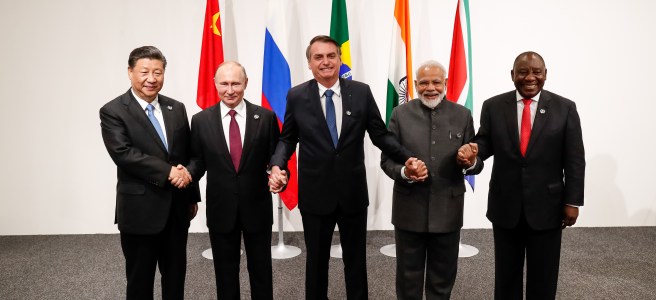
In August, after several more or less concrete announcements since 2012, the time has finally come: At its upcoming summit in South Africa, the expanding group of BRICS countries wants to concretize plans to create its own currency in order to openly challenge the global hegemony of the U.S. dollar.

Founded in 2009, the alliance of the (then) emerging economies Brazil, Russia, India, China and South Africa, which takes its name from their initials, also plans to discuss admitting more countries to the loose alliance. There are now 19 applications for membership, including from regional powers such as Egypt, Saudi Arabia, Indonesia, Iran, Argentina, Thailand and Venezuela.

It seems within reach that this alliance will achieve its strategic goal of breaking the hegemony of the West and the U.S. and establishing a so-called multipolar world order. A first step in the direction of de-dollarization is to be taken by the agreements of individual BRICS countries to use their domestic currencies in trade with each other.

At first glance, a replacement of the U.S. dollar as the world’s reserve currency seems quite realistic, given that the over-indebted U.S. has been in geopolitical and economic decline for years, while the BRICS alliance is on the rise. On the surface, the numbers speak for themselves: The share of the G7 countries (the U.S., Germany, Japan, France, Great Britain, Italy and Canada) in global gross national product has fallen from 50 percent in the early 1980s to 30 percent today, while the BRICS countries have increased their economic output from around 10 percent to 31.5 percent of global economic output over the same period. Thus, even before the upcoming enlargement, the ambitious alliance already has a larger production base than the Western states.

However, this rise is largely due to China; thus, the disparities and imbalances in the potential new currency bloc would be enormous. Between 2008 and 2021, China’s per capita gross domestic product increased by 138 percent. In India, the figure was 85 percent, while Russia saw only a modest increase of 14 percent. Brazil effectively stagnated with a meager increase of four percent, and in South Africa, GDP fell by five percent.

China now accounts for 70 percent of the gross national income of the BRICS countries, while Russia’s per capita income is five times that of India. These huge disparities make even the notorious imbalances in the eurozone, as exposed during the euro crisis, pale in comparison. Moreover, the BRICS grouping has so far had a very loose structure, hardly comparable to the results of the long process of institution-building and standardization that preceded the introduction of the euro in the EU. The alliance has no executive or legislative branch; it has not even established a central secretariat.

The alliance is also marked by a strong ambivalence. It was founded with the intention of ending the hegemony of the West and the imperial practices of the hegemonic power, the U.S. Attacking the U.S. dollar as the world’s reserve currency is a central project within this strategy. But at the same time, the BRICS countries are not striving for a fundamental change in world trade, they are ultimately only seeking to inherit the West and the U.S. within the framework of the world capitalist system – and to fall into the same imperialist practices that the U.S. is accused of. This is evident not only in Russia’s imperialist war in Ukraine, but also in the conflicts within the alliance: China and India, for example, are often on the brink of war in the Himalayas over border disputes.

But the common economic interests are at least as strong as the centrifugal forces outlined above. It is not just a matter of intensifying trade relations and geopolitical cooperation in order to reduce dependence on the Western centers. The BRICS states are not only striving to create their own currency, but also their own development bank based in China. This is because the semi-peripheral states have to operate in a late capitalist world system whose structures and institutions are Western-dominated, from the leading role of the dollar to Western supremacy in the World Bank and International Monetary Fund.

What this Western supremacy leads to is illustrated by the central banks’ fight against inflation in the centers, which is leading to outright economic collapses in many poorer countries. As a result of the U.S. Federal Reserve’s interest rate hikes, a quarter of all emerging and developing countries “have effectively lost access to international bond markets,” the Financial Times warned in mid-June. The World Bank’s growth forecast for this group of countries with particularly poor access to credit was cut from 3.2 to 0.9 percent.

This credit crunch, triggered by the fight against inflation in Western countries, is an important factor in the huge rush to join the BRICS group. Many crisis-ridden countries, such as Argentina and Venezuela, which are currently seeking membership, are simply hoping to tap alternative sources of financing – especially from China. In the future, not only will trade between these countries be conducted in the future BRICS currency, but it will also become the foundation of a new financial system geared to the interests of the semi-periphery.

This all sounds great in theory. But in practice, the emerging economies will find themselves similarly financially dependent on China, which, by creating a BRICS currency and an alternative financial system, will also seek to create alternative investment opportunities to reduce its vulnerability to U.S. sanctions. The potential BRICS currency would thus only be conceivable as a monetary vehicle for a hypothetical national hegemony, like the U.S. dollar.

Still, 60 percent of the world’s foreign exchange reserves are in dollars, down only slightly from an all-time high of 70 percent at the beginning of the 21st century. Some 74 percent of international trade, 90 percent of currency transactions, and nearly 100 percent of oil trade is conducted in U.S. dollars. To take the lead, China would ultimately have to bear the hegemonic costs inevitably incurred in a crisis-ridden late capitalism choking on its productivity: Chinese trade surpluses would have to be reduced and turned into deficits, while the Chinese financial market would have to be opened up.

Since the 1980s, the dollar’s hegemony has been based in economic terms precisely on global deficit cycles, in which enormous U.S. trade deficits generate credit-financed demand, while the U.S. financial market absorbs the resulting profits in the form of securities. China still holds huge amounts of U.S. securities and was for a time the United States’ largest creditor.

China would have to become a “black hole” of the world economy, like the U.S., whose gravitational pull sucks up, by means of trade imbalance and budget deficits, the surplus production of a late capitalist world economy choking on its hyperproductivity – at the cost of deindustrialization and destabilizing speculative bubbles. And this is hardly conceivable, given that the Chinese financial sector has already been and is being shattered by severe financial and debt crises. A new world reserve currency does nothing to change the causes of the economic and ecological crisis process, in which capital is coming up against its internal and external limits.

This is also illustrated by the current trade relations between Russia and India, where the U.S. dollar has been eliminated as a payment currency. After the outbreak of the war in Ukraine, Russia became by far the largest supplier of oil to India, which is running a large trade deficit. In the first eleven months after the outbreak of the war, Russian exports to India amounted to $41.5 billion, while Indian exports to Russia reached only $2.8 billion.

In fact, this is a classic beggar thy neighbor policy, as practiced by the long-time “world export champion” Germany: By running a trade surplus, they also export debt, deindustrialization and unemployment. The difference is that Russian banks and oil companies currently have to park their trillions of rupees in Indian bank accounts because there is no way to transfer or reinvest the money.

Originally posted in jungle world on 06/22/2023

The Multipolar Debt Crisis

More and more countries in Latin America, Africa and Asia are over-indebted or even facing bankruptcy. As a lender, China is also affected by this crisis and has had to grant emergency loans to protect its own banks from payment defaults.

Tomasz Konicz

The interest rate hikes by Western central banks to combat stubborn inflation – the key rate is now 5 to 5.25 percent in the U.S., and 3.75 percent in the euro zone – have already led to the collapse of three regional banks in the U.S. and are dampening economic growth on both sides of the Atlantic. But this turbulence is nothing compared to the shocks facing many economically weaker countries. As it becomes more and more expensive to take out new loans, they are finding it increasingly difficult to service their foreign debts, most of which are denominated in U.S. dollars.

Particularly in Africa, Asia, Latin America and the Middle East, more and more countries are finding themselves in a classic debt trap, in which economic stagnation, recession and rising borrowing costs fatally interact. The situation has already been compared to the “Volcker shock” of 1979, when the then chairman of the U.S. Federal Reserve, Paul Volcker, raised key interest rates in the U.S. to over 20 percent at times to combat many years of stagflation, triggering a debt crisis particularly in countries in South America and Africa.

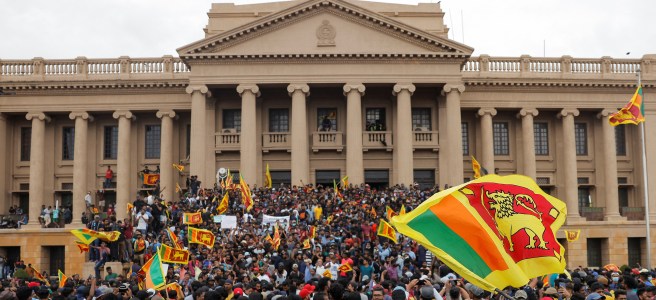
In mid-April, the Financial Times, citing a study by the NGO Debt Justice, reported that the foreign debt service of a group of 91 of the world’s poorest countries would consume an average of 16 percent of their government revenues this year, with that figure expected to rise to 17 percent next year. The last time a similar figure was reached was in 1998. The hardest hit, according to the report, is Sri Lanka, whose debt service this year is equivalent to about 75 percent of projected revenues, leading the Financial Times to expect the island nation to “default on payments” this year.

Zambia, which, like Sri Lanka, went through a sovereign default last year, is also in acute danger. The situation is similarly dire in Pakistan, where 47 percent of government revenues will have to be used to service foreign loans this year. The consequences for the people of these and many other countries are already dramatic: Governments are no longer able to pay salaries, for example, or finance imports of energy or food, and the fall in the value of their currencies is exacerbating inflation, poverty and hunger.

But it is not just the poorest countries that are threatened. In Argentina, for example, where the central bank is printing money to finance the budget deficit, inflation has reached 109 percent and threatens to turn into devastating hyperinflation. Like many other states in crisis, Argentina has signed an emergency program with the International Monetary Fund (IMF) that includes $44 billion in loans in exchange for austerity measures. In mid-May, Argentine President Alberto Fernández called for renegotiations with the IMF in light of a drought-induced crop failure for wheat, Argentina’s most important export. Vice President Cristina Fernández de Kirchner called the agreement “scandalous” and a “fraud.”

China, which has become one of the world’s largest lenders in recent years, plays a special role in the current debt crisis. Under the global development program of the Belt and Road Initiative alone, also known as the “New Silk Road,” at least $838 billion in loans and transactions had been made by the end of 2021, mostly to finance infrastructure and other major projects in Africa, Asia and Latin America. Most of the loans were made by Chinese banks. China wanted to lay the foundation for future economic hegemony.

But since then – after the Covid 19 pandemic and the Russian invasion of Ukraine, the global surge in inflation and a slowdown of growth in China itself – Chinese banks have become more reluctant to lend to poorer countries. According to a study by the Rhodium Group, as early as 2021, about 16 percent of loans made abroad from China, worth about $118 billion, were at risk of default and would have had to be renegotiated.

Just one year later, the Chinese foreign debt crisis had already expanded considerably, according to a study by the Kiel Institute for the World Economy (IfW). According to the study, 60 percent of loans were already at risk of default in 2022, prompting Beijing to grant 128 emergency loans totaling $240 billion to 22 debtor countries. In most cases, the debtor countries are only granted a deferral by issuing new loans to repay due payments, which allows for an “extension of maturities or payment terms”; a cancellation of debts occurs “only extremely rarely,” according to the IfW.

Most of these refinancing loans were granted by the Chinese central bank, which effectively rescues the Chinese banks that originally granted the loans. The authors of the IfW study therefore compared China’s current actions to the granting of so-called rescue loans to Greece and other southern European countries during the euro crisis, which also involved rescuing banks that were threatened with default.

Crisis and bridging loans flow mainly to “middle-income countries” because they account for 80 percent of China’s foreign credit volume and thus represent “major balance sheet risks for Chinese banks,” according to the IfW. Low-income countries, on the other hand, have received very little in the way of crisis loans, as their sovereign bankruptcies would be unlikely to jeopardize the Chinese banking sector. Moreover, the average interest rate on Chinese crisis loans is said to be five percent; the IMF standard is two percent. Debtor countries that have received crisis loans include countries such as Sri Lanka, Pakistan, Argentina, Egypt, Turkey and Venezuela.

The IfW also noted that for a large part of the rescue loans, the modalities and scope of the loan programs are not publicly available. As a result, “the international financial architecture is becoming more multipolar, less institutionalized and less transparent.” This lack of transparency also affects loans previously made by Chinese banks, they said. In a recent in-depth report on the debt crisis, the Associated Press (AP) news agency cited findings from a study by the research group Aid Data that found at least $385 billion in Chinese loans in 88 countries through 2021 alone that were “hidden or inadequately documented.”

Many of the poorest countries in Africa or Asia readily accessed Chinese money at the height of the global liquidity bubble between 2010 and 2020, using it to finance infrastructure and prestige projects that are increasingly turning into investment ruins during the current crisis surge. For these countries, secrecy is now a serious problem because, in the event of default, the affected country’s international creditors will have to agree on who will defer loans or waive repayments, and to what extent. However, Western lenders and institutions such as the IMF or the World Bank are currently refusing emergency programs in many cases because the modalities of China’s loan programs are unclear and they cannot reach an agreement with China. Some poor countries are therefore in a “state of limbo,” writes AP, because China is unwilling to accept losses, while the IMF refuses to grant low-interest loans if they are only used to pay off Chinese debts.

The lenders’ negotiations are further complicated by the intensifying global political competition between Western countries and China. The increasing fragmentation of the global economy makes it “more difficult to resolve sovereign debt crises, especially when there are geopolitical divisions among major sovereign lenders,” IMF Managing Director Kristalina Georgieva warned in January.

Western countries, meanwhile, are hoping to use China’s foreign debt crisis to roll back the influence China has built up through its lending in many regions of the world. EU Commission President Ursula von der Leyen said in May that there was now an “opportune moment” for the G7 countries and their partners after “many countries in the Global South have had bad experiences with China” and found themselves in “debt crises,” while Russia had only “mercenaries and weapons” to offer. If the West acted quickly, she said, it could form mutually beneficial partnerships with these countries. Companies and banks could be involved in developing “comprehensive packages” that would also shift parts of production chains to developing countries. She said the EU wants to promote “not only the extraction of raw materials, but also their local processing and refinement.” Von der Leyen is thus speculating with a bad memory of her potential “partners” in the Global South, who have already had painful experiences with Western credit programs since the 1970s.

Originally published in jungle world on 06/01/2023

New Old World Order?

Can state-capitalist China inherit the United States’ position as global hegemon?

Tomasz Konicz

If the Russian-Chinese summit declarations and Western assessments are to be believed, the 21st century will be defined as an era of Chinese hegemony. At their Moscow war summit in mid-March, Putin and Xi advocated a “just multipolar world order” that would put an end to the era of U.S. hegemony.[1] A British government report, on the other hand, warned of a world of “danger, disorder and division” that Beijing was creating in an open, “epoch-shaping challenge” to the liberal, “rules-based world order.”[2] Even British analysts should find it difficult to see the crisis-ridden late capitalist world as anything other than “danger, disorder and division.” Such assessments are obviously simple projections. But that does not necessarily mean that they are completely wrong – as a cursory glance at the carnage in Ukraine and the saber-rattling over Taiwan shows.

Talk of a multipolar world order is thus, on the one hand, the ideology of all those authoritarian states of the semi-periphery which, by means of imperialist power and war policies, are striving to take over from the eroding U.S. in order to achieve a similar supremacy or dominance at the regional or global level as Washington achieved in the second half of the 20th century. The rise of regional interstate conflicts is precisely an expression of this very real multipolar world disorder in a period of global crisis in which there is effectively no longer a world hegemon. Whether we’re talking about Russian imperialists, Iranian mullahs, Turkish neo-Ottomaniacs, or German out-and-out Nazis and Querfrontler, envy of Washington’s disintegrating means of power is what is motivating this new era of anti-Americanism. And this is especially true of the U.S. dollar. The greenback, as the world’s reserve currency based primarily on the oil trade, has given Washington the ability to borrow in the value of all commodities to finance, for example, its military machine. If, on the other hand, Erdogan turns on the printing press, inflation will simply rise.

This is why recent currency deals between China, Russia and a number of semi-peripheral states are raising eyebrows. In mid-March, during a state visit to Riyadh, President Xi proposed switching oil trade with Saudi Arabia to the Chinese yuan to counter the “increasing weaponization of the dollar.”[3] Riyadh is said to be seriously considering the symbolic move to unwind some of its oil trade with Beijing. In warring Russia, the yuan has risen to become the most traded currency in the face of Western sanctions.[4] Beijing has struck similar bilateral currency deals with Brazil,[5] Pakistan[6] and Venezuela.[7] At the last BRICS meeting in February, the creation of an alternative currency system for “emerging markets” was even discussed.[8] The Financial Times warned back in March that Western functional elites should prepare for a “multipolar currency world order” – which would mean the loss of Washington’s “extraordinary privilege” of borrowing in the world’s reserve currency.

On the one hand, these increased movements away from the dollar can be traced back to the U.S. sanctions against Russia at the beginning of the war of aggression against Ukraine, since this was the first time that Russian foreign assets were frozen (Lavrov spoke of “theft”), a fact that was carefully registered by all regimes that have to reckon with the prospect of coming into conflict with Washington. But this tendency towards de-dollarization and de-globalization can only be fully understood against the background of the imperial decline of the United States and the historical crisis process. Only when this is taken into account does it become clear why China will not be able to take over the United States’ role as hegemon.

Giovanni Arrighi, in his fascinating work Adam Smith in Beijing, has described the history of the capitalist world system as a succession of hegemonic cycles. A rising power achieves a dominant position within the system in a phase of ascendancy characterized by commodity-producing industry; after a signal crisis, this hegemonic power enters imperial decline, in which the financial industry gains importance, to be finally replaced by a new hegemon with greater means of power.

And this sequence can be empirically traced in the case of both Great Britain and the USA. The British Empire, which became the ‘workshop of the world’ in the context of industrialization in the 18th century, transformed itself into the world’s financial center in the second half of the 19th century, before being replaced in the first half of the 20th century by the economically ascendant U.S., which in turn experienced its ‘signal crisis’ during the crisis phase of stagflation in the 1970s. This was followed by the deindustrialization and financialization of the U.S., leading to the economic dominance of the U.S. financial sector. The indebtedness of the declining hegemon to the imperial ascender, which Arrighi also addressed, can be seen both in the case of Great Britain vis-à-vis the United States and through the deficit cycle of the United States vis-à-vis China.

The dollar thus achieved its world position in the context of the postwar Fordist boom, when the Marshall Plan also cemented U.S. hegemony in devastated Europe. And it was precisely this long period of Fordist expansion that formed the economic basis of U.S. hegemony. With the end of the postwar boom in the stagflationary phase, financialization and the implementation of neoliberalism, the economic basis of the Western hegemonic system changed: in the systemic crisis of valorization, the increasingly indebted United States became the “black hole” of the world system, absorbing the surplus production of export-oriented states such as China and the FRG through its trade deficits – at the price of increasing deindustrialization. Beijing and Berlin thus had every reason to tolerate U.S. hegemony and the dollar as the world’s reserve currency, for without the American market China’s rise to become the new “workshop of the world” would not have been possible.

Late capitalism, choking on its own productivity and increasingly running on credit, chained the “production sites” and deficit states together within the framework of this globalization of deficit cycles and the corresponding bubble economy, while at the same time increasing the potential for conflict due to processes of socio-economic disintegration. This crisis tendency was personified very concretely by Donald Trump, who was elected by an eroding white middle class and who wanted to reindustrialize the U.S. by means of protectionism – and thus unintentionally accelerated the decline of the dollar, which was accepted precisely because of the deficits of the dollar area. In fact, since Trump’s presidency, we can hardly speak of U.S. “hegemony” in the traditional sense of the word. The United States now holds its position only by means of naked dominance, mainly because of its military-industrial sector, which is the real backbone of the dollar – and this is what makes a military confrontation between China and the United States likely. The U.S. has its back against the wall globally, just as Russian imperialism did in the post-Soviet space on the eve of the Ukraine war. This was also evident in the current banking quake, which was triggered by U.S. government bonds, of all things.[9]

The crisis-induced rise in protectionism thus seems to be giving the world’s reserve currency, the dollar, a break. And yet, because of the unfolding global socio-ecological crisis of capital, the 21st century will not usher in an epoch of Chinese hegemony. The yuan is not going to inherit the dollar. The hegemonic rise of the People’s Republic, marked by the dominance of commodity production, took place within the framework of the aforementioned global deficit cycles, in which the debt dynamics in the West generated demand for Chinese exports – and it ended with the crisis surge of 2008. With the bursting of the real estate bubbles in the U.S. and Europe, the extreme Chinese export surpluses declined (with the exception of the U.S.), while the gigantic stimulus packages launched by Beijing to support the economy led to a transformation of China’s economic dynamics: Exports became less important, and the credit-financed construction industry and the real estate sector became the main drivers of economic growth.

Thus, China already passed its ‘signal crisis,’ which marks the transition to a financial market-driven growth model, in 2008. China’s growth is thus also based on credit; the People’s Republic is highly indebted, just like the declining Western centers of the world system.[10] The Chinese deficit economy generates even greater speculative excesses than in the U.S. or Western Europe, as the distortions in the absurdly inflated Chinese real estate market in 2021 made clear.[11] Economically, the hegemonic decline of the People’s Republic has already begun due to the global systemic crisis, even though it has not yet been able to gain its hegemonic position geopolitically.

The lack of a new leading sector, of an accumulation regime that mobilizes wage labor on a mass scale in commodity production, which is a manifestation of the internal barrier of capital, constitutes the major difference between contemporary China and the U.S. at the end of World War II. This is particularly evident in Beijing’s foreign policy ambitions, where the “New Silk Road” initiated an ambitious global development project modeled on the Marshall Plan – and brought the People’s Republic its first international debt crisis.[12] Of the approximately $838 billion that Beijing has invested in building a China-centered economic and alliance system in developing and emerging countries by 2021, about $118 billion is said to be at risk of default after the outbreak of the current wave of crisis (the pandemic and the war in Ukraine).[13]

There is no global economic springtime in sight, only over-indebtedness[14] and inflation.[15] Because of its collapsing debt towers at home and abroad, China appears to be in decline even before it has achieved hegemony. In addition, there is the external, ecological barrier of capital, since the People’s Republic, in the course of its state-capitalist modernization, has become the largest emitter of greenhouse gases, which, given the threat of climate catastrophe, makes a similar development path for other countries of the global South pure ecological insanity (but at the same time, it would be simply perverse for the centers to preach renunciation to the global South). The historical hegemonic cycle of the capitalist world system is thus superimposed on the socio-ecological crisis process of capital, interacting with it and allowing the hegemonic rise and fall of China to merge.

A hegemonic system, in which the position of the hegemon would be tolerated, is no longer feasible due to the increasingly manifest internal and external barriers of capital, due to the economic and ecological double crisis. Imperialism in the current phase of crisis, in which the historical expansionist movement of capital has turned into a contraction leaving behind Failed States, amounts to isolation and pure resource extractivism. The isolation of the areas of socio-economic collapse, which no longer play a role as markets, goes hand in hand with the brutal struggle of various countries for the dwindling raw materials and energy sources needed to feed the sputtering valorization machine.[16]

There is a clear historical trend here. The quest for direct control of colonies and protectorates in the 19th century, the era of British hegemony, gave way in the 20th century to informal imperialism, as practiced by Washington through coups and the installation of dependent regimes. In the final phase of the capitalist world system, imperialist rule seems to amount to the mere maintenance of infrastructural extraction routes through which resources and energy carriers are to be transported from the areas of economic and ecological collapse to the remaining centers.

Thus, what is unfolding in the current crisis imperialism is a logic of last man standing, in which the consequences of the crisis are passed on to the competition.[17] These power struggles between state subjects, which have now reached the point of open war, are carrying out the objectively advancing crisis process. It is a geopolitical power struggle on the sinking late capitalist Titanic, in which there are in fact no winners. That is why all the apparent alliances are so fragile, as was seen most recently in the EU’s moves to distance itself from the United States on the Taiwan issue.[18]

And yet, against the backdrop of the socio-ecological crisis, the struggle between Russo-Chinese Eurasia and the United States’ Oceania, in which Ukraine and Taiwan form an acute and a potential flashpoint, can certainly also be understood as a struggle between the future and the past. It is a struggle between the declining era of neoliberal governance and the emerging era of openly authoritarian rule,[19] in which authoritarian structures and social disintegration interact, as can be seen almost paradigmatically in the Russian state oligarchy and mafia rule.[20] The crisis is literally driving the eroding late capitalist state behemoths into confrontation, so that the unleashing of capital’s growing auto-destructive tendencies in a large-scale war is quite possible.


[1] https://www.n-tv.de/politik/Xi-und-Putin-wollen-gerechtere-Weltordnung-article23996962.html

[2] https://www.aljazeera.com/news/2023/3/14/russia-china-creating-world-of-danger-disorder-division-uk

[3] https://www.globaltimes.cn/page/202212/1281416.shtml

[4] https://www.bloomberg.com/news/articles/2023-04-03/china-s-yuan-replaces-dollar-as-most-traded-currency-in-russia#xj4y7vzkg

[5] https://www.globaltimes.cn/page/202303/1288326.shtml

[6] https://www.aa.com.tr/en/energy/invesments/pakistan-china-agree-to-trade-in-yuan/22190

[7] https://www.aa.com.tr/en/energyterminal/finance/venezuela-opts-to-use-chinese-yuan-for-oil-trade/763

[8] https://www.ft.com/content/02d6ab99-ea36-41c4-9ad3-9658bb1894a7

[9] https://exitinenglish.com/2023/06/09/silicon-valley-bank-the-weakest-link/

[10] http://fingfx.thomsonreuters.com/gfx/rngs/CHINA-DEBT-HOUSEHOLD/010030H712Q/index.html

[11] https://www.konicz.info/2021/11/27/einstuerzende-neubauten/

[12] https://www.ft.com/content/ccbe2b80-0c3e-4d58-a182-8728b443df9a

[13] https://exitinenglish.com/2023/03/05/china-multiple-crises-instead-of-hegemony/

[14] https://www.theguardian.com/world/2023/mar/28/china-spent-240bn-belt-and-road-debts-between-2008-and-2021

[15] https://www.ft.com/content/049aef43-4f03-45a1-bf65-749cd44921cc?emailId=af7e811c-648b-4ffa-b140-d7980fc81974&segmentId=22011ee7-896a-8c4c-22a0-7603348b7f22

[16] https://www.konicz.info/2021/10/14/ddr-minus-sozialismus/

[17] https://www.konicz.info/2022/06/23/was-ist-krisenimperialismus/

[18] https://www.nbcnews.com/news/world/macron-europe-china-taiwan-usa-outrage-rcna79090

[19] https://exitinenglish.com/2022/08/12/a-new-quality-of-crisis/

[20] https://www.konicz.info/2022/05/25/rackets-und-rockets/

Originally published on the EXIT homepage on 05/10/2023

Silicon Valley Bank: The Weakest Link

The current turmoil in the financial sphere is only the latest chapter in the late capitalist systemic crisis.

Tomasz Konicz

Here’s to a new one? The collapse of the IT industry’s house bank, California’s Silicon Valley Bank (SVB),[1] seems at first glance to herald a new financial crisis, bringing back memories of the collapse of the transatlantic housing bubble in 2007-09.[2] With Silvergate Capital, a financial institution specializing in cryptocurrencies, having recently gone into liquidation, and Signature Bank also stumbling, the entire financial system is threatened with a conflagration that can only be averted by a massive intervention by U.S. policymakers – who have had plenty of experience in crisis management over the past few decades.[3]

This banking crisis initially seemed to affect mainly financial institutions with ties to the IT industry. SVB specialized in financing startups in the Californian tech industry. The bank ran into trouble after accumulating $1.8 billion in losses on the sale of securities.[4] After an emergency round of capital raising failed and the bank became effectively insolvent, the Department of Financial Protection and Innovation (DFPI) took control of the financial institution. The crypto bank Silvergate Capital, which also financed new tech companies, is also in liquidation.

In their initial public reactions, U.S. President Joe Biden and Treasury Secretary Janet Yellen went to great lengths to clearly distinguish the current crisis measures from Washington’s approach after the housing bubble burst in 2008.[5] In a television interview, Yellen categorically ruled out a government bailout of troubled banks similar to the infamous bailouts during the 2008 financial crisis. The banking system is truly safe and resilient, the Treasury secretary said, citing the financial market reforms and additional regulations put in place in response to the 2008 financial crisis – even though the Trump administration had rolled back some of them.[6]

President Biden gave a speech assuring U.S. citizens that they could rely on their financial system because all bank customers would have access to their savings. In the United States, the FDIC protects deposits of up to $250,000, but Biden announced that he would protect all bank deposits in unlimited amounts and guarantee their payment. In this way, Washington apparently wants to prevent a banking storm. The U.S. president promised that taxpayers would not incur any costs as a result of these crisis measures, since the Deposit Insurance Fund, into which the financial institutions pay, would be responsible for this. On the other hand, investors who had invested capital in the affected financial institutions had taken a risk and would now have to bear their losses. The U.S. president also said the management of the banks that went into liquidation should be fired.

However, Washington’s concrete crisis measures are nowhere near as populist as the U.S. president promised in his speech. Washington needs to throw some kind of lifeline to the faltering banking sector in order to avoid an uncontrollable escalation like the one that followed  the bankruptcy of Lehman Brothers in 2008, which resulted in a “freeze” of the financial sphere (interbank lending came to a virtual standstill because financial market players no longer trusted each other).[7]

The lifeline that crisis policy is throwing to the shattered late-capitalist financial sector this time bears the sonorous name Bank Term Funding Program (BTFP).[8] In essence, it is a lending program of the U.S. Federal Reserve, which, even in the face of manifest market turbulence, will quickly provide banks with emergency loans against collateral in order to prevent defaults and liquidity shortages in the financial sector. Banks will be able to pledge government bonds in particular, but also mortgage-backed securities, as collateral. The trick to the whole thing is that the securities are to serve as collateral at their face value, not at their current market value.[9] Normally, banks have to put up their securities as collateral at market value if they want to get additional liquidity from the central bank. The central bank is thus effectively overriding the typical market mechanism in order to stabilize the shattered financial sector. In addition, banks can take advantage of the central bank’s crisis program known as the discount window, where bonds can be deposited as collateral for loans without the usual haircuts.

Like stocks, government bonds trade at a market value that may differ from their face value at issuance. Changes in interest rates and the market value of government bonds are inversely proportional. When interest rates fall, bond prices rise. The reverse is true when interest rates rise, causing bond prices to fall. And this is logical: Bonds issued in a low interest rate period lose market value because of their lower interest rate in a high interest rate period. And it is precisely this period of high interest rates, initiated by central banks to fight inflation, that has led to a massive decline in the value of government bonds.

Deviations between the face value and market value of government bonds are not a problem as long as they do not have to be sold prematurely. After all, government bonds are usually used as a safe haven for low-interest, long-term investments. It only becomes a problem if banks have to sell these securities prematurely during a period of high interest rates due to a lack of liquidity. This was precisely the case for SVB, which operates in Silicon Valley, where many companies in particular are suffering from the Fed’s high interest rate policy and have to draw on their deposits more often than average. It was thus emergency sales of U.S. government bonds that led to SVB’s bankruptcy.[10] Rumors of liquidity problems at the IT bank then triggered a run on the bank, with customers withdrawing $42 billion in a single day.[11]

The Californian IT bank was just the weakest link in an unstable financial sector, as many financial institutions are in a similar predicament. They hold huge amounts of government bonds on their balance sheets, which are rapidly losing value as central banks fight inflation. How big is the problem? According to the Financial Times, the potential losses on bonds that could result from the growing discrepancy between face value and market value are currently around $600 billion in the U.S. alone.[12]

Meanwhile, other crisis candidates are emerging, such as the U.S. bank First Republic, which had to be stabilized by several major banks with a $30 billion liquidity injection.[13] At the same time, U.S. banks made massive use of the Federal Reserve’s emergency lending programs. The Fed pumped $152 billion into the financial sector through its discount window in one week, far surpassing the previous weekly record of $111 billion, set shortly after the collapse of investment bank Lehman Brothers in 2008.[14] By comparison, in the week before the Silicon Valley bank failure, U.S. financial firms borrowed only $4.58 billion through the Fed’s discount window.

The massive losses in the value of bank shares in recent days are thus merely an expression of accumulated crisis potential, which is leading to a corresponding flight of capital. Moreover, the imminent bankruptcy of Credit Suisse shows that this latent crisis potential is not limited to the U.S. The ailing Swiss bank’s shares have plummeted and it is suffering from a massive outflow of capital,[15] forcing it to ask the Swiss central bank for a “sign of support.”[16] Switzerland’s currency guardians did not let themselves be left out: 50 billion francs are being pumped into the ailing financial institution to stabilize it for the time being. In a sense, the noble Swiss bank was also an ailing financial institution that had already run into rough waters some time ago in the wake of a series of scandals and dealings that were nothing short of criminal.

Thus, there seems to be an important difference between the current turmoil and the crisis surge of 2007-09. The great wave of transatlantic real estate speculation was accompanied by the mass issuance of dubious subprime mortgage securitizations, which proved toxic after the bubble burst in 2007 and endangered the global financial system. This time, it is bland, supposedly risk-free government bonds that are threatening to be the downfall of the banks involved. These securities are not being bought for speculative purposes, as was the case with the mortgages bundled into “securities” during the housing bubble, but as collateral – especially in uncertain times.

And yet: This most recent “financial quake” is actually just the latest chapter in a long-running, systemic crisis process,[17] in which latent and manifest stages alternate.[18] The sharp decline in the value of government bonds is simply due to the fact that many of these securities were issued during a prolonged period of very low interest rates. With brief interruptions, the global financial system has been in a historically unique period of zero interest rates since the bursting of the real estate bubbles in the U.S. and the EU in 2008. With this “cheap money” policy and the extensive purchasing of junk securities, the aforementioned “toxic” mortgage securitizations, the central banks have stabilized the financial sphere.

Central banks have thus become the toxic waste dumps of the global financial system, as evidenced by their bloated balance sheets. In recent years, the ECB and the Fed have bought trillions of dollars worth of securities, effectively printing money.[19]  This “liquidity” of the central banks led to the formation of a corresponding liquidity bubble,[20] which stabilized the global economy and fueled the boom in the financial sphere, which in its overheated final phase led to absurdities like the swarm speculation in meme stocks like Gamestop.[21] The crisis policy used to combat the consequences of the real estate bubble thus laid the foundation for the speculative dynamics to come.

In addition, central banks have increasingly bought up government bonds simply to finance the deficits of the states – especially in the U.S. and the eurozone. Government bonds form the backbone of the financial sphere, and the “market” for them is gigantic, as the states have had to take on more and more debt in the past bouts of crisis in order to keep the late capitalist world system from collapsing through economic stimulus programs and other crisis measures. The U.S Treasury market alone, which has been in crisis for months,[22] and which, according to the Financial Times, is suffering from a latent lack of liquidity (in other words: nobody wants to buy them), includes securities with a nominal value of about $23.5 trillion (that’s 23,500 billion!). The currently looming crisis surge is thus much more dangerous than it appears, because the foundation of the world financial system, the markets for sovereign debt of the core states, has become brittle. (For more details, see: “Mountains of Debt on the Move”).[23]

And that’s really the point: There is no fundamental difference in terms of economic impact between the dubious mortgage securitizations from the era of great transatlantic real estate speculation and the stodgy government securities that are now causing problems for the financial sector. Whether the private sector borrows subprime mortgages to stimulate the construction industry and fuel the economy, or whether governments borrow to keep the great “economy” alive through their stimulus programs and investments, it is all the same in this respect. In both cases, demand is created in the here and now, with the loan representing an anticipation of future capital valorization. The mortgagee has to pay off his mortgage, including interest, just as the government has to service its bonds through tax revenues. When this no longer seems realistic, speculative bubbles burst, the corresponding mountains of debt threaten to collapse – and financial crises ensue.

The recurring financial crises are thus an expression of a crisis-ridden late capitalist world system that is increasingly running on credit. Since the implementation of neoliberalism in the 1980s, which was only possible in response to the stagflation crisis of the 1970s,[24] global debt has been rising much faster than world economic output.[25] In a sense, capitalism, which is based on the valorization of labor power in commodity production, has become too productive for itself; the system is choking on its productivity, lacking a new accumulation regime in which wage labor could be profitably valorized since the emergence of the IT industry in the 80s. To paraphrase Marx, the productive forces are, as it were, breaking the bonds of the relations of production.

The emergence of a globalized, neoliberal financial market capitalism with a veritable financial bubble economy is thus a systemic reaction to this inner barrier of capital (Robert Kurz), which, through ever increasing competition and rationalization, gets rid of its own substance, value-creating labor in commodity production. The missing demand is to a certain extent generated by credit, which brings with it ever greater instabilities and crises of increasing intensity. In this historical process of indebtedness and crisis, states play an increasingly important role as crisis managers. On the one hand, through the many economic stimulus programs, and on the other hand, through the central banks’ purchases of government bonds and other securities, which stabilized the financial sphere and effectively printed money. The expansionary monetary policy of the central banks allowed the corresponding liquidity bubble to form, in which the liquidity pumped into the markets led to an inflation of securities prices, until finally the inflation bled into the real economy.[26]

The pandemic and the war in Ukraine ultimately acted as external triggers, bursting the liquidity bubble that had been inflated by central banks’ loose monetary policies. The current inflation is thus fed by several sources: in addition to the explosion in energy prices in the wake of the war in Ukraine, the inflationary consequences of the full-blown climate crisis (especially for food), and the supply shortages during the pandemic, the rise in prices is also attributable to the money printing of recent years, which is now manifesting itself in the form of real inflation following the bursting of the Everything Bubble in the financial sphere.[27]

Monetary policy was therefore forced to change course in order to be able to combat inflation. Interest rates were successively raised and, at least in the U.S., bond purchases by the central bank were scaled back. The fact that this policy of tight money, viewed in isolation, has been somewhat successful is evidenced by the latest inflation figures from the U.S., where inflation has now been reduced to six percent – just a few months ago, the United States was still threatened with double-digit inflation. The slightly lower core inflation rate of 5.5 percent, which excludes energy and food prices, also shows that price increases are not only being driven by shocks from the war in Ukraine and the pandemic.[28]

At the same time, however, the fight against inflation has starved the financial sphere of liquidity and made it more difficult to run the deficits that are systemically necessary in late capitalism. To put it bluntly, the system can now no longer simply run on credit (last year, global debt levels actually fell significantly, as reported by the IMF).[29] Thus, a few months after the great monetary policy turnaround to a restrictive monetary policy, the financial sphere is thus again on the verge of a full-blown banking crisis, which only points to the systemically necessary debt compulsion of the hyper-productive late capitalist world system outlined above.

This debt compulsion of crisis-ridden late capitalism can be traced very concretely in the balance sheets of the central banks, which, as explained above, have had to buy up more and more securities and government bonds in order to stabilize the world financial system through this indirect money printing. This was supposed to end with the advent of inflation and the shift in monetary policy to a policy of high interest rates. Indeed, the Fed’s balance sheet has been shrinking rapidly over the past few months as it has stopped buying new bonds and securities. The Fed’s total assets have fallen from a peak of nearly $9 trillion in mid-2022 to $8.3 trillion. But after the banking panic of the past few days, massive amounts of liquidity had to be pumped into the markets again as part of the crisis programs described above, so that the Fed’s balance sheet swelled to more than $8.6 trillion. A few days of crisis were thus enough to revise months of gradual reduction of slowly maturing securities on the central bank balance sheet. The central banks simply cannot escape their function as toxic waste dumps of the late capitalist financial system.[30]

The long-term hopelessness of capitalist crisis management is manifested in this increasingly obvious monetary impasse. It is a veritable crisis trap in which monetary policy finds itself,[31] which in fact can only determine the further path into the inevitable unfolding of the crisis: deflation or inflation? Either inflation is given free rein to stabilize the economy and the financial markets, or the path of deflation is chosen, which would be triggered by a financial market quake – as the Wall Street Journal recently warned.[32]

This aporia of capitalist crisis policy,[33] which only refers to the inner barrier of the capital relation choking on its own productivity, could so far be bridged by the continued construction of global debt towers, which the current inflationary surges now threaten to put an end to. Thus, in the end, politics can only determine the form of the inevitable impending devaluation of value: either via the path of inflation, which would devalue money as a general equivalent of value, or via the path of deflation, in which capital would be devalued in its constant (factories, machines, production sites) and variable aggregate states (wage labor).

I finance my journalistic work mostly through donations. If you like my texts, then you are welcome to contribute – either via Patreon or via Substack.


[1] https://www.ft.com/content/b556badb-8e98-42fa-b88e-6e7e0ca758b8

[2] https://www.konicz.info/2007/03/05/vor-dem-tsunami/

[3] https://www.zeit.de/wirtschaft/2023-03/usa-silicon-valley-bank-janet-yellen-signature-bank-notenbank?utm_referrer=https%3A%2F%2Fnews.google.com%2F

[4] https://www.tagesschau.de/wirtschaft/finanzen/kursrutsch-cryptobanken-101.html

[5] https://www.dw.com/de/us-regierung-sichert-einlagen-bei-pleite-banken/a-64964942

[6] https://edition.cnn.com/2023/03/14/politics/facts-on-trump-2018-banking-deregulation/index.html

[7] https://www.konicz.info/2009/09/11/produkt-der-krise/

[8] https://www.ft.com/content/72c25414-aabe-432a-a785-a8b2bd6887f9

[9] https://www.finanzen.net/nachricht/zinsen/mitteilung-us-notenbank-fed-wirft-rettungsleine-aus-kreditlinie-soll-banksystem-stabil-halten-yellen-optimistisch-biden-verspricht-einlagensicherheit-12249312

[10] https://www.zeit.de/wirtschaft/2023-03/usa-silicon-valley-bank-janet-yellen-signature-bank-notenbank/seite-2

[11] https://edition.cnn.com/2023/03/14/tech/viral-bank-run/index.html

[12] https://www.ft.com/content/5e444ba2-0afc-49e8-bfec-5fc17ef7ee39

[13] https://www.faz.net/aktuell/finanzen/us-banken-stuetzen-first-republic-bank-mit-30-milliarden-dollar-18754703.html

[14] https://www.manager-magazin.de/unternehmen/banken/bankenkrise-fed-gibt-ueber-notfallprogramme-derzeit-mehr-geld-aus-als-nach-lehman-pleite-a-ef292d06-47de-40eb-b8ee-e5ebb999d2db

[15] https://www.ft.com/content/85f6768d-0a01-41a3-8925-1c636d3f7dbc

[16] https://www.ft.com/content/0324c5a6-cecd-4fb3-85b3-7cdc99a33e4e

[17] https://www.konicz.info/2021/11/16/zurueck-zur-stagflation/

[18] https://www.konicz.info/2019/01/28/die-urspruenge-der-krise/

[19] https://www.konicz.info/2022/12/09/geldpolitik-vor-dem-bankrott/

[20] https://www.konicz.info/2015/08/26/die-grosse-liquiditaetsblase/

[21] https://www.konicz.info/2021/01/30/hedge-fonds-gamestop-und-reddit-kleinanleger-die-grosse-blackrock-bonanza/

[22] https://www.ft.com/content/bc7271f9-a0aa-4643-bed3-40d2d5ec80d1

[23] https://exitinenglish.com/2022/08/12/mountains-of-debt-on-the-move/

[24] https://www.konicz.info/2021/11/16/zurueck-zur-stagflation/

[25] https://www.imf.org/en/Blogs/Articles/2022/12/12/riding-the-global-debt-rollercoaster

[26] https://www.konicz.info/2021/08/08/dreierlei-inflation/

[27] https://www.konicz.info/2022/09/03/the-walking-debt/

[28] https://edition.cnn.com/2023/03/14/economy/cpi-inflation-february/index.html

[29] https://www.imf.org/en/Blogs/Articles/2022/12/12/riding-the-global-debt-rollercoaster

[30] https://www.federalreserve.gov/monetarypolicy/bst_recenttrends.htm

[31] https://www.konicz.info/2022/12/09/geldpolitik-vor-dem-bankrott/

[32] https://www.wsj.com/articles/bank-failures-like-earlier-shocks-raise-odds-of-recession-beb1e376

[33] https://www.konicz.info/2011/08/15/politik-in-der-krisenfalle/

Originally published on konicz.info on 03/20/2023

Keynesianism in Crisis

While many elements of Keynesian economic policy are used in the day-to-day crisis, post-Keynesianism is running wild as an ideology on the German left.

Tomasz Konicz

Whether they are stock-conservative market disciples[1] or staid social-democratic trade unionists,[2] in times of crisis, they are all Keynesians. In every crisis episode of recent years, when it was once again necessary to save the fading late capitalism from collapse by means of billion-dollar economic stimulus programs and massive money printing, the British economist, whose demand-oriented economic policy was dominant until it was replaced by neoliberalism in the 1980s, experienced a fleeting public boom. After the bursting of the transatlantic housing bubble in 2008 or the pandemic-induced slump in 2020, everyone was suddenly talking about John Maynard Keynes, who, as the court economist of the old statist social democracy, had advocated an active role for the state in investment programs and monetary policy. Until, after the usual wear and tear in the media circus, nobody talked about him anymore and capitalism seemed to return to “business as usual” after the “Keynesian” stabilization phase.

All that was left were the Keynesians, who had been pushed out of the political and academic mainstream in the neoliberal age and were constantly whining, and with whom the left beyond social democracy now had to contend. But the constant lament from the spectrum of neo-Keynesians and Modern Monetary “Theory” (MMT) that more Keynesianism is needed to make everything better again and for late capitalism to return to the era of the economic miracle is, to put it mildly, misplaced in the face of political realities. Many of the tools of Keynesianism continue to be used in crisis management, but they are not discussed or perceived as such. Keynes has long been a pragmatic part of everyday crisis management, and many of the crisis measures and programs that have stabilized the system since 2008 bear his signature.

And this is only logical against the background of the historical genesis of this school of economics: Keynesianism found its way into the capitalist mainstream after the end of the Second World War precisely as the great “lesson” from the crisis phase that began in 1929 – and in times of crisis the capitalist functional elites almost reflexively resort to its instruments. Consistent regulation of the currency and financial markets, the state as an economic regulatory and steering agent pursuing an active investment policy, a demand-oriented wage and social policy, in which the wage earners of the economic miracle were also understood as consumers, and a counter-cyclical economic policy – these were the now idealized features of the Keynesian economic order until the rise of neoliberalism under Thatcher and Reagan, to which the neo-Keynesians want to return.

It Doesn’t Get Cheaper Than This

The pragmatic recourse to the instruments of Keynesianism finds its clearest expression in all the economic stimulus programs that were launched in the wake of the intensifying episodes of crisis. As a result of this increasing intensity, these government subsidy and investment packages have grown in size with each new wave of crisis,[3] as the notorious management consultancy McKinsey demonstrated with reference to the global financial crisis of 2008/09 and the pandemic of 2020.[4] By mid-2020, global government spending to mitigate the effects of the pandemic-generated crisis surge had already reached around $10 trillion – three times the amount of the 2008/09 crisis programs.

And it was precisely the German government, which was cautious in its economic policy in 2008 and only made negative headlines at the time with the infamous (and disastrous in terms of climate policy) car scrappage program, that launched particularly far-reaching crisis programs in 2020. In relation to Germany’s GDP, Berlin even launched the largest economic stimulus package of all Western industrialized countries: it amounted to 33 percent of GDP. In addition, the Merkel government also initiated a gradual shift away from the pernicious austerity regime in the “German” eurozone by agreeing to a European economic stimulus program in mid-2020 as part of the European budget, which, with a volume of 750 billion, nevertheless includes 380 billion euros of aid payments to the periphery.[5]

And in terms of monetary policy, both the European Central Bank (ECB) and the Federal Reserve (Fed) have, until recently, followed the “it doesn’t get cheaper than this” approach. Key interest rates in all Western currency areas have tended to fall further and further in the 21st century. Between 2009 and 2021, a zero interest rate policy prevailed – with brief interruptions – to support the economy and the financial sector. In addition, after the bursting of the transatlantic real estate bubble, the central banks resorted to pure money printing, first by buying mortgage securities and later increasingly by buying government bonds– injecting additional liquidity into the financial sphere and leading to securities price inflation in the context of the great liquidity bubble that burst in 2020. Over the course of the 21st century, the Fed and the ECB have increased their balance sheets almost tenfold, becoming the dumping grounds of the late-capitalist financial system, doomed to perpetual boom, and the largest holders of their sovereigns’ debt instruments.

Hyperactive Central Bank Capitalism

The central banks have thus become key economic actors in the course of the crisis process, since without their intervention both the financial sphere and government financing would have collapsed. One could speak of central bank capitalism, as the political economist Joscha Wullweber does in a book of the same title, which highlights the dependence of one part of the financial sphere, the largely unregulated market for repurchase agreements (repos), on central banks’ money printing.[6] The current attempt by the ECB and the Fed, in the face of double-digit inflation rates (only the Bank of Japan is desperately bucking the trend),[7] to curb inflation, which has multiple causes (the pandemic, war, the bursting of the liquidity bubble, the climate crisis), by resorting to restrictive monetary policy is not working,[8] but does not necessarily go hand in hand with an end to government bond purchases.

In the eurozone, the PEPP (Pandemic Emergency Purchase Program), a 1.85 trillion euro program that buys government bonds while raising interest rates (net purchases are to be suspended next March),[9] has been created specifically to stabilize the eurozone, effectively undermining the fight against inflation – and in turn strengthening the economic role of the state, which can continue to finance its budget deficit under the PEPP. In addition, there have been steps toward an active economic policy by the state, especially with regard to the Green New Deal. Neoliberal hardliners[10] are now complaining loudly in the Handelsblatt about the state’s efforts to “steer credit” towards the environment, which would be expressed above all in the introduction of the EU taxonomy regulation defining sustainable investments (ironically, investments in natural gas and nuclear power are also considered “sustainable” in this context). Moreover, German Vice-Chancellor Robert Habeck’s State Secretary Sven Giegold – an Attac activist from the very beginning – already spoke out a year ago in the Financial Times (FT) in favor of an “active industrial policy” by Berlin, which should “support innovations” in order to transform the FRG into an “ecological and social market economy.”[11]

However, this structure of crisis capitalism, characterized by increasing state activity, is not the result of a coherent strategy, but an expression of the respective efforts to prevent a collapse of the world economy during the acute episodes of crisis. It is a Keynesianism of blind action, in which functional elites acted quasi-reflexively. The emergency programs and policy changes, often introduced as temporary measures, then become permanent in the course of the crisis; they coagulate into new structures and dynamics in latent crisis phases. In the words of then Finance Minister Schäuble, the German government’s actions during the global financial crisis in 2009 were “driving on sight.”[12][13] The packages of measures simply build on each other. Habeck’s active industrial policy, for example, for which Giegold drummed up support in the FT, has its precursor in the state promotion of “national champions” under his predecessor Peter Altmaier, who also wanted to specifically promote Germany’s export industry in the face of increasing crisis competition and informal state subsidies in China and the United States.[14]

This “driving on sight” of the functional elites in manifest times of crisis, in which ever new elements of state-capitalist crisis management are applied in response to waves of crisis, gives this formation all the characteristics of a transitional stage within the late-capitalist unfolding of crisis. The economic and ecological crises that force politicians to adopt crisis Keynesianism are not the expression of a “wrong” economic policy, but of the escalating internal and external contradictions of the capital relation, which manifest themselves quite concretely in constantly rising debts (faster than world economic output) and an incessantly rising CO2 concentration.

Due to the ever increasing global level of productivity, the world system is, in fact, increasingly running on credit, unable to develop a new leading industrial sector, a new regime of accumulation in which masses of wage labor would be valorized. Through money printing and deficit spending, the state is increasingly acting as a last resort to postpone the crisis, now that deficit accumulation in the context of the neoliberal financial bubble economy (dot-com bubble, real estate bubble, liquidity bubble) has largely exhausted itself in the hot financial markets. For example, the broad-based U.S. stock index S&P 500 has now fallen about a thousand points after reaching its historic high of more than 4700 points at the end of 2021.

Modern Monetary Ideology

The late phase of globalized financial bubble capitalism, in which central banks’ expansionary monetary policies contributed to the inflation of securities prices in the financial sphere – to the point of swarm investing and the fleeting booms of meme stocks like GameStop[15] – also gave rise to an extreme form of late- and post-Keynesian economic ideology, which, ignoring any systemic crisis analysis, especially the connection between bubble formation and central banks’ monetary open floodgates, could claim that all of the economic and social problems of late capitalism could be solved by printing money. After all, interest rates and inflation remained low between 2008 and 2020.

Modern Monetary Theory (MMT) seemed to have succeeded in squaring the capitalist circle. Full employment, the welfare state, economic growth and ecological turnaround are only a matter of expansionary monetary policy, according to the central thesis of MMT. According to this neo-Keynesian monetary theory, which is very popular on the socialist left in the United States, governments that control their currency can freely increase government spending without worrying about deficits. This is because they can always print enough money to pay off their national debt in their currency. According to this theory, inflation is not a problem as long as the economy does not reach its natural growth limits or there is unused economic capacity, such as unemployment.

Printing money until full employment – that is the goal of this late Keynesian demand-driven economic ideology, born in the wake of the financialization of capitalism that it failed to understand. Most proponents of MMT point to the expansionary monetary policy of the U.S. Federal Reserve, which pumped trillions of dollars into the faltering financial markets from 2007 to 2009 and from 2020 onward. Since the money printing known as “quantitative easing” apparently did not result in any surge in inflation, MMT wants to elevate these crisis measures to the guiding principle of neo-social democratic economic policy. An expansive monetary policy is supposed to increase the supply of money as a commodity until demand is satisfied, unemployment has disappeared and the economy is humming along. The historically unprecedented purchasing programs of the central banks, with which a late capitalism running on credit is painstakingly stabilized, are ultimately to be declared the new normality by MMT – and thus become an ideology, a justification of the existing.

It is also no coincidence that MMT has its political home in the U.S., which controls the world’s reserve currency, the U.S. dollar. This allows Washington to borrow in the global value measure of all commodities. What it looks like when peripheral countries, which find their global measure of value in the U.S. dollar, start printing their own currencies at will can currently be studied, for example, in the Turkey of the “interest rate critic” Erdogen, where the inflation rate threatens to accelerate into triple digits.[16] MMT is thus not only a very exclusive ideology that may still find supporters in the eurozone, but it is simply disgraced by the experiences in the periphery and semi-periphery.

Thus, neo-Keynesianism sees the cause of the current capitalist malaise primarily in a lack of money supply. The real cause of the crisis, however, is the lack of a leading economic sector, the lack of a new regime of accumulation that would valorize wage labor on a massive scale. Of course, such a regime will never be re-established due to the high level of global productivity. The irrational end in itself of capital is, after all, its highest possible valorization through the exploitation of wage labor – the only commodity that can produce surplus value as the substance of capital – in commodity production. Keynesian demand policy, on the other hand, pretends that capitalism has already been overcome, as if the satisfaction of needs – and not the unlimited valorization of capital – were the purpose of the capitalist economy. It is the usual Keynesian sleight of hand that simply hides the irrationality of capitalist socialization.

We can clearly observe that since the 1980s, as a rule, when capital accumulation in the real economy sputters, speculative growth in the financial sphere sets in. What MMT ignores here is the connection between quantitative easing and the growth of the bloated late capitalist financial sector. The Fed’s money printing (like that of the European Central Bank) did indeed lead to inflation – to the inflation of securities prices in the financial markets. Thus, the inflated financial sector so frequently demonized by the Keynesians – the basis of the global debt dynamics that act as an economic engine – was the decisive factor in preventing a period of stagflation, such as the one that broke the back of Keynesianism in the 1970s and opened the way for neoliberalism. Neoliberalism unleashed the financial sphere precisely in response to the crisis phase of stagflation, which, as a form of crisis postponement, led to the formation of a zombie capitalism that ran on credit and lurched from bubble to bubble.[17]

The Return of the Deflationary Past

Capital thus loses its own substance, value-creating labor, in commodity production, which drives policymakers, confronted with ever greater mountains of debt, into a dead end: Inflation or deflation? In concrete terms, the aporia of capitalist crisis policy resulting from the inner barrier of capital is illustrated by the dreary dispute between supply-oriented neoliberals and demand-oriented Keynesians over the priorities of economic policy, which has been going on for years.[18] Twitter Keynesian Maurice Höfgen likes to practice this mindless shadowboxing.[19] It’s always the same refrain, reeled off in a thousand variations: The neoliberal warning of over-indebtedness and inflation in the case of economic stimulus programs is countered by the Keynesians with the warning of the deflationary downward spiral triggered by austerity programs. Both sides are correct in their diagnoses, which were only obscured by the financial bubble economics of the neoliberal era. Now, in the era of stagflation, it is becoming clear that it is precisely the monetary policy of central banks that is in a crisis trap.[20] Central banks would have to raise interest rates for the sake of inflation, and at the same time lower interest rates to prevent a recession.

Incidentally, the historical period of stagflation in the 1970s outlined above – to which the late capitalist world system is currently returning at a much higher level of crisis– was the point at which Keynesianism actually failed brilliantly.[21] After the end of the great post-war boom, which was fueled by the Fordist accumulation regime, all Keynesian policy prescriptions failed. Thus, neoliberalism was able to prevail in the 1980s only because Keynesianism failed spectacularly –with double-digit inflation rates, frequent recessions, and mass unemployment. When a has-been Keynesian like Heiner Flassbeck claims – true to style in the Querfront magazine Telepolis[22] – that it was only the energy and oil price crisis that triggered the rise in inflation then as now, he is lying to himself. Despite all the economic stimulus programs, Keynesianism was not able to create a new regime of accumulation – and it will not be able to conjure up new markets that could valorize masses of wage labor at the current global level of productivity.

Neoliberalism “solved” the problem through the speculative expansion of the financial sphere, the financialization of capitalism, i.e. through the postponement of crisis within the framework of a veritable financial bubble economy, which allowed capital to live a kind of zombie life on credit for three decades. This is also the fundamental difference between the stagflation of the 1970s and the current phase of stagflation. The level of crisis is much higher – and this can easily be seen from the ratio of total debt to economic output, which has risen from around 110 percent at the beginning of the neoliberal era in 1980 to 256 percent today (excluding the financial sector).[23]

And a sustainable reduction of this mountain of debt is possible only at the price of a recession – in other words, not at all in the long run. Quite apart from the fact that responding to recessions with Keynesian stimulus programs is ecological madness. The recessions of 2009 and 2020, which erupted in the wake of the crisis surges of the time, resulted in the only years in the 21st century in which CO2 emissions declined. But the stimulus packages described above led to the highest emissions increases of the century in the years that followed. In 2009, greenhouse gas emissions fell by 1.4 percent,[24] only to rise by 5.9 percent in 2010 thanks to Keynesian stimulus programs![25]In 2020, emissions fell again by 4.4 percent due to the pandemic, while in 2021 they increased by 5.3 percent due to multiple stimulus packages.[26] Destitution in recession or climate death? This is the expression of the ecological aporia of capitalist crisis policy.

Ideological Material for Leftist Crisis Opportunism

Obdurate old Keynesians like Flassbeck, as well as the completely crazy new generation around MMT, stubbornly ignore these simple connections, which point quite clearly to the necessity of system transformation. They still promote the fairy tale that the wrong policies led to financialization, to the expansion of the financial markets in the neoliberal era – and that the only thing to do is to “contain” them. And, of course, they routinely repeat their tired routine of warning against restrictive monetary policy despite double-digit inflation. But the acrobatics with which the evidence of the crisis trap of bourgeois policies is denied in order to repeatedly dismiss inflation as an “anomaly” to be fought with “real” Keynesian policies are becoming downright embarrassing. In Keynesianism, which is rapidly turning into regression, there is simply no sense of shame, even when one’s own predictions are so clearly embarrassed by the reality of the crisis, as in the current phase of stagflation.

In Flassbeck, the notorious Höfgen, and in many other Keyensians who are absolutely blind to the world crisis of capital, there is a reflex to deny all evidence of the ideological impasse in which they find themselves. Just as inflation is not “real” inflation, they call for the “real” Keynes in crisis policy, since everything that has been used so far in terms of methods does not correspond to the ideal. In all depressing frankness, this is evident in the author of the above-mentioned book on central bank capitalism, who describes at length how central banks have to prop up the bloated financial system, only to claim that this is not Keynesianism because financial markets are not restrained:[27] “So the current heavy intervention by central banks in the financial system and even the support measures taken by governments during the Covid pandemic are not a return to the strong state or a new Keynesianism. Despite the severity of the crises, there have been no far-reaching changes in the course of economic and fiscal policy. It is a way of governing that takes place within the market-liberal economic order that continues to prevail. Neither the functioning of the financial system in general nor that of the shadow banking system in particular is being questioned. But that is exactly what would have to happen to overcome the system’s inherent tendencies toward crisis.”

In fact, today’s crisis Keynesianism cannot live up to the old ideal because, as a form of precarious crisis management, it is confronted with the consequences of the decade-long financialization of capitalism. It is depressing: Joscha Wullweber describes the consequences of this financialization on the basis of what he calls the “shadow banking system” of repo transactions[28] and laments the consequences of the rapid expansion of the financial sphere, only to remain in the capitalist thought-prison and declare the structural dynamics a mere question of a wrong policy. And it is precisely this way of thinking that makes Keynesianism an easy ideological vehicle for left opportunism.[29]The Keynesians are courted by the “Left Party” because they reduce the systemic crisis to a mere question of policy, which legitimizes the deliberate complicity in crisis management of entire Left Party rackets, from left-liberal to right-nationalist. The Keynesian critique of capitalism has long since coagulated into an ideology.

Post Keynesian War Economy

Keynesianism, with its drab deficit spending and its love for the state, cannot, of course, solve the deepening internal and external crisis of capital, but it can function as a transition to a new quality of crisis. Keynes can provide a useful bootloader, a transitional vehicle, to a qualitatively new form of authoritarian crisis management, especially for functional elites who often act “on sight.” Ideologically advanced post-Keynesians, such as the Taz editor Ulrike Herrmann, have long understood this:[30] In her recent book on the “end of capitalism,” she combines an account of the external limit of capital largely cribbed from the critique of value with a commitment to the war economy – including ukase (decree, Russian) and rationing. The Taz editor wants to endow the German state, which is blind in its right eye and riddled with right-wing cronies, with immense power and make it the central agent of social reproduction in the crisis. Here too, of course, Ms. Herrmann is building on a Keynesian critique of capitalism in which the state appears as the great antagonist of capital – and not as part of the capitalist system that is going down with it, as is already the case in a number of “failed states” on the periphery.

This, authoritarian, post-democratic crisis management, carried out by eroding, sometimes openly savage state apparatuses, is what the course of the crisis boils down to. The Keynesians play only the – stupid or perfidious – cheerleaders of this objective crisis tendency towards anomic authoritarianism. Keynesianism, which is only considered to be to the left of social democracy because of the absurd rightward shift of the entire political spectrum, thus degenerates here, too, into ideology in the purest sense: to justify the threatening authoritarian state-capitalist crisis administration, which would be the exact opposite of the emancipation from the collapsing late-capitalist objective coercion regime, an emancipation that is necessary for the survival of humanity. Consequently, the left should finally come to see the Keynesians for what they objectively are: ideologues.

I finance my journalistic work mostly through donations. If you like my texts, then you are welcome to contribute – either via Patreon or via Substack.


[1] https://www.faz.net/aktuell/wirtschaft/der-volks-und-betriebswirt/volkswirtschaftslehre-sind-wir-jetzt-alle-keynesianer-1775435.html

[2] https://www.freitag.de/autoren/der-freitag/in-der-krise-sind-alle-keynesianer

[3] https://www.konicz.info/2020/10/27/vergleich-der-krisen-2020-vs-2008/

[4] https://www.mckinsey.com/featured-insights/coronavirus-leading-through-the-crisis/charting-the-path-to-the-next-normal/total-stimulus-for-the-covid-19-crisis-already-triple-that-for-the-entire-2008-09-recession

[5] https://www.sueddeutsche.de/politik/eu-sondergipfel-haushalt-1.4973847

[6] https://www.bpb.de/shop/zeitschriften/apuz/geldpolitik-2022/507732/zentralbankkapitalismus/

[7] https://www.konicz.info/2022/12/30/japan-in-der-krise-mehr-alkoholismus-wagen/

[8] https://www.konicz.info/2021/08/08/dreierlei-inflation/

[9] https://www.ecb.europa.eu/mopo/implement/pepp/html/index.en.html

[10] https://www.handelsblatt.com/meinung/homo-oeconomicus/gastkommentar-homo-oeconomicus-kreditlenkung-ist-kein-gutes-rezept-fuer-klimaschutz/27974940.html

[11] https://www.ft.com/content/fa740376-da98-4067-92b4-85d315bbb6e2

[12] https://wolfgang-schaeuble.de/wir-fahren-auf-sicht-dazu-muss-man-sich-offen-bekennen/

[13] TN: The phrase “driving on sight” [Fahren auf Sicht] refers to driving a car with the headlights off, in essence only being able to see and react to what is right in front of you, without much ability to anticipate or plan for the future.

[14] https://www.ifo.de/publikationen/2005/aufsatz-zeitschrift/nationale-industriepolitik-brauchen-wir-nationale-champions

[15] https://www.konicz.info/2021/01/30/hedge-fonds-gamestop-und-reddit-kleinanleger-die-grosse-blackrock-bonanza/

[16] https://www.konicz.info/2022/01/31/werteverfall/

[17] https://www.streifzuege.org/2017/wir-sind-zombie/

[18] https://www.konicz.info/2011/08/15/politik-in-der-krisenfalle/

[19] https://twitter.com/MauriceHoefgen/status/1610588756754534400

[20] https://www.konicz.info/2011/08/15/politik-in-der-krisenfalle/

[21] https://www.xn--untergrund-blttle-2qb.ch/wirtschaft/theorie/stagflation-inflationsrate-6794.html

[22] https://www.telepolis.de/features/Die-Welt-vor-der-Rezession-Diese-alten-Fehler-werden-die-Lage-verschaerfen-7286773.html?seite=all

[23] https://www.imf.org/en/Blogs/Articles/2021/12/15/blog-global-debt-reaches-a-record-226-trillion

[24] https://www.reuters.com/article/us-climate-emissions-idUSTRE6AK1OU20101121

[25] https://www.reuters.com/article/us-iea-co2-idUSTRE74T4K220110530

[26] https://joint-research-centre.ec.europa.eu/jrc-news/global-co2-emissions-rebound-2021-after-temporary-reduction-during-covid19-lockdown-2022-10-14_en#:~:text=In%202021%2C%20global%20anthropogenic%20fossil,the%20world’s%20largest%20CO2%20emitters.

[27] https://www.bpb.de/shop/zeitschriften/apuz/geldpolitik-2022/507732/zentralbankkapitalismus/

[28] Wullweber (source in footnote no. 26) summarizes repurchase agreements (repos) as follows: “Repos are contracts under which securities are sold at a certain price in order to repurchase them after a defined period of time at a predetermined price plus interest. […] In principle, a repo is nothing more than a pawnshop: One side needs money and deposits a pledge in the form of a security as collateral. The other side has money and lends it against this collateral. […] Generally speaking, in the shadow banking system there are, on the one hand, financial players such as hedge funds and commercial banks that need funds to make a short-term profit through transactions with different risk profiles or to make up for a shortfall in capital reserves. […] On the other hand, you find money market funds, asset managers, pension funds and other institutional investors or even companies that want to invest their excess capital with relatively low risks and comparatively high returns.”

[29] https://exitinenglish.com/2023/01/23/opportunism-in-the-crisis/

[30] https://exitinenglish.com/2023/04/02/rebranding-capitalism/

Originally published on oekumenisches-netz.de in 02/2023

Rebranding Capitalism

The liberal end as an authoritarian beginning: When left-liberal business editors write about the end of capitalism, they mean its descent into authoritarianism. A review of Ulrike Herrmann’s “The End of Capitalism.”

Tomasz Konicz

For just where fails the comprehension,

A word steps promptly in as deputy.

With words ’tis excellent disputing;

Systems to words ’tis easy suiting;

On words ’tis excellent believing;

No word can ever lose a jot from thieving.

Mephisto in Goethe’s Faust, Part 1

At last! After all these long years,[1] in which critics of value, like lonely voices in the wilderness, have addressed the self-destructive tendencies of capital, and warned of the collapse of the process of civilization due to the incompatibility of capitalism and climate protection,[2][3] it now seems that the mainstream of published opinion is also taking up this issue. This is hardly surprising in view of the manifest systemic crisis, in which all attempts to nurse capital back to health are bound to fail.[4] While the opportunistically closed-off “Left Party,” in which national-social and left-liberal rackets fight for hegemony,[5] clings to its dull social demagoguery, Ulrike Herrmann, economics editor of the daily newspaper taz, the left-liberal organ of the ruling Green Party, has written a book on the “end of capitalism,” the subtitle of which at least notes the incompatibility of “growth” and climate protection.[6]

Isn’t that great? Herrmann’s radical crisis theory, for years thoroughly marginalized, not least in the taz, now seems to be becoming “mainstream”! The former Keynesian Herrmann, who still in her 2018 bestseller Kein Kapitalismus ist auch keine Lösung (No Capitalism Is Also No Solution) refused to part ways with her beloved capitalism, thoroughly misinterpreting Karl Marx in the process, now sees no alternative to an alternative system. Unlike many arch-conservative leftists who are still stuck in the 19th century, Herrmann seems to have undergone an enormous change of heart within a few years, from a healthy worshipper of capitalism to a post-capitalist. Better late than never!

What does it matter if some of the central statements of her new book give the impression of having been simply copied from texts of the critique of value, without a citation or a simple reference to where Herrmann suddenly gets her wisdom, which includes the inevitability of the “demise” of capitalism? Take, for example, when she writes that there is no alternative to “renouncing growth,” because otherwise things would end violently in the long run, having “destroyed the foundations of life.”[7] This is an – admittedly rather hairy – rendition of a central thesis of the critique of value.[8] The same applies to the (former?) Keynes fan’s observation that Keynesian stimulus programs boost the economy in times of crisis, but at the same time literally fuel the climate crisis.[9]

In the late-bourgeois media and political establishment, where competition and copyright are sacred, intellectual theft is considered a serious offense; it is pursued by “plagiarism hunters” and can end the career of a politician or journalist. Without saying so, Herrmann seems to be shamelessly drawing on the resources of value-critical crisis theory, which has been systematically marginalized for years, not least in her newspaper. Measured by the standards of the liberal middle class to which she belongs, this is unacceptable; it comes close to intellectual theft.

But within the left, within progressive, emancipatory forces, different rules apply. Ideally, an open-source approach prevails, so to speak. Here, insights and theoretical findings are common property that can and should be disseminated and, above all, criticized and further developed by all interested parties. Insight is a collective process gained in dialectical discussion, in dispute. And Herrmann’s book – in contrast to most of the intellectual exhalations of the “Left Party,” which is passing into open decay – seems to fulfill a central progressive claim in the manifest systemic crisis: It clearly emphasizes that overcoming capitalism is necessary for survival. Por la causa, for the sake of the cause, it is also important to remember that Herrmann acts as a multiplier. In her media appearances, with the support of the green and liberal media, she can reach tens or even hundreds of thousands of people, not hundreds or – if all goes well – thousands, as is now common in the left-wing scene.

So, is the struggle for a post-capitalist future finally becoming mainstream in the face of the manifest systemic crisis? Or, to put it another way: Is Herrmann’s book a progressive contribution to the crisis debate? First of all, one might have doubts about this after reading the effusive praise Herrmann heaps on capitalism for its alleged merits (democracy! prosperity! comfort!) before discussing the ecological barriers of its development. Here, of course, the narrow-minded perspective of the German, white middle class comes into play, which confidently ignores the catastrophic conditions in the periphery of the world system and the underclass in the centers.

But here, too, one could argue that the praise of capitalism is intended to soften the necessary rupture that the middle class itself would suffer if it were to part intellectually from its golden capitalist thought-cage. On the other hand, it becomes more difficult to maintain a positive assessment of her argumentation when Herrmann starts to develop quite concrete specifications for an “alternative” way of doing business – which look suspiciously like the old state capitalism of the 1930s – with reference to the slogan “System Change, not Climate Change.”

The economics editor of the taz refers quite specifically to the wartime economy of Great Britain, which is supposed to serve as a model for a post-capitalist alternative (the wartime economy of the Nazis, by the way, differed little in its basic features, with the exception of forced labor in the last years of the war). State planning, rationing and a renunciation of consumption are cited as methods by which the reduction of emissions would have to be achieved quickly. Finally, Herrmann demands that every citizen be assigned the same CO2 limit of one ton per year, so that the rich would have to cut back far more than the middle class or the poor.

This plea for state capitalism is flanked by ideas from the alternative ecological milieu of the Greens: the degrowth movement, the barter economy, or the public goods economy. The sharing of goods, the reduction of working hours, an unconditional basic income, and vocational reorientation are mentioned in this context as supporting measures of a state-planned “survival economy.”[10] A state capitalism with a green tinge, so to speak. The renunciation of consumption in the face of state-organized rationing of goods and joint yoga courses – this is what Herrmann’s “system alternative” seems to amount to, and it can only be sold as such because the taz journalist takes great care not to elaborate a concept of capital, as even the weekly newspaper Freitag noted in its review of the book.[11] That capital is a process of the unlimited valorization of waged labor in commodity production, a totality that shapes the entire society in its image,[12] Herrmann, in her previous book, at least still suspected in her discussion of Marx.[13] All that remains of this is the regressive and nebulous talk of “growth.”

It is simply not clear what Herrmann means by capitalism, so capitalist institutions, processes or phenomena can be sold as post-capitalist. A renunciation of consumption, as Herrmann demands, implies the continued existence of consumption, which is, after all, only an expression of commodity production. Consumption, as opposed to the satisfaction of needs, is always commodity consumption, that is, a by-product of the pursuit of maximum profit. In a post-capitalist society, however, human needs would have to be freed from the constricting corset of the commodity form. Herrmann thus wants to abolish capitalism while retaining the “elementary form” (Marx) of capital, the commodity as the bearer of value. A necessary liberation of needs from the consumption compulsion of the commodity form in post-capitalism, however, could save resources on a massive scale without being perceived as a “renunciation of consumption.”

Oh yeah, and private ownership of the means of production is also supposed to be a part of the overcoming of capitalism, in the “Democratic Private Planned Economy” (Thus Herrmann on British wartime capitalism). Hermann’s post-capitalist labeling fraud, however, applies above all to the state, which is not a counter-principle to the market and capital, but, in its capacity as the “ideal total capitalist” (Marx/Engels), a necessary pole of capitalist societies, guaranteeing the functioning of the overall system as a corrective agent. Historically, the state was also the midwife of capital, by means of the monetization of feudal levies in the firearms economy (Robert Kurz) of absolutism, and it is dependent on the valorization process of capital through taxes.[14] Without sufficient capital valorization there is no state – and vice versa. That is why, in the crisis episodes of the past decades, many states on the periphery collapsed one after the other and became the notorious “failed states,” because in these places the economic crisis of capital had grown to such an extent that even the state apparatuses had gone wild.

In her middle-class-compatible fetishism of the state, the taz author is thus once again completely Keynesian. At this point, at the latest, the fact that Herrmann only copied the ecological side of the crisis process of capital from the critique of value, without adequately perceiving its economic dimension, takes its revenge.[15] The current systemic crisis is not a mere re-enactment of the crisis of enforcement (Robert Kurz) of the 1930s and 1940s, when Fordism made its breakthrough as a new regime of accumulation with the total mobilization for war.[16] There is no prospect of a new regime of accumulation, which is why the tendencies of state erosion are spreading more and more, even in the centers. In Germany, this takes the form of right-wing networks and rackets, which are acting with increasing self-confidence (the taz reported, for example, on the coup plans of Uniter & Co.) – and to whom Herrmann now wants to entrust control of the reproduction of society as a whole. State capitalism is already a crisis reality in many places: for example in China, in the form of the Russian state oligarchy, or even in Egypt, where the Egyptian military is building a “war economy” without war.[17] State expansion and state erosion often go hand in hand.[18]

Of course, Herrmann would indignantly reject suggestions that she would look to Russia or Egypt as models. But this is – like the state Nazi networks in the FRG – the harsh reality of the crisis, not the Keynesian ideal of the impartial regulating state. The capitalist state, too, is caught up in the socio-ecological crisis of capital. And at the same time, it is a common capitalist crisis reflex, as the above shows, that the role of the state increases in times of crisis. The authoritarian and “brutalizing” state will play a greater role in the further course of the crisis. And that is why Herrmann’s statements must be called ideology, justification. It provides the justification for the coming era of authoritarian state crisis management in the capitalist systemic crisis, which is now not only devastating the periphery, but is also fully taking hold in the centers. The German middle class’s fear of the crisis is likely to provide mass support for this authoritarian flight into the arms of the seemingly strong state – from which the German right is likely to benefit (the AfD is already on the rise).

This justification takes place through the gutting of the concept of capitalism, which degenerates into a mere empty phrase that can be filled with content at will. It is a strategy borrowed from the advertising industry, where it has become a habit to fill words with content at will. Since capitalism has fallen into disrepute due to its permanent economic and ecological crisis, its form of crisis must be given a new label, a new tag: the capitalist crisis management that Herrmann propagates is no longer capitalism, according to the central ideologem of the taz editor. That is why Herrmann does not give a definition of capital, as Freitag criticized; she has to remain vague so that this ideological sleight of hand can succeed.

Actors from the Green Party, the party of the social austerity of Agenda 2010 and the wars of aggression that violated international law, are thus leading the production of ideology in the climate crisis: the chimera of “green capitalism” that has been successfully propagated for years is now giving way to a mere relabeling of the looming authoritarian crisis management as post-capitalism. This is a Mephistophelian trick that takes ideology to a new level: it is a rebranding of capitalism that operates with empty words while capitalism has a very bad reputation due to its permanent crisis.

And that is why it is also legitimate to be outraged by the fact that Herrmann, here completely the bourgeois competitive subject, is basically committing intellectual theft, taking central insights of value critique out of their theoretical context and incorporating them distortedly into her state-capitalist ideology. But this approach is characteristic of this rapidly brutalizing middle-class milieu in its ruthless crisis competition, which we must also judge by its own copyright standards.

Finally, it should be noted that this late Keynesian fetish of the state, even in its idealized and largely unrealistic version, has nothing to do with emancipation, if this is to be understood as the overcoming of capitalist fetishism and its absurd regime of coercion, which is driving towards socio-ecological collapse. Emancipation is not “hollow talk” pursued by “do-gooders,” but the necessary, conscious shaping of the reproduction process in a thoroughly conflictual, egalitarian discourse encompassing all of society. And this liberation of democracy from the fetishistic fetters of capital would ultimately be more efficient than any state economy, which inevitably tends towards authoritarianism, as a look at the history of the GDR or the Soviet Union shows. But the most efficient social reproduction possible, freed from the capitalist irrationality of limitless valorization, would be urgently needed, especially in view of the escalating climate crisis.

Ulrike Herrmann, Das Ende des Kapitalismus. Warum Wachstum und Klimaschutz nicht vereinbar sind – und wie wir in Zukunft leben werden, kiwi, 2022

I finance my journalistic work mostly through donations. If you like my texts, then you are welcome to contribute – either via Patreon, or via Substack.


[1] https://www.konicz.info/2008/07/14/mit-vollgas-gegen-die-wand/

[2] https://konkret-magazin.shop/texte/konkret-texte-shop/66/tomasz-konicz-kapitalkollaps

[3] https://www.mandelbaum.at/buecher/tomasz-konicz/klimakiller-kapital/

[4] https://www.konicz.info/2020/04/11/konjunktur-fuer-gesundbeter/

[5] https://www.xn--untergrund-blttle-2qb.ch/politik/deutschland/linkspartei-opportunismus-in-der-krise-7288.html

[6] https://www.deutschlandfunk.de/ulrike-herrmann-sieht-kapitalismus-am-ende-100.html

[7] https://www.deutschlandfunk.de/ulrike-herrmann-sieht-kapitalismus-am-ende-100.html

[8] https://www.konicz.info/2019/05/27/minimalprogramm/

[9] https://www.nd-aktuell.de/artikel/1147322.klimaschutz-die-weltverbrennungsmaschine.html

https://www.heise.de/tp/features/Das-Virus-die-Weltwirtschaft-und-das-Klima-4679329.html

[10] https://taz.de/Kapitalismus-und-Klimaschutz/!5879301/

[11] “Unfortunately, the author does not give us a clear concept of what she wants to call capitalism in essence, although that would actually be necessary if one wants to explain the necessity of the end of capitalism.” Source: https://www.freitag.de/autoren/der-freitag/das-ende-des-kapitalismus-ulrike-herrmann-will-geplante-kriegswirtschaft

[12] https://www.untergrund-blättle.ch/politik/theorie/emanzipation-in-der-krise-7306.html

[13] https://de.wikipedia.org/wiki/Kein_Kapitalismus_ist_auch_keine_L%C3%B6sung#Karl_Marx

[14] See also: Robert Kurz, The Bang of Modernity. Innovation through Firearms, Expansion through War: A Look Back to the Origins of Abstract Labor. Online at : https://www.exit-online.org/textanz1.php?tabelle=transnationales&index=3&posnr=167&backtext1=text1.php

[15] https://www.untergrund-blättle.ch/wirtschaft/schuldenberge-im-klimawandel-7112.html

[16] Robert Kurz, Die Demokratie frisst ihre Kinder, Bemerkungen zum neuen Rechtsradikalismus. https://exit-online.org/textanz1.php?tabelle=autoren&index=37&posnr=49&backtext1=text1.php

[17] https://carnegie-mec.org/2022/01/31/retain-restructure-or-divest-policy-options-for-egypt-s-military-economy-pub-86232

[18] https://exitinenglish.com/2022/08/12/a-new-quality-of-crisis/

Originally published on konicz.info on 12/14/2022

Radicalism vs. Extremism

Some reflections on the anti-fascist transformation struggle in the manifest systemic crisis.

Tomasz Konicz

 “It is indeed my opinion now that evil is never “radical,” that it is only extreme, and that it possesses neither depth nor any demonic dimension. It can overgrow and lay waste the whole world precisely because it spreads like a fungus on the surface. […] Only the good has depth that can be radical.” – Hannah Arendt

Where did all the “extremists,” who seek to dominate the current social protests by using social demagogy, suddenly come from?[1] In the German media circus – where ignorance is a competitive advantage – the extremist threat to the democratic “center” of society is always seen as coming from the fringes, or, to put it more precisely, from an imaginary outside. As if extremist aliens were hijacking our good bourgeois democracy. All this rampant delusion[2] couldn’t possibly come from the seemingly rational capitalist mainstream, could it?

The concept of extremism, as it is commonly used in public discourse, is in fact hollow; it refers not only to the political and ideological “distance” between the moderate center and the militant “fringes” of the political spectrum. By listing outward characteristics and extreme methods, it is also an expression of the political majority conditions that prevail at the moment. The center is the political place where the majority of people are, while the “extremes” of the “lunatic fringe”[3] are thought to be the small, lunatic minorities. Thus, the commonly used term extremism refers only to the fringes of the political spectrum. This spectrum, however, is subject to change, and for years it has been marching sharply to the right, in interaction with ever new waves of crisis.

But every actor in the bourgeois political establishment wants to be part of the center. The AfD is no exception.[4] Starting with the Sarrazin debate and continuing with the euro crisis, the refugee crisis, and the AfD’s march through the country, culminating in the Corona mania of the lateral thinkers, the political spectrum has begun to shift. If only because other parties and political forces are reacting to the successes of the right – mostly by trying to copy or adapt parts of the ideological “recipe for success” of the New Right, which is what Ms. Wagenknecht is trying to do.[5] Views of what is considered “normal” and part of the “center” consequently changed during the rise of the New Right. What was once considered agitation and “brown” becomes normal.[6] This calculation is also part of the strategy of the New Right, which seeks to achieve its hegemony of discourse precisely by deliberately breaking taboos and trampling on the most basic norms of civilization.[7]

Ideology and Extremism of The Center

“Extremism” finds supporters in the center of society, thus rendering the bourgeois concept of extremism – which is located in the environment of the ideology of totalitarianism – completely meaningless and therefore “extremely” useless.[8] In the eastern part of the FRG, the AfD has long been the strongest of the parties. So can it really be called “extremist”?[9] And yet, a modified concept of extremism is indispensable for understanding the rise of the New Right in the crisis. But it has to be understood precisely as a crisis-related “extremism of the center,” as an ideological reaction primarily of the middle classes, of the bourgeoisie, to the crisis-related dislocations.

Ideology is not to be understood here as a mere fantasy or figment of the imagination, but rather as a distorted perception of social reality that seeks to justify and legitimize it despite its contradictions and distortions. Ideology, therefore, always refers to the contradictions of the society in which it emerges. Consequently, a critique of ideology is also a critique of society. Ideology is fabricated precisely in the center, in the culture industry and in the media business, and it always carries an ideologically distorted moment of truth; it fabricates half-truths in order to make people resign themselves to a self-destructive mode of economy that is devastating society, climate systems and the environment, a devastation that is becoming more and more obvious.

In response to waves of crisis, right-wing crisis ideology thus pushes the legitimation patterns and narratives prevailing in the “center” to their ideological extreme in a kind of conformist rebellion. The concept of centrist extremism can thus only shed light on the foundations of right-wing crisis ideology – which is rooted precisely in the existing and seemingly “everyday” – if it is taken seriously and not merely used as a purely formal conceptual shell to which forces at the fringes of the political spectrum are assigned in a totalitarian-theoretical manner.

On the one hand, the New Right thus draws on views, values and ideological frameworks that prevail in the mainstream of the societies in which it is successful. This middle-class ideology, whose form has been decisively shaped by the neoliberal hegemony of the last three decades, is being sharpened and taken to an ideological extreme in response to the dynamics of the crisis. It is thus not “external” forces opposed to the bourgeois center that are now questioning many civilizational norms. The center, unsettled by the crisis, is incubating ideologies of human inequality entirely on its own. Thus, it is not the desire to change the world that fuels centrist extremism, but the reactionary reflex to cling to crisis-ridden late capitalist society.

Therefore, it is necessary to show the continuities between the center and the right-wing populist ideology. It is not a matter form, but of concrete ideological content. It is only by examining the concrete content of new-right ideology – as well as its rooting in the mainstream of late-bourgeois societies – that the aforementioned concept of centrist extremism becomes fully comprehensible. And this ideological continuity also explains why the New Right was able to achieve such rapid electoral success. It is precisely because there is no need for an ideological break. It is the same, well-worn ideological path on which the paranoid and fearful citizen drifts to the extreme.

Competitive Pressure and Location Nationalism

Which ideological concepts, then, that have become hegemonic in the “center,” especially in the era of neoliberalism, are being sharpened and taken to extremes by the New Right? First and foremost is the idea of competition, which under neoliberalism has taken hold in almost all areas of society.[10] And of course, right-wing populism and right-wing extremism in all their varieties have always enthusiastically embraced the principle of competition, modifying and sharpening it in many different ways. Right-wing ideologies give this basic principle of the capitalist economy, market competition, a “higher,” timeless meaning by imagining competition as an eternal basic principle of human coexistence: The ideological spectrum here ranges from Social Darwinist ideas to culturalism, racism, economic chauvinism, and the Manichean delusion of German National Socialism, which hallucinated an eternal competition and struggle for survival between Aryans and Jews.

The hatred of “do-gooders” and of moral action is an expression of this crisis-induced barbarization of capitalist competitive pressure, which is characteristic of fascism. The extent to which the hegemony of the New Right has already advanced in this respect is made clear by the right-wing friendly Querfront protagonists of the rapidly eroding left. Christian Baron, for example, denigrated in Freitag (40/2022) as “moral” any criticism of Wagenknecht’s longstanding promotion of the AfD in the financial and refugee crises.[11] This not only confused radical criticism of the activities of the brown fringe of the “Left Party” with morality, but also reproduced the usual resentment of the New Right, which pushes the crisis-induced barbarization of the principle of competition through hatred of the basic principles of civilization.

However, a corresponding drift to the extremism of the center also takes place at the identitary level, in national identity. The era of neo-liberal globalization produced a special form of nationalism and a modification of national identity in the middle class of the “export world champion” Germany, which was very strongly influenced by economic thinking. This locational nationalism, which drew its chauvinism from successful competition on world market, was accompanied by a change in nationalist patterns of exclusion. Culturalism, racism and xenophobia were often economically mediated.

In these economically based resentments, the cultural or racial hierarchization of nations and minorities is derived precisely from their economic position in the world economy or in the national economy concerned. Economic success is said to indicate superior genes or culture, in Germany especially the right attitude towards work, while impoverishment and marginalization are inversely attributed to genetic or cultural deficiencies. These sentiments already found their public breakthrough during the Sarrazin debate,[12] and they became public consensus during the euro crisis, when Schäuble harassed Greece with ever new “austerity packages.”[13]

Moreover, right-wing crisis ideology falsely imagines that the victims of the crisis are its perpetrators. The Hartz IV recipients, according to Sarrazin, are responsible for their misery due to their deficient genetic make-up; the lazy Southern European, according to Schäuble, are to blame for the euro crisis; the refugees, according to Wagenknecht, abuse the “right to hospitality.” This personification of the causes of the crisis in corresponding scapegoats also shows quite concretely that the crisis is a historical process that takes place in stages and promotes the ideological “driving to the extreme” of the existing ideology: The Agenda 2010, which brought about the misery of Hartz IV, which Sarrazin then wanted to attribute to genetic defects, the European debt crisis, the mass migration movements from the periphery, which is collapsing in civil wars, to the centers – these are concrete phases of a crisis process of the capitalist world system that takes place in stages.[14]

National Response to the “Social Question”

The social demagogy of the New Right, which is currently especially successful in the former GDR and which made the AfD the strongest party, is based precisely on giving a national answer to the “social question” in the familiar patterns of thought formed in the brutalization of neoliberalism: “social peace” is to be achieved at the expense of all those who do not belong to the national collective. The right-wing narratives of foreigners who only want our money, of conspiracies to cut off our natural gas, are accompanied by complaints of rising prices and social erosion. This national-socialism that is developing and that has reached the “left”[15] thus seeks to externalize, to project outward, the internal contradictions of capital that are coming to a head as a result of the crisis. These are the same reflexes that appeared, for example, in the euro crisis, when the Greeks, Italians, Spaniards or Portuguese were declared to be the cause of the debt crisis, a crisis that would not have existed without the extreme trade surpluses of the burnt-out republic of Germany.[16]

This process of extremist “brutalization” of the center can thus be traced quite concretely: Since the beginning of the 21st century at the latest, an ideological “rearmament” has taken hold in the Federal Republic, in which the familiar line of thought is not abandoned but taken to the extreme. In the systemic crisis, the logic of the capitalist system is not questioned by the vast majority of the population, but driven into the barbaric. For right-wing populism, therefore, a public that has been conditioned by neoliberalism for decades is a guarantee of electoral success in times of crisis. All it has to do is to continue to stir existing fears, to fuel existing resentments, and to further push ideological armament by means of “courageous taboo-breaking” (similar centrist extremism brought someone like Donald Trump to the White House in the US).

The maxim of the right-wing populist “extremism of the center” is fully effective. What emerges from the frightened – and the fear is only too justified – center of society in response to the misunderstood crisis is poured into politics: Close the borders! Foreigners out! Forced labor for useless deadbeats! Germany first!

And after all, it’s quite easy to become a Nazi. In almost all European states right-wing populism can triumph precisely because it is so easy to understand – no fundamental break with the dominant ideology is required. And it is easy because, as a conformist rebellion, it does not seek alternatives but remains on the surface of appearances. The well-trodden ideological lines of thought do not have to be abandoned; they lead almost naturally into the barbarism that is emerging.

To Be Radical Is to Go to The Root of The Matter

What is needed, however, is not a parroting of the rising resentments that feed on the decaying forms of capitalist ideology, as practiced, for example, by the “Left Party” of a Wagenknecht,[17] but a clear break with the logic of the system in order to initiate a broad social discourse that seeks to initiate a transformative movement.[18] Clinging to categories and concepts such as state, people, nation, market, money, and capital, whose real social equivalents are disintegrating due to the crisis, can only lead to disaster. The radical break with the dominant capitalist discourse of the crisis, which is rapidly running amok, is a bare necessity in the face of the crisis.

To be radical means to tackle a problem fundamentally, to penetrate to the root (radix) of the problem. That is why radicalism is not a preliminary stage of extremism, as is repeatedly suggested in the hollow, late-bourgeois discourse on extremism. Radicalism is the opposite of extremism. While the latter remains on the surface of phenomena, pushing the ideology that prevails in the center to the extreme, radicalism strives for depth, in order to penetrate to the core, to the essence of phenomena. Thus, the struggle against the New Right, if it is to be consistent and ultimately successful, would also have to be accompanied by radical reflection in order to produce an adequate practice.

A radical anti-fascism would therefore have to fight against the re-emergence of fascism not only as an external phenomenon, but also as a terrorist form of capitalist rule during the crisis. The crisis ideology of the New Right, which is rooted in the neoliberal center, is an expression of very concrete contradictions that escalate because of the crisis: the social as well as the ecological crisis of capital, which has reached the limits of its development and threatens to drag humanity into the abyss, into barbarism. The New Right, on the other hand, is the political subject that concretely carries out this objectively threatening crash in the systemic crisis. This is especially true of the climate crisis, to which the New Right responds with trivialization and denial on the one hand, and with a drift toward eco-fascism on the other.[19]

A radical anti-fascism that understands fascism as a potentially mass-murderous crisis form of capitalist rule would thus seek to understand and conduct the struggle against the fascist danger as part of an inevitable transformative struggle for a post-capitalist future.[20] Broad anti-fascist alliance building, as it was already successfully practiced in the 90s, would have to go hand in hand with the open thematization of the systemic crisis and the role of the New Right as the executor of the barbaric and destructive potentials unleashed in the process.[21]

Thus, in the current phase of the unfolding world crisis of capital, the anti-fascist struggle has the central role of keeping open the possibility of an emancipatory course of transformation – in the struggle against the extreme right.[22] Actually, emancipatory forces would have to be the exact opposite of the right-wing friendly social demagogy of Sahra Wagenknecht’s “Left Party.”[23]

The break with capitalism, which is sinking into a permanent crisis – and which carries fascism with it like a storm cloud carries rain – is necessary because it is objectively imminent. Either the transformation of the system will take place in forms of fascist barbarism, or we can fight for an emancipatory transformation. The social reality shaped by the frothing fascist crisis ideology is the yardstick of radical anti-fascist practice, which must go to the root of the very real capitalist systemic crisis. And this would not be mere voluntarism, but insight into the necessity of a transformative anti-fascism.

I finance my journalistic work largely through donations. If you like my texts, then you are welcome to contribute via Patreon.


[1] https://www.mdr.de/nachrichten/deutschland/gesellschaft/wer-protest-ost-deutschland-inflation-100.html

[2] https://www.konicz.info/2020/05/25/die-verbrechen-des-bill-gates/

[3] https://en.wikipedia.org/wiki/Lunatic_fringe

[4] https://www.zeit.de/politik/deutschland/2016-03/afd-analyse-erfolg-landtagswahlen-partei-waehler

[5] https://www.konicz.info/2021/06/29/schreiben-wie-ein-internettroll/

[6] https://www.kontextwochenzeitung.de/politik/444/neue-braune-normalitaet-6213.html

[7] https://www.konicz.info/2018/01/17/oesterreich-mit-permanenten-tabubruechen-wird-eine-neue-normalitaet-geschaffen/

[8] Cf. Eva Berendsen et al: Extrem unbrauchbar – Über Gleichsetzungen von links und rechts, Berlin 2019.

[9] https://www.facebook.com/photo/?fbid=645182253946598&set=a.122195239578638

[10] https://www.konicz.info/2017/09/22/national-und-neoliberal-2/

[11] There, with an evident misuse of a Droste quote, it literally says: “[…] ‘If the brain has come up short, morals are taken very readily,’ wrote the sadly deceased writer Wiglaf Droste. This can be seen in all the major debates of recent years. During the financial crisis from 2007 onwards, ‘good’ left-liberals interpreted the ‘bad’ protests against big banks as ‘truncated capitalism’ that was ‘structurally anti-Semitic.’ During the ‘refugee crisis’ in 2015, those who pointed out that there was a need not only for a ‘welcoming culture’ for refugees, but also for locals who felt fear of social decline, because otherwise the democratic legitimacy of refugee aid was at risk, saw themselves defamed as ‘racist’ […]” Source: https://www.freitag.de/autoren/cbaron/wagenknecht-putin-afd-querfront-einwurf-in-eine-bezeichnende-debatte

[12] https://www.sopos.org/aufsaetze/4ca59c0843dfe/1.phtml.html

[13] https://www.heise.de/tp/features/Willkommen-in-der-Postdemokratie-3374458.html?seite=all

[14] https://oxiblog.de/die-mythen-der-krise/

[15] https://www.konicz.info/2016/08/11/die-sarrazin-der-linkspartei/

[16] https://www.konicz.info/2010/05/04/krisenmythos-griechenland/

[17] https://exitinenglish.com/2023/01/23/opportunism-in-the-crisis/

[18] https://www.untergrund-blättle.ch/politik/theorie/transformationskampf-statt-klassenkampf-7289.html

[19] https://www.konicz.info/2019/08/30/der-alte-todesdrang-der-neuen-rechten/

[20] https://www.konicz.info/2022/10/05/transformationskampf-statt-klassenkampf/

[21] https://www.konicz.info/2019/08/30/der-alte-todesdrang-der-neuen-rechten/

[22] https://exitinenglish.com/2023/02/22/emancipation-in-crisis/

[23] https://exitinenglish.com/2023/01/23/opportunism-in-the-crisis/

Originally published on konicz.info on 10/27/2022