Golden Times of Crisis?

Robert Kurz

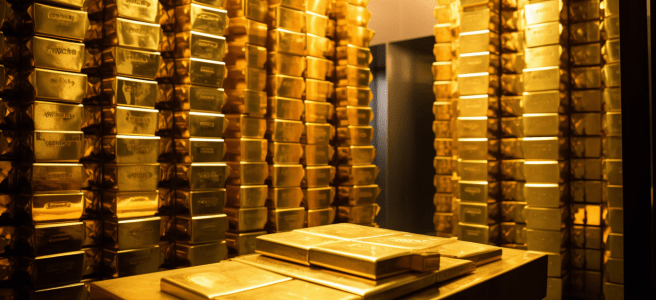
“Afraid for our money!”: The tabloid headlines once again speak from the commodity souls of the people. Yesterday, it was the shock of the real estate crash and the subsequent global financial crisis; today, it is the shock of the imminent bankruptcy of the Greek state that is increasing general insecurity. With each new case, the chain of bad loans proves to be so far-reaching that there are still victims far away. It is no coincidence that the intensification of contradictions is concentrated on money as the medium and end in itself of capitalist “abstract wealth” (Marx). This once again raises the long-suppressed question of the substance and institutional anchoring of money itself. Until World War I, this was not an issue because of all central currencies were pegged to gold. In the war economies and the Great Depression, this peg had to be broken. Necessity was made a virtue; Keynes called gold a “barbarian relic.”

After World War II, the Bretton Woods monetary system was initially anchored to the dollar as the world’s money, which was the only currency still convertible into gold. After this last peg was removed in 1973, the global monetary system shifted to floating exchange rates with increasing uncertainty. Keynesianism collapsed in the face of inflation, which until then had only been known as a consequence of the war economies. The monetarist doctrine of neoliberalism still promised strict limits on the money supply, but even this purely formal commitment was abandoned in the wake of the bursting of financial bubbles since the turn of the century and replaced by a de facto “zero interest rate policy” of the central banks. Now, the money glut that fueled the deficit booms is culminating in a nascent crisis of financial markets and state finances. A growing number of economists are flirting with a “re-monetization” of gold in order to restore monetary stability in a kind of deliverance.

But the clock cannot be turned back. As Marx already showed in the second volume of Capital, gold production as the basis of the monetary system is an unproductive burden, which today would amount to about 5 percent of gross domestic product; roughly the size of the military-industrial complex, which is also capitalistically unproductive. But the problem goes deeper. The decoupling of money from its value substance corresponds to the decoupling of commodities from their labor substance. The price system is only formal and hangs in the air, so to speak. This is just another expression of the fact that the productive forces can no longer be represented in the form of value, as Marx had predicted. After a long period of incubation since 1973, this state of affairs is now breaking through to the surface as a burgeoning crisis of the money medium itself. It is no coincidence that the crisis of the financial markets has rapidly shifted to the state guarantors of money. As always, the weakest links break first, but the problem is a general one. Since socialism beyond the logic of valorization and its medium currently appears unthinkable in the public consciousness, the emergency measures will only open up new contradictions that will assert themselves with increasing speed. The return of the “barbarian relic” could not gild the crisis period, but only bring the fetish character of the ruling mode of production to final recognition.

Originally published in Neues Deutschland on 04/30/2010

The Dawn of The Euro

Robert Kurz

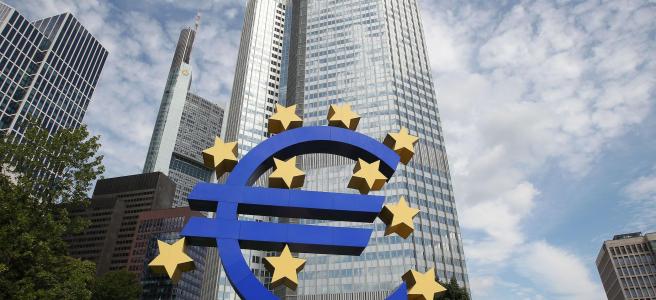
From the start, the euro was an artificial currency with elementary design flaws. Formally, it does not correspond to a single political sovereignty. However, this does not make the European Central Bank (ECB) more independent; instead, its monetary policy becomes a bone of contention between conflicting interests. In essence, the construct is even more precarious. The euro has been imposed on completely different national productivity levels and capital strength. But this inherently contradictory monetary union was the only way to stand up to the other major economic blocs in the process of globalization. This only worked as long as the global deficit economy, fed by financial bubbles, could flourish. After the overdue financial crash, the crisis was nationalized everywhere. Now the second wave is coming in the form of a general crisis of state credit, as the central banks’ flood of money has to subsidize an economy that is no longer self-sustaining. The wildly fluctuating currency relations no longer reflect a relationship of economic strength and weakness, but rather the situation in the decay of monetary policy at that moment. This is evidenced by the fact that all currencies are losing dramatically against gold. Because of its contradictory construction, the euro is only the weakest link in a global process of devaluation. This weakness corresponds to the imbalance in the European domestic economy. National chauvinism is hopeless, because the deficits of the denounced “sinners” are only the flip side of Germany’s export surpluses. The enormous rescue package will either inflate the euro as the first central currency or trigger a deflationary shock if, in return, extreme austerity measures suffocate the intra-European deficit economy. Either way, the euro is unsustainable, but there can be no return to the old national spaces either. The collapse of the euro is the next stage in the disintegration of capitalism. Its sorcerer’s apprentices are fleeing from one monetary catastrophe to the next.

Originally published in taz on 05/15/2010

Trouble in The Eurozone

Inflation Is Avoided Only at the Price of Radical Deflation

Robert Kurz

Countries are becoming increasingly deeply entangled in the contradictions of monetary policy. Only with the help of unprecedented budget deficits could the global economic crisis initially be absorbed, with no self-sustaining recovery in sight. Now the postulate of a state policy of austerity and debt relief threatens to suffocate the fragile economy once again. The IMF board is flirting with “controlled inflation” as a way to further postpone the unmanageable problem. It is no coincidence that the eurozone has moved to the center of the crisis of monetary policy. The monetary union construct delivered a common central bank to the old national sovereigns with different levels of productivity and unequal capital strength. It was designed to externalize this internal contradiction by means of the globalized deficit economy. As its power weakens, the possible sovereign default of the capital-weak euro countries has become an explosive device attached to the monetary union.

After the guarantees and subsidies for the ailing banking system and the deficit-ridden economic stimulus programs, the EU has now launched a third, even larger rescue package for the state finances of the bankrupt candidates. It is staircase wit [Treppenwitz] that in this situation Estonia is being admitted to the euro community and praised for meeting stability criteria that no longer even exist. The European Central Bank (ECB) has already begun buying worthless government bonds. The problem, however, is not the nominal size of the deficits among the alleged “sinners,” but their lack of capital strength. The nominal deficit, measured in terms of national GDP, is higher in the FRG than in Spain, for example. But the FRG has so far been able to keep its head above water thanks to its immense export surpluses, especially in the eurozone. Since 2009, the other EU states have been pushing to reduce this “imbalance.” On the other hand, it has been said that the FRG should not be punished for its export strength, but that the others should create similar conditions for themselves. However, these conditions consist of the fact that the FRG has the largest low-wage sector in Western Europe and combines this with its capital strength. Moreover, the resulting export surpluses can only be financed by the deficits of the capital-weaker countries.

Now the cat is biting its own tail. The intra-European deficit cycle has come to a halt, exposing the contradiction of the monetary union. The ECB’s unrestrained money glut and the complete abandonment of the Maastricht criteria will only not lead to inflation of the euro if, in return, national budgets are radically cut. At present, the FRG’s political class and media are indulging in national chauvinism toward the “sinners.” Conversely, the left is ranting about the “diktat” of the FRG in the eurozone and the erosion of national sovereignties. This ideological discourse does not want to recognize that there is an interdependence here. The extreme austerity policies introduced to save the euro will inevitably lead to a deflationary shock. When state-induced purchasing power runs dry, not only the general devaluation of labor but also the devaluation of physical and commodity capital will flood the eurozone. This shows that the supposedly autonomous export strength of the FRG in the EU has feet of clay. Rescuing the euro and the banking system, which is already largely dependent on the drip of the state and is now also sitting on ailing government bonds, is only possible at the price of a depression in the capital-weak euro countries. Greece has already set the course for this; Spain, Portugal and other countries will follow. The result can only be an explosion of mass unemployment in the FRG, which in turn will affect the rest of the EU. An austerity policy by hook or by crook in the euro countries with negative trade balances, which is tantamount to a collapse of the German export economy, threatens to put the FRG’s budget, which has long been overstretched itself, in the same position as that of the denounced deficit sinners. Capital strength will then turn into capital weakness. When the deflationary consequences of the austerity dictate become apparent, a new U-turn would lead to a chaotic combination of deflationary and inflationary tendencies (stagflation). The Merkel government is in no position to impose its self-interest on the EU, but is vacillating between the choice of plague or cholera. A fortiori, the clock cannot be turned back to a national economic and monetary area in the sense of a bleating D-Mark chauvinism, which has always been based on a one-sided export orientation. Thrown back on its own domestic economy, German glory would have to give up the ghost completely. The internal contradictions of the European monetary union would thus become the catalyst for the second wave of the crisis.

Originally published in the weekly newspaper Freitag on 05/20/2010

We Are Opel

Robert Kurz

In the various packages to save capitalism from itself, the billion is the smallest unit. The works council and the workers of Opel, a company that is in a permanent state of crisis, do not want to hide and are doing their part. Opel boss Reilly and works council chairman Franz have agreed on a package of cuts in wages, vacation and Christmas bonuses amounting to more than one billion euros over the next five years. This is intended to pave the way for government guarantees of 1.8 billion euros. However, in anticipation of a rigid austerity policy, it is by no means certain that these guarantees will actually materialize. In any case, at least 4,000 of Opel’s 24,000 jobs in Germany will be eliminated. The Süddeutsche Zeitung wrote about works council Franz after the agreement: “No question, this is how winners perform.” Is it still going on? While elsewhere in the EU general strikes are being called and factories occupied, Deutschland-AG is mutating into a crisis management community. Pride in having the fewest strike days is no longer enough. The threat potential of Hartz IV and the largest precariat sector in Western Europe make the German trade unions’ hearts sink into their pants: fear eats souls. The agreement at Opel threatens to be the prelude to a race to the bottom in key industries, driving down the general wage level even further. That won’t help. Employee participation in the management of the company can only intensify the macroeconomic downward spiral after the economic stimulus programs have run their course. But the view of the social interrelations is clouded anyway. The ideological community of renunciation is based solely on the false hope of saving one’s own corporate skin in the crisis competition, regardless of what happens to the others. When the catastrophe of state finances triggers the second wave of the economic collapse, Opel will still be the first to go. In the state of consciousness of anticipatory obedience, the only thing that helps is prayer.

Originally published in the print edition of the weekly newspaper Freitag on 05/27/2010

Apocalyptic Technologies

The economic-scientific complex and the destructive objectification of the world

Robert Kurz

Modern natural science is, as far as we know, the most successful project in human history. But it is also by far the most catastrophic. Success and catastrophe need not be mutually exclusive; on the contrary, it is precisely the greatest success that can harbor the greatest potential for catastrophe. It is true that more positive knowledge about nature has been accumulated since the 17th century than in all the millennia before; but for the vast majority of people this knowledge has manifested itself only in negative form. Technologically applied natural science has made the world uglier, not more beautiful. And the threat that nature poses to man has not diminished, but increased in a nature that has been technologically transformed by man himself.

If the “first nature” of biological man has always been over-shaped [überformt] and transcended by culture, giving rise to a social “second nature,” in modernity this “second nature” has intervened with unprecedented violence in the “first nature” and shaped it in its image. The result is a second-order force of nature that has become even more unpredictable than the first-order force of nature with which we were originally familiar.

It is an unholy ruling alliance of economists, natural scientists, technicians and politicians that administers the scientific-technological development process in the form of the modern social system, not only ignorantly defending the independent dynamics contained therein against any critique, but also continuing to push them forward without regard for collateral damage. On the other hand, the critique of science by outsiders and dissidents remains doubly helpless, because it can neither question the social form nor the structure of scientific knowledge, but mostly limits the problem to the moral conduct of scientists, i.e. to the ethical question of “accountability.”

In contrast to this worn-out ethical enterprise, the recent feminist current of the critique of science goes much deeper. This critique shows that the epistemological paradigm of modern natural science is not “neutral” at all, but has a cultural, sexually defined matrix. The concept of “objectivity,” as can be seen from the very beginnings of the history of modern science in Francis Bacon (1561-1626), is unilaterally male-determined; and the claim associated with it is not primarily directed toward knowledge and toward an improvement of life, but toward subjugation and domination.

US-American theorists such as the molecular biologist Evelyn Fox Keller and the philosopher Sandra Harding conclude from this that the strict separation of subject and object, on which modern science is based, must be questioned. However, they are not concerned with a romantic critique of science, but rather with a “different natural science” that frees its cognitive process from the claim to subjugation. In doing so, they draw a parallel between scientific-technological and economic rationality in modernity, both of which boil down to interests in domination and exploitation.

Modern natural science and the modern capitalist economy are not directly identical, but they are similar in character and are interrelated. Beyond the feminist approach of Fox Keller and Harding, this affinity can be demonstrated both historically and structurally. The natural sciences, the economy, and the state apparatuses of modernity have a common root in the early modern revolution in military firearms. Hence the specifically masculine determination of modernity. The social upheaval brought about by the cannon exploded the structures of the agrarian natural economy with the formation of standing armies, a previously unknown large armaments industry, and the expansion of mining. This situation created not only capitalism, but also a corresponding image of nature.

The specifically modern strict separation of subject and object is the product of this history: Just as the male subject of the military revolution literally defined the world as “cannon fodder,” as a pure object of annihilation, so the state apparatus and economic rationality defined individuals as objects of administration and business management. The emergence of natural science was integrated into this development from the very beginning. It is no coincidence that early modern technological inventions were in many ways related to the military innovation of firearms; one need only think of the projects of Leonardo da Vinci, who, like many of his learned contemporaries, constructed cannons and even famously anticipated the development of submarines and attack helicopters.

But it was no mere external expediency that linked the rise of natural science to the military revolution and the capitalism it spawned; it was the epistemological basis of that science itself. Scientific rationality also defined its object as one to be subjugated; right down to the treacherous imagery of “objective” scientific language, as Evelyn Fox Keller shows. The detachment from the dogmas of theology was not a real emancipation of knowledge. On the contrary, it took place under the sign of the emerging military-industrial complex and its secularized economic theology. In this context, nature had to appear as an alien and hostile object. Objectivity thus turned into objectification, cognition into rape.

The common worldview underlying the various forms of objectification is inevitably a mechanistic one. For only mechanical objects can be fully objectified and manipulated. Just as the modern state reduces the living individual to a ghostly abstract legal person, and just as the logic of economics demands that society be reduced to the dead matter of money, so, analogously, natural science reduces natural processes to mechanical interrelations. This reductionism does not necessarily follow from the knowledge of nature per se, but it is a product of the historical tendency towards subjugating objectification.

In social practice, economic, political and scientific reductionism have intertwined to form a totalitarian structure in which man and the world are defined as hostile objects of manipulation. Economics could only be so rigorous in its use of science because scientific rationality has the same roots and inherently follows a similar mechanistic imperative. To this day, we are dealing with a military-economic-scientific complex. The manipulating subject, who, as a natural scientist, politician and economist, has completely separated himself from his objects, has had to objectify and manipulate himself: he has sunk to the level of a mere servant and executor of the independent military-industrial and economic-technological complexes.

The destructive power of these interlocking complexes and their unleashed dynamics has long since crossed the red line beyond which the economically-scientifically generated “natural disasters” begin. As natural capitalism and capitalist natural science come up against certain natural limits and attempt to break through them by force, their reductionist and mechanistic logic threatens to go beyond the creeping destruction of the natural foundations of life into the creation of directly apocalyptic technologies of self-destruction.

Until the middle of the 20th century, the economic-scientific complex had limited itself to subjecting naturally existing substances to its logic of objectification and to consuming them as objects. The moment of destruction occurred only as an indirect side effect. In the last 50 years, on the other hand, the system has proceeded not only to intervene in nature, but to produce a physically and biologically “different nature” from the ground up, because the mere external manipulation of earthly nature has been exhausted. To the extent that the economic-scientific complex recognizes no logic other than its own, and therefore no natural limits, it is insane enough to want to emancipate itself from nature altogether.

After the Second World War it became foreseeable that the fossil fuels stored on earth for millions of years would dry up, at least in an economically usable form, due to modern overexploitation. Thus, the capitalist culture of combustion threatened to reach a natural limit. The answer to this was nuclear technology, i.e. the attempt to unleash a form of energy not found in earthly nature, and, in fact, totally independent of it. The potential for major catastrophes like Chernobyl or Harrisburg is not the only self-destructive factor here. Even the accident-free operation of this technology accumulates mountains of radioactive waste, whose absolutely hostile effect on life can no longer be processed and degraded by natural processes themselves, but lasts for tens of thousands of years – a culturally unimaginable period of time. This apocalyptic dimension of nuclear technology, however, is not due to the need for knowledge of nature per se, but to the compulsive claim of modern natural science to objectify nature and to consign to destruction everything that resists this objectification.

The same logic as with regard to the energetic basis of capitalism is evident at the level of the transformation of natural substances. Until the end of the 20th century, the technological application of natural science in the economic space of capital was concentrated on the physical and chemical transformations of industrial production. Agriculture, as agribusiness, was increasingly organized along the lines of industrial capitalist production, but direct interventions in the biological “material” were largely limited to traditional methods of animal and plant breeding.

It is no coincidence that this limit was exceeded at the end of the 20th century. For in the third industrial revolution of microelectronics it has become clear that the industrial use of inorganic substances as a carrier of economic growth has been exhausted; even the so-called service society cannot compensate for this exhaustion. The reaction of the system is again excessive and irrational: organic nature, life itself, is to be broken down into its elementary components and transformed in order to create “another biology” independent of natural earthly evolution. With the help of genetic engineering, the economic-scientific complex wants to produce plants, animals and ultimately also human beings in its image, which are already “second nature” on the elementary biological level and thus literally creatures of capital with skin and hair.

Genetic engineering would not automatically follow from scientific knowledge of the genome alone. The largely unexplored interrelations are far too complex for the possible consequences of technological interventions to be controllable at this level. It is no longer a question of a limited scientific procedure on individual exemplary materials, but the entire earthly interrelation of life as such is transformed into a laboratory object. Mistakes, mishaps, or unknown mechanisms can at any time turn into uncontrollable biological chain reactions, genetic deformations, and incurable new epidemics. Humanity itself becomes a collective laboratory animal for biotechnological risk experiments. And again, natural science does not have to be subordinated externally to the economic imperative for any of this to happen. Rather, genetic engineering is also a product of its own logic of the objectification and subjugation of nature.

The frightful moment of ecological reflection has long since passed. With the energetic program of President Bush, the capitalist world power USA is returning to the reckless expansion of nuclear technology; the rest of the world will follow this program. And everywhere the inhibition thresholds for the rigorous use of genetic engineering are falling, everywhere governments are relaxing safety standards, everywhere the “ethical discourse” is languishing in the face of economic-technological “constraints.” In order to stop the apocalyptic technologies, not only a different social form is needed, but also a different natural science in the sense of Evelyn Fox Keller and Sandra Harding. If scientific knowledge cannot emancipate itself from the logic of a life-hostile objectification of nature, the economic-scientific complex will succeed in turning the earth into a physical desert.

Originally published in Folha de São Paulo on 06/17/2001

The State of Money and The Money of The State

Robert Kurz

Can the state, through its command, override the internal contradictions of the capitalist economy? The state and the market are indeed institutionally opposed to each other. But they have a common basis. The state machine must be financed, as must capital investment or the cultural enterprise. That is why money forms an overarching medium. It is the material expression of “abstract wealth” (Marx) and is universal only because it represents the capitalist end in itself of making two euros out of one. In this way, the medium of money is tied to the accumulation of capital. Its labor substance, in turn, depends on the social standard of productivity as enforced by competition. It follows that the state can regulate the substantive accumulation of capital, but cannot conjure it up or even replace it. In the absence of sufficient autonomous capital valorization, there is nothing left to regulate.

The state is a machine of money insofar as it guarantees the external framework of valorization. Precisely for this reason it has no command over money. It can only regularly obtain its own money by taxing the real production of surplus value (profits and wages). It is misleading to speak of state investment as if it were a contribution to growth. When the state builds roads and schools or finances education and research, this is social consumption because the purchasing power for it was previously deducted from real surplus-value production. The same applies to the activities of construction companies, educational institutions, etc., to the extent that they are financed by government spending. As soon as the state borrows through bonds because its regular revenues are insufficient, it is thereby subject to the same conditions as companies and private individuals. However, the servicing of the loan (interest and repayment) presupposes a capital-productive application, which does not take place in the case of the state. It is as if an enterprise did not produce value, but only consumed. That is why Marx, in the 3rd volume of Capital, presented the state debt, traded in the form of securities, as a special form of “fictitious capital,” illusory from the outset. Nor does the state character of the central bank as the “lender of last resort” give the state any real command over money. The central bank’s authority is purely formal, but not substantive. Its creation of money out of nothing can only represent the real value substance of capital accumulation. If more money is injected than corresponds to the real value relations, this results in the devaluation of money itself. Of course, this is all the more true if the state no longer submits to the terms of credit, but instructs its central bank to transfer money directly to it. On the one hand, states all over the world are currently resorting to this desperate measure. On the other hand, they are trying to contain the consequences through a rigid austerity policy. In doing so, they are moving in a circular contradiction that can only lead to new distortions. If state failure and market failure are joining hands at ever shorter intervals, this points to the crisis of the overarching medium itself. It is just another expression of the fact that the productive forces have outgrown the form of “abstract wealth.” This is as much a disgrace to faith in the state as it is to faith in the market.

Originally published in Neues Deutschland on 05/28/2010

State Aid and Market Logic

Opel becomes a model case of desperate contradiction processing

Robert Kurz

In the midst of the global financial and economic crisis, the free-market community has changed horses. The state, long dismissed as a bureaucratic evil, has been harnessed everywhere with gigantic financial packages to pull the wagon of capital to safety. On the one hand, the meek market radicalism thus acknowledges that the state has always been an integral part of the social system and not an external disruptive factor. On the other hand, it shows precisely because of this that the state cannot be a sovereign savior, but is itself imprisoned by the inner contradictions of the glorious market economy. The state programs, which were on par with those of the war economies, have only postponed and shifted the problem of a lack of real capital valorization. While the transnational financial bubble economy lasted for two decades until the crash, national state finances are already reaching their limits within a year.

According to the economists’ own standards, the crisis can only be overcome if there is a comprehensive market shakeout. In plain language: Even large corporations have to jump ship in order to reduce overcapacity and then supposedly get a fresh start. In the financial sector, however, the bankruptcy of Lehman Brothers was seen not as a market shakeout, but as the worst possible accident and the trigger of the crisis. As a result, not only were the other major banks kept afloat by financial injections from the state, but industrial corporations were also bailed out. General Motors in the U.S. and its subsidiary Opel in Germany are prime examples of this. After much wrangling over state aid, Opel stayed with GM, but the problem has not gone away. In the automotive sector in particular, the tentative economic spring is living almost exclusively on government programs. Apparently, there is little faith in autonomous market forces if state aid for the GM subsidiary is now being discussed again.

Opel is becoming a model case of desperate state contradiction processing. By supporting the still-struggling carmaker, the federal and state governments are distorting competition according to market criteria. This applies to foreign competitors as well as to other German automakers and their European subsidiaries. There is a simple reason why we hear so little about this. If European sales collapse after the economic stimulus programs expire, all the car companies will go to their countries and point the finger at Opel or GM. It would be an admission that the initial stimulus aid has failed and that the state needs to provide long-term support for key industrial sectors.

Postponed is not canceled. Since the shift to the state has not changed the underlying problem of the deficit economy, the market shakeout is still to come. In view of the already overstretched state finances, continuing to try to delay this consequence is like trying to square the circle. At the same time, the much-vaunted monetary and economic policy fronts between the U.S. and the EU have turned into their opposite. The former pioneer of market radicalism is subsidizing its wobblers without restraint and is apparently willing to accept an inflationary surge in the long term, perhaps in the belief that there is no alternative to the dollar as the world currency. Conversely, the European faith in the state, which has temporarily returned to favor, is experiencing its Waterloo because the contradictory structure of its monetary union has made the crisis of state finances manifest in this area for the first time. Therefore, a crisis Keynesian escape to the future, as in the United States, has become impossible. Although the permanent subsidization of the economy by the state will also come to an end there, the European escape route is already running in the opposite direction.

The regulation of drastic austerity programs for the euro countries, as is also being pursued in Germany, is of course in stark contrast to the option of new rescue packages. Governments face a dilemma. Either they save all of them or none of them. Why should Opel, of all companies, be subsidized when the elimination of subsidies is on the agenda everywhere? What’s more, the government’s austerity measures and possible tax hikes (or both) threaten to strangle the weak economy in the entire eurozone, which has been supported by the government since 2008, all the more quickly. Once again, the auto industry will be particularly hard hit, not least German exports to the EU. It is impossible to save Opel with an exemption and at the same time expose it to the next economic slump. Focusing on the will of the electorate as reflected in the opinion polls cannot undermine the logic of the crisis. The famous market shakeout will prevail even if people no longer want to know anything about it because there is no self-sustaining upswing in sight. Capitalism does not work without the state, but neither does it work with the state alone.

Originally published in the print edition of the weekly newspaper Freitag on 06/03/2010

An Uncertain Future

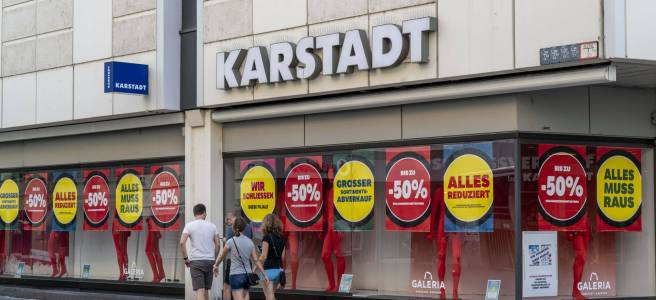
Like Opel, Karstadt remains a borderline case of devaluation

Robert Kurz

Too big to fail? In terms of risk to capital as a whole, this question first arose in the case of banks classified as “systemically important,” which led to expensive bailouts by the state. For different reasons, the car company General Motors was considered too important to be completely scrapped. Here, the state stepped in out of concern for the industrial regions and their respective votes. Now that the dust has settled a bit on GM’s bankruptcy, state aid to its German subsidiary Opel has become doubtful. But there are also cases that do not qualify for the Good Samaritan approach of the state. These include the bankruptcy of the Arcandor Group, which gobbled up well-known retail brands and gambled itself away in the process. Of the candidates for bankruptcy, the Quelle mail-order company found no favor with the state or investors. The former showpiece of the economic miracle was put to sleep; the central complex in Nuremberg-Fürth is now a ghost town, like the old halls of Grundig and AEG. By contrast, the Karstadt department store group with its 25,000 employees, which was also swept away by the Arcanador crash, no longer attracted the eye of Father State after a lean period of bankruptcy administration, but it did attract the covetous gaze of investment companies.

It’s nothing new for entrepreneurial bargain hunters to scoop up devalued real and commodity capital for pennies on the dollar during a crisis, before they themselves go over the edge or a general upswing comes along. Three bidders have been found for Karstadt: a consortium called Triton, a private investor named Nicolas Berggruen, and the Highstreet Group (majority controlled by Goldman Sachs and Deutsche Bank). This does not inspire confidence, nor do the conditions. For example, the 98 municipalities with Karstadt stores were forced to forego business tax revenues. Berggruen won the bidding because he is the only one willing to take on all the employees. But he will only go through with the deal if Karstadt’s landlords (none other than the Highstreet Group, which was involved in this poker game) agree to drastic rent reductions.

If it works out, the bankruptcy administration simply had the right timing. While Quelle was swept away by the crisis maelstrom in 2009, Karstadt is now keeping its head above water in the environment of the economic stimulus programs. And although trillions of dollars and euros were burned in the financial crash, the flood of money from central banks has since provided investment funds with liquidity again. That’s why bankrupt properties are arousing increased buying appetites; whether it’s out of an interest in trading the organs of the corpses of companies or a more genuine interest in continuing operations. However, austerity programs and currency crises with new economic slumps as a consequence could put a damper on both options. Like Opel, Karstadt remains a borderline case of capital devaluation. The future of the company and its employees is supposed to be secure, but these days the future may only have the scope of a reprieve.

Originally published in the weekly newspaper Freitag on 06/10/2010

Who Lives Beyond Their Means?

Robert Kurz

First it was the financial markets that were accused of lacking responsibility in the face of the crisis, then state finances. When they are at the end of their rope, the powerless can only come up with grandmotherly wisdom. Suddenly there is talk of deficit sins everywhere, as if this were a completely new discovery. We have lived beyond our means, they say. But what does that mean? If it were merely a matter of the misconduct of deficit sinners who have violated “proper” capitalism, then all those who can no longer service their debts would simply have to go bankrupt. This was the case with Lehman Brothers. But the consequences were so devastating that since then the due bankruptcies have been postponed by adventurous financial actions. First in the banking system, then in large corporations like General Motors, and finally in countries like Greece. Against the laws of the market, central banks are pumping more and more liquidity into the markets. In comparison, the announced austerity measures are just a drop in the bucket.

There is a simple explanation for this internal contradiction in government action. Debtors and creditors have always been in a relationship of mutual dependence. The debts of one appear as the credit balances of the other. Today, this relationship has taken on a historically unprecedented dimension. As the demise of Lehman Brothers has shown, any major bank failure threatens to trigger a global chain reaction. There is no longer a simple relationship between debtors and creditors; instead, the credit balances that have become fictitious serve in turn as pseudo-collateral for borrowing. All creditors are also debtors and vice versa. The Greek national bankruptcy had to be prevented because important major banks are sitting on hundreds of billions of dollars of ailing government bonds. The same applies to the bad loans held by banks, manufacturing companies and private individuals.

What no one wants to admit is that material production capacities have outgrown the social form of capital valorization. Therefore, the argument that we are now dealing with a socialization of losses at the expense of the taxpayers is insufficient. That would still presuppose an intact real valorization. In reality, however, the credit bubbles have become the fragile foundation of the entire world system as an anticipation of imagined future value creation. If one takes the social productive forces as a yardstick, then most people are living far below their means. While, according to international statistics, global mass poverty continues to increase, the existence of the much-vaunted middle class, even in the emerging countries, depends on inflated national and transnational credit. The currently acclaimed export boom in the automobile industry, for example, is based on this. Delaying a market shakeout with ever new guarantees and debt rescheduling is nothing more than an attempt to keep the productive forces locked into the logic of valorization, which has become insubstantial. But the holes in the financial system are only being plugged in order to tear open new ones. The next financial crisis is programmed by the postponement measures themselves, no matter where it starts. It is the capitalist mode of production itself that has long been living beyond its own means.

Originally published in Neues Deutschland on 06/25/2010

Economic Deceptive Packaging

Robert Kurz

The healthy positivist scientific mind prefers to rely on facts, facts, facts – and nothing else. But pure bean-counting is questionable because, especially in economics, it is not certain that the beans being counted even exist. The most primitive form is, of course, the direct falsification of balance sheets, which neither corporations and banks nor governments shy away from, especially in times of crisis, as we have seen again recently. And as far as official statistics are concerned, Churchill famously said that he did not trust any that he himself had not falsified. But the distortion of empirical truth usually goes on quite legally. All that is needed is to change the criteria for collecting the figures.

It was not only in the U.S. that the accounting rules during the financial crisis were designed in such a way that banks could conveniently outsource their toxic paper to so-called special purpose vehicles. What the U.S. economist Roubini called the “shadow banking system” and blamed in part for the crisis was not dismantled, but actually expanded. The same goes for public finances. A considerable mass of debt is hidden in “shadow budgets” that are not accounted for. A similar trick has long been used in unemployment statistics. Every year the methods of recording are reformulated. For example, part of the labor market miracle in the FRG can be attributed to the fact that, as of recently, the unemployed served by private placement agencies are simply no longer counted.

But even if the numbers are correct, they can be colored nicely by interpretation. When it comes to gross domestic product, neither absolute figures nor relative percentages of growth tell us anything if the reference variables are ignored. What matters about growth is the starting point. In Eastern Europe, high growth rates of 7 percent and more have been celebrated. This was accomplished after the collapse of the Eastern Bloc had led to devastating deindustrialization. Moreover, post-crash growth was largely fueled by debt in foreign currencies (euros, dollars, Swiss francs) and is now proving extremely fragile.

The notion of China as a new economic world power is also based on distorted interpretations. The impressive growth rates are not only due to deficit structures (export one-way streets, now credit-financed government programs), but also to a low starting level. Experience shows that growth declines sharply during the transition from extensive to intensive industrialization. Despite the increase, China’s GDP of $4.6 trillion is still far below that of the U.S. and the EU of $14 trillion each, with a much larger share of the world’s population. It is doubtful that China can serve as a global growth engine for the FRG, for example. Here, too, the 1.4 percent growth forecast for this year must be seen in the context of the lower starting level after last year’s 5 percent slump. Everywhere and in every respect, the lazy magic of numbers stands on feet of clay. The apparent facts should be taken with a grain of salt, because ultimately the objective logic of capital valorization cannot be fooled. This was already true of the financial crash of 2008, which was not apparent from the official facts.

Originally published in Neues Deutschland on 07/23/2010