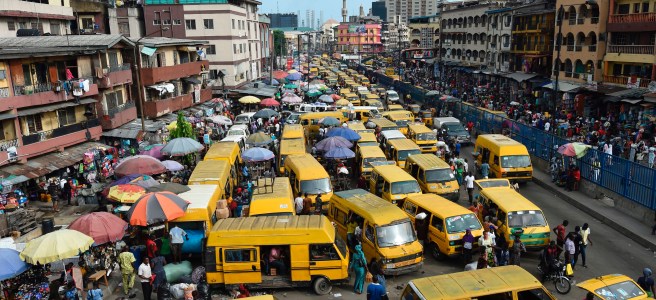
Population Growth as a Supposedly Central Ecological Problem
It should always make us sit up and take notice when critique of the capitalist mode of production and way of life, which leads to ever-increasing consumption of resources and is based on indifference towards people and nature, is sidestepped precisely by making the real scandal the mere number or rate of increase of the human population (of course mostly in the “developing countries” – which undoubtedly also has a racist component). The horror of “overpopulation” was already propagated in the late 18th century by Thomas R. Malthus with his law of population. Supposedly, humans reproduce in a strictly geometric manner, whereas food production can only be increased arithmetically. For Malthus, therefore, caring for the poor would be irresponsible, as it would only worsen their lot. The poor would multiply even further and everything would get worse. The poor are, so to speak, the “unfortunate ones who have drawn the blank in the great lottery of life” (Malthus 1977, 94; on Malthus, see Kurz 1999a, 138ff.; see also Mielenz 2008). Malthus’s law of population and his perfidious justification and misinterpretation of famines did not remain mere theory. When, due to capitalist economic dynamics, the need for food could not be expressed as solvent demand and resulted in hunger, bourgeois ideologues were quick to justify mass death with “overpopulation” and the “struggle for existence.” Accordingly, they also refrained from combating hunger (for example, by banning food exports from the famine region and distributing food without regard for the amount of “work” that had been performed).[1] According to this cruel capitalist logic, humanitarian aid would prevent a market adjustment of “human resources,” i.e., no new “equilibrium” would be established if the “superfluous” were allowed to live.
In the second half of the 20th century, many people saw population growth as the main obstacle to the catch-up development of so-called Third World countries. Efforts were therefore made to reduce population growth in the “Third World.” To this end, development aid was linked to appropriate measures. These measures even included testing new contraceptive methods on women in the “Third World” that had not been approved in industrialized countries (see, for example, the essays in: Beiträge zur feministischen Theorie und Praxis Nr.14).
In the 1970s, when ecological destruction became a topic of public concern, Malthusian ideas were linked to ecology. The “population bomb” was apparently endangering the planet and the “limits to growth” would allegedly soon be reached.
Such arguments have persisted to this day and, against the backdrop of the crisis and the general tendency to wage war on the poor and the “superfluous,” have taken on a threatening relevance. It is not capitalism that is the focus of critique, but people themselves who are the problem. Capitalism has been internalized and taken for granted to such an extent that it and its peculiarities go as unnoticed as air pressure (especially since capitalism is usually seen only as a sinister machination of the “top 1%” or similar).
Verena Brunschweiger, for example, argued along these lines in her book Kinderfrei statt Kinderlos [Child-Free Instead of Childless], which caused a sensation in 2019.[2] Brunschweiger sees herself as a feminist and rightly criticizes the ideology of motherhood, according to which a woman can only have a fulfilling life if she brings children into the world because that supposedly corresponds to her nature. In doing so, she criticizes the discrimination against childless or “child-free” women. Brunschweiger states that an anti-feminist backlash is taking place in Western societies, not least against the backdrop of a pro-natalist offensive by autocrats and their corresponding rabble.[3]
The insidious thing about Brunschweiger’s book is the link it makes between a child-free lifestyle and climate protection: “It is unreasonable to constantly demand explanations from childless women for their decision. We need a new social norm that, conversely, expects parents to explain why they believe they have the right to further endanger all of our lives on this planet” (Brunschweiger 2019, 50). In other words, we should refrain from having children in order to reduce CO2 emissions. She refers to various studies (such as Schrader 2019). She assumes that the sheer number of people is the problem and will ultimately lead to the ruin of this planet. The more people there are, the more flights and mountains of waste there are, so to speak. So if the birth rate is reduced so that the total number of people shrinks, the planet can recover. Not having children is also the right decision because “very few children will later, as adults, solve the plastic problem in the ocean or end the unjust distribution of resources on our planet” (Brunschweiger 2019, 130). She apparently rules out the possibility that modern consumerism could be criticized and overcome (ibid., cf. Greß 2022). Children will necessarily become as narrow-minded as their parents. So it would be better if they had never been born in the first place. Anti-natalism thus serves not only to protect women from the patriarchal prison of the family, but also to save the planet. The more people there are, the more misery there is, the more resources are consumed, and the worse off the Earth is. Consequently, she also refers to the anti-natalist philosopher David Benatar, who argued that it is morally imperative to “cause as little suffering as possible.” Therefore, according to Benatar, there is “a moral obligation […] not to reproduce” (ibid., 37 and 36). Fewer people, less suffering. A person who is not born does not suffer. It’s that simple. But it gets even better: Brunschweiger also refers to misanthropic associations such as the VHEM, the “Voluntary Human Extinction Movement,” whose followers are convinced that the biosphere would only have a chance to recover once humans had disappeared from it (ibid., 117). In an interview with the Westfalen-Blatt (March 13, 2019), Brunschweiger said that she found such a position “too extreme.” But, Brunschweiger continued, she “understands that there are people who would like that. Of course, it wouldn’t be bad for the rest of the biosphere if it could recover a little from humans and animals and plants could live in harmony. But if there were 38 million of us in Germany instead of 80 million, then one Earth would be enough. But at the moment, we need three Earths.” On the other hand, she suggests that the destruction of the environment does not depend solely on the sheer number of people; she mentions that a British “child pollutes the environment and wastes resources 30 times more than a child from sub-Saharan Africa” (Brunschweiger 2019, 112). She does not pursue this idea further, especially since she implicitly presumes that greater prosperity also means greater alignment with Western capitalist states, with the corresponding waste of resources and production of nonsense and junk.
If the aim were to pursue a progressive population policy that is not misanthropic and does not deprive people of their very existence, social circumstances would have to be taken into account, since a high number of children is hardly due to a patriarchal ideology of childbearing alone, but above all to socio-economic living conditions (in addition to education, degree of urbanization, etc., cf. Bricker/Ibbitson 2019). Heide Mertens writes: “It is not the availability of appropriate contraception, but the social circumstances in which women have children that determine the number of children they have. It is not the number of people that determines the state of the environment, nor is it solely the level of technology used to cultivate nature, but the way in which people produce” (Mertens 1994, 182).
Nowadays, however, it is not the social system that is the focus of critique, but rather the people who are made superfluous by capitalism and then flee environmental destruction and war who are seen as the real problem. With regard to the present, the “overpopulation discourse” therefore remains extremely controversial, “because, especially in the current eco-movement, it is once again recklessly assumed that, firstly, there are ‘too many’ people and, secondly, that their unbridled consumption is destroying the earth” (Wildcat No. 104, 21).
These are by no means isolated or extreme cases. “The list of reactionary nonsense caused by climate change is long,” as eco-socialist Daniel Tanuro notes (Tanuro 2015, 128). Economists have seriously proposed “supplementing the market for greenhouse gas emission rights with a market for ‘the right to procreate’ (!) in order to control the impact of demographics in developing countries on the climate” (ibid.). Economists at the London School of Economics offset unborn human lives and their presumed CO2 emissions with the CO2 savings achieved by green technologies. These ideological henchmen have calculated that “spending $7 on family planning per year would save more than one ton of CO2 by 2050. To achieve the same result using green technologies, $32 would have to be spent” (ibid. 130). Two so-called “experts” who wrote a study for the Pentagon in 2003 warn of a “flood of climate refugees” (!) and conclude that countries such as the US and Australia would “probably build fortresses.” They write “cold-bloodedly,” as Tanuro points out, “that ‘around these fortresses, the deaths caused by war, but also by hunger and disease, would reduce the size of the population, which would then adapt to the carrying capacity [of the ecosystem] over time’” (ibid., 127f.). A misanthropic discourse that blames “overpopulation” in the “Third World” for climate change amounts to nothing less than “the mass extermination of the poor, as if they were surplus lemmings” (ibid., 128). Such reactionary population policy discourses also come from the UN, which one might naively think “is above suspicion” (ibid., 128, see Abeselom 1995 for more detail with a focus on Ethiopia). Incidentally, the claim that the population will continue to grow is empirically untenable (this cannot be discussed further here: see Bricker/Ibbitson 2019, Trumann 2024, and Wildcat No. 104, 20ff.).
A “Malthusian discourse” has long since found its way into the ranks of eco-socialists and post-growth economists. In some cases, extremely reactionary positions are represented there. In German-speaking countries, for example, an “overpopulation thesis” is advocated by the eco-socialists Bruno Kern and Saral Sarkar. In his book (translated and edited by Bruno Kern), Sarkar cites numerous wars and violent conflicts and attributes them, using more or less biological arguments, to overpopulation (alongside nationalism and identities). Even the Middle East conflict (!) is said to have overpopulation as its main cause: “But most observers and commentators fail to mention the deeper cause of the conflict’s intractability, namely that it is a war over birth rates” (Sarkar 2025, 45, cf. in contrast: Wistrich 1987 and Tarach 2010)!
Kern expressly distances himself from Malthusianism “in the sense of a ‘selection of the superfluous’” (Kern 2019, 37). According to Kern, overpopulation must be related to the “respective ecological footprint, and measured by this standard, it is precisely the rich industrialized nations that are ‘overpopulated’” (ibid.). This essentially means that “overpopulation” here cannot really have anything to do with the mere “number of people,” but rather with a destructive way of life and production.
On the other hand, Kern writes: “More people means more infrastructure cast in concrete and land sealing, apartments, hospitals, roads, factories, large-scale energy supply systems, etc.” (Kern 2024, 111). And: “It’s trivial: the more people claim resources for themselves, the scarcer they become” (ibid., 106). Consequently, Kern believes it is “essential to examine all possibilities for curbing population growth in a non-repressive manner” (Kern 2019, 38).[4]
Kern points to another aspect, namely the finite nature of agricultural production in general and the fact that the earth cannot feed an unlimited number of people (even in a society free of capitalism), especially since the amount of land suitable for agriculture is declining due to soil erosion and desertification (peak soil). Climate change will exacerbate this situation enormously. Projections showing that ten or more billion people could easily be fed “are based on false presuppositions, such as the current intensive agricultural use of the soil, which is obviously not sustainable.” According to Kern, sustainable agriculture would be “more extensive in terms of land use and less productive” (Kern 2015, 335).
This “argument” can be countered as follows: if, on the one hand, more and more regions of the world become uninhabitable due to climate change, i.e., ecologically ruined, we must prepare ourselves for unprecedented refugee movements and famines. The key point here is that demographic changes have a different timescale and it is therefore nonsensical to try to halt climate change through population policy: “Demographics are a factor that must be taken into account, but they are not a cause of climate change and even less a solution to the challenge of drastically reducing emissions, which must be done in an extremely short period of time” (Tanuro 2015, 129, emphasis added).
On the other hand, Mathusians should instead be asked the question: How can we ensure food security without declaring part of humanity superfluous or the world overpopulated? The fact that organic farming is sometimes less productive does not necessarily mean that there would be less food available overall if eating habits were changed (e.g., less animal products) and the sometimes enormous waste of food were stopped. This deserves attention, rather than talk of overpopulation (which in no way precludes sensible family, education, and sexual policies). What if the planet is really so ruined at some point that it is indeed no longer possible to feed many millions or billions of people (because large areas of agricultural land are devastated or washed away), and humanity does not overcome capitalism, or does so too late? It is doubtful whether the outcome would be any different if the world population had been lower: in this case, the Malthusian argument would no longer apply, because in a devastated world there would actually be too little to go around, as too much land would have been ruined, too little harvested, etc. Even then, it would be a fallacy to say that there were too many people.
Above all, if agriculture is retained as the substrate of capital’s valorizing movement, a decline in population would by no means relieve the burden on the planet (this is demonstrated, for example, by current and future rationalization drives in food production: cf. Becker 2025). The so-called overpopulation discourse never addresses the exact causes of hunger, in particular how hunger can be explained in the midst of abundance. Robert Kurz wrote on this subject: “The social barrier to the production and distribution of food is not determined by a lack of agricultural yields in comparison to the size of the population, but by the economic form of the modern commodity-producing system. The logic of economic profitability forces an irrational restriction of resources, which is particularly evident at the elementary level of nutrition. In principle, people are only given access to food on the condition that their labor can be used profitably. If this criterion cannot be met because ‘excessive’ productivity has made their labor superfluous, they are put on starvation rations, even though food production capacity has increased. While for all pre-modern societies a record harvest promised at least temporary abundance for all, it must appear disastrous to the economic calculations of agribusiness because such an ‘oversupply’ would depress prices. Therefore, it is normal market practice to destroy agricultural products en masse or dispose of them through denaturation when yields are exceptionally high. Hunger becomes a product of abundance itself” (Kurz 1999b, emphasis added).
Making population growth or the number of people the central problem therefore neglects the real reason for the destruction of the world: an irrational mode of production that views all nature as nothing more than raw material, that wants to incorporate all nature into the metamorphosis of capital M-C-M’, completely disregarding nature and its necessary characteristics, and thus increasingly striving to transform nature into a capitalist product (which tends to be synonymous with its destruction). It is the monstrous valorizing movement of capital that prevents a relationship between humans and nature and between society and nature that could enable long-term commitment or long-term reproducibility, not too many people. However, one should not go to the opposite extreme here: we should not consider any so-called “instrumentalization” or “domination of nature” to be negative per se and, in turning away from technology and industry, imagine a harmonious, romantic, and kitschy relationship with nature.
It should be noted that the usually misanthropic recourse to so-called overpopulation has repeatedly served as an excuse not to deal with the critique of political economy and patriarchy, but rather to reproach and deny the poor (especially those in the “Third World’”) their very existence (cf. Abeselom 1995; cf. also Kayser 1985). If capitalism rejects certain groups of people or masses of people in the sense that the labor market (or the world market) cannot absorb them, i.e., they cannot sell themselves as “labor” (and therefore their needs cannot be expressed as solvent demand), then the problem is not seen in the subjugation of people to abstract labor or in the destruction of their subsistence or expulsion from it – no – it is the people themselves, their mere existence, that is made into a problem. The decisive issue remains putting an end to the deformation and destruction of the world by capitalism. Making the number of people as such the central problem ultimately leads to reactionary waters.
Literature
Abeselom, Kiros: Der Mythos der Überbevölkerung als Mittel zur Wahrung der bestehenden gesellschaftlichen Strukturen – Die theoretischen Grundlagen der UNO-Bevölkerungskontrollpolitik: malthusianische und neo-malthusianische Wurzeln, Bonn 1995.
Autorenkollektiv: Wildcat Nr. 104, Köln Winter 2019/20.
Becker, Matthias Martin: Bodenlos – Wer wird die Welt ernähren? – Umbrüche in Agrobusiness und Tierindustrie, Klön 2025.
Bricker, Darrell; Ibbitson, John: Empty Planet – The shock of global population decline, London/New York 2019.
Brunschweiger, Verena: Kinderfrei statt kinderlos – Ein Manifest, Marburg 2019.
Familienplanungszentrum – Balance (Hg.): Die neue Radikalität der Abtreibungsgegner_innen im (inter)nationalen Raum – Ist die sexuelle Selbstbestimmung von Frauen heute in Gefahr?, Neu-Ulm 2012.
Greß, Johannes: Konsumideologie – Kapitalismus und Opposition in Zeiten der Klimakrise, Stuttgart 2022.
Guastella, Dustin: Eine Linke, die Angst vor der Zukunft hat, ist zum Scheitern verurteilt, jacobin.de vom 9.7.2025, online: https://jacobin.de/artikel/zukunft-antinatalismus-strategie.
Kayser, Gundula: Industrialisierung der Menschenproduktion – Zum faschistischen Charakter der Entwicklung neuer Technologien der Geburtenkontrolle, in: Beiträge zur feministischen Theorie und Praxis Nr. 14, Köln 1985, 55-67.
Kern, Bruno: Das Märchen vom grünen Wachstum – Plädoyer für eine solidarische und nachhaltige Gesellschaft, Zürich 2019.
Kern, Bruno: Industrielle Abrüstung jetzt! – Abschied von der Technik-Illusion, Marburg 2024.
Kern, Bruno: Karl Marx – Texte – Schriften – Ausgewählt, eingeleitet und kommentiert von Bruno Kern, Wiesbaden 2015.
Kurz, Robert: Schwarzbuch Kapitalismus – Ein Abgesang auf die Marktwirtschaft, Frankfurt 1999a. Online: https://exit-online.org/pdf/schwarzbuch.pdf.
Kurz, Robert: Natura denaturata: Die Ernährung der Menschheit durch den Kapitalismus, 1999b, Online: https://www.medico.de/natura-denaturata-13898.
Malthus, Robert: Das Bevölkerungsgesetz, München 1977, zuerst 1798.
Mertens, Heide: Frauen, Natur und Fruchtbarkeit – Die Bevölkerungsdebatte und die ökologische Tragfähigkeit der Erde, in: Wichterich, Christa (Hg.): Menschen nach Maß – Bevölkerungspolitik in Nord und Süd, Göttingen 1994, 181-200.
Mielenz, Christian: Wie die Karnickel – Biologisierung und Naturalisierung kapitalistischer Phänomene am Beispiel der These einer »Überbevölkerung“, in: exit! – Krise und Kritik der Warengesellschaft Nr.5, Bad Honnef 2008, 105-126.
Riesebrodt, Martin: Fundamentalismus als patriarchale Protestbewegung, Tübingen 1990.
Sarkar, Saral: Krieg, Gewalt und die Grenzen des Wachstums, Marburg 2025.
Sauer-Burghard, Brunhilde: Wie mann Frauen als Aggressionsobjekte unsichtbar macht – Fundamentalismen im Diskurs der patriarchalen „kritischen“ Wissenschaft, in: Beiträge zur feministischen Theorie und Praxis Nr. 32, Köln 1992, 59-65.
Schrader, Christopher: Die Kinder und der Klimaschutz, spektrum.de vom 13.3.2019, online: https://www.spektrum.de/news/die-kinder-und-der-klimaschutz/1629194.
Tarach, Tilman: Der ewige Sündenbock: Heliger Krieg, die ‚Protokolle der Weisen von Zion‘ und die Verlogenheit der sogenannten Linken im Nahostkonflikt, Freiburg/Zürich 2019, 3. überar. Aufl.
Tanuro, Daniel: Klimakrise und Kapitalismus, Köln 2015, zuerst Paris 2010.
Tharoor, Shashi: Zeit der Finsternis – Das Britische Empire in Indien, Berlin 2024, zuerst Neu Delhi 2016.
Trumann, Andrea: Kostenfaktor Kind – Die Geburtenrate sinkt ungeachtet politischer Maßnahmen, jungle.world vom 16.5.2024, online: https://jungle.world/artikel/2024/20/geburtenrate-weltweit-sinkt-kostenfaktor-kind.
Wistrich, Robert: Der antisemitische Wahn: Von Hitler bis zum Heiligen Krieg gegen Israel, Ismaining bei München 1987.
[1] During British colonial rule, Indian journalist Shashi Tharoor documented numerous famines whose death tolls were similar to those caused by Stalin or Mao (cf. Tharoor 2024, 265ff.). Of course, these famines had nothing to do with alleged overpopulation.
[2] It should be noted that anti-natalist discourse is much more widespread in the English-speaking world than in Germany, so Brunschweiger’s position is by no means an “exotic opinion”; see also Guastella 2025.
[3] Wherever religious or ethnic extremists gain influence, there has always been an increase in patriarchal terror, which is repeatedly directed against reproductive rights (cf. Balance 2012), as demonstrated recently by Trump’s authoritarian restructuring of the USA. Religious fundamentalism has therefore been rightly described as a “patriarchal protest movement” (Riesebrodt 1990). However, the patriarchal core of religious fundamentalism has often been downplayed by its mostly male critics (see Sauer-Burghard 1992).
[4] I assume that Kern is referring here to eugenic measures or China’s former one-child policy.
Originally published in October 2025 on www.oekumenisches-netz.de
 EXIT! in English