As is well known, it was the real estate bubble in the Anglo-Saxon countries and in parts of the eurozone that first fed the global deficit economy and then, when it burst, triggered the biggest financial and economic crisis in more than half a century. The battered housing markets are now on state-financed life support. Government guarantees and subsidies have cushioned the threat of a collapse in real estate prices. The aim is to prevent further dramatic asset losses and bank failures. But as long as the market shakeout is artificially delayed, the entire sector will hang like a log on the leg of the global economy. In any case, it is not obvious where a new fuel for future deficit booms will come from. Since real estate prices have not yet bottomed out due to government intervention, the de facto zero interest rate policy of the central banks is of no use. It will not be possible to conjure up a consumption miracle from a credit-financed real estate boom on either side of the Atlantic any time soon.
Hopes are now pinned on China. There, huge credit-financed government stimulus programs have temporarily offset the slump in exports. The central bank’s policy of low interest rates, which commercial banks (unlike in Europe and the U.S.) had to pass on to companies and private individuals on government orders, is also contributing to this. This not only finances dangerous overcapacities in industrial production and in infrastructure as future investment ruins. An increasing part of the cheap money is flowing into the stock markets in Shenzhen and Shanghai, but above all it is flowing into real estate speculation. According to official figures, housing prices rose by 10.7 percent in a year. The Shanghai economist Wang Jianmao even claims that these “harmonious statistics” are faked. According to his own calculations, the real rate of increase was 23.5 percent. In China, the next big real estate bubble is obviously inflating. China’s record growth, supposedly unaffected by the global economic crisis, may turn out to be a sham. For the same mechanism of a financial bubble economy that had previously driven the global economy and Chinese exports to an inevitable crash is now repeating itself in China’s domestic economy.
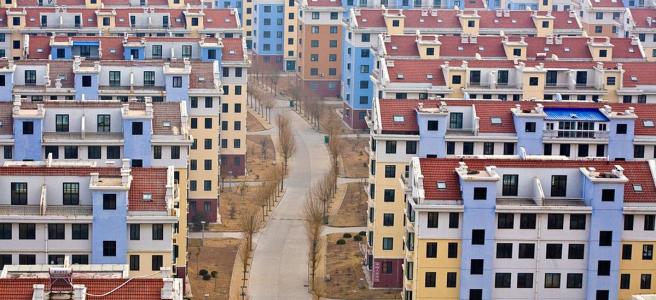
But there are significant differences. The part of the middle class involved in real estate speculation is nowhere near as broad as in the U.S., for example. There is a lack of people who, in the face of constantly rising real estate prices, borrow against houses they have bought with no equity and then convert these loans into consumption. So the Chinese bubble will not lead to a consumption miracle. Certainly not to the extent that the country’s own export surpluses could now be consumed domestically and, in addition, the world’s commodity surpluses could be absorbed (as the U.S. had done before). A speculative increase in housing prices does indeed create a boom in the construction industry, which supports a growing part of the economy. But all that is being built are uninhabited ghost settlements. The second boost to the economy from mass consumption through the mortgage loans to small home builders has failed to materialize. Therefore, the Chinese bubble is expected to burst much sooner than the American one. If the usual mass of bad loans remains, it will no longer be possible to finance the immense excess production capacities. Then the Chinese miracle would also have to give up the ghost.
Originally published in Neues Deutschland on 04/02/2010
 EXIT! in English