On Democratic State Terror in Times of Neoliberalism
In the commodity-producing patriarchy, the individual is recognized only insofar as they can prove themselves as a productive container of labor power. The rights granted to them by the state are therefore conditional. They must squeeze themselves into the formal shell of bourgeois subjectivity in order to be able to act as an “agent of abstract labor”[1] (Robert Kurz), which means nothing other than having to sell oneself through and through. In this context, the capitalist real categories such as money, commodities and labor are regarded by bourgeois common sense as ontological determinations of human existence in general. As soon as one begins to question them in practice, the much-vaunted bourgeois tolerance and plurality would reach its absolute limit and the subjects would clearly feel the force of the visible fist of the state (this has actually already been made clear in purely system-immanent social struggles, as history and the present show).[2]
If, however, the sale of one’s own labor power fails, the resulting social disasters are perceived as a “security threat” even by the most liberal constitutional state.[3] As Robert Kurz pointed out in the Schwarzbuch Kapitalismus [Black Book of Capitalism], the reaction against the fallen out and the poor in the third industrial revolution can only take the form of a war on facts, the form of a crusade (“The Last Crusade of Liberalism”).[4]
As far as the war on social facts is concerned, the French sociologist Loïc Wacquant, in his book Punishment of the Poor: The Neoliberal Government of Social Insecurity, has analyzed the changes in penal and prison policies in recent decades, and the reasons for these changes.[5] These changes are most evident in the ever-increasing prison population.[6] Although this book was published and reviewed several years ago, it is still worth reading because what Wacquant wrote is by no means obsolete in these times of the inner barrier and the permanent state of exception, but is still relevant and powerful. Although Wacquant deals primarily with the situation in the U.S., at the end he also addresses parallel developments in Europe.[7]
From Charitable State to Prison State
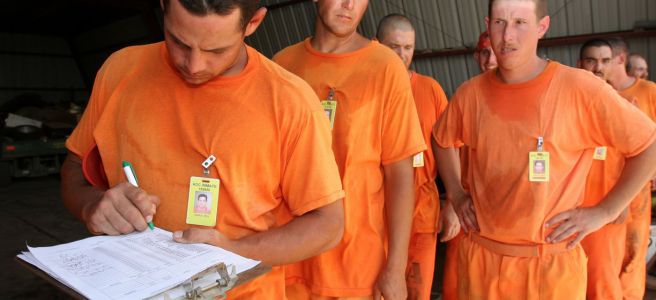
At the beginning of the 21st century, there were about 700 people in prison for every 100,000 people in the U.S., or a total of just under 2 million. In 1975, the figure was just under 400,000.[8] “Even South Africa at the close of the civil war against apartheid, with 369 inmates per 100,000 inhabitants in 1993, imprisoned half as many people proportionatelyas the prosperous America of President Clinton” (119, emphasis in original).
In addition, the penal system has become the third (!) largest employer in the country. The neoliberal state spares no expense in financing this enterprise. Thus, for example, “in Texas, the growth rate of the correctional budget was six times that of the university budget” (158).
But not only is the number of people in prison exorbitantly high, so is the number of people who are under “criminal justice supervision,” i.e., people placed on probation or “released on parole after having served the greater share of their sentence […]. In total, the stock of Americans under penal oversight grew by more than four and a half million in twenty years;starting from 1.84 million in 1980, it rose to […] 6.47 million in 2000” (133, emphasis in original).[9]
Their situation remains precarious, with a high probability of ending up behind bars again. Moreover, they are treated as pariahs by being subjected to a rigorous regime of interventions and surveillance: “Thus, in addition to the deployment of ‘intermediate sanctions’ such as house arrest and ‘boot camps,’ ‘intensive supervision,’ day [!] reporting, community service, and telephone or electronic surveillance […] the grasp of the American judicial system has been considerably enlarged thanks to the proliferation of criminal databanks […]. The result is that the country’s various police agencies […] now hold some 55 million “criminal files” – as against 35 million a decade earlier – on about 30 million individuals,corresponding to nearly one-third of the nation’s adult male population. Access to these databases varies by case and by jurisdiction. Some can be consulted only by judicial authorities […]. Others are accessible not only to other public bureaucracies […] and welfare services, but also to private persons and organizations via the Internet. These ‘rap sheets’ […] are commonly used, for example, by employers, to weed out ex-convicts applying for jobs. And it matters little that the information included in them is frequently incorrect, out of date, harmless, or sometimes even illegally disseminated: their circulation places not only criminals and those suspected of offenses, but also their families, friends, and neighborhoods, into the sight of the police and penal apparatus” (134f., emphasis added).
These interventions are no longer designed to help these people “reintegrate” (itself a highly problematic term) into society. These people are to be kept under control so that as many as possible can be “recaptured” (144).
Moreover, in many states these people are disenfranchised not only while they are in prison, but also while they are under criminal supervision, and in 13 states for life (!), so that “over 4.2 million Americans are thus excluded from the exercise of so-called universal suffrage, including 1.4 million black men representing 14 percent of the African-American electorate” (185).[10]
As mentioned at the beginning, civil rights are conditional. The development outlined by Wacquant for the U.S. and Europe is a prime example of this.[11]
But what happened historically that led to a steady increase in the prison population while the rate of violent crime remained constant or even decreased?[12] The quadrupling of the “U.S. carceral population in two decades cannot be explained by the rise of violent crime. It results from the extension of recourse to confinement for a range of street crimes […] that did not previously lead to a custodial sanction, especially minor drug infractions and behaviors described as public disorders and nuisances, as well as from the continual stiffening of sentences incurred.[13] After the mid-1970s […] when the federal government declared its ‘War on drugs,’ incarceration has been applied with growing frequency and severity to the gamut of offenders, be they career criminals or occasional lawbreakers, big-time bandits or small-time hoodlums, the violent and the nonviolent” (125f., emphasis in the original).
Thus, contrary to oft-repeated conservative claims, prisons are not filled with violent criminals, but with nonviolent petty criminals (incarcerated for things like drug offenses), most of whom come from the lower strata of society. Wacquant emphasizes several times that this is primarily a matter of controlling “the disruptive street ‘rabble’” (131). Moreover, the prison population today is now overwhelmingly African-American (relative to its share of the total population), whereas in 1950 it was 70% white (197).[14]
This rapid increase in the prison population, which predominantly affects the poor, is also due to the dismantling of the welfare state, or rather the “charitable state,” since the mid-1970s (41ff.).[15] The resulting social dislocations were countered by an expansion of the penal state; instead of “welfare,” “workfare” and “prisonfare” were now the order of the day – which led to explanatory patterns that are still common today, according to which the poor are only poor or unemployed because of their dependence on social benefits and their “moral depravity” (84). In any case, the numerous reforms led to a new understanding of the state toward the poor, “according to which the conduct of the dispossessed and dependent citizens must be closely supervised and, whenever necessary, corrected through rigorous protocols of surveillance, deterrence, and sanction, very much like those routinely applied to offenders under criminal justice supervision. The shift ‘from carrots to sticks,’ from voluntary programs supplying resources to mandatory programs enforcing compliance with behavioral rules by means of fines, reductions of benefits, and termination of recipiency irrespective of need, that is, programs treating the poor as cultural similes of criminals who have violated the civic law of wage work, is meant both to dissuade the lower fractions of the working class from making claims on state resources and to forcibly instill conventional morality into their members” (59f., emphasis in original).
A preliminary culmination of such reforms was the one passed under Clinton in 1996: This “reform” did not really offer anything historically new, “it merely recycled remedies issues straight of the country’s colonial era even as these had amply demonstrated their ineffectiveness in the past: namely, drawing a sharp demarcation between the ‘worthy’ and the ‘unworthy’ poor so as to force the latter into the inferior segments of the job market […] and ‘correcting’ the supposedly deviant and devious behavior believed to cause persistent poverty in the first place” (79).
The criminalization of poverty also took on new dimensions under Clinton: “The penalization of public aid extends even to its material setting and ambiance. The physical resemblance of the post-reform welfare office to a correctional facility is striking […].[16] The mandatory activities purported to instill the work ethic in welfare recipients and the string of incentives […] and especially penalties (escalating benefit cuts, eventually leading to permanent ineligibility) look like a first cousin of intensive supervision programs for probationers and parolees, or other ‘intermediate sanctions.’ Classes such as the ‘job readiness’ and ‘life skills’ workshops are redolent of the contents-empty rehabilitation courses given to convicts behind bars. […] Furthermore, upon closer examination, aside from strict spatial confinement, the employment circumstances of the convicts are not that different from the degraded conditions of the unskilled wage earners on the outside after ‘welfare reform’” (102, 184).
When the poor are treated like criminals, it is a sign that the former are deprived of their status as bourgeois subjects and reduced to their “bare life” (Agamben). The state of exception is imposed upon them. As the excluded, they are the object of control by the visible fist of the state, armed with batons, guns, and desk murderers. In effect, the poor are turned into ‘gypsies’; for their treatment is very similar to that of the Sinti and Roma – who for centuries represented the antithesis of the well-behaved and hard-working bourgeois philistine – in anti-Gypsy racism.[17]
What remains unclear, however, is why there has been a change in penal policy since the mid-1970s. Wacquant notes at various points that at that time there was a “fragmentation of wage labor” (287), a “deskilling of the labor market” (70), and the “advent of desocialized wage labor, vector of social insecurity” (281, emphasis in original). Wacquant takes phenomenological note of the precariousness of work, but without explaining it in terms of value theory.
As a result of the economic upheavals that began in the 1970s, black people in particular, who had previously been employed in the Fordist industries, became economically superfluous. For many, drug dealing became the most important source of income.[18] Hence the proclaimed war on drugs, which was a way of making poverty invisible by putting the economically superfluous behind bars. The prison, as Wacquant accurately describes, is “a container for undesirable dark bodies” (61).
For Wacquant, however, economics alone does not fully explain the growth of the prison population because it does not explain the blatantly racist character of this development, which disproportionately affects black people.[19] The black civil rights movement, which also received support from parts of the white middle class, broke up urban black ghettos and made social advancement seem possible. But when Martin Luther King Jr. went from attacking the legal inequality between blacks and whites to attacking the socioeconomic inequality between the two groups, white support waned. According to Wacquant, the dismantling of the welfare state (which many black people had taken advantage of) should be understood as an attempt to re-establish exclusionary racism after the success of the civil rights movement (195ff.). The accompanying policy of locking people away turned the prison into a “judicial ghetto” (205).
The Perverts to The Pillory!
But it is not only black people and the poor who are under the heel of the new penal regime. Another main target group of this regime clearly demonstrates the hysteria and vindictiveness into which the bourgeois addiction to harmony (of the Protestant variety) transforms: the (alleged![20]) sex offenders.
Wacquant writes in this regard: “To be sure, those suspected or convicted of sexual offenses have long been the object of intense fears and severe sanctions, owing to the particularly virulent stigma that befalls them in a puritanical culture strangled in taboos that until recently, made crimes of contraception, adultery, sex play (such as oral and anal intercourse) even between spouses, and of autoerotic practices as banal as masturbation and the perusal of pornographic materials, not to mention interracial marriage” (210).[21]
The hysteria about sex offenders is nothing new. Today’s hysteria has several historical antecedents: The years 1890-1914, when “sexual ‘perverts’ were first identified and singled out for eugenic intervention, and the period 1936-57, when hordes of ‘sex psychopaths’ were believed to be roaming the country in search of innocent victims, ready to strike at every turn” anticipated today’s culture-industry-fueled hysteria (210).[22]
Again, the “legislative activities” of the punishment regime have nothing to do with the actual “statistical evolution of offenses.” In the 1990s, for example, a whole series of laws were passed which, for the sake of simplicity, are referred to as “Megan’s Law.”[23] These include interventions that can only be described as totalitarian. In Louisiana, for example, it is an ex-sex offender “himself who is responsible for revealing his status in writing to his landlord, neighbors, and officials running the neighboring schools and public parks, on pain of one year imprisonment […]. Beyond which the law authorizes ‘all forms of public notification,’ including the press, signs, flyers, and bumper stickers placed on the fenders of the sex offender’s vehicle. The courts can even require ex-convicts for a sexual offense to don a distinctive garb [!] indicating their judicial status – much like the star or yellow linen caps [!!] worn by Jews in the princely cities of late medieval Europe” (217).
Of course, former sex offenders are registered in databases that are made available to the public (and are available on CD-ROM). Needless to say, these databases are growing; in 1998, for example, one in every 150 adult males in California was registered. But this “data, which no one takes the trouble to verify, turned out to be erroneous in many cases. […] Moreover, Megan’s CD-ROM reports neither the dates of the infractions – which can go all the way back to 1944 – nor the fact that many of these infractions have long since stopped being punishable by law […]” (220).
In addition, many states have enacted “two strikes” laws, under which recidivist sex offenders are automatically sent to prison for life and can be forced to undergo chemical castration (!) (216). The use of once effective psychotherapeutic methods for sex offenders has also been massively curtailed (230). Once a prison sentence has been served in full, it is still possible to be forcibly committed permanently (!) to a psychiatric ward, which is no different from the high-security wing of a prison (complete with solitary confinement, etc.). The mere assumption of dangerousness (!) on the basis of a “mental abnormality” (236) is sufficient for this course of action.
Moreover, in the case of sex offenders, the media use sensationalism to exaggerate individual incidents to the point where the middle-class idiot gets the impression that there must be an ‘epidemic.’ This conveys a certain image of the sex offender: They are deviant and dangerous, so no one talks about possible rehabilitation, and the sentences imposed appear too lenient anyway (209ff.). A lynch mob is not far away. If it becomes known that a sex offender has moved in nearby, he may have to be relocated because of the civil-protestant lynch mob, which is why in California “the state correctional administration is considering creating a kind of ‘judicial reservation’ in a desert zone […] where it would resettle sex parolees rejected by the population” (223).[24]
It should be emphasized that anyone who has committed or is alleged to have committed an applicable act is placed in the category of “sex offender,” with all the consequences implied here.[25]
The treatment of the fallen out in the U.S. is a prime example of neoliberalism’s war on social facts. Potentially hovering over everyone is the state of exception. It is becoming more and more the norm and, in principle, extended to more and more people. Accordingly, the democratic state cudgel is being armed. State terror is becoming a program that promises law and order. Bludgeoning and imprisonment have always been the ultima ratio of the state –this is especially true for Western democracies –but the difference between today and earlier times may be that today’s criminal law regime with its disciplinary interventions no longer sets (and probably cannot set) limits for itself. Thus Wacquant writes: “In February 1999, the state assembly of Virginia debated a bill aiming to put on free access via internet the complete list of all those convicted of a criminal offense, adults and minors, including minor driving violations and violations of licensing and registration statutes. Punitive panopticonism has a bright future ahead in America.” (237, emphasis in original).
When the crisis-ridden bourgeois state does not succeed in its struggle against reality, with its practice of discipline and punishment, and when a bourgeois paradise of virtue does not want to emerge, it reacts only with a further intensification of its practice of terror, which grows more and more into a paranoid delusion. In this way, the bourgeois penal fanatic continues to misunderstand the chaotic world and, in his madness, decrees interventions and ordinances that, while promising to save “security” and “freedom,” increasingly turn the whole of society into a prison and thus make a farce of all freedom and security.
Loïc Wacquant: Punishing the Poor: The Neoliberal Government of Social Insecurity, Durham 2009.
[1] See Robert Kurz: The Substance of Capital, London, 2016.
[2] It is also particularly evident in the reactions to resistance to emerging capitalism in times of primordial accumulation, see e.g. Peter Linebaugh, Marcus Rediker: Die vielköpfige Hydra – Die verborgene Geschichte des revolutionären Atlantiks, Berlin/Hamburg 2008; see also Silvia Federici: Caliban and the Witch: Women, the Body, and Primitve Accumulation, New York 2004.
[3] Here, too, one finds what one is looking for if one looks at the historical origins of bourgeois security thinking, see Matthias Bohlender: Metamorphosen des liberalen Regierungsdenkens – Politische Ökonomie, Polizei und Pauperismus, Weilerswist 2007. And if the social dimension is perceived at all, then social remedies, state handouts, are granted with the intended goal of loyalty to the existing system; poverty has thus also always been seen as an “educational problem.”
[4] Robert Kurz: Schwarzbuch Kapitalismus – Ein Abgesang auf die Marktwirtschaft, Frankfurt 1999, 667ff.
[5] Wacquant teaches at the Universitiy of California at Berkeley, see Loïcwacquant.net.
[6] Wacquant is not the first to present such an analysis: about a decade earlier, the Nils Christie published the book: Crime Control as Industry: Towards Gulags, Western Style. In the first edition, the subtitle still had a question mark, which was dispensed with in the subsequent editions for obvious reasons.
[7] The experience of recent decades shows that for the core capitalist states it is true that certain developments in the U.S. also appear in Europe with a certain time lag. However, if the connection with capitalism as a whole is not reflected upon and if they are causally attributed to the U.S., this can be a source of anti-Americanism, cf. Barbara Fried: “Antiamerikanismus als Kulturalisierung von Differenz – Versuch einer empirischen Ideologiekritik”, in: Associazione delle Talpe, Rosa Luxemburg Initiative Bremen (eds.): Maulwurfsarbeit II – Kritik in Zeiten zerstörter Illusionen (2012), 70-88.
[8] 132ff. More recent figures, which not surprisingly tend to be higher today, can be found at prisonstudies.org. In addition, about a quarter of the world’s prisoners are in U.S. prisons, although it remains unclear how reliable these figures actually are. Wacquant notes, for example, that about 726 people were executed in China in 2003. However, if one were to count executions not ordered by the courts, the figure would be 10,000-15,000 (36). For some prison populations, there may be similar discrepancies between “official” and “unofficial” figures. The catastrophic conditions in the overcrowded prisons, about which Wacquant provides much harrowing material, will not be discussed here for reasons of space; those interested will also find what they are looking for, for example, at hrw.org.
[9] More recent figures speak of about 7 million people who are in prison or under criminal surveillance, that is, one in 31 (!) adults.
[10] A recent study cites a number of 5.85 million people affected by disenfranchisement, see Jean Chung: “Felony Disenfranchisement: A Primer”, May 10, 2016, at sentencingproject.org.
[11] In the course of the fight against terrorism, the surveillance and control mania has once again intensified. The effects on civil rights etc. were already examined years ago in various books, for example in Ilija Trojanow, Juli Zeh: Angriff auf die Freiheit – Sicherheitswahn, Überwachungsstaat und der Abbau bürgerlicher Rechte, Munich 2010. Jihadism is by no means to be trivialized here, as is common among some leftists, but the anti-terrorism measures are hardly those explicitly directed only against Islamism; thus Trojanow and Zeh show that these laws are now being applied in completely different areas: “The mania for control has long since left the sphere of counter-terrorism and has also affected health care, the tax system […] and even everyday life on the street. In the UK, local authorities are using anti-terror laws (namely the Regulation of Investigatory Powers Act 2000, RIPA) to spy on citizens who might be littering in the street, failing to properly dispose of dog poop, or selling pizza illegally. […] Parents are being spied on to find out if they are enrolling their children in a school outside of their designated district. In the first half of 2008, 867 terror investigations were opened against everyday criminals. In the blink of an eye, the ‘fight against terrorism’ becomes a sharp sword in the hands of a law-and-order bourgeoisie, as if the best form of society were realized in an education camp […] The fight against terrorism tends to turn into a fight against ‘socially harmful behavior’. By then, at the latest, there is a little terrorist lurking in every citizen, and free society is on its way to ruin” (134 f.). In the end, everything is sacrificed for so-called “security.”
[12] Figures from 1960-2014 can be found at http://www.disastercenter.com/crime/uscrime.htm.
[13] Particularly piquant is the so-called “three-strikes law,” under which a life sentence is automatically imposed after a third conviction. In California, this applies to about 500 offenses, including non-violent offenses, such as simple shoplifting (!) (85).
[14] In 2013, for example, out of a total of 18.5 million black males, 745,000 were in prison, see, e.g., Antonio Moore, “The Black Male Incarceration Problem is Real and It’s Catastrophic,” huffingtonpost.com, Feb. 17, 2015; A black man is six times as likely to end up behind bars as a white man, see George Gao: “The black-white gap in incarceration rates,” pewresearch.org, July 18, 2014.
[15] That this has not changed to this day is repeatedly shown by various studies, such as Bernadette Rabuy and Daniel Kopf: “Prisons of Poverty: Uncovering the pre-incarceration incomes of the imprisoned” (2015) on prisonpolicy.org.
[16] By the way, the local offices of the social ministries are called “Job Centers” (!), (p.119). Obviously, the Clinton reforms are equivalent to the later Hartz IV reforms in Germany.
[17] Cf. Roswitha Scholz: “Homo Sacer und die ‘Zigeuner’ Antiziganismus – Überlegungen zu einer wesentlichen und deshalb ‘vergessenen’ Variante des Modernen Rassismus,” in EXIT! – Krise und Kritik der Warengesellschaft, no. 4 (2007), 177-227, cf. also the two anthologies Antiziganistische Zustände, Münster, edited by Markus End et al. (2009) and (2013).
[18] See the interview with Curtis Price, “In den Ghettos sind die Drogen zum wichtigsten Wirtschaftsfaktor geworden” in Wildcat – Zirkular no. 42/43 (1998).
[19] The bottom line is that the war on drugs is a war against blacks, according to Michelle Alexander, see e.g. Larry Gabriel: “Jim Crow’s drug war: Why the War of Drugs is a war against black people,” in: Detroit Metro Times,11/28/2012. On the racism of the penal system in the U.S. see also the conversation with Michelle Alexander in: Junge Welt, 08/25/2012.
[20] The “alleged” is emphasized here because consensual sex between young adults and adolescents is also considered a sexual offense. In the U.S., this is called statutory rape. However, the tightening of sexual criminal law, which continues to this day, and of course also in Europe, has de facto led to an increasing criminalization of consensual (!) youth sexuality, with all the consequences mentioned above. Corresponding reports are occasionally circulating in the German media, such as the “case” of Kaitlyn Hunt (queer.de). It is therefore hypocritical or downright ignorant for some to complain about homophobic politics in Russia while remaining silent about sexual politics in the U.S.
This topic (and the parallel developments in Europe/Germany) was systematically dealt with in the German-speaking world by Max Roth: Uncle Sams’s Sexualhölle erobert die Welt – Die neue Hexenjagd auf Kinderschänder? und die weltweite Enthumanisierung des Sexualstrafrechts unter US-Diktat, published by the anti-imperialist Ahriman-Verlag, Freiburg, 2013. Although Roth can be criticized for his anti-feminism and crude anti-Americanism, the material gathered on the subject (mostly from U.S. sources) speaks for itself.
[21] See further Roth, “Amerikas puritanisches Erbe,” (114-156).
[22] On eugenics in the U.S., see the chapter “A Eugenic Civilization” in Jeremy Rifkin: The Biotech Century: Harnessing the Gene and Remaking the World, New York 1999.
[23] But it did not stop there. “In 2006, the Adam Walsh Act was passed. It provides for mandatory public registration of juvenile “sex offenders.” The Adam Walsh Act created a separate new federal agency (with the obscene acronym SMART) to handle registration, and the cost to states of implementing the law was estimated to total nearly a billion dollars for the first year alone. The Adam Walsh Act expands both the scope of data recorded in registries (e.g., to include fingerprints, palm prints, and DNA samples) and the scope of persons covered. […] Nonviolent acts which the U.S. Sex Offender Act declare a crime, explicitly suffice as grounds for registration. This includes consensual sexual contact among or with juveniles or even just nudity in public, e.g., skinny dipping […] (Roth 231f.).” Also noteworthy is the current definition of “child pornography,” which includes homemade nude images exchanged between children under the age of 18, cf. Roth, “Eine islamoide Definition der Kinderpornographie,” (240-263). This can only be described as a paranoid delusion.
[24] Such settlements are now a reality.
[25] In 2015, there were approximately 750,000 registered “sex-offenders” in the U.S., see statisticbrain.com.
Originally published in exit! 14 in 2017.
 EXIT! in English