The more capitalism invokes its rationality, the more irrational it seems to become. Thus, the competition for survival on the markets has led to policy of cutting costs no matter what. Fewer and fewer employees are expected to handle more and more tasks. Wages are to be reduced, and breaks should ideally no longer occur at all. When it comes to working conditions, stinginess is cool. During the crisis, this cost-cutting mania was accelerated, even to the detriment of quality control. Recalls, breakdowns, defects and scandals are on the rise. The radicalization of business management is backfiring on business management itself. This is simply because the capitalist concept of “efficiency” is completely empty. It does not refer to the concrete content of production, but only to the abstract maximization of profit, which has apparently finally entered the stage of its historical incompetence.
This is precisely why the business mania has spread to everyday life. Not only schools, scientific institutes, theaters or children’s shops are to be run like businesses and oriented towards cost-cutting, but also personal relationships. Even the individual person is regarded as a two-legged business, and is subjected to tests (e.g. by the labor administration) to determine the “rationalization potential” of his or her lifestyle. The satirical slogan “sleep faster, comrade” appears as the animalistic seriousness of crisis capitalism; the general pressure for a meaningless “increase in efficiency” has taken on the dimension of a social obsessive-compulsive disorder.
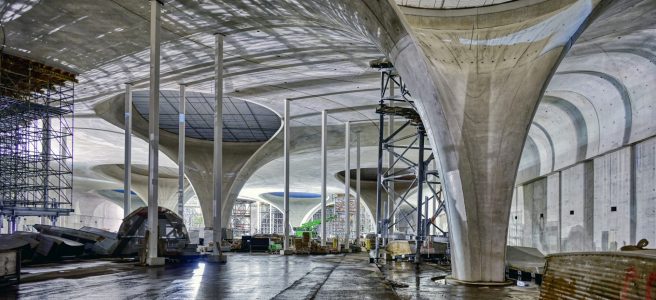
But the imperialism of the economy has two faces. While, on the one hand, a penny-pinching miserliness of the abstract time regime prevails and even going to the toilet is monitored by companies, on the other hand, an almost feudal culture of extravagance prevails. The mania for cost-cutting in business management is matched by a mania for economic grandeur, which blossoms in a relationship with politics. A prime example of this is Deutsche Bahn’s absurd prestige project Stuttgart 21, the estimated cost of which has risen from 4 to 7 billion euros to 12 billion euros, according to independent experts. There is no money for the tracks for local and freight traffic, but for the ICE metropolitan traffic, which is supposed to compete with the airplane, they are allowed to splurge. This pyramid scheme is also likely to backfire on its creators, because the result is likely to be ruined investments.
Ruinous economic prestige thinking has spread to all areas of society, as has a miserly obsession with saving money. They are two sides of the same coin. Municipalities that are thinning out their administrative and transportation personnel are greedy for large-scale events (see Duisburg and the Love Parade disaster); others want to build stadiums for international matches from scratch, while at the same time almost rationing toilet paper. And the same “entrepreneurs of their labor” who allow themselves to be made fools of the performance hustle, omnipresent surveillance and senseless rationalization programs of their lifetimes, plunge into debt for the sake of neurotic prestige consumption, the servicing of which they then save from their mouths. It is not a sign of stability when a society vacillates between extremely contradictory behaviors. Those who rationalize themselves to death must in turn puff themselves up to survival size. Alienated total expenditure is both; but the world is perishing in a noble way.
Originally published in Neues Deutschland on 09/17/2010
 EXIT! in English